




Abstract
Introduction
Using a cross-sectional population-based survey, electronic vapor product (EVP) use was evaluated in relation to physical activity levels among high school students in Georgia.
Methods
We used self-reported EVP and cigarette use from the Georgia Student Health Survey 2.0 data from 2018 (N =362 933) and used multi-level multinomial logistic regression models to estimate relative risks of the type of product use relative to no-use by levels of physical activity.
Results
Nearly 7% of the students were EVP-only users. The relative risks of being an EVP-only user were 11% and 23% higher for those who were physically active 2-3 days/week and 4-5 days/week, respectively, compared to those who were physically active <=1 day/week.
Conclusions
Being physically active was positively associated with EVP use among adolescents. Health promotion education and health policies should be developed as a means of reducing EVP use among adolescents.
Implications
This study evaluated the relationship between electronic vapor product (EVP) use and physical activity among high school students in Georgia. The prevalence of EVP use was higher among physically active adolescents. The findings suggest incorporating EVP prevention into physical education and sports coaching such that physical education teacher and sports coaches who are trusted upon by students are delivering the message on EVP prevention among adolescents.
Introduction
E-cigarettes have become increasingly popular in the United States (US), especially among adolescents. In 2020, 3.02 million (19.6%) of US high school students, grades 9 to 12, reported e-cigarette use 1 while traditional cigarette smoking is declining. 2 E-cigarettes are marketed for smoking cessation,3,4 however, e-cigarette use has not been found to be associated with increased smoking cessation among the general adult population. 4 Adolescents who are e-cigarette users are also more likely to shift to cigarette use later in life. 5 Therefore, e-cigarettes pose a substantial threat to future adolescent population health.
The state of Georgia, similar to many other Southern states in the US, has a smoking prevalence level consistently higher than the national average.6,7 However, when federal law raised the minimum age of sale of all tobacco products to 21 in December 2019, Georgia was one of the Southern states that did not prohibit adolescents who reached age 18 to access EVP. 7 Previous research reveals youth access to EVP as a public health concern due to the association of EVP use among adolescents that engage in physical activity and participate in sports. 8 Physical activity has been medically proven to be beneficial for adolescent mental and physical well-being, 9 including cognition, 10 and can minimize the participation in other risky behaviors that negatively impact health such as traditional cigarette smoking. 11 Physical activity (PA)- non-solitary and sport participation also provides ample opportunities for social interaction among young people. 12 Increased social interaction for example through group sports participation may increase risk of tobacco use. For example, social interaction was found to be an important pathway to binge drinking among Asian American Adolescents. 13
When assessing the relationship between traditional cigarette use and physical activity, cigarette users engaged in physical activity less frequently than non-smokers and e-cigarette users were more likely to be physically active, participating in competitive, intramural, and team sports, compared to non-users, particularly among adolescents. 8 These findings highlight the importance of addressing the increase in adolescent EVP use as a target for public health strategies. This study aims to test the hypothesis that EVP use is positively associated with being physically active among adolescents using a population-based sample in Georgia.
Methods
Data
We used 2018 school year data from the Georgia Student Health Survey 2.0 (GSHS) – an annual, anonymous, self-reported, web- and population-based survey implemented by the Georgia Department of Education and is mandatory for all public school districts. 14 The survey contained self-reported information on the health status and health behaviors of school students in Georgia. 14 Data was obtained from the Georgia Department of Education as open records with race and ethnicity redacted. To avoid any potential reporting bias, schools with less than 100 respondents were excluded. The final dataset consisted of 362 933 high school respondents from 439 schools for 2018.
Measures
The dependent variable was tobacco use status based on the following questions: “During the past 30 days, on how many days did you smoke EVPs such as e-cigars, juuls, e-pipes, vape pipes, vaping pens, e-hookahs, or hookah pens?” and “During the past 30 days, on how many days did you smoke cigarettes?” with consecutive sets of integers ranging from 0 to 30 days as response options. Responses were combined to form 4 levels of mutually exclusive categories: “No-use,” “Cigarette-only”- those reporting at least one day of traditional cigarette use but no EVP use, “EVP-only” ”- those reporting at least one day of EVP use but no traditional cigarette use, and “Dual-use”- those reporting at least one day of both traditional cigarette and EVP use.
The independent variable of interest was levels of physical activity, assessed using the following question: “In the past 7 days, how many days were you physically active for at least 60 minutes at school or home?” with 4 response options: “Not at all,” “1 day per week,” “2-3 days per week,” or “4-5 days per week,” Not at all and 1 day per week were combined to form <=1 day per week.
Statistical Analysis
Chi-square tests were used to assess the percentage of students in each category of tobacco use status based on sex, grade, and physical activity levels. Multi-level multinomial logistic regression models were then used to estimate relative risks and 95% confidence intervals (CIs) for the association between tobacco use status and physical activity using non-users as the reference group. Standard errors were clustered at the school level and each model was adjusted for respondent sex and grade. All statistical analyses were conducted using R v3.5.
Results
Distribution of High School Students by Tobacco Use Status (2018 Georgia Student Health Survey, N = 362 933) and Relative Risk (95% Confidence Interval) of Engaging in Cigarette only, Electronic Vapor Products only, and Dual-use by Levels of Physical Activity.
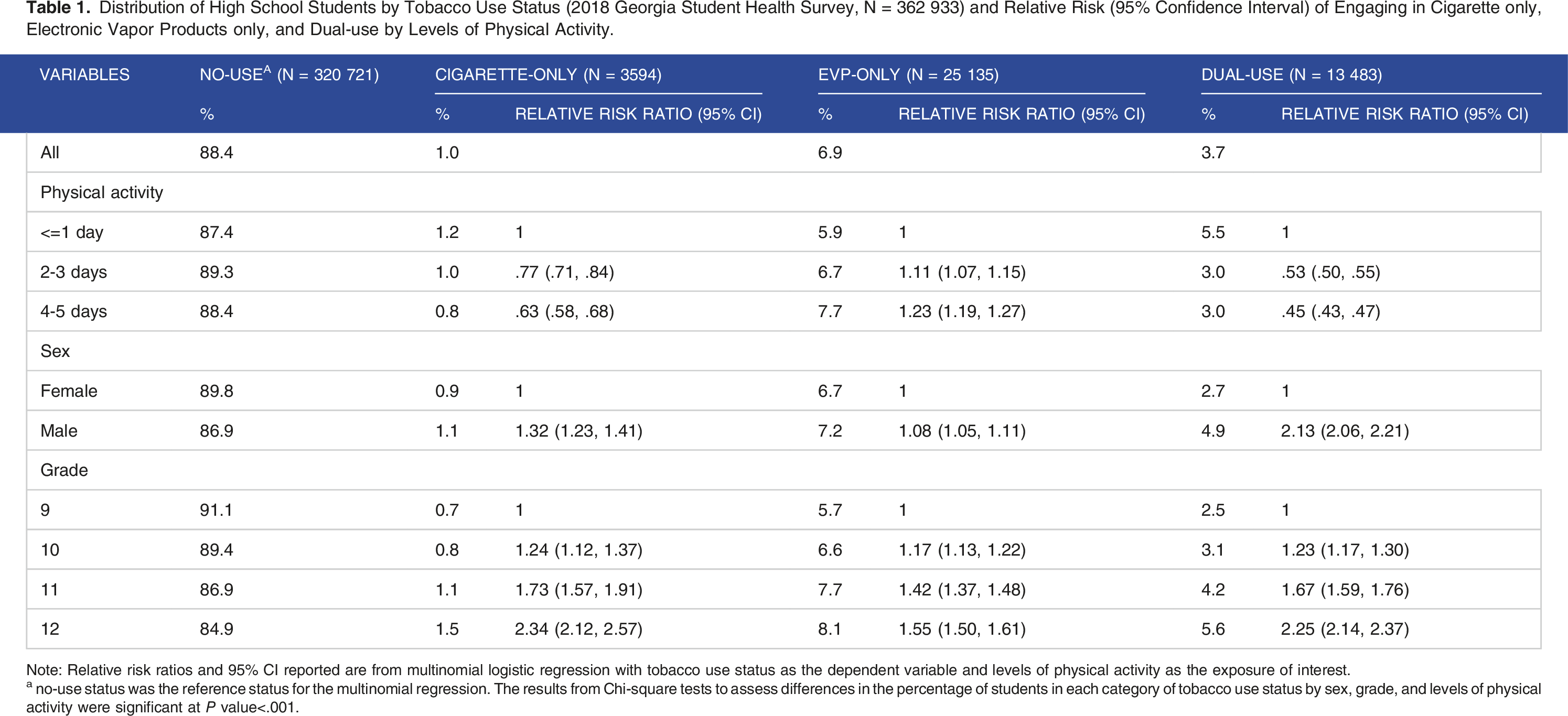
Note: Relative risk ratios and 95% CI reported are from multinomial logistic regression with tobacco use status as the dependent variable and levels of physical activity as the exposure of interest.
a no-use status was the reference status for the multinomial regression. The results from Chi-square tests to assess differences in the percentage of students in each category of tobacco use status by sex, grade, and levels of physical activity were significant at P value<.001.
Discussion
The results of this study show that high school students in Georgia who were physically active were more likely to be EVP users and less likely to be cigarette users, either exclusive or in conjunction with EVP use. These findings are consistent with previous literature8,15-18 and are the first with a US-based population of students. A Canadian study revealed youth that smoke tobacco are more physically inactive, whereas youth e-cigarette users exhibit higher physical activity engagement. 8 E cigarette users were more likely to participate in intramural, competitive, and team sports and more likely to meet physical activity guidelines compared to non-users.8,18 Similarly, a study among young adults aged 18 to 25 years old found a statistically significant association between increased e-cigarette use and higher physical activity levels. 17 It is possible that the motivating factors that encourage e-cigarette use may also be associated with encouraging higher physical activity levels. 18 Among adults, weight loss and control have been reported as a motivating factor in e-cigarette use; 19 this may be due to smoking’s effect on the body to increase metabolic rate and reduce appetite. 15 Physical activity is also a well-known method for weight loss and control, further relating the motivating factors between EVP use and PA.
Differences in the association between EVP use, cigarette smoking, and physical activity were also seen based on the type of PA. For example, Pokhrel, Schmid and Pagano 17 found less vigorous aerobic activities such as biking and walking to increase smoking risks, while vigorous aerobic activities like running and swimming were protective against smoking. Furthermore, a cross-sectional study using data from the 2014-2015 Population Assessment of Tobacco and Health study (Wave 2) concluded individuals that engaged in moderate-vigorous physical activity (MVPA) were less likely to be e-cigarette users. 16
Traditional public health strategies focusing on increasing physical activity to prevent risk behaviors might not be effective for all adolescents. 20 Rather, this study suggests a need to identify physically active adolescents as a risky group to be affected by the increasing EVP popularity. As both sports activity and substance abuse are shown to be important drivers of peer socialization among the younger populations, 21 it is possible that EVP use is gaining popularity as a socialization vehicle after participating in sports. A previous study of African American adolescents found that sport participation might indirectly influence one’s substance use through peer substance use, as sports participants were observed to have higher levels of peer substance use. 22 This kind of possible peer influence, combined with the possible false perception among adolescents that EVPs are safer, 23 could have contributed to the higher risk of EVP among those with higher level of physical activity. Previous evidence suggests e-cigarette use has a lower prevalence among older populations due to reductions in physical activity and sport participation as age increases. 24 Evidence from this study and related research suggests that adolescents that participate in sports and physical activity are at an increased risk for EVP use. Therefore, when tailoring public health policies, interventions, and future research for EVP use, younger populations should serve as the target population for prevention methods. Future research should consider assessing drivers of EVP use among this population such as assess the influence of perceived beliefs and social environmental factors under the Health Belief Model, the data on which were missing in our study.
Limitations
Due to the cross-sectional design of this study, we were only able to establish causation between EVP use and levels of physical activity. Schools with <100 respondents were excluded, however, only 44 schools (<10%) had to be removed from the study. Furthermore, the data used in this study represents 75% (GSHS required participation rate) of all high school students in Georgia; therefore, selection bias is limited. The outcome measure of PA in this secondary dataset did not allow classification of PA according to the level of energy expended. 25 Furthermore, respondents’ misunderstanding of PA could have led to under reporting of PA such as not considering daily activities such as stair climbing when reporting PA levels. Additionally, experimental users of EVP were indistinguishable from regular users.
Conclusion
Health promotion and education programs are needed to educate adolescents about the harm of e-cigarettes. 26 Public health practitioners and policymakers must tailor prevention strategies to adolescents who are more likely to use EVP. Current evidence-based population-level public health approaches for addressing EVP use among adolescents include e-cigarettes in smoke-free indoor air policies, restricting young peoples’ access to e-cigarettes in retail settings, licensing retailers, implementing price policies, and developing educational initiatives targeting younger populations. 27 In addition, strategies to curb e-cigarette advertising and marketing appealing to young, physically active adolescents, and strategies to reduce access to flavored tobacco products by young people must be implemented. Physical education teachers, middle and high school sports team coaches, club sport coaches, and celebrities may have a unique role to play when it comes to tobacco prevention among the younger population by including EVP use behavior alongside healthy eating 28 and sleep behaviors, 29 particularly those engaging in physical activities.
Footnotes
Acknowledgment
The authors would like to acknowledge the Georgia Department of Education for providing this data under an open records request.
Declaration of Conflicting Interests:
The author(s) declared no potential conflicts of interest with respect to the research, authorship, and/or publication of this article.
Funding:
The author(s) disclosed receipt of the following financial support for the research, authorship, and/or publication of this article: University of Georgia Presidential Interdisciplinary Seed Grant Program.
Compliance with Ethical Standards:
Research involving human participants and/or animals: The research received not human subjects’ research status as the findings are from de-identified secondary data set.
