



Abstract
Adolescent smokers tend to have friends who also smoke. This association has been attributed to peer socialization and peer selection effects. However, evidence regarding timing and relative magnitude of these effects is mixed. Using a random-intercept cross-lagged panel model, we examined the reciprocal relations between adolescent cigarette use and perceptions of friends’ cigarette use in a sample of 387 adolescents, assessed annually for 4 years. Adolescent cigarette use predicted increases in perceived friend use before the reverse effect emerged. Further, some of the effect of early adolescent cigarette use on subsequent use was mediated by changes in perceived friend use. The results support a greater role for friend selection than socialization in predicting early adolescent cigarette use.
Keywords
Tobacco use is a leading cause of preventable morbidity and mortality in the United States. An estimated 87% of cigarette smokers initiate cigarette use before age 18, with 5.6 million American youth being at risk of dying prematurely from illness related to cigarette smoking.1 The health care costs associated with smoking in the United States exceed $170 billion annually, 2 with the health risks associated with long-term smoking being markedly high among those who initiate smoking in adolescence. 3 Perceptions of peer norms and smoking behaviors are identified as robust predictors of smoking initiation and progression during adolescence.4,5 Despite the wealth of research, it remains unclear to what extent are peer influences on adolescent smoking related to adolescents selecting peers with similar smoking behaviors (i.e., selection effects) vs adolescents being socialized to have similar smoking behaviors as their friends (i.e., socialization effects). Although these processes of selection and socialization are complementary and work together in predicting adolescent smoking behaviors, from a prevention standpoint it is critical to understand which processes matter most and at what time point developmentally. This study makes use of longitudinal data to examine the relative magnitude and timing of peer selection and socialization influences on adolescent smoking behaviors.
Peer influence in adolescence
During adolescence, peers play a significant role in the process of identity exploration and development. As adolescents seek peer approval and acceptance, they tend to be highly susceptible to peer norms, behaviors, and expectations, 6 including those related to substance use. 7 Adolescents’ perceptions of their peers’ cigarette use behaviors (i.e., descriptive peer norms) are a consistent predictor of adolescents’ own cigarette use behaviors.8,9 Indeed, meta-analytic evidence from 75 studies of peer effects on adolescent smoking revealed that adolescents who have peers who smoke are twice as likely to smoke themselves as those who do not have peers who smoke. 5 This association can be explained by two underlying processes: selection (i.e., adolescents who smoke tend to select friends who have similar cigarette use norms and behaviors) and socialization (i.e., adolescents’ smoking behaviors and norms are shaped by their peers’ smoking norms and behaviors).
Selection vs socialization: Mixed evidence
Peer selection and socialization are complementary processes that are both linked with adolescent substance use, however, their effects can vary at different time points during adolescence. 10 Identifying the timing and relative magnitude of these effects in predicting adolescent smoking initiation and progression is critical in designing prevention programs that are tailored to target the right processes at the right time. Past research—primarily with alcohol use11,12 but also a few studies with cigarette use13,14—have found that selection effects tend to be more significant in predicting substance use initiation during early-mid adolescence, whereas socialization effects play a greater role in predicting maintenance and progression of substance use in later years. Nevertheless, the evidence regarding their relative importance across adolescence is mixed, with some studies finding stronger selection effects especially in early adolescence11,12; others reporting significant socialization influences, 15 often in later years 16 ; and still others documenting both selection and socialization effects. 17
The inconsistency in findings could be linked to the fact that prior studies have not always examined the effects longitudinally; this is highlighted by studies that show differential influence of selection effect by age 11 or level of use. 13 Further, the analytic techniques used in most prior studies do not accurately account for within-person stability, nor do they typically model the effects of both processes simultaneously in the same model. These criteria are important in case of processes, such as peer selection and socialization, that are reciprocal rather than unidirectional. To accurately measure within-person reciprocal effects, it is important to partial out the individual-level “trait-like” stability (or within-person stability) in the constructs so that it does not confound the lagged effect estimates. 19
Using longitudinal data from a large sample (N = 2453) of 6th–9th grade students, Simons-Morton and Chen 15 employed a sophisticated analytic approach (i.e., auto-regressive latent trajectory modeling; ALT) to examine the developmental trajectories of adolescent cigarette use and perceptions of peer use, as well as the cross-lagged effects between these two variables from one wave to the next. 18 The cross-lagged findings from their model revealed that the effect of perceived peer substance use on change in adolescent substance use was stronger and more consistently significant across waves than the opposite effect, providing evidence in support of socialization effects. It is important to note though that their measure of adolescent and peer substance use included both alcohol and cigarette use. As such, examination of cigarette use independent of alcohol use may uncover different trends. Furthermore, their findings may have been biased due to the underlying limitations of the ALT model (see Hamaker et al., 19 p. 106 for details), including additional model constraints, and the interpretation of the lagged effects being conditional on the random intercept and slopes, making it less than ideal for testing within-person reciprocal processes and directionality of effects. A primary concern with ALT models is the need for specifying the shape of the growth pattern. 19 Though Simons-Morton and Chen 15 fit linear growth curves to assess functional form, they did not compare fit of higher-order models (e.g., quadratic), which may have represented their data more accurately. If growth in substance use in their sample was non-linear, specifying a linear growth form would lead to inaccurate parameter estimates and interpretations from the ALT model.
In a similar-aged sample of Dutch adolescents (N = 1886), Mercken and colleagues 16 found that selection processes played a significant role in predicting smoking initiation, but the effect of selection declined with age, and adolescents smoking behaviors were increasingly influenced by their peers in later years. Selection effects are also found to be the predominant influence in predicting cigarette use in a comprehensive review of peer influences on substance use behaviors. 7 Nevertheless, because 7 of the 13 studies included in this review analyzed only two time points of data, the findings may suffer from reliability issues and may inaccurately support the predominant influence of peer perceptions due to the rapidity with which perceptions can change, as compared to behaviors.
To address the mixed evidence regarding peer selection and socialization effects in predicting adolescent smoking initiation and progression, we employed a more recent and flexible approach to modeling reciprocal linkages, known as the random-intercept cross-lagged panel model (RI-CLPM) using longitudinal data from four annual assessments from early to mid-adolescence. The RI-CLPM does not constrain change across waves in the same way as the ALT model, which allows for greater flexibility and accuracy in modeling the between- and within-person change, especially in the context of cross-lagged effects. 19 RI-CLPM is also well-suited for testing of directionality and timing of effects in reciprocal models.
Hypotheses
In this study, we employed a RI-CLPM to examine the relative influence of socialization and selection effects on adolescent cigarette use. Based on prior evidence, we hypothesized that both selection and socialization effects would be observed, with evidence of bidirectional associations between adolescent cigarette use and perceptions of friend cigarette use. 7 Further, we hypothesized that selection effects would emerge earlier, and be stronger than socialization effects because there is greater evidence in support of selection effects during early-mid adolescence. 14 Findings from this study will help address the limitations of prior studies, provide clarity on how socialization and selection effects influence early adolescent cigarette use behaviors, and help guide prevention programming.
Methods
Design and demographics
Data were obtained from a large community sample of adolescents (N = 387, mean baseline age = 11.41 years, SD = 0.88; 52% female) who were assessed on six occasions from 2004 to 2010. Participants were recruited from schools, libraries, and community centers in the greater Philadelphia area (see Romer et al. 20 for details). Parental consent and youth assent were obtained in accordance with the study protocol approved by the Institutional Review Board of the Children’s Hospital of Philadelphia. Assessment time points were spaced 1 year apart for the first five waves. The sixth assessment was conducted after a gap of 2 years. This study analyzed data from wave 2 through wave 5 (heretofore referred to as T1-T4). There was 10% loss to follow up across these waves. Missingness was unrelated to participant demographics or key study variables. Because we were interested in examining predictors of early patterns of cigarette use, we did not include data from wave 6 when cigarette use patterns were established (with relatively fewer cases of new onset) or from wave 1 when there were very low rates of cigarette use.
Mean age of participants at T1 was 12.61 years (SD = 0.89; range = 11.0-14.8). At T4, participants mean age was 15.75 years (SD = 0.95; range = 14.2-18.2). Socioeconomic status (SES) was assessed using parent reports on the Hollingshead Two-Factor Index with a mean SES score of 47.2 (SD = 15.39; range = 15-77). Non-Hispanic White (55.8%, n = 216) and non-Hispanic Black (26.4%, n = 102) were the most common self-reported racial-ethnic groups, followed by Hispanic (of any race; 9.04%, n = 35) and other racial-ethnic group, comprised primarily of Native American and Asian American participants (8.53%, n = 33).
Measures
Perceived Friend Cigarette Use (T1–T4) was assessed using the question, “of your friends and the people your age that you spend time with, how many smoke cigarettes?” (1 = None, 2 = A few, 3 = About half, 4 = Most, and 5 = All).
Frequency of Cigarette Use (T1–T4) was measured using an 8-point scale (0 = never used - 8 = used daily for the past 30 days). Given the non-normal distribution (skew range = 2.46–8.08, kurtosis range = 4.82–78.50), the responses were recoded into three categories (0 = never tried a cigarette, 1 = smoked cigarette in past [>30 days ago], and 2 = smoked cigarette [≤30 days ago]) which decreased skew and kurtosis across each wave.
Regarding model covariates, participants self-reported their age, sex (male/female), and race-ethnicity. Family SES was assessed using the Hollingshead Two-Factor Index. Age and family SES were included as continuous covariates, while sex and race-ethnicity were dummy-coded with males and non-Hispanic White participants coded as the respective reference groups. All demographic covariates were assessed at T1, with the exception of family SES which was assessed at study baseline (wave 1).
Analytic plan
The structural equation modeling (SEM) package lavaan 21 in R (version 3.6; R Core Team 2019) was used for modeling. The robust variant of maximum likelihood (MLR) was used to account for non-normality in the data. Full information maximum likelihood (FIML) was used to account for missing data in all models, causing 16 participants to be excluded from the final model due to missing exogenous covariates in the RI-CLPM (analysis N = 371). Time-stable effects of the covariates were controlled by regressing the random intercepts onto the covariates; for details on model specification see Hamaker et al. 19 Significance of indirect effects was assessed with 5000 bootstrap draws with bias-corrected bootstrap percentile method to adjust for bias in the distribution of indirect effects. 21
Model fit was assessed using guidelines by Hu and Bentler 22 : Comparative Fit Index (CFI) ≥ 0.95, Root Mean Square Error of Approximation (RMSEA) ≤ 0.06, Standardized Root Mean Square Residual (SRMR) ≤ 0.08. χ2 is another measure of fit reported for consistency, though its utility in assessing fit of larger samples has been long questioned. 23 For this reason, Hoelter’s N is also presented, which shows what sample size would evoke a significant p for this model, allowing assessment of the effect of sample size on the significance. 23
Results
Adolescent self-report and perceived friend cigarette use.

Correlation matrix for variables used in RI-CLPM.
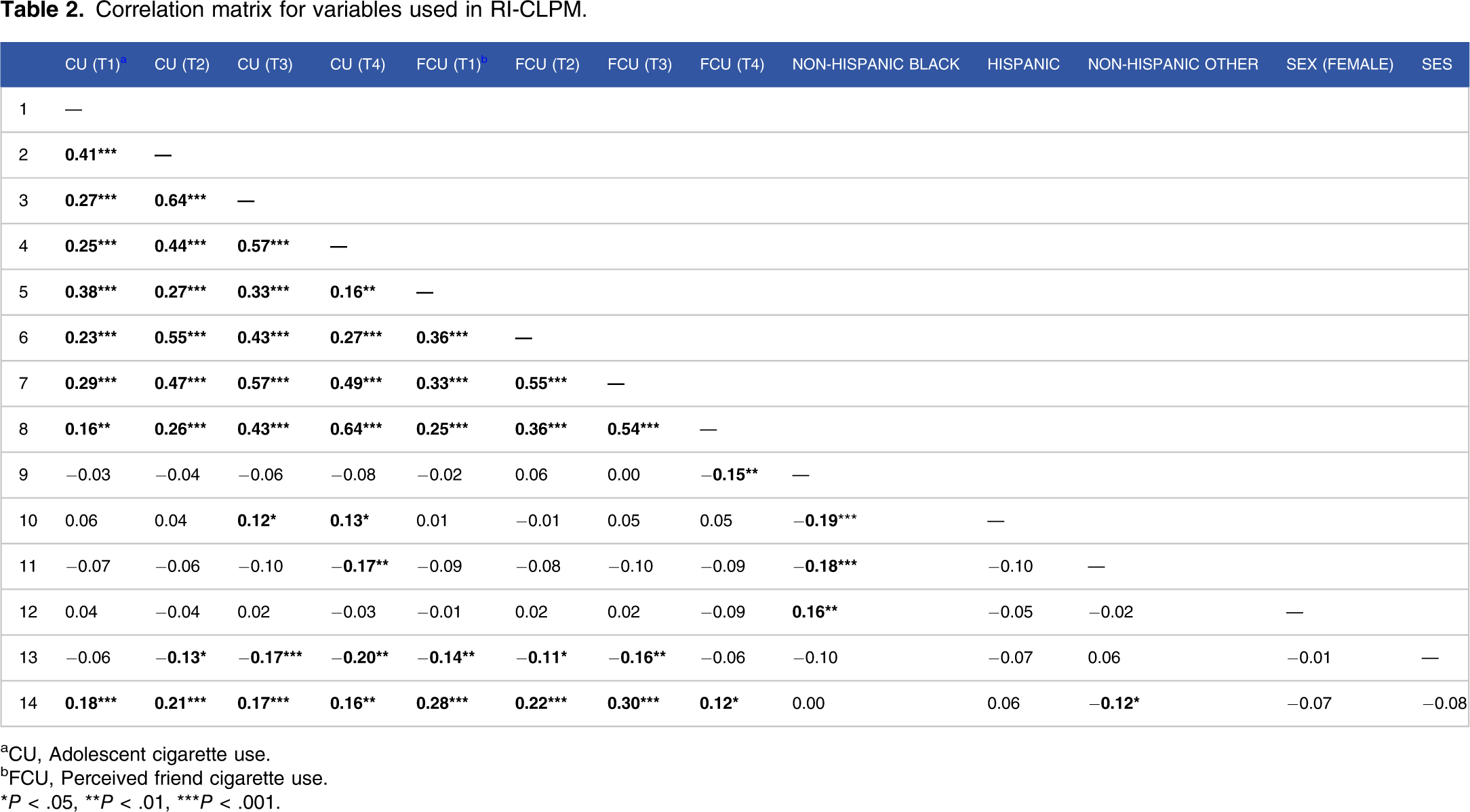
aCU, Adolescent cigarette use.
bFCU, Perceived friend cigarette use.
*P < .05, **P < .01, ***P < .001.
RI-CLPM results
Selected parameter estimates from RI-CLPM.

aCI, Confidence Interval.
bStandardized Estimates for dichotomous, dummy-coded variables are standardized only in terms of outcome.
cFCU, Perceived Friend Cigarette Use.
dCU, Adolescent Cigarette Use.
eIndirect bias corrected CIs determined empirically with 5000 bootstrapped draws, and thus do not have exact P-values. bolded lines as significant at P < .05. *P < .05, **P < .01, ***P < .001.

Simplified RI-CLPM diagram of perceived friend cigarette use (FCU) and adolescent self-reported cigarette use (CU) from T1 to T4. Note. RI, random intercept; Covariances, double-headed arrow; direct path, single-headed straight arrow; indirect paths, single-headed curved arrow. Solid lines and bold estimates are significant, whereas dotted lines and non-bolded estimates are non-significant. Demographic variables and non-significant indirect paths were omitted for clarity. SemDiag was used to create the figure (Mai, Zhang, and Yuan, 2016).
Two significant indirect effects were also observed, with adolescent cigarette use at T2 predicting increases in perceived friend cigarette use (T2–T3) which in turn predicted increases in adolescent cigarette use (T3–T4). This indirect pathway shows how early adolescent cigarette use predicts progression in cigarette use over time through its effect on perceived friend cigarette use. In other words, adolescents who initiate smoking at an early age are more likely to select peers with similar smoking behaviors, and this, in turn, predicts increases in adolescent’s own cigarette use over time (through socialization). The second indirect effect involved adolescent cigarette use at T2 predicting increases in perceived friend cigarette use from T2 to T3 which in turn predicted further increases in perceived friend cigarette use from T3 to T4. This finding indicates that adolescents who initiate smoking at an early age are more likely to select friends who also smoke, and these selection processes persist across time during early-mid adolescence. Both these indirect effects were significant at P < .05 (see Table 3) and demonstrate how early adolescent cigarette use predicts future use partly due to increased perceptions of friend cigarette use.
Estimates of covariate effects on the random intercepts are reported in Supplementary Table 1. In brief, older participants reported higher cigarette use (95% Confidence Interval [CI] of Unstandardized Estimate = 0.03, 0.10; β = 0.25) and greater perceived friend cigarette use (95% CI = 0.10, 0.22; β = 0.36) as compared to younger participants. Adolescents from lower SES backgrounds reported greater cigarette use (95% CI = −0.003, −0.001; β = −0.13) and higher perceived friend cigarette use (95% CI = −0.006, −0.001; β = −0.14) than those from higher SES backgrounds. The only significant racial-ethnic difference observed was that participants in the non-Hispanic other group, comprised primarily of Native American and Asian American participants, reported significantly less cigarette use than the non-Hispanic White participants (95% CI = −0.13, −0.02; β = −0.31). No other variables significantly covaried with either outcome at P < .05 (Supplementary Table 1).
Random intercepts
We did not detect a significant between-subjects effect in addition to the within-subjects effect. Although it is possible that there was no between-subjects covariance between perceived friend cigarette use and adolescent cigarette use, this seems unlikely with an r = 0.76. It may have been the case that our model parsed much of the available variance into the within-subjects portion of the model, and we did not have adequate power to detect a between-subjects effect, as suggested by the non-significant variance in the random intercept of cigarette use (Estimate = 0.05, 95% CI = −0.02, 0.14). In other words, it is possible that cigarette use is emergent during this time and we lacked the sensitivity in our measure to detect stable individual differences across this age range. The estimate being non-significantly different from 0 potentially explains the lack of significant covariance observed between the two random intercepts. Despite this, we retained the random-intercept structure to allow accurate interpretation of the within-subjects changes in the panel portion of the model.
The RI-CLPM fit the data well by all metrics outlined by Hu and Bentler 22 (CFI = 0.954, RMSEA = 0.055 [0.039, 0.070], SRMR = 0.048). χ2 for the model was significant, (χ2 (df = 45) = 95.37, P < .001); however, a Hoelter’s N of 241 suggests that our χ2 would be non-significant if we had less than 241 participants; thus, our model was deemed to fit the data well.
Discussion
In this study, we examined the relative influence and timing of selection and socialization effects in predicting adolescent cigarette use over time. Prior studies have revealed mixed findings, with some studies reporting stronger selection effects and others documenting significant socialization effects, or both selection and socialization effects. We addressed limitations found in prior research by analyzing four waves of data from a large community sample of adolescents and using a more advanced and flexible modeling approach, that is, RI-CLPM, which allowed us to examine reciprocal relations between adolescent cigarette use and perceived friends’ cigarette use patterns across adolescence.
Our findings revealed that the influence of selection outweighed that of socialization for predicting early adolescent cigarette use, with both processes reciprocally influencing each other. This finding is consistent with prior studies that have similarly documented earlier and stronger selection effects in case of adolescent cigarette use,13,14 but is inconsistent with the longitudinal study by Simons-Morton and Chen 15 using ALT modeling. We believe this inconsistency may be due to the inherent limitations of the ALT model that make it less appropriate for examining directionality of effects in a reciprocal effects model. 19 The cross-lagged effects in the ALT model are interpreted in relation to the random intercept and slope factors, which in turn are dependent on a combination of other factors in the model. If the growth factors are not accurately specified in ALT models, then any higher-order, between-subject differences not accounted for by the model can bias the within-subject estimates. In comparison, the RI-CLPM approach does not impose any constraints on the mean structure, or the growth pattern, thereby allowing a more accurate estimation of the reciprocal processes at the within-level. Furthermore, Simon-Morton and Chen 15 assessed both alcohol and cigarette use as part of their measure of substance use, which may have yielded different findings. Our results add support to the majority of prior studies which argue in favor of selection effects in the development of adolescent cigarette use by using a more robust and appropriate RI-CLPM with four waves of data from early to mid-adolescence.
Specifically, we found that early adolescent cigarette use predicted perceived friend cigarette use at subsequent waves, with significant indirect effects on future adolescent cigarette use and perceived friend use. No indirect effects were observed in the opposite direction, that is, from perceived friend cigarette use to either later adolescent cigarette use or later perceived friend use. Further, adolescent cigarette use influenced perceived friend use before the effect of perceptions on adolescent use emerged. Overall, our findings support the peer selection hypothesis which emphasizes that adolescents tend to select peers with similar smoking behaviors, and that selection precedes the influence of peer group norms and behaviors on adolescent behavior (i.e., socialization effects). The importance of selection effects is expected to decline in later years when adolescents are increasingly influenced by the smoking behaviors of their peers. 9
Recent RI-CLPM findings by Defoe and colleagues 24 using the same sample showed that in case of cannabis use, perceived friend use predicted future adolescent cannabis use (i.e., socialization effects), but adolescent cannabis use did not predict perceptions of friend use (i.e., selection effects). One reason for the dominance of socialization (vs selection) effects in case of adolescent cannabis use might be related to the legality of use. At the time of the study, cannabis was an illicit substance in Philadelphia (study recruitment site) but was likely available through peer networks. It is, therefore, possible that peer networks played a critical role in obtaining access and promoting uptake of cannabis use. With cigarettes being more readily available and legally used by older family members, it is possible that risk transmission for cigarette use can originate more easily through families, and that peer socialization effects on adolescent cigarette use occur later in development. 16 Early adolescents who smoke may be more likely to gravitate more towards cigarette-using peers (i.e., selection effects) rather than be influenced by those in their current social networks (i.e., socialization effects).
Although adolescents are often described as being unduly under the influence of peers, our findings suggest that peer influence plays less of a role in predicting cigarette use behaviors in younger adolescents, who may be more under the influence of their families 25 or media depictions of smoking behaviors. 26 Preventive interventions aimed at reducing early smoking onset should focus on disrupting the initial selection processes. Parents, through monitoring and supervision, could play a critical role in delaying early onset of cigarette use. 27 Social norms marketing campaigns that aim to change perceptions of peer substance use norms 28 may be more effective in mid-late adolescence when socialization effects exert a stronger influence.
One might wonder how our findings relate to the current tobacco landscape in as much as the dominant form of tobacco initiation is with electronic cigarettes, such as JUUL and Puff Bar. 29 Research suggests that early initiation of these products is facilitated by exposure to advertising on social media, 30 which is also consistent with the possibility that initial attraction to this form of tobacco is driven by factors apart from socialization by friends. Nevertheless, the rapid uptake of these products later in adolescence is likely to be facilitated by peer influence. The present research suggests that early initiation of substances that are legal and widely marketed are more likely to be spurred by factors apart from peer use.
Limitations and future directions
Our findings in support of selection effects may be biased due to our reliance on adolescent self-reports of their own cigarette use and perceived friend cigarette use, resulting in a false consensus effect. 31 Adolescents also tend to have inaccurate perceptions of their peers’ substance use behaviors.9,32 Therefore, without accounting for actual change in peer networks while simultaneously comparing actual friend cigarette use to perceptions of friend use, we cannot definitively explain the effect of adolescent cigarette use on perceptions of friend use at future waves. Though it is possible that cigarette smokers remain in their peer networks after they start smoking and inaccurately perceive their friends as engaging in greater cigarette use, this seems less probable as changes in peer networks are relatively common during this developmental period (e.g., DeLay et al. 13 and Long and Valente 33 ). It is perhaps more likely that adolescents who smoke tend to select friends who also smoke, and that these selection effects explain the observed association between adolescent cigarette use and increases in perceived friend use over time.
Although we found stronger evidence for selection effects in our analyses, it is possible that peer socialization effects may have been operating at wave 1 (i.e., in baseline data that we did not include due to low rates of cigarette use). We believe this is unlikely because any effect of friends’ cigarette use (autoregressive or cross-lagged) did not emerge until later waves in our analyses. It is perhaps more likely that in younger years, adolescents tend to select friends with similar smoking attitudes and behaviors, as prior work has also suggested (e.g., Kiuru et al. 14 and DeLay et al. 13 ).
Selection processes may operate in a number of ways to contribute to individual and peer group smoking patterns. For instance, some members of peer groups may leave the group when other members begin smoking. 7 DeLay et al. 13 noted specific ways that selection operates for high-vs low-smoking individuals; the former tends to drop friends based on dissimilarity whereas the latter seek out new friends with similar values. In light of present findings supporting the salience of peer selection for adolescent cigarette use, further exploration of selection mechanisms, particularly in relation to long-term dependence symptoms, is warranted. Future research should also evaluate the potential moderating effect of accuracy of perceived friend cigarette use as compared to peers’ actual self-reports, such that adolescents who have more accurate perceptions of peers’ use may be effected differentially as compared to those who have biased perceptions.
Future studies with larger samples could also examine heterogeneity in these trajectories to determine if sub-groups or clusters are observed and if they are uniquely associated with patterns of adolescent cigarette use. Furthermore, incorporation of more complex patterns of smoking behaviors, including other nicotine delivery methods (e.g., vaporizing) or simultaneous use with cannabis could be examined in a similar framework. We were unable to test these outcomes as we did not assess simultaneous or sequential use of cannabis and tobacco use in current sample, and at the time of data collection, vaporizing was not as common among adolescents. 29
In conclusion, our findings reveal that unlike use of illicit drugs, early adolescent cigarette use originates relatively independently of peers, leading adolescents who smoke to select friends who do the same. It is primarily later in adolescence that peers begin to influence the uptake and increase in smoking. As such, prevention programming might more effectively be directed toward families with smokers to reduce rates of early cigarette use onset among adolescents.
Supplemental Material
sj-pdf-1-tui-10.1177_1179173X211066005 – Supplemental Material for Selection versus socialization effects of peer norms on adolescent cigarette use
Supplemental Material, sj-pdf-1-tui-10.1177_1179173X211066005 for Selection versus socialization effects of peer norms on adolescent cigarette use by Christopher M Loan, Atika Khurana, Joanna Wright and Daniel Romer in Tobacco Use Insights
Footnotes
Declaration of conflicting interests:
The author(s) declared no potential conflicts of interest with respect to the research, authorship, and/or publication of this article.
Funding:
The author(s) disclosed receipt of the following financial support for the research, authorship, and/or publication of this article: The project was supported by grants R01DA018913 and R01DA033996 from the National Institute on Drug Abuse.

Supplemental Material:
Supplemental material for this article is available online.
References
Supplementary Material
Please find the following supplemental material available below.
For Open Access articles published under a Creative Commons License, all supplemental material carries the same license as the article it is associated with.
For non-Open Access articles published, all supplemental material carries a non-exclusive license, and permission requests for re-use of supplemental material or any part of supplemental material shall be sent directly to the copyright owner as specified in the copyright notice associated with the article.
