



Abstract
Objective:
To provide a nontraditional source of data to university policymakers regarding student, faculty, and staff approval of university smoke/tobacco-free policies, as published through campus newspaper articles.
Methods:
From January to April 2016, a total of 2523 articles were retrieved concerning campus smoking/tobacco at 4-year, public universities. Of these, 54 articles met the inclusion factors, which described 30 surveys about campus approval of tobacco-free policies and 24 surveys about smoke-free policies.
Results:
In all, the surveys included more than 130 000 respondents. With the exception of 4 surveys, all reported that the most of the respondents approved a tobacco/smoke-free campus policy.
Conclusions:
Although the study had several limitations, the findings provide a synthesis from a nontraditional data source that is consistent with findings from the peer-reviewed literature, in which most of the students, faculty, and staff on university campuses approve of smoke/tobacco-free campus policies.
Introduction
Tobacco use is a major health problem in the United States. Firsthand and secondhand smoke (SHS) are associated with negative health issues, including several types of cancer, respiratory problems, cardiovascular disease, and reproductive health issues. 1 Smoking is the leading cause of preventable death, killing an estimated 480 000 Americans each year. 1 It is also estimated that tobacco use costs US $130 billion in direct medical costs and US $150 billion in productivity loss every year. 1 Moreover, smokeless tobacco use is also harmful to health and associated with oral lesions, gum disease, tooth decay, and cancer of the mouth, esophagus, and pancreas. 2
Tobacco use is also an important health issue on university campuses. The National College Health Assessment reports that the nation’s university students are current users of several types of tobacco, including cigarettes (9.7%), e-cigarettes (4.9%), hookah (water pipes) (4.6%), cigars, little cigars or cloves (4.4%), and smokeless tobacco (2.5%). 3 In addition, quantitative4–6 and qualitative7,8 research findings suggest that SHS exposure is a problem at universities without stringent tobacco policies. For instance, in one study, 45% of students report that SHS is difficult to avoid while outdoors on campus. 9 Similarly, in a separate study, 77% of students report being bothered by outdoor SHS on campus. 10
To address tobacco use, public health experts recommend the implementation of smoke-free policies as an evidence-based strategy. The Surgeon General, 11 Community Guide to Preventive Services, 12 American Lung Association, 13 and the American College Health Association 14 recognize empirical research findings that indicate tobacco-free policies are effective in reducing both firsthand and secondhand exposure to tobacco. As such, these organizations recommend that communities strive to implement comprehensive tobacco control policies.
Fortunately, there is a growing trend among colleges and universities in the United States to become smoke free or tobacco free. According to Americans for Nonsmokers’ Rights, there were only 446 smoke-free campuses in 2010, whereas in 2016, there were more than 1400. 15
In the process of becoming a smoke-free or tobacco-free university, an essential step is to assess the campus community’s attitudes toward a comprehensive policy. The US Department of Health and Human Services’ Tobacco-Free College Campus Initiative, 16 Americans for Nonsmokers’ Rights, 17 and public health departments18,19 strongly suggest surveying students, faculty, and staff to gauge the community’s overall opinion of a smoke-free (ie, prohibition of smokable tobacco products) or a tobacco-free (ie, prohibition of smokable and smokeless tobacco products) campus. Survey results can demonstrate to policymakers the support of the campus for such a policy.
Although a number of peer-reviewed publications report campus opinion of tobacco policies, the findings have not been completely consistent. Several studies indicate that the most of the students, faculty, staff, and administrators approve of a transition to a smoke-free20,21 or tobacco-free campus.22–26 For example, Lupton and Townsend conducted a systematic review of 19 articles from both peer-reviewed and gray literature from the United States and the United Kingdom, finding that 58% of students and 68% of faculty supported smoke-free campus policies. 27
However, 2 studies suggest that only a minority support comprehensive policies. For instance, Thompson et al 28 show that only 32% of more than 14 000 students sampled from 30 different colleges in Idaho, Oregon, and Washington are in favor of prohibiting smoking outdoors. In addition, the study by Loukas et al 29 of a convenience sample of 1118 students (from a population of 39 020 students attending 5 colleges in Texas) had a much lower level of support for prohibiting smoking outdoors as compared with indoors. In other words, although most of the community members supported a smoke-free or tobacco-free campus, a couple of studies found less support for banning outdoor use.
Granted, an abundance of peer-reviewed literature exists regarding campus approval of tobacco policies; however, there has yet to be a synthesis of this topic from nontraditional data sources, specifically, campus newspapers. Given the potential for publication bias in peer-reviewed literature, 27 public health professionals value additional, supplemental data from nonacademic sources. Because several experts recommend that advocates publicize poll data of tobacco policy approval via student-run campus newspapers,16–19,30 the purpose of our study was to further examine this issue by reviewing survey findings published within campus newspapers. Even though news media are subject to several limitations, previous research has used the news as an adjunct source of data for traditional research methods.31–33
This study attempted to answer several research questions. First, considering there are more than 1000 smoke-free universities in the United States, 15 and because public health experts recommend gathering and publicizing poll data of tobacco policy approval via student-run campus newspapers,16–19,30 it could be assumed that there would be a plethora of newspaper publications regarding such polls, however, no one has yet investigated this issue. As such, this study will answer the question: How often are approval surveys published in online campus newspapers?
Second, although it is recommended that members of university campuses advocate for change by conducing opinion surveys, the methodology of such recommendations is vague, at best.16–19,30 It is important to understand how opinion polls on campus are actually implemented. Therefore, this study will answer the questions: Who tends to conduct tobacco policy approval surveys? What research methods are used?
Finally, this study will serve to provide a synthesis from a nontraditional data source (ie, university newspapers) to answer the question: What percent of campus communities discussed in the articles approve of smoke-free or tobacco-free policies?
Methods
Prior to conducting the study, the Institutional Review Board at Liberty University determined that the study was exempt because all articles retrieved for the review were freely available online and did not include any identifying information of participants regarding survey results.
During January through April 2016, the government’s National Center for Education Statistics’ “College Navigator” Web site (http://nces.ed.gov/collegenavigator/) was used to locate universities. College Navigator gives users the option to filter institutions of higher education based on state location, public or private status, and length of degree options (eg, 4-year degree, 2-year degree). 34 College Navigator was filtered to select universities throughout the entire United States that are public and offer 4-year degrees. Universities that are private or only offer 2-year degrees were excluded from the study after an initial search found only a small number of student newspapers from these institutions. Moreover, public, 4-year universities tend to have larger enrollments, which would provide larger sample sizes for surveys regarding campus approval of tobacco policies. We also excluded universities that did not have a physical campus (ie, online universities) and thus no need for a campus tobacco policy.
Each university name was copied and pasted into an electronic document. The Internet was then used to search for each university’s online student-operated newspaper. Universities were excluded from the study if they did not have a student newspaper or if the student newspaper was only available in print form due to the difficulty of obtaining and searching through archived print newspapers.
The search pane of each student newspaper was searched using a combination of the following terms: smoke, smoking, tobacco, policy, ban, survey, and vote. The term “vote” was included because student voting regarding a referendum also acts to gauge campus approval of tobacco policies. Each resulting article was copied and pasted into an electronic document and searched for a description of any survey or vote that was conducted regarding the campus community’s approval of a new tobacco policy.
Articles were excluded if they were regarding smoke-free or tobacco-free policies but did not include information about campus surveys about tobacco policy approval. In addition, articles were excluded if the sample size of the survey was not specified or if the article was regarding tobacco policies other than comprehensive policies (eg, designated smoking areas, only prohibiting smoking a certain distance from building entrances). If an article cited multiple surveys conducted on campus, each survey was included in the study.
The articles were analyzed to determine the type of tobacco policy, who conducted the survey, the survey’s methods, sample size, and percent of the sample’s approval. Newspaper articles that reported Likert-based categories of percentage approval (eg, strongly approve, somewhat approve) were collapsed into a single percentage. Finally, to provide context of each survey, the universities’ Web sites were also explored to determine the student enrollment as well as the smoking policy that was in place during the time of the survey.
Results
We located 510 online student newspapers from the 707 four-year universities in the United States. There were a total of 2523 articles retrieved concerning smoking or tobacco on campus. Of these, 51 articles met the inclusion factors, which described 30 surveys about campus approval of tobacco-free policies (Table 1) and 24 surveys about smoke-free policies (Table 2). Three articles described multiple surveys. The articles were published from 2007 to 2015. In all, the surveys included more than 130 000 respondents.
Campus survey methods and approval of a tobacco-free campus.
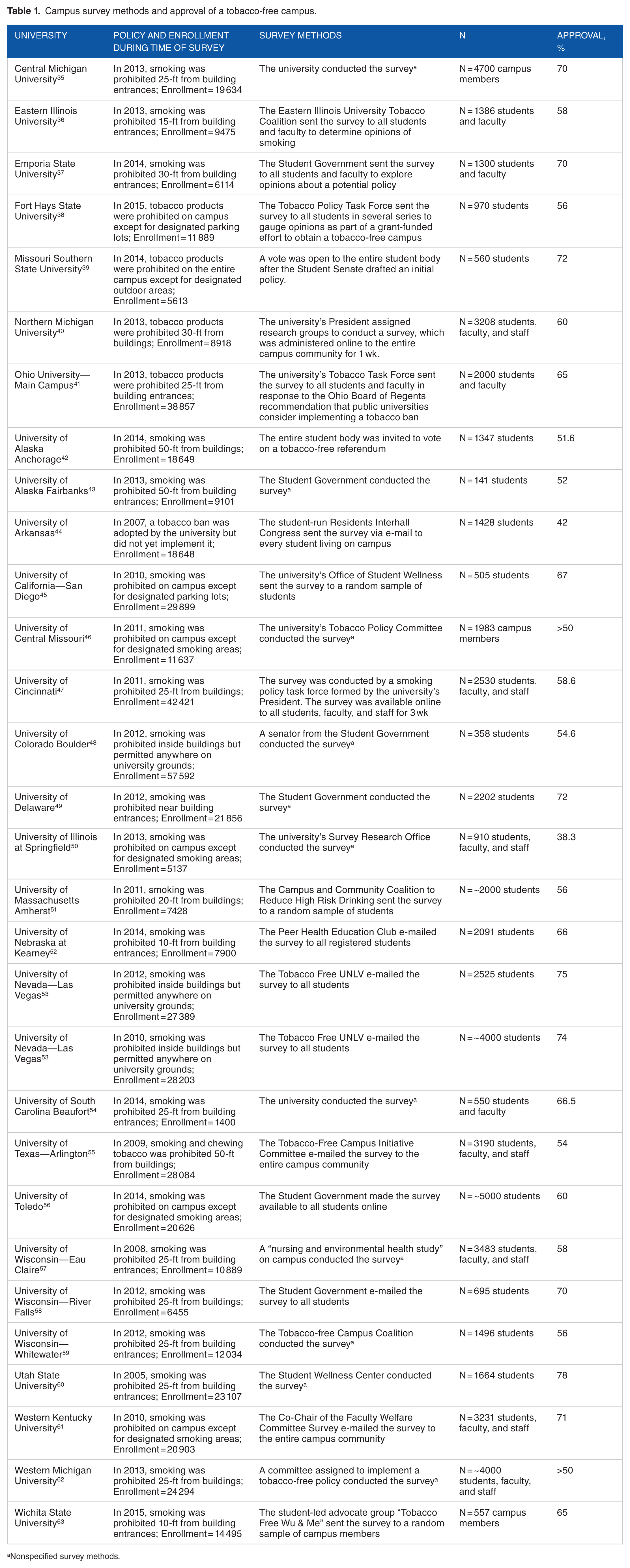
Nonspecified survey methods.
Campus survey methods and approval of a smoke-free campus.

Nonspecified survey methods.
Surveys and votes were conducted most often by a form of student government (n = 19, 35%) or a university-sanctioned tobacco/smoke-free task force/coalition/committee (n = 14, 26%). Others who conducted surveys included service or academic departments within a university (eg, Safety Council, Department of Health Promotion), student-based public health clubs, students who conducted the survey as part of project for a class, college health/wellness centers, faculty senate/committee, lone faculty members, college presidents, and “the university” in general.
The most common survey methods included sending a survey (or opening a survey on a Web site) electronically to the entire campus (n = 18, 33%) and opening the policy to be voted on by the entire campus (n = 6, 11%). Other methods included sending the survey to a random sample of the population and recruiting a convenience sample to complete the survey. It is important to note that the methods of 24 (44%) surveys were not specified in the articles.
The universities included in the study had a variety of tobacco policies in place during the time of their campus surveys/votes. Specifically, 19 universities prohibited smoking at building entrances, ranging from 10 to 50 ft (M = 22.22, SD = 9.74, Mdn = 25), with 1 policy vaguely prohibiting smoking “near” building entrances. There were 15 universities that prohibited smoking around building perimeters, ranging from 20 to 50 ft away from buildings (M = 29.67, SD = 10.77, Mdn = 25). Of the universities in the study, 14 prohibited smoking on the entire campus, with the exception of designated smoking areas. There were 5 universities that did not prohibit smoking outdoors and 1 university that had adopted, but not yet implemented, a policy that prohibited smoking on the entire campus.
With the exception of 4 surveys, all reported that most of the respondents approved of a tobacco/smoke-free campus policy. Not every article reported an exact sample size. There were 7 articles stating that surveys were “almost,” “roughly,” “nearly,” or “over” a certain sample size. Similarly, 2 articles simply stated that a “majority” of survey respondents had approved of a tobacco/smoke-free policy, without giving an exact percentage.
Discussion
The current analysis of campus newspaper articles included in this study signals that most of the campus community members (eg, students, faculty, staff) who participated in the surveys or campus votes approved of comprehensive tobacco-free and smoke-free policies, regardless of the type of policy in place at the time of the survey. Granted, a large number of articles in the review did not report the sampling methods used in the surveys; however, the surveys that used random sampling or included the entire campus population had similar findings. In other words, even though the survey methods varied across studies, the overall finding of majority approval was consistent. These findings provide a synthesis from a nontraditional data source that reflects the peer-reviewed literature, in which most people would prefer a tobacco/smoke-free campus.20–27
It is noteworthy that there were universities with a relatively low percentage of approval for a tobacco/smoke-free campus. This may indicate either low interest in the topic or low support for tobacco- and smoke-free initiatives in these communities. However, the low approval may have been from the limitations of the surveys. At the University of Arkansas, the survey was administered to only students who lived on campus, which did not capture the opinion of those who lived off campus, or faculty/staff members of the community. Moreover, at the time of the survey, a tobacco-free policy had been recently adopted, but not yet implemented, which may have caused an increase in negative opinion during the transition between policies. 44
At the Missouri University of Science and Technology, although only 46% approved, even less disapproved (43%) of a more stringent policy. 66 Also, at the University of Idaho, 2 surveys were conducted, resulting in a majority and minority approval rating. The survey with the higher approval rating was considered the more scientifically rigorous of the 2 studies by the university’s Director of Health and Wellness. 76
A number of campuses whose student government and/or task force conducted a survey suggest that the student body considered tobacco use as an important issue. According to the Tobacco-Free College Campus Initiative, a student government and tobacco-free task force should play a major role in assessing how many people on campus approve of a tobacco-free policy. 16 The findings in this review suggest that those who advocate for a tobacco/smoke-free policy on their campus should consider collaborating with student government and/or campus tobacco task force.
Given the potential of publicizing survey findings through a campus newspaper, this study indicates possible areas of improvement. First, although the analysis of campus newspapers retrieved more than 50 articles, it was expected that more newspaper articles would have been located, especially because there are more than 1000 smoke-free colleges and universities in the United States. 15 Perhaps more advocates of campus tobacco policies should consider using their campus newspapers to publicize survey findings. Second, advocates who desire to publish survey results via campus newspapers should work with reporters to when reporting the statistics to help paint a better picture of overall approval, how the surveys were conducted, and by whom.
The results from this study provide several opportunities for future research. First, previous studies indicate that certain disparities exist among demographics regarding support of tobacco policies, such as sex, race, and smoking status.20,22,25,29 University administrators and/or students conducting polls should consider including various demographics to tease apart approval from various groups of people on campus. Second, researchers should also consider studying how campus approval of tobacco policies is framed by campus newspapers, such as from a public health issue or a civil liberties issue. For example, several newspapers included quotes from students regarding their view of personal rights, such as “This is a public university under the domain of being an open public space. People should be able to exercise their rights that they have in the public space - smoking included.” 44 Other articles were framed from a public health perspective by emphasizing faculty and student quotes regarding the harms of tobacco. Third, the findings from this study suggest that campus newspapers can serve as an easily accessible, and searchable, nontraditional source of data for a variety of research topics. Although campus newspapers clearly do not have any advantage over traditional data sources in terms of validity, researchers may want to consider examining additional qualitative and quantitative information that might be available in campus newspapers.
This study had several limitations. First, it is important to emphasize the difference in methodologic rigor between surveys found in the peer-reviewed literature and in campus newspapers. Because university newspapers are not peer-reviewed, it should not be assumed that the surveys included in this study were of high-quality research design or accurate. Second, the search terms used to select potentially relevant newspaper articles, although identical across each institution, may not have retrieved all articles of campus surveys regarding tobacco control policies. Third, the analysis focuses on only a small number of campuses in the United States that were not selected randomly. Moreover, the campuses were only 4-year, public universities. As such, the study’s results cannot be generalized to institutions in other countries, 2-year institutions, private institutions, or even public universities. Finally, the articles tended to publish only the percent of campus approval, without noting the percent of people who held neutral or disapproving opinions. That information could have been helpful in judging against the percentages of approval.
Conclusions
The university campus is an educational environment as well as a workplace, where students, faculty, and staff spend many hours per day. In these functions, the campus is an important environment for protecting the health of students and employees and for role modeling of good health behavior. The results of this analysis of campus newspapers suggests that among those surveyed and among those who voted regarding policy change, with a few exceptions, there was attitudinal support in most of the students and employees for both tobacco-free and smoke-free policies.
Footnotes
Acknowledgements
The authors acknowledge student interns Emily Pless and Deryl Chin who assisted with data collection.
Funding:
The author(s) received no financial support for the research, authorship, and/or publication of this article.
Declaration of conflicting interests:
The author(s) declared no potential conflicts of interest with respect to the research, authorship, and/or publication of this article.
Author Contributions
CMS conceived and designed the experiments. CMS and BAG analyzed the data. CMS, ZK, BAG, and MPD wrote the first draft of the manuscript; contributed to the writing of the manuscript; agree with manuscript results and conclusions; jointly developed the structure and arguments for the paper; and made critical revisions and approved final version. All authors reviewed and approved the final manuscript.
Disclosures and Ethics
As a requirement of publication, authors have provided to the publisher signed confirmation of compliance with legal and ethical obligations including but not limited to the following: authorship and contributorship, conflicts of interest, privacy and confidentiality, and (where applicable) protection of human and animal research subjects. The authors have read and confirmed their agreement with the ICMJE authorship and conflict of interest criteria. The authors have also confirmed that this article is unique and not under consideration or published in any other publication, and that they have permission from rights holders to reproduce any copyrighted material. The external blind peer reviewers report no conflicts of interest.