




Abstract
Movements cause changes in cortical rhythms emanating from the sensorimotor area. It is known that alpha and beta brainwaves take an important role of motor activity and motor imagery. Besides, theta rhythm is considered to carry substantial information about movement initiation and execution. In this study, effect of theta brainwave on movement detection was investigated in four-right handed participants who performed extensions with fingers of right hand using electroencephalography (EEG). Movement and rest epochs from continuous EEG record were extracted using muscle signals. Channels located over sensorimotor area were selected and referenced according to common average and Laplacian reference methods. Power spectral density function was used to display existence of theta band in frequency domain. To analyze theta, alpha and beta rhythms of the epochs individually and together, we filtered them to their interval range with Butterworth bandpass infinite filter before feature extraction and classification stages. Then, principal component analysis and Hjorth parameters were chosen to extract efficient features in the study aiming to investigate the effect of theta brainwaves on finger movement detection. According to classification accuracies using support vector machine classifier, alpha, beta, theta rhythms and also their different combinations were compared with each other. The performance of the epochs including alpha, beta and theta rhythms were the best and they were classified ~2% to 4% higher value in accuracy than the signals including only alpha and beta rhythms. According to this, it has proved that theta brainwave takes a role and makes contribution to motor activity.
Introduction
Brainwaves are neural oscillations or electrical impulses observed in brain. They are categorized into five groups: delta, theta, alpha, beta, and gamma rhythms. These rhythms arise according to type of activity like emotions, imagery, and body movement. It has been known for many years that motor activities as a result of functional activation of sensorimotor area make salient changes in different rhythms especially alpha (8-13 Hz) and beta (13-30 Hz).1–7 The main research in this regard was made by Jasper and Penfield 1 in 1949. According to their findings, movement preparation and execution have been consistently associated with beta-band oscillation and power of brain oscillatory activity in this band has decreased. The decrease in amplitude has defined as event-related desynchronization (ERD). As a result of the reproducible observations, it was seemed that beta power ERD in motor cortex has changed in related to movement preparation, and it has been risen from 2.0 to 1.0 s before movement initiation for visual-based stimuli task.8–15 Many studies also made to search alpha rhythm during movement execution.16–20 In rest duration, large amplitude brain oscillations in the alpha band were measured over sensorimotor cortex, while power decrement of the alpha oscillation was observed in execution duration.21–23 During finger movement, event-related electroencephalography (EEG) was recorded and the researchers found that there has been different alpha rhythms (rolandic mu and coherent alpha rhythms) effect in the central area of brain. 24 Spectral power changes were discovered in 7.5-10.5 Hz, 18-25 Hz, 25-35 Hz bands during observation and execution of thumb and index finger. 25 Pfurtscheller et al 26 showed that lower (8-10 Hz) and upper (10-12 Hz) alpha band were triggered by index finger movement. A study about fast finger movements demonstrated presence of the alpha and beta bands over premotor and primary sensorimotor cortex. 27 Power changes between pre-movement and movement stages of right index were seemed for 7-10 Hz, 10-13 Hz, 13-20 Hz. 28 Zaepffel et al 29 investigated beta power during preparation and execution of complex grasping movements. They observed an increase beta band with stimuli and a decrease during preparation and execution. Besides, theta band was thought to be significant to attain more information before movement initiation and during activation. 5 A new study showed that phase locking effect in delta-theta (2-7 Hz) band is observed before movement initiation. 30 Based on the previous studies which searched the effects of brainwaves during movement execution, it was demonstrated prominence of alpha and beta rhythms, and that also delta rhythm may also be significance. Our study aims to demonstrate the appreciable presence of theta rhythm as much as the crucial presence of alpha and beta rhythms during motor activity for finger movement. First, asset of theta band was demonstrated using power spectral density (PSD) function. Next, theta oscillation, alpha oscillation, and beta oscillation of oscillatory components were separately extracted from brain signals using band bass filtering. Finally, variances of principle component analysis (PCA) and Hjorth parameters were used in feature extraction stage. Finally, accuracy rate of movement detection in only theta rhythm (θ), only alpha rhythm (∝), only beta rhythm (β), only alpha-beta rhythms, only theta-alpha-beta rhythms were compared with each other using support vector machine (SVM) to prove effects of theta rhythms in finger movement.
Material and Methods
Participants
Four healthy male participants were participated in experiments. All participants are normal and have no neurological or psychiatric diseases. Their age range is 21-27 years. All volunteers were informed about experimental procedures approved by Karadeniz Technical University Faculty of Medicine Ethic Council, Turkey (N-24237859-164). In addition, written consent was provided in advance.
Procedure
Experiments were performed in a dimly lit room. Participants were sat on a computer screen. They were asked to relax and minimize body movements (such as blinking and swallowing, if necessary). Words of thumb, index, middle, ring, and little were shown on the screen for 2 s as stimuli. Finger flexion movements for each finger of right hand were performed with random gaps ranging from 3 s to 6 s according to the visual-based stimuli by participants. A motion trial was defined as a finger extension movement consisting of 2s-motion and a no-motion trial was described as 2s-gap after the termination of the finger movement. A session, which was initiated with a beep sound, took 2 min, and there was 10 trials for both motion and no-motion in a session. Our experiments for each participant were performed on 5 days and our database comprised 25 sessions including 250 motion trials and 250 no-motion trials.
Recording of EMG and EEG signals
EEG and electromyography (EMG) data were acquired using Brain Quick-32 equipment which has 19 electrodes placed according to the international 10-20 system and a bipolar surface electrodes placed forearm extensor digitorum muscle. The reference electrode was placed on linked mastoid. The channel potentials were sampled at 256 Hz and the electrode impedances were brought below 10 kΩ before the initiation of experiment. EEG and EMG signals analyses were performed in MATLAB.
Preprocessing of the recorded data
EEG data were prepared to analyze and to suppress artifacts with preprocessing. Power line noise was removed by notch filter at 50 Hz. Common reference and Laplace reference techniques were performed to reduce spatial noise. Channels C3, CZ, and C4 over sensorimotor cortex were used for finger movement analysis. Then, they were referenced with common reference (C3C, CZC, and C4C) and Laplace reference (C3L, CZL, and C4L) methods. The channels filtering was made to obtaining theta, alpha, and beta oscillatory components using fourth-order Butterworth bandpass filter designed according to the theta, alpha, and beta frequency ranges before feature extraction. EEG motion trials of 2s-length were segmented by 2s after the onset of the finger movement according to EMG data. No-motion trials also were extracted by 2s after the termination of the finger movement.
Power spectral density function
Frequency characteristic of EEG trials were analyzed in spectral domain by PSD function to show which bands were present during finger movement. PSD function demonstrates a distribution of power values in the signal as a function of frequency. It is useful to realize that frequency limitations are requirement when analyzing data and is formulated as follows:


where

Principle component analysis and Hjorth parameters
PCA and Hjorth parameters are commonly used as efficient feature extraction techniques in time domain. In this study, we selected these techniques to detect movement among motion and no-motion trials.
PCA: It is a linear transform based on the statistical representation of a random variable and is used to analyze and to compress data. PCA method is implemented in equations (4) to (8):


Eigenvalues and eigenvectors are obtained as follows:

v and λ represents the eigenvectors and corresponding the eigenvalues, respectively. The projected data y are calculated as follows:

In our study, variances of PCA transform were used to features. They are formulated in equation (9):

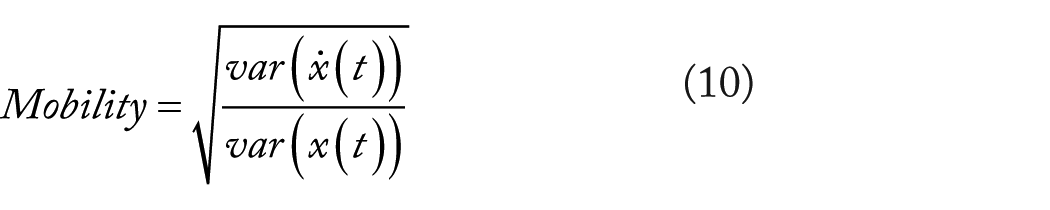
Hjorth parameters: The parameters are activity, mobility, and complexity. They indicate statistical properties of signal in the time domain. Mobility representing the mean frequency and complexity representing the change in frequency are given in equations (10) and (11):

Support vector machine classification
The trials were randomly permutated 50 times before feature extraction and classification steps to calculate movement detection accuracies. After each permutation, half of the data were chosen for training set and the rest for testing test. It was guaranteed that the data in training set were not used in the testing set. The SVM is searched for the optimal hyperplane via support vectors to separate different classes. The SVM classifier was trained with training data set with their labels. Labels of testing data set were tried to predict using the trained SVM classifier. The predicted labels were compared with true labels to evaluate movement detection accuracies.
Results
Demonstration theta present using PSD function during finger movement
Finger movements have caused changes in mean PSD function obtained from motion trials. These changes have been more prominent, especially at some specific frequencies. They have looked like fluctuation. Interval of the specific frequencies were defined as efficient frequency band. Borders of the frequency band were set according to clear drops in the fluctuation.
The fluctuations of mean PSD functions were shown in Figure 1. According to them, the range of efficient frequency bands was specified by red lines. The rhythms covering the efficient frequency bands during finger movement were determined as given in Table 1. The frequency bands of the all participants were detected as ~6-25 Hz. Mean power in theta band 22.16, 7.90, 13.43, and 12.21 µV2/Hz in no-motion duration decreased 19.59, 6.36, 9.67, and 8.76 µV2/Hz in motion duration for participants 1, 2, 3, and 4, respectively. Rhythms for motion were noted based on evaluated frequency bands. All participants’ frequency bands during finger movement have consisted of not only alpha and beta rhythms but also theta rhythm as seen Table 1.

Fluctuations in mean PSD function.
Frequency bands and rhythms during finger movement.

Analysis of theta rhythm effect for movement detection
To detect finger movement, PCA and Hjorth parameters were selected as feature extraction techniques. The common referenced and the Laplace referenced channels were used to construct feature vectors. Motion trials and no-motion trials in different rhythms were classified with SVM. Accuracies and their standard deviations (std) for 50 permutations were given in Table 2. According to investigation of performances of θ, ∝, and β rhythms, the highest accuracy was obtained in β rhythm with 80.90% ± 2.13% for participant 1 and with 73.61% ± 2.66% for participant 2, as in ∝ rhythm with 76.21% ± 2.15% for participant 3 and with 68.07% ± 2.06% for participant 4. 85.26% ± 2.24%, 79.18% ± 1.52%, 80.87% ± 2.08%, and 65.52% ± 2.03% were accuracies in 2-union of ∝ and β, for participants 1, 2, 3, and 4, respectively. Furthermore, accuracies in 3-union of θ, ∝, and β (*θ, ∝, β) were calculated as 87.27% ± 1.79%, 81.21% ± 1.39%, 83.99% ± 1.90%, and 70.34% ± 2.12%. When comparing performances of 2-union to 3-union, the best results were obtained in 3-union. The highest accuracies for all participants were obtained for 3-union.
Accuracies of movement detection for rhythms and their combinations.

Discussion
During finger movement, 24 claim that the changes in rolandic mu and coherent alpha rhythms have occurred in the central area of brain, while beta power ERD decreases in motor cortex.8–15 Moreover, Pfurtscheller et al 26 demonstrated that lower (8-10 Hz) and upper (10-12 Hz) alpha band were triggered by index finger movement. Our findings supporting previous studies show that alpha and beta band have taken an important role in finger movement when considering the fluctuation of PSD function. Furthermore we has proved remarkable theta present both using PSD function fluctuation, and the changes in power.
A common opinion is that motor activities are related to the changes of alpha band (8-13 Hz) and beta band (13-30 Hz) in brainwaves.1–7 However, our findings have demonstrated that the changes during execution of finger movements have occurred in not only alpha and beta rhythms but also in theta rhythm.
Conclusions
It is crucial to understand which rhythms are associated with movement execution for the development of control of external devices such as prosthesis and orthosis in brain-machine interfaces. Studies on decoding and analyzing of motor action and motor imagery have commonly focused alpha and beta rhythms. In this study, we investigated whether or not theta rhythm has effect on occurring finger movement. First, spectral characteristics of alpha, beta, and theta bands for motor activity were obtained using PSD function. According to fluctuations and power decreases in PSD function, we have supposed that theta has taken roles for the movement execution. Second, this assumption has been proved by classification accuracies of signals in different bands. The best results for movement detection were obtained from features, which were extracted from signals in 3-union consisting of alpha, beta, and theta as well. Addition of tetra rhythm to alpha and tetra rhythms resulted in ~2% to 4% increase in performance. Finally, the results have proved that theta rhythm is as important as alpha and beta rhythms to detect motion.
Footnotes
Funding:
The author(s) received no financial support for the research, authorship, and/or publication of this article.
Declaration of conflicting interests:
The author(s) declared no potential conflicts of interest with respect to the research, authorship, and/or publication of this article.
Author Contributions
All authors contributed equally to the conception, writing, and editing of this article. All authors reviewed and approved of the final manuscript.
