



Abstract
One of the main challenges in breast cancer management is health system literacy to provide optimal and timely diagnosis and treatments within complex and multidisciplinary health system environments. Digitalised patient navigation programs have been developed and found to be helpful in high- and low-resource settings, but gaps remain in finding cost-effective navigation in the public sector in Malaysia, where resources are scarce and unstable. Hence, we set out to develop a virtual patient navigation application for breast cancer patients to enhance knowledge about cancer diagnosis and treatments and provide a tracking mechanism to ensure quality care. This paper identifies the requirement for in-hospital patients’ navigational needs for cancer diagnosis, the cancer diagnosis and treatment process’s components and pathways, developing the app and usability study on the usefulness of a cancer navigation mobile application in navigating cancer care at the University of Malaya Medical Centre (UMMC). Key features found when designing the in-hospital application are managing the medical appointments, finding the location of each medical department, and providing information to breast cancer patients, healthcare managers and providers to ensure a coordinated care pathway. In future work, we plan to implement the JURNI in-hospital patient navigation and perform usability studies involving the actual patients, physicians and administrators. We are also working towards enhancing data security, adding other local languages and artificial intelligence capabilities to improve the patient’s journey.
Introduction
Breast cancer (BC) is the most often diagnosed cancer worldwide, after lung cancer with the highest mortality rate among all cancers in the female population. 1 In Malaysia, BC is the most common cancer where 22% of the cases are diagnosed at Stage IV. 2 Late detection and poor access to treatment are the causes of the low percentage of survival of patients. 3 According to Taib et al, 4 the delay is caused by a few reasons; such as limited knowledge of disease and disease outcomes, knowledge of treatment and treatment outcomes, psychological and physical resources and support; and roles in decision-making. Other factors include sociodemographic characteristics, health-seeking behaviours and healthcare system-related issues. 5 BC patients also have low breast health literacy, for example they are unaware of the signs of breast cancer, risk factors, or even the available screening services. 6 The information on treatment processes for BC patients is also scarce. 7 Cancer patients are often plagued with anxiety, and this may worsen with unclear diagnostic and treatment pathways due to communication barriers and logistic reasons. Patients become doubtful of what to do as they need to manage a large amount of diversified information and complex appointment schedules with prolonged and complex treatment regimes. With digital transformation, it is timely that a clear and informative navigation app be developed and implemented to expedite diagnosis and allow better navigation and coordination for healthcare providers. The proposed app will allow referral networks between participating clinics and hospitals to navigate people in the community to the right clinics and undergo evidence based tests to achieve timely diagnosis.
The University Malaya Medical Centre (UMMC) has a mature multidisciplinary team managing breast cancer; with availability of a homegrown Electronic Medical Records (EMR). 8 This in-house EMR provides an opportunity for a digitalised solution as there is a dire need for a customized app that deals with much more than self-examination, treatment procedures, awareness and important information on tests needed for coming to a diagnosis. In this paper, we present the development process of the app using a hybrid software engineering approach. Initially, the patients’ navigational needs for cancer diagnosis, the cancer diagnosis components and pathways are determined, followed by development of a prototype of an in-hospital navigation application that can monitor and guide patients throughout their diagnostic and treatment journey for breast cancer at the UMMC.
Existing patient navigation systems
According to the National Cancer Institute, 9 patient navigation is a process provided by a person, such as a clinical provider, who guides a patient through the healthcare system. This process helps patients go through their medical journey, from detecting the disease to the end of the treatment. Patient navigation also enhances communication between patients and healthcare providers, allowing them to get proper and valuable information and make appropriate decisions about their health care.
Based on the American Association for Cancer Research study, the origin of patient navigation is the hearings entitled ‘National Hearings on Cancer in the Poor’ conducted by the American Cancer Society that stated the barriers faced by poor Americans diagnosed with cancer. With those findings, Dr Harold Freeman established his team’s first patient navigation program in 1990 at a public hospital in Harlem, New York. The main idea of patient navigation is to provide timely care to patients who experience financial barriers, the inability to afford the fees, and information barriers and have less knowledge about cancer and treatment. In addition, patient navigation aims to deal with the patient’s emotional barriers, such as fear and distrust, when diagnosed with cancer. 10 According to Nelson et al 11 to improve the effectiveness of patient navigation, the systems should be tailored to specific populations by looking into language translations, reminders for appointments and connectivity between patients and healthcare systems.
According to Dalton et al, 12 the types of patient navigation services that were offered in middle or low-income countries mirrored those used in high income countries, notably facilitating linkages to follow-up services, providing counselling, providing financial support, coordinating appointments and maintaining communication with patients and families-lies. Here, we review some of the selected existing patient navigation systems that could be used as models to develop a patient navigation system in this paper.
Oncology Interactive Navigator (OIN)
The Oncology Interactive Navigator (OIN), was the first virtual patient navigation in Canada, invented in 2013. This website tool aims to remove the challenges faced by patients who suffer from colorectal cancer or melanoma. Providing high-quality continuum care and comprehensive, complementary, and timely sources of cancer information and support via this website tool gives most patients more confidence and knowledge in dealing with their diagnosis and treatment. As a result, the OIN website tool offers accessible and reliable information that can rely on their needs and preferences. 13
Lupus Interactive Navigator (LIN)
Based on preliminary thorough needs surveys from the Oncology Interactive Navigator (OIN), another modified version of the virtual navigation tool, the Lupus Interactive Navigator (LIN), was developed for lupus patients. The main objective of this navigation application is to provide knowledge and support for the self-management of persons with lupus in terms of emotions and behaviours. The LIN website has succeeded in aiding lupus patients by engaging patients and delivering information based on high-quality evidence, managing symptoms and medication, accessing community support services and offering details on incorporating a healthy lifestyle. In a survey performed by Neville et al, 14 lupus has shown its importance in assisting healthcare providers as patients were pleasured by this navigation tool that was easy to navigate, useful and had plenty of high-quality, credible information about their disease and medication, especially for those who are new to the condition.
Project safety net and breast health portal
Besides providing a wealth of medical knowledge and emotional support, virtual navigation websites tools such as Project Safety Net and Breast Health Portal focus on assisting patients in accessing healthcare with an emphasis on enhancing timely screening, diagnosis, treatment services and personalized health plans. Its purpose is to expand health enhancement and illness prevention possibilities, particularly among medically underserved populations, at an affordable cost. Based on the study by Highfield et al, 15 the website offers features like finding the nearby clinic, checking personal medical information or diagnosis history remotely, and making the site bilingual have helped the underserved population access assistance from patient navigators efficiently.
Accenture patient navigator
With the advanced technologies in the implementation of patient navigation, an enhanced version of virtual patient navigation was proposed by the Accenture Company in 2013. The goal of the Accenture Patient Navigator is to provide more than just high-quality assistance from health professionals. Still, it includes reducing the no-show rate at physician appointments by monitoring appointments and lining up transportation to get patients to their doctor appointments. It also includes ease of use for healthcare providers to record notes and assign patient tasks. Patient navigators have achieved great success when implemented in the St. Vincent Health System in Pittsburgh, as it has been shown to help facilitate timely access to medical treatments. 16
Project RED-virtual patient advocate
Project Re-Engineered Discharge (RED) is a structured hospital-based program intended to provide patients and care providers with the knowledge necessary to continue treatment at home. Project RED has introduced an animated digital patient advocate or navigator named Louise to promote patient safety and reduce the re-hospitalization rate of patients by providing high-quality information. The tasks of this virtual patient advocate include planning for follow-up of tests during hospitalization, medicine schedules and educating the patients on their diagnosis. 17 In addition, it is also designed to create a discharge plan, ‘After Hospital Care Plan’ (AHCP), for the patients and their family members to instruct the patients when a problem arises. 17 A survey by Cancino et al 18 showed that Project RED had reduced the hospital readmission rate and enhanced the overall patient experience.
ACS Cares
ACS Cares is a mobile application funded by the American Cancer Society (ACS). It aims to provide timely, oncologist-approved information for cancer patients and their families so that they can make suitable healthcare decisions. Apart from providing high-quality resources, the application also prepared many valuable tools to help patients navigate their cancer care, such as tracking patients’ symptoms, seeking physician assistance and recording medical appointments manually. 19
Methodology
We initiated the design of an in-hospital navigation application JURNI (Journeying with Patients’ Understanding and Responding to Needs Interactively), by identifying patients and healthcare providers’ navigational needs. A multidisciplinary group of stakeholders were identified; breast surgeons, breast care nurses, clinical oncologists, radiologists, pathologists, managers, administrators, policymakers and IT professionals from the UMMC. A JURNI committee was formed to discuss the app requirements. Supplementary file 1 presents the terms of reference for the JURNI committee. Weekly meetings and discussions were held over the period of 2 years, between 2021 and 2023, to detail the requirements for the JURNI app as well as to develop diagnosis and treatment pathways. A systematic combination of plan-driven and agile approaches during the stakeholder meetings was used during the requirements engineering process to create the JURNI prototype. The utility of the JURNI prototype apps and provider interphase was reached together with all the stakeholders. A care pathway and data flow diagram were co-designed between the stakeholders to represent the elements of BC patients’ diagnosis and treatment process. These meetings were held to discuss policy issues with regard to telemedicine, to discuss the best approach for the patients to interact with clinicians and nurses, to design a cancer care pathway, radiological appointment workflow and a referral pathway with criteria of Person Under Investigation (PUI) and criteria of discharge, clinical support tools and to consolidate diagnostic care pathways and patient interactive functions. Supplementary file 2 shows sample of minutes of the meetings with stakeholders.
The features include functions that enable users to log in using their medical record number in UMMC, book an appointment with their doctor via the application, and check their health information with the diagnosis history in UMMC. In addition, the JURNI application provides evidence-based comprehensive patient information and a map display system for users.
This paper introduces a hybrid plan-driven approach and an agile approach for designing and developing the JURNI app. Being an in-hospital application, the framework of JURNI needs to be well structured, and all the requirements must be defined and documented at the beginning, followed by the design, building and testing of the software as per the plan-driven software development method. However, this method is less flexible when dealing with requirement change requests. Hence, we introduced the agile development method at the design and implementation stages. Agile development has faster delivery of requirements change requests as it does not redo the requirements specification process.20,21 This approach was critical in JURNI in that the many different departments the patients journeyed through required several perspectives and inter and intradepartmental coordination, such as making radiology appointments through surgical and oncology clinics. According to Yang, 22 agile has almost a similar software development life cycle to a plan-driven approach, but the difference is each phase is divided into small iterations for the design and implementation stages. According to Heeager and Nielsen, 23 meshing plan-driven and agile methodologies are beneficial in developing safety-critical software such as medical systems. Figure 1 shows the development process of the plan-driven and agile approaches, whereas Figure 2 shows the hybrid structure of the plan-driven and agile approaches.

Development methodologies: plan driven and agile.

Hybrid plan-driven and agile approach.
Requirement engineering
In this study, the requirement engineering process was divided into three subprocesses: requirement elicitation and analysis, requirement specification and requirements validation. Each of these subprocesses is explained below.
Requirement elicitation and analysis
Requirement elicitation and analysis is identifying the system requirement via observations of existing software applications, discussion with stakeholders and listing the need for the software application. In this process, we followed the elements of the plan-driven development process for requirement engineering. It can be accomplished by performing requirement discovery, classification, organization and requirements specification.
Requirement discovery
Requirement discovery is the stage where the information is gathered from the feasibility study or existing virtual patient navigation to determine the requirement of the JURNI application with the stakeholders. For this stage, the provision of various users was collected and presented in a story (Table 1).
Users stories created for user requirements.

Requirements classification and organization
In the requirements classification and organization stage, the user requirements for this app were gathered from the user stories and determined by user requirements. The software requirements are implemented based on the user requirements collected, which are:
Users can check their breast cancer patient’s diagnosis histories via the applications.
Users can search the department’s location at the UMMC
Users can check, make, erase and amend medical appointments via the application.
Requirement specification
The final stage of requirement discovery is requirement specification, which is defining the user and system requirements in a requirement document. For JURNI, the user requirements and system requirements were written in natural language so that they were understandable by end-users and patients without a technical background.
Functional and non-functional requirements
Functional requirements
The functional requirement for an application is identifying what the application should do. The JURNI app was developed to assist breast cancer patients remotely. There are five main functional requirements in the in-hospital patient navigation application JURNI:
The users in this case include patients, clinical providers and managers.
A user can check and respond to medical appointments via the application.
A user is allowed to check their diagnosis history.
A user can see the whole diagnosis/treatment process according to the diagnosis/treatment options chosen.
The system shall provide a map of the location of the departments at the UMMC.
The system shall send medical appointment reminders to the user via the application.
Non-functional requirements
The non-functional requirements for an application refer to the software performance or constraints, such as reliability and response time (Table 2).
Non-functional requirements.

Software design
The design of JURNI follows a software engineering approach using a hybrid development methodology. The development must be done using standardised modelling which includes designing context, interaction, structural and behavioural diagrams. In the following sections, these diagrams describe the functionality of the JURNI app and the user navigation. Software developers then use these designs as a blueprint to build the app.
Context model
The operational context of a system is depicted in the context model by six different subsystems cooperating with the main system (Figure 3).

Context model for JURNI application.
Interaction model
A use case diagram was sketched to highlight the interaction of various users with the JURNI app (Figure 4).
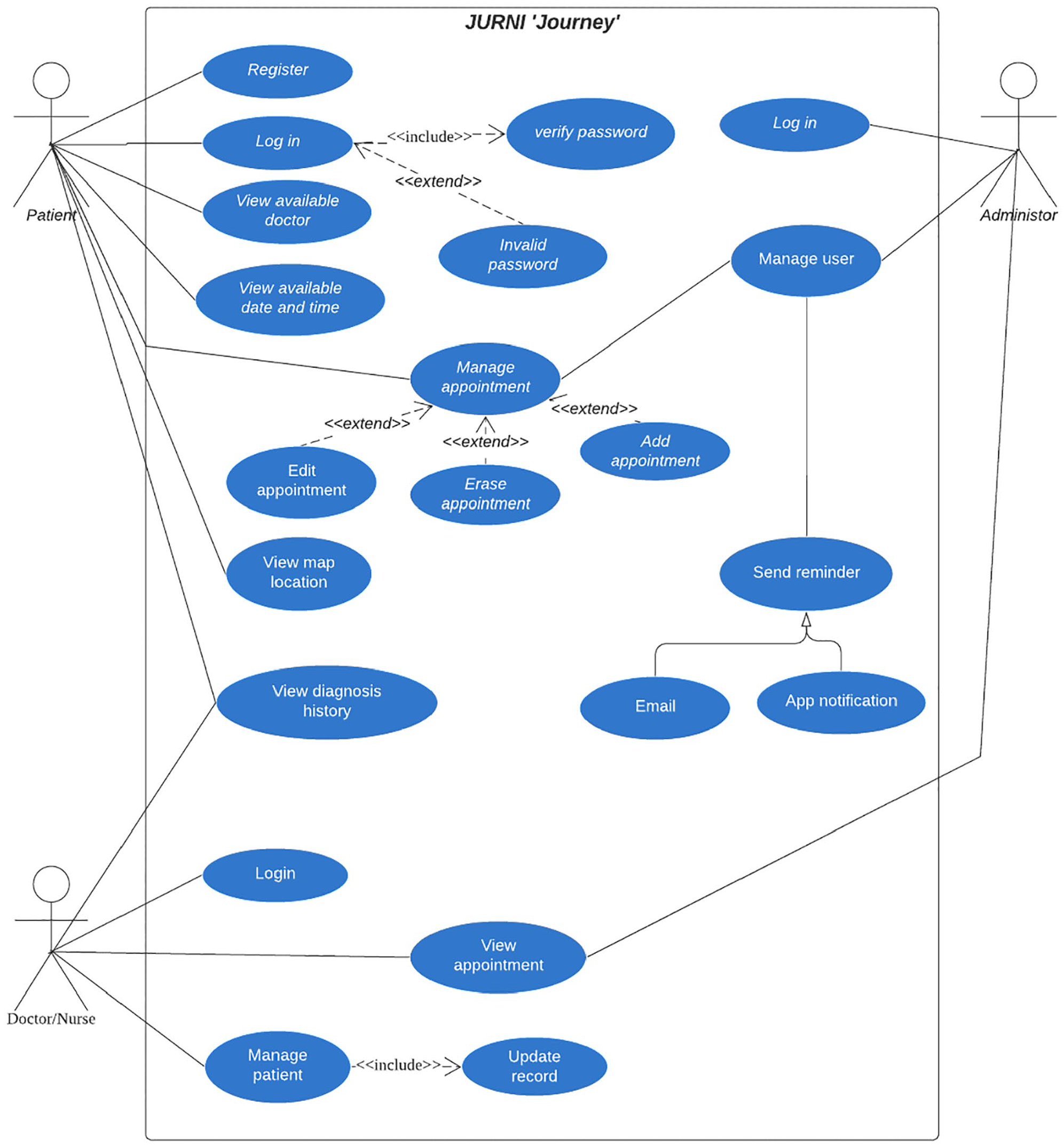
Use case diagram for JURNI.
Structural model
The components of JURNI are represented in the structural model in Figure 5.
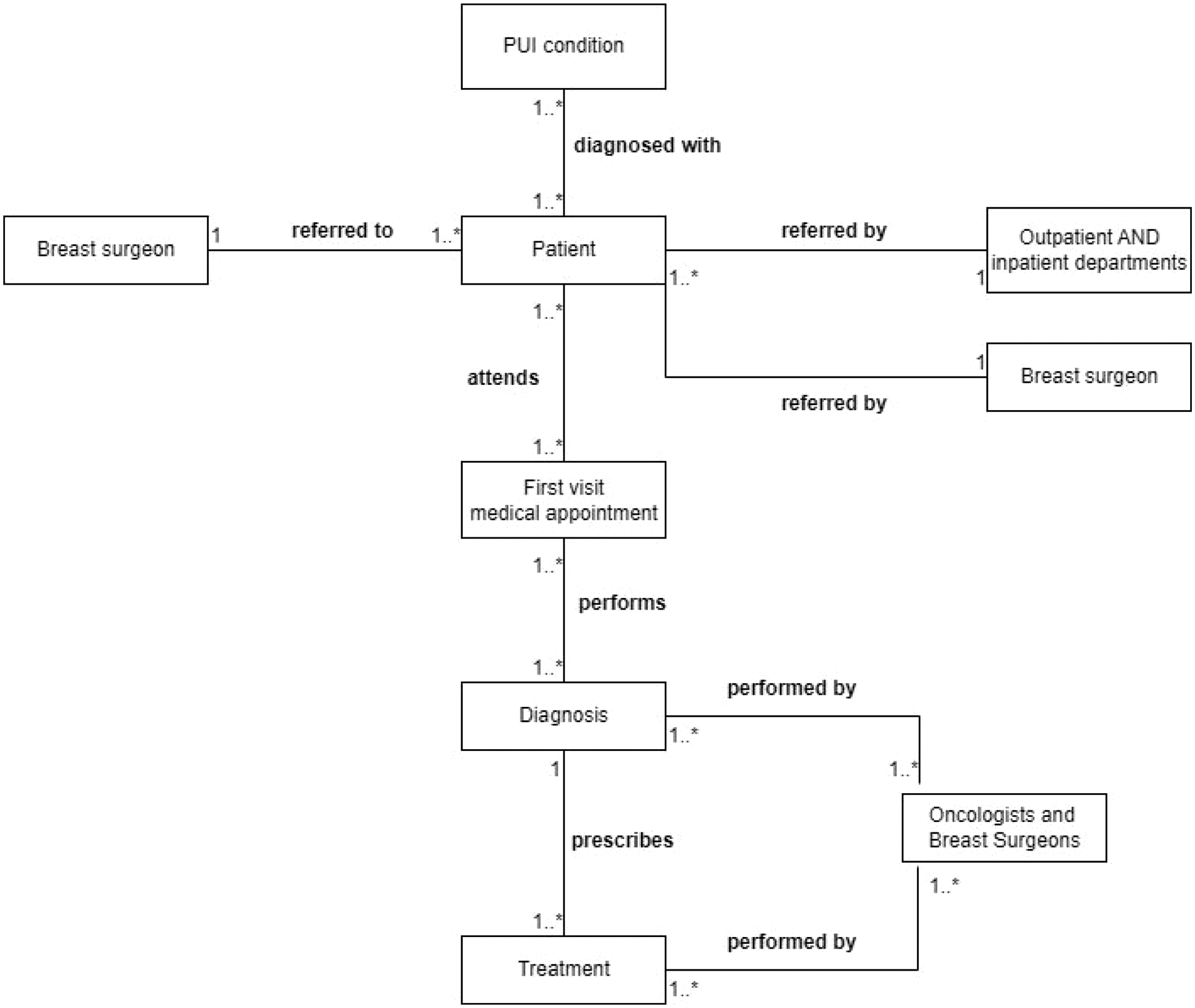
Structural model of the JURNI app.
Behavioural model
The data-driven model in JURNI is separated into the diagnosis workflow (Figure 6) and treatment option workflow (Figure 7). Medical professionals will use these workflows when dealing with patients.

Diagnosis workflow for JURNI application.

Treatment option workflow of the JURNI app.
Architecture design
JURNI is modelled using a three-tier client-server architecture a presentation tier, a logic tier and a data tier. The presentation tier contains the user interface for patients, breast surgeons and the oncology team, while the logic tier shows how the data is accessed and processed in the system server. The data tier is where all the patient information is stored (Figure 8).
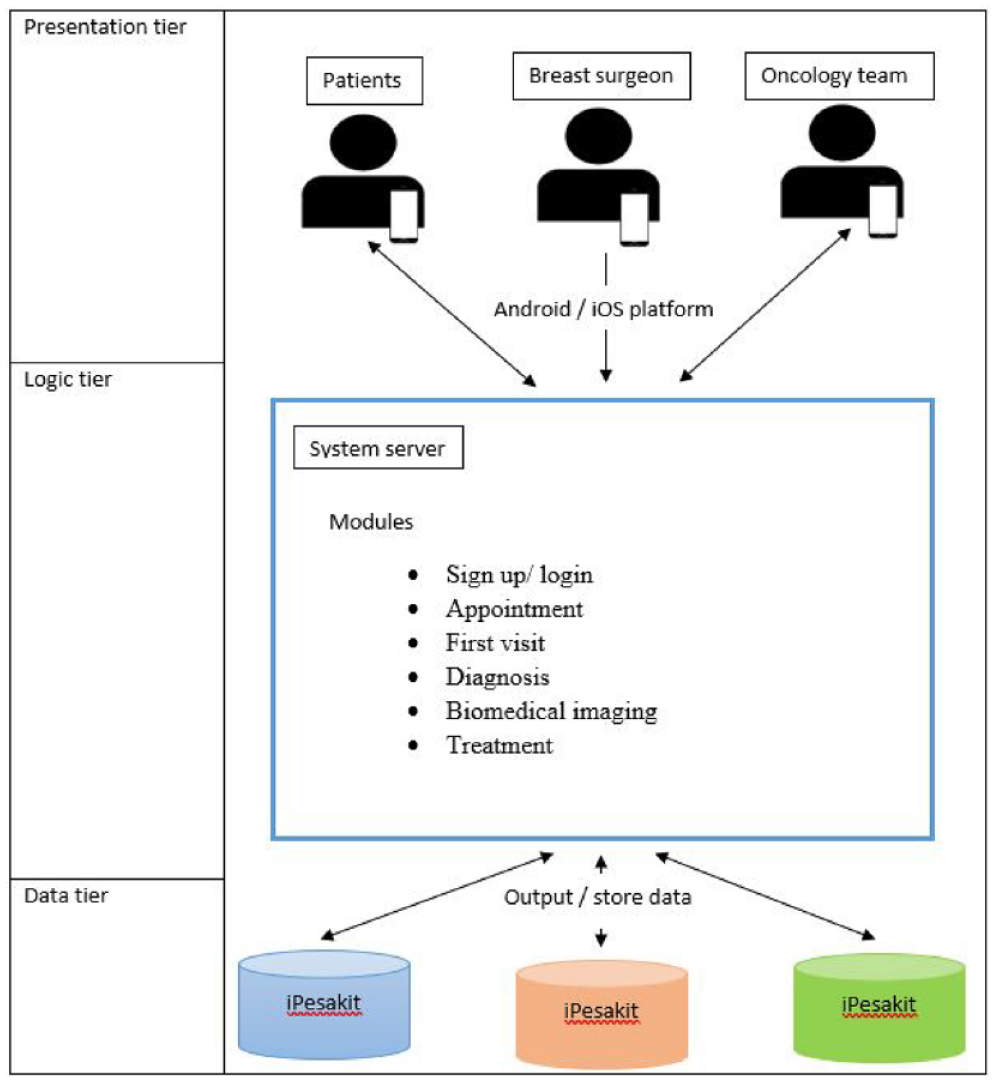
Architectural design of the JURNI app.
Functionality testing
In this paper, a qualitative user testing was conducted as it is more appropriate with the hybrid of plan-driven and agile methodology. User testing is the process by which actual users who carry out specific actions under exact circumstances verify the usability of an application. 24 This procedure aims to assess the application’s usability and assess to app’s functionality and design before implementation. In this paper, the JURNI prototype was evaluated by the stakeholders (Supplementary file S1) to determine whether each feature embedded in the prototype fulfils the expectation and the requirement stated earlier during requirement engineering. If the interface or components do not meet the stakeholders’ expectations, the interface and features of the JURNI prototype will be modified according to the stakeholders’ feedback. Some of the feedback from the stakeholders to improve the usefulness of the cancer care navigation application as follows:
(1) The JURNI prototype should include two types of patients with different UI: a. Patients under investigation for new or recurrent BC. b. BC patients under proper treatment.
(2) PUI’s user interfaces needs to avoid using some sensible words such as breast cancer.
(3) Patients only have the right to send responses via the JURNI app requesting to accept, reject, or reschedule the appointment.
(4) The location on the appointment page should be clickable and will redirect to the page that contains the list of directories for each floor in UMMC.
(5) There should be different content based on the type of users.
(6) Change the font of the interface to a more formal font to give a professional look.
The JURNI app will be tested by patients when implemented throughout UMMC, which is expected to be in the next 12 months. Currently, the app is designed to manage the journey of breast cancer patients, but it will be expanded for all patients in the hospital using the same modules presented in this paper.
Development of JURNI using the ionic framework
The Ionic framework 25 was utilised to develop the JURNI framework. Ionic is an open-source framework for developing cross-platform mobile applications by leveraging web components and web technologies. It also allows utilizing different APIs for navigating through the taps in our single page application. Ionic uses the Cordova framework, which builds the final hybrid application to run natively on mobile phones’ web view and provide access to the device features, including camera, location and many more.
In order to meet the requirements of the JURNI, each tab, including the Home page, Appointment page, Diagnosis History, Location and Info page, was designed to fulfil a specific task, ensuring a streamlined user experience. On the home page, patients can see the overall steps they need to take in their treatment plan, the steps they need to take in their treatment plan, progress and upcoming events. In the appointment tab patients can manage their appointments. The list of events is displayed on this page. Patients can reject, accept or suggest a different date which the hospital should confirm. The application gains the appointment list and all other patient information by connecting to the server in the UMMC. On the history tab, all the up-to-date details about the patient treatment plan are displayed. Patients can find the map of the UMMC, transportation information and a complete list of buildings, departments and facilities with exact details on the location tap. To equip the patients with necessary and useful information about the procedures, FAQ part, key concepts and terminologies and some YouTube videos, which can be watched directly on the page, are provided on the info tab.
The app can send important dates, information and notifications to the patients to maintain consistent contact with them. Direct interaction with the involved physicians via text messages in the app in the event of emergencies is also considered, and it can be accessed by pressing the mail icon on all tabs.
Data security and privacy
Data security and privacy of healthcare data are the foundational building blocks of any healthcare information system, including mobile apps. The backend of the JURNI mobile app will be managed by the hospital’s in-house EMR iPesakit, which is compliant with the Personal Data Protection Act 2010 (PDPA). 8 In the case of using clinical data with identifiers, we had to obtain written permissions from the ethics committee for a given duration required for the job execution. The patients will be given awareness and training of data privacy issues to protect against data leaks and unauthorised use of their personal data. With regard to the JURNI app, users must log in with their medical record numbers, and the nurse will give them a pre-registered password. For first-time users, patients must agree with the terms and conditions of the JURNI application to access the home page. At the moment, no level of encryption has been implemented.
Results and Discussion
The JURNI application is an in-hospital patient navigation application, particularly for the People Under Investigation (PUI) for breast cancer. Figure 9 shows the landing page of the JURNI app.

Landing page of the JURNI app.
Modules of the JURNI app
The main modules of the JURNI app with related figures are presented in Table 3.
Features of the JURNI app showing the patient’s journey from the first breast clinical visit.


Features of the JURNI app: (a) admission page of the JURNI app, (b) survey to classify the type of patients, (c) home page of JURNI app, (d) appointment page of JURNI app, (e) diagnosis history page of JURNI app, (f) location page of JURNI app, (g) list of directories of each floor in UMMC, (h) guidance to use public transport, and (i) information page of JURNI app.
Language features of the JURNI app
The JURNI app enables patients to switch the application’s language according to their preferences. The current version of the JURNI app only provides English and Malay versions (Figure 11).

Malay version of the JURNI app.
Discussion
Implementing the patient navigation program has become more significant in cancer care, reducing the barriers between patients and the support system that the hospital provides. Patient navigation prompts cancer detection and should be integrated into a hospital’s healthcare system. 26 A patient-centred, sustainable service acts as an intervention process that removes the barriers between patients and the healthcare system throughout cancer care. Patient navigation also plays an essential role in providing emotional support to the patients as they might become fearful, stressed and overwhelmed by emotion when diagnosed with cancer or chronic disease. Based on the study published by Rousseau et al. 27 The patient navigation program alleviates patients’ emotional distress when they receive the cancer diagnosis and following cancer treatment. Besides enhancing patients’ emotional aspect, patient navigation also aids patients in making a better-educated decision on their cancer diagnosis and treatment. Patient navigation strengthens the relationship between patients and physicians by rephrasing the information or recommendations physicians give into an understandable format, formulating the questions and discussing issues related to cancer care with the patients, reducing the cognitive demands associated with the treatment decision. 28
In this paper, a mobile app to navigate breast cancer care, JURNI, was successfully designed and developed. This app’s diagnosis and treatment options workflows represent patients’ overall diagnosis and treatment process. Compared to existing systems and apps reviewed in Section ‘ACS cares’, the JURNI app contains additional features presented in Section ‘Modules of the JURNI app’. The existing apps compared in this paper were selected from similar apps used in developed countries. The comparison shows that JURNI has all the essential features, such as information about a diagnosis, patient engagement, follow-up plan, role-based access, peer support network, location map or direction and multilingual, despite the limitations of resources in a low and middle-income country. While these existing apps or systems might not be comprehensive enough to cover all available navigation apps, these selected systems were used as guide on the features of patient navigation apps that were implemented successfully. In the future, a more systematic review could be conducted to study existing patient navigation apps and mirror new and useful features in the upgrade of the JURNI app. Figure 12 shows the summary of the comparison.

Comparison of the JURNI features with existing patient navigation systems or mobile apps.
As mentioned in Section ‘Existing patient navigation systems’, we could not find published patient navigation apps for cancer patients in low and middle-income countries. The requirements-gathering process presented in this paper, integrated with hybrid software development methodology, could be used as a model by other low or middle-income countries to improve the diagnostic and treatment processes. The modules developed are as good as apps developed in high-income countries (Figure 12), and with the development processes presented in this paper, any low-resource setting could now implement a patient navigation app.
While this app was developed with a comprehensive requirements gathering process with a team consisting of developers, software engineers, medical professionals and clinicians at the breast clinics, there is still a need for patient testing in the actual setting. In this paper, we could not conduct actual patient usability testing due to the institutional policy. The University Malaya Medical Centre is using this app as a model to build a comprehensive app for all the patients in the hospital before extensive patient testing is carried out. Being a public hospital, UMMC has to prioritise service to the patients rather than focusing on add-ons such as apps that help patients navigate. Limited funds, getting approvals from management and ICT resources are the leading causes of delays in implementing app at the hospital level. Hence, with all these, it is difficult to conduct patient-level testing at this point. Having said this, the primary purpose of this study was to establish a software engineering process for patient navigation app development in a medical setting that could be modelled by developers interested in developing a similar app in low or middle-income countries. In this paper, we developed a prototype of JURNI, which will be implemented by the hospital’s IT team for hospital-level usage.
Although mobile apps can be useful in many ways, there are potential challenges, such as patients’ literacy, especially senior citizens, in using devices. The hospital must be prepared to set up a booth to help the patients with the app installation and training on using the features. A help feature in the app can be added to provide some assistance. Another critical challenge is getting informed consent. Apps often collect sensitive personal health information (PHI). Thus, unauthorized access, data breaches, or misuse of this data can lead to harm. Users may not fully understand what they agree to when sharing data or using the app. Hence, the app must ensure clear, accessible terms of service and explicit consent is obtained. App developers must ensure robust security protocols, regulation compliance and data use transparency. Other challenges might be the availability of high-speed internet access. These potential challenges could be addressed in similar studies in low- and middle-income countries.
In the future, the JURNI app can be refined further by adding artificial intelligence capabilities to improve usability and making it as simple as possible for everyone to use regardless of age and language barriers. We will be considering the socio-economic, demographic features and quality of life according to the study done by Ganggayah et al. 29 Another important feature would be to add payment gateways to allow patients to make contactless payments via the mobile app. The JURNI app will be expanded to include new features for other diseases, such as colorectal and lung cancer and cardiovascular disease. Other features include establishing a group chat feature in the JURNI app and providing news or other departments in UMMC for cancer rehabilitation and financial and psychosocial support. Finally, we anticipate that the JURNI app will be more usable if other mainstream languages such as Mandarin and Tamil are included, apart from only English and Malay to support the diverse patient care in the country. These additional features are expected to be implemented once the pilot testing of the initial phase has been done in 12-month timeline. We are also requesting funding that would allow us to work on these new features.
Conclusion
In conclusion, the patients’ and health system’s navigational needs for breast cancer diagnosis and treatment at the Universiti Malaya Medical Centre have been critically identified. Besides highlighting the need and importance of a patient navigation system in prompting the detection of breast cancer in a low and middle-income country, this paper presents the modelling of the system using a software development approach, using a mesh of agile and plan-driven techniques. The requirements have been carefully identified via meetings with clinicians to determine the functionalities of the patient journey app, JURNI. Once implemented, this app is expected to aid healthcare providers and nurses in guiding and monitoring patients’ journeys and enhance the interaction level with the medical team.
Supplemental Material
sj-docx-1-his-10.1177_11786329241309309 – Supplemental material for JURNI (Journeying with Patients’ Understanding and Responding to Needs Interactively): An In-Hospital Navigation Application for Timely Diagnosis and Treatment of Breast Cancer at the University Malaya Medical Centre
Supplemental material, sj-docx-1-his-10.1177_11786329241309309 for JURNI (Journeying with Patients’ Understanding and Responding to Needs Interactively): An In-Hospital Navigation Application for Timely Diagnosis and Treatment of Breast Cancer at the University Malaya Medical Centre by Sarinder Kaur Dhillon, Foad Kalhor, Wong Seng Kai, Teh Mei Sze, Nisha Mohd Shariff, Manisha Sekaran and Nur Aishah Taib in Health Services Insights
Supplemental Material
sj-docx-2-his-10.1177_11786329241309309 – Supplemental material for JURNI (Journeying with Patients’ Understanding and Responding to Needs Interactively): An In-Hospital Navigation Application for Timely Diagnosis and Treatment of Breast Cancer at the University Malaya Medical Centre
Supplemental material, sj-docx-2-his-10.1177_11786329241309309 for JURNI (Journeying with Patients’ Understanding and Responding to Needs Interactively): An In-Hospital Navigation Application for Timely Diagnosis and Treatment of Breast Cancer at the University Malaya Medical Centre by Sarinder Kaur Dhillon, Foad Kalhor, Wong Seng Kai, Teh Mei Sze, Nisha Mohd Shariff, Manisha Sekaran and Nur Aishah Taib in Health Services Insights
Footnotes
Acknowledgements
We are very thankful to Universiti Malaya Medical Center, particularly the management, clinicians, medical practitioners and the IT department for providing assistance and giving us the support to develop this app. We would like to thank Nurul Aqilah Mohd Nor for arranging all the meetings with the stakeholders involve in this study.
Funding:
The author(s) disclosed receipt of the following financial support for the research, authorship, and/or publication of this article: Universiti Malaya Impact-Oriented Interdisciplinary Research Grant Programme (IIRG006B-19HWB).
Declaration of conflicting interests:
The author(s) declared no potential conflicts of interest with respect to the research, authorship, and/or publication of this article.
Author Contributions
SKD designed the entire study, the mobile app and wrote the manuscript. FK built the mobile app using IONIC framework. WSK conducted the requirements gathering process via meetings with clinicans, designed all the diagrams in the manuscript and also wrote the manuscript. TMS, NMS and MS provided medical input for the content of the app. NAT came up with the idea of a mobile app for UMMC, provided medical input and contributed in the writing of this manuscript.

Supplemental Material
Supplemental material for this article is available online.
References
Supplementary Material
Please find the following supplemental material available below.
For Open Access articles published under a Creative Commons License, all supplemental material carries the same license as the article it is associated with.
For non-Open Access articles published, all supplemental material carries a non-exclusive license, and permission requests for re-use of supplemental material or any part of supplemental material shall be sent directly to the copyright owner as specified in the copyright notice associated with the article.
