



Abstract
In arid and semiarid regions, the high compactness and poor water permeability of the soils severely limit agricultural production. This study aims to shed light on techniques to enhance the permeability of these soils—specifically, by improving soil properties through mulching with organic grass clippings. We evaluated the effects of mulching with clippings of two organic grasses: alfalfa (Medicago sativa L.) and ryegrass (Lolium perenne L.) on soil porosity, water
Introduction
In arid and semiarid regions, over one-third of the total landmass is under the threat of water scarcity. In these regions, the expansion of low-permeability saline-sodic soil with a very low saturated hydraulic conductivity and high alkalinity (WRB, 2014; Zhang et al., 2019), has aggravated land degradation (Chaganti & Crohn, 2015). Groundwater storage is also affected by the very low soil permeability (Tedeschi & Dell’Aquila, 2005). Water infiltration into soils is an important part of the hydrological cycle of rainfall, surface water, soil water, and groundwater—and determines the rate at which rainfall or irrigation water is converted to soil water (Baumhardt & Jones, 2002; Le Mer et al., 2021; Wu et al., 2021). Thus, finding ways to improve the infiltrability of low-permeability soils is critical to effective production.
Soil water infiltration and water-holding capacity are crucial for crop growth, impacting water movement, nutrient transfer, and plant-soil-water interactions (Basche & DeLonge, 2019; Johnson, 2023; Rawls et al., 2003). Previous studies have confirmed that soil water infiltration and water-holding capacity are affected mainly by soil properties (da Silva et al., 2021; Schwartz et al., 2019), especially soil structure and pore characteristics (Basset et al., 2023; Suarez et al., 2006). The degree of compactness of a soil reflects the condition of its structure and is a vital factor in how much water can infiltrate and retain the soil in a given period (infiltration rates generally decrease as soil compactness increases; Capowiez et al., 2021; van Dijck & van Asch, 2002). Water moves by gravity into the open pore spaces in the soil, including macro-, meso-, and micropores, and the connectivity and size of the pores directly determine the infiltration rate and retention capacity (Ju et al., 2024; Smet et al., 2018). The size of soil porosity is contingent upon the soil texture, structure, and organic matter content (de Lima et al., 2022). Numerous studies have indicated that soil organic matter improves and maintains soil porosity through promoting the form of soil agglomerate stability. Hence, modifying soil properties to enhance soil infiltration rates was widely applied (Basset et al., 2023; Rahmati, 2017).
Recent studies in which plant straws were crushed and used to mulch the surface of saline-sodic soils indicate that such mulching can reduce water erosion (splash erosion and runoff erosion) by increasing surface roughness and preventing direct interaction between rainfall and surface soil (Prosdocimi et al., 2016). Further, the physical structure of the soil may be improved by increasing soil organic carbon through decomposition of the mulch material by soil organisms that come in contact with the soil surface (Paul et al., 2020). Numerous studies have reported that a significant increase in soil organic carbon is often correlated with the enhancement of soil aggregation and the development of permanent pore (Basset et al., 2023; Mulumba & Lal, 2008). Straw mulch can also increase soil water holding capacity, capillary moisture capacity, and field moisture capacity (Oliveira & Merwin, 2001). Straw mulch has the advantages of low cost (plant clippings being a rich renewable resource in agricultural production) and relatively trouble-free application (Bordonal et al., 2018), while minimizing environmental pollution and promoting the recycling of agricultural waste (Hussain et al., 2021).
Solonetz, a low-permeability soil type, covers approximately 135 million hectares globally. It is a typical highly saline-sodic soil with the top layers exhibiting low hydraulic conductivity (average Ks < 0.1 mm day−1), high alkalinity (average pH >9.5), and high sodicity (average exchangeable sodium percentage >60%). These properties present considerable challenges for agricultural use, as farming on solonetz soils demands substantial inputs of irrigation and fertilizers, leading to inefficient water and nutrient use and associated environmental concerns. Consequently, finding ways to improve soil permeability is an urgent need. To date, approaches such as chemical amendments, irrigation, and phytoremediation have been widely applied to ameliorate soil sodium levels and improve soil structure, fertility, and permeability (Gao et al., 2020). However, these methods often involve high costs, substantial time investment, and the risk of secondary pollution, limiting their long-term sustainability. Mulching with agricultural organic material has been successfully utilized in potato and winter wheat cultivation in dry farming. This practice effectively improves crop yield by modulating soil moisture and temperature conditions, thereby enhancing crop growth. However, few studies have been conducted on the improvement of soil structure and permeability in saline soils by mulching with agricultural organic material. In this study, we hypothesized that mulching with organic grass clippings may improve the infiltration capacity of low-permeability soils by modifying soil porosity and compactness. Specifically, we selected two types of grass clippings–alfalfa (Medicago sativa) and ryegrass (Lolium perenne)—as mulching materials. The aims of our study were to: (1) examine the effects of the two types of grass clippings on soil porosity and water-holding capacity of low-permeability soil; and (2) determine the benefits of mulch materials on the initial and steady-state infiltration rates of the soil.
Materials and Methods
Study Site
The field experiments were conducted in north central China, at the Xidatan Experimental Station (38°50′N, 106°24′E, 1,156 m), in Pingluo County, Shizuishan City, Ningxia Hui Autonomous Region (Figure 1) The climate of this area is a typical continental one—dry, little rain, heavy wind and sand storms, moderate sunshine, and strong evaporation. The annual average temperature is 9.4°C, the annual average precipitation is 176.3 mm, and the average annual potential evaporation is 1706.1 mm. In the experiment year (August 2020–September 2021), the number of rainy days was 38, with cumulative precipitation amounting to 70.9 mm. Meanwhile, the monthly maximum temperature was recorded in July at 37°C, while the minimum temperature occurred in January, reaching -24°C (https://www.ssmhjd.com/pingluo/history.html). The soil of the study area is classified as takyric solonetz (WRB, 2014). Details of the soil particle composition, bulk density, electrical conductivity of saturated paste extracts, pH of saturated paste, and other main soil physicochemical properties of this soil type have been reported by Zhang et al. (2014, 2019). Alfalfa is one of the most important forage crops in the world. It is widely cultivated because of its high nutritional value, strong drought resistance, and good adaptability to poor soil conditions. Ryegrass (Lolium perenne L.) has strong adaptability and can grow in soils with poor drainage. For these reasons, both species have been widely planted in the study region and have attained significantly higher biomass than other herbaceous crops.

Location map of the study area (a), and the three treatments: bare land without herbage clippings mulching (BL, b), Lolium perenne clippings mulching (LC, c), and Medicago sativa clippings mulching (MC, d).
Experimental Design
To explore the effects of mulching with organic grass clippings on the infiltrability of very low permeability soils, we designed a completely randomized experiment consisting of two treatments: (1) mulching with clippings of organic Medicago sativa (MC), and (2) mulching with clippings of organic Lolium perenne (LC). The control plots were bare land (BL) without any mulching and disturbance (Figure 1). Each treatment was assigned three plots, each with a size of 2 m × 2 m and a space of 1 m. The plots were flat and were abandoned for at least 3 years. In 2020, the topsoil (0–20 cm) of the plots had a bulk density of 1.48 g cm3, a pH of 10.1 in 1.1 H2O, and 6.6 g kg−1 of soil organic matter. The soil surface was undisturbed before treatment and was maintained undisturbed after the application of the grass-clipping mulch (no later addition of mulch materials and no-tillage). The fresh Lolium perenne and Medicago sativa were cut into 5 cm pieces, and amounts of 4 kg m−2 of each were evenly spread over the corresponding plots. Medicago sativa was easily collected from farmer households, and Lolium perenne was obtained via lawn mowing. Then, to prevent the mulch materials from being blown away, a 0.5 cm layer of sand was spread over the clippings and compacted. The bare land control plots were also covered with a 0.5 cm layer of sand.
It should be pointed out that the study area had been abandoned for many years, and therefore our experiments—to investigate only the effects of mulch materials on soil infiltrability—were not in any way affected by planting of crops or other disturbances following the mulch applications. The field experiments were conducted in August 2020, and soil samples were collected in September 2021.
Measurement of Infiltration Rates
Soil water infiltration experiments were conducted for three times, in October 2020 (experiment 1), June 2021(experiment 2), and September 2021(experiment 3), respectively. We analyzed the effects of the MC and LC mulch materials on water infiltration of the saline-sodic soils via the double-ring method (taking care during the process to keep the soil surface undisturbed). The infiltrometer, with a 20-cm-diameter inner ring and a 35-cm-diameter outer ring—the latter to serve as a buffer against the lateral movement of water—was gently inserted into the soil to a depth of 5 cm. The inner and outer rings were then filled with water at the same time, with the surface of the water maintained at 5 cm. A ruler was vertically inserted into the inner ring and a stopwatch was used to record the time for the water level to drop 1 mm. To minimize measurement error, we tested the three MC plots and the three LC plots using three double-ring infiltrometers at the same time. Each was carried out three times. The initial infiltration rate was calculated as the average infiltration rate of the first 3 min, the steady-state infiltration rate was calculated as the average infiltration rate of the final 3 min, and the average infiltration rate was taken as the average infiltration rate during the whole infiltration process by the methods of Wu et al. (2016). Furthermore, a sunshade was employed during the infiltration tests to minimize the impact of temperature on water infiltration processes.
Soil Measurement of Soil Hydraulic Characteristics
This study focused on 0 to 30 cm soil layer since topsoil properties significantly influence organic grass mulching. For each of the treatment plots, undisturbed soil samples were collected using a 100 cm3 cutting-ring (height and diameter of 5 cm) from 0 to 10, 10 to 20, and 20 to 30 cm soil depth. To measure soil water content, soil porosity, and soil water-holding capacity, we employed the cutting-ring method, as follows: after inserting a cutting-ring (100 cm3) vertically into the soil, we used a knife to carefully remove it, then transported to the laboratory. In the lab, all undisturbed soil samples were weighed (M1) and then transferred to a larger container (with the lower cap facing down) and water was added until the water surface was level with the upper edge of the cutting-ring. After soaking for 24 hr, all cutting-rings were removed, excess water was wiped off, and weighed to obtain the value M2 (g). Next, all the cutting-rings were placed into a container of dry sand for 2 hr, allowing additional water to be absorbed, and weighed again to obtain the values of M3 (g). The same method was then followed for another 6 hr of water absorption, yielding the M4 (g) Finally, all the samples were put into an oven at 105°C to dry to a constant weight, which corresponds to M5 (g). Additional calculations included the saturated moisture capacity (SMC, %), capillary moisture capacity (CMC, %), and field capacity (FC, %) were calculated using the following equations (Wu et al., 2016):





where M0 (g) is the weight of the cutting-ring, including the bottom cover.
The soil total porosity (TP), soil capillary porosity (CP), and soil non-capillary porosity (NCP; Wu et al., 2016) were obtained following the conversion method:

where ds represents the particle density (g cm−3).


The extent of soil compactness strength of each treatment was measured with a soil compactness detector (TJSD-750-II). Samples were collected from three depth intervals (0–10, 10–20, and 20–30 cm), with three replicates of each, and the values of soil compaction of the three depth intervals were averaged to determine the effects of the grass-clipping mulches on soil properties.
Statistical Analysis
One-way analysis of variance was used to test for differences in soil water holding capacity, soil porosity, compactness, and infiltration rate between MC, LC, and BL at the p < .05 level. Correlation analysis was used to analyze the relationship between soil water holding capacity, soil porosity, and soil infiltration rate. Statistical analyses and the majority of figures were generated using R version 3.6.2, while specific figures were created using Sigma Plot 14.0.
Results
Mulching With Grass Clippings Increases in Both Soil Infiltration Rates and Soil Water Content
Compared with BL, both the MC and LC plots saw increases in soil water infiltrability. The water infiltration rate in the MC plots was faster than that in the LC plots (Figure 2). The initial infiltration rate of BL in first, second, and third experiments were 54.04, 93.26, and 102.24 mm hr−1, respectively, all significantly (p < .05) lower than (except for second experiment) the initial infiltration rate of LC and MC, which measured 137.93 and 93.00 mm hr−1 in first experiment; 190.11 and 167.27 and 93.00 mm hr−1 in second experiment; and 167.27 and 126.25 mm hr−1 in third experiment (Figure 2). There was no significant difference in stable infiltration rate between BL, LC, and MC (p > .05, Figure 2), the values of BL, LC, and MC, which measured 6.17, 12.09, and 13.04 mm hr−1 in first experiment; 7.29, 7.71, and 8.73 mm hr−1 in second experiment; and 4.91, 8.73, and 17.21 mm hr−1 third experiment. Average infiltration rate in LC and MC (except for in third experiment) were significantly (p < .05) higher in first and second experiment (Figure 2). When LC and MC mulched the saline-sodic soil, average infiltration rate increased by 197% and 108% in first experiment; 74% and 101% in second experiment; and 35% and 43% in third experiment, respectively (Figure 2).
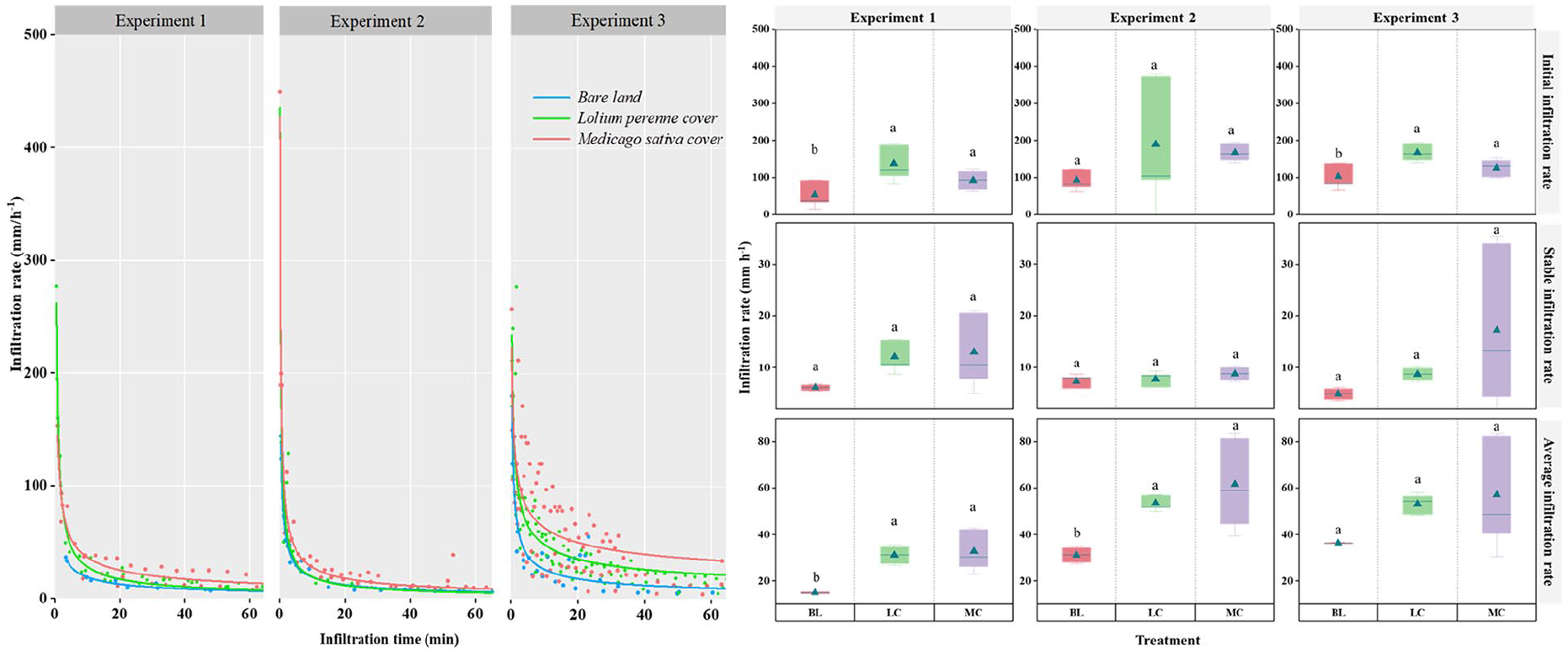
Changes of soil infiltration rate with infiltration time, and initial infiltration rate, steady-state infiltration rate and average infiltration rate in bare land without mulching of grass clippings (BL), Lolium perenne clippings mulching (LC), and Medicago sativa clippings mulching (MC). The lines of different colors represent the fitted relationship between infiltration rate and infiltration time. The horizontal lines above and below in the box indicated the first quartile and third quartile. The horizontal lines in the box represents median values. The small black triangles represent averages of the water infiltration rate.
As depicted in Figure 3, soil water content in LC and MC were significantly (p < .05) higher in BL, at a depth of 0 to 30 cm, increasing by 12% and 8%, respectively. The soil water content in the uppermost layer (0–10 cm) and the sub-uppermost layer (10–20 cm) increased by 3% and 2% in LC, and by 6% and 2% in MC, respectively, but these changes were not statistically significant. In contrast, significant changes (p < .05) in soil water content were observed in the 20 to 30 cm soil layer when LC and MC were applied to mulch the saline-sodic soil, with increases of 23% and 16%, respectively.

Soil water content of bare land without mulching of grass clippings (BL), Lolium perenne clippings mulching (LC), and Medicago sativa clippings mulching (MC) in the 0 to 30 cm soil layer. The difference between different treatments were not significant at .05 level.
Mulching With Grass Clippings Improves Hydraulic Properties and Porosity of the Low-Permeability Soil
After 1 year of mulching, the soil capillary moisture capacity and field capacity of LC increased approximately 4% over the BL values, while the soil saturated water content increased by approximately 8% for MC and 12% for LC (Figure 4). Moreover, soil total porosity was higher in the mulch-treated soils (2% higher for MC and 1% higher for LC), and soil non-capillary porosity increased as well—by 16% and 33%, respectively (Figure 4). The soil compacting strength in MC and LC plots decreased by 49% and 28% in the 0 to 10 cm soil layer, and by 41% and 30% in the 10 to 20 cm soil layer, respectively (Figure 5). The soil non-capillary porosity and soil total porosity values were positively correlated with those of the average infiltration rate (AIR), initial infiltration rate (IIR), and steady-state infiltration rate (SIR). Capillary porosity, on the other hand, exhibited a negative correlation with AIR, IIR, and SIR, but those relationships were not significant. The reduction in soil compactness induced the increase in soil water infiltration rates. We also found a significant negative correlation between the values of soil compactness and those of soil non-capillary porosity (Figure 6).

Water holding capacity, soil total porosity, soil capillary porosity and soil non-capillary porosity in the 0 to 30 cm soil layer between bare land without mulching of grass clippings (BL), Lolium perenne clippings mulching (LC), and Medicago sativa clippings mulching (MC). The horizontal line above and below in the box indicated the first quartile and third quartile. The horizontal line in the box represents median values. The small black triangles represent averages of soil moisture capacity and averages porosity of different soils.
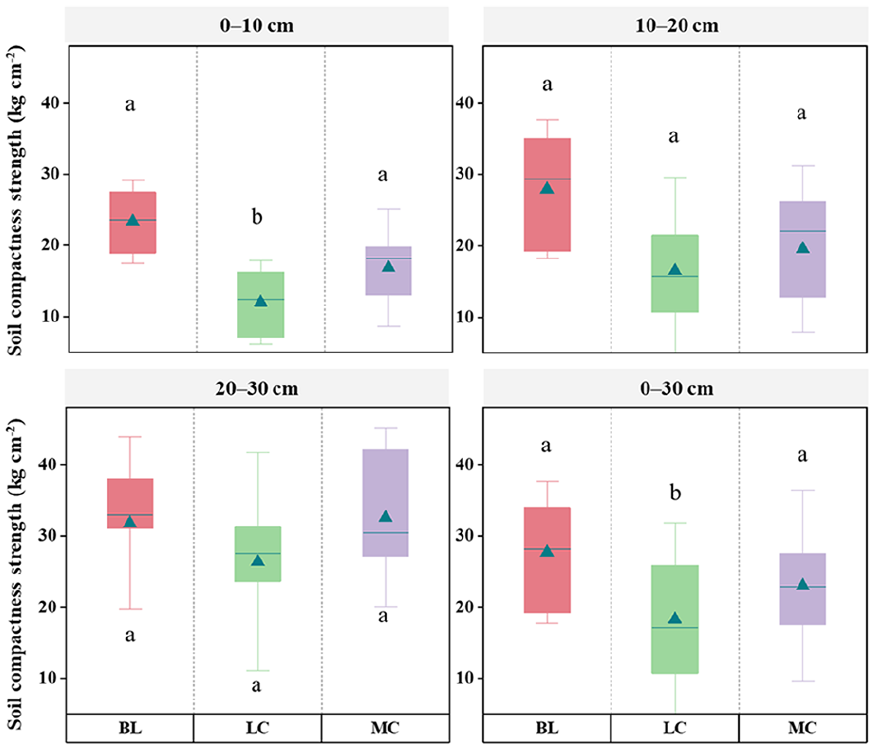
Comparison of soil compactness in bare land without mulching of grass clippings (BL), Lolium perenne clippings mulching (LC), and Medicago sativa clippings mulching (MC) in the 0 to 30 cm soil layer. The central solid lines in the box are the median. The horizontal lines above and below in the box indicated the first quartile and third quartile. The small black triangles represent the mean values of soil compactness.

The correlation analysis between different soil properties and different stages of water infiltration rates. Blue indicates positive correlations and red indicates negative correlations, the numerical values represent correlation coefficients. IIR, SIR and AIR represent initial infiltration rate (mm hr−1), steady-state infiltration rate (mm hr−1) and average infiltration rate (mm hr−1), respectively; TP, CP and NCP represent soil total porosity (%), soil capillary porosity (%) and soil non-capillary porosity (%), respectively; and SC represents soil compactness.
Discussion
Saline-sodic soils exhibit very low infiltration rates and poor aeration, which severely restrict agricultural productivity. Our findings demonstrated that organic grass mulching serves as an efficient and economical soil amendment, significantly enhancing infiltration rates. This improvement was achieved by reducing soil compressive strength and boosting total porosity and non-capillary porosity (Figures 4–6). Soil compactness is an important factor affecting soil infiltrability. Many studies have indicated that plant materials can reduce soil compressive strength and thereby increase water infiltration rates (Mulumba & Lal, 2008; Oliveira & Merwin, 2001). Organic grass mulching reduces soil compressive strength via physical cover and biological processes. Grass clipping mulching acts as a protective layer on the soil surface, reducing the direct impact of rainfall (Biswas et al., 2022; Sadeghian et al., 2021). Additionally, the decomposition of organic materials from the mulch releases substances that improve soil aggregation by binding soil particles together, thereby reducing soil compaction (Wang et al., 2019). Mulching with grass clippings increased soil non-capillary porosity, which in turn enhanced the soil water infiltration rate (Figures 3 and 6). The presence of organic grass mulch stimulates microbial activity, particularly among microbes involved in decomposing the organic material (Thakur et al., 2019). As the mulch decomposes, it promotes the formation of soil macropores, which enhances soil porosity—a key factor for improving infiltration (Cui et al., 2019; Kakeh et al., 2021). This microbial activity facilitates gas exchange and water movement within the soil, further increasing non-capillary pore space. Additionally, the organic material boosts the soil’s organic carbon content, which aids in the formation of stable aggregates, ultimately improving non-capillary porosity and contributing to better water retention and soil aeration (Figure 4). In addition, organic grass mulching was found to be beneficial to conserve soil moisture by reducing soil evaporation (Figure 3).
Our study also showed that mulching of with grass clippings significantly enhances the initial, stable and average soil water infiltration rate (Figure 2). Other recent studies have shown that mulching with organic grass clippings in contact with the soil surface expedited the decomposition of plant communities by soil organisms, forming organic matter (Paul et al., 2020). In the natural environment, mulching with plant litter augmented soil organic matter s content, and this positive effect increased with mulching time (Jia et al., 2018). Because the accumulation of soil organic matter is conducive to improvements in soil structure and hydraulic s characteristics, mulching may be one of the most important ways to remediating low-permeability soils. It is worth mentioning that the initial soil infiltration rate had a greater LC than MC. In concrast, the MC treatment resulted in higher stable and average soil infiltration rates than those of LC treatment. This difference may be attributed to the significant lower C/N ratio and lignin content in Medicago sativa (alfalfa) compared to Lolium perenne (ryegrass; Barros et al., 2019). Grass clippings with higher C/N ratios and lignin content, such as from ryegrass, decompose more slowly. This slower decomposition reduces the rapid and efficient accumulation of relatively large and stable mineral-associated organic matter in soil organic matter, which has been found to be negatively correlated with both lignin content and C/N ratio content (Córdova et al., 2018; Cotrufo et al., 2015). Therefore, we hypothesized that the higher stable and average soil water infiltration rate of MC compared to LC was due to the more effective contribution of alfalfa grass clippings to soil organic matter content and soil structure improvement. This is further supported by Figure 4, which shows that MC slightly outperforms LC in terms of total porosity and capillary porosity. Overall, our results demonstrate that mulching with organic grass clippings improves both soil porosity and soil structure, and thereby can significantly enhance the infiltrability of low-permeability soils. At the same time, this methodology offers high environmental protection and is non-polluting.
Conclusions
Our study proposed that mulching with organic grass clippings has great potential for improving the infiltrability of low-permeability soils. Our results demonstrated that this methodology significantly increased soil total porosity and non-capillary porosity, and thereby decreased soil compactness, leading to greater water infiltration capacity. Added benefits are that the grass clippings are an environmentally friendly and pollution-free material, are easily obtainable, and are low cost. For these reasons, the grass-mulching methodology provides an efficient and sustainable solution to the low-permeability soil problem in drylands and should be widely implemented.
Footnotes
Acknowledgements
We thank the editor and the anonymous reviewers for their constructive suggestions and comments on the manuscript, thank Yingge Xie, Yulei Ma, and Yuanjun Zhu for their help of review and editing, formal analysis, draw figures, and funding acquisition in the revision edition, and thank our work-team colleagues for assistance with field works.

Author Contributions
Xia Li: Investigation, Data curation, and Writing—original draft. Manuel López-Vicente: Writing—original draft and review & editing. Manuel Esteban Lucas-Borja: Writing—original draft and review & editing. Bradford P. Wilcox: Writing—review & editing. Gao-Lin Wu: Conceptualization, Methodology, Formal analysis, Supervision, Funding acquisition, and Writing—original draft and review & editing.
Funding
The author(s) disclosed receipt of the following financial support for the research, authorship, and/or publication of this article: This study was funded by the National Key R&D Program of China (2023YFD1900300), and the Key Research and Development Plan of Ningxia Hui Autonomous Region (2022BEG02002).
Declaration of Conflicting Interests
The author(s) declared no potential conflicts of interest with respect to the research, authorship, and/or publication of this article.
Data Availability Statement
The data that support the findings of this study are available from the corresponding author upon reasonable request.