




Abstract
Background:
Globally, khat chewing practice becoming an alarming and common among the youth generation, especially in higher educational institutions. It may also lead to frequent misbehavior, poor academic performance, and memory impairment among students. This study aimed to determine the prevalence of khat chewing practice and associated factors among medical students in Gondar town, Ethiopia, 2019.
Method:
A cross-sectional study was employed on 422 medical students. Data were collected using a self-administered questionnaire and analyzed using SPSS 20 software. Stratified followed by random sampling was employed to select the samples. A multivariable logistic regression model was fitted to identify the predictors. P ⩽ .05 was used to select statistically significant factors.
Result:
The current prevalence of khat chewing practice among medical students was 21.5%. The odds of khat chewing practice was higher among males (AOR = 3.353; 95%CI [1.460-7.701]), Muslims (AOR = 6.390; 95%CI [1.903-21.460]), fifth and 6 year students (AOR = 3.391; 95%CI [1.354-8.488]), smokers (AOR = 5.081; 95%CI [1.898-13.601]), alcohol users (AOR = 4.872; 95%CI [2.094-11.332]), students who had khat chewer close friends (AOR = 30.645; 95%CI [12.261-76.589]).
Conclusion:
Since a significant proportion of students were found to be khat chewers, continuous awareness creation on the impact of khat chewing and counseling services are recommended.
Introduction
Khat (Catha edulis) is an herbal product consisting of the leaves and shoots of the Catha edulis Forsk shrub, a member (genera) of the evergreen celastraceae family that is cultivated in most parts of the world, particularly in Eastern Africa and Arabia.1,2 It is also widely cultivated in Ethiopia. 3 Khat is chewed for its stimulatory effect due to the presence of more than 40 psychoactive substances contained in the fresh leaves of the herb. 4 The dominant stimulator ingredients include cathinone, cathine, and norephedrine. 5 These psychostimulant substances are structurally similar to amphetamine and acting on catecholaminergic synapses, which increases the levels of dopamine in the brain that may lead to activation of the sympathetic nervous system.6,7
Studies have documented the number of khat chewers in Ethiopia has significantly increased over time, and now, it has become popular in all segments of the Ethiopian population. 8 Currently, it has become a significant practice in youth, especially university students, and quickly becoming a significant public health problem.9-11 The prevalence of khat chewing was 27.7% among high school students in Dire Dawa, 12 6.7% among Adigrat University students, 13 28.7% among Axum University students, 14 23.6% among preparatory school students in Bale Zone, 15 33.1% among health officer and medical students of Jimma university, 16 40.0% among Adama university students, 17 24.2% high school students in Harare town, 18 37.8% among Jimma university students (29), 7.8% among Students at Debre Markos Poly Technique College, 19 and 7% among medical students of Addis Ababa University. 20 The major factors that influence khat chewing includes being male,15,16,18-21 religious practices,16,18 their age,16,18 having friends who chewed khat,14,18,19,21 cigarette smoking, 14 alcohol drinking,15,20 the family member who had a history of khat chewing,14,15,18,21 year of study, 16 economic status.21,22 The other predisposing factors include the need for concentration and relaxation,22,23 peer pressure, and place of residence. 22
Students consumed khat to remain alert and wakeful at night, especially during examination periods. However, khat chewing has social, economic and health effects. It can be associated with personal and social effects such as carelessness, poor interaction with the societies, poor confidence, misbehavior; and economic problem because of the high expense of purchasing khat. 24 The chronic use of khat is associated with increased blood pressure/hypertension,25,26 development of gastrointestinal tract problems, 26 cytotoxic effects on liver and kidneys,26-29 and keratotic lesions at the site of chewing, 25 malnutrition, psychotic reactions after chronic use, depressive reactions, myocardial infraction and cardiovascular disorders,26,30,31 male sexual dysfunction, 30 stroke and death. 32 Studies revealed that mental distress and depression related problems are prominent health effects of khat chewing on university students.17,19,33 It is also associated with mental health problems such as headaches, dizziness, impaired cognitive functioning and concentration, poor academic performance, fine tremor, insomnia, alertness, dependence, headache, and anxiety.34,35 Despite its health, social and economic impact; khat chewing becomes common practice among students and youths in Ethiopia. Even though there are several studies conducted on university students, as per our knowledge no studies have been conducted among medical students in this study area. Therefore, the present study can fill the gap of information on the prevalence of khat chewing practices and associated factors among medical students, who have a longer study period and intense class loads. Information on the prevalence of khat chewing and its associated factors among medical students can also provide significant input for health-related policymakers to design effective intervention strategies to minimize the khat chewing practice and its harmful effects. It can also be used as baseline information for the researchers. Therefore, this study aimed to assess the prevalence of khat chewing practice and associated factors among medical students in Gondar town, Ethiopia.
Methods
Study design, area, and period
A cross-sectional study design was conducted to assess the prevalence of khat chewing practice and associated factors among medical students in Gondar town, from March 1 to June 26, 2019. There were a total of 1708 medical students in Gondar town, which was chosen for this study because medical students study for long periods of time and generally have more exposure to stress.
Source and study population
All medical students in Gondar town were the source population, while medical students in the University of Gondar who were present during the data collection period were the study population.
Inclusion and exclusion criteria
Medical students who are present during data collection were included. Medical students with self-reported illness and/or unable to respond during data collection were excluded.
Sample size and sampling procedure
A single population formula was used to estimate the sample size by considering the prevalence of khat chewing was 50% (there is no study conducted in similar study population in the study area), confidence level of 95%, 5% margin of error and with the assumption of 10% non-response rate. Then, the final sample size became 422. After having the list of medical students from the registrar offices, stratified proportional sampling followed by a computer-generated simple random sampling technique was used to select the study participants for this study. The stratification was formed from first to sixth year medical students (Supplemental Annex 1).
Data collection tool and procedure
Self-administered structured questionnaire was prepared by reviewing different literatures6,21,23,33,36-38 and validated through face validation by 3 environmental health experts and 1 psychiatric expert. It was also pretested in health science students of private colleges in the town. Data were collected by 3 environmental health professionals (BSc degree), who have taken training bout the questionnaire to avoid any ambiguity or misconception.
Operational definition
Lifetime prevalence of khat: the proportion of students who had ever use khat in their lifetime. 14
Current prevalence of khat: the proportion of students who were chewing within 30 days preceding the study. 14
Cigarette smoker—was defined as a student who had smoked cigarettes on 1 or more days in the preceding month (30 days) of the survey. 39
Alcohol drinker—was defined as a student who had consumed at least 1 drink/day for at least once a week. 40
Data quality control
The questionnaire was pre-tested and validated; training was also given for data collectors. Data were checked for completeness, coded and entered appropriately prior to the analysis.
Data processing and analysis
Data were entered and cleared using EPI-INFO version 7.0.0 statistical package and export into SPSS software version 20 for further analysis. Bivariable logistic regression analysis was performed to find the association of each independent variable with khat chewing. All variables with a P-value of .25 at bivariable logistic regression analysis were entered into the multivariable logistic regression model. P-value ⩽.05 was considered statistically significant. Adjusted odds ratio (AOR) and its 95% confidence interval (CI) were calculated for potential associated factors included in the final model.
Results
Socio-demographic characteristics of respondents
Four hundred and twenty two subjects were included in the study and the overall response rate was 409 (96.95%). About half (50.4%) of the respondents were males. Most of students were within the age of 20-24 years old (72.1%). The proportion of Orthodox Christians was 64.5% followed by Muslims 13.4% (Table 1).
Socio-demographic characteristics of medical students in Gondar town, Ethiopia, June 2019 (N = 409).

Others*: Protestant, Catholic, Seventh day Adventist.
Reasons reported by respondents for starting khat chewing
A total of 78.41% of current chewers (n = 69) started chewing khat after joining university. The main reason given for starting khat chewing was to concentrate and study more (46.60%), followed by enjoyment/relaxation purposes (27.27%), to avoid stress (20.45%), peer pressure (3.41%), khat accessibility (2.27%) (Figure 1).

Reasons for starting khat chewing among medical students in Gondar, Ethiopia, June 2019 (n = 69).
Self-reported effects of khat chewing among the respondents
Different harmful effects of khat chewing were mentioned by students who chew ever khat (n = 97). The prominent effects noted among current khat chewers were depression and social problem (80.21%) and economic crisis (14.58%), followed by poor academic performance (5.215%) (Figure 2).
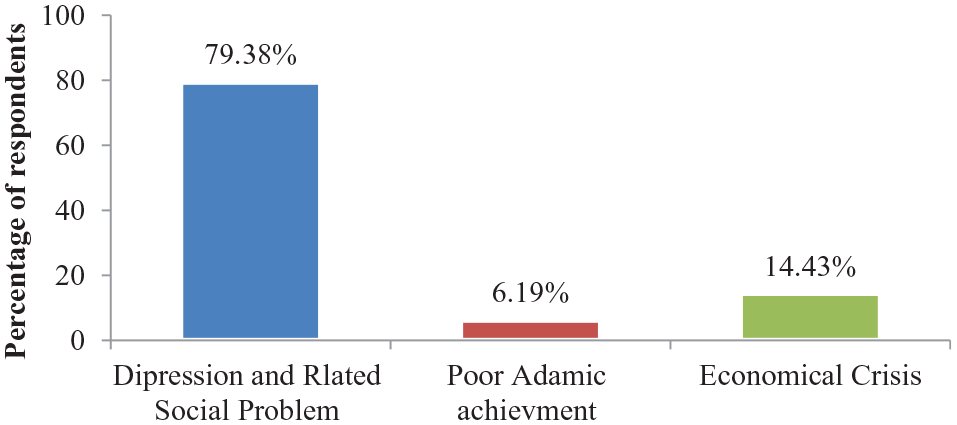
Self-reported effects of khat chewing among medical students in Gondar, Ethiopia, June 2019 (n = 97).
Reasons to stop chewing among the respondents
Different reasons to stop khat chewing were reported by the students who were khat chewers but now stop khat chewing practice (n = 19). The protruding reason to stop khat chewing was its health related effects (47.37%) including depression, gastro-intestinal problems, effect on teeth, and feeling of sexual dysfunction. The other reasons reported by the respondents were religious education (36.84%), expensive cost of khat (10.53%), and family influence (5.26%) (Figure 3).

Reasons to stop khat chewing among medical students in Gondar, Ethiopia, June 2019 (n = 19).
Prevalence of khat chewing and associated factors
Current prevalence of khat chewing was 21.5% (Table 1). Variables that were associated with khat chewing practice in bivariable logistic regression (P < .25), were fitted in the multivariable logistic regression model. Sex, religion, year of study, smoking habit, alcohol drinking, and having khat chewing friends were associated with khat chewing practice among medical students. Being male was 3.353 times more likely to chew khat than female students. The odds of Muslim students to chew khat was 6.390 times the odds of other religion followers. Being fifth and sixth year medicine student in the university were 3.391 more likely to chew khat than first and second-year medicine students (Table 2).
Bivariable and multivariate logistic regression analysis of factor associated with khat chewing among medical students in Gondar town, Ethiopia, June 2019 (N = 409).

Other Substances: Shisha, Hashish.
P ⩽ .05 = significant at 95% level of significance.
Discussions
In this study, the lifetime and current prevalence of khat chewing among medical students in Gondar town was found to be 23.7% and 21.5 respectively. This finding was consistent with other studies conducted among preparatory school students in Bale Zone 23.6%, 15 high school students in Harare town 24.2%, 18 and in Dire Dawa 27.7%. 12 This consistency may be due to cultural and age group similarity between the study populations. However, the result of the study was lower compared to the study conducted among college students in Gondar town 42%, 23 among Adama university students 40.0% 17 and among Axum university students 28.7%. 14 The reason might be the difference in the surrounding in the universities and most students in our study area are on campus where there is high control as compared to the above mentioned areas. The result of the study was also higher than other study conducted among medical students of Addis Ababa University 7%, 20 among students of Debre-Markos Poly Technique College 7.8%. 19 The reason might be the accessibility and availability of khat chewing to the university and acceptance of the student to the habit.
The main reason given for starting khat chewing were to concentrate and study more and enjoyment/relaxation purposes, followed by to avoid stress, peer pressure, khat accessibility. Those factors consistent with other are also reported by other studies.19,36 This implies prevention strategies will be effective if they are focusing on these factors to minimize khat chewing practice among higher education institutions; which includes forming conducive reading environment and recreation areas in the campus. 24 The prominent harmful effects reported by the respondents were depression and social problem (80.21%) and economic crisis, followed by poor academic performance. Depression was the most common perceived harmful effect among the respondents. This finding also supported by other studies.17,19,36 The protruding reason to stop khat chewing was its health related effects (47.37%) including depression, gastro-intestinal problems, effect on teeth and feeling of sexual dysfunction; followed by other reasons such as e religious education, expensive cost of khat and family influence. This implies creating awareness regarding health effects of khat chewing, educations given by religious leaders and increased cost/tax of khat may be significant directions to the current khat use practice in higher education institutions.
Sex, religion, year of study, smoking habit, drinking alcohol habit, and having khat chewer close friends were significantly associated with khat chewing practice among medical students. This study showed that the habit of khat chewing practice was 3.353 times higher in males than females, which is in line with research findings reported for Jimma university students, 16 for college students in Northwest Ethiopia 18 and for college students in Saudi Arabia. 41 This might be due to the fact that, in Ethiopia, males face lesser social and cultural restrictions towards khat chewing practice than females. This implies awareness creation is important to strengthen the common social and cultural restriction to intensify their restrictions not only females but also on males. Muslim students were 6.390 (AOR 95%CI = [1.903-21.460]) times more likely to chew khat than other religious followers. This is also consistent with the finding of other studies in Ethiopia and abroad.14-16,20 This association might be due to the fact that khat hewing practice has traditionally been confined to Muslim populations, and also it might be due to the religious dogma. This implies religious education through religious leaders to create awareness about the harmful effects of khat use may be used as an effective treatment mechanism to reduce chat chewing practice in higher education institutions. This study showed that fifth and sixth year students are 3.391 times more likely to chew khat. The reason might be their long waiting time in the university may cause depression and also faces more peer pressure/influence and they focus more on social interactions than academic issues than other year students. Students who have chat chewer friends were 30.645 times more likely to chew khat. This finding is also in line with other studies.14,18,20 This is because respondents who had khat chewing friends tend to imitate and exercise what they see from their peers due to peer-pressure and need of socialization. Students who smoked cigarette are 5.081 times more likely to chew khat. This finding is also in line with other studies.14,16,20 Simultaneous use of alcohol, cigarette and other psychoactive substances with khat chewing is commonly employed as a means to help decrease or eliminate the exciting/stimulating effects of khat chewing.21,23 This implies that Khat chewing has a far reaching implication in regard to leading to the use of other addictive substances which could result in a multiple addiction with dangerous consequences. Therefore, higher education institutions should screen their students who are khat users and consult to recover before their transition to intensified substance abused.
Limitations of the Study
The questionnaire was not a standard; it was prepared by reviewing literatures and validated by environmental health and psychiatric experts. Since it is a descriptive cross-sectional study, doesn’t show cause-and-effect relationship. Since the issue is sensitive, there may be social desirability bias. Findings from this study may not be generalized to the whole young people, because the study involved only medical students.
Conclusion
Significant proportion (one-fifth of) students were found to be khat chewers. Sex, Religion, year of study, smoking habit, alcohol drinking, and having close friend who chews khat were important predictors of khat chewing practice. Therefore, promoting protective activities such as strengthening programs to create awareness for students, strictly ban the use of khat and provide counseling programs for students to help in coping with the problem.
Supplemental Material
sj-pdf-1-sat-10.1177_1178221821999079 – Supplemental material for Khat Chewing Practice and Associated Factors among Medical Students in Gondar Town, Ethiopia, 2019
Supplemental material, sj-pdf-1-sat-10.1177_1178221821999079 for Khat Chewing Practice and Associated Factors among Medical Students in Gondar Town, Ethiopia, 2019 by Tsegaye Adane, Walelegn Worku, Jember Azanaw and Lamrot Yohannes in Substance Abuse: Research and Treatment
Footnotes
Acknowledgements
We would like to thank University of Gondar for its support to conduct this research. We would also like to thank our study participants and data collectors for their willingness and cooperation in collecting all necessary data for the success of this work.
Funding:
The author(s) received no financial support for the research, authorship, and/or publication of this article.
Declaration of conflicting interests:
The author(s) declared no potential conflicts of interest with respect to the research, authorship, and/or publication of this article.
Author Contributions
LY: concept development, prepare the questionnaire, collect, analyze and interpret the data. WW: Advise throughout the process. TA: Advice throughout the process, analyze and interpret the data and prepare the manuscript. JA: reviewed the manuscript. All authors read and approved the final manuscript.
Ethics Approval and Consent to Participate
Ethical approval was obtained from the Institutional Review Board of University of Gondar. Written informed consent was also taken from the study participants. Confidentiality of information was also kept properly.

Availability of Data and Materials
All data underlying the findings are fully available without restriction. All relevant data are within the manuscript.
Supplemental Material
Supplemental material for this article is available online.
References
Supplementary Material
Please find the following supplemental material available below.
For Open Access articles published under a Creative Commons License, all supplemental material carries the same license as the article it is associated with.
For non-Open Access articles published, all supplemental material carries a non-exclusive license, and permission requests for re-use of supplemental material or any part of supplemental material shall be sent directly to the copyright owner as specified in the copyright notice associated with the article.
