



Abstract
Objectives:
Although neutropenic fever is one of the most well-known oncologic emergencies and the common causes of death, a few studies have been conducted in resource-limited countries, particularly in Ethiopia. This study aimed to assess the burden, risk factors, and management of neutropenic fever among solid cancer patients in Ethiopia.
Methods:
A hospital-based retrospective follow-up study was conducted from January 2017 to February 2021. Data were collected from patient’s medical charts using a structured data abstraction format and analyzed using STATA version 14.2. Logistic regression analyses were used to identify independent predictors of neutropenic fever, and a p-value of < 0.05 was considered statistically significant.
Results:
A total of 416 patients were included, with a mean age of 51 ± 14 years. The cumulative incidence of neutropenic fever was 13%. Advanced age, low baseline white blood cell, prolonged duration of neutropenia, and presence of two or more comorbidities were factors significantly associated with neutropenic fever (p < 0.05). Among patients who need primary prophylaxis, 68% of patients did not get appropriate primary prophylaxis, and 30%, 71%, and 93% of prescribed anti-bacterial, anti-fungal, and anti-viral agents were inappropriate according to Infectious Disease Society of America Guideline, respectively.
Conclusion:
Neutropenic fever was common among solid cancer patients and it is multifactorial. The rate of guideline adherence during prophylaxis and treatment of neutropenic fever was poor. Health care professionals should be aware of these risk factors, and greater effort is needed to reduce the risk of neutropenic fever.
Introduction
Cancer is a group of diseases that results from uncontrolled growth and reproduction of body cells. 1 It is one of the most common causes of morbidity and mortality in Ethiopia. 2 A survey conducted in 182 countries reported that there were 7.6 million cancer-related deaths in 2008, of which 63% of death occurred in developing countries. 3 In 2018, there were 18.1 million new cases of cancer and 9.6 million associated deaths in the world. 4 According to the National Ministry of Health, Ethiopia, there are 60,960 new cases, and 5.8% of total national death every year in Ethiopia is due to cancer. 1
Neutrophils are a part of the phagocyte system and the first cellular component for inflammatory response and innate immunity. 5 Neutropenic fever (NF) is the most well-known oncologic emergency and life-threatening medical condition. On average, 2%–21% among hospitalized cancer patients in the United States died because of NF. 6 Cancer patients are at high risk of infection because of different reasons; breakdown of normal skin and mucosal barriers, reduced and altered immunoglobulin, bone marrow abnormality, and neutropenia secondary to chemotherapy are common risk factors. In the absence of prophylaxis use, between 48% and 60% of neutropenia patients become febrile, and around 16% to 20% of them have bacteremia. 7 History of prior NF, significant metastasis disease, absence of antibiotics prophylaxis measure or granulocyte colony stimulating factor (G-CSF), cardiovascular disease, poor performance status, poor performance status, and cardiovascular disease are significantly associated with a high mortality rate. 8
NF is a common and life-threatening complication of chemotherapy treatment in patients with solid cancer patients, which required urgent diagnosis and interventions. Empirical antibiotics therapy is standard practice in the treatment of NF.9,10 However, there is a significant debate about the selection of initial antibiotic regimens. 3 The initial regimen in seriously ill patients should cover both gram-positive and gram-negative pathogens and should be administered intravenously.11–13 However, vancomycin (or other agents active against aerobic gram-positive cocci) is not recommended as a standard part of the initial antibiotic regimen for fever and neutropenia (A–I). These agents should be considered for specific clinical indications, including suspected catheter-related infection, skin or soft-tissue infection, pneumonia, or hemodynamic instability. 14 Administrations of antibiotics reduce mortality, shorten the length of hospital stay, and increase the quality of life.7,11 However, these are not evidenced in developing countries including Ethiopia because of low screening practices for different cancers, lack of antibiotic sensitivity tests, and inappropriate use of antibiotics. Despite the presence of frustrating reports on the overuse of antibiotics in general medical use, few studies have been conducted on the burden and management practice of NF in Ethiopia. Therefore, the objective of this study was to assess the burden, risk factors, and management of NF among solid organ cancer patients in Ethiopia.
Methods
Study design, period, and area
A hospital-based retrospective follow-up study was conducted among adult solid cancer patients attending between 1 January 2017 and 30 February 2021 at the oncology ward of the University of Gondar Comprehensive and Specialized Hospital (UOGCSH).
Study population
Patients with a confirmed diagnosis of a malignant solid tumor with age ⩾18 years, who were on cancer chemotherapy, and who had a normal baseline absolute neutrophil count were included in this study. We exclude patients who had a history of neutropenia, prior exposure to chemotherapy, and incomplete medical and laboratory records. Because of this group of patients, it was difficult to differentiate the new case of neutropenia from the older existing case.
Sample size determination and sampling techniques
Cochran single proportion formula for a categorical variable was used to calculate the required sample size for this study. As per the Authors’ knowledge, no study was found in Ethiopia on this area. Therefore, 50% of the incident rate was used in the sample size calculation. Using standard normal distribution (Z = 1.96) with a confidence interval (CI) of 95% and 0.05 marginal error, the minimum sample size required for this study was 384. After adding a 10% non-response rate, the calculated sample size was 423. Finally, 416 participants were included in the final analysis because 7 participants had incomplete data that were identified during data entry. A systematic random sampling technique was used and the proportional allocation was presented (Figure 1). The population from January 2017 to February 2021 was 953 and the sample size calculated was 423. K = N/n; thus, K = 2; 25 ≈ 2. We took the sample of every two patients until the sample size was reached

Sample size distribution of adult solid cancer patients at University of Gondar Comprehensive and Specialized Hospital from January 2017 to February 2021 (n = 416).
Outcome measure
The primary outcome of this study was an incidence of NF. The proportion of guideline adherence during prophylaxis use and management of NF was the secondary outcome of this study.
Data collection and tool
A structured, pretested data abstraction format prepared by reviewing different kinds of literature was used to collect all necessary data from ’patients’ medical charts. The data abstraction format is composed of detailed information on ’patients’ characteristics, including sex, age, residency, occupation, body mass index (BMI), body surface area (BSA), and clinical data, including diagnosis/assessments, type of malignancy, types chemotherapy agent, number of medications, number of cycles, comorbidities, absolute neutrophil counts, body temperature, selected empiric therapy for NF, including the name of the drug(s), chemotherapy delay, and duration of therapy. The National Comprehensive Cancer Network (NCCN) guideline and Infectious Diseases Society of America (IDSA) guideline were used as standard guidelines to evaluate appropriate indications of prophylaxis and empiric antibiotic for NF, respectively. Risk classification was performed using the Multinational Association for Supportive Care in Cancer (MASCC) scoring system. 15
Data quality assurance
Data collectors were selected based on previous work experience at the oncology ward to reduce confusion during the data collection process. They were trained by the principal investigator regarding the data collection technique and process before the actual data collection was started. The data abstraction tool was pretested using Cronbach’s alpha test in 5% (21 patient records) of the sample size at the UOGCSH oncology ward to assure the internal consistency of the tool so as to meet the objective of the study. Pretested patient records were not included in the final data analysis. The scale of reliability coefficient for NF was 72.25%, which was an acceptable internal consistency. An independent supervisor was closely following the data collection process and the completeness of the data was checked by the principal investigator daily.
Statistical analysis
The data were entered into a computer database using Epi-data version 4.6 and exported to STATA version 14.2 for better analysis. Continuous variables were presented as means (standard deviation). Categorical variables were presented as frequency and percentages. The logistics regression model was used to see the association between NF and independent variables. Multivariate logistic regression analysis was conducted for variables with a p-value <0.25 in bivariate analysis where p < 0.05 was considered statically significant. The Hosmer–Lemeshow goodness-of-fit test for logistic regression was performed and the model was well fitted to NF (p = 0.42). In addition, time to recovery in NF between different regimes was compared using two-sample t-tests. The contingency coefficient test and variance inflation factors were used to check the presence of multicollinearity for categorical and continuous variables, respectively. The result of these tests showed that there was an insignificant correlation between variables.
Operational definitions
Absolute neutrophil count (ANC) (cells/mm3) was defined as [total white blood cell (WBC) × (neutrophil % + %band)]/ 100. If the band is not available in the setup, it was set as 0 value. 12 Neutropenia was defined as a reduction of ANC lower than 1500 cells, 13 whereas NF means sustained body temperature of greater than 38°C for ⩾1 h in patients with ANC count <500 cells/mL or ANC decreased to <500 cells/mm3 within 48 h. 14 In this study, baseline ANC means ANC value before initiating the first cycle of chemotherapy, and chemotherapy dose delay is defined as a delay of planned chemotherapy for ⩾7 days. 16 NF recovery is defined as patients who have normal body temperature and ANC greater than 500 cells/mm.3,14.For performance status, poor performance status is defined as an Eastern Cooperative Oncology Group (ECOG) (⩾2) and good performance status is ECOG (0–I). 17
Results
Socio-demographics and clinical characteristics of participants
A total of 416 patients were included in this study. The mean age of the patients was 51 ± 14 years. More than two-thirds of the patients were female (322 (77%)) (Table 1). More than half of the patients had good performance status (231 (56%)), and nearly, two-thirds of the patients (268 (64%)) had an advanced stage of cancer. Similarly, 155 (61%) patients had distant metastasis to the liver, lung, bone, and other sites of metastasis (Table 2).
Socio-demographic characteristics of adult solid cancer patients at University of Gondar Comprehensive and Specialized Hospital from January 2017 to February 2021 (n = 416).

BSA: body surface area; BMI: body mass index.
Merchant, student, person in spiritual schools.
Clinical and laboratory characteristics of adult solid cancer patients at University of Gondar Comprehensive and Specialized Hospital from January 2017 to February 2021 (n = 416).

BUN: blood urea nitrogen: ECOG-PS: Eastern Cooperative Oncology Group performance status; LDH: lactate dehydrogenase; PLT: platelet count; WBC: white blood cell; Hgb, hemoglobin, SCr, serum creatinine; ALT: alanine transferase; AST: aspartate transferase ANC: absolute neutrophil count.
Brain, adrenal gland, and peritoneum.
Types of chemotherapeutic regimens for solid cancer treatment
A total of 416 patients took 416 courses of chemotherapy, 21 types of chemotherapy regimens, and 2708 chemotherapy cycles throughout their treatment regimens. The mean cycle of the treatment course was 6.3 ± 1.1. Adriamycin–cyclophosphamide with four cycles of paclitaxel (92 (22%)) followed by adriamycin–cyclophosphamide (86 (21%)) were the most commonly prescribed chemotherapy regimens (Table 3).
Regimen of chemotherapy administered among adult solid cancer patients from January 2017 to February 2021 at University of Gondar Comprehensive and Specialized Hospital (n = 416).
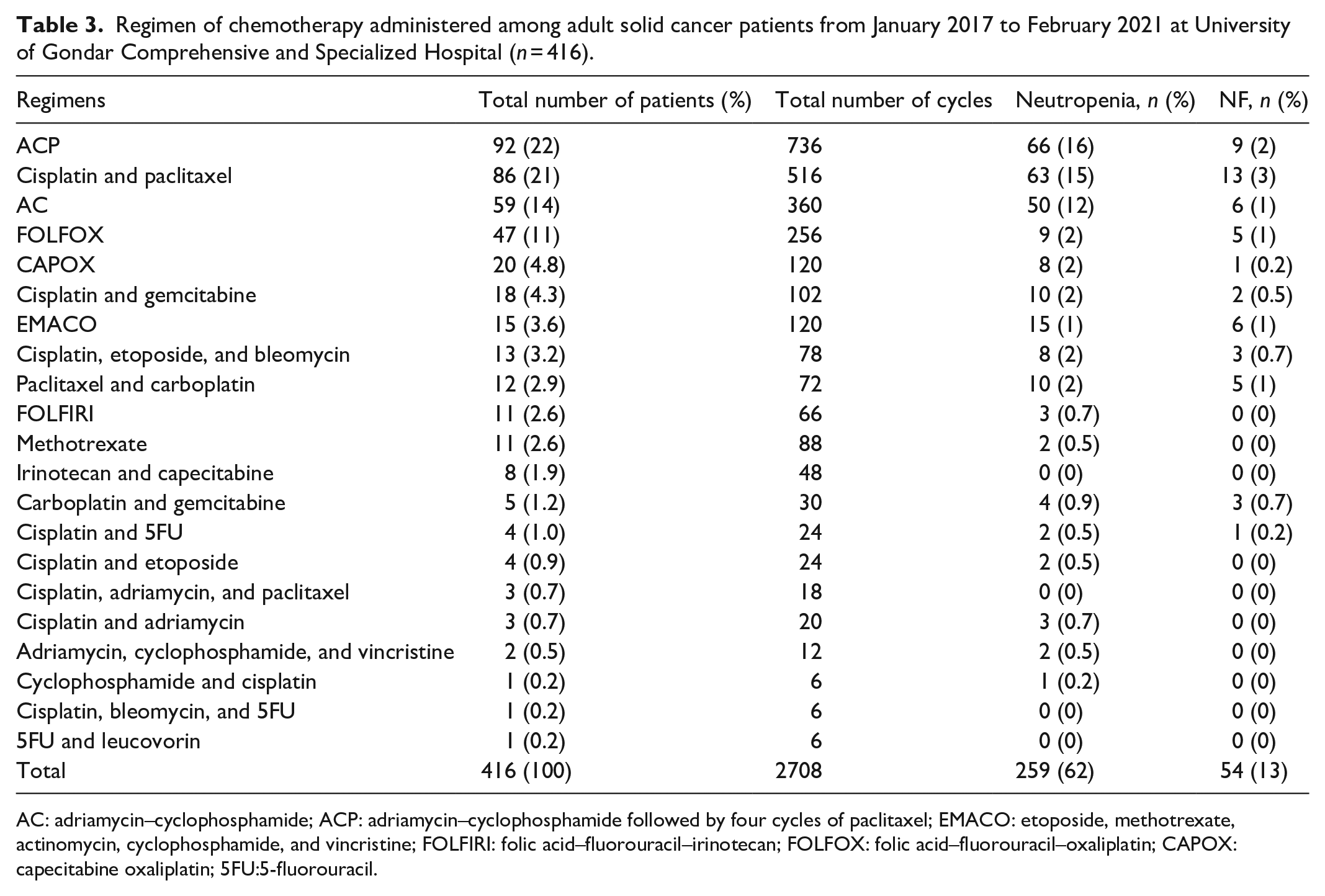
AC: adriamycin–cyclophosphamide; ACP: adriamycin–cyclophosphamide followed by four cycles of paclitaxel; EMACO: etoposide, methotrexate, actinomycin, cyclophosphamide, and vincristine; FOLFIRI: folic acid–fluorouracil–irinotecan; FOLFOX: folic acid–fluorouracil–oxaliplatin; CAPOX: capecitabine oxaliplatin; 5FU:5-fluorouracil.
Incidence and distribution of NF
The study includes six common solid cancers in the hospital, where breast cancer was the most prevalent (152 (37%)). From a total of study participants, 259 (62%) patients developed neutropenia, and 54 (13%) patients (95% CI: 9.9–16.3) had NF. NF was most common in gestational trophoblastic disease and ovarian cancer (23% vs 22%), respectively (Table 4). The incidence of NF was more frequently encountered in the first cycle of chemotherapy and decreased subsequently through the eighth cycle (Figure 2).
Distribution of chemotherapy-induced neutropenic fever among adult solid cancer patients by cancer type at University of Gondar Comprehensive and Specialized Hospital from January 2017 to February 2021 (n = 416).

GTN: gestational trophoblastic disease; NF: neutropenic fever.

Incidence of neutropenia fever among solid cancer patients based on chemotherapy cycles at University of Gondar Comprehensive and Specialized Hospital from January 2017 to February 2021 (n = 416).
Risk factors for NF
In the multivariate analysis advanced age, low baseline WBC, prolonged duration of neutropenia, and presence of two or more comorbidities were significantly associated with NF. Accordingly, patients aged ⩾65 had a risk to develop NF by odds of 3.5 to patients aged less than 65 years: adjusted odds ratio (AOR) 3.5 (95% CI: 1.2–10.3; p = 0.022). Similarly, patients with lower baseline WBC had a high risk of NF by odds of 3.4 than patients with normal baseline WBC count: AOR 3.4 (95% CI: 1.1–10.7; p = 0.033). Prolonged duration of neutropenia also increased the risk of NF by odds of 2.5 than patients with a shorter duration of neutropenia: AOR 2.5 (95% CI: 1.2–5.3; p = 0.015). Patients having two or more comorbidities had a risk to develop NF by odds of 2.9 than patients who did not have comorbidities: AOR 2.9 (95% CI: 1.2–7.5; p = 0.021) (Table 5).
Multivariable logistic regression for associated factors of neutropenic fever incidence among adult solid cancer patients at University of Gondar Comprehensive and Specialized Hospital from January 2017 to February 2021 (n = 416).

NF: neutropenic fever; AOR: adjusted odds ratio; COR: crude odds ratio; CI: confidence interval; ECOG-PS: eastern cooperative oncology group performance status; BMI: body mass index; LDH: lactate dehydrogenase; ANC: absolute neutrophil count; WBC: white blood cell.
Significance (p < 0.05).
Guideline adherence for NF prophylaxis and treatment
According to NCCN guideline NF risk classifications, 92 (22%) patients were high risk, 28 (6.7%) patients were intermediate risk with a risk factor, 196 (47%) patients were an intermediate risk without risk factors, and 100 (24%) patients were unclassified risks. Of patients who need primary prophylaxis for the prevention of NF (92 + 28 = 120), 81 (68%) patients did not get primary prophylaxis. Regarding the time of prophylaxis, 27 (69%) of 39 patients got prophylaxis at an inappropriate time (Table 6). Management of NF was major with anti-bacterial. In addition to filgrastim, anti-viral and anti-fungal agents were used. Two-sample t-tests showed that the addition of filgrastim to antibiotics significantly reduces NF recovery by 11 days (95% CI: 9.9–12; p = 0.0001) as compared to antibiotic treatment only (Table 7). The majority of patients (49 (91%)) were treated with a combination of vancomycin. Of these combination regimens, vancomycin plus ceftazidime was most frequently (56%) prescribed. Based on IDSA guidelines, inappropriate prescribing of anti-bacterial, anti-fungal, and anti-viral agents was 30%, 71%, and 93% of prescriptions, respectively (Table 8).
NCCN guideline adherence of neutropenic fever prophylaxis among adult solid cancer patients at University of Gondar Comprehensive and Specialized Hospital from January 2017 to February 2021 (n = 416).

FN: neutropenic fever.
Filgrastim use comparison for neutropenic fever among adult solid cancer patients at University of Gondar Comprehensive and Specialized Hospital from January 2017 to February 2021 (n = 416).

NF: Neutropenic fever.
Appropriateness of antibiotic treatment for neutropenic fever based on IDSA guideline among adult solid cancer patients at University of Gondar comprehensive and specialized hospital patients from January 2017 to February 2021 (n = 416).

Discussion
In this study, the cumulative incidence of NF was 13% (95% CI: 9.9–16). The result was closely similar to other studies conducted previously in the world.18,19 However, the result was higher than previous studies done in Japan (6.9%) and Portugal (8%).20,21 This difference might be due to genetic variation; black populations had lower neutrophil count and leucocyte count relative to the white population. 22 In addition, the patients in our study had a new cancer case and on first chemotherapy, the exposure would relatively be more sensitive to chemotherapy toxicity relative to recurrent cases. 20 However, the use of primary prophylaxis is not common in our setting. It was also higher than a study done in Nigeria (5.3%). 23 This variation might be due to the use of primary prophylactic G-CSF based on risk stratification is not common in our setup. NF was higher in breast cancer than other types of cancer. This result might be due to frequent use of high-risk chemotherapy regimens—doxorubicin, cyclophosphamide, and taxane-based regimen which has a high bone marrow suppression adverse effect. 24 The incidence of NF episodes was higher in the first (15%) and second cycles (13%) and decreased in subsequent cycles. The finding was consistent with previous studies done in the United States, Europe, and Denmark.24–26 This might be because patients had lower tolerability levels at the onset of chemotherapy. 27 The mean duration of NF was 48 days. This was longer than a study conducted in the United States (11 days) and Belgium (6 days).25,28 This difference might be due to a lack of frequent monitoring of complete blood count as per standards in our setting.
Older age (⩾65 years) was a risk factor for chemotherapy-induced NF. This result was supported by other studies carried out in Europe, the United States, Korea, Australia, and Japan.26,29–32 This might be due to immune senescence, a phenomenon which is a gradual deterioration of the immune system with aging. 33 In addition, this group of patients could have reduced bone marrow, liver, and renal functions and is more susceptible to chemotherapy-induced complications. 34 The prolonged duration of neutropenia was significantly associated with the incidence of NF. This result was in line with studies conducted in the United States and Korea.30,35 This might be because a longer period of myelosuppression will render patients prone to infections. Similarly, the presence of two or more comorbidities was significantly associated with NF. This could be due to several underlying pathologic mechanisms, including defective bone marrow functions, impaired phagocyte systems, and altered barrier function which might be increase access of microorganisms into the body. 36
Different studies showed that cancer patients have a high risk for tuberculosis (TB) and also there are a high prevalence of human immune deficiency virus (HIV) infection.37,38 The risk of TB in cancer patients is due to immunosuppression caused by chemotherapy and local anatomical alterations in the lungs caused by primary lung cancer or metastasis. HIV infection itself is a risk factor for malignancy and a cause of cancer-related death. 39 Particular sub-Saharan Africa is by far the most affected region of the world by the HIV pandemic, with 25.8 million people living with HIV (69.9% of the total). 40 A review conducted in sub-Sahara Africa showed that the incidence of Kaposi sarcoma, non-Hodgkin lymphoma, and squamous cell lesion was increased 4, 4, and 21.9 times among HIV-positive patients. 41 This strong association between cancer and HIV infection was not supported by our findings. This variation might be because of the poor screening habits of participants in our study. In addition, we used a retrospective follow-up study; therefore, important cancer comorbid conditions might have been missed. In the future, it could be interesting to investigate the level of association between cancer with TB, and HIV in different health care institutions with a large sample size.
Of the total study participants, 68% of patients received prophylaxis. However, only 31% of participants received appropriate prophylaxis as per NCCN recommendations time for the prevention of NF, which stated patients should receive G-CSF therapy within 24–72 h of post-chemotherapy. 42 This report was supported by other different studies conducted in the world.14,43,44 This guideline non-adherence might be due to inadequate training and experience of prescribers and, a lack of standard treatment protocol in our setting. 45
More than two-thirds of NF patients (70%) were treated with antibiotics plus filgrastim. The result of our study was in agreement with the American Society of Clinical Oncology (ASCO) recommendations. 46 The finding of our study showed that adjuvant use of filgrastim to NF significantly reduced the time of neutrophil recovery. The finding was supported by a previous observational study in Pakistan and India.47,48 This might be because the use of filgrastim accelerates the production and circulating of neutrophils by reducing the transient time from stem cells to mature neutrophils. 49 In this study, the majority (95%) of the patients were treated with combined antibiotics and 30% of prescription was inappropriate.
Vancomycin-based combinations were the most frequently prescribed regimen in this study (91%). This finding was consistent with a study conducted at Black Lion Specialized Hospital, Ethiopia. 50 However, 33% of vancomycin was inappropriately indicated based on criteria set by the IDSA 2010 guideline. Studies conducted in United States and Korea showed that the addition of vancomycin had no significant benefit on reduction of mortality; rather, it increased the risk of antibiotic resistance and nephrotoxicity.51,52 In addition, this study found that the majority (82%) of patients received anti-fungals, but 71% of them inappropriately. The finding was supported by studies conducted in France, Spain, and California.53–55 This guideline non-adherence might be due to poor practice of definitive therapy due to the lack of specific microorganism identification techniques in our setting. In our study, 50% of patients received anti-viral agents. However, the majority of the patients (93%) took anti-viral without evidence of viral infection, which was contradicted IDSA guidelines. 14
Limitation of the study
This study has several limitations. This study was conducted in one hospital setting; the result may not be generalized to whole health care centers in Ethiopia. As we used a retrospective follow-up study, the necessary data such as chemotherapy dose reduction, previous antibiotics use, and duration of therapy might have been missed. Determinants of neutropenic fever might be affected by imprecision, since the confidence intervals of the AOR were large, probably due to the small number of events for each outcome. Similarly, continuous variables in this study were dichotomized, and also the high number of independent variables was included in the multivariable model which might reduce the statistical power and result in an over-fitted model, respectively. In addition, the incidence of NF might be affected by the quality of life, and nutritional status, which were unable to address in this study. Despite these limitations, this study gives new insights into the incidence, guideline adherence to management practice, and predictors of NF among adult solid cancer patients, which could serve as a source of direction by identifying areas for intervention.
Conclusion
This study showed that the incidence of NF among solid cancer was high. It occurs most frequently during the first and second cycles of chemotherapy than in subsequent cycles with a mean duration of 38 days. Advanced age, low baseline WBC, prolonged duration of neutropenia, and the presence of two or more comorbidities were independent predictors of NF. More than one-half of solid cancer patients (53%) were treated with surgery and chemotherapy. According to the NCCN guideline, 68% of patients did not get appropriate primary prophylaxis. NF was mainly managed by a combination of antibiotics. The addition of filgrastim to antibiotics significantly reduced neutropenia fever recovery time by 11 days. The rate of IDSA guideline adherence during treatment of NF was poor. Among prescribed anti-bacterial, anti-fungal, and anti-viral agents, 30%, 71%, and 93% of prescriptions, respectively, were inappropriate based on this guideline. Predicting and screening high-risk NF has great clinical significance. This may help to monitor and manage NF which improves the outcome of chemotherapy. Risk factors of NF are multidimensional and health care professionals should be aware of these risk factors, and maximum effort is important to reduce the risk of NF in the early course of chemotherapy. In addition, more research considering tumor biomarkers and prospective follow-up study are important to assess the overall condition. The Ministry of health should also prepare a standardized and updated local guideline for the management of NF for a better outcome for cancer patients.
Supplemental Material
sj-docx-1-smo-10.1177_20503121221098236 – Supplemental material for Burden, risk factors, and management of neutropenic fever among solid cancer patients in Ethiopia
Supplemental material, sj-docx-1-smo-10.1177_20503121221098236 for Burden, risk factors, and management of neutropenic fever among solid cancer patients in Ethiopia by Samuel Agegnew Wondm, Ephrem Mebratu Dagnew, Sumeya Tadesse Abegaz, Mekdes Kiflu and Bekalu Kebede in SAGE Open Medicine
Footnotes
Acknowledgements
The authors thank participants, the University of Gondar, and data record staff members of the University of Gondar
Author contributions
S. A. W. had an important contribution to the conception and design of this study; S.A., E.M.D., S.T.A., M.K., and B.K. have contributed to statistical analysis and interpretation, and also participated during manuscript preparation, and agreed and gave approval to the manuscript to be submitted and published in this journal. They agree to be accountable for all aspects of the work.
Availability of data and materials
The data sets used and/or analyzed during the present study are available from the corresponding author upon reasonable request.
Declaration of conflicting interests
The author(s) declared no potential conflicts of interest with respect to the research, authorship, and/or publication of this article.
Ethical considerations
Ethical approval for this study was obtained from the Ethical Clearance Committee of the Department of Clinical Pharmacy, the School of Pharmacy, the University of Gondar (APPROVAL NUMBER/ID SOPs/133/2021). Informed consent was waived since the study was conducted retrospectively, and also, it was difficult to get the study participants directly. Confidentiality of the patients was maintained by ensuring the data obtained from study participants were used only for research purposes. In addition, the information collected was not directly linked to the respective participants; in the way that the names of patients were not used. Codes were used as an identifier.
Funding
The author(s) disclosed receipt of the following financial support for the research, authorship, and/or publication of this article: This study was funded by the School of Pharmacy, College of Medicine and Health Sciences, University of Gondar. The University has no role in designing, conducting, and reporting the study
Informed consent
Informed consent was waived since the study was conducted retrospectively, and also, it was difficult to get the study participants directly.

Supplemental material
Supplemental material for this article is available online.
References
Supplementary Material
Please find the following supplemental material available below.
For Open Access articles published under a Creative Commons License, all supplemental material carries the same license as the article it is associated with.
For non-Open Access articles published, all supplemental material carries a non-exclusive license, and permission requests for re-use of supplemental material or any part of supplemental material shall be sent directly to the copyright owner as specified in the copyright notice associated with the article.
