



Abstract
Background:
“Expectancies,” or beliefs about outcomes, robustly correlate with and predict several behaviors including electronic nicotine delivery system (“e-cigarette”) use. However, there is limited qualitative research available regarding relevant e-cigarette vaping expectancies.
Objectives:
The present study used a qualitative approach to derive and refine e-cigarette expectancy themes among young adults.
Methods:
We conducted 12 focus groups and two individual interviews with young adult nonusers, e-cigarette vapers, cigarette smokers, and dual users to assess beliefs about the effects of e-cigarettes. After a series of open-ended questions, follow-up questions assessed reactions to domains previously examined in expectancy measures for cigarette smoking and e-cigarette vaping. The constant comparative method was used to derive themes from transcripts.
Results:
Four main themes (Positive Reinforcement, Social Benefits, Negative Affect Reduction, Negative Consequences) emerged from the results. Each theme contained three associated subthemes (Positive Reinforcement: Sensorimotor Experiences, Taste, Stimulation; Social Benefits: Social Facilitation, Influence on Others, Convenience; Negative Affect Reduction: Stress Reduction, Appetite Reduction, Boredom Reduction; and Negative Consequences: Health Risks, Addiction, Secondhand Effects).
Conclusions/importance:
Previously identified smoking expectancies appear relevant for young adult vaping, with some notable refinements. Positive reinforcement aspects encompassed aerosol clouds, vaping tricks, and unique flavors. Social benefits included influencing others via social media and competitive activity, as well as the convenience of use in a variety of places. Negative affect reduction was controversial among user groups, but vaping was seen as more interesting than smoking and thus more effective at boredom reduction. Young adults were uncertain regarding negative consequences, but appreciated a potential for secondhand effects. Measure refinement via qualitative research and future field testing can enhance our understanding of this relatively new behavior, supporting tobacco control surveillance, marketing/labeling regulations, and counter-advertising development/evaluation.
Keywords
Introduction
The impact of electronic nicotine delivery systems (“e-cigarettes”) on population health continues to be controversial. The extent to which e-cigarettes are helpful or harmful to public health will depend on the differential impact concerning two key groups: (1) cigarette smokers seeking to quit; and (2) youth susceptible to smoking.1–3 For cigarette smokers seeking to quit, switching from cigarette smoking to e-cigarette “vaping” may be an effective harm reduction technique, given the substantially lower levels of harm found with e-cigarette use to date.1,4,5 However, e-cigarettes are not harmless6,7 and the evidence regarding the effectiveness of e-cigarettes for quitting cigarette smoking, although supportive, also suggests that long-term use is common.8,9 Thus, current evidence allows for the possibility that e-cigarettes may improve the health of cigarette smokers, provided they are motivated to completely quit smoking. However, long-term use remains a concern.
For youth nonsmokers, there is considerably more concern regarding the rapid levels of growth.10,11 There is widespread agreement that e-cigarette initiation among nonsmokers, particularly youth, should be avoided. The only debate, if any, is regarding whether or not the rates of youth usage constitute an epidemic.12,13 Given that data showing e-cigarette use among youth and young adults is associated with the initiation, persistence, and escalation of cigarette smoking,7,14 e-cigarettes potentially could slow or even reverse reductions in cigarette smoking.
Understanding e-cigarette attitudes and use patterns among young adults may be particularly important. Young adults are more likely than older adults to experiment with e-cigarettes, whether or not they have ever smoked cigarettes. 15 This age range, sometimes referred to as “emerging adulthood” represents a time when youth transition into social contexts (eg, college, workplaces) with tolerance or even promotion of risky behaviors, often resulting in an increased prevalence of substance use and the development of addictive patterns.16,17 Almost all (99%) of those with a history of daily cigarette smoking report trying their first cigarette before the age of 26 years. 18 Although adolescent smoking in the United States has decreased dramatically since 2011, the likelihood of young adult smoking initiation has increased. 19 Indeed, since approximately 2004, nicotine initiation in young adulthood is now more likely than adolescence.20,21 As such, young adults are an ideal population for helping to understand the potential long-term impact of e-cigarettes on public health.
One prominent theoretical construct in predicting behavior, based on social cognitive theory, is referred to as “outcome expectancy,” that is, belief about the result of a behavior. 22 Drug outcome expectancies refer to beliefs about the results of drug use and are a key tool in predicting substance use initiation and continued use. 23 Before use of a substance, drug expectancies are believed to develop from observation via the media, peers, and family members. 24 After use initiation and during continued use, expectancies tend to become stronger, more specific, and more positive (eg, “smoking will help me relax around friends”). 25 E-cigarette expectancies are associated with e-cigarette initiation,26–28 switching from combustible cigarettes to e-cigarettes, 29 vaping frequency and dependence, 30 and intention to quit e-cigarettes. 29
Prior e-cigarette expectancy research primarily used adaptations of existing smoking expectancy measures (eg, “smoking calms me down when I feel nervous” altered to “vaping calms me down when I feel nervous”).26,27,29–32 For example, 28 of 40 items initially used by Pokhrel and colleagues 26 and 9 of 14 items used by Harrell and colleagues 31 were directly derived from prior smoking expectancy measures. Other research by Hershberger and colleagues 28 used items from a broad variety of sources, including items previously found to be predictive of use or intent to use e-cigarettes and beliefs previously found to be targeted in e-cigarette advertisements,26,27,33–35 to create a Comparing E-cigarettes and Cigarettes questionnaire. 28 Implicit in much of this research is the assumption that e-cigarette use may be driven by motives similar to cigarette smoking. However, there is little research examining this issue directly.
Qualitative research conducted so far suggests young adult perceptions regarding e-cigarettes may be unique from cigarette smoking. E-cigarette users in Hawaii reported distinctive beliefs related to social, recreational, and sensory outcomes. These included positive beliefs, such as sensory satisfaction, social enhancement, and control over intake, as well as negative beliefs, such as addiction, health consequences, and high expenditures. 36 Focus groups in Connecticut found adolescents and young adults reporting benefits of e-cigarettes including usefulness in quitting cigarette smoking, but also concerns regarding lack of satisfaction, nicotine addiction maintenance, and health impact.37,38 In North Carolina, youth reported appreciating the flavor variety and reduced harm, as well as the ability to modify nicotine content and perform tricks (e.g. French inhale), but disliked the uncertainty regarding content, the addictive potential, and the lack of a cue to stop use. 39
The present study adds to the literature by using qualitative methods to probe for e-cigarette expectancies among young adults. We aspired to understand both why some young adults use e-cigarettes (ie, risk factors for use), and why some do not use e-cigarettes (ie, protective factors against use). Further, beliefs among cigarette smokers are important to understand, as there are considerable concerns regarding prolonged dual use of both substances or transition from e-cigarettes to cigarettes. 7 To investigate these issues, we assembled groups of young adults stratified by their use of cigarettes and e-cigarettes.
Methods
Procedures
Young adults (aged 18–29 years) were recruited from a large metropolitan city in southeastern United States from November 2015 through May 2016. Advertisements publicized a paid opportunity for young adults to provide opinions about e-cigarettes and vaping. Interested participants were screened over the phone to assess if they met inclusion and exclusion criteria for one of the groups for which we were recruiting. Stratification of cigarette use and e-cigarette use yielded four group categories: nonusers; cigarette smokers; e-cigarette vapers; and dual users. Screening questions asked about prior and current use of cigarettes and e-cigarettes. Based on prior research regarding “established” e-cigarette use, as well as the use of a young adult sample, criteria for substance use included 50 or more lifetime use occasions. 40 As shown on Table 1, nonusers reported no use of either product in the past month and no more than 50 lifetime use occasions; cigarette smokers reported smoking at least 50 times, current daily smoking, and no e-cigarette use in the past month; e-cigarette vapers reported using e-cigarettes at least 50 times, current daily e-cigarette use, and no smoking in the past month; and dual users reported using e-cigarettes at least 50 times, current daily use of either substance, and past-week use of both substances. We focused on daily, rather than nondaily use, in an attempt to get opinions from consistent, informed users. We screened 209 individuals. Of these, 42 were ineligible due to past-month nondaily use, 29 were ineligible due to age, 9 met criteria for a group for which we were not currently recruiting, and 3 were ineligible due to recent experimental e-cigarette use (<50 lifetime occasions). The remaining 121 met qualification criteria for one of the groups. However, most of these participants were unable to meet during a planned time and did not respond to attempts to follow-up. We enrolled 49 participants in total.
Focus group inclusion criteria: stratification by cigarette and e-cigarette use.
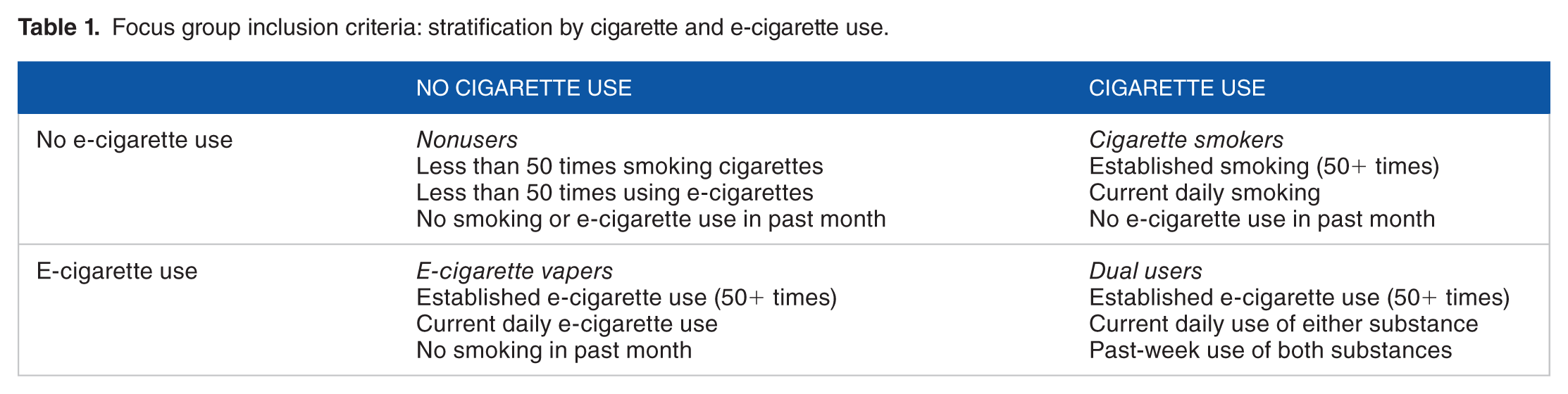
We conducted a total of 14 sessions. These included four focus groups involving young adult nonusers (n = 3, 5, 8, 5), three exclusive cigarette smoker groups (n = 2, 3, 2), three exclusive e-cigarette vaper groups (n = 8, 2, 2), two dual user groups (n = 2, 4), and two individual interviews with dual users. These additional individual interviews were conducted due to both difficulty in recruiting dual users and perceived importance of their perspective, as arguably the most risky group.41,42 Sessions were either conducted at a local community college or at a medical school located near both a community college and a 4-year university. Two research team members, a moderator and a note-taker, facilitated each meeting. Sessions were digitally recorded and lasted approximately 1 hour. To verify smoking status, a Vitalograph BreathCO monitor was obtained to provide expired air carbon monoxide (CO) concentration readings.
After informed consent, the moderator began the session with the aid of a semi-structured interview guide. The session began with a brief summary of the expectancy concept and the research goal of examining expectancies for e-cigarette use. Participants were initially encouraged to respond broadly regarding what they would expect to happen if they were to use an e-cigarette. Follow-up questions were then asked to ensure that all beliefs regarding short-term, long-term, positive, negative, personal, and social effects were addressed. Next, if not previously mentioned, themes from cigarette smoking expectancy questionnaires,32,43–45 and the limited research on e-cigarette expectancies available,26,27,31 were probed. These included assessment of four domains previously found to be important for college students and adults: Health Risks, Stimulation/State Enhancement, Negative Affect Reduction, and Weight Control;43,44 three domains found to be relevant for adolescents, college students, and adults: Social Impression, Social Facilitation, and Boredom Reduction;26,44 and a domain that was cited as an important factor for e-cigarette initiation: Sensory Experience. 26 Lastly, participants were asked if there were any areas not discussed and if there was anything they wished to add. Participants received $25 for participation. The study protocol was approved by a medical school Institutional Review Board.
Analysis
Audio recordings were transcribed into verbatim transcripts. Interim analysis was conducted after each set of focus groups to examine if saturation had occurred, that is, themes were being repeated by multiple participants and no new information was emerging. 46 Based on quality standards for qualitative research,47,48 transcripts were coded using inductive content analysis and the constant comparative method. 49 Specifically, the initial code book included the eight a priori themes (domains from the literature) from the interview guide. This allowed for an initial framework upon which subsequent coding could expand on or refute. Transcripts were coded independently by at least two coders, including the lead author and research assistants trained in qualitative coding. If ideal levels of reliability (κ ⩾ 0.8) were not achieved, a third team member was asked to code the transcript. Codes were refined via comparison and discussion, and reorganized into key themes and subthemes until consensus was reached. This analysis phase was repeated until all coding discrepancies were resolved and novel codes no longer emerged (ie, saturation). Novel code emergence and eventual saturation is described below for each theme. Summaries of each code and representative quotes are provided below.
Results
Participant characteristics
The sample was young (M = 20.78 years, SD = 2.36) and majority male (n = 34, 69.4%). As shown in Table 2, 22 identified as non-Hispanic white, 15 non-Hispanic African American, 4 non-Hispanic Asian, and 2 non-Hispanic multiracial; 6 identified as Hispanic. Approximately half of the participants (n = 25, 51.0%) were students at a 4-year university. Others were community college students (n = 9, 18.4%), graduate students (n = 3, 6.1%), a high school student (n = 1, 2.0%), and nonstudents (n = 11, 22.5%).
Sample characteristics (n = 49).

Mean carbon monoxide readings were consistent with self-report of cigarette smoking status (nonusers M = 0 ppm; vapers M = 1.5 ppm, SD = 1.9; cigarette smokers M = 17.5 ppm, SD = 6.6; dual users M = 11.2 ppm, SD = 14.1). The majority of nonusers reported never using cigarettes/cigars (n = 17, 77.3%) or e-cigarettes (n = 16, 72.3%), with three nonusers reporting smoking once or twice (13.6%) and two reporting smoking 10 times (9.1%). Two nonusers (9.1%) reported vaping once or twice, one (4.5%) reported vaping 4 times, one (4.5%) reported vaping 20 times, and one (4.5%) reported vaping 30 times. The majority (n = 10, 83.3%) of the vapers reported vaping over 100 times, all (n = 7, 100.0%) of the smokers reported smoking over 100 times, and majorities of the dual users reported both vaping (n = 6, 75.0%) and smoking (n = 6, 75.0%) over 100 times. The majority (n = 7, 58.3%) of the vapers were ex-smokers (over 50 lifetime cigarettes), but the remainder (n = 5, 41.7%) had smoked fewer than 50 lifetime cigarettes. All exclusive vapers reported the use of advanced e-cigarette devices (eg, “rebuildable atomizer,” “tank”), rather than first generation “cig-a-likes.” Most cigarette smokers (n = 5, 71.4%) had never established a pattern of e-cigarette use, with estimates of lifetime use ranging from 0 to 30 times. However, the remaining two were “ex-vapers,” having established a pattern of e-cigarette use previously, but without any current use. All dual users used e-cigarettes in the week prior to screening and most (n = 7, 87.5%) were daily e-cigarette users. A minority (n = 3, 37.5%) used first generation “cig-a-likes,” while most (n = 5, 62.5%) reported use of more advanced devices (eg, mechanical mod, box mod, tank). Additionally, all dual users smoked cigarettes in the past week and three-quarters (n = 6, 75.0%) were daily cigarette smokers.
Content analysis
Numerous sensorimotor experiences were described. See Table 3 for full quotes by group. Nonusers noted that “on social media, there are people that like doing like weird tricks” that are “fun to watch.” Vapers reported that they liked “seeing the cloud” and that it was “visually satisfying.” Dual users noted that some people refer to themselves as “cloud chasers” who “have competitions.”
“I do know a couple of people who do vape who have never smoked a cigarette in their life. Only because you can do tricks and stuff with it. You can have fun with it. The vapor, it is a rather thick vapor – that is the vegetable glycerin doing that – and you can do different things with it. You can blow O’s, you can make tornados.” (Dual user)
Example quotations within the main theme of Positive Reinforcement.
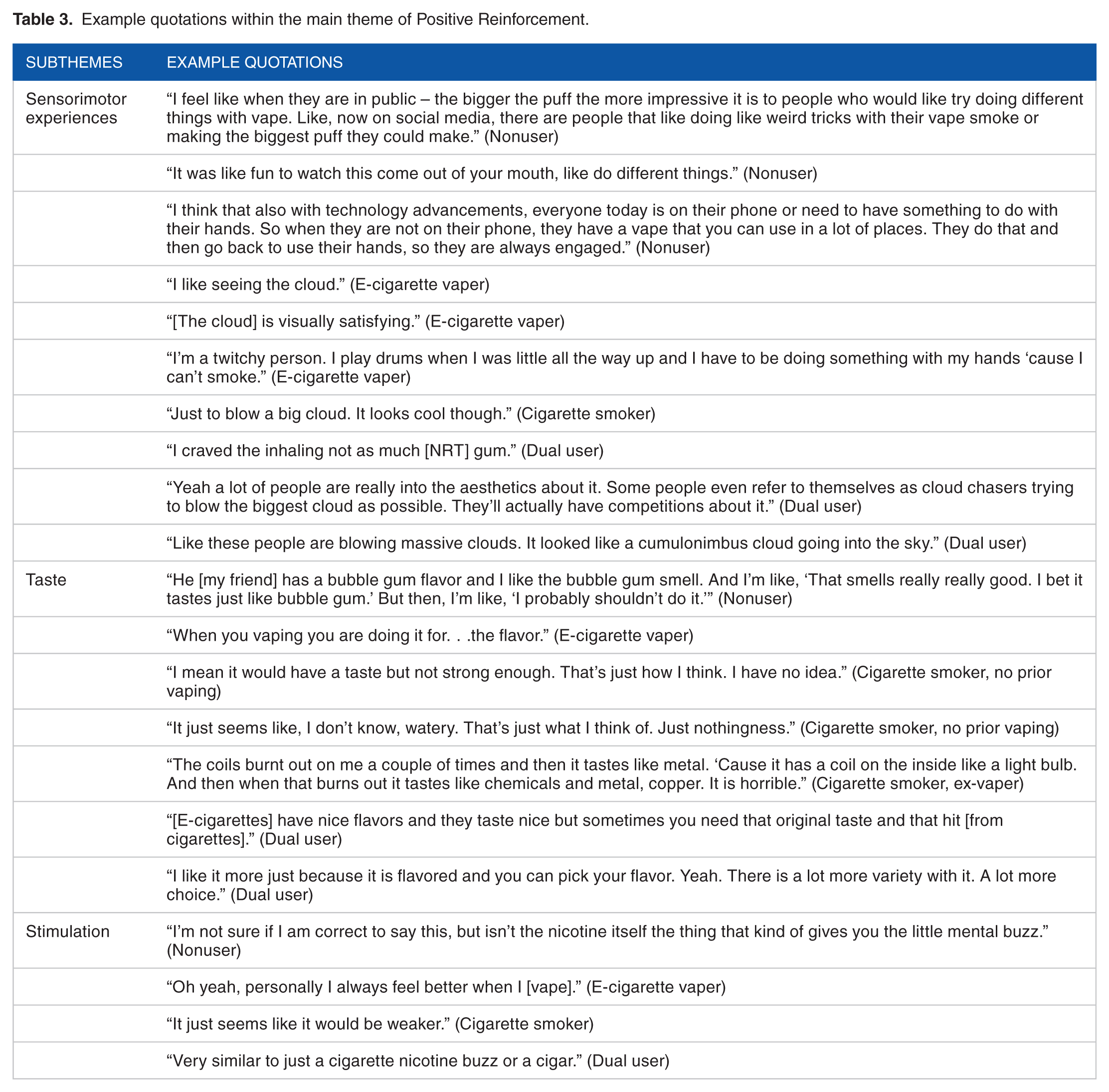
We used the term “sensorimotor experience,” rather than simply “sensory experience” to include hand movements. Nonusers observed that “everyone today is on their phone” and “when they are not on their phone, [e-cigarette users] have a vape,” so they always have “something to do with their hands.” Indeed, users reported they valued being able to do “something with my hands” and “craved the inhaling” experience that was similar to smoking.
“I’m a twitchy person. I play drums when I was little all the way up, and I have to be doing something with my hands ‘cause I can’t smoke so that really does [help]. . . keeping your hands busy and always constantly doing something.” (E-cigarette vaper)
Taste was added as its own category due to repeated mentions, both positive and negative. A nonuser reported curiosity about the flavors.
“He [my friend] has a bubble gum flavor and I like the bubble gum smell. And I’m like, ‘That smells really really good. I bet it tastes just like bubble gum.’ But then, I’m like, ‘I probably shouldn’t do it.’” (Nonuser)
A vaper emphasized that you are doing it for “the flavor,” but cigarette smokers felt it would not be “strong enough” and would be “watery” or “just nothingness.” An ex-vaping smoker also noted issues with “burnt out” coils in the e-cigarette that taste “horrible.” Dual users enjoyed the “variety” and “choice,” but also noted that sometimes you needed the “original taste” and “hit” from cigarettes. There was some disagreement, however, about whether the flavor or the nicotine were more important.
“With me, it is more of a flavor thing ‘cause I’ve always smoked Marlboro Reds and I’ve never had a juice that could replicate that flavor. . . It is kind of an acquired taste after a while. It is just something that a vape can’t really achieve. Maybe it’ll be easier to replicate as time progresses. . . It’s not so much the nicotine thing for me. Just the flavor.” (Dual user)
Participants also commented on the Stimulation effects of e-cigarettes, with all groups repeatedly using the term “buzz” to describe the experience, although some cigarette smokers felt the stimulation would be “weaker.” Users also commented on the ability to modify nicotine dosage.
“I started with a higher level because the average cigarette is somewhere around 32 mg nicotine. You get a really strong buzz. So I went to 12 mg so I would get a little bit of the same feeling but not intense and crazy like it would be.” (Dual user)
“I would say [with vaping] it’s even a bigger social aspect [than smoking] because you have – you don’t have cigarette conventions, you don’t have shops where you go sit down, relax, and smoke. There’s a large social aspect to [vaping] and I think it’s a great thing.” (E-cigarette vaper)
Example quotations within the main theme of Social Benefits.

Another social benefit noted was Influence on Others. Nonusers reported concerns that e-cigarette use was becoming a trend among youth.
“It’s a danger with the art part of it. You make these rings and they look cool and the kids be like, ‘I want to do that’ but then do it later with a real cigarette maybe.” (Nonuser)
In contrast, vapers appeared to enjoy getting others to try the devices, particularly if it could help others quit cigarette smoking. Both vapers and dual users reported that others will “try out” their devices “to see what the craze is all about.”
“I’ve had people walk up to me and ask, ‘What this is?’ And I’ve talked to them about it because a lot of people smoke and are trying to get out of it. So I talk to a lot of people who smoke about vaping and they usually walk away pretty satisfied with the conversation.” (E-cigarette vaper)
Convenience also came up as a notable aspect of e-cigarettes. Nonusers were concerned e-cigarettes are used more than traditional cigarettes “because it is easier and more convenient.” E-cigarette vapers agreed.
“It’s not like a cigarette where you are restricted to certain areas. It’s a lot more accessible and you can use them in a lot more places.” (E-cigarette vaper)
In addition, users appreciated that they can “decide how long you want to do it for instead of the cigarette telling you.”
“So, just to have that convenience of – pull it out, take a puff, and put it back wherever it was – allows you to do whatever you were doing and go about your day and doesn’t really restrict your life.” (Dual user)
On the other hand, cigarette smokers felt that e-cigarette use gets “kind of technical” in terms of maintenance and other issues.
“I think I broke 1 or 2 vape pens and I kept buying them every time. Then the coil went out maybe one time and I just went and bought another $15 pen and just didn’t want to change it out anymore.” (Cigarette smoker)
“I had to smoke a cigarette after my exam too. Smoking e-cigarette, I’m not quite sure. I don’t think it would help.” (Cigarette smoker) “[It] like takes the edge off. In a situation I would smoke a cigarette I would just hit the vape instead. Stressful situations, school which is stress, everything that is stress, I would drive to smoke a cigarette, now I try to lean towards the vape instead.” (Dual user)
Example quotations within the main theme of Negative Affect Reduction.

The pattern was repeated in relation to Appetite Reduction. Nonusers felt that starting one “unhealthy habit” might lead one to start other unhealthy habits. In contrast, a smoker wondered if e-cigarettes would be as effective as tobacco cigarettes.
“It satisfies my hunger, so I’m not really hungry for food because I already chain smoked some cigarettes. But I think if I was to try an e-cigarette my appetite would probably be normal.” (Cigarette smoker)
Dual users disagreed on the effectiveness of vaping for appetite reduction compared to smoking. One reported that either activity “pretty much destroys your appetite.” However, another dual user disagreed.
“Partially. Yes. But then there is another part. I don’t know. It doesn’t do the same thing. For some reason if I smoke a cigarette I feel like I don’t need to eat. I smoke an e-cigarette I feel like, I still am going to go to the kitchen and get that extra slice of pizza. Let’s be real.” (Dual user)
Boredom Reduction responses were similar. Nonusers felt this could be a risky way to deal with boredom, indicating that is how “addictions form,” but vapers felt it would be effective.
“It really does work to cure boredom though. . . I can’t smoke so that really does relieve the boredom factor.” (E-cigarette vaper)
Cigarette smokers felt vaping would be ineffective to reduce boredom for more than “5–10 minutes,” while some dual users felt it may be even more effective than smoking.
“When I am bored yes, e-cigarettes. I don’t normally smoke when I am bored but I might have an e-cigarette or a vape, stuff like that.” (Dual user)
“Compared to someone who doesn’t use e-cigs and doesn’t use any tobacco products at all, you’re obviously not going to be as healthy if you do this because you are still inhaling something that you shouldn’t be, right? Like it’s not air, its high density water vapor, so I mean you are still doing something that is ultimately bad for your body even if it’s not as bad or barely bad at all.” (E-cigarette vaper)
Example quotations within the main theme of Negative Consequences.
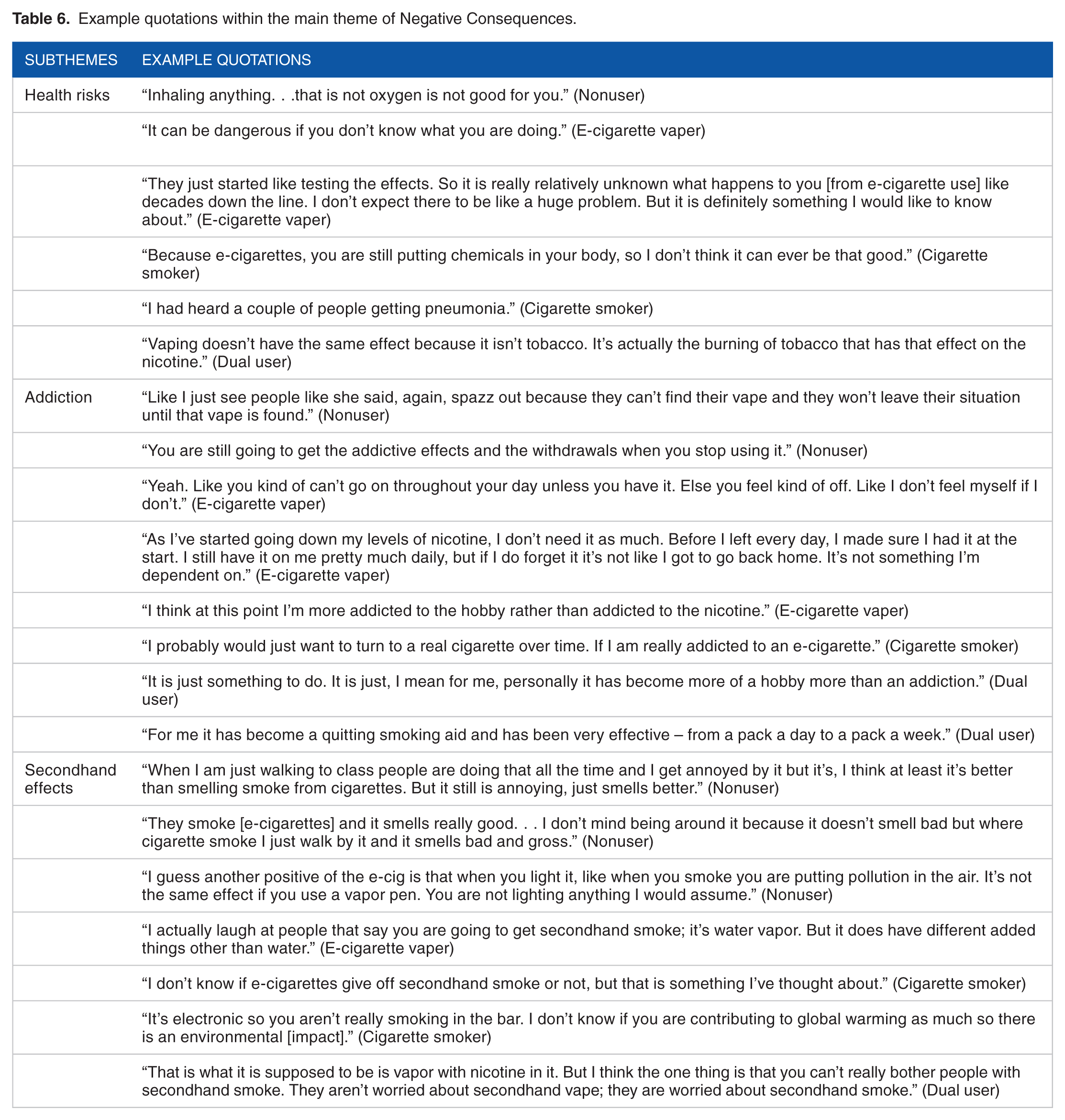
Dual users generally reported that e-cigarettes were much safer than traditional, combustible cigarettes.
“For the 2 years I’ve been doing it, I’ve seen a big difference in my own health in a way. When I started vaping, it was just a thing that I did and I still smoked a pack a day at that point. . . After I finally took the initiative to make it my go-to instead of a go-to cigarette – sometimes it is this [vaping device] and cigarettes sometimes – I’ve seen a difference in my health in a different way where lung function and everything about that [had an] effect. Positive effect.” (Dual user)
Another concern reported was the possibility of Addiction. Nonusers indicated concerns that use could lead to neglecting responsibilities and worried about “the addictive effects and the withdrawals when you stop using it.”
“You [are] probably spending more money on doing these things and taking time away. And if you are our age, it’s taking time away – you guys know – it’s taking time away from homework, your social life, things like that.” (Nonuser)
Some vapers and dual users also reported addiction concerns.
“It is also kind of a dependence thing. Like once you start it you aren’t going to want to stop it because you are going to feel awful. And it is a lot based off of the individual. Some people are more addictive than others.” (Dual user)
However, many denied they were addicted to vaping. Some users regarded vaping as a “hobby,” rather than attributing use to nicotine addiction.
“I definitely do it every day but I feel like I could stop if I really wanted to, you know.” (E-cigarette vaper)
Dual users reported beliefs that e-cigarettes can help them quit their combustible cigarette addiction with some reporting wanting to quit nicotine entirely.
“My long term effect is hopefully going to be quitting cigarettes and it has been working so far and I hope to be done by the time I’m out of school.” (Dual user) “When you have that craving – now I’m craving my vape – I just want a little bit of nicotine. I don’t want all that nicotine that a cigarette is going to give me all the time now. So stepping down to 0 is going to be [my goal].” (Dual user)
Secondhand Effects came up as a novel concern. Nonusers indicated annoyance and concern regarding secondhand effects of e-cigarette aerosol, although some reported that e-cigarette aerosol “smells better” than cigarette smoke.
“But now like because the e-cigarettes are flavored, I don’t mind breathing walking by breathing it in though. But now I kind of want to research it, ‘cause can it cause something in the long term?” (Nonuser)
Vapers and dual users generally reported beliefs of no or minimal secondhand effects from vaping.
“There aren’t any chemicals to be thrown back at anybody. It is just – the only harmful thing that is in it is nicotine if you choose to use it. And you take that up when you inhale it.” (E-cigarette vaper)
Discussion
Studies examining e-cigarette expectancies over the past few years have used measures modified from existing cigarette smoking expectancy questionnaires.26–31 The extent to which items from these measures are relevant to e-cigarette use, particularly among young adults, was uncertain. To address this concern, we conducted focus groups and individual interviews with groups of young adults stratified by e-cigarette use and cigarette smoking. Consistent with theory and survey-based research,23,26,28,31 vapers and dual users reported many benefits of e-cigarette use, whereas nonusers and exclusive cigarette smokers indicated overall skepticism. Some domains previously found to be relevant for cigarette smoking were again mentioned here as relevant for vaping, including the overall themes of Positive Reinforcement, Social Benefits, Negative Affect Reduction, and Negative Consequences.23,43,44 Important potential refinements and novel subthemes were identified for future research.
Positive Reinforcement refers to the various rewarding effects associated with acute drug use. 43 Participants indicated the importance of some of these immediate outcomes, including clouds, hand movements similar to smoking, the tastes of different flavors, and stimulation (“buzz”). There was particular emphasis placed on some experiences novel to e-cigarettes, such as vaping tricks, unique flavors, and various levels of nicotine. Vaping tricks appear particularly influential, given their ability to be posted on social media and be a source of competitive activity.
Social benefits were also noted as important, particularly being able to spend time with friends who smoke cigarettes, as well as visit vape shops and go to e-cigarette conventions. Participants noted “influence on others,” that is, a belief that others who see one vaping might be intrigued by it, as a potential benefit/concern. The importance of this issue may be related to the rapid growth of e-cigarette use over the past decade and the increased value of social connection among this cohort. As noted by other researchers, perception of increased social standing is an important component of e-cigarette use, both among young adults28,36 and among adults in general. 28 “Convenience” was noted as another important construct. This is consistent with positive e-cigarette expectancies identified via concept mapping. 50 Although convenience is not an outcome expectancy per se (because it is not a belief regarding the consequences of vaping), beliefs about issues such as convenience and cost may nevertheless be important drivers of substance use behavior. For example, prior research examining a convenience belief measure among e-cigarette users with a history of cigarette smoking found that, unlike other positive beliefs, convenience was not associated with decreased rates of cigarette smoking. 29 Instead, that study found a trend towards higher rates of continued smoking, perhaps suggesting e-cigarette use allows the “convenient” maintenance of nicotine addiction in locations where cigarette smoking is prohibited. On the other hand, participants also noted that e-cigarette use can be more complicated than cigarette smoking and this may discourage individuals from initiating or continuing e-cigarette use.
Negative affect reduction was noted in relation to stress and other unpleasant emotions, unwanted food cravings, and boredom reduction. Notably, these patterns differed by user group. Nonusers generally expressed concern about vaping as a coping strategy. Exclusive vapers tended to be most positive in their endorsement of e-cigarettes to fill these needs, while cigarette smokers tended to be skeptical. Dual users reported viewing vaping as a tool to avoid smoking, albeit one that was typically inferior to smoking. An exception to this was boredom reduction, where vaping was seen as a more interesting activity than cigarette smoking.
Finally, a number of negative consequences were brought up, including health risks, addiction, and the novel concern of secondhand effects. There was general uncertainty noted regarding potential health risks, although nonusers and cigarette smokers seemed to agree there must be some negative health effects. One cigarette smoker mentioned the potential for pneumonia, an unproven consequence unique to e-cigarettes.51,52 Vapers and dual users tended to be more positive, believing health risks to be minimal if handled properly and certainly much less than smoking. Secondhand effects were also reported as a concern. Most smoking expectancy measures were created before the Surgeon General’s report on secondhand effects of smoking. 53 Dangers associated with secondhand effects of either smoke or aerosol are now much more widely appreciated, which may explain why this issue emerged as a new concern. Again, these young adults were uncertain about possible effects from e-cigarette aerosol, but generally thought it was much less risky, and better smelling, than cigarette smoke.
Overall, the findings indicated some overlap between e-cigarette vaping and cigarette smoking expectancies, but also revealed some areas that may be missing and should be studied further. Cigarette smoking expectancy measures have a long history in research related to understanding initiation, dependence, and treatment of cigarette smoking. 54 Research on e-cigarette vaping expectancy measures to date suggest they can similarly be helpful.28,29,55 The present findings support the relevance of prior literature and add to our understanding of similarities and differences between smoking and vaping expectancy measures, particularly the differences by user group among a young adult population.
Limitations
There are some limitations to this study that should be noted. An important limitation is the difference in the sizes of each group, which may have biased the results and categories that were coded. Future studies may consider different inclusion criteria. Data collection involved two interviews in addition to the focus groups. This allowed for more of a perspective from the relatively rare and likely more risky group of dual users.41,42 However, interviews may yield different content than focus groups. Focus groups allow for interaction data resulting from participants questioning one another and commenting on each other’s experiences, but also creates social contexts that may result in concealment of certain information. Interviews, on the other hand, avoid both the advantages and disadvantages of focus groups. Combining these two types can allow for confirmation across data collection techniques and enhancement of the richness of the data, but the potentially divergent epistemological assumptions inherent to the two methods need to be considered. 56 Future research may consider including larger numbers of both interviews and focus groups to help address how information obtained varies by type in relation to this issue.
Our relatively small sample is unlikely to be representative of the population as a whole. However, the purpose of this study was the identification of themes for further field testing. Tests with larger groups will help assess generalizability. Further, although a strength of this study is the inclusion of young adults from diverse racial, ethnic, and education backgrounds with a variety of different patterns of cigarette smoking and e-cigarette use, there were some limitations in participant diversity. First, the sample was majority male. Although this is similar to e-cigarette users in the general population,15,57 it should be noted that female e-cigarette users and smokers may have different attitudes.58,59 Our inclusion criteria defined dual users as past-week use of both substances, unlike other studies that defined dual use based on past-month usage.41,42 For this qualitative study, we preferred past-week use so that participants could easily recall their experiences and provide a detailed and accurate responses to the prompts. In addition, nondaily users were excluded. These decisions may have resulted in a relatively smaller, more experienced groups due to their more recent use of both substances and daily use of at least one substance. On the other hand, use and nonuse were defined in part using the demarcation of 50 lifetime use occasions, rather than the 100 cigarettes criteria sometimes used.60,61 Few participants in this study used between 50 and 100 times, but they nonetheless may differ from other classifications. These may be worthwhile subpopulations to evaluate in future research. Finally, data collection was conducted before the advent of widespread “pod mod” and Juul use, 62 which should be investigated in subsequent studies.
Implications
A variety of interventions to discourage uptake of e-cigarettes among nonsmoking youth, and perhaps, if justified, to encourage smokers to switch to e-cigarettes, are possible. These could include marketing regulations, labeling requirements, and counter-messaging development. Success of these techniques will be enhanced by a clear and compelling research base involving relevant constructs, such as expectancies. Field testing and further refinement of these e-cigarette expectancy themes and associated items will provide critical data on young adults’ likelihood to engage in this rapidly increasing behavior, as well as a tool to enhance research, clinical, and public health efforts. Examining expectancies and other constructs in more detail can aid in providing a fuller picture of e-cigarette beliefs and, thus, more informed targets for intervention.
Footnotes
Acknowledgements
We thank Jean Forster and Thomas Eissenberg for input and advice regarding focus group interpretation. We further thank Bryanna Vesely for help in recruitment, scheduling, and conduct of focus groups, as well as Research Assistants Lauren Marshall, Jillian Phillips, Leigh Sitler, Thomas Small, and Jacob Smith for assistance in coding and formatting. We thank all study participants for their participation.
Funding:
The author(s) disclosed receipt of the following financial support for the research, authorship, and/or publication of this article: Research reported in this publication was supported by grant number R03CA195124 from the National Cancer Institute at the National Institutes of Health (NIH) and Food and Drug Administration (FDA) Center for Tobacco Products. The content is solely the responsibility of the authors and does not necessarily represent the official views of NIH or the FDA.
Declaration of conflicting interests:
The author(s) declared the following potential conflicts of interest with respect to the research, authorship, and/or publication of this article: Author THB receives research support from Pfizer, Inc. No other conflicts of interest are declared.
Author contributions
PTH led the manuscript writing and revision process and the interpretation and synthesis of transcripts, with input from THB, KJE, TEB, LOB, VNS, and GPQ. THB provided project mentorship. GPQ provided qualitative expertise consultation. LOB assisted with revisions. All authors read and approved the final manuscript.”
Human Subjects Statement
This study was approved by the Eastern Virginia Medical School IRB.
