



Abstract
Background:
Young adults are increasingly using electronic nicotine delivery systems (ENDS). The standard ENDS device involves an electric coil that heats a wick to vaporize an e-liquid solution. “Dripping” is another method that involves applying e-liquid directly to the coil. Dripping increases risk of harmful toxic compounds in vapor aerosols. Despite evidence of high levels of dripping among adolescents, young adult prevalence is unknown.
Methods:
Young adults aged 18 to 24 completed an online survey assessing vaping and dripping status, type of devices used, tobacco use, and vaping expectancies. Among ever-vapers, univariate and multivariate logistic regression models assessed whether demographics predicted dripping and use of dripping devices. Multivariate Analysis of Variance compared never- and ever-drippers on expectancies for vaping outcomes.
Results:
Over 2 in 5 young adult ever-vapers (43.7%) reported dripping. A multivariate regression model found that male gender (AOR = 1.83), identifying as White (AOR = 2.37), and use of other tobacco products (hookah; AOR = 1.91; cigars; AOR = 2.26; cigarettes; AOR = 2.51) were associated with dripping. E-cigarette users who reported lifetime dripping were more likely to consider vaping stimulating, socially facilitating, and flavorful. They ascribed lower health risks to vaping and felt it could reduce negative affect, weight gain, nicotine cravings, and boredom (all P < .05).
Conclusion:
Dripping was a highly prevalent behavior among this sample of young adults, particularly among White males. These findings point to the importance of gaining a greater understanding of the drivers and consequences of vaping and dripping behavior.
Introduction
There has been a dramatic increase in the use of electronic nicotine delivery systems (ENDS) in recent years.1,2 This increase is largely driven by young adults (ie, 18-25). From 2011 to 2019, ENDS use (ie, vaping) for 12th graders increased from 1.5% to 27.5%. 3 Analysis of college students by Monitoring the Future found that from 2017 to 2018, past-month vaping increased from 6.1% to 15.5%, which the authors noted was one of the largest year-to-year increases in the 40-year history of the survey. 4 The growth of vaping undermines other successful efforts to lower tobacco use among young adults. 2 Thus, more research is needed to understand vaping trends, including alternative vaping behaviors, with this population.
A notable trend of somewhat unclear popularity involves dripping e-liquid onto heated coils to create vapors for inhalation. 5 Dripping is concerning because it entails greater harm for users through increased exposure to toxicant emissions from higher combustion temperatures of e-liquids. 6 Most ENDS devices are designed so that e-liquids are absorbed into a cotton wick. The wick prevents e-liquids from over-heating. When e-liquids overheat, or the coils dry out, users experience an unpleasant taste called a “dry puff.” The term dry puff refers to users’ experience of inhaling a burnt taste from overheated e-liquids. Overheated e-liquids are more likely to produce toxicants in aerosol vapors, such as volatile aldehydes associated with lung disease. 7 Dry puff conditions are more likely when dripping because users have to manually apply e-liquids to the coils. 6 There is evidence that dry puff conditions yield increased toxicity in aerosol clouds.6,8 However, there is also debate about the level of toxicity and how often users experience dry puff conditions.8,9 Still, dripping is more likely than standard e-cigarettes to produce toxic aerosols due to the increased likelihood of dry puff conditions. 6
There is little research investigating ENDS users’ perceptions about the expected consequences that is, expectancies 10 ; of dripping. Expectancies are beliefs about the outcome of a behavior that robustly correlate with and predict behavior.11,12 Understanding vaping expectancies is important because expectancies predict tobacco dependence and smoking cessation intentions.13-15 Adolescents list increased throat hit, improved flavor and tastefulness, and ability to control vapor clouds as reasons for dripping. 5 However, it is unclear if young adults share similar reasons or perceptions regarding dripping.
Surveys of adolescent high-school students who reported having ever used an ENDS device (ie, ever-users) in Connecticut from 2015 to 2017 found that approximately 20% had tried dripping.5,16 Dripping has been associated with other risky health behaviors, including an increased likelihood of lifetime tobacco use. 16 A sample of adolescents aged 15 to 17 recruited via social media found that among current (past-month) ENDS users, 46% reported ever trying dripping. 17 Another study examining Southern Californian high school students in 2015 to 2016 found that 87% of current e-cigarette users reported ever dripping. 18 We could find no reports regarding young adult rates of dripping.
Dripping can be accomplished in 2 main ways. First, users can modify (“hack”) devices to drip e-liquids directly on coils. This type of dripping involves altering devices in ways unintended by the manufacturer. 19 Second, users can buy devices commercially designed for dripping. Direct dripping atomizers (DDAs) and rebuildable dripping atomizers (RDAs) allow users to fit a “drip tip” mouthpiece over the atomizer (ie, a coil attached to battery posts housed on a deck). With DDAs and RDAs, users can drip onto exposed coils or draw e-liquids from tank reservoirs. 20 Automated dripping devices (ADD) are manufactured devices that allow for the benefits of dripping but are less complicated to use. 21 “Squonk mods” are dripping devices where users can squeeze (ie, “squonk”) a button that feeds e-liquid onto the coils. Initially produced by vaping enthusiasts, manufacturers eventually began mass producing devices, such as the KangerTech Dripbox. Despite the apparent popularity of dripping devices, there appears to be no research about the prevalence of dripping devices among users.
Further, while some studies have investigated dripping among adolescents and youth,5,16 there appear to be no published reports documenting dripping or ADD use among young adults. As tobacco use typically begins or stabilizes in young adulthood,22,23 more research is needed to understand dripping behaviors within this population. This study used a cross-sectional survey to better understand dripping behaviors of young adults. The survey was guided by the following research questions: What is the prevalence of young adult dripping and ADD use? What are the characteristics of drippers as compared to non-drippers? Is dripping driven by similar expectancies among young adults as for adolescents? To answer these questions, we conducted a secondary analysis of a survey of young adults, measuring frequency of ENDS use (ie, vaping), dripping behaviors, type of ENDS device used, tobacco use behaviors, and expectancies about the consequences of vaping.
Materials and Methods
Participants and procedures
Young adults (ie, 18-24) were recruited from a community college in a Southeastern city in the US in the summer of 2017. All enrolled students (N = 7861) were sent an invitation to participate in the survey. Of these students, 1876 (24%) opened the invitation e-mail, 60 opted out, 873 clicked through to participate, 734 started the survey, and 579 completed the entire survey, indicating an acceptable response rate of 31% of those who opened the e-mail.24,25 Some partial entries are included. Our results are from a secondary analysis of a larger project to develop a measure of electronic nicotine vaping outcomes. 26 Participants were paid $10 (via Amazon gift card) upon completing the survey. A medical school institutional review board approved all research, and the community college consented to the research and provided email addresses for recruitment.
Measures
Demographics
Participants were asked to report gender identification (1 = Male, 2 = Female, 3 = MTF Transgender, 4 = FTM Transgender, and 5 = prefer not to say), racial identification (1 = American Indian or Alaskan Native, 2 = Asian, 3 = Black or African American, 4 = Native Hawaiian or Other Pacific Islander, 5 = White, and 6 = Other), and age. Ethnicity was measured by asking if participants identified as Hispanic, Latina/o, or Spanish origin (Yes or No). For analytical purposes, we created a 4-category variable (1 = Black or African American, 2 = White, 3 = Hispanic, Latina/o, or Spanish origin, 4 = Other).
Vaping status
Participants were asked if they had ever used or tried a vaping device (eg, e-cigarette, vape, or tank). Responses included, 1 = No, 2 = Yes, but not in the last 6 months, or 3 = Yes, in the last 6 months. Next, participants were asked how many days they had used a vaping device of the last 30 days. Responses included, 1 = Every day, 2 = Almost every day, 3 = Once or twice a week, 4 = A few times a month, 5 = Once, and 6 = I did not use a vaping device in the last 30 days. Vaping status was dichotomized as “never-vaper” (No, never used or tried a vaping device) or “ever-vaper” (Used or tried a vaping device in lifetime: either in the last 6 months or previously) for analyses. Participants were asked when they had first used a vaping device (eg, electronic cigarette, vape, vape-pen, etc.). Responses ranged from 10 years old or younger to 25 years or older. The first used vaping device variable was categorized as “under 18,” “18 years old,” or “19 years old or older.”
Dripping status
Participants were asked if they had ever used (or tried) a dripping method to add e-liquid to an e-cigarette, even once. Responses included, 1 = No, 2 = Yes, but not in the last 6 months, or 3 = Yes, in the last 6 months. Dripping status was dichotomized as “never-dripper” (No, never used or tried a dripping method) and “ever-dripper” (Used or tried a dripping method in lifetime: either in the last 6 months or previously).
Type of device used
Participants indicated the types of devices they had used to vape, even once. Options included, disposables, cartridge-based devices, refillable tank systems, a dripping device (eg, dripbox, squonk mod, or bottom feeder mod), and other (please specify). Participants were then asked to indicate which device(s) they currently used most often.
Tobacco use
Participants were asked if they had ever used (or tried) a cigarette, little cigar or cigarillo (such as “Black & Milds”), or hookah (a water pipe used for smoking). Responses ranged from, 1 = No, 2 = Yes, and 3 = Yes, in the last 6 months. Each tobacco product was dichotomized as “never used” (No, never used or tried) or “ever used” (Used or tried: either in the last 6 months or previously). Participants indicated which tobacco product they used first: 1 = cigarette, 2 = ENDS, 3 = cigar, 4 = hookah, or 5 = other.
Brief Vaping Consequences Questionnaire for Adults (BVCQ-A)
Expectancies for vaping outcomes items were adapted from the brief smoking consequences for adult scale. 27 Similar to prior research, 10 items were modified for use for e-cigarette use rather than cigarette smoking. Specifically, all participants were informed at the beginning of the survey that “‘vaping device’ refers to electronic devices used to vaporize and inhale nicotine, such as electronic cigarettes, e-cigarettes, e-vapes, vapes, vape-pens, mods, tanks, and e-hookah.” Items for the BVCQ-A were also modified to use the term “vaping” rather than “use an e-cigarette.” The measure we used involved 10 sub-scales: (1) negative affect reduction (example items: “Vaping calms me down when I feel nervous”; “Vaping will relax me.”), (2) stimulation (“An e-cigarette can give me energy when I’m bored or tired.”; “I enjoy the nicotine buzz from e-cigarettes”), (3) social facilitation (“I feel more at ease with other people if I have an e-cigarette”), (4) weight control (“Vaping keeps my weight down”), (5) taste (“I will enjoy the flavor of an e-cigarette”), (6) boredom reduction (“When I’m alone an e-cigarette can help me pass the time”), (7) craving (“Vaping will satisfy my nicotine cravings, (8) health risks (“The more I vape, the more I risk my health”), (9) negative physical feelings (“Vaping irritates my mouth and throat”), and (10) stigma (“I look ridiculous while vaping”). Items were rated on a scale from 1 to 5. Cronbach’s α reliabilities ranged from .69 to 93 and were comparable to prior research using the BVCQ-A. 10
Analytic strategy
SPSS 25 was used to analyze data. Binary logistic regression was used to assess whether demographics (gender: male vs female or other, age: 18-19 vs 20, 21-22, or 23-24, race/ethnicity White non-Hispanic, Hispanic, and Other vs non-Hispanic Black African American), and other tobacco product use (ever use: cigarettes, cigars, and hookahs) predicted use of device type (ie, cartridge, refillable, or dripping device) and never-dripping (vs ever-dripping) for ever-vapers. A series of bivariate logistic models were first run with the individual predictors, followed by a second binary logistic regression model controlling for all predictors (see Tables 2 and 3). Multivariate Analysis of Variance (MANOVA) assessed differences between never-drippers and ever-drippers on expectancies for vaping outcomes. For the MANOVA, dripping status (never vs ever) was the independent variable, with the 10 expectancies for vaping outcomes as dependent variables (see Figure 1).

MANOVA comparisons between never-dripper (n = 165) and ever-dripper (n = 140) e-cigarette ever-users on expectancies for vaping outcomes (BVCQ-A).
Results
Participant characteristics
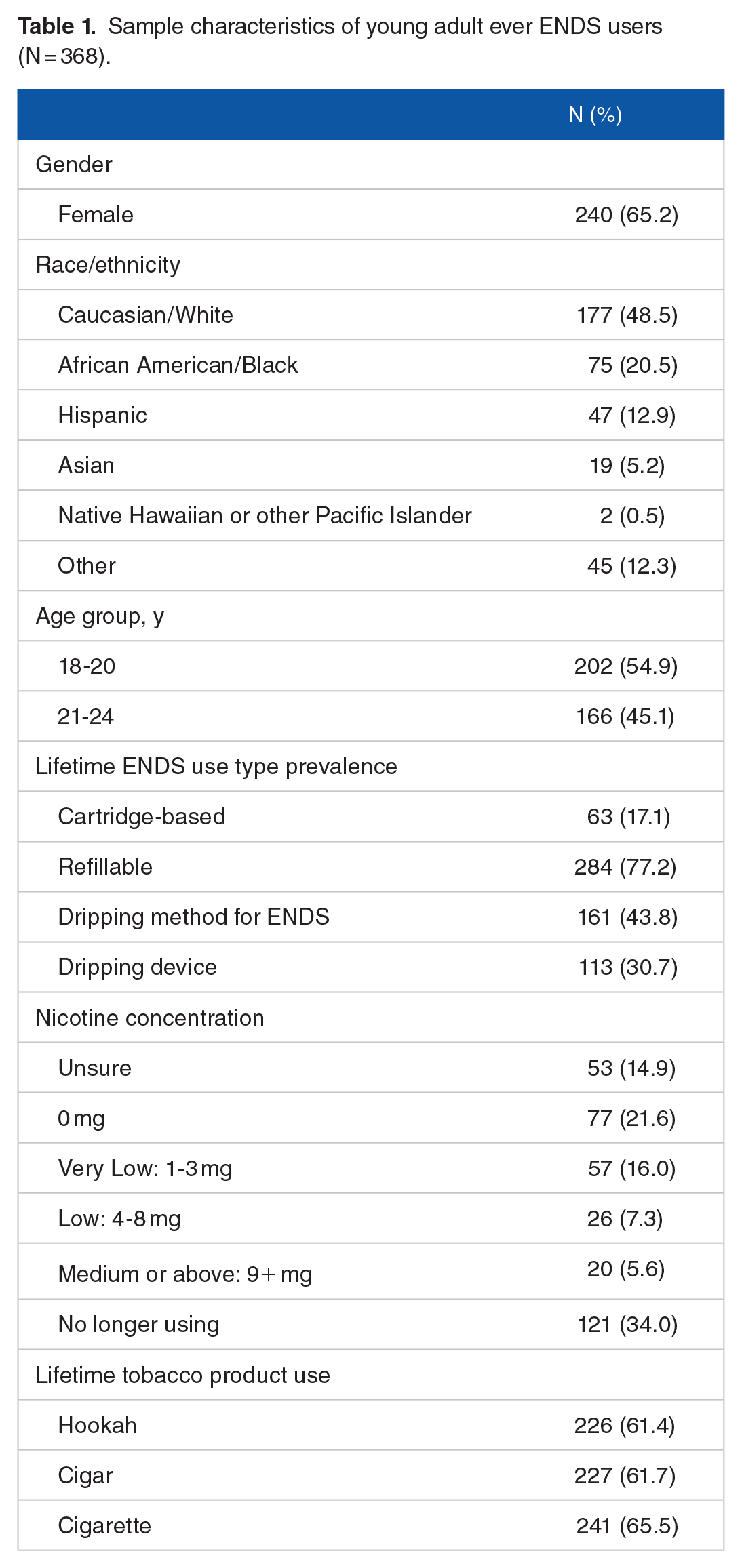
Participant characteristics are shown in Table 1. Of the total sample (N = 733), approximately half were ever-vapers (n = 368); while the other half reported no lifetime history of vaping (n = 365). Among ever-vapers, the majority identified as female (65.2%), White (48.5%), non-Hispanic (87.2%), and 18 to 20 years old (54.9%). For ever-vapers (N = 368), 56.3% reported never-dripping (n = 207) versus 43.8% for ever dripping (n = 161).
Sample characteristics of young adult ever ENDS users (N = 368).
Most used devices for ever-vapers
Among ever-vapers, the most used vaping devices were refillable tanks (n = 284, 77.2%), dripping devices (n = 113, 30.7%), cartridge-based devices (n = 63, 17.1%), and disposables (n = 92, 25.0%).
Associations between predictors and lifetime history of type of electronic device
Ever drippers were more likely to be male (AOR = 1.83, P < .05) and White (AOR = 2.37, P < .05), or self-identified as Other for racial/ethnic category (AOR = 2.44, P < .05). Ever drippers were more likely to have used hookahs (AOR = 1.91, P < .05), cigars (AOR = 2.26, P < .05), or cigarettes (AOR = 2.51, P < .05). For type of device used, being male (AOR = 1.81, P < .05), identifying as White (AOR = 4.88, P < .05) or as Other racial/ethnic category (AOR = 2.77, P < .05) predicted using dripping devices. For full results, see Table 2 (univariate) and Table 3 (multivariate).
Univariate associations between predictors and lifetime history of type of electronic nicotine use.

Abbreviations: 95% CI, 95% confidence interval; OR, odds ratio.
Dripping device (dripbox, squonk mod, bottom feeder mod).
Little cigar or cigarillo (such as “Black & Milds”).
Multivariable logistic regression results predicting lifetime history of type of electronic nicotine use.

Abbreviations: 95% CI, 95% confidence interval, AOR, adjusted odds ratio.
Dripping device (dripbox, squonk mod, bottom feeder mod).
Little cigar or cigarillo (such as “Black & Milds”).
Expectancies for vaping outcomes: Never-drippers versus ever-drippers
MANOVA multivariate results showed a significant main effect for dripping behavior on vaping outcome expectancies, Wilks’ Λ = .71, F (10, 581) = 12.08, P < .001,
Discussion
Despite evidence that dripping may have serious adverse health effects 6 and is a popular trend for adolescents,5,16 there appeared to be no studies on young adult dripping behaviors. We surveyed young adult community college students about vaping, dripping, and tobacco use to address this gap in the literature. Results showed that over 2 in 5 young adult ENDS users reported dripping, which is higher than the approximately 1 in 5 in adolescent reports. 16 Ever-drippers were more likely to be male and White and have smoked hookah, cigars, and cigarettes. For vaping expectancies, ever-drippers (vs never-drippers) were more likely to consider vaping to have positive outcomes, such as reduced negative affect, social stimulation, and ability to control weight and reduce boredom. These findings point to the importance of gaining a greater understanding of the drivers and consequences of vaping and dripping behavior and the potential health consequences of dripping, particularly given concerns about respiratory effects. 28
Our results are important for identifying the prevalence of dripping within a young adult sample. In our survey, over 2 in 5 young adult ENDS users reported dripping. This is a higher number than recent surveys showing 1 in 4 (26.1%) adolescents having dripped. 16 Although these results are preliminary, they identify higher dripping rates for young adults. Since there are no published reports about dripping behaviors with this population, our results help set the agenda for future research in this area. However, more research is needed to determine if young adults show consistently higher rates of dripping and whether these rates are maintained. Given new developments within ENDS technology, particularly the use of nicotine salts and pod-mod devices,29,30 it is unclear the extent to which dripping remains a popular activity among youth. Nonetheless, it should be noted that trends within substance use technology tend to repeat themselves, for example, Duell et al. 31 Further, it is vital to maintain an accurate history of substance use prevalence as we attempt to disentangle health effects on substance users in the decades to come.
When considering these findings, it is important to note past research criticisms for imprecise wordings on dripping-use questions, see, Polosa and Howard. 32 In light of this issue, we included items designed to capture the prevalence of use for different devices, including drippers. Among ever-vapers, the most used vaping devices were refillable tanks, dripping devices, cartridge-based devices, and disposables. These results differ slightly from research documenting trends in ENDS use for adolescents from 2017 to 2019. 33 For instance, Bold et al 33 found that use of disposables had increased over time from 2017 to 2019, while mod use had decreased. In our sample from 2017, RDAs, refillable tanks, and drippers were more popular than cartridge devices or disposables.
Further, our results showed that being 19 years old or older (vs 18 years old) when first used a vaping device was associated with cartridge use and use of refillable devices. These results show adoption of vaping during young adulthood within our sample and further suggest potential differences between adolescents and young adults on device type preference and patterns of adoption by age. These results are cross-sectional and preliminary, however, and more research is needed to investigate whether transitioning from adolescence to young adulthood is associated with parallel transitioning for device preferences among ENDS users.
In terms of participant profile, ever-drippers in our sample were more likely to be male, White, and also more likely to smoke hookah, cigars, and cigarettes. Our results comport with previous research showing males to be more likely to vape, and use ENDS devices. 34 Results also align with previous research linking the prevalence of dripping with other tobacco-product use. 16 However, our findings on race and ethnicity depart from previous findings on health-risk behaviors among young adults. Recent research found no differences for ethnicity on lifetime (vs never) ENDS use for a young adult sample. 35 Our results showed that participants who self-identified as White or as other race were more likely to drip than self-identified Black or African American respondents. Although these results should be interpreted with caution, they point to possible associations between gender, ethnicity, dripping, and other tobacco use, thereby highlighting possible future research areas.
One unique contribution of this paper is the exploration of different expectancies for vaping outcomes between never-drippers and ever-drippers. As noted, dripping is a distinct form of vaping that requires users to either modify their device or purchase a device specifically designed for dripping.20,21 The act of dripping presents greater risk for users 6 ; thus, it is important to understand perceptions that motivate dripping behaviors. Past research showed that respondents dripped for various reasons, including making larger clouds or performing vape tricks.5,16,19 However, no research has investigated outcome expectancies for ever-drippers. Tobacco-use expectancies have been found to predict tobacco dependence and smoking cessation intentions.13,14 Similarly, smokers perceived less negative consequences for vaping. 10 However, there is no research on how ever-drippers perceive and understand the consequences of vaping.
Our results found that ever-drippers (vs never-drippers) were more likely to consider vaping stimulating, socially facilitating, and flavorful. Ever-drippers ascribed lower health risks to vaping and felt vaping could reduce negative affect, weight gain, nicotine cravings, and boredom. Some of these effects may be due to actual differences in the levels of nicotine released by dripping as opposed to standard electronic nicotine use. 6 These results suggest ever-drippers underestimated possible health risks of dripping and arguably over-estimating health benefits. Results could be explained by ever-drippers in our sample being unaware of the health risks of dripping (eg, toxicity from dry puffs) or aware but less concerned about those risks. The cross-sectional nature of the survey does not allow for comment on the directionality of effects. Still, it is noticeable that there were significant differences between never- and ever-drippers on 9 of 10 vaping expectancy outcomes (see Figure 1). More research is needed to understand better if ever-drippers perceive and understand negative and positive health consequences of vaping differently than vapers who never drip.
The results of this study should be interpreted in light of limitations. Our survey relied on a convenience sample of community college students. The findings need to be reproduced in other samples. Further, we used a cross-sectional survey design, which cannot speak to causality. A longitudinal design may better describe the causal effects of vaping and dripping over time. Our dripping question captured whether participants had ever dripped and self-reported history of dripping but did not include an “I don’t know” response option. New or experimenting ENDS users may have dripped with an ADD or squonker device without realizing they were dripping. Future research could explore awareness of dripping among ENDS users, especially when using manufactured devices that automate dripping processes. The expectancy items captured vaping expectancies broadly, and even though dripping is a form of vaping, more work is needed to target expectancies specifically about dripping. The current survey only demonstrates that ever-drippers (vs never-drippers) differ in their vaping expectancies. Finally, a more discrete analysis among historically marginalized populations (eg, racial, ethnic, gender, and sexual minorities) could better understand how dripping behaviors manifest across different populations. We present these limitations to aid future research examining the intersection of vaping, dripping, tobacco use, and outcomes expectancies for young adults.
Conclusions
The long-term health consequences of ENDS use are uncertain. It is important to understand the diversity of ENDS use to help determine which ENDS may be harmful under which use conditions. Dripping represents one important form of ENDS modification and ENDS use that may modify future health outcomes. Although reports on adolescent rates are available, this is the first report on young adult use and the first to report on rates of use of Automated Dripping Devices. This survey of young adults revealed several interesting results concerning vaping, dripping, tobacco use, and expectancies for vaping outcomes. Our results found that ever-drippers were more likely to be male and to have tried multiple other tobacco products. Ever-drippers had different expectancies for vaping outcomes compared to young adults who had used ENDS but never dripped. By identifying characteristic differences for ever-drippers, this study provides a foundation for assessing the prevalence of dripping among young adult populations and informs future research aimed at investigating tobacco-use behaviors among this cohort.
Footnotes
Acknowledgements
We thank Kelli England for assistance in survey set-up. We further thank Jacob Smith and Tidewater Community College for assistance in survey recruitment. We thank all study participants for their participation.
Funding:
The author(s) disclosed receipt of the following financial support for the research, authorship, and/or publication of this article: Research reported in this publication was supported by grant number R03CA195124 (PI: Harrell) from the National Cancer Institute (NCI) at the National Institutes of Health (NIH) and Food and Drug Administration (FDA) Center for Tobacco Products (CTP). PTH’s work on this paper was supported in part by the Virginia Foundation for Healthy Youth (VFHY) contract number 8521065 (PI: England). ZM’s work on this paper was supported by the National Institute of Drug Abuse of the NIH and FDA CTP (R01DA047397, PI: Popova). NIH, FDA, and VFHY had no role in the study design, collection, analysis, or interpretation of the data, or writing the manuscript. The content is solely the responsibility of the authors and does not necessarily represent the official views of VFHY, NIH, or the FDA.
Declaration of conflicting interests:
The author(s) declared no potential conflicts of interest with respect to the research, authorship, and/or publication of this article.
Author Contributions
PTH was responsible for the study concept, design, statistical analysis, and paper outline. ZBM drafted the initial manuscript, assisted with data analysis, and assisted with interpretation of findings. TEM assisted with data analysis and formatting tables. ZBM, LOB, TEM, and PTH provided critical revisions of manuscript drafts for important intellectual content. All authors critically reviewed content and approved the final version of the manuscript for publication.
