




Abstract
Introduction:
Rapid increase in youth use of Electronic Nicotine Delivery Systems (ENDS) led the state and the federal governments to implement minimum-age policies to restrict minors’ access to vaping products. Limited success of the age restrictions fueled efforts to increase the distribution age of all tobacco products to 21 (ie, Tobacco 21 or T21 policies). With limited data on the T21 policies, the current study examines the prevalence of ENDS use and the perceptions about ENDS among youth in the pre- and post-policy-implementation periods for one of these bans in the state of Florida.
Methods:
This study conducted secondary analysis on the responses from the 2014 and 2015 Florida Youth Tobacco Survey, which collected cross-sectional data.
Results:
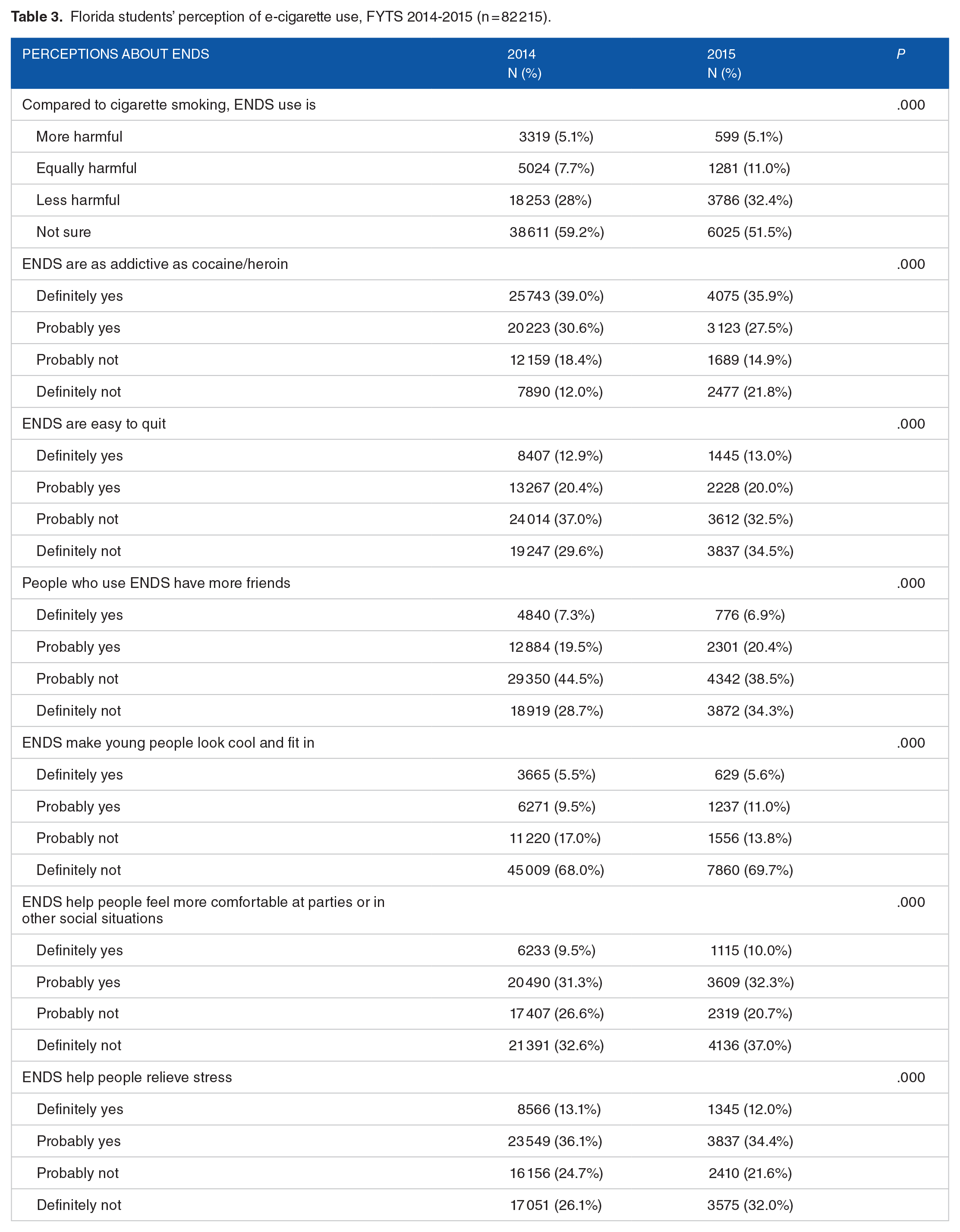
Compared to the data from spring of 2014, the minimum-age policy enacted on July 1, 2014 did not lead to a significant decrease in Florida’s high school and middle school students’ ever ENDS use (14.9% in 2014 vs 25.8% in 2015) and current ENDS use (7.5% in 2014 vs 12.4% in 2015). There was some ambiguity among students regarding the ENDS harm—more students in 2015 thought of ENDS as both equally (11.0% vs 7.7%) and less (32.4% vs 28%) harmful than cigarettes. There was a decrease in the proportion of students who were unsure about their answer to this question (51.5% vs 59.2%).
Conclusions:
Policy change alone may not be effective in shifting the trend of ENDS use among middle and high school students. Although students may know about some of the ENDS effects, many of them are still not aware about the harms. Interventions in school and in the community should be aiming to raise this awareness.
Introduction
Electronic Nicotine Delivery Systems (ENDS) include electronic cigarettes (e-cigarettes), hookah pens, vape pens, vaporizers, e-pipes, and other vaping products with nicotine. ENDS rise to popularity among youth has become especially concerning in the past few years. In the past decade, current use of ENDS (ie, defined as use at least once in the previous 30 days) among middle school and high school students has increased from 0.6% (2011) to 10.5% (2019)1,2 and 1.5% (2011) to 27.5% (2019)1,2 respectively.
Popularity of ENDS among youth can be attributed to the perception that vaping devices are safer than cigarettes; curiosity about tobacco-containing technological innovations; attraction to the varied flavors; vulnerability to peer influence; and attempts to cease cigarette smoking.3-5 Developmental changes in the nervous system put youth at higher risk for nicotine addiction.6,7 Nicotine-containing vaping products can lead to not only continuous use into adulthood, but also cigarette smoking in people who had previously never smoked.8,9 Public health advocates are concerned about the presence of harmful ingredients in ENDS (eg, carcinogenic nitrosamines, metals, carbonyl compounds, oxidants/reactive oxygen species, and irritants), spontaneous explosions of vaping products, and e-cigarette or vaping product use-associated lung injury (EVALI).10-12
On July 1st, 2014, the state of Florida introduced a minimum age policy (SB 224), which outlawed the sale of ENDS to people under the age of 18 (ie, minors). This bill also prohibited providing free samples to minors, displaying containers with ENDS (unless those containers were inaccessible to customers), and selling ENDS in vending machines. These restrictions did not apply to retailers that already restricted access to their premises to adults. This policy also required retailers to have an age identification system in use at the point of sale and to post signage notifying of these changes. Review of data collected prior to and after the implementation of this policy may better inform successful public health strategies to deter the onset and promote cessation of ENDS use among youth. The primary objective of this study is to examine the prevalence of ENDS use among middle and high school students before and after the ban. The secondary objective of this study is to examine middle and high school students’ perception of ENDS use before and after the ban.
Method
Recruitment
The present secondary analysis study examined results from the cross-sectional Florida Youth Tobacco Survey (FYTS) to examine the trends in pre- and post-minimum-age policy implementation. The FYTS’s 2014 results were selected as the pre-policy data and students’ responses on the FYTS 2015 were selected as the post-policy data. The 2014 and 2015 FYTS are part of the annual statewide, school-based confidential surveys administered in the spring to Florida’s public middle and high school students (6-12 grade levels). 13 At the time of this cross-sectional survey, the student participants were aged 9-21 years and resided in Florida. The FYTS is based on a two-stage cluster probability sampling. The first step of this design was a random selection of public middle and high schools. Classrooms were randomly selected from each recruited school. All students in the selected classrooms were invited to participate in the FYTS.
ENDS Use
The ever ENDS use definition and question was worded as vaping ENDS at least once in a lifetime, and the current ENDS use was defined as using ENDS at least once in the previous 30 days. Because the frequency of ENDS use was not asked until the 2015 FYTS, this question was omitted from the analysis. The following questions were selected to examine the ever ENDS use: “Have you ever tried, even once, using an electronic cigarette?” and “Have you ever used an electronic vapor product?” The current ENDS use was described with responses to the following questions: “During the past 30 days, have you used an electronic cigarette?” and “During the past 30 days, on how many days did you use an electronic vapor product?”
Perceptions about ENDS and ENDS Use
The Socio-Ecological Model (SEM) guided the selection of factors for this study. 14 The SEM presents five levels of factors that can influence behavior: intrapersonal, interpersonal, organizational, community, and policy. Intrapersonal factors, such as perceptions about tobacco products, have immediate influence on individual behavior and were our starting point for the study.
Similar to the questions on the ENDS use, questions related to youth perception about ENDS varied in wording between the two years. However, response options to these questions were identical and stated in the same order. Thus, the 2014 and 2015 questions were paired based on the same topic of interest. The following questions were related to youth perception about ENDS: comparison of ENDS to cigarettes, comparison of ENDS to heroin and cocaine, ease of quitting ENDS, ENDS use as a facilitator of having more friends, ENDS use as an indicator of looking cool, ENDS use as a facilitator of comfort at parties, and ENDS use a facilitator of stress relief.
Students’ positive or favorable perceptions of ENDS and ENDS use were defined as agreement (“Definitely yes” or “Probably yes” responses) with the following statements: “e-cigarettes are easy to quit,” “people who use e-cigarettes have more friends,” “e-cigarettes make young people look cool and fit in,” “e-cigarettes help people feel more comfortable at parties or in other social situations,” and “e-cigarettes help people relieve stress.” Disagreement (“Probably not” or “Definitely not” responses) with these statements was categorized as negative or unfavorable perceptions of ENDS and ENDS use. Negative perception of ENDS and ENDS sources were also categorized in agreement (“Definitely yes” or “Probably yes” responses) with the statement on ENDS addictiveness (“e-cigarettes are as addictive as cocaine/heroin”). Students’ perception of ENDS as “more” or “equally harmful” as cigarette smoking were considered as negative perception, as well. Students’ positive or favorable perceptions were categorized as considering ENDS “less harmful” than cigarette smoking.
Analysis
Data were analyzed using the SPSS software. 15 Participants’ demographical characteristics between the 2014 and 2015 years and the treatment/control groups were compared using the t-test for the continuous data and chi-square test for categorical data. Weight was applied to account for the sample size difference between the 2014 and the 2015 samples. The “treatment” group consisted of minors (students to whom the ban applied), and the “control” group consisted of adult students (aged 18 and older to whom the ban did not apply). ENDS use was cross-tabulated by students’ age and the year of the survey. Two difference-in-difference (DD) models were used to assess differences in prevalence of ENDS use between the two survey years. For this analysis, (0, 1) indicators were created for the policy year (2014 = “0,” 2015 = “1”) and the treatment (less than 18 = “1”) and control (18 or older = “0”) groups for the age characteristic. The difference-in-difference interaction term (DID) between the policy year and the age group was the product of variables “age” and “survey year.” To estimate each DD model, the treatment and control groups were pooled, and a multinomial logistic regression was fit to assess if the introduction of the Florida’s minimum-age policy had any relationship to the likelihood of ENDS use among Florida minors.
In both of the models, we controlled for the policy change flag, the treatment group flag, and the interaction of these two variables, in addition to other factors (ie, community, organizational/institutional, interpersonal, and intrapersonal factors) that may have influenced the rates of current and ever ENDS use. Factors that were included in this analysis came from the FYTS’ questions on demographics (ie, age, sex, grade level, ethnicity, race, type of residence, amount of daily exercise, letter grades), ENDS sources, location of ENDS use, frequency of ENDS use on school property, use of ENDS for smoking cessation, perceptions about ENDS use (ie, comparison of ENDS harm with that of traditional cigarettes, comparison of ENDS addictiveness with that of heroin and cocaine, ease of quitting ENDS, popularity of ENDS users, “cool” appearance of ENDS use, comfort from ENDS use during social situations, relief of stress from ENDS use), exposure to anti-tobacco events, exposure to other students’ ENDS use, exposure to staff and teachers’ ENDS use, exposure to family members’ ENDS use, school’s restrictions on ENDS use on campus, and exposure to promotion of ENDS via movies, radio, TV, internet, billboards, and magazines. These variables were chosen based on review of literature published on factors that may be related to ENDS and cigarette use. Selection of the variables also depended on the availability of the questions in both the 2014 and the 2015 surveys. It was important to account for these ENDS-related variables as the ENDS use may be influenced by all SEM levels.
Participants’ perceptions of ENDS were compared between the 2 years using the chi-square test, treating the variables as categorical. Because the chi-square test can be sensitive to large sample sizes, results of this analysis were also verified with an independent-samples t-test, treating the variables as ordinal.
Results
After pooling the 2 years in the observation period, the analysis included a total of 82,215 middle and high school students (Table 1). The sample of students from the 2014 survey was larger than the 2015. There was a significant (P < .001) difference in most of the demographic characteristics between the participants surveyed in 2014 and 2015. The pooled sample was weighted to account for these differences.
Demographic characteristics of surveyed students from Florida middle and high schools, FYTS 2014-2015 (n = 82 215).

Out of the total recruited participants, the treatment group (ie, respondents, to whom the ban applied) consisted of students aged 9-17 while the control group comprised of students aged 18 and older. There were 76 393 students in the treatment group (14.29 [1.852 ± 0.007] age; 49.2% Female, 47.0% non-White) and 5822 in the control group (18.28 [.697 ± 0.008] age; 45.5% Female; 49.3% non-White). Between 2014 and 2015 the prevalence of ever use of ENDS among students increased 73%, from 14.9% to 25.8%. Prevalence in the treatment group increased 73%, from 13.2% to 22.8%, while the control group increased 76%, from 1.7% to 3.0%. Between 2014 and 2015 the prevalence of current use of ENDS among students increased 65%, from 7.5% to 12.4%. Prevalence in the treatment group increased 66%, from 6.5% to 10.8%, while the control group increased 60%, from 1.0% to 1.6%. The interaction term (DID) between the policy year and the age group was not significant after adjusting for other covariates (Table 2).
Odds ratio of ever and current ENDS use among students from Florida public middle and high schools, FYTS 2014-2015 (n = 82 215).
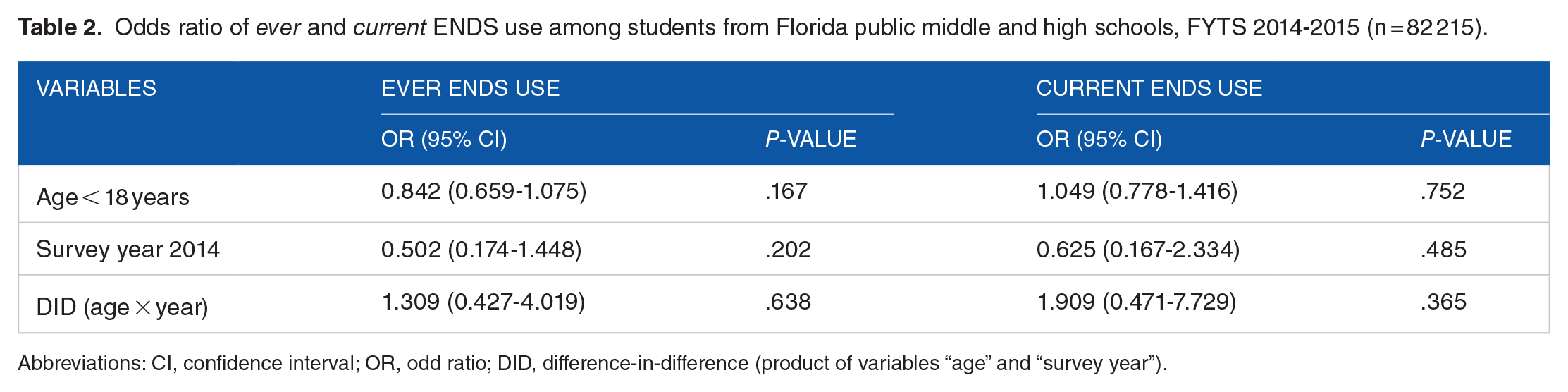
Abbreviations: CI, confidence interval; OR, odd ratio; DID, difference-in-difference (product of variables “age” and “survey year”).
As seen in Table 3 students’ perceptions about ENDS significantly differed between the 2 years (P < 0.001). Compared to 2014, fewer students in 2015 were sure (51.5% vs 59.2%) about ENDS harm. However, more students in 2015 were confident in their answer about ENDS lower harm (32.4% vs 28%) and greater harm (11.0% vs 7.7%). In 2015, there was also an increase in the number of students who thought favorably of ENDS. More students were confident that ENDS were not as addictive as cocaine or heroin (21.8% vs 12.0%) and that this tobacco product was easy to quit (34.5% vs 29.6%). However, during that same year, there was an increase in the number of students who were certain that ENDS users had fewer friends (34.3% vs 28.7%); ENDS use did not help people feel more comfortable at social situations (37.0% vs 32.6%); and ENDS did not relieve stress (32.0% vs 26.1%).
Florida students’ perception of e-cigarette use, FYTS 2014-2015 (n = 82 215).
Discussion
Findings of this study raise questions about the efficacy of the stand-alone minimum-age policies. As this study shows, the Florida policy was implemented with the intention of reducing the rates of ENDS use. Although the prevalence of the ENDS use increased in the year (2015) following the policy implementation, some of the students’ opinions did shift towards a more cautious and unfavorable perception of ENDS. An exception to this trend was comparison to smoking, in which more respondents in 2015 considered vaping of ENDS less harmful than the use of combustible cigarettes. In this case, more than half of students were either not sure about the harm of ENDS use or thought of it as less harmful than cigarette smoking.
It is possible that changes in students’ perceptions about ENDS may have been influenced by not only the policy, but also other socio-ecological factors. Some of these influential factors may have included observation of ENDS use or hearing about ENDS from students’ friends and family, exposure to ENDS promotion on TV and social media, viewing of anti- and pro-tobacco campaigns, and learning about ENDS in school curriculum. Therefore, it is important to consider these factors in future analyses and to further examine the aspects of ENDS regulation and the possibility of its connection to the trends in ENDS use and population’s perceptions about ENDS.
While regional differences may exist, results from the Florida sample closely mimicked the national statistics for the same years. 1 In absence of a similar national policy at that time, these results suggest that the presence of minimum-age policy in Florida did not affect the rates of ENDS use among adolescents. In fact, the rates of ENDS use were higher in the post-policy year of 2015 than in the spring of 2014 before the policy was implemented. While the 2014 minimum-age policy in Florida did not lead to an immediate decrease in ENDS use among adolescents in the subsequent year (2015), increase in the Florida youth vaping rates slowed in the year (2017) following the implementation of the 2016 national minimum-age policy. 16 In 2016 the U.S. Food and Drug Administration (FDA) implemented a national minimum-age policy, which banned distribution of tobacco products and ENDS to minors. 17 The national minimum-age policy of 2016 also slowed down the national rates of current ENDS use among middle (5.3%-4.3%) and high (16%-11.3%) school students. 18 However, both the national and Florida state rates quickly picked back up in following years.16,18 When vaping rates continued to rise, in late 2019 the federal government limited tobacco product (including ENDS) distribution to people aged 21 and older (“Tobacco 21” or “T21” policy). 19 Prior to 2019, many states enacted their own minimum-age policies, and many more followed after the federal ban. Since Florida’s ban on tobacco distribution to people under the age of 21 took effect in March of 2020, there is currently no known data available to evaluate its immediate effectiveness.
Policies raising the age limitation for tobacco distribution to 21 may be more effective than those limiting it to 18. Considerable research is needed to examine effectiveness of the national, state, and regional Tobacco 21 policies as each varies in its components and strength. Arguably, it would be harder for students of middle school and high school age to find friends 21 and older than those who are 18. Thus, it would be harder for these students to obtain the ENDS. However, middle and high school students may continue finding and using ENDS, and the overall prevalence may persist (or keep increasing) if youth perception about these products continues to be favorable. Therefore, it might not be enough to simply ban ENDS distribution to youth. More comprehensive interventions may be required to shift the current ENDS trends. These interventions may include raising students’ and communities’ awareness about ENDS harms, reducing social acceptance of these products, limiting youth exposure to ENDS use by establishing indoor and outdoor use policies, banning display of ENDS products in places frequented by minors, restricting point-of-sale marketing and other tobacco advertising, promoting health warnings on ENDS products, restricting ENDS packaging, outlawing ENDS flavors, closing online ENDS distributors, requiring stronger age verification systems, establishing retail license policies for ENDS distributors, and reducing tobacco retailer density.
This study has several strengths. First, the annual survey was conducted by trained specialists from an established and well-trusted agency of the Florida Department of Health. Second, participants for this study were randomly recruited through a two-stage cluster probability sampling, which should have resulted in samples representative of youth in the state of Florida. Third, data for both years were drawn from large samples. Potential study limitations may include recruitment of participants, informed consent process, along with collection and recording of data, which were not overseen by the investigators of this secondary analysis study. However, the study investigators trust the competence and diligence of the Florida Department of Health staff in completion of these steps. Because recruitment for the original study was not completely random, there is a possibility of a sampling bias. This means students from different backgrounds and with different preferences, thoughts, behaviors might have been under- or over-selected for the survey, and, thus, may have influenced the prevalence and percentages in the results. Nonresponse bias may also be a potential threat if some of the students were selected but did not show up to the survey in order to skip school, for example. Nonresponse from students may also deprive the survey results of a potentially valuable contribution. The focus of the present study on ENDS did not take into account youth use of other tobacco products—it is possible that respondents' use of other tobacco products may have been associated with their ENDS use and perceptions of ENDS. Because some of the differences in students’ perceptions about ENDS are clinically small but reach statistical significance due to the sample size, interpretation based on these results may be exaggerated. Although the survey was confidential, there may be a limitation in relying on students’ self-report about ENDS use—response and desirability biases may have been present among students who were not comfortable disclosing their tobacco use or other socially unacceptable behaviors. However, because ENDS are becoming part of conventional tobacco products, prior research shows students’ self-report on this topic may be a reliable indicator. 20 An additional limitation may come from the timing of the survey. The 2015 data was collected less than a year after the implementation of the minimum-age policy, which means the ENDS distributors and the Florida population were not given enough time for enforcement of this change.
In conclusion, minimum-age policy is not a guaranteed or immediate solution to the epidemic of ENDS use among youth. Although a majority of middle and high school students may know some of the effects of ENDS use, popularity of these products can persist even after the policy’s restrictions. Most of the middle and high school students appeared not to be aware or sure about the ENDS harm. The minimum-age policy appears unrelated to students’ awareness. Therefore, other interventions (eg, anti-tobacco campaigns) should also be implemented to raise students’ awareness about ENDS and to target the prevalence of ENDS use among youth.
Footnotes
Funding:
The author(s) received no financial support for the research, authorship, and/or publication of this article.
Declaration of conflicting interests:
The author(s) declared no potential conflicts of interest with respect to the research, authorship, and/or publication of this article.
Authors’ Contributions
AF prepared the original draft of the manuscript and edited the subsequent drafts. LH, JHE, CK, CG, and RS provided guidance and helped in editing of the manuscript.
