




Abstract
Background:
Rheumatoid arthritis (RA) is considered a notable prolonged inflammatory condition with no proper cure. Synovial inflammation and synovial pannus are crucial in the onset of RA. The “tumor-like” invading proliferation of new arteries is a keynote of RA. Commiphora wightii (C wightii) is a perennial, deciduous, and trifoliate plant used in several areas of southeast Asia to cure numerous ailments, including arthritis, diabetes, obesity, and asthma. Several in vitro investigations have indicated C wightii’s therapeutic efficacy in the treatment of arthritis. However, the precise molecular action is yet unknown.
Material and methods:
In this study, a network pharmacology approach was applied to uncover potential targets, active therapeutic ingredients and signaling pathways in C wightii for the treatment of arthritis. In the groundwork of this research, we examined the active constituent-compound-target-pathway network and evaluated that (Guggulsterol-V, Myrrhahnone B, and Campesterol) decisively donated to the development of arthritis by affecting tumor necrosis factor (TNF), PIK3CA, and MAPK3 genes. Later on, docking was employed to confirm the active components’ efficiency against the potential targets.
Results:
According to molecular-docking research, several potential targets of RA bind tightly with the corresponding key active ingredient of C wightii. With the aid of network pharmacology techniques, we conclude that the signaling pathways and biological processes involved in C wightii had an impact on the prevention of arthritis. The outcomes of molecular docking also serve as strong recommendations for future research. In the context of this study, network pharmacology combined with molecular docking analysis showed that C wightii acted on arthritis-related signaling pathways to exhibit a promising preventive impact on arthritis.
Conclusion:
These results serve as the basis for grasping the mechanism of the antiarthritis activity of C wightii. However, further in vivo/in vitro study is needed to verify the reliability of these targets for the treatment of arthritis.
Introduction
Rheumatoid arthritis (RA) is an autoimmune long-term disease that has enhanced the mortality rate all around the world due to disability and progressive deformation of joints that are mainly characterized by pannus formation, synovitis, and erosion of cartilage and bones. 1 People suffering from RA have a higher chance of premature death from cardiovascular diseases (CVDs). Disease-modifying antirheumatic drugs (DMARDs), biological DMARDs, glucocorticoids, nonsteroidal anti-inflammatory drugs (NSAIDs), and small molecular signal inhibitors are therapeutic agents currently used worldwide for the treatment of RA by reducing inflammation, ceasing the disease activity, alleviate pains in joints, stop and slow the damaging of joints and disease process, respectively.2,3 Since the mechanism of origin and progression of RA is not completely understood, the current agents only improve the quality and ability of a patient’s life and its proper functioning, but there is no curative treatment available for its eradication. According to the study in 2023, the death rate risk has increased to 15% among patients compared to general people, especially in women, its prevalence is at a higher incidence that varies in different regions. 4 The drugs used in its treatment have acute adverse effects on patients, and they have to face common irritation in the gastrointestinal tract, cardiovascular risk, and kidney failure and thus develop Cushing’s syndrome. Therefore, a systematic, alternative, and effective clinical therapy with moderate adverse effects and low toxicity is required urgently to decrease incurable pain and raise the quality of a patient’s life with RA. 5
Traditional herbal medicine has remained a source of inspiration for the last few years due to its therapeutic effects on maintaining the health of thousands of people in Asia by using certain biomolecules from traditional plants. 6 The interdisciplinary fields including artificial intelligence, bioinformatics, and computational biology with huge information in science have transferred medical research to multiple target-finding mechanisms by using a network pharmacology (NP) approach. 7 In the recent management of medical research, THM has significantly directed innumerable challenges by giving rise to multicomponent, personalized, and comprehensible therapies due to their potential and fewer side effects. 7
Commiphora wightii, belonging to the family Burseraceae and class Magnoliopsida, is commonly named a Guggul plant. 8 It is a short-height plant that is 2 to 3 m in length or a branching shrub, occurring in Pakistan and Indian states. The plant’s exudates serve antibacterial, anti-inflammatory, and antioxidant properties. 9 It is thought to be an effective drug for orthopedic disorders, arteriosclerosis, obesity, hypolipidemia, 10 inflammation, gout, and rheumatism. 11 Commiphora wightii is a well-known antihyperlipidaemic drug. Guggulsterones (GSs) are active components of this drug which are responsible for this effect. 12 Beta-Sitosterol (BS) is one of the bioactive compounds in the C wightii plant, it is generally considered a safe, natural, and effective nutritional supplement and has been shown to have many potential benefits. Beta-Sitosterol possesses antioxidant, antimicrobial, angiogenic, antioxidant, immunomodulatory, antidiabetic, anti-inflammatory, anticancer, and antinociceptive activities without major toxicity. 13 Previous studies describe that guggul when taken orally can cure internal tumors, malignant sores, obesity, liver dysfunction, intestinal worms, leucoderma, sinus, and edema. It is also used as an Ayurvedic medicine for the prevention and treatment of various other diseases such as inflammatory bowel disease (IBD), ulcers, arthritis, CVDs, diabetes, and so on. 14 The main ingredients of guggul are GS and boswellic acid (BA) which are obtained from Commiphora and Boswellia, respectively. It also contains a huge number of lignans and keto sterols, which contributes to the vivid health beneficiary effects of guggul.14,15 The effect of C wightii has been well proven against different inflammatory diseases such as RA through downregulated RANKL-induced osteoclastogenesis and blocked interleukin (IL)-1beta mediated production of chemokines and epithelial neutrophil activating peptide-78 (ENA-78), MMP-1,-3 via suppression of nuclear factor Kappa B (NF-κB), nuclear p50, and p65 subunit and IκBα degradation in RA.16,17
Network pharmacology is a novel, systematic, potential, and widely used analytical method useful in the field of drug designing by analyzing their interactions with certain diseases, genes, and protein targets. 18 Owing to its efficient and holistic properties, the model of “one target” and “one protein” has been transferred to the multicomponent model of “drugs-targets-pathways-diseases” by incorporating multiple genes, drugs, pathways, and targets. Complex interactions between genes and diseases are deciphered using molecular biology, bioinformatics, and databases in NP to elucidate therapeutics and effective targets. 3 This characteristic of NP is useful and has been broadly demonstrated for detecting putative active targets and complex mechanisms of traditional herbal medicine against a certain disease. Moreover, the combination of NP and docking using traditional herbal medicine has paved the way to treat RA as a powerful approach. 18 Hence, NP has been proven a very advantageous method for figuring out issues related to traditional herbal medicine. 19
We are using innovative methods such as NP and molecular docking approach to investigate the mechanism of C wightii for the cure of RA. The expectation is that the outcome of this work plan will pave the findings for further investigation and give adequate fundamental principles for developing a specialized treatment against RA.
Methodology
Collection of bioactive compounds of C wightii
All compounds related to C wightii were obtained from Dr Duke’s Phytochemical and Ethno-botanical Database, 20 KNApSAcK-3D, 21 traditional Chinese medicines integrated database (TCMSP) 22 and literature mining 10 of compounds C wightii on PubMed and Google scholar. It provides deep knowledge about phytochemicals as well as biological activities. Furthermore, PubChem 23 and ChemSpider 24 were applied to get the remaining information about the active compounds, for example, canonical SMILES, molecular weight, physicochemical properties, and structure information. Afterwards, bioactive compounds of C wightii were retrieved from SwissADME 25 by satisfying the criteria of oral bioavailability (OB) of ⩾30%. Moreover, a drug likeness (DL) of ⩾18% was retrieved from the Molsoft tool. 26
ADMET profiling
SWISS ADME 27 tool was used to examine the physiochemical characteristics of constituents such as their absorption, distribution, metabolism, excretion, and toxicity. All of those factors increase the drug extent or the speed of drug delivery to tissues, which in turn affects the compound’s pharmacological activity and effectiveness as a treatment. High-quality therapeutic compounds should be effective against various disorders and exhibit suitable ADMET characteristics at therapeutic concentrations. SWISS ADME is a web tool that provides an open avenue to a large pool of quick reliable predictive testing for biochemical characteristics, pharmacology, drug-likeness, and drug design compatibility. 27 In addition, the Protox II tool 28 and ADMET lab 2.0 29 were used for the analysis of various kinds of toxicity such as AMES, cytotoxicity and mutagenicity, respectively. This step is crucial because many drugs fail due to cytotoxicity and poor pharmacokinetic properties.
Acquisition of C wightii targets
Target prediction is an important step to knowing about the molecular interaction that occurs between medicinal plants to cure various types of disorders. By selecting the specie Homo-sapiens, all the targets related to bioactive compounds of C wightii were attained by using the Swiss target prediction tool 30 and STITCH database. 31 For this purpose, SMILES of each bioactive compound was pasted into the database by restricting the search to “Homo sapiens.” Moreover, the combined score was put as ⩾0.7 for further analysis. Swiss target prediction is an online and freely available tool that is used for the reverse pharmacophore screening strategy of the macromolecule targets of small bioactive compounds. 32 As a consequence, the targets with a combined score ⩾0.7 were chosen.
Collection of disease target genes of RA
The next preliminary stage is to predict genes related to disease to investigate the molecular basis of traditional medicine used to treat a variety of disorders and diseases. Therefore, all the genes associated with RA were obtained from the GeneCards database 33 and DisGeNET, 34 respectively. Furthermore, these databases are also providing additional information related to genes, for example, their expression, localization, and function. After removing all the duplicate genes, the common targets of plant and disease were retrieved from Venny 2.1. 35 Hence, a Venn diagram was constructed consisting of common targets from CW-RA, and the output was constructed in the form of an image. Notably, Venn diagrams are frequently used tools for the graphical representation of unions, intersections, and differences across many datasets for the identification of the targeted genes. 36
Topological protein-protein network construction
All the potential targets from the Venn analysis were introduced into the String database by following the canon setting of confidence score > 0.4 for the generation of protein-protein interactions (PPIs) to understand the involvement of proteins in a variety of biochemical processes for the better understanding of bioprocess, cellular organization, and molecular functions. 37 Moreover, these results were put into Cytoscape software 38 for the interpretation of the degree of targets. However, the target network consisting of a higher number of degrees was built by using a plug-in known as cytoHubba. 39 Moreover, “vital targets” were defined as target genes with the highest degree of interconnectivity. The key node was determined using 3 topological characteristics, including betweenness centrality (BC), closeness centrality (CC), and degree centrality (DC). Notably, Cytoscape is freely available bioinformatics software that allows you to integrate, visualize, and analyze biological networks in the form of a combined conceptual framework.
Enrichment analysis via GO and KEGG
DAVID database was used 40 for the prediction of genes and pathway enrichment analysis DAVID is a database that states a comprehensive investigation of enriched functional genes to recognize the biological content behind a vast gene list. Moreover, it is also used to find out the list of interacting proteins. 41 Afterwards, all the results of KEGG and GO were introduced into Cytoscape 3.7.2 for the construction and visualization of compound-target-pathways networks. It is noteworthy, that the enrichment results were considered statistically significant if the p value < .05. Furthermore, the Bubble map was constructed by using R-package with the help of GGPLOT2.
Molecular docking
A molecular docking study was conducted to visualize the pattern of interaction that occurs between active constituents and targeted proteins. The 3D crystal structure of the target protein was retrieved from Protein Data Bank (PDB) 42 by selecting the organism as Homo sapiens only. Discovery Studio 43 was used for the purification of protein by removing all the water molecules and already present ligands to avoid unnecessary hindrances and clashes while docking. The structure of all the targets was imported into the PyRx Auto dock 44 to perform docking and visualize the docked structure in Discovery Studio and Chimera X. 45 The suitable docked complexes were selected based on maximum binding affinity and lower the root-mean-square deviation of atomic positions, or simply root-mean-square deviation (RMSD) value. The RMSD defines an optimality criterion to determine the rotation and translation that best separate rigid-body from internal movements. To screen out putative constituents and their possible targets, docking results between key compounds and targets were used as a major evaluation benchmark. The current research workflow is depicted in Figure 1.

A graphical synopsis of allover technique used to identify viable compounds and their potent therapeutic targets for arthritis treatment.
Results
Prediction of active compounds of C wightii
After the removal of duplication, a total of 29 phytochemicals were gained from Dr Duke’s phytochemical database, and 30 compounds related to C wightii were retrieved from the review of the literature10,46 (Table 1). All the predicted compounds were further investigated for the presence of active compounds by applying the criteria of DL ⩾ 0.18 and F ⩾ 30%. Bioavailability is defined as the degree and extent of the drug being absorbed in the blood circulation system. Notably, high-level bioavailability compounds are more efficient because they enable the human body to take in more of the necessary nutrient without requiring greater doses. However, a drug’s likelihood of becoming an oral medication in terms of bioavailability is measured by drug-likeness (DL). In the preliminary phase of drug discovery, DL generated from the structures and features of the actual drug has been routinely employed to screen out unwanted constituents.42,47 Hence the result indicates that 15 out of 59 compounds namely (Guggulsterol-III, Beta-Sitosterol, Guggulsterol- I, Cholesterol, Cis-GS, Guggulsterol- II, Guggulsterol- IV, Myrrhanone B, Guggulsterol-V, E-GS, GS-M, Campesterol, Stigmasterol, Quercetin and Dehydroguggulsterone M) satisfied the screening standard that include Oral Bioavailability (OB) ⩾ 30% and DL ⩾ 0.18. Any compound that fails to comply with these rules is unlikely to be bioavailable and have poor absorption.
Represent the potential therapeutic active compounds of C wightii.

The result of ADMET profiling based on different classes such as BBB penetration, GI absorption, and P-glycoproteins substrate exhibit positive outcomes that assist the capability of compounds to behave as a drug candidate. Table 2 explored ADMET screening of bioactive compounds of C wightii. However, the compounds that showed toxicity were eliminated from the subsequent analysis which shortlisted 7 bioactive compounds namely (Beta-Sitosterol, Cholesterol, Guggulsterol-IV, Guggulsterol-V, Myrrhanone B, Campesterol and Stigmasterol) to be used for advance investigation.
Information about the ADMET profiling and toxicity analysis of bioactive compounds of C wightii.

Acquisition of plant and disease targets
All the targets associated with 7 active constituents were retrieved from the Swiss-Target prediction tool and STITCH database which showed 367 targets for further analysis. However, target genes coupled with RA were retrieved from GeneCards and DisGeNET, which includes 4793 targets from GeneCards and 2723 targets acquired from DisGeNET. Later, Draw Venn was used for the Intersection of disease and identified targets of compounds. A total of 111 antiarthritis target genes were acquired for further analysis as shown in (Figure 2A).

Representation of Network pharmacology approach analysis of numerous pathways, multicompounds, and multitargets for the cure of arthritis. (A) Illustrate Venn diagram, (B) represent the compound target network, (C) shows top 10 hub genes PPI network, and (D) top-10 hub genes ranked by their associate degrees.
Development of compound-target network
Commiphora wightii resulted in a total of 7 potential therapeutic compounds. These 7 compounds corresponded to a variety of distinct targets. Furthermore, 7 plant-related constituents were identified, and the “bioactive compound genes” network was constructed by using 111 key targets and their associated pathways (Figure 2B). This gives us solid evidence that when C wightii is used as an anti-arthritis medication, several targets may have a synergistic effect. The degree of shortlisted 7 compounds in the gene-pathways-compound network was then evaluated and summarized in Table 3. As mentioned in the table, Beta-Sitosterol, Cholesterol, Campesterol, and Stigmasterol belong to the class steroid while Guggulsterol-IV and Guggulsterol-V belong to the class flavonoid. Whereas, Myrrhanone B belongs to the Triterpenoids class.
The degree of 7 bioactive compounds examined in Cytoscape using the network analyzer.

Topological protein-protein network construction
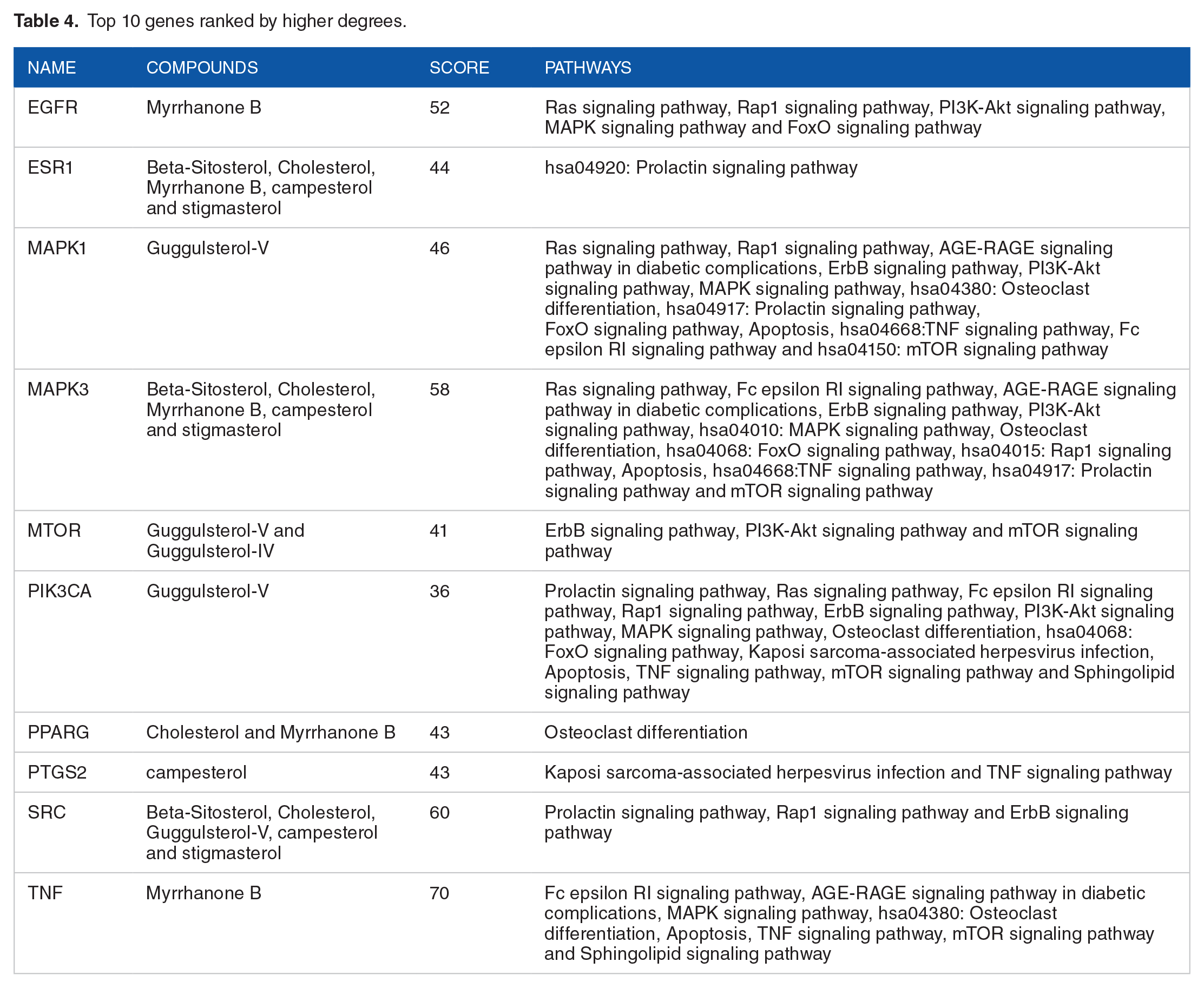
On the side to improve the visualization and process of targets, it is essential to study the PPI of the potent targeted genes. For this purpose, common 111 potential targets affiliated with disease and plant were imported into the database of string for the generation of the PPI network. In PPI analysis, edges indicate the PPI, whereas nodes illustrate proteins. The network has 111 numbers of nodes, and 891 numbers of edges whereas, the average number of neighbor degrees was 16.1. The network diameter and radius were 5 and 3, respectively. Moreover, the clustering coefficient was 0.565. Notably, the analysis of the PPI tool present in the Cytoscape was used (Figure 2C). TNF (70), SRC (60), MAPK3 (58), EGFR (52), MAPK1 (46), PTGS2 (43), PPARG (43), MTOR (41), ESR1 (44), and STAT1 (34) showed a higher degree (Figure 2D) that plays a significant role by connecting all the other nodes in PPI network. The highest degree suggests that inhibition of potent targeted genes are highly interconnected, suggesting that all of these genes could be possible therapeutic targets. Following a comparison between these results and those provided by enrichment assay (Table 4), 3 genes of C wightii particularly PIK3CA, TNF, and MAPK3 were outlined as key targets of anti-arthritis and selected for docking study further.
Top 10 genes ranked by higher degrees.
Enrichment analysis via GO and KEGG
A total of 111 major targets that were retrieved from plant and disease were observed in DAVID 6.8 platform having information about KEGG and GO. The GO analysis notifies us about the biological processes, their molecular functions and cellular components of the targets. By applying the screening limitation of count ⩾ 2 and p ⩽ 0.05 the result demonstrated that 564 biological processes, 68 cellular components, and 130 molecular functions as shown in Figure 3. According to the GO functional analysis, C wightii targets were related to collagen binding, kinase activity, integrin binding, and so on. In addition, for the examination of functions as well as signaling pathways of the common targets KEGG was applied. The results indicate the top 10 enriched pathways that include the PI3K-AKT signaling pathway having a higher gene count that is 36, Kaposi sarcoma-associated herpesvirus infection and the signaling pathway of Ras has 28 gene counts, whereas, the Rap1 signaling pathway includes a 27 gene count, In addition, AGE-RAGE pathway in diabetic complications and FoxO signaling pathway indicate 24 gene counts. Notably, Apoptosis showed 23 gene counts and so on. It is noteworthy, that C wightii can be used for various abnormal conditions like cancer, Hepatitis B, Pancreatic cancer, acute myeloid leukemia, and Glioma according to the KEGG pathway analysis. Owing to the evidence and visualization CW may act as a promising drug candidate for the treatment of certain types of other disorders and diseases. Later on, based on the enrichment analysis 3 targets namely TNF, MAPK3, and PIK3CA play a significant role when compared with the PPI network analysis and hence these 3 targets were chosen further for molecular docking.
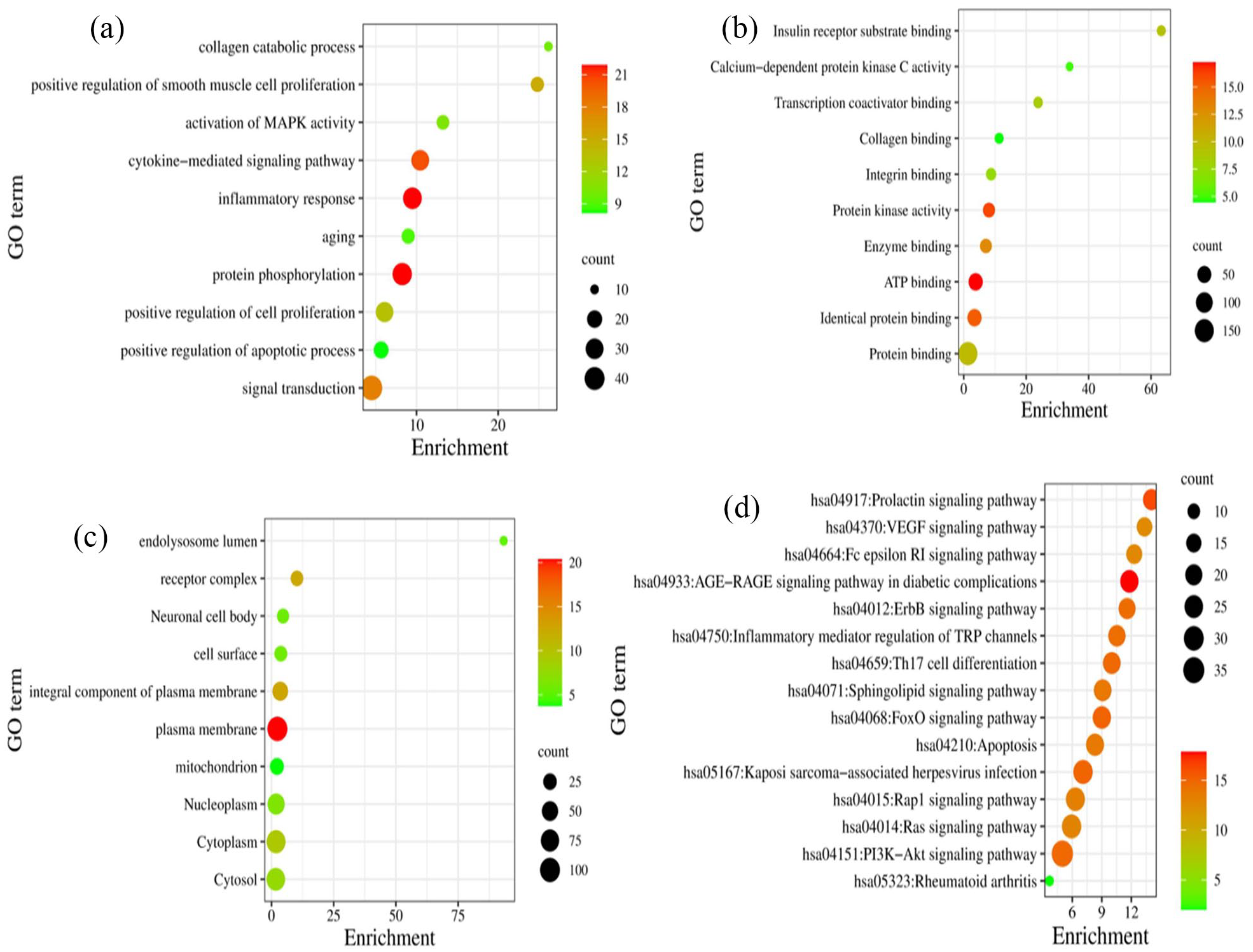
Representation of enriched pathways and functional annotation in the form of Bubble chart (A) represent the GO biological process. (B) Shows GO molecular function. Whereas, (C) represent GO cellular process and (D) represent enriched KEGG pathways.
Construction of pathways-target-compound merge network
To achieve the merge compound-target-pathway network in which the targets act as a bridge between compound and signaling pathways were obtained from Cytoscape, where the degree of the entire 111 common active compounds was analyzed by using the merge tool in Cytoscape as shown in Figure 4, the pathways-target-compound network interaction was constructed which demonstrated the mechanisms of drug action in the arthritis treatment. Notably, the network analysis indicates that numerous targets were hit by numerous compounds. This fact revealed that the compounds (Guggulsterol-V, Myrrhahnone B, and Campesterol) can act as a core target for the treatment of arthritis and these 3 compounds were selected as a ligand for Molecular docking.

Pathways formed by C wightii. The orange color nodes show the hub genes, the yellow nodes showed the potential therapeutic bioactive constituents whereas, blue nodes show pathways coupled with targeted genes.
Molecular docking
It is crucial to examine the structure-based design of the compound and its capacity to forecast the binding conformation of a ligand to the particular target binding site after the analysis of the compound-target-pathways network. The proteins were chosen primarily because they were significant key contributors to the PPI, KEGG, and CTP network. Moreover, these proteins are discovered to be crucial in the mechanism of arthritis. PyRx was used to perform docking among the potent bioactive compounds present in C wightii

Depiction of docked complexes of therapeutic 3 target genes namely MAPK3 (4QTB) (a), TNF (2AZ5) (b), and PIK3CA (3HMM) (c) having maximum binding affinity with their respective compounds.
Information about interaction and binding energy occurs between bioactive compounds with their associate therapeutic targets.

Discussion
Rheumatoid arthritis is an inflammation-based systemic condition with an ambiguous interconnection to autoimmunity and the presence of particular major organs. Moreover, angiogenesis, bone loss, and immunological modulation have an impact on the musculoskeletal system as well as the entire body. 48 As far as conventional technique is studied, the idea of “one drug one target” designing drug theory is used, in contrary NP, which strives to investigate the relationship between diseases and medications, is based on multiple-targeted therapy. 49 The utilization of systems biology, hierarchical clustering, interconnectivity, and reliability are among the innovative aspects of this strategy. 50 Network pharmacology studies were effectively used to uncover potential targets and determine how compounds interact with unknown signaling pathways. A remarkable and effective method for the systemic elucidation of disease mechanisms and the identification of novel bioactive elements, the NP paradigm offers a new vision of the relationship between a therapeutic target and a disease as an entire. 50
Guggulu, or C wightii, has evolved into a popular traditional remedy for the treatment of arthritis, tumors, microbial infection inflammatory bowel illnesses, obesity, wound pain, and inflammation. It is probably one of the most well-known and ancient herbs in Ayurveda therapy. 51 Therefore, C wightii has drawn more attention in the clinical cure of RA because of its clear efficacy and least-negative effects. So, in the current investigation, we used the NP approach to generate target networks, perform enrichment analyses of these targets, and disclose probable pathways to evaluate the potential therapeutic targets associated with CW therapy of RA.
Notably, with the aid of a target interaction network, we organize 10 hub key inhibition targets (MAPK1, ESR1, EGFR, TNF, SRC, PTGS2, PPARG PIK3CA, MTOR and MAPK3) of C wightii during the cure of RA. Notably, TNF is believed to be one of the primary mediators of acute inflammation in RA. Several research studies have revealed that it plays a vital part in native joint problems and structural bone loss by increasing osteoclast (OC) induced bone regeneration. 52 Whereas, MAPKs perform a crucial role in provoking inflammation and joint destruction, making them important targets for therapeutic intervention in long-term inflammatory conditions like RA. 53 In addition, MTOR plays a significant role in cartilage development and growth. 54 Furthermore, during the pathogenesis of RA, EGFR can stimulate the production of cytokines by synovial fibroblasts. 55 Hence, the aforementioned targets proved to have a significant effect on RA because of their strong connection, which recent studies have also demonstrated. According to the enrichment assay results, we discovered that certain essential targets can control various pathways.
Furthermore, GO functional annotation was used to learn more about biological processes from the BP, MF, and CC perspectives. Gene enrichment study suggests that the major pathways involved in C wightii are used to treat arthritis in the following ways are PI3K-Akt signaling pathway, RA, signaling pathway of Ras, Fc epsilon RI signaling pathway, Th17 cell differentiation, signaling pathway of Prolactin, Apoptosis, and so on. According to existing evidence, the signaling pathway PI3K/AKT is required for proper joint tissue metabolism. However, it is also responsible for the onset of osteoarthritis. 56 However, apoptosis and RA act as major pathways that regulate hemostasis and tissue composition. 57 Moreover, the Prolactin signaling pathway has a broad effect on the growth and differentiation of immune system cells. Furthermore, it is linked to the existence and development of many immune-related diseases like RA and hyperprolactinemia. 58
In docking analysis, it was discovered that the binding affinity with the maximum docking score was far more efficient for evaluating the interaction among both bioactive compounds and potential targets. The docking results show that TNF, MAPK3, and PIK3CA all participated in multiple signaling pathways of arthritis, demonstrating the synergistic impacts of several targets. These findings suggest that the main bioactive compounds in C wightii may lessen inflammation in joints by interacting with TNF, PIK3CA, and MAPK3. Furthermore, favorable results were observed in the respective ADME properties of 4 active compounds that were used in docking studies for various models, including, blood-brain barrier permeability, gastrointestinal absorption, and P-gp substrate, which significantly support active compounds’ acceptability as drug candidates in preclinical and clinical studies.
This study used an NP approach to illustrate the molecular basis of bioactive compounds of C wightii. The findings revealed that NP provided important benefits in investigating the drug’s action mechanism. Our research had some limitations. First, the whole study used an NP approach to investigate the possible candidates of C wightii in the cure of RA, but animal experiments were also considered necessary. Second, because data collection is difficult, the database may not have all known or unidentified targets and PPIs. This situation may improve in the future as more data will be available.
Conclusion
This study provides the most recent scientific groundwork for establishing the adequacy of multitargets and constituents, as well as exploring additional vital arthritis targets. In the current research, the approach of NP with the combination of docking was used to reveal C wightii molecular processes to cure arthritis. Furthermore, our findings suggest that the genes TNF, PIK3CA, and MAPK3 are viable and promising curative candidates for lowering arthritis incidence. The overall reliability of these candidates for the evaluation of RA treatment was confirmed. However, the approach we used has some limitations that need to be addressed. This approach relied solely on a network for analysis to identify vital therapeutic targets and pathways related to disease, and higher clinical and experimental confirmation is required.
Footnotes
Acknowledgements
The authors extend their appreciation to King Saud University for funding this work through a research-supporting project (RSP2024R376), Riyadh, Saudi Arabia.
Funding:
The author(s) disclosed receipt of the following financial support for the research, authorship, and/or publication of this article: This research was funded by a research supporting project (RSP2024R376), Riyadh, Saudi Arabia.
Declaration of conflicting interests:
The author(s) declared no potential conflicts of interest with respect to the research, authorship, and/or publication of this article.
Author Contributions
MAA-M; and MA; Conceptualization, Data curation, Formal analysis, Funding acquisition, Investigation, Methodology, Project administration, Supervision, Writing—original draft. All authors have read and agreed to the published version of the manuscript. MAA-M; MAA; I YA-R; MG; MA; Conceptualization, Data curation, Formal analysis, Investigation, Methodology, Supervision, Writing—original draft. All authors have read and agreed to the published version of the manuscript.
Informed Consent Statement
“Not applicable.”
Data Availability Statement
“Not applicable.”