




Abstract
Malaria is a deadly disease that continues to pose a threat to children and maternal well-being. This study was designed to identify the chemical constituents in the ethanolic fruit extract of Azadirachta indica, elucidate the pharmacological potentials of identified phytochemicals through the density functional theory method and carry out the antimalarial activity of extract using chemosuppression and curative models. The liquid chromatography-mass spectrometry (LC-MS) analysis of the ethanolic extract was carried out, followed by the density functional theory studies of the identified phytochemicals using B3LYP and 6-31G (d, p) basis set. The antimalarial assays were performed using the chemosuppression (4 days) and curative models. The LC-MS fingerprint of the extract led to the identification of desacetylnimbinolide, nimbidiol, O-methylazadironolide, nimbidic acid, and desfurano-6α-hydroxyazadiradione. Also, the frontier molecular orbital properties, molecular electrostatic potential, and dipole moment studies revealed the identified phytochemicals as possible antimalarial agents. The ethanolic extract of A indica fruit gave 83% suppression at 800 mg/kg, while 84% parasitaemia clearance was obtained in the curative study. The study provided information about the phytochemicals and background pharmacological evidences of the antimalarial ethnomedicinal claim of A indica fruit. Thus, isolation and structure elucidation of the identified phytochemicals from the active ethanolic extract and extensive antimalarial studies towards the discovery of new therapeutic agents is recommended for further studies.
Keywords
Introduction
Malaria is an endemic tropical disease whose causative agent is the protozoan Plasmodium, and it is spread by female Anopheles mosquitoes. 1 The deadly pathogenic disease results in an increase in child mortality and deteriorates paternal and maternal health. Globally, about 3.3 billion people have been estimated to be at risk of the causative agents of malaria, with 216 million people recorded in 2016.2-4 Africa remains the most affected continent of the world and accounts for 92% of all malaria deaths. 5 Also, Nigeria has been ranked as the worst-hit country in terms of malaria transmission, morbidity, and mortality. 6
The increasing cases of malaria recorded in Africa, Asia, and other continents are attributed to limited access, availability, and affordability of orthodox therapeutic agents.7,8 Also, the increasing resistance of Plasmodium falciparum to most synthetic antimalarial agents, including artemisinin-combination therapy, has contributed tremendously to high morbidity and mortality obtained in malarial patients. 5 Therefore, there is a need to discover cheaper, accessible, and effective antimalarial agents from natural sources with lesser side effects.
Azadirachta indica A. Juss. (Meliaceae), also called neem, is a medicinal plant endemic to Africa, Australia, and Southern Asia. 9 Traditionally, the leaf is used in the treatment of malaria and sore throat. The fruit is used to treat sores, malaria (personal communication), body pain, and as an insect repellant. 10 Also, the stem bark and leaf are used in the treatment of inflammation, malaria, diabetes, and bronchitis.10-13 Pharmacological studies of the fruit showed they possess larvicidal, anti-inflammatory, antipyretic, antihelmintic, antidiabetic, and antimicrobial activities.14-19 Although A indica fruit is used as an antimalarial agent traditionally, there is no scientific data to support its efficacy in the treatment of the disease.
Computational methods have become instrumental in the drug discovery process. The use of density functional theory (DFT) has become globally acceptable in drug discovery to save cost, time, and resources. 20 Density functional theory is useful in studying their electronic properties in relation to their pharmacological potentials.21,22 Therefore, this study evaluated the in vivo antiplasmodial activity of ethanol fruit extract of A indica followed by the chemical profiling of the extract. Also, the electronic properties of the identified compounds were calculated to elucidate the role of the chemical constituents as potential antimalarial agents.
Materials and Methods
Plant material
The fruit of A indica (Meliaceae) was collected within Obafemi Awolowo University (OAU) campus. The fruit was identified, authenticated, and deposited at the Faculty of Pharmacy Herbarium, Ife by Mr. I. I. Ogunlowo of the Pharmacognosy Department, OAU, Ile-Ife, with voucher specimen number FPI 2423. The fruits were air-dried, powdered, and 500 g of the dried powder was macerated in 1500 mL ethanol for 48 hours with intermittent shaking. The resultant extract (17 g) was filtered, evaporated in vacuo, freeze-dried, weighed, and stored.
LC-MS profiling of the extract
A linear trap quadrupole (LTQ) Orbitrap spectrometer (Thermo Scientific, USA) was used to carry out liquid chromatography-mass spectrometry (LC-MS) analysis. The instrument is equipped with an Agilent 1200 HPLC system (Santa Clara, CA, USA) and connected to a photodiode array (PDA) detector. Sample preparation was done by making the fruit extract into a final concentration of 2 mg/mL in methanol and was centrifuged for 5 min at 6600 r/min and loaded for analysis. A reverse phase Luna C18 column (60 × 3 mm, 3 μm) (Phenomenex, Torrance CA, USA), was used to carry out high-performance liquid chromatography (HPLC) analysis of the sample. The mobile phase consists of water (+0.1% formic acid) A and methanol (+0.1% formic acid) B at a flow rate of 360 μL/min. The gradient was configured to be a linear gradient from 96% A to 100% B over 14 minutes, followed by 100% B for 4 minutes, then a return to the initial concentration of 96% A in 0.6 minutes, and allowed to equilibrate for 4.6 minutes. The column oven condition was kept at 30°C, and the injection volume was 6 μL. Spectrometry analysis was carried out in positive mode with a nominal mass resolving power of 60 000 at 400 m/z, spray voltage of 6 kV, and a scan rate of 1 Hz. The spectrometer was run with a capillary temperature of (300°C), a tube lens of 100 V, collision gases were argon and nitrogen as sheath gas (66 arbitrary units) and auxiliary gas (8 arbitrary units), respectively.7,23 Xcalibur software 2.2.48 was used for data analysis. Compounds were proposed by comparison of acquired MS data with literature.
DFT studies of identified phytochemicals
Density functional theory analysis of phytochemicals identified from the ethanolic extract of A indica fruit was performed using the Spartan 14 programme containing functional B3LYP (Lee-Yang Parr exchange-correlation functional method). Also, a 6-31G basis set was chosen for the DFT study.
24
During the calculations, the values of the frontier orbital energies were computed from the most established conformation of the compounds using the following formulas:




Animals
Seven-week-old Swiss albino mice of either sex weighing between 18 and 24 g (male and female, not pregnant) were obtained from the Animal House, Faculty of Basic Medical Sciences, College of Health Sciences, OAU, Ile-Ife, Nigeria, where they were housed in aluminium cages with wood shavings used as beddings and allowed free access to water and food (Growers’ mash) under 12-hour day/night cycle. The animal experimental methodology was approved by the Health Research and Ethics Committee of the Institute of Public Health, OAU, Ile-Ife, Nigeria. They were also handled in accordance with the National Institutes of Health (NIH) Guide for the care and use of laboratory animals (NIH Publication, No. 83-123 (revised), 1985). They were acclimatized for at least 7 days before use and randomly divided into groups of 5 mice each for the experiments.
Parasite
Plasmodium berghei strain NK65 sensitive to chloroquine (CQ), obtained from Professor O G Ademowo of the Institute of Advanced Medical Research and Training (IMRAT), University College Hospital, Ibadan, was used to assess the in vivo chemo-suppressive and curative antimalarial activity. The parasite strain was preserved via serial passage of blood taken from an infected mouse into an uninfected mouse. The donor mouse was sacrificed, and blood was withdrawn through cardiac puncture into a heparinized bottle to prepare the inoculum. It was diluted with normal saline solution so that 0.2 mL of the inoculum will contain 1.0 × 10⁷ parasitized red blood cells.
In vivo antimalarial assays
The chemosuppressive and the curative activities were performed by oral administration of the extract (100, 200, 400, and 800 mg/kg), CQ (10 mg/kg), and normal saline to groups of 5 mice each, 2 hours after infection and thereafter daily for 3 days in the chemosuppressive model, while in the curative model, the administration was done daily for 5 days starting from the third day after infection.25,26 The temperature of each mouse was taken using a digital clinical thermometer inserted into the rectum before the administration of the extracts or drugs. The level of parasitaemia was determined for each mouse on Day 4 (D4) and daily after infection for the chemosuppressive and curative models, respectively, by cell counting of 5 fields in a view of the microscope of a thin blood smear, fixed with methanol and stained with Giemsa, obtained from the tail of each mouse.25,26 The average parasitaemia in each group was calculated to determine the percentage chemo-suppressive and curative activities of the extract using the following formula:

where A and B are the mean parasitaemia in the negative control and the test groups, respectively. 27 The extract’s antimalarial chemo-suppressive activity was determined by the percentage reduction of parasitaemia in treated groups compared with the untreated infected group.
Survival times and percentage of survivors
The animals were further observed for 28 days for mortality while survival times and percentage of survivors were estimated.25,28 The percentage of survival time was calculated for each group by using the following formula:

Statistical analysis
Values were expressed as mean ± standard error of the mean (SEM) and analysed statistically using 1-way analysis of variance (ANOVA) followed by Student-Newmann-Keuls’ post hoc for comparison to determine the source of significant difference for all values. Values of P < .05 were of statistical significance.
Results and Discussion
Chemical profiling of phytochemicals from A indica
An LC-MS method was developed to identify some compounds in the extract of A indica and the chromatogram generated is presented in Figure 1, while the fragmentations are shown in the supplementary file.

LC-MS fingerprint of the ethanolic extract of A indica fruit.
The identification was done by comparing the molecular ions, mass fragments, and pattern of fragmentation with values in literature. These compounds are presented in Table 1.
Identified compounds from the positive ionization mode of A indica fruit extract.

The compound eluting at retention time (rt) 17.95 min (entry 1) had a molecular ion at m/z 531.2229 [M + H]+ and was consistent with the formula C28H34O10. It was identified as desacetylnimbinolide which was previously isolated from the twigs of A indica. 29
A peak at retention time (rt) 23.69 minutes (entry 4) showed a molecular ion at m/z 483.2744 [M + H]+ with a molecular formula of C29H38O6. It was identified as O-methylazadironolide, a compound previously isolated from the flowers of A indica. 32 A precursor ion at m/z 275.1641 [M + H]+ with molecular formula C17H22O3 eluting at rt 31.70 minutes was identified as nimbidiol. Nimbidiol is a modified diterpenoid isolated from the root bark of A indica. 33 The 2 peaks detected at m/z 401.2324 [M + H]+ (C24H32O5) and m/z 459.2381 [M + H]+ (C26H34O7), eluting at rts 18.46 and 19.15 minutes, respectively, were identified as desflurane-6α-hydroxyazadiradione and nimbidic acid.30,31 Desflurane-6α-hydroxyazadiradione was previously isolated from the methanolic extract of the leaves, while nimbidic acid was obtained from the seeds of A indica.
The identified compounds, with the exception of nimbidiol, can be classified as limonoids. Morphological parts of A indica are rich sources of terpenoids, most especially limonoids. 34 Limonoids and other types of terpenoids are known to possess strong antimalarial activity.35-37 Also, the identified compounds are structurally similar to epoxyazadiradione, azadirachtin, and deacetylnimbin isolated from different parts of A indica, which elicited excellent antiplasmodial activity.38,39 Hence, these identified limonoids from A indica fruit extract might also show good antiplasmodial activity. However, this needs to be ascertained via biological screening.
DFT studies of identified phytochemicals
The structures of the identified chemical constituents were optimized, and the diagrams are presented in Figures 2 and 3. The information about the ability of a phytochemical to donate an electron is obtained from its highest occupied molecular orbital (HOMO) analysis, while the electron acceptance capacity of a molecule is elucidated by its lowest unoccupied analysis. 40 Nimbidiol (EHOMO = −5.88 eV) gave the highest EHOMO value, while desacetylnimbinolide (EHOMO = −6.49 eV) gave the lowest EHOMO value, indicating that nimbidiol has the highest electron-donating ability. Also, nimbidic acid (ELUMO = −1.93 eV) has the highest electron-accepting ability due to its low ELUMO value (Table 2).

HOMO diagram of desacetylnimbinolide (A), nimbidic acid (B), nimbidiol (C), O-methylazadironolide (D), and desflurane-6α-hydroxyazadiradione (E).

LUMO diagram of desacetylnimbinolide (A), nimbidic acid (B), nimbidiol (C), O-methylazadironolide (D), and desflurane-6α-hydroxyazadiradione (E).
Frontier molecular orbital parameters of the identified compounds.

Abbreviations: EHOMO, highest occupied molecular orbital energy; ELUMO, lowest unoccupied molecular orbital energy; S, softness; ΔEGap, energy gap; χ, electronegativity; µ, chemical reactivity; η, hardness; ω, electrophilicity index.
The energy gap of phytochemicals is useful in predicting their chemical reactivity, stability, and biological activity against a targeted disease. Hence, the lower the energy gap of a molecule, the more reactive and the less stable it is.41,42 Nimbidiol gave a lower energy gap value than nimbidic acid, desacetylnimbinolide, O-methylazadironolide, and Desfurano-6α-hydroxyazadiradione (Table 2). Hence, the reactivity of the molecules is in the order of nimbidiol > desacetylnimbinolide > desfurano-6α-hydroxyazadiradione > O-methylazadironolide > nimbidic acid while the stability of the identified phytochemicals is nimbidic acid > O-methylazadironolide > desflurane-6α-hydroxyazadiradione > desacetylnimbinolide > nimbidiol (Table 2). The flow of electrons is significant in facilitating interactions between compounds and target macromolecules. These interactions affect and often times increase the biological activity of bioactive compounds. 43 Lower energy gaps have been linked to increased flow of electrons and sometimes increased biological activity.44,45 Nimbidol has the lowest energy gap. Thus, it is likely to display strong interactions with the enzyme responsible for different disease conditions which could contribute extensively to the activity of the ethanolic extract of A indica.
The softness, chemical hardness, and chemical potential of phytochemicals are other vital parameters that are useful in elucidating the reactivity and stability.46,47 Hence, phytochemicals with the lowest hardness value can elicit good biological activity. In this study, nimbidiol gave the lowest hardness and highest softness value when compared to other molecules. Soft molecules are more reactive and more likely to interact with biological target macromolecules than hard molecules.48,49 Hence, it can be inferred that nimbidiol may be the most reactive phytochemical as compared to nimbidic acid, desacetylnimbinolide, O-methylazadironolide, and desflurane-6α-hydroxyazadiradione. In terms of the chemical potential feature of the compounds, those with higher chemical potential value show lower stability and higher reactivity. 50 The chemical potential value of the compounds is in the order of nimbidic acid > nimbidiol > desflurane-6α-hydroxyazadiradione > O-methylazadironolide > desacetylnimbinolide.
Furthermore, the electrophilicity and electronegativity of a molecule help in obtaining cogent information on electron acceptance and electron-withdrawing properties of a molecule. 51 Therefore, a higher electronegativity and electrophilicity value of a phytochemical indicates its ability to attract and donate an electron. Hence, nimbidic acid and desacetylnimbinolide are the best electron-accepting and electron-donating molecules, respectively. Generally, the closeness in the electrophilicity values of the identified phytochemicals suggests they may be responsible for the pharmacological potentials of the ethanolic fruit extract of A indica. This is because a high electrophilicity index is associated with a high binding affinity of phytochemicals to enzymes responsible for different disease conditions. 52
Molecular electrostatic potential analysis
Molecular electrostatic potential (MESP) is a reactivity map that helps to elucidate the suitable regions for nucleophilic and electrophilic attacks of phytochemicals.22,53 It is useful in explaining the biological potentials, molecular size, chemical reactivity, hydrogen-bonding interaction, and the positive, negative, and neutral electrostatic potential regions of drug candidates.50,52 In this study, the MESP maps of the identified phytochemicals were obtained using the B3LYP at 6-31G as shown in Figure 4. The electrostatic potential levels of the identified phytochemicals are displayed in red (electron-rich region), blue (electron-poor region), and green (neutral region). The presence of these regions provides vital information on the potential of drug candidates to bind and inhibit the action of enzymes implicated in disease conditions. Generally, the regions that possess oxygen atoms in desacetylnimbinolide, nimbidiol, O-methylazadironolide, mimbidic acid, and desfurano-6α-hydroxyazadiradione showed negative electrostatic potentials, while those with red colour showed the electron-rich centre of the molecules. Hence, they are susceptible to forming hydrogen bonding interactions with enzymes implicated in malaria pathophysiology. Also, electrophilic attacks may occur in the red regions of the molecules.

Molecular electrostatic potential of desacetylnimbinolide (A), nimbidic acid (B), nimbidiol (C), O-methylazadironolide (D), and desflurane-6α-hydroxyazadiradione (E).
The dipole moment of identified phytochemicals
The dipole moment of a molecule is globally relevant in predicting its pharmacological potential against diseases. It helps to elucidate the electrostatic interaction and electrical distribution of drug candidates with enzymes implicated in the pathophysiology of diseases. 53 Also, the use of charge distribution to study the intermolecular and intramolecular electronic interaction of phytochemicals helps develop new therapeutic agents with lesser side effects.52,53
The dipole moment of phytochemicals helps to determine their stability. The lower stability of a molecule results from its high dipole moment. The dipole moment of desacetylnimbinolide, nimbidiol, O-methylazadironolide, nimbidic acid, and desfurano-6α-hydroxyazadiradione are presented in Table 3.
Calculated dipole moment of the identified phytochemicals.

In this study, desfurano-6α-hydroxyazadiradione had the lowest dipole moment while nimbidiol had the highest dipole moment. Therefore, desfurano-6α-hydroxyazadiradione is the most stable and less-reactive phytochemical, while nimbidiol is the most reactive and less-stable molecule.
Acute oral toxicity
Any extract tolerated by mice at a dose of up to 5000 mg/kg without any toxicity signal can be considered nontoxic and safe.54,55 Considering the fact that administration of up to 5000 mg/kg, doses of the ethanolic extract A indica fruit produced neither death, skin changes, aggressiveness, diarrhoea, restiveness, seizures, dizziness, weakness, or withdrawal from food or water. Hence, it may be concluded that the extract tested was not toxic. This suggests why A indica is freely used for the management of malaria in ethnomedicine.56-58 This result is similar to other work carried out on Plumeria alba. 28
Four-day suppressive test of the ethanol extract of A indica fruit
Agents that reduce parasitaemia by 30% and above have been considered to exhibit schizontocidal activity against the malaria parasite. 59 In this study, the in vivo antiplasmodial activities of the ethanol extract of the A indica fruit were examined using the 4-day suppressive test and the curative test. The results are presented in Table 4.
Antiplasmodial activity of A indica fruit extract in mice infected P berghei in 4-day chemosuppressive test.

Abbreviation: NC, negative control; CQ (chloroquine), standard drug.
Data show the mean ± SEM, n = 5. Tween 80 in normal saline; chloroquine (10 mg/kg) = positive control. Only values with different superscripts within columns are significantly different (P < .05), 1-way analysis of variance followed by the Student-Newman-Keuls’ post hoc test).
The parameters used in the determination of the activity of the test doses include the percentage of chemosuppression and the mean survival time. The result of the study on A indica ethanol fruit extract showed that the extract at each tested dose displayed remarkable % parasitaemia significantly different (P < .05) from the 6.35 ± 0.34 produced by the negative control. While there were no significant variations in the level of parasitaemia reduction elicited at doses of 100 to 400 mg/kg, the highest reduction in parasitaemia of 0.85 ± 0.04 was recorded for the positive control (CQ) which was comparable with the value recorded at the dose of 800 mg/kg (Table 4).
The result also showed a dose-dependent chemosuppressive effect on parasitaemia which ranged from 61% to 83%. All the doses tested elicited activity significantly higher than that of the negative control but lower than that of the positive control (CQ) except at the dose of 800 mg/kg which gave a comparable activity. The A indica fruit extract can be considered to be an active malaria schizontocidal agent.
Also, there was no significant difference between the average survival times of mice in the group treated with 100 and 800 mg/kg of A indica fruit extract and the untreated group (Table 5). Similarly, previous report on the aqueous extract of A indica leaf extract showed that there was reduction in parasitaemia in a malarial chemo suppressive test. However, the mice could not survive beyond Day 4 of the experiment, while the positive control group survived beyond Day 30 of the test. 60 This likely could have been caused by a discontinued treatment of the mice with A indica ethanol fruit extract beyond Day 3; hence a recrudescence was most likely caused by submicroscopic parasitaemia and delayed schizogony.
Antiplasmodial activity of A indica fruit extract in mice infected with P berghei in Rane’s test.
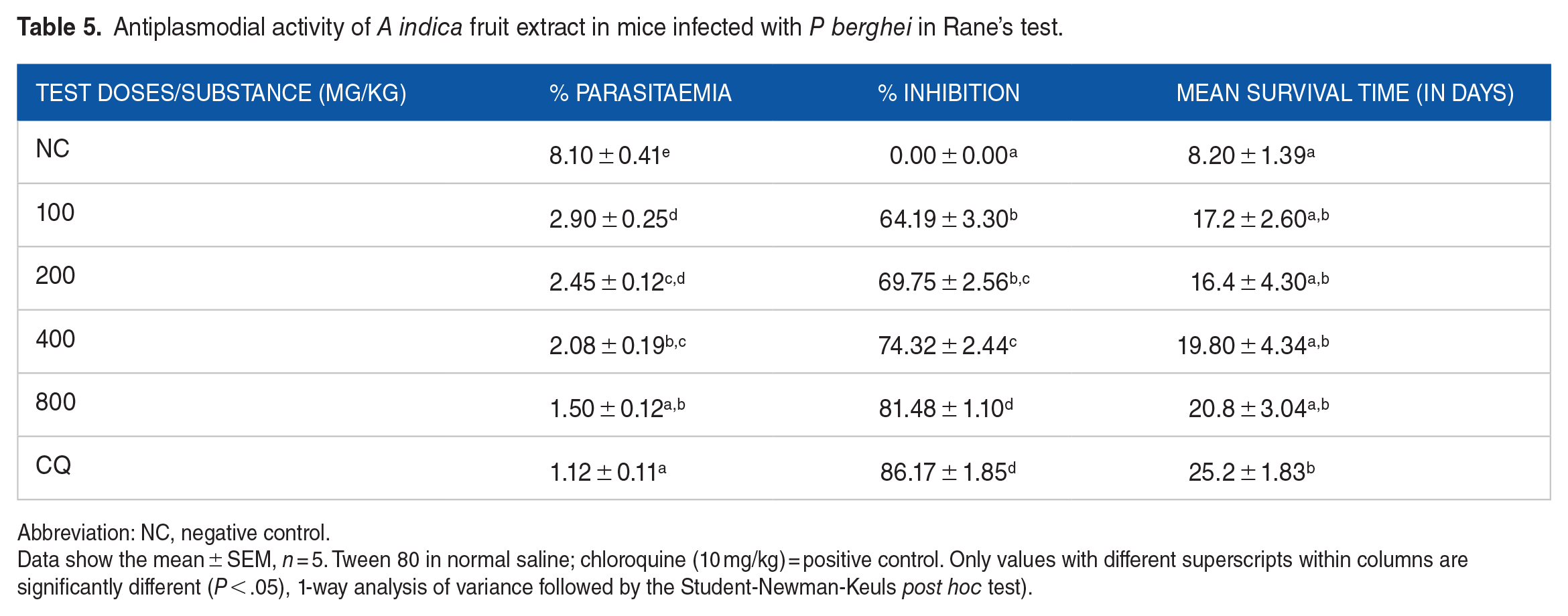
Abbreviation: NC, negative control.
Data show the mean ± SEM, n = 5. Tween 80 in normal saline; chloroquine (10 mg/kg) = positive control. Only values with different superscripts within columns are significantly different (P < .05), 1-way analysis of variance followed by the Student-Newman-Keuls post hoc test).
The merozoites which were likely to have emerged from the liver cells must have afterwards invaded the red blood cell and re-establish infection after Day 3 posttreatment with A indica fruit extract and thus reduce the average survival time when compared with the standard positive control drug. 61
Rane’s test of the ethanol extract of A indica fruit
The in vivo antiplasmodial activities of the ethanol extract of the A indica fruit were examined by withdrawing blood samples daily (Day 4 to 7) and smears were prepared to determine the curative effect of the extract using the Rane’s. The results obtained are shown in Figure 5.

Graph showing the percentage parasitaemia against doses of the ethanol extract of A indica fruit from Day 3 to 7 in an in vivo antimalarial activities (clearance) test where PC, NC, 100, 200, 400, and 800 mg are the tested doses of the extract.
The parameters used in evaluating the curative activity of the test doses include the percentage inhibition and the mean survival time, mostly used in the screening of antimalarial drug candidates. The results showed a significant reduction in the level of parasitaemia from Day 3 to 7 at all tested doses as compared with the negative control except on Day 4 where there was no variation in the values at 100 mg/kg. The extract elicited comparable activity across all doses from Day 3 to 6.
The results shown in Table 5 indicated that the ethanol extract of A indica fruit significantly reduces parasitaemia in a dose-dependent manner when compared with the negative control (Tween 80 in normal saline), at (P < .05 in all cases). The highest average percentage of parasitaemia inhibition (86.17%) was noted in mice treated with CQ 10 mg/kg, which was comparable to the activity elicited by the test extract (81.48%) at the dose of 800 mg/kg. This indicates that A indica ethanol fruit extract has a direct curative antimalarial activity in vivo, especially at higher doses. This observation is similar to the findings obtained from the evaluation of the antiplasmodial activity of A indica ethanol leaf extract in mice in vivo, whereby parasitaemia was completely eliminated at the higher dose (600 mg/ kg) with no recrudescence compared to the lower doses like CQ (10 mg/kg). 62 Also, similar report was obtained for the Anarcadium occidentale ethanol leaf extract which demonstrated a curative effect of 54.20%, 80.66%, and 80.69% at 400 mg, 600 mg, and 800 mg respectively against P berghei infection in mice. 63 These showed a more effective antimalarial curative effect at prolonged and higher doses as observed in this work.
The ethanol extract of A indica fruit was able to reduce parasitaemia significantly and equally prolonged the survival period of infected mice comparable to the value recorded for the standard drug, in the antimalarial curative assay.
Median effective doses values of A indica fruit in 4-day suppressive and Rane’s tests
The effective median dose (ED50 and ED90) of A indica was determined from a graph of percentage suppression or percentage inhibition against the doses of the extract using the Microsoft Office Excel 2013 programme and the results are shown in Table 6.
Median effective doses (ED50 and ED90) values of the ethanol extract of A indica fruit.

Abbreviations: AQ, aqueous; BUT, butanol; DCM, dichloromethane; EtOAc, ethyl acetate; NC, negative control; N-HEX, N-hexane.
Data show the mean ± SEM, n = 5. NC: Tween 80 in normal saline.
The ED50 and ED90 are the respective doses that will give a reduction in parasitaemia levels of the untreated mice by 50% and 90%, respectively, under standard experimental conditions. The result showed that the ED50 and ED90 of A indica fruit are 321.70, 652.84, in the 4-Day Suppressive and 248.2678, 508.5354 in the Rane’s Tests, respectively, while the ED50 and ED90, of CQ, the positive control has been reported to be 2.19 ± 0.10 and 4.29 ± 0.10, respectively.64,65
Conclusion
This study showed that ethanolic extract of A indica fruit extract demonstrated significant parasite suppression but was not able to prolong the survival time compared with the control which points out that the degree of suppression was not adequate to maintain the overall well-being of the infected mice. The optimal antiplasmodial curative activity of A indica fruit extract was noted at 800 mg/kg with a higher survival time than CQ, the standard drug. An effective medicinal extract is expected to mitigate parasite load and hence the survival of infected animals, as demonstrated by the antimalarial curative activity of this work. The electronic properties of desacetylnimbinolide, nimbidiol, O-methylazadironolide, nimbidic acid, and desfurano-6α-hydroxyazadiradione gave a better insight into their potential as possible antimalarial agents. It also showed that the molecules might be among the antimalarial agents in the ethanolic extract of A indica fruit. Further haematological investigations should be carried out on A indica fruit extract to determine its mechanism of action against malaria parasites.
Supplemental Material
sj-docx-1-bbi-10.1177_11779322231154966 – Supplemental material for LC-MS Analysis, Computational Investigation, and Antimalarial Studies of Azadirachta indica Fruit
Supplemental material, sj-docx-1-bbi-10.1177_11779322231154966 for LC-MS Analysis, Computational Investigation, and Antimalarial Studies of Azadirachta indica Fruit by Kolade O Faloye, Stephen A Adesida, Samuel A Oguntimehin, Adetola H Adewole, Olajide B Omoyeni, Sunday J Fajobi, Jeremiah P Ugwo, Isaac D Asiyanbola, Victoria O Bamimore, Emmanuel G Fakola, Olayemi J Oladiran and Michael Spiteller in Bioinformatics and Biology Insights
Footnotes
Acknowledgements
The authors are grateful to the German Academic Exchange Service (DAAD) for a research grant at INFU, TU Dortmund. They thank Ms Eva Wieczorek (INFU, TU Dortmund) for her assistance with HR-ESI-MS data acquisition.
Funding:
The author(s) received no financial support for the research, authorship, and/or publication of this article.
Declaration of conflicting interests:
The author(s) declared no potential conflicts of interest with respect to the research, authorship, and/or publication of this article.
Author Contributions
KOF contributed to conceptualization, supervision, investigation, methodology, validation, data curation, writing – original draft, writing – review & editing. SAA contributed to supervision, investigation, methodology, validation, data curation, writing – original draft, review & editing. SAO contributed to Data acquisition, methodology, writing – original draft, review & editing. AHA contributed to Methodology, data curation, writing – original draft, writing – review & editing. OBO contributed to methodology and data curation. SJF, IDA, VOB, OJO, and GGF contributed to Methodology, review & editing. MS contributed to LC-MS data acquisition.
Supplemental Material
Supplemental material for this article is available online.
References
Supplementary Material
Please find the following supplemental material available below.
For Open Access articles published under a Creative Commons License, all supplemental material carries the same license as the article it is associated with.
For non-Open Access articles published, all supplemental material carries a non-exclusive license, and permission requests for re-use of supplemental material or any part of supplemental material shall be sent directly to the copyright owner as specified in the copyright notice associated with the article.
