



Abstract
The Independence Plaza of Otavalo in Ecuador is a well-known international tourist destination that brings together Indigenous vendors of the Kichwa-Otavalo nationality. Although the side-by-side stands are lined with what look like traditionally handmade crafts, most of what is sold here is mass produced. Among the overwhelming display of industrialized textiles, this article aims to understand the perseverance of local handloom weavers. We argue that the materiality of weaving practices resists disappearing over time, despite difficulties, because the artisanal process vests weavers with creative possibilities to make work and make kin. Using a phenomenological research design based on in-depth interviews and participant observation, we found that skilled practice, embodied knowledge, and knowledge transmission shape the creation of value and that value creation also shapes practice, knowledge and its transmission. These aspects constitute prospects for artisans to make a tenuous place for themselves in a global market economy.
Introduction
One of the most popular tourist destinations in Ecuador is the handicrafts Independence Plaza of Otavalo, best known as the Indian Market, located in the town of Otavalo about two hours from Ecuador’s capital city of Quito. This market, or the Plaza of Ponchos (traditional South American single-piece garment with a slit in the middle of the head) is an almost obligatory stop in tourist packages, where mostly Indigenous vendors of the Kichwa-Otavalo nationality sell their wares in an outdoor fair that takes up a central plaza of Otavalo. Although the side-by-side stands are lined with what look like traditionally handmade crafts, most of what is sold in the Indian Market is mass-produced. The high costs of competition make it unsustainable to produce handmade artisan work at the prices tourists expect and are willing to pay.
Otavaleños (Indigenous People from the area of Otavalo who belong to a Kichwa nationality) are especially known for their textile production and commercial trading, historically in exchanges with Quito, and more recently as migrants commercializing their goods in cities throughout the region, in the United States, and in Europe (Ordóñez & Colmenares, 2019). Innovations in production and circulation—including industrialized practices, incorporating materials manufactured abroad, and segmented commercialization through trans-local and digital intermediaries—are widely recognized as part of Otavaleños’ “entrepreneurial spirit” (Kyle, 2001). Both men and women take active part in the commercial process, “any division of labor by sex holds in merchandising, at least by Indians” (Parsons, 1945, p. 31). Yet, despite these shifting contexts and markets, handmade weaving persists in communities around Otavalo. Handmade textile artisans’ face increasing difficulties in competing with Andean handicrafts replicated industrially for far cheaper in factory settings that now reach as far as China. In this context, how can we understand the perseverance of handloom weavers in Imbabura, Ecuador, despite transformations in textile production and socio-economic conditions that have made subsisting on their weaving work more difficult?
Answering this question can help us shed light on rural practices more generally, including small-farm and subsistence agriculture practices, that persist despite increasingly unfavorable and hostile economic contexts. In this article, we argue that the materiality of weaving practices resists disappearing over time insofar as the artisanal process vests weavers with creative possibilities to make work and make kin. Given the precarity of their positions in social, economic, and political structures, these possibilities constitute prospects for making a place for themselves in a global market economy.
Methodologically, this study began with a qualitative phenomenological research design focused on understanding the structure and meaning of human experience. For Patton (2014), phenomenology is a popular term that can refer to a philosophy, a research paradigm, an interpretive theory, an important tradition in qualitative research, or a framework for methodological analysis, which in any case explore how human beings make sense of their experience and transform this experience into individual level or shared meaning. A phenomenological design in social science seeks to capture and succinctly describe how people experience a phenomenon, in this case hand weaving. Other phenomenological studies on manual craft activity have identified motivations for artisans continuing with their practices, motivations that include: a deep respect for traditions; personal satisfaction; maintaining continuity in ways of being; social connections; and economic compensation (Tzanidaki & Reynolds, 2011). Women, in particular, relate their craft practice with the continuity of family traditions and the possibility of transmitting these to their children and grandchildren.
Since our study explores the richness of artisans’ experience, our research design was less concerned with sample size than with their contexts, histories, craft making and interpretations, visiting their workshops and homes, as part of a longer-term project on the history and the practices of hand weaving in the area. This study is based on in depth interviews and participant observation conducted between December 2021 and June 2022, with six male and female artisans from Otavalo as they carried out their weaving activities. The results were processed through content analysis that identified three thematic patterns (Mayring, 2000) in their stories and practices: their ways of making work, how they make kin, and, in the intersection of their constitution of labor and social relations, how they make a place for themselves in the global economy of crafts.
Historical and theoretical background
From obrajes to tourist markets
In their history books, Ecuadorian students learn that the Otavalo area’s textile fame began in the colonial period, when obrajes (colonial sites in which textiles were produced with forced labor) functioned as proto-factories established by Spaniards who brought materials and tools for handlooms, as well as extractive logics for exploiting native labor. Yet the weaving skills of native Andean people have their roots centuries earlier, in pre-Hispanic cultures. When Spaniards arrived in the Americas, they found consolidated textile practices: “In 1580, a few cumbicamayocs (skilled textile artisans), the most respected textile weavers in the Incan empire, were to be found in the town of Otavalo” (Caillavet, 2000 in Borchart, 2007, p. 197). Moreover, these authors argue that colonial institutions sought to control and appropriate pre-existing textile production and commerce in this area.
Beginning in the 16th century, obrajes applied the central colonial institution of mita (place of native forced labor), in which natives were obligated to work in agriculture, mining or other productive activities for the benefit of Spanish territories; this was the case for textile production in the Imbabura province, where Otavalo is located. Miño-Grijalva (1989) explains that although the concept of the factory as a large-scale production center was positioned and legitimized in the 19th century as a consequence of the Industrial Revolution, the factory logics were established centuries before, as in the case of obrajes, which operated for more than three centuries until the end of the colonial era around the 1830s.
During the republican period in Ecuador, throughout the 19th and 20th centuries, textile activities were gradually inserted into industrial production so that the proper textile factories, inherited by local elites, were consolidated not only in Imbabura but also in other parts of the Ecuadorian Andes. Nevertheless, despite often working for and in collaboration with obrajes and factories, hand weavers managed to adapt their economic practices. Domestic workshops of independent artisans survived in parallel to the existence of the colonial obrajes and the later manufacturing centers, transforming pre-Hispanic weaving traditions through the incorporation of materials and tools introduced by the Spanish, particularly with the use of sheep’s wool and the telar (treadle loom). The relative success of domestic handmade weaving, however, met with increasingly difficult conditions toward the end of the 20th century. Figure 1 shows one of the few classical wooden treadle looms that can be found in the Peguche area.
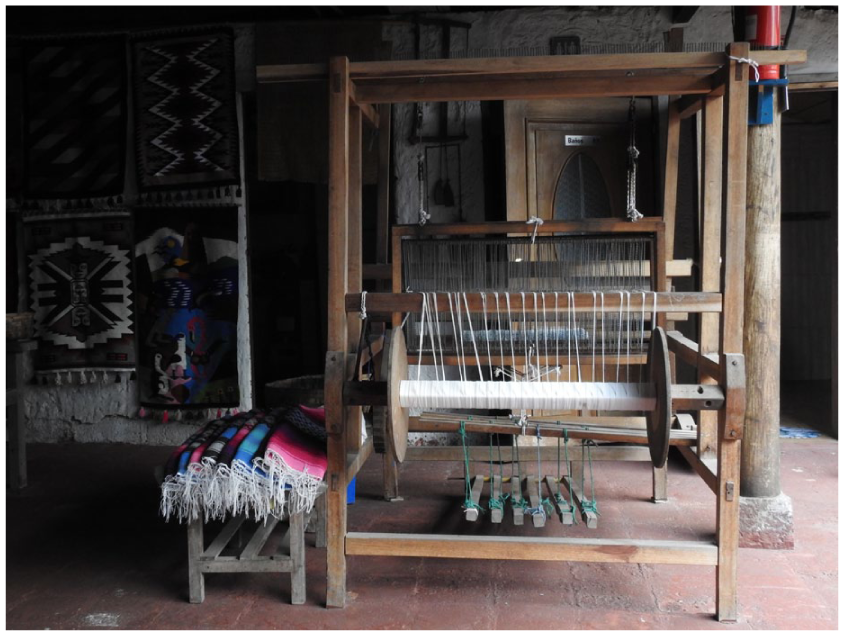
Wooden telar for demonstrations in José’s showroom.
Not only did industrial technology continue to advance in this period, but modernization paradigms and eventually neoliberal multiculturalism sought to incorporate “the native” into global markets, particularly through tourism (Comaroff & Comaroff, 2009). According to Terry (2020), the growth of the international tourism market from the 1980s led to strategic changes in adaptation and in the diversification of production, with commodified textiles characterized by their circulation as objects, patterns, ideas, and techniques. In these contexts, and particularly given the dominant lenses of developmentalism and entrepreneurship through which the artisan’s activities have been interpreted, there have been too few attempts to explore the reasons that the materiality and practices of their crafts continue to persist. In Ecuador, craft work tends to be a footnote in the more dominant narratives of Indigenous economies and politics.
Approaches to craft making and craft markets
Craftsmanship, with a focus on the development of manual production techniques, has been explained from multiple perspectives. Through a perspective that focuses on the continuation of artisan processes, Gilda Hernández (2012) studies the case of pottery: the technique that craftsmen follow for forming [their pieces] is neither determined by the existent raw materials nor by tools, but rather by the conceptualization that artisans have of their own pottery technology, that is, what potters consider as essential characteristics of their pots, and how they think pots should be made. (p. 35)
In such an analysis, the creative process reproduces itself independently from the material dimensions of artisan’s work. Tim Ingold (2000), in contrast, explains that artisan creation does not respond to the “standard interpretation” based on Cartesian logic that separates cultural imagination from the material world. For Ingold, there is no subject-object division in the process of creation, but rather a process of correspondence that absorbs both the material and the maker of the product.
Ingold (1996) thus also refutes the notion that the evolution of human abilities can be explained either from innate biology or from cultural transmission by tradition. He proposes that abilities evolve through a system of relationships that are constituted and transformed over time, in which skills: are incorporated into the modus operandi of the developing human body through a history of training and experience, under the guidance of already skilled practitioners, and in an environment characterized by its own distinctive textures and topography, littered with the products of previous human activity. (p. 178)
This emphasis on making, and in the producer’s affective engagements with their materials and work, has helped to steer anthropological perspectives toward art and craft making and helped to elaborate theory around the experiential, relational and indeterminate quality of production (Cant, 2018).
As we pointed out above, however, the analytic focus on the aesthetic and affective “does not acknowledge the alienated forms of making that dominate a huge portion of human experience” (Howard, 2018, p. 74). In this line, Makovicky (2020) aims to disrupt the anthropological habit of separating two aspects of craftsmanship, making and markets. According to the author, while questions of making are discussed in terms of skilled practice, embodied knowledge and knowledge transmission, questions of value are framed in terms of domestic economies, global markets, and aesthetic regimes, with little consideration of the ways that practices of material transformation themselves may be implicated in the creation of value.
Perspectives of the political economy of craft have examined how aesthetic regimes, knowledge economies and business models influence craft products and labor in the global marketplace and reconfigure class, gender, and ethnicity relations in craft communities. In recent years, and in the contemporary search for alternatives to capitalist economic structures, craft labor has gained prominence with the hopeful idea that “the artisan economy is morally distinct from capitalism: more democratic, more aesthetically pleasing, more environmentally sound, and it offers meaningful opportunities for self-actualization and personal fulfillment” (Munro & O’Kane, 2022, p. 13). Yet as these authors also note, the so-called artisan economy may also ideologically legitimate capitalism in its direct contributions to accumulation and the reproduction of economic hierarchies. In this article, we complement and complicate such economic debates on craft making by showing that its role in creating work and creating value is co-constitutive with its material, social and affective dimensions.
New approaches to the materiality of craft production can help us to understand the emergent character of work in artisan production and processes, as well as how such processes also create social relations. In dialogue with these approaches, we show how artisan processes only become work in the processes of making, in intersection with ideas of the artisan-tradition and the materiality of the craft. As we will see, in the Ecuadorian context, these dynamics are also indissociable from the production of social and kin relations. Nevertheless, as Howard (2018) notes, material anthropological approaches often pay insufficient attention to the ways that the material constitutions of work and kin play important roles in unequal and globalized socio-economic structures and artisan responses to these. We thus put materialist approaches to craft processes –which help us to understand the work and social relations that artisan practices constitute– into dialogue with analyses that highlight the ways that labor and kin relations shape and are shaped by positions and possibilities in market economies.
Findings and discussion
Creating work and value through artisan processes
As we noted above, craft making only becomes work under certain conditions. Frampton’s (2002) interpretation of Arendt’s distinction of labor and work is useful here, in which labor corresponds to activities required to satisfy vital needs, while work produces the world of alienated objects. In this section, we look at the ways that the ideas and experiences of the artisan-author and the material place of the workshop transform craft making into work. If it is work that makes objects, it is also this work where value resides.
Luzmila is part of the board of directors of the local Otavalango Museum, installed in the remains of a textile factory in Imbabura that operated until the end of the 20th century. This cultural facility is currently administrated by Luzmila’s Indigenous community; her family and other members of the community acquired the rights of the property years ago. Her husband still weaves on a wooden hand loom, but the sale of his textiles does not provide enough income to cover the families’ subsistence. Luzmila acknowledges that: making a living from handcrafts is difficult, you don’t get rich. What you really want is to keep your parents’ ways of weaving from disappearing. He [her husband] is so rooted in what he learned from his parents about crafts and culture that he keeps at it and encourages others to keep weaving as well (Luzmila, female, 60 years old).
Economic motivations are far from the only reasons that Luzmila’s husband continues to weave.
Yet these other motivations –which include cultural dimensions and social continuity– are precisely what make the creation of economic value possible, what make craft making into work. Craft work is valued in the market as the result of the material and affective dimensions of creating the textile; weaving and work are generated reciprocally. This reflects Cant’s (2018) point that the category of artisans and the practice of work must be actively ‘made’ in workshops, as the material objects are also made. We see how hand weaving makes the artisan and “a different kind of work” in the process itself. Matilde (female, 75 years old), in Figure 2, manually adjusts the yarn thickness while she explains, All the work that has to be done for [the piece] to be handmade, takes time. A machine is automatic, the only thing the person does is to put the material in and it’s done. . . Hand weaving is different, you must keep at it and keep at it, it’s a different kind of work.
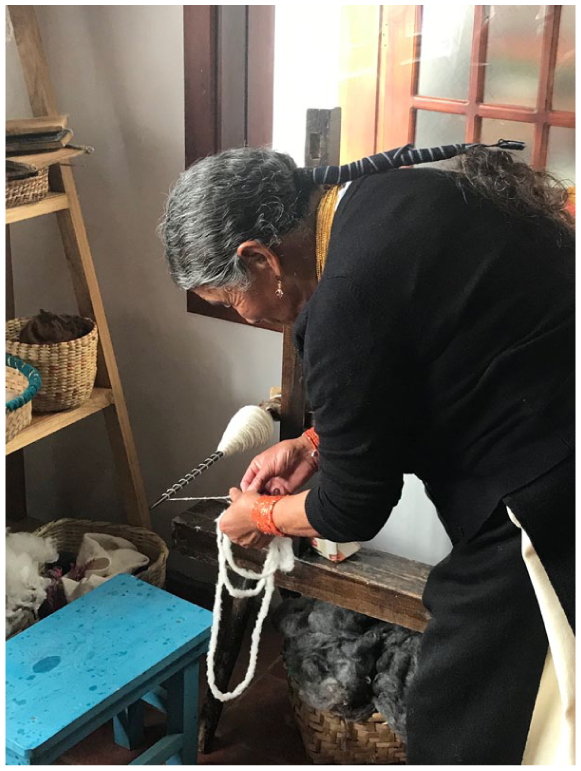
Matilde spinning wool using the torno (spinning wheel).
The specificities of the artisan, in contrast to the machine-operator, are in part related to the impossibility of completely systematizing handcrafted work through rational designs. In another interview, Matilde focused less on the work itself and more on the details of the weaving process: “If I want to weave in one color, I choose a single color, but if I’m making patterns, I choose other colors that will combine well. Everything comes from the head, there is no design” (Matilde, female,75 years old). Matilde’s works with trial-and-error, rather than with a predetermined design, such that the process itself, as well as the textile product, are finally both singular and imperfect.
There is, in this sense, an abiding uncertainty in the process of handcrafting work, that is stabilized by and indissociable from the skills and experience of the artisan. As Martin (2017) writes, “the quality of the result is not predetermined, but depends on the judgement, dexterity, and care which the maker exercises as he works . . . The quality of the result is continually at risk during the process of making” (p. 83). Not only do the affective dimensions of the craft making turn the artisanal process into work –that is, into value– but the artisan’s skills and experience do so as well. This, then, is the centrality of the artisan to the process of creating work.
Yet the artisan is not an individual, particularly in Indigenous communities such as those in the Imbabura province. Luzmila speaks of her husband’s work as part of a longer tradition, saying that “what is learned is never forgotten. . . An Otavaleño taita (father or traditional and spiritual wise man) from Quinchuquí taught him to weave” (Luzmila, female, 65 years old). The sanctity with which weavers in Imbabura speak of their elders and the weaving process that they received and carry through time is what Diodati (2017) calls a “wholehearted” surrender “to the tradition within which they work. . . Surrender involves full confidence in the tradition within which one operates” (p. 217). Weavers feel a responsibility and a commitment to maintaining their craft practices, a responsibility and commitment to their craft tradition that makes them and makes their work. Another weaver notes, “My purpose has been to give life to what came before, which is no longer” (José, male, 76 years old). Memory and the continuity of cultural and craft traditions permit the mitigation of risk inherent in the individualized and trial-and-error process of hand weaving.
That tradition involves not only processes but also the material artifacts for crafting, processes and artifacts that constitute the workshop. With the handloom, the workshop can be anywhere the loom is located. Luzmila continues describing her husband’s weaving trajectory: “He began to travel to fairs all around the world, taking his backstrap loom to show how he weaves. When he sold his textiles, he was the one who sold the most because of his demonstrations” (Luzmila, female, 65 years old). There is a close relationship between memory and the material, in this case the weaving artifact that is the inherited loom. Thus, if the loom is as critical to the traditional process as is the knowledge of weaving, then the workshop is defined less by its physical space and more by both the artifacts and the people through which that practical and affective knowledge is transmitted.
Contemporary craft production depends on the transformation of artisanal processes into work, through the incorporation of one’s weaving into the craft tradition (Diodati, 2017). The making of craft work, in turn, is thus also the making and remaking of this tradition, and of the memory and social relations that constitute it. In this sense, tradition and traditional processes are not static, but continually evolve through the transformation of workshop spaces, the value of work and continually changing economic and political contexts, as well as weavers’ responses to these. As we have seen in this section, the artisanal process continues to be important to the handloom weavers we spoke with, despite hostile market contexts, because of its generative possibility to create not only economic, but also affective and culturally important work and value. Another reason that weavers continue to dedicate themselves to their craft is because it is through these material processes that they also make kin.
Indigenous, artisan, and kin communities of practice
Weaving in Imbabura –as is the case for many “traditional” crafts– is impossible to understand without understanding the social and family relations that provide the material and immaterial infrastructure for its continuation. Yet hand crafted weaving does not just depend on kin, it also makes kin, in Donna Haraway’s sense of establishing “mutual, obligatory, non-optional” relations: “It’s not necessarily to be biologically related but in some consequential way to belong in the same category with each other in such a way that has consequences. . . [to] have accountabilities and obligations and pleasures” (Haraway in Paulson, 2019) that are specific to these human and beyond-human networks.
Hand weaving is both the legacy of family practices and the creation of networks of accountabilities, obligations, and pleasures. The Otavaleño taita who taught Luzmila’s husband to weave was a respected elder in their Indigenous community. Likewise, another weaver, José, explained that he worked with another taita, his father-in-law, who helped him prepare himself for his craft. It was the time he spent weaving with taita that constitutes the value of his work: “My father-in-law had patterns for the fine wool. . . That is our art. . . its value depends on all the time it takes to prepare oneself”. (José, male, 76 years old)
But the possibilities of sustaining themselves economically as artisans has depended on making explicit choices that demarcate one’s relations and obligations. Until the latter part of the 20th century, the city of Otavalo was occupied by white-mestizo settlers, while Indigenous people lived in the rural peripheries. José recalls that he had the privilege of studying in the city, but “it wasn’t easy for runas (Indigenous persons) from communities to integrate into the city. . . I returned to the community because I did not agree with the city people, it was another way of life”. Instead of seeking to incorporate himself into urban work in the city of Otavalo, José dedicated himself to his family’s line of work.
Jose came of age just as elitist reactions critical of 1950s developmentalism –a critique which nevertheless shared developmentalism’s inherent dualism between the modern and the traditional– began to value the “native.” In 1942, Olga Fisch, an artist of Hungarian origin established a brand for international marketing of Ecuadorian folk-art products, and José and his wife Marina were beneficiaries of her attention to his family’s craft: “Señora (lady) Olga Fisch got to know my taita’s weaving and began to contract all the work he did on handlooms” (Marina, female, 70 years old). Beyond and connecting families, Indigenous communities have become important containers for the contemporary valuing of the handmade, in which specific skills are brought to the attention of foreign designers. Fisch (1985), in her book of memories, acknowledges that the Indigenous artisans she worked with were technically excellent, even though creativity was limited in the production of new motifs.
Beginning in the final third of the twentieth century, international organizations such as the United Nations’ International Labor Organization (ILO), the Peace Corps, and other agencies, sought to encourage sustained craftsmanship, especially if the populations involved were indigenous. These organizations implemented projects that taught tapestry weaving and introduced innovations in the designs of Indigenous peoples’ handwoven products (Rowe, 1998). Currently, however, tapestry weaving in the central Ecuadorian Sierra is no longer practiced, while the weaving practice of sheep wool hand spinning persists in Salasaka, as Indigenous women of the area still use hand spinning to make their own garments though, such as rebozos (a general term for different kinds of shawls), lishtas (light shawls weaved with thin colored lines) and ponchos (Toro-Mayorga & Acosta-Torres, 2024).
In the 1970s, weavers sought to work in cooperatives to continue with the larger scale textile production demanded by the tourist-oriented trade. These cooperatives were, in part, the result of the foreign intervention of members of the Peace Corp that established workshops as cooperatives in several places in the Highlands with Indigenous populations, to develop textile products with new designs for foreign customers (Kyle, 2001). But the kind of mutual obligations that are necessary for craft work to continue –as neither pure creative, artisanal process nor salaried, alienated work– did not exist in those settings. Luzmila, who came from generations of weavers explained that: In the factory there could be partners or a cooperative, but only those at the top do well, those who don’t know much are left at the bottom. That is why it’s better to work with family. There were cooperatives here, but it didn’t work out; our taitas and mamas (mothers or female elders) told us that people were no longer trustworthy. Now everyone works with his or her own family. (Luzmila, female, 65 years old)
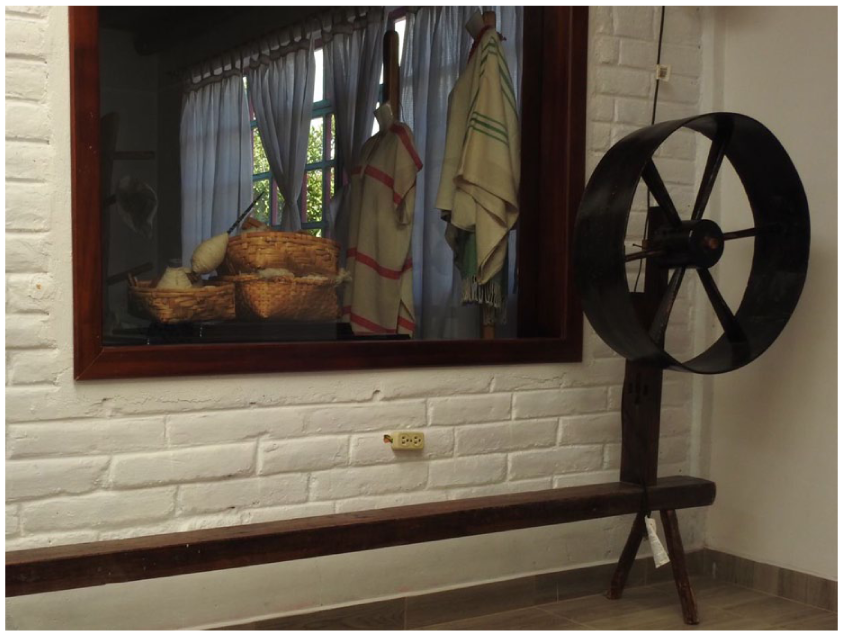
The artisans who have workshops speak of a long trajectory of gradually forging a space for themselves and their families. Tools like a wooden spinning wheel, known as torno in Figure 3, make part of the process of preparing the wool for weaving.
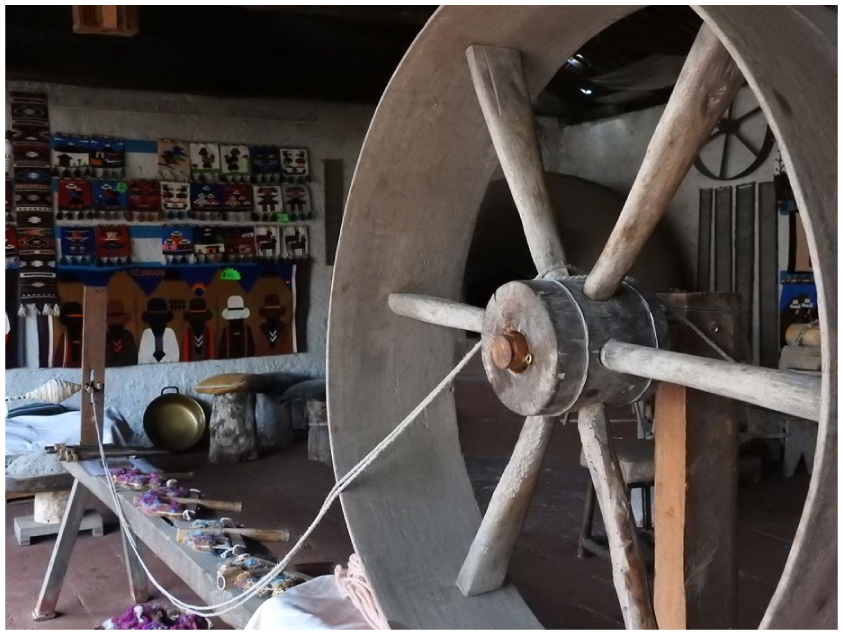
Torno (spinning wheel) and typical tapestry at Jose’s showroom.
As we saw above, artisan authorship rests on shared creative processes, even as the artisan creates individual pieces. As with Cant’s (2018) case with woodcarving artisans, . . . rather than ownership of the means of production, [craft] relations of labour are generated by the intermingling of the art world’s ideology of ‘authorship’ with the intimate relations of kinship. . . Through work, people create themselves through their agency and at the same time create others for whom they work, or with whom they share the fruits of their labours. (p. 1)
The fruits of that work are not only the craft products, but the craft itself. If recent anthropologies of craft making establish the production of “skill-specific identities” along with sharpening of skilled practices (Martin, 2017, p. 77), these identities in the world of weaving in Imbabura are indissociable from Indigenous and kin identities.
Further, it is precisely these social relations that weavers seek to reproduce in their participation in contemporary tourist markets, as we will see in the next section. The central point of this section has been the constitution of social ties, of kin relations, which generate the crafted product itself, which becomes “a material manifestation of sociality, a sedimentation of the relationships that went into its making” (Prentice, 2017, p. 172). Those in Indigenous communities with a shared craft tradition are as much “communities of practice” (Gowlland, 2017, p. 194) as they are kin communities. The perseverance of handloom weavers in Imbabura is a testament to its complex multi-dimensionality, in its production of work, value, and social and kin relations that result in unique products, such as the artisan balnket shown in Figure 4.
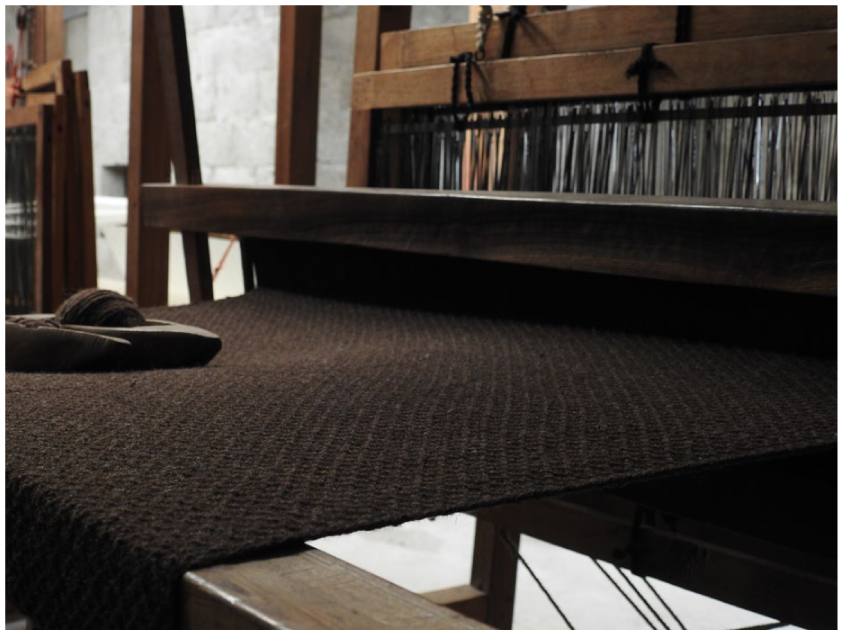
Texture of a finished blanket woven in a wooden treadle loom at Segundo’s workshop.
Value in international economies
Not only do the crafts they produce locate artisans in very particular places in the contemporary market economy, but so do the identity and social relations that are part of the artisan processes, as we saw above in the valorization of the Indigenous identities of Otavalo craftsmen and women. In this final section of the article, we look at the ways that the dynamics of work and kin in the artisan process shape their precarious positioning in a globalized economy. Since the mid twentieth century, the rise of celebratory multiculturalism and mass tourism have been significant for the possibilities and limits of artisan production.
Luzmila, a female 65-year-old weaver in Imbabura, long ago learned how to use both the backstrap and the treadle loom. But it was her parents’ relationship with the tourist industry that has secured a position for her to continue weaving with these looms. Since she was very young, and aided by a small crafts shop shown in Figure 5, she “grew up with visitors.” Her parents, more merchants than weavers, welcomed and worked with tourists, “which is why they now come to visit me, journalists as well, from different countries. They have featured us in books which has really helped us” (Luzmila, female, 65 years old). Late twentieth century tourism and the neoliberal multiculturalism that structures much of its dynamics, has both facilitated and limited the continued evolution of craft production. Just as craft tradition can be both limiting and sustaining, so can craft markets. As we noted above, artisanal crafts have been revalued in the last decades because they represent the possibilities of economic production and consumption that is not driven by the predatory logics of capital accumulation and value extraction (Munro & O’Kane, 2022).
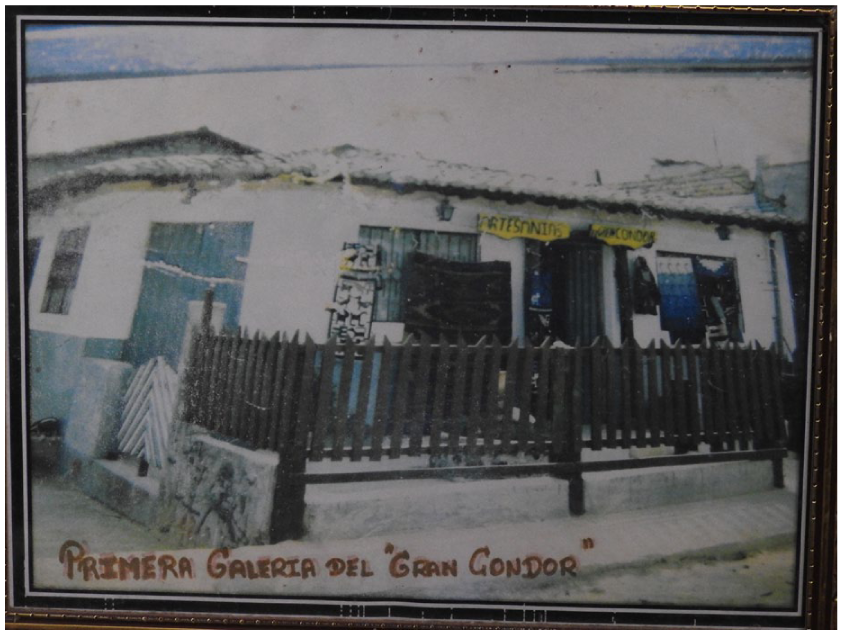
Photo from the 1980s of a pioneering crafts gallery in Peguche-Otavalo.
This perspective is marked even more starkly when the artisans producing the crafts are Indigenous. The artisan workshops we visited ranged from small sparse rooms with dirt floors to carefully arranged spaces that might capitalize on such a perspective, aimed to attract international tourist interested and consumption. As Bose (2019) writes on an artisan scroll painter in India, “[he] actively participated in this construction and performance of ‘tradition’ through his narratives of origin and his ‘demonstration’ of the craft, so that his studio was transformed into a hyper-real diorama” (p. 241). Bose notes the historical similarity to nineteenth-century colonial expositions, though the difference is of course the director behind the performance. If Orientalist expositions sought to freeze the “Other” in a timeless pre-civilization context, the artisans we and Bose study know exactly what they are doing.
For the handloom weavers we spoke with in Imbabura, it is evident that an international market is necessary for them to continue creating and selling their textiles. As another woman weaver explains: What makes it possible for artisan workshops to survive is when they have people who value and buy their products. When we find a public that has as awareness and respect for what is handmade, artisanal, based on our culture, when we can connect with those kinds of people, they are willing to pay the price that needs to be paid. That is what keeps this workshop going. (Paola, female, 50 years old)
For the most part, domestic consumption markets cannot sustain handmade craft production because of its cost of production; cheaper industrial fabrics flood domestic tourist craft markets. Nor have there existed sustained public policies in Ecuador that might support artisan work, as national economic strategies have insisted on strengthening the country’s primary export role (Galo Ramón, conference notes, March 2022). There are scarce local or digital markets in which a national affluent public might peruse expensive clothing or exclusive decorative products. Thus, the skills that the Imbabura weavers develop are linked to systems of changing socio-economic relations in particular environments.
It is in this context that Matilde, a 75-year-old weaver shares her hopes that her commitment to her craft will translate into its appreciation. After decades of arduous and tireless artisanal work, she and her daughter have managed to open a small and very welcoming gallery at their home, which is shown in Figure 6. Her dedication to her craft is the remaking of tradition, the generation of work and value and the materialization of affective and social links: “What drives me is that I always put my craft first, looking to continually improve it. I’ve also knocked on many doors to make sure it’s valued since it’s handmade”. When Matilde talks about knocking on doors, she means that she looks for opportunities to sell her products by offering what she makes herself. She creates her product in the context of the weaving tradition and the relationships within her Indigenous and kin communities, but with a view to it being valued as she produces and values it.
Matilde’s gallery showcasing its exclusive products.
It is, then, not only the economic possibilities of foreign buyers that make selling in international markets fundamental to the production of handwoven textiles, but also the international valuing of the folklore traditions and Indigenous identities that are part of their artisan production. Most of the artisans with whom we spoke recounted at length their experiences outside their places of origin, from the Ecuadorian city of Guayaquil to regional capitals in Latin America, and to cities of the United States and Europe. The appreciation of their work in these places, for the reasons explored in this article, has been an incentive to continue with the artisanal work of weaving rooted in their childhood.
Conclusions
Though increasingly uncommon, the ancestrally rooted work of manual loom artisans has persisted, despite their marginalization from the times of colonial obrajes to the onslaught of the accelerated modernization and homogenizing capitalist globalization of the 20th and 21st century. In this article, we put materialist approaches to craft processes into dialogue with perspectives that seek to understand work and kin relations to understand artisan’s persistence, though precarious, in the global market economy.
As we have seen, hand weavers not only seek to establish their craft making as work but hope that their role as artisans and the specificity of the handmade will allow them to sell their products despite their less competitive costs than industrial textile products. As they make work and value through their relationship and recreation of the artisan tradition, and as they make kin and community through the sociality of their products, they also use these dimensions of craft making to position themselves and transform the economic field, insofar as they emphasize and seek the recognition of the value of the handmade. It is this multiple meaning of handcrafted weaving—in terms of its cultural, economic, and social significance—that makes the craft’s survival possible.
Making and markets are thus inescapably interconnected, with skilled practice, embodied knowledge, and knowledge transmission shaping the creation of value just as value creation shapes those fundamental elements of craft making. The experiences of manual loom weavers in Imbabura shows us that the opposition between the “traditional” and the “modern” is not only constituted by the modernizing processes itself that creates and depends on peripheries of romanticized separate spheres of ancestral practice, knowledge and peoples, but more interestingly is leveraged by the weavers themselves in the ways that they make work, kin and value. As such, artisans continue to create their textiles and at the same time reinvent their own existence, just like peasants, who refuse to disappear.
Footnotes
Acknowledgements
The authors acknowledge the generosity of the artisans from Peguche and Otavalo in Ecuador. Special recognition to the artisan from Galería El Gran Condor, to Matilde and Paola, graceful artisans from Warmi Maki, to José Farinango and Maria Muenala from Peguche Wasi and to Luzmila Zambrano from Museo Viviente Otavalango. They shared their experiences with genuine interest in making their art known, so it is valued and preserved from disappearance.
Authors’ note

Funding
The authors disclosed receipt of the following financial support for the research and publication of this article: funding from Universidad Técnica del Norte INVESTIGA-UTN Research Calls.
Declaration of conflicting interests
The authors declared no potential conflicts of interest with respect to the research, authorship, and publication of this article.
Glossary
Kichwa language
cumbicamayocs skilled textile artisans
Kichwa native Andean language
lishta light color shawls weaved with thin colored lines
poncho traditional south American piece garment with a slit in the middle of the head
rebozo shawl
runa Indigenous person
taita father or traditional and spiritual wise man
Spanish language
mama mother or female elder
mita place of native forced labor
obrajes colonial sites in which textiles were produced with forced labor
Otavaleños Indigenous People from the region of Otavalo who belong to a Kichwa nationality
señora lady
telar wooden treadle loom
torno spinning wheel to produce wool yarn