




Abstract
This article is an investigation into how cultural debates are staged within the planning hearing for a new concert hall in Edinburgh. Through an analysis of the hearing and interviews with protagonists, it shows how the material, in this case the proposed concrete cladding, functions within a cultural controversy, providing an excellent example of how materials are socially mediated. The findings suggest that the debates over cultural impact and elitism rehearsed in the hearing are inextricably tied to two opposing ontologies of concrete, one very fixed, the other far more open. It is argued that planning hearings are an under-explored area in which cultural policy is effected, though the entwinement – indeed co-constitution – of material and cultural issues shows that the course and eventual conclusion of these debates are highly complex.
This article is an investigation of the planning hearing as an arena in which debate over cultural interventions takes place. It gives an insight into where and how the appropriateness of such interventions are discussed within society. The argument, using an analysis of a planning hearing for a new concert hall in Edinburgh, is that debates over a material, in this case concrete, become the locus for much larger issues of culture’s place in society and the shape actors want the city to take. Focusing on such moments of controversy is part of a long line of, often Actor-Network-Theory-inspired, social investigation, as they reveal the significant work undertaken to establish scientific ‘truths’ or, in this case, the appropriateness of cultural artefacts (Latour, 1987; Sismondo, 2010: 120–135; Yaneva, 2009). There is, however, far less consideration of cultural controversies and how these are aired and worked through, despite the fact that most major cultural buildings are accompanied by mild to virulent dissent. 1 Once built, though, such cultural artefacts usually become ‘common-sense’ pieces of urban furniture (see Philippou, 2018: 1294).
As a result of the analysis undertaken here, the ontology of concrete is shown to be contested and inextricably social, linking with an established discourse on materialities, while the planning hearing is revealed as an overlooked site in which cultural debates take place and in which local government policy has direct impacts on cultural infrastructure and provision. This offers a shift in the focus of a sociologically informed study of culture, from the status of the art work, the institutions and ‘spaces’ of the cultural world and the cultural significance of buildings (Crossley and Bottero, 2014; Delitz, 2017; Shapiro, 2019; Tanner, 2010), to the work that is done in support of cultural projects and the hurdles that they must overcome, in other words, how the impacts of major cultural interventions are debated and filtered through society. As Steets comments, the ‘passion with which discussions are conducted in many places around the world around erecting new buildings or reconstructing historical ones suggests that much more is involved than the actual positioning of stones, steel and glass’ (2015: 93). Both Jones and Yaneva describe how various actors link buildings to particular futures (Yaneva and Humphrey, 2012: 33; see also Jones, 2020: 76). This process will be observed in the competing visions of this concert hall, with some seeing it as an elite bastion, others as a cultural beacon.
That there is more at stake than ‘mere’ planning regulation is significant because such a planning hearing is one of the few arenas in which a major piece of arts infrastructure is formally and publicly debated, however obliquely, alongside the local and national press. Politics proper, at least in the UK, rarely concerns itself with specific cultural developments, leaving a gap that is filled in the main by influential local elites (Balke et al., 2017), a situation that at first glance fits snugly within a Bordieusian paradigm of classical music as a means of distinction (Bourdieu, 2010; Longhurst and Savage, 1997). Eleonora Belfiore (2009) has argued for some time that much arts policy is simply arts ‘advocacy’, meaning that the planning hearing is a rare opportunity for an external deliberative apparatus to weigh up the pros and cons of such interventions, even though their cultural impact is not supposed to be up for debate. The consequences of this supposed omission will be discussed later.
Planning hearings are designed as opportunities for a committee of local councillors (elected local representatives) to investigate the details of a proposed building project, with the applicant, objectors and heritage bodies invited to present. By no means all proposals are presented at hearings, only those that are particularly significant or controversial. In this case, TH Real Estate (responsible for a nearby shopping development), certain councillors on the committee, and some of the local residents criticize the design. Four main arguments against the proposal are made by the objectors. They are: the materials (concrete), the size and dominance of the new building, the difficulty of servicing it by drinks vans and orchestral vehicles, and the contention that normal scrutiny is not being applied because this is a cultural building. Here, the focus will be on the first and last, with the intention of showing that there is less distance between them than might at first appear. Particularly important will be how discourses around concrete intersect with the other cultural arguments raised for and against the building.
These are not abstract discourses but are raised in practice by the actors who employ them. They will be traced here through an analysis of the public planning meeting and 14 semi-structured interviews with those involved in implementing the concert hall: an architect from David Chipperfield Architects, arts administrators from the local council, local heritage bodies, national music organizations, and four of the ten local councillors on the committee. 2 The planning hearing of 24 April 2019 was the main event of a wider project looking at the work of the International Music and Performing Arts Charity Scotland (IMPACT Scotland), which involved regular informal contact with the organization over a period of 18 months, observation of some meetings, study of planning and design documents, and the interviews. 3 The approach was qualitative, in part due to the small number of ‘experts’ that each have very different roles in the story of this hall. The sample of councillors interviewed was self-selecting, meaning that not all views are represented here, yet it still provides an important insight into the decision-making process, particularly when cross-referenced with the hearing, which is on the public record. Little analytical purchase was observed in comparing data from the hearing and data from interviews so that their differences are not dwelt on here. 4 In this article the empirical material is placed in dialogue with relevant historical and theoretical approaches.
After some brief background to the building design, an overview is given of approaches to materiality and culture from a broad range of disciplines, including sociology, architecture and anthropology. The discussion will then move on to an examination of how cultural debates play a part in the planning process, despite attempts to eradicate them from proceedings. To explore this, two different ontologies of concrete will be discussed that more or less separate objectors from supporters: the first, ‘concrete is concrete’, a closed perspective that is certain of what the material is and can achieve; the second, a more open attitude to its possibilities and interactions with place and history.
Building Context and Design
The building under discussion in the hearing, which was the subject of presentations and debates for five hours, was a proposed concert hall in the very centre of the city. David Chipperfield Architects, at the behest of their clients IMPACT Scotland, put forward a design for a hall behind Dundas House, one of the first buildings of Edinburgh’s New Town and designed by one of Britain’s most celebrated 18th-century architects, William Chambers. The design comprised an auditorium, a rehearsal or small performance space and a publicly accessible foyer, all within a relatively tight site. The circulation spaces were intended to double-up as workshop or educational rooms, while the upper ‘crown’ provided views over the city.
This was the design under discussion during the hearing but it will not be the building’s finished form. Behind the planned concert hall is a large retail, hotel and residential complex, due to be completed in stages throughout 2021/22, with a large and controversial central hotel, labelled in much of the national press as the ‘Walnut Whip’, though known locally by some less charitable monikers (Allan, 2021). Heritage bodies strongly criticized the hotel design at its own planning hearing, predicting that it could have a damaging effect on the city’s UNESCO world heritage status (Gourtsoyannis, 2015). After the concert hall planning hearing described here, TH Real Estate (now Nuveen Real Estate), who are responsible for the St. James development, called for a judicial review of the concert hall planning process, which could have mired the City of Edinburgh Council in legal proceedings for a period of years, thereby delaying construction of the concert hall. After a process of mediation, an agreement was reached on a smaller building that contains fewer facilities, requiring the submission of a variation to the original plan. At the time of writing, this plan is still being developed. Irrespective of whether the design discussed during the hearing is built, it is argued here that its function as a lens through which cultural debate can be viewed remains the same. The tension between concert hall and St. James developers, and the controversial precedent of the planning consent given to St. James Quarter, are both important contextual factors to the hearing discussed here.
No changes are planned to the location of the concert hall, to be named the Dunard Centre, which will sit at a key juncture of the New Town plan, comprising the termination of an axial line along George Street. 5 The plot is currently occupied by a now empty banking building built in the 1960s, the negligible architectural value of which is one of the few things upon which all parties appear to agree. To one side of the site sits another landmark of Edinburgh’s enlightenment, Robert Adam’s Register House, while at the time of the hearing the cranes of the St. James Quarter stood tall behind. A UNESCO World Heritage Site and a conservation area, flanked by listed buildings and another large building site: this is architectural sensitivity at its most extreme. Architect David Chipperfield is no stranger to sites of historic and cultural significance. The Neues Museum in Berlin, for example, is a study in making an old building new but without erasing its history (Chipperfield and Weaver, 2003). Selected by IMPACT by means of a competition, his brand of solid, unflashy modernism that sits in dialogue with its context – and significant international track record – evidently appealed to the panel.
The hall is the latest in a series of attempts over many decades to try and find a new home for the Scottish Chamber Orchestra (SCO), though IMPACT are keen to stress that the remit is much wider than just classical music, including folk, jazz, spoken word, comedy and events during the Edinburgh International Festival. The chief donor, Carol Grigor’s Dunard Fund, after which the hall is named, is a long-term supporter of the orchestra, as well as other arts organizations in Edinburgh such as the Edinburgh International Festival. The fund has already pledged £35 million, to be supplemented by further private philanthropy and public funds from the UK government at Westminster, from Scottish Government and the City of Edinburgh Council (the latter three funds part of the ‘City Region Deal’ and its match funding).
A great deal was riding on this hearing, therefore, for all the actors involved: the clients had already spent years designing and advocating for the project; TH Real Estate wanted to define a site directly adjacent to their own not-yet-built, multi-million-pound shopping centre; heritage bodies were keen to preserve the character of the New Town; councillors wanted to scrutinize a controversial planning issue; architects wanted to see their designs come to fruition; and residents wanted to have their say on a building that was to be built right next to their homes. Focusing on concrete may appear to limit the impact of these diverse concerns, yet, as will be seen, its malleability means it can be recruited to act on behalf of many of these groups.
Culture and Materials
The issues that divide or unite people in society are settled not only in the institutions and practices of politics proper, but also, and less obviously, in tangible arrangements of steel and concrete, wires and transistors, nuts and bolts (Winner, 1980: 128).
Langdon Winner is not alone in implying that concrete is the paragon of tangibility. The material provides a most apt mental marker for ‘concrete’ as an adjective: nothing is more real, solid and inflexible. Stewart Brand (1997: 2) makes a similar linguistic point when he states that architecture means ‘unchanging deep structure’ as well as the design of buildings, a conception that contrasts with his own developmental understanding of the discipline. Concrete, then, would appear to make an ideal test case for studies of materiality: after all, what could be more concrete than concrete?
Yet, there are ways in which the following study does not fit comfortably within the established anthropological and sociological discussions that have made up the majority of contributions to the study of material culture (e.g. Berger, 2016; Tilly, 2006). This is due to the fact that what is discussed here is not a piece of concrete that already exists, although a sample does come into proceedings, but a debate over a proposed material. There is a strong affinity between proposed buildings and technological projects, which are so carefully dissected by writers working in Science and Technology Studies (STS), in that ‘interpretations of the project cannot be separated from the project itself, unless the project has become an object’ (Latour, 1996: 172). 6 There is no lump of the material that planners can point to as the object but an apparently unreliable signifier ‘concrete’ that can be variously described as a class of objects, a process of making or a linguistic shorthand.
This material is part of what Yaneva describes as the ‘interpretable object’, that is, the building in the iterative and dynamic process of conception and design. Architects ‘play the role of supporters, of friends’ to make the design accessible and meaningful (Yaneva, 2009: 7), a process also labelled ‘configuring the user’ (Woolgar, 1990: 58). Yaneva is part of an established subfield that explores the sociology of architecture and built environment (see Gieryn, 2002; Hommels, 2005; Jones 2011), with Yaneva and Hommels bringing a particularly strong STS perspective. This work is often sensitive to the networks that sanction what can be built and where, as well as the models, images and designs that constitute how such a building moves through society. There is still an emphasis on the architectural profession, yet other studies, such as that of Molnár (2005), look further afield at the cultural currents to which debates over the built environment contribute and the processes by which meaning accrues around buildings. The interaction between the processes of meaning creation and its aesthetic and regulative consequences is a key concern here, which also speaks to literature developing in critical planning studies (e.g. Buser, 2013; Harrison, 2014; Rydin, 2012).
In isolating a proposed material in this manner, this study falls within the bracket of a renewed interest in materialities, sometimes labelled ‘new materialism’ (see Bennett, 2010; Coole and Frost, 2010). While there are common theoretical foundations to many of the contributions in this field, particularly a debt to STS, this article is not an explicit attempt to contribute to the most recent theoretical debates around politics or ontology that belong to it. 7 Rather, the focus here is empirical, showing how a material-centred approach can contribute to a better understanding of social mediation, and the pragmatics of cultural planning,
On the question of ‘materials’ in building, there has also been a renewed interest in architectural discourse. Katie Lloyd-Thomas (2007: 2) states that ‘historically, discourses and theories of architecture have tended to concern themselves with formal questions and to establish the architect as form giver’, while, at the same time, the ‘method we use to develop architectural proposals – orthographic drawing – describes only form, and relegates material to the empty spaces between the lines’. With Lloyd-Thomas, what is argued here is that what goes ‘between the lines’ has its own stories and histories: even concrete, which is often described as giving architects ‘control’ through the relative ease with which it can be sculpted (Parnell, 2015). Despite this renewed interest in materiality, material-centred criticism is by no means a common approach taken by socio-architectural scholars, in whose work the building is the standard unit of analysis, with attention paid in particular to buildings’ symbolism, function and affectual characteristics. 8 The work of figures such as Brian Massumi and Manuel DeLanda inform Lloyd-Thomas’s conceptual efforts to take materiality seriously (DeLanda, 2004; Massumi, 1992). Tim Ingold’s work is also highly influential (2007). It is not only, as Cuff (1991: 116) states, that ‘the social context of a work of architecture is at least as influential as the properties of building materials or the building site’ but that the sites and materials themselves are far from immune to the cultural and social meanings that accrue over time.
Naturally, as a social process, this is no tension-free arrival at an ultimate decision but a messy tangle of arguments and controversies. In this, the planning committee is an ideal arena for such a study as, as Latour (1987: 30) states, in approaching ‘the places where facts and machines are made, we get into the midst of controversies’ and these are ‘more controversial’ the closer we come. In contrast to the view of concrete as the reliable material par excellence it has in fact been selected here for its unique aptitude for such controversy. Parnell (2015: 371) states that the ‘material itself is neither inherently good nor bad, ugly nor beautiful, but an empty vessel that we fill up with meaning and a medium to carry that meaning across time and place’.
In this statement, Parnell is reflecting on Adrian Forty’s Concrete and Culture (2012), a ‘material history’ of concrete, which, along with Cyrille Simonnet’s Le Béton (2005), is a particularly influential and substantial contribution to the specific literature on this material. 9 Some of the debates that follow will be in dialogue with Forty’s study as, unsurprisingly, the dominant understandings of concrete that he describes are present in the thoughts of actors within the planning environment. These include concrete’s contested temporality and aesthetic controversy. A crucial difference, however, which is at times as relevant to Forty as it is to Parnell, is that there is the creation of a distinction between ‘the material itself’ and its ‘meanings’, a distinction that the approach here will problematize. Lefebvre (1991: 137), too, makes a similar distinction between material’s meaning and essence when he states that architects work with ‘both materials analogous to signs (bricks, wood, steel, concrete) and matériel analogous to those “operations” which link signs together . . . (arches, vaults, pillars and columns; openings and enclosures, construction techniques; and the conjunction and disjunction of such elements)’. It is argued here that the inability to distinguish concrete from its meanings, its contested ontology in other words, provides an arena for cultural debates to take place. This does not simply mean that these debates are transferred from one to the other, though this may take place to a degree, but that the two – concrete and culture, material and society – are co-constitutive. This will be explored after an analysis of how culture is referenced specifically in the planning hearing debate.
Culture in the Concrete Debate
For an outsider coming to the British planning system there is a curious blinkeredness to proceedings. As mentioned earlier, the building discussed must be abstracted from its use if that use is deemed appropriate. There are established reasons, however, for considering use and the form of development separately, such as when a site retains the same use but requires a new building, or vice-versa. This means that the concert hall should be debated as if it were a hotel in a location where both would be permitted, the only differences in these examples being what kind of servicing and potential nuisance to the surrounding residents these might cause through their different use (such as late-night crowds and early deliveries). The details of the architectural design and (external) materials are also very much part of the debate so that some control is exercised over the developing cityscape. The impact of this building on the arts in Edinburgh should not be up for discussion, though Labour Councillor Child does acknowledge it, stating that she ‘like[s] the materials’ and that the ‘cultural benefits are enormous, absolutely huge’ (Planning Hearing, 24 April 2019).
The question of culture also comes into the planning hearing in another way, however, with suspicions aroused over whether this building is not receiving the scrutiny it would otherwise were it not for its supposed cultural benefits. Conservative Councillor Rose states that ‘if this was a different development . . . I think we would be scrutinizing it a lot more, asking a lot more searching questions about it and sending them away’. Quoting a previous presentation by a local resident, he states that there is a danger that ‘cultural issues trump everything else’ while raising his concerns regarding servicing and the building material (Planning Hearing, 24 April 2019). There is some argument, therefore, about whether this elimination of cultural impact through not considering the building’s use really takes place, despite all councillors interviewed stating it is vital to the planning process. In the case of this building, several councillors and the objectors TH Real Estate state that these cultural benefits, which are not specifically defined, are seen to mask the apparent faults of the building, which would be far more conspicuous if it had another use. In interview, Councillor 2 asks, in respect to what they feel is an overly dominant profile to the building: ‘would that have been allowed if it was an office block?’ (Councillor 2, Interview, 31 May 2019).
The previous lengthy debate over the materials used for the St. James Quarter appears to be foremost in many councillors’ minds. Scottish National Party Councillor Dixon states there was a lengthy and in-depth discussion about whether the buildings of the new precinct should be clad in sandstone or limestone, with limestone eventually winning out (Planning Hearing, 24 April 2019). Councillor 2 also goes on to make this comparison: ‘a huge amount of restrictions was put on the St. James [shopping] Centre, you know, a huge amount of additional cost etc. etc. etc., because of the materials. And I do strongly feel that this centre was let off because it’s a cultural centre and I don’t think that’s right’ (Interview, 31 May 2019). The accusation is that a lower bar is set for a cultural building in contravention of planning policy, an accusation councillors who voted in favour unsurprisingly deny in interview.
David Chipperfield also denied that his firm thought they could ‘get away’ with poor architecture because of the cultural programme. In the planning meeting he stated that ‘the gods we have to answer to are, are. . . are architectural ones’ and said that those present should not ‘underestimate the pressure we have felt, the responsibility of this’ and they had not been ‘over-protected by the cultural programme’. Obviously, however, the fact it is a cultural building informed the architects’ approach, with the attraction of making the building a ‘lynch-pin site’ that will be a ‘very strong destination for the city both in terms of culture, but also in terms of going [and] having a coffee at lunch time’ (Planning Hearing, 24 April 2019). The building cannot be judged culturally, even though it is a significant part of the design.
Thus far, it has been implied that this awareness of culture is only on the side of those supporting the hall, giving some support to those who argue that cultural issues were taken into account. Yet, cultural currents of a different kind are present in at least one of the objectors. Councillor 1 states that a concert hall ‘appeals to a certain. . . I was going to say class but group of people’ and that they are ‘acutely aware that although Edinburgh probably has a higher density of that profile of person, em, that it will be of little or no interest to a significant majority of the population’. The councillor continues that they are aware that the project is ‘being driven by people from a particular demographic profile, who are the sort of concert-going set’ that ‘have amongst them, the great and the good of Edinburgh, quote unquote’ (Interview, 31 May 2019). Here rise the well-established debates concerning cultural distinction, with a particular future of the hall laid out as a bastion of high culture that will do little for the general populace. The presence of an internationally mobile architectural firm in the shape of David Chipperfield Architects may add to this impression, what with the established discourse around ‘starchitects’ and the iconic structures that emerge from an apparently international ‘competition’ amongst cities (McNeill, 2009; Sklair, 2017). From this viewpoint, the concert hall is the pet project of powerful interests that hold sway over much cultural policy and, it seems, other aspects of city life. 10 Such thoughts are equally outwith the scope of planning policy and, while they are not given as a primary reason for objection, they are revealing in terms of this councillor’s approach. Evidently, there are significant tensions in the planning regime’s insistence on turning a blind eye to questions of cultural impact. In this case the building’s use is implicated in reasons both for and against.
That this debate should not take place at the planning hearing is a significant contributing factor to the depth of the discussions around concrete. There is a displacement from questions of public good, civic cultural contribution and elitism in artistic institutions to the properties and possibilities of concrete. The depth and apparent passion that concrete elicits are not just because of the controversy surrounding the material but are an intensification brought about by certain avenues of debate being shut off. Such issues are by no means alien to planning regimes throughout the world. Jocelyne Cesari, 9 while discussing ‘Mosque conflicts in European cities’, states that arguments put forward on the local level to justify refusal are the same throughout Europe: ‘noise and traffic nuisance, incompatibility with existing urban planning, non-conformity with existing security norms.’ Yet beneath these complaints, the ‘resistance to new mosques is always linked to a meta-narrative about Islam’ (Cesari, 2006: 1019). A less blatant transposition of debates is identified by Molnár, who explores how pre-existing cultural debates can be recruited to bolster claims of architectural legitimacy within professional discourse: in this case, how debates over vernacular approaches to modernist prefabricated housing in postwar Hungary were transposed onto long-standing debates over modernization. There is significant overlap here with the way in which actors, for Molnár (2005: 130–131), impose ‘broader cultural schemes on professional debates in the form of discursive structures that are adaptable across a range of intellectual fields’. 11 In the concert hall case, the dammed streams of cultural debates appear to flow into those of materials, using established discourses around elitism or, for those in favour, the benefits of cultural participation.
It might be expected that the material world provides a more solid basis for such debates, yet, as the next section will explore, the conversations surrounding concrete ontology become just as contested.
Ontology 1: Concrete is Concrete
The proposed material is, essentially, a collection of stones set in concrete or, in the words of the City of Edinburgh Council chief planner, ‘concrete made from selected stone aggregates of various scales exposed through a refining honing process’ (City of Edinburgh Council Chief Planning Officer, Planning Hearing, 24 April 2019). The advantages of this approach, according to the application, are that it gives a number of parameters that can be altered in terms of base colour, stone tone(s) and texture, as both the stones put into the ‘cake mix’ and the basic concrete colour can be controlled (David Chipperfield, Planning Hearing, 24 April 2019). The intention is that the base fits with the general tone of the Craigleith sandstone, which is the main material of the Edinburgh New Town, while the detail of the stones picks out the mixed hues of the surrounding buildings. The objections to this, however, rest upon an unerring certainty that the new proposals are no advance on previous instantiations.
The technical discourse offered around the material by the chief planner is seen by critics (panel members and objectors) as a rhetorical device to obscure its essential nature. ‘Still’, concrete is concrete: A building made of concrete, nice concrete, sparkly concrete, but it’s still concrete! (Councillor 1, Interview, 31 May 2019). And I will argue until I’m blue in the face that it should not have been in concrete, because I don’t care what people say, it is not suitable. And I don’t care concrete is made up of stone in concrete, it’s still concrete (Councillor 2, Interview, 31 May 2019). You will also hear Sir David [Chipperfield] I’m sure explain that concrete, his concrete, will be beautiful. But it’s still concrete (Mike Prentice, TH Real Estate, Planning Hearing, 24 April 2019).
12
The roots of this certainty can be traced back to the history of concrete as a building material, particularly in the decades after the Second World War, and the legacy of Brutalism. 13 In Edinburgh, two of the most prominent exponents of this, the old St. James Centre and government building New St. Andrew’s house, were demolished to make way for the new St. James development. These examples are employed as a warning from history by the developers of the shopping centre in relation to concrete, Mike Prentice from TH Real Estate stating that ‘I have no doubt that the architects of the original St. James Centre and the New St. Andrew’s house . . . made the same points’ and that they ‘were voted the second ugliest buildings in Scotland’ (Planning Hearing, 24 April 2019). History, in this view, tells us that the material can be hyped and polished but that it is ultimately a disappointment. Surprisingly, little mention is made of the significant history of major cultural, and particularly musical buildings, being rendered in concrete in the UK. Two of London’s major concert halls, the Royal Festival Hall and the Barbican, have intricate concrete facades, not to mention countless other post-Second World War cultural buildings throughout Europe and North America. It is important to bear in mind that at the time of these developments concrete was often seen as a prestige material and was not simply a means of keeping costs down. Calder refers to a ‘rumour’ that ‘went round architecture schools in the 1970s’ that it would have been cheaper to clad the National Theatre in London with marble than the existing concrete (Calder, 2015: 337; 2016: 9). He argues, too, that the skills involved in creating good concrete during the 1960s constituted one of the ‘great craft traditions’. Regardless of whether the total bill came to more than marble, the idea of concrete as a material of the future had a profound influence on cultural buildings and housing in the UK.
The controversy surrounding the material did not come as a surprise to the applicant. Indeed, concerns about this issue led to the special fabrication of large mock-ups that were shipped over from Ireland for members of the committee to view on their final visit to the site (Figure 1). 14
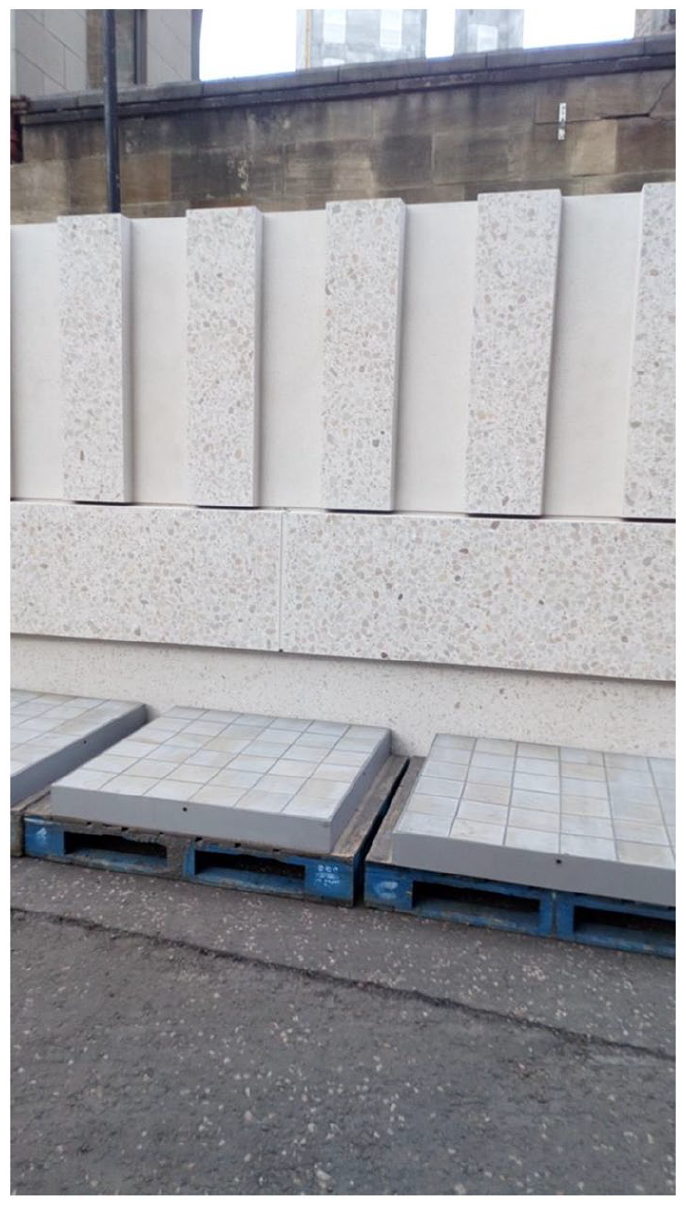
Concrete mock-ups on site.
Within the team, two approaches emerged to the ‘difficulty’ of the question of concrete: first, ‘this is not concrete’, a discursive attempt, primarily using technical language, to label the building as using a qualitatively different type of material (not mentioning concrete at all); second, ‘concrete is not the concrete you think it is’, which involves complete honesty in the use of concrete coupled with an attempt to show, using physical props and imaginative description, that the material is not tied to the failings of the past. 15 That there was no agreement on the approach taken by the applicant team members meant that the two strategies were employed simultaneously, something that Conservative Councillor Mowat picks up on in her observation that ‘you’re sort of giving the impression that this is concrete but it’s not concrete’ (Planning Hearing, 24 April 2019). Certainty over what concrete is becomes crucial as this version of concrete could never be a sensitive reaction to place in a historic environment, while others also point out that it is far from future-proof (see Smith, forthcoming). This is one way that questions of culture enter the concrete debate, through a negative and ontologically secure view that it could never be an architecturally sensitive choice.
Ontology 2: Concrete as Stone; Stone as Concrete
Certainty over concrete’s essence was only evident on the side of the objectors, in whose interests it was to define the material as incontrovertibly deficient. Indeed, concrete seemed to be a deal-breaker in terms of councillors’ decision-making: none openly voiced scepticism over the material while voting to approve the building, just as none praised the materials for their aesthetic worth while criticizing the very idea of a concert hall. The issue, as far as the empirical material can tell, split the councillors into ‘yes’ and ‘no’ camps.
On the side of its supporters, there is a far greater focus on the material’s development, history and future potential. This is a development from initial, most notably Brutalist, discourses that seek to praise the material in the light of its ‘honesty’ in displaying how the building is structured (see Banham, 2011: 22). The arguments in favour of concrete as a suitable building material in this location rely on both a more open attitude towards what concrete can be as well as, crucially, a questioning of the primary alternative: stone or, to make their pointed distinction, stone cladding. In this, the apparently deleterious realities of modern construction are not the preserve of this supposedly synthetic material. This is a point that Chipperfield discusses at some length: Mostly, the reason we like stone is not just because of its colour and its materiality but because stone buildings were built stone on stone and all the buildings just looking out the window we can see buildings that were built out of stone. They were not clad in stone, they do not have stone applied to them, which is how we build buildings nowadays. What we do is we apply, we don’t build stone buildings, we can clad buildings with stone and invariably what would happen is that those are, em, panels of stone and eh with em, gaps in between. This is a very difficult conversation to have because it’s something quite technical but you can tell the difference between a new stone building which is subject to um eh. . . value engineering and the, the habits of the construction industry. (David Chipperfield, Planning Hearing, 24 April 2019)
As a society, then, there has been something of a loss of stone expertise, and the desire to finance it since the days of Edinburgh’s first New Town. The St. James developers state that ‘we just removed over 20,000 tonnes of concrete from the adjoining site. We had our own lengthy debates over whether limestone or sandstone would be appropriate, but concrete?’ (Planning Hearing, 24 April 2019). Yet a timelapse sequence of the St. James construction site would show that concrete and steel are vital to the basic structure of the new buildings, just as they are at the core of the vast majority of modern construction.
The convenor of the committee, Councillor Neil Gardiner, in summing up his final reasons for voting to approve the application, picks up on the points made by the applicants, stating that ‘using stone with modern methods of construction where it’s really just hanging panels’ is ‘just a sort of decorative appliqué’. Edinburgh, he states, ‘is a stone city and must remain a stone city and this is a different way of using stone-like material in a satisfactory way’ (Planning Hearing, 24 April 2019). Certain key features of what should characterize stone are seen to be undermined in its modern application. The image of stone as a substantial building material is seen as vital to its appreciation, the fact that most stone is cladding appears to be a poor reflection of its essential qualities in this light. Cladding is seen as inauthentic.
In this, the concrete is said to provide a quality closer to the stone character of the city in its substance and contribution to the fabric of the building. This is the beginning of a dramatic turnaround in the meanings and functions of two crucial terms in the debate: stone and concrete. Stone, it is argued, does not fulfil the promise of the stone that built the city whose heritage is so important to preserve, while, at the same time, concrete is not the concrete of previous decades that created the grey monoliths that proved so controversial.
Cllr. Gardiner even manages to take this one step further, stating that ‘stone is essentially made up of particles compressed and sandstone is very much like concrete in some ways. So, having had the presentation, seen the samples, I am reassured that this will work well with the existing stone building which are of paramount importance to Edinburgh’s world heritage listing’. Councillor 1, on the other hand, comes to the opposite conclusion from a similar train of thought, pursuing instead a ‘stone at all costs’ strategy, stating that ‘the appearance of stone gives a certain gravitas’ even when ‘it’s false stone, and it’s reconstituted stone sometimes’ (Interview, 31 May 2019). Even stone subject to similar industrial processes to the (precast) concrete suggested for the building still maintains, for this councillor at least, the necessary facade for the city. To summarize, arguments are being made that stone is like concrete, concrete like stone, and the ways in which Edinburgh’s identity as a ‘stone city’ is to be sustained are called seriously into question. The open attitude to concrete’s ontology naturally makes the contexts for its application far more wide-ranging, contrasting markedly with the ‘concrete is concrete’ perspective.
Conclusion
I think our neighbour said that concrete is concrete. Which sounds a bit like ‘Brexit is Brexit’.
16
Em, and neither is concrete concrete, nor is Brexit Brexit. (David Chipperfield, Planning Hearing, 24 April 2019)
The building is approved by six votes to four (the full complement is usually 11 including the convenor but there is one absentee). Ultimately, the complexity and nuance of the debate must come down to a binary decision for each individual councillor. What is clear from the analysis is that debates examined are curiously not just about concrete but nor can they be divorced from what concrete is. Other wider debates of culture and heritage, the importance of classical music and elitism masquerade as questions purely of materials yet there is no Kantian, or indeed Platonic, essence that can be appealed to that is separate from these very same debates.
There is of course a danger that concrete is being used purely instrumentally to ‘hi-jack’ the question of materials in order to score points in some kind of wider culture war. While the empirical material cannot refute this for certain, it seems unlikely that the sustained and in-depth criticism of the materials and cultural impact could be ‘coordinated’ in such a manner. The argument is rather that social mediation is vital to understand the material world and that the material world is a valuable lens through which to survey the workings of the social, indeed that a division of the two can be highly problematic. 17 Controversy can be found at the heart of the material just as it is at the centre of the social and, in this case, the question of whether a new concert hall is appropriate. 18
It is clear that questions of cultural impact from various perspectives are an unavoidable part of the debate around materials and are, therefore, very much part of planning debates. Focusing on the ‘neutral’ realm of materials, it turns out, is no protection against the infiltration of these questions of culture. Indeed, the material debate is a cultural debate when considering issues of heritage and architectural worth. No councillor made this connection, however, as they see the expurgation of cultural issues relating to the building’s use as vital to the system, and any admission to the contrary would invalidate their decision-making within this system. Yet, such issues clearly arise with some regularity in British planning practice, where controversial buildings receive complaints through socially sanctioned avenues that mask their true motivations.
This study shows one of the stages upon which debates over culture are rehearsed in society. Questions of high vs low art, for example, are not discussed explicitly, but impact on debates that have a lower bar to entry and that connect to more people, such as those of materials. The context of the St. James development, both in its proximity to the site and the controversy around its planning hearing, also show that planning decisions are never made in isolation. With the shopping centre rising slowly behind the concert hall site, there can hardly have been a clearer invitation to consider the roles of culture and commerce within the city, as well as their potential tensions.
The discussion of the theme of concrete also displays how the various meanings of culture can overlap, with issues of heritage, urbanism and music bundled into a catch-all ‘cultural impact’. No attempt has been made here to define this more explicitly, as the ambiguity is an important facet of the empirical material. This lack of distinction in the only forum of public decision-making points to the difficulties of cultural planning, as it is just such distinction that can make the difference between effective and ineffective interventions into cultural infrastructure. There is a challenge here to cultural policy and planning regarding whether cultural issues might be better integrated into decision making. If culture is to take a leading role in regenerating city centres in particular, preferential treatment on this often all-important stage might be more officially licensed. At present, the practical work of debating culture takes place in the contested future of the material world, a point that has far-reaching consequences for the social in the material, and the material in culture.
Footnotes
Acknowledgements
I would like to thank the participants, particularly the IMPACT team, for their contribution to this research. I would also like to thank Peter Peters and the research team at the Maastricht Centre for the Innovation of Classical Music for reading and improving various drafts of this article.
Funding
This research is funded by the Province of Limburg, the Netherlands.
