




Abstract
Young Māori (Indigenous New Zealanders) and Pasifika (Pacific Islanders born outside their country of heritage) wāhine (women) in Aotearoa—Māori name for New Zealand—are reported as being less active compared to other young women and men. Taking strengths-based approaches, we amplify the voices of physically active young Māori and Pasifika wāhine to provide insights that can inform policy and practice. Weaving Indigenous methodologies and qualitative methods, we engage 31 young Māori and Pasifika wāhine (16–25 years) from cities in Aotearoa. Our objective is to understand their (a) motivations to participate, (b) preferred activities and (c) perspectives on participation. Using thematic-analysis, we discovered they were influenced by cultural knowledges including hauora (a Māori concept of health and well-being) and whanaungatanga (building relationships). Based on our findings we suggest physical activity for young Māori and Pasifika wāhine focuses on improving mental hauora, and use group activities that include learning new skills.
Introduction
The health and social benefits of physical activity and sport are well known, yet participation levels for young Indigenous and culturally diverse women continue to be lower than young men and other young women (Eyler et al., 1998; Pfaeffli & Gibbons, 2010; Stronach et al., 2016). Similar reports in Aotearoa—Māori (Indigenous New Zealanders) name for New Zealand, indicate that Indigenous wāhine (women) from 18 years and above living in low socio-economic regions are less active (Brocklesby & van Bergenhenegouwen, 2019; Sport New Zealand, 2021; Wilson et al., 2023). Recent international scholarship with and for Indigenous young people use strengths-based and/or culturally specific approaches to understand their motivations to be physically active and much of this research is conducted by scholars from these communities (Maxwell et al., 2021; McGuire-Adams, 2017). Some of their findings include cultural understandings of well-being, the role of family and community, and self-empowerment (McGuire-Adams, 2017; Stronach et al., 2016). A key point to consider is that sport participation for Indigenous communities has not always been positive where experiences such as racism, exclusion, and misrepresentation continue to frame their experiences (Enari & Keung, 2024; Hippolite & Bruce, 2010; Keung & Enari, 2022, 2023; Nakhid & Enari, 2024; Nemani & Thorpe, 2023).
Contributing to this literature, we focus on a group of young Māori and Pasifika (Pacific Islanders born outside their country of heritage) wāhine living in low socio-economic urban areas in Aotearoa who are physically active. Using their lived experiences, we examine features of participation to develop knowledge that could be used to engage wāhine who are less active. Through adopting a strengths-based approach to our research we aim to amplify the positive narratives of the young wāhine and explore the role of culture in their choices to participate. This approach also challenges the stereotypes faced by young wāhine, highlighting how their lived experiences offer valuable insights into their cultural and sporting identities. We also contribute to a growing body of international literature that uses culturally informed strengths-based approaches to understand the physical activity motivations of young Indigenous women.
Cultural context and researcher positionings
Aotearoa is socially and politically influenced by Te Tiriti o Waitangi (The Treaty of Waitangi), hereafter Te Tiriti, which is the founding document signed between the Crown (Queen Victoria) and the Indigenous Māori people in 1840 (Orange, 2015). Te Tiriti intended to establish a framework for coexistence between Māori and British settlers which included preserving, acknowledging, and upholding Māori in their own self-determination (Hudson & Russell, 2009; Orange, 2015; Terruhn, 2019). However, Māori continue to experience significant social disparities such as poverty, poor health, and low levels of education thus indicating that the Crown is yet to fulfil Te Tiriti obligations (Came, 2021; Came et al., 2021; Gustafson et al., 2024). In the context of this article, breaches of Te Tiriti continue to influence and impact the lives of young wāhine in Aotearoa.
Pacific peoples in Aotearoa are a diverse group whose cultural heritage is from the Pacific Islands. In the 2018 Census, 66% of Pacific people were reported as being born in Aotearoa and many had mixed ethnicities (Stats NZ, 2023). To acknowledge this group of individuals, we use the term “Pasifika” as it represents Pacific people who were born outside of their country of heritage. Doing this we respect their nuanced identities and their diverse lived experiences in Aotearoa (Fa’avae, 2022). Importantly, in this article, we refer to Pasifika as Indigenous because they are Indigenous to their respective islands of heritage. As such, we contribute to literature with and for Pacific Indigenous women and centre their lived experiences (Motusaga, 2016; Trask, 1983).
In Aotearoa, Māori and Pasifika peoples share a variety of cultural and social interconnected relationships. Cultural connections include similar linguistics, similar lived experiences, and an innate understanding of being brown (Enari & Haua, 2021; Matika et al., 2021). Historically Māori and Pasifika were part of the great Polynesian migration and currently in Aotearoa they experience similar social disparities including low employment rates, discrimination, and poor health outcomes (Gabel, 2022; Kukutai et al., 2020; McAllister et al., 2022; McCullough, 2021). There are also a growing number of mixed-ethnic Māori and Pasifika peoples in Aotearoa whose experiences are different than those identifying with a single ethnicity (Rocha & Webber, 2017; Si‘ilata, 2017). In this article, we acknowledge the different historical influences for young Māori, Pasifika, and mixed Māori-Pasifika wāhine, and purposefully focus and amplify their lived experiences.
The roles and positionality of wāhine Māori (Māori women) and Pasifika wāhine in their respective cultures historically focused on caregiving and influencing community dynamics. For wāhine Māori, their mana (a Māori concept of spiritual power, authority and respect) as wāhine was often linked to the sacred spiritual nature of childbearing and the genealogical ties that were created (Sharman, 2019; Simmonds, 2009). Likewise, Pasifika wāhine played central roles in the family including homemaking and caregiving, along with strong religious affiliation (Pasefika Proud, 2016; Tuiburelevu, 2018; Wilson, 2013). While these roles remain constant, they have broadened as young Māori and Pasifika wāhine in Aotearoa redefine and shape their own identities and stories through their own self-determination. This includes how and why they engage in physical activity.
To explore Indigenous wāhine experiences, we disclose our researcher positionality. The first author is a mixed Māori-Samoan woman and her lived experiences provided Indigenous insights and cultural rationale for our research. She was supported culturally by the third and fourth authors, also Indigenous, who are academics with extensive research experience with, for, and by, Māori and Pacific peoples. The second, and fifth, authors supported through subject knowledge as experienced researchers in gender, physical activity, and sociology. Reflexivity was constantly practised and while our positionalities were varied, we had a united view of understanding the physical activity motivations of the young wāhine in this research. We aim to provide culturally specific knowledge to inform policy that will respectfully understand, engage, and enhance participation.
Methodology
This research weaves two Indigenous methodologies; Mana Wahine (a theoretical research framework designed with, for, and by Māori women aimed at centring their voices) (Pihama, 2020; Simmonds, 2011), and Masi Methodology, which is a Pacific framework designed by, with, and for Pacific women (Naepi, 2019, 2021). Weaving Mana Wahine and Masi Methodology has been done intentionally to respect, value, and centre the voices of the participants in this study who are Māori, Pasifika, or a combination of both. We draw inspiration from Tutone et al. (2023), who used Mana Wahine and Masi Methodology to respect the ethnicities of their participants while exploring their shared experiences.
In practice this included drawing from Mana Wahine and Masi Methodology principles and applying them through all phases of this research including recruitment, data gathering, and analysis. The overarching principle for implementing Mana Wahine and Masi Methodology was to ensure that the young wāhine were centred during every single phase. For example, during the wānanga and individual interviews some young wāhine were picked up and dropped off where they needed to go, and all young wāhine were provided a full meal including mains, desserts and food to take home. Importantly, they were treated with respect and care at all times and their voices and experiences were centred throughout the analysis phases (Nemani et al., 2023).
Methods
Two qualitative methods were used to gather data. These were (a) two 1-hr wānanga (group discussions) and or individual interviews held 6 months apart and (b) self-selected digital diaries. Aligning with current research with and for Indigenous young people, a co-participatory approach was used where the young wāhine self-selected from a range of digital methods including videography, photography, digital activity log, and social media pages (Maxwell et al., 2021; Rice et al., 2016). Data from wānanga and interviews were transcribed, and raw data from digital diaries were analysed using culturally responsive and reflexive thematic-analysis (Braun et al., 2016).
Participants
This research included 31 young Māori and Pasifika wāhine between 16 and 25 years, 16 from South Auckland and 15 from Porirua, Wellington (Table 1). These locations were selected due to having similar demographics including high numbers of Māori and Pasifika, and low socio-economic regions in large urban cities. The young wāhine included, 18 Samoan, 17 Māori, and 16 of mixed ethnicities with the most common being Māori-Samoan. Social situations for the participants varied with seven in high school and four university graduates. Seventeen of the young wāhine were working and four were mothers with young toddlers or babies.
Participant information.
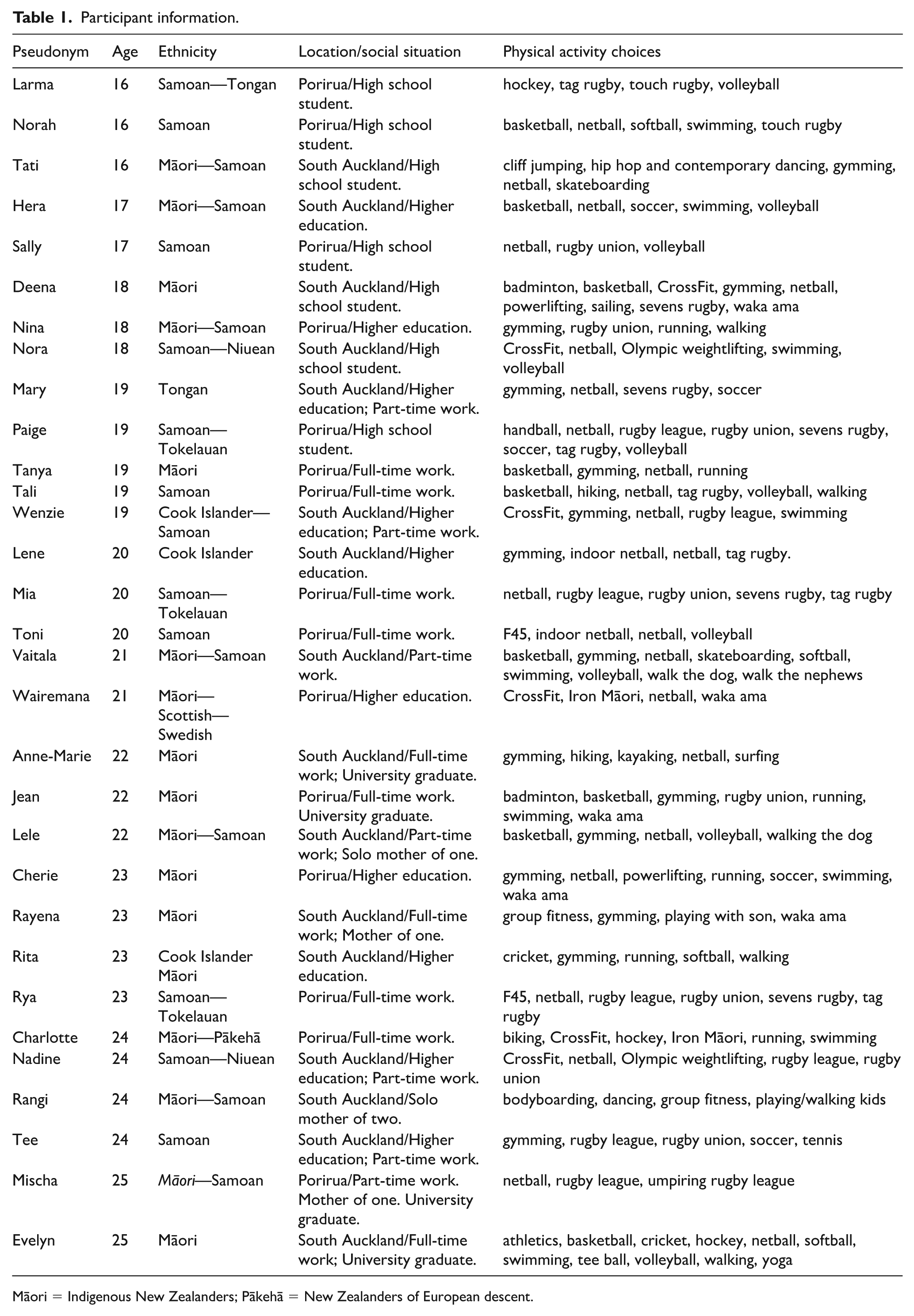
Māori = Indigenous New Zealanders; Pākehā = New Zealanders of European descent.
Gymming is a term that was frequently used by the young wāhine and is an informal word widely accepted among young people that means working out at a gym (Anwar & Ali, 2020; Contractor & Rasquinha, 2021).
Ethics
This research was conducted in full compliance with ethical standards. Full ethical approval was provided by the Faculty of Māori and Indigenous Studies at the University of Waikato. Prior to data collection, participants were provided detailed information about the study after which they gave their informed consent. Participants self-selected a pseudonym or had us select one for them. These names are used to represent them in this article.
Findings and discussion
Our findings focus on how gender, culture and ethnicity intersect to impact the physical activity experiences of the young wāhine. We acknowledge that the findings may be a function of our sample who are physically active so these recommendations may not be suitable for young wāhine who are inactive. Also, while we have a smaller sample size (n = 31), the depth of our findings provide cultural nuance that merits consideration for practitioners working with, and for young Māori and Pasifika wāhine.
In this section, we present and discuss our findings under the following themes: (a) motivations to participate, (b) physical activities of choice, and (c) participation perspectives.
Motivations to participate
Scholarship on motivations for Indigenous young peoples participation in physical activity and sport revealed that these included connection with friends, family and community (Gordon et al., 2013; Keung & Enari, 2022; Stronach et al., 2016), leaning into their natural athlete stereotypes (Hokowhitu, 2003; Stronach et al., 2016), and Indigenous knowledges of well-being (Calder-Dawe et al., 2023; Carlson et al., 2022; Enari & Keung, 2024). In this section, the themes we discuss include hauora (a Māori concept of health and well-being), cultural and holistic understandings of hauora, whanaungatanga (building relationships) and connection, and finally escapism.
Hauora
When describing their understanding of well-being, most of the young wāhine referred to hauora and holistic views of well-being. Hauora is often represented through a Māori health model called Te Whare Tapa Whā (a holistic Māori health model), which represents four walls of a marae (a communal and sacred meeting place in Māori culture where people gather). Each wall relates to an area of health that needs to be maintained and balanced. These are taha wairua (spiritual well-being), taha whānau (social and family well-being), taha hinengaro (mental and emotional well-being), and taha tinana (physical well-being) (Rochford, 2004).
Hauora was the main reason the young wāhine were physically active. Tati (16-year-old) explains,
I kind of live off the four elements of hauora because if you don’t have spiritual, you lack purpose. If you don’t have socials, you’re drained, if you don’t have your emotions fixed, you’re kind of crowded, and if you don’t have physical, you’re not free. So, if you have all these aspects, you’re basically living the best life even if you’re going through tough times.
Similarly, Nina (18-year-old) describes why she embodies hauora in her approach to physical activity:
Physical activity has always allowed me to keep my spiritual health, social health and mental health in check. If I didn’t have that physical exercise component, I wouldn’t be able to perform or give as much as I can. It’s been a part of my life for so long that I have to keep active.
Here the balance of all four components of hauora are portrayed through Nina (18-year-old) embodying and describing how they are part of her life. This cultural alignment with physical activity is also similar to the Medicine Wheel used by Indigenous Anishnaabe (a group of Indigenous peoples from Canada and the USA) scholars in Canada where physical activity is used to identify the “interconnection to mental, emotional and spiritual well-being of urban Aboriginal adults” (Lavallée, 2007, p. 128).
Many of the young wāhine also used activity to improve their taha hinengaro and self-care. Wairemana (21-year-old) shares her views.
The biggest motivator for me to exercise over the past few years has been my mental health and taking care of myself. Personally, working out or being involved in physical activity has never been about the physical side of it, but rather the positive impact that I know it will have on my internal mental environment. Although I haven’t been as motivated to do physical activity since leaving college [high school], what helps me is being around people who are motivated and doing things.
While Wairemana is motivated by the internal effects of being physically active, being in a group with similar motivations is also important. This aligns with research on young Indigenous people who have indicated that being with others in a supportive environment assists motivation for participation (Mason et al., 2019).
Whanaungatanga
Whanaungatanga (building relationships with others) comes from the Māori word whānau (family and friends). Whanaungatanga enhances feelings of belonging and acceptance among groups of people (Moorfield, 2024). For the young wāhine, their motivation to be physically active was shaped around whanaungatanga. Some of the young wāhine even pursued a career in sport and exercise because they wanted to help build their communities. Cherie (23-year-old) explains why she shifted careers from being a chef to a personal trainer:
The main reason I started studying and why I wanted to be a personal trainer was because of my own mental health. Exercise helped me with my own mental health and so I wanted to know more to help myself and others too. It’s not a cure, but it helps.
Important to note is that Cherie openly shared her struggles with mental health and coming to terms with being a young gay wāhine Māori. She wanted to help other young wāhine who are experiencing similar struggles. This motivation aligns with the work of McGuire-Adams (2017) and Stronach et al. (2016), where the Indigenous women were motivated to help their communities using physical activity because of the transformational changes they had experienced themselves.
Aligning with Indigenous scholarly research where physical activity and sport engagement is viewed as a family affair (Gordon et al., 2013; McGuire-Adams, 2017; Nelson, 2009; Stronach et al., 2016), Anne-Marie (22-year-old) explains, “I will say that physical activity and sport is a way to reconnect whether it be with friends or family.” Many young wāhine had active parents and family members so grew up with sport and physical activity as part of their lives. Jean (22-year-old), who is an age group world champion in a traditional sport, shares how being active has impacted her life since childhood:
I think being active is normal in my family. Since I was 5 years old, we have always participated in [this sport] and it’s always been normal to exercise with my family. My mum was my coach, and we used to always go to nationals, and now I’m coaching. It’s about supporting whānau and helping anyone who wants to reach their potential.
Many of the young wāhine explained that their participation and engagement in particular sports were a result of their family or church activities while growing up and it has become part of their identity. Rya (23-year-old) shares, “Everyone in our family played rugby since nappy days. We got into it because we saw all our cousins and we were like, if our boy cousins can do it, so can we!” Here we see a gendered and whānau approach to participation and engagement in sport. Interestingly, Rya and her sisters were selected for provincial teams in rugby while her boy cousins missed out.
The young wāhine who are mothers continued a positive generational narrative of being active by aligning their motivations to be active for their children. In her diary, Rayena (23-year-old) shares the following:
My decision to get into physical fitness was because I wanted my son to see that his Mum cares about her health and physical wellbeing. Kids mirror their surroundings so if they are surrounded by love, kindness and even things like healthy eating habits and exercise, they will copy. I have always been a person who has been into sports so just because I’m a young mum, I have no excuse to why I cannot be physically active.
Rayena further writes about how frustrated she is when seeing young Māori and Pasifika children who are obese and offers a solution that includes improving the surroundings for the children; she alludes to the increased cost of living and the affordability of takeaway foods which she believes is “killing our people”. These issues are not new to places such as South Auckland—a group of suburbs in the southern part of Auckland city and Porirua—a city in the Wellington region where numerous takeaway food venues often take precedence over fresh fruit and vegetables because they provide cheaper and higher food volume options. While we do not focus on nutrition in our study, Rayena’s concerns raise important points about access to healthy kai (food), kai sovereignty—the right for Māori to manage their own food systems, and eating practices that should support physical activity and sport in low socio-economic communities. Numerous scholars have also identified poor food options as an issue in these communities (Elers et al., 2021; Starck et al., 2021; Turrell, 1996).
For some of the young wāhine, sport and physical activity is a way to socialise and spend time with their friends. Tati explains, “it really helped me be more confident with people. I don’t usually socialise a lot, but through sports and dance, I met new people. That’s how I started connecting with others.” Some of the young wāhine shared that they had formed social sport teams with their friends after they had finished high school and that they used the weekly social sport competitions as a chance to spend time together in a fun, stress free environment. Other young wāhine enjoyed gymming with their friends as they helped motivate and keep each other accountable. This concept supports previous Indigenous scholarship where group and community participation helps maintain motivation (Mason et al., 2019; McGuire-Adams, 2020).
Escapism
While most of the young wāhine in our study enjoyed participating in physical activity and sport in groups, some also enjoyed exercising alone as it gave them a space to escape from their responsibilities. Most of the young wāhine in our study had gendered and cultural responsibilities in their families such as babysitting, housework, and part-time work to financially help their parents (Thorpe et al., 2025). They also field social pressures and discrimination in schools, applying for jobs and shopping (Cormack et al., 2020; Kapeli et al., 2020; Tobler et al., 2013). Due to these external responsibilities and pressures, their participation in physical activity and sport became a stress reliever and an escape. Deena (18-year-old) explains, “For me it’s a way out. When I have had a long stressful day and I’m just trying to forget all about it, I go to the gym. It’s just really therapeutic.” Similarly, Lene (20-year-old), who has family responsibilities as an older daughter and is also studying, explains,
It’s a good break from reality, I reckon. For me it’s like when you’re stressed, there’s family stuff going on or school stuff going on, it’s like yes, training, I can do something I [emphasis added] like. Even if fitness is not what I like, it’s a break from reality, and when training finishes I think “oh dammit, I’ve got an assessment due tonight.”
Mary (19-year-old) likes to exercise alone because it helps her de-stress and it gives her a space where nobody can interfere with her, and Nora (18) shares, “I find it as a reset. I like working out in the afternoon after all the stress with school and stuff. I like to unload by almost dying in a workout and that helps me sleep better at night-time.” These findings provide nuanced gendered and cultural differences that differ from research that suggests Indigenous peoples enjoy physical activity and sport in groups (Mason et al., 2019; Stronach et al., 2016). Our findings support research where women participate for stress release (Thorpe, Brice, et al., 2023; Thorpe, O’Leary, et al., 2023), and extends this by considering how gendered and cultural responsibilities on young wāhine shape their physical activity engagement.
Physical activities of choice
In this section we examine the highest participated activities by the young wāhine by analysing their experiences. Aotearoa scholars O’Brien et al. (2019) provide ethnic-specific physical activity suggestions for Māori and Pacific women (16–45 years) that include whanaungatanga and cultural meanings for being active. It is important to note that while the young wāhine in our cohort were physically active, the costs of participation continues to be a barrier for some young people, and particularly those from lower socio-economic regions across Aotearoa (Hamlin & Ross, 2005; O’Brien et al., 2019). We contribute to this research by focusing specifically on young Māori and Pasifika wāhine.
The activity type participation by the young wāhine ranged from 3 to 11 different types (Table 1). Despite there being a range of different activities, the highest participation rates were netball (74%) and gymming (48%). This differs from the types of participation in O’Brien et al. (2019) which had music and dance for Pacific wāhine, and walking and floor exercises for wāhine Māori. These differences are likely due to the younger age and lower number of participants in our study. In the following sub-sections, we aim to increase understanding of the engagement in netball and gymming by examining the experiences of the young wāhine.
Netball: The high participation numbers in netball for this study provides some interesting insights. First, most of the young wāhine played netball in primary school and some were socialised into netball because of their mothers or aunties who also played. Deena explains,
My Mum was competitive in netball so I never had a choice. She used my height and made me play. I was twice the size of every other girl in primary school, so it was easy. One year I didn’t even have to trial because they just put me straight into the top team which was kind of sad to lots of other girls.
Interestingly, not all the young wāhine wanted to play netball as some thought it was too girly. This comment aligns with Marfell’s (2019) research on netball which argues against the heteronormative feminine culture reproduced in Aotearoa and suggests that this culture be shifted to be more inclusive of alternative understandings of femininities and bodies. However, because netball was a sport that most girls played, many ended up participating because they did not want to be left out and because their friends were playing.
With some wāhine, netball became the sport that maintained connections with friends, and it became a normalised activity in their everyday lives. Their reasons for continued participation included whanaungatanga which included spending time together and enjoying each other’s company rather than competing. Tali (19) and her friends used it as their way to keep in touch on a weekly basis; she shares, “When I was in primary school I made new friends who played netball so we all played together. I guess it’s just gone from that to high school, to where we are playing now.” Anne-Marie (22) shares how it keeps her family connected: “With netball, I do it with a lot of my family members because we’ve got a whānau team and a club that’s been together for the last four years.” In these examples we see that a community had been created among family and friends, where netball became an important connecting part of their lives. This resonates with the work of Stronach et al. (2016) where sport is used as a social space for Indigenous women.
Unfortunately, not all young wāhine had positive experiences with netball. Lene (20) shares her experiences:
I used to play serious netball for reserves team in the top grade and when I didn’t get selected I was depressed. It was really unfair for some of my friends and teammates who were trialling for netball too. They were Pasifika and had bigger bodies but they had to meet a certain weight to be considered to be selected. I was ok because I fit the weight category, but it was pretty sad for my friends because they’d do all they could. Like, they would stop eating, they would fast, do all these diet plans for nothing as they couldn’t meet the weight criteria. It was really disappointing. I only play netball socially now not just because of this, but because of the culture of netball.
Lene’s comments align with previous research that describes how young Pasifika wāhine are discriminated against for having larger bodies in sports such as netball (Nemani & Thorpe, 2023). Here we see that there can also be negative effects on participation that are also discriminatory.
Gymming: Gymming was the second highest activity that the young wāhine engaged in and their reasons for participation varied. Cherie (23) who is studying to be a personal trainer shares her views:
I found that free weights in the gym is quite a confidence builder. Once I got over the fear of getting used to that sort of thing and people watching, I started really enjoying it. So learning to take that a bit further is something I’m really enjoying.
Mary (19) who is studying a degree in sport also likes learning new things in the gym:
I go to the gym at the town centre where the pools are and to Nesian Fitness. The machines they have at the gym at the town centre are quite basic and there’s other things I want to try. When I go to Nesian Fitness they have a whole lot of new equipment that I haven’t seen or tried before so I like to go there to try them out.
Here we see that the young wāhine enjoyed learning different things particularly related to lifting weights or using different machines. Notably, these young wāhine likely embraced new experiences in the gym because they were studying in the fitness industry. Despite this, practitioners could consider teaching young wāhine new things in the gym to build confidence and maintain interest.
Some young wāhine enjoyed doing workouts that had a variety of different exercises including HIIT (high-intensity interval training) and group exercise training. Rayena (23) shares what she enjoys in her journal:
I like the atmosphere of gym classes. I like how everyone is doing the same thing and we all push each other. I prefer pairing up for the sets because I do find myself slacking off and not pushing myself as hard as I would if I were with a buddy. I think my self-motivation has always been an issue. I doubt myself way too much and I think that just comes down to past experiences or even my own personality.
In this example, we see that working out with others helped with motivation and confidence. Many of the young wāhine joined a gym with their friends and, much like netball, used it as a social space where they would meet, enjoy each other’s company and work together on improving their health and well-being. Once again, we see that whanaungatanga plays an important role in the choice of activity.
For practitioners, this provides helpful insights into features that could enhance physical activity participation for young Māori and Pasifika wāhine. We suggest that the type of activity may not encourage participation, but rather learning something new to build confidence and participation with friends and/or family. Also, individual choice and freedom might also be an important factor.
Participation perspectives
In this final section, the young wāhine share their views on physical activity participation. Interestingly, the young wāhine in this study were adamant that all Māori and Pasifika wāhine around their age were physically active. Norah (16-year-old) states, “I’m serious, I’ve never met a brown girl my age, that doesn’t do something. We all play sports.” Cherie supports this by saying, “I can’t think of anyone that does nothing. I think everyone I know does something.” Tali (19-year-old) contributes thoughtfully when saying “I’m trying to think of someone who doesn’t do any kind of activity, but nobody comes to mind. I feel like there should be someone but there literally is no one.” Many of them questioned the research that indicated they were a less active group and asked where this information came from. Rita (23-year-old) suggests,
Maybe the people who did the research think we don’t do a lot of exercise but to be honest, we do a lot of stuff. All these rugby teams, most of them are Māori and Pacific Islanders. Where did they get all the information? I’m just saying, but I feel like they put us down.
Although there are only 31 participants in this study, and the young wāhine most likely gravitate to those who are also physically active, their concerns merit further attention. While our study does not focus on the mechanisms of large-scale data gathering, we see an opportunity for further research. Aligning with studies with and for young Indigenous people in other countries (Njeze et al., 2020), we support intersectional strengths-based approaches to conducting research with, and for them. Examining the cultural and social ways young wāhine are physically active provides nuanced knowledge of how they can be supported to participate.
Although the young Māori and Pasifika wāhine were unable to identify others who were less active, they provided advice on how to improve participation. Nina suggests,
I feel like the first step would definitely be a group fitness session with their friends. So like a friend thing, you know, encouraging them and giving them the option to come if they want. Letting them know it’s going to be cool and fun and also making it free as well. Also use it as an opportunity to catch up afterwards for lunch, or breakfast is usually a good hook.
A nuanced suggestion we see here was the use of food to encourage participation. Nina’s suggestion shows that she resonated with the cultural value that food has in bringing people together, particularly for Māori and Pasifika (Akbar et al., 2022). Norah supports this and explains, “I feel like we are people-people. We were brought up to do things together with other people and that’s our way of learning and meeting new people.” All of the young wāhine took it upon themselves to invite anyone who was less active. This aligns with Indigenous research where group mentorship plays an important role in helping to empower other women to participate in physical activity (McGuire-Adams, 2017).
While group participation is an important factor, the costs involved in participation were identified as a barrier. The young wāhine recognised that there were many different opportunities for participating, but that cost may be an issue: “There are so many opportunities in South Auckland. We’ve got swimming pools, and gyms everywhere. I think it’s just hard for people to find, and people just can’t afford it. It’s good that the pools are free though” (Lele, 22-year-old). To address cost, the young wāhine suggested providing free programmes for people who could not afford to participate. They mentioned that with the increased costs of living, it was likely that people would be more inclined to pay their bills and put food on the table rather than pay to go to a gym or group fitness class.
Some young wāhine provided a different perspective that related to changing their mindset around being physically active. For example, Rayena explained,
Nothing can stop you from being physically active other than yourself. You don’t need to sign up to a gym, you don’t have to be good at sport. Just going for a walk around your neighbourhood it’s good for you!
Taking ownership of being physically active was something that many of the young wāhine agreed with, but they also acknowledged the difficulties of maintaining motivation. This is where being a member of a group or community assisted in participation as it provided external social motivation by encouraging a sense of belonging. Although some of these young wāhine highlight individual responsibility, there are underlying impacts of the social determinants of health, including lack of employment, low wages, and poor housing, that influence and affect young wāhine living in low socioeconomic regions. Some of these factors combined with cultural and gendered expectations have the potential to limit opportunities and motivations to be physically active despite their best intentions.
Conclusion
Our findings align with Stronach et al. (2016) when stating that Indigenous “women are influenced by the complex amalgamation of personal, family, community, and broader societal influences” (p. 22). These intersecting factors impacted the motivations, experiences, and perspectives of the young wāhine in this study. Importantly, the young wāhine included the use of cultural knowledge hauora and whanaungatanga throughout this study. This knowledge affected the ways that they engage in activity on a personal level where their motivations related to hauora which then affected their activity choices. While the young wāhine indicated that whanaungatanga and participating in groups with their friends was important, they also enjoyed the individualism and escape from responsibilities afforded by exercising. We note that although netball and gymming had the highest participation in this study, we suggest that the underlying reasons related to whanaungatanga and learning something new to build confidence. The young wāhine also provided suggestions for practitioners which included the use of food as a tool to encourage participation, and providing free activities to increase affordability.
An interesting finding that goes beyond the scope of this study was the firm conviction among the young wāhine that all the young Māori and Pasifika wāhine within their circles were indeed active. Their voices and experiences underscore the value and importance of strengths-based approaches to research particularly those that depict Māori and Pasifika as inactive. This research highlights their resistance to such stereotypes and advocates for Indigenous frameworks to redefine physical activity and sporting benchmarks. Herein we recommend that strengths-based approaches be used for physical activity and sport research with, for and by young Māori and Pasifika wāhine so their knowledge can inform policy that directly impacts them.
Footnotes
Acknowledgements
We acknowledge the young Māori and Pasifika wāhine who generously and freely shared their time, experiences, and insights with us. Your strength, wisdom, and courage are at the heart of this research. This work would not have been possible without your voices and we are deeply grateful for the opportunity to learn from all of you.
Authors’ Note

Funding
The authors disclosed receipt of the following financial support for the research, authorship, and publication of this article: The first author received a Sport New Zealand PhD scholarship that helped fund this research.
Declaration of conflicting interests
The authors declared no potential conflicts of interest with respect to the research, authorship and publication of this article.
Glossary
Anishnaabe a group of Indigenous peoples from Canada and the USA
hauora a Māori concept of health and well-being
kai food
mana a Māori concept of spiritual power, authority and respect
Mana Wahine a theoretical research framework designed with, for, and by Māori women aimed at centring their experiences and voices
Māori Indigenous New Zealanders
marae a communal and sacred meeting place in Māori culture where people gather
masi traditional Fijiian barkcloth
Pākehā New Zealanders of European descent
Pasifika Pacific Islanders born outside their country of heritage
taha hinengaro mental and emotional well-being
taha tinana physical well-being
taha wairua spiritual well-being
taha whānau social and family well-being
Te Tiriti o Waitangi the treaty of Waitangi
Te Whare Tapa Wha a holistic Māori health model
wahine woman
wāhine women
wāhine Māori Māori women
wānanga group discussions
whānau family and friends
whanaungatanga building relationships