



Abstract
Throughout the Pacific, the whānau/’āiga (family) is an integral element of community and identity. Within Polynesian communities, it is common for the whānau (family – Māori) or ‘aiga (family – Samoan) to be the most important aspect of one's existence. For many Polynesian (Māori and Pacific) athletes, the family unit is central to their ability to succeed in professional sport. The cultural identity that is developed within the family unit as well as the support and nurturing provided are ingredients for Polynesian athletes to thrive in spaces where they may not otherwise: gaining collective support in ways that are not always readily afforded to Western society. This paper draws from the stories of male professional Māori and Pasifika rugby league athletes to provide deeper insight into the critical role of Polynesian families in professional sport. As Polynesian sport academics, who were given deep insight from these athletes, we use our insider lens to tell this story.
Introduction
Throughout the Pacific, the whānau/’āiga (family) is an integral element of community and identity. Within Polynesian communities, it is common for the whānau (family – Māori) or ‘aiga (family – Samoan) to be the most important aspect of one’s existence (Haua and Enari, 2023). For many Polynesian athletes, the family unit is central to their ability to succeed in professional sport. The cultural identity that is developed within the family unit as well as the support and nurturing provided are ingredients for Polynesian athletes to thrive in spaces where they may not otherwise: gaining collective support in ways that are not always readily afforded to Western society (Borell and Enari, 2024; Enari and Keung, 2023, 2024).
This paper draws from the pūrākau (stories) of professional male Polynesian rugby league athletes to provide deeper insight into the critical role of Polynesian families in professional sport. We then use the insights provided by the athletes as a decolonial frame for understanding the importance of recognising family in Polynesian athlete success.
The methodological approach to the paper establishes our decolonial positioning (Smith and Smith, 2023). By utilising distinctly Polynesian research methods and a research design that incorporates Pasifika worldviews and epistemologies and foregrounds the power of Pacific storytelling, we, as Polynesian sport academics, use our insider positionality to share the deep insight provided by these athletes. As Whitinui (2021) notes ‘including Indigenous worldviews, values (axiology), epistemologies, methodologies, theories, and ways of knowing requires that we as sports sociologists come to know how our own research (im)positions impact Indigenous Peoples in all areas of society’ (p. 6). As Māori and Samoan scholars, we also intentionally create space for the use of our own languages throughout this paper. We see the use of our language alongside Indigenous methodologies as a further contribution to the wider decolonisation of academic conventions.
I am not an Individual;…I share divinity with my ancestors…. I am not an individual, because I share a Tofi (inheritance) with my family…. I belong to my family and my family belongs to me…This is the essence of my sense of belonging. (His Royal Highness Tui Atua Tupua Tamasese; Efi, 2002: 6)
The above quote by the former head of state of Samoa demonstrates what family has meant to Pacific people for centuries. This quote also shows how a person is their family, and their family is them. Tagaloa (2008) suggests that people were only able to survive the environmental conditions of the islands through a strong family system. Today, the family is still upheld as the ‘most important agency of human interactions’ among Pacific people (Territory of American Samoa, Office of the Governor, cited in Carmichael, 2007: 23). The family is a support network that encourages each family member to work towards the greater wellbeing of the aiga potopoto (extended family) (Carmichael, 2007). Iofi (1980) considers the aiga potopoto as an entity that can provide its members with an assurance of physical, economic, psychological and emotional protection. It is through the family that Pacific people in the diaspora can stay connected to their language, culture and ancestral knowledge. As Pacific family members migrate, they do not disconnect from their relatives and village; instead, they extend their family base wherever they travel and live (Enari and Taula, 2022; Faleolo, 2019; Lilomaiava-Doktor, 2009).
The family unit is influential in shaping young people, and this was prevalent throughout the pūrākau (stories) of the participants. The influences that the whānau unit had on their careers indicate that this was the dominant feature of the Polynesian experience in professional rugby league. In the research from which this paper is drawn, the whānau emerged as a site of balance, grounding, support and identity. As a result, the whānau and aiga can be seen as the core support mechanism, site of influence and identifier for many of the participants.
While each participant spoke of the positive influences of whānau, some also spoke of some of the paradoxes of whānau that can also arise. The complexities of whānau were described by some participants as the negative, or less beneficial, impacts of whānau influence. Some of these complexities included external pressures from the wider family to succeed or provide financially, as well as the pressure to succeed that came from other familial-level groups such as peers. These complexities of whānau provide insight into the influences, not only of family units but also more explicitly of Polynesian family units, that can impact a young man attempting to transition into a professional rugby league career.
By reaffirming the importance of whānau to Polynesian athletes and opening space to examine aspects of family that are less beneficial to athlete success, this article will provide an understanding of the broader impacts of whānau for male Polynesian rugby league athletes by sharing their voices to understand through their experiences.
Pacific people and rugby league
Rugby league as a sport has, since its inception, had considerable favour with the working classes. As a sport that has offered an accessible means of social mobility for Māori and Pacific athletes for the last three decades, the growth of rugby league in the South Pacific is evident (Borell and Enari, 2024; Enari and Keung, 2022; Keung and Enari, 2022; Ravulo, 2019). From the Anglo working-class origins of the sport, rugby league has become a global sporting commodity with the largest domestic competition being the National Rugby League (NRL) in Australia.
There has been significant growth in the Polynesian professional rugby league population since the 1990s. Lakisa et al. (2014) note that ‘the Pasifika diaspora in Australia is making an indelible imprint on the sport of rugby league’ (p. 347). Hawkes (2018) adds that ‘Rugby league is fast becoming a Pasifika majority-played sport in Australia’ (p. 327). The growth of Polynesian numbers in professional rugby league is indicative of many phenomena including social mobility, inclusivity and familial connection to, and through, rugby league. The many convergences between Pacific people and the sport have been well documented in a recent growth of academic inquiry (see Borell, 2015, 2012, 2022; Coffey and Wood, 2008; Ehlen, 2021; Enari and Keung, 2024; Hawkes, 2019, 2018, 2023; Keung, 2018; Keung and Enari, 2022; Lakisa et al., 2014; Lakisa et al., 2019; Lakisa, 2020; Panapa, 2024; Panapa and Phillips, 2014).
The growth of Polynesian representation in professional rugby league can be attributed to the recent migration history of Polynesian people (Borell, 2012, 2022; Hawkes, 2018; Lakisa, 2020). The modern migration patterns of Polynesian athletes involve migration from the Pacific Islands to New Zealand in the 1950s; then recent migrations have seen Polynesians settling in Australia, often as New Zealand citizens (Lakisa, 2020; Valiotis, 2008). This growth of Polynesian migration into New Zealand and Australia has led to Polynesian men being significantly overrepresented in the NRL constituting close to 50% of all professional contracts yet making up just over 1% of Australia’s total population (Borell, 2022; Enari and Keung, 2023).
With such a high proportion of the NRL’s athletes descending from a Polynesian heritage, it is imperative that any continued discussions around the impact, influence and experiences of Polynesian athletes in the code of rugby league are inclusive of a Polynesian voice and perspective.
Methodology
Research conducted with and for Indigenous people requires a level of cultural humility that extends beyond simple cultural sensitivity. Forerunners of decolonial Indigenous research methodologies, such as Graham Hingangaroa Smith and Linda Tuhiwai Smith, have validated Māori and Indigenous, including Polynesian, knowledge production through the emergence and development of Kaupapa Māori Research (KMR) (Smith, 1997, 2015; Smith, 1999, 2005, 2015). As an indigenous approach to research, KMR values the traditional and contemporary knowledge systems of Māori. KMR, thus, ‘assumes the existence and validity of Māori knowledge, language and culture’ (Smith, 2015: 48).
A KMR approach to research has been adopted here to provide cultural safety for the researcher and participants. This is extended by also embracing pan-Pacific research methods alongside KMR methods to move into a shared broadly Polynesian research methodology. KMR is a distinctly Māori research methodology, strategy and theoretical framework that allows for the incorporation of Māori principles and practices while shaping the research through Māori philosophies (Borell, 2022; Erueti, 2015; Smith, 1997; 2015; Smith, 1999; 2005; 2015).
Some guiding principles of KMR include, but are not limited to, whakapapa (genealogy), te reo Māori (the Māori language), tikanga (Māori protocols) and rangatiratanga (Māori self-determination or autonomy) (Smith, 2015). These guiding principles were interpreted in the research project as follows: Whakapapa: The researcher is Māori and is knowledgeable in the genealogies of the Pacific. There is also a respect for developing relationships prior to engaging in kōrero. (conversations) Te reo Māori: Where appropriate Māori language was used and where possible researcher and participant met kanohi ki te kanohi (face to face) to share kōrero. (conversation) Tikanga: Adherence to Māori customs, i.e the act of koha (gift giving), kai (sharing of food), and manaakitanga. (hospitality and respect) Rangatiratanga: Recognition of both researcher and participant as autonomous ambassadors of their own whakapapa. Positioning the knowledge being shared through pūrākau (stories/storytelling) as valid and, in accordance with KMR accepting ‘experience as evidence’. (Graham Smith, 27 June 2024, personal communication)
Another critical aspect of KMR is the development and nurturing of relationships between researcher and participant. Relationships and relationship-building are revered throughout the Pacific (Erueti, 2015; Naepi, 2015). Relationships are also central to pan-Pacific research methodologies and are an ‘integral part of Pasifika culture’ (Patterson, 2012: 21).
To account for the participant base consisting of Pacific people beyond Māori, the use of a pan-Pacific methodology that wove both KMR and Pacific values together emerged as a culturally appropriate approach to research. Pan-Pacific methodologies must provide safe spaces for these relationships while being guided by values that are intrinsically Pacific in origin and execution. As is the case for KMR and Māori in Aotearoa, pan-Pacific methodologies serve to extend knowledge production for, by and with Pasifika peoples throughout Te Moana Nui a Kiwa (The Pacific Ocean) (Bennett, 2013). Pan-Pacific research methodologies refer to methodologies that respond to several Indigenous Pacific ethnicities through shared values such as reciprocal relationships, respect and being community-orientated (Enari 2020; Naepi, 2015; Penitito and Sanga, 2002; Sanga, 2004). Incorporating, and interweaving, the shared values of Māori and other members of the Pacific, pan-Pacific methodologies allow for a shift away from Western, Eurocentric, assumptions of research.
The pan-Pacific methodology deployed here incorporates the Pūrākau research method with the Talanoa research method. The Pūrākau research method is Māori in its approach and is a culturally appropriate research method for engaging in qualitative research with Māori participants, and the Talanoa research method is a distinctly Pasifika research method that provides a culturally appropriate, and effective, strategy for forging and maintaining relationships with Pasifika participants in research (Borell, 2022).
As a qualitative strategy that emerges from KMR, Pūrākau, or the use of oral histories and storytelling, is used to provide the narratives of the participants in the research. Effective use of the Pūrākau method allows for a more culturally sensitive approach to broader narrative inquiry techniques. Pūrākau, as a research method, continues the legacy of KMR in that it is a further attempt to resist the coloniality of academic research convention by validating the experiences of Māori (and other Indigenous peoples) as knowledge through the act of storytelling (Borell, 2022; Erueti, 2015; Lee, 2009). Pūrākau is an intentional attempt to further showcase the broad epistemic depth of Indigenous theory, philosophies and methodologies (Lee, 2009).
The Talanoa method, like Pūrākau, centres on the idea of storytelling. Essentially, Talanoa is to have a conversation about anything and nothing in particular (Suaalii-Sauni and Fulu-Aiolupotea, 2014; Vaioleti, 2006). For the purposes of this research, the interpretation of Talanoa is to have conversations, and to tell stories, about experiences. A safe space was created to allow for the participants to bring their whole selves, culture, ancestors and all (Enari and Matapo, 2020; Matapo and Enari, 2021).
This research saw the lead author engage in Talanoa with 10 professional Polynesian rugby league players. For each participant, relationships were established and nurtured prior to engaging in Talanoa. For many of us from the Pacific, reputation matters less than our intention. So, it is culturally appropriate to take time to establish, and subsequently nurture, relationships with those who share their experience and knowledge. Where possible the Talanoa were conducted kanohi ki te kanohi (face to face) as is typically custom. However, some participants were in opposing hemispheres at the time of Talanoa so these were conducted either via FaceTime, Skype or phone call. Through these, Talanoa participants shared their stories.
The participants reflect a cross-section of Polynesian peoples. Representing Māori, Tongan, Samoan and Cook Island Māori, the participants were selected due to their Polynesian whakapapa and their careers in rugby league. We are mindful, however, that other Pacific nations are not represented in this study and would encourage future research to be done with a wider representation of Pacific peoples (Table 1).
Discussion
Through the pūrākau of the athletes, it becomes apparent that the whānau is a critical factor in the development of identity, the support mechanisms offered to athletes and the potential for success. The whānau can also serve as a complex site of counter-productive behaviours or overbearing cultural conventions. The following sections will provide insight into player experiences with family and the pursuit of a career in professional rugby league. Because, you know, they’re the backbone. I don’t want to sound too cliché but, you know, they are. I just couldn’t have made it without them. (Lagi) Oh, they played the biggest role. You know, from my parents to my older siblings. I’m the youngest, like I said, so I was made sure that I never forgot I was the youngest. (Iosefa)
For Māori, the whānau is the most central family unit and often extends beyond the immediate family. The whānau is the basic building block of the whole Māori social system (Mead, 2016). These building blocks can range from a household to extended families numbering in the thousands. While whānau can be encompassing of many people, a trait of the whānau unit that differentiates it from larger social units is the cohesion of familial connection, whakapapa.
Throughout history, the whānau has been a space of nurturing, education and aroha (love) for Māori. Durie (2006) states that: A primary whānau role is the transmission of culture, knowledge, values and skills. Intergenerational transfers encompassing cultural values and experiences, including associations with turangawaewae, are significant sources of identity and contribute to learning, development, and the realisation of potential. (p. 7)
The shaping of language, values and cultural worldviews is a fundamental whānau function; thus, it is from within the whānau that young people source much of their education (Durie, 2006). As a result, it can be said that the whānau is a primary site of identity forming for young people.
Other roles the family have within Pacific societies include family traditions, passing on and acknowledging family genealogy, and the place and role of the family within the nation (Kolone-Collins, 2010). Among Māori and Pacific people, the family is also known for ‘modelling’ good behaviour for everyone to abide by (Galuvao, 2016: 132). While this is not always the case, the family is largely seen as a safe space where development and growth occur, and the cultural and formal education of young people is supported.
In their examination of Samoan youth culture in social work, Vakalahi and Godinet (2008) discuss the importance of family and cultural systems as having a significant impact on youth behaviour. They state that family and culture are the essence of a Samoan person’s way of life and that Samoan culture advocates loyalty to, and pride in, the family unit as well as kinship groups (Vakalahi and Godinet, 2008). Within Pasifika cultures, the family unit extends beyond the household. Iosefa, Leo, Manu, Taane and Filipo all emphasised the importance of aspects such as church and school for contributing to their community identity. For Teariki and Ropata, it was the cultural elements of their community that moulded them. I wasn’t out of place, and I wasn’t the only one who had to speak Samoan or Tongan or, you know, I wasn’t the only [one] who had to go to church on Sundays or do the white Sundays and learn the memory lines for Sunday school exams haha and that sort of stuff. You know I was able to share it with my mates. (Iosefa) I always grew up in a very Māori way…like we’re a very proud Māori family… our whole family was very Māori oriented and motivated. (Teariki)
Rodriguez and McDonald (2013) also note that ‘For Polynesians, life is experienced through a collective or socio-centric identity’ (p. 209). Their work also highlights the status of individuals as being determined, and emphasised, by the community. They, you know, um Pasificans we’re not too far removed from the marae, and that collective living. And, we sort of have that culturally embedded into our lifestyles and our outlooks on life. We share plates of food. You know, walking up to one another and picking up, picking food off someone else’s plate is the way we share the love with one another. (Ropata)
Lakisa et al. (2014) support the importance of family in their research about the Pacific diaspora in Australia acknowledging that Pasifika perspectives consider family to be the fundamental social unit and emphasise the importance of collectivism stating that Pasifika people value ‘the needs, wishes, and desires of groups over those of individuals’ (p. 354). According to Rodriguez et al. (2015), the connections of community or ‘the consocial way of being is instilled and enacted from an early age [in Pasifika communities]’ (p. 111). Discussing Pasifika masculinities in American Football players in the USA, Rodriguez et al. (2015) appreciate that the Pasifika way of being specifically fa’a Samoa (the Samoan way) is difficult to translate, but they give values such as family, humility, respect and loyalty as quintessential elements of a Pasifika world view. It’s hard, it’s hard bro. It’s not all sunshine and rainbows now. Like, bro, I’ve got no one there bro. Like, I’ve got mates. But, they’ve got, y’know they’ve got their family. Mines, all my family are here [NZ] but when I go there it’s just rugby league, rugby league, rugby league. (Teariki)
This excerpt from Teariki reveals how integral connection and collectivism can be for young Polynesian athletes. While Teariki recognised the need to be professional and the hard work that was required for that to occur, he could also reflect on how much more difficult that is to do when dislocated from family. It was not uncommon for the men who shared their pūrākau to speak of the loneliness and depression that consumed them from being away from their whānau. That was very tough for me, and I was on the phone legit crying every night with my mum. Every night, every single night. (Teariki) I probably would’ve cried like probably the first two months. I was pretty homesick bro…The thing that kept me motivated was my family. And, if I don’t have that here then how am I going to get there, y’know, to the top?. (Manu)
The participants of this research reinforce the values of family and the level of loyalty, and respect for the family within the Pasifika, and Māori, communities. For the participants, the family was a site of nurturing, identity-forming, support and grounding. Throughout the extended pūrākau and Talanoa, engaging with the participants in conversations about family and the influence of family, it became apparent that the pan-Polynesian view of holding familial connections at the pinnacle of their worldview was as much about their culture and upbringing as it was about their own individual identity. Many felt that they were who they were because of who raised them and how they were raised. For Manu, having eight siblings and a large extended family ‘The thing that kept me motivated was my family.’ The role of the father emerged as influential in many pūrākau. Iosefa noted ‘Well, for starters, um, you know, my hero and my, ah I guess, my first person I idol[is]ed was my father’. Coakley (2021) acknowledges the father as a site of connection between youth and sport. He adds that sporting relationships between fathers and their children were often formed as a means of spending ‘quality parenting time with their children’ (p. 158). Throughout the participants’ pūrākau, the father was often the initial connection to rugby league. Some wished to emulate their fathers; others used the sport to break down the models they provided. Some also spoke of strong mother figures who organised and supported their journeys through the sport and mothers who fulfilled the role of the father. What was common among all participants’ stories was the theme of family. Others followed their brothers into the sport reflective of a tuakana teina (older sibling of the same sex)–teina (younger sibling of the same sex) relationship.
The tuakana–teina (older–younger sibling) relationship is one of reciprocity that empowers leadership and support (Rewi et al., 2022). Tuakana–teina is common throughout Eastern Polynesia, most notably in the Cook Islands and Aotearoa (Reilly, 2010). Reilly (2010) explains this older-brother-younger-brother relationship as tracing back to the founding ancestral population of Eastern Polynesia and ‘the structural germ that repeatedly generated each island’s chiefly hierarchy’ (p. 211). These relationships are symbolic of role modelling that provides a pathway for the younger brother to resonate with communities and activities (Macfarlane et al., 2018).
Reilly (2010) describes the tuakana role as that of a leader within the family and community units. However, the teina have the right to move out from the shadows of the tuakana if they have the skills, or attributes of a leader. The role of the older brother emerges as an important one in the pūrākau of some participants and demonstrates a relationship that can provide direction and purpose in a young athlete’s journey. For Lagi, Taane, Ropata and Leo, the influence of their older brothers was paramount. Lagi shared that one of his driving motivators was to play football alongside his brother, and Leo spoke of his older brothers as his support system. But yeah, that’s, that was something that I really, really wanted to do as one of the, I suppose, you know one of the wishes that I really wanted to play football alongside my brother. (Lagi) That was really our support system y’know, so our older brother, he’s 6 or 7 years older than me he was sort of like a bit of an advice giver and a bit of a father figure really for me and my other siblings. (Leo)
As a support mechanism, the tuakana–teina relationship has allowed some of these men to find a purpose, and a career, in rugby league through a common cultural convention in the Pacific. Rewi et al. (2022) argue that tuakana–teina invokes a reciprocity that encourages leadership and wisdom as well as being premised upon cooperation, loyalty and respect that works to keep balance among the wider family and community units. For some of these athletes, their tuakana were the supporters of, and drivers for, their success.
Each of the participants attributed their success (which all varied with regard to professional careers) to the grounding provided by their families. Whether it was relationships with their fathers, mothers or siblings, family was fundamentally important to each of the participants. The family site is what has created, shaped and nurtured the identities of these young men and continues to play a sizable role in how they view their own worlds. Each of the participants spoke of having a grounding in their family. For Iosefa, his family was a safe space where he could return from playing in front of 30,000 people to being the youngest son tasked with mundane household chores.
There was a recognition among many of the participants of their parents’ sacrifices. An acknowledgement of the commitment from their families to assist with smooth navigation of the burdens of high-level sport. Again, this appreciation of the family unit provides a sense of the stability that a family can offer a young athlete.
Complexities of whānau
As I continued to play and I was doing quite well on the field obviously came with more money, and then when you’re earning a bit more money and, in the limelight, not only does the public know, your family knows. (Iosefa)
It is apparent through the pūrākau of the participants that whānau is a significant site of support, identity and nurturing. However, there are certain aspects of the family revealed in the participants’ pūrākau that are less conducive to athlete success and there are complexities that emerge from whānau that do not necessarily serve to benefit these young men pursuing a career in professional sport.
Within many Polynesian cultures, specifically within the family social unit, it is expected that the current generation supports the generation before them as they did when raising them (Keung and Enari, 2022). In transnational situations, we often see remittances or payments made back to the country of origin for parents, elders and villages (Beissel, 2020; Besnier et al., 2020; Connell, 2015; Fa’aea and Enari, 2020; Horton, 2012; Stewart-Withers et al., 2017). This is still a fundamental part of Pacific cultures and includes the expectation of younger generations supporting the family (Marsters and Tiatia-Seath, 2019). This expectation can be a big burden. While the athletes may feel indebted to their families, this level of pressure can be extreme if the player is not receiving the necessary money to support their families, as well as themselves. Hawkes (2018) reveals that for many Pasifika families, ‘sport is often perceived as a way out of low socioeconomic conditions and a way to serve family and community’ (p. 321). This is something that Taane sees in his role as a coach on a daily basis through the networks of people around the young athletes. That’s probably the biggest difference is that culturally a lot of our island boys are sending money to their families and unfortunately for a lot of them it doesn’t last for very long. (Taane)
Zakus and Horton (2009) explain remittances as the Pasifika socio-cultural concept of the ‘sending of money home to support not only one’s own direct family, but also extended transnational kin networks’ (p. 73). While their examination of Pasifika rugby players does not examine the impact of remittances on individual athletes, they do note that the practice as a cultural expectation if not managed accordingly can be harmful to transnational athlete migration: ‘the extensive and tightly held kin relationships of Pasifikas appear to foster tenacious and long-enduring transnational kin networks and ties to home to an extent not found among other transnational groups’ (Zakus and Horton, 2009: 73). This indicates complexity of the Pasifika family unit. If not navigated well, this can be a contributor to significant stress for young male athletes, who are expected to send some of their earnings to immediate and extended family.
The family and the extended family are the most critical dimension of Pasifika culture. Thus, the sharing of success, or finance, is not limited to the immediate family unit, ‘it includes aunts uncles, cousins and their partners. In these extended families, all responsibilities, roles and chores are shared’ (Horton, 2012: 2397). For many Pasifika athletes, the ability to be able to provide for their whānau or ‘āiga through remittances or other variations of financial support can be both a blessing and a curse. So, that was a struggle for some you know because, again, there was a struggle to even go from a struggling family to me earning six figures at a young age. And, you know, aunties and uncles come out of the woodworks and needing a loan. (Iosefa)
Through such cultural occurrences and traditions, these young men transition from being children to supporters of their families almost immediately. Taane saw this as another pressure that young professional rugby league players have to carry: ‘That pressure that goes with being that main provider can be a bit too much for some of them’.
Another aspect of Polynesian society that can have an influence on the development of these young men is the essentially absent transition from adolescence to adulthood: ‘Traditional Pacific Island cultures have a clear concept of adolescents as apprentice adults rather than individuals occupying a hazy transition phase’ (Ofahengaue Vakalahi et al., 2007: 30). In a traditional society, this may be an unavoidable and accepted part of one’s impressionable years. Lakisa et al. (2014) regard ‘Kinship obligation and reciprocal giving and receiving… [as] the cultural and economic foundation of Pasifika social systems and communities’ (p. 354). However, in contemporary metropolitan spaces, this has the potential to create confusion, conflict and stress. As Lakisa et al. (2014) also note, ‘The complexities of reciprocity have been highlighted in the shifting attitudes toward remittances sent by members of the Pasifika diaspora’ (p. 355). There’s a difference between a Māori or Polynesian kiwi going over on a contract compared to a Pākehā or European going over to play. There is still that marginalised difference there as well. (Filipo)
These pressures are often Pasifika in nature and, as noted in Filipo’s pūrākau, are not likely to be faced by non-Pasifika peoples to the same degree. This is not to say that there are no familial pressures applied to other young men of non-Pasifika heritage. More so, due to cultural expectations, this is a phenomenon more likely to impact the professional development of Pasifika rugby league players than others (Keung and Enari, 2022). There is also a need for education among Pacific families who have sons pursuing a professional rugby league career.
These expectations, and burdens, of the familial unit, will not be universal across all Pasifika households. But, as noted by Ofahengaue Vakalahi et al. (2007), there is an apparent void of transition between child and adulthood. Professional sporting groups expect a quick transition from adolescent to adult; interestingly, this aligns well with traditional Pacific cultures that have similar expectations. This void of adolescence may attribute to the expectations of players from a young age to pursue and achieve professionalism in sport. Though possibly detrimental to personal development, it could be a potential strength.
Using the experiences of Polynesian athletes to decolonise ‘traditional’ sports relationships
Cultural resurgence and the normalisation of Indigenous practices contribute to the decolonial project (Corntassel, 2012; Maldonado-Torres, 2007; Mignolo, 2010; Smith, 1999, 2005). By validating the cultural practices and norms of Indigenous cultures, we have an opportunity to disrupt previously normalised everyday sporting practices, effectively curbing the coloniality of professional sport. By normalising the connection between athlete and family, we can have a significant impact on the institution of professional sport and how it engages with Pacific people. This could be a starting point, in sport, for what Maldonado-Torres (2007) refers to as the ‘decolonial turn’. By recognising and valuing the role and influence of family in the lives of Pacific athletes, there is an opportunity to challenge the current family dynamics (or lack thereof) in broader sporting relationships. The decolonial turn invites marginalised communities into positions of power-sharing by bringing recognition of what was once silenced (Mignolo, 2010).
A decolonial turn is required in professional rugby league for the advancement of those Māori and Pasifika athletes who the game is becoming increasingly reliant on. According to Smith and Smith (2023): A decolonising approach understands the role and impact of imperialism and colonialism on the world as we know it, in a historical, material, and epistemic sense, and further holds to a set of ideas about ways to critique systems and institutions of power. A decolonising approach also offers ways to think about knowledge and the making of knowledge outside the dominant framing of knowledge and research. (p. 2)
The way we think about knowledge must extend beyond the conventional models of power in sport. By sharing the stories and experiences of Māori and Pasifika athletes, we offer a decolonising approach that validates the nature of experience as evidence and positions the athlete as the expert in the field, literally.
By allowing for the family unit to be more present and influential in the careers of athletes, there is an opportunity to destabilise ‘traditional’ sporting relationships between organisations and athletes. Historically, Polynesian athletes within the NRL have been a commodity for the consumption of fans and the profit of the sports authorities. Recognition of the importance of family to Māori and Pasifika athletes could have immense benefit to the broader NRL organisation, or the NRL clubs within the national league, by improving the well-being of what is quickly becoming the majority of their player base. It is worth noting that there must also be a connection between sporting organisations and families that allows Pacific families to be educated into the world of professional sport.
The value afforded to whānau and ‘aiga in the participants’ stories demonstrates a significant awareness among the player body of how important family is to their own success. The complexities revealed also illuminate the impact that family can have on an athlete’s transition and success in professional sport more broadly. It is important that sporting bodies, clubs, organisations and powerbrokers, too, understand how integral the family site is for athlete performance, happiness and, ultimately, success.
Recent developments such as the Rugby League Players Association and the subsidiary Mana Group that addresses Polynesian athletes are a step in the right direction. However, as the number of Polynesian athletes in top grade (as well as all of the grades and pathways below) continues to trend upward, there is a genuine need for sporting organisations such as the NRL to consider the implications of athlete–family relationships. This can begin with a greater cultural awareness of the nuances of family for Māori and Pasifika athletes. This should also be extended to ensure Māori and Pacific families, iwi (tribes) and villages are present in NRL policy formation right through to implementation. This will help eliminate cultural misunderstandings between Rugby League organisations and Māori and Pacific communities, while also ensuring our knowledge systems are forthrightly implemented throughout the system.
Conclusion
For Māori and Pacific people, family is a sacred pre-ordained lineage that one is born into. For Indigenous people, family is the first place one learns their morals, values and place in the world (Fa’aea and Enari, 2020; Wilson, 2017). Therefore, it is no surprise that family is the starting point for all the participants in their pursuit of excellence on the football field. Rugby league as a sport and as a potential career path has a polarising sense of duality that must be navigated and negotiated. Rugby League offers social mobility but can also be fraught with the risk and pitfalls of fame; it is a sport that showcases extraordinary athletes but also a corporate machine that commodifies bodies (Uperesa, 2022). Without grounding in family, the road to a career in rugby league is difficult. Parents, siblings, coaches, mentors and extended family all influence and mould the bodies and minds of these young athletes in their rugby league pathways.
Family can be a source of uplifting an athlete’s sense of identity, place, resilience and inclusivity (Keung and Enari, 2022). Often, as Macfarlane et al. (2018) conclude, family is the ‘overarching lever’ that nurtures these pillars within an individual’s world. This is supported by the pūrākau of the participants and recent rugby league literature (Hawkes, 2019; Lakisa et al., 2019). However, other facets of the family offer potentially detrimental impacts on athlete success. Through the pūrākau of the participants, it is evident that there are varying impacts that can come from the family. What is important in the development and shaping of these young men is that there is an awareness of the cultural and familial pressures that these athletes may be carrying. We believe more collective, open and honest dialogue between Polynesian athletes, their families and other stakeholders is needed to help decrease these pressures, for example having coaches, parents and athletes openly Talanoa in a safe space on how all parties can support the athlete (Keung and Enari, 2022).
By further validating the experiences of Polynesian athletes as both knowledge and evidence, it is our hope that professional sporting bodies, such as the NRL, will continue to develop stronger relationships with, and understanding of, our people moving forward as a part of the decolonial turn in professional sport. We acknowledge not all young Polynesian men will have the same lived experiences. However, the commonality among many of the participants’ stories along with academic research shows that family is a site of nurturing and grounding. In essence, the family can stabilise the athlete in times of turbulence. When the metaphoric ocean of professional rugby league is fraught with turbulent waters, the family can provide the stability required to navigate the sea. Alternatively, in calmer waters, the athlete may not require as much assistance from the whānau. The whānau, however, remain attached to the athlete providing a safety net for when the swells once again rise. Collectively, all stakeholders including sport clubs, coaches and sport boards must harness the power of the whānau, for it is from there that they will get the best out of their Polynesian athletes (Borell, 2022; Enari and Keung, 2024).
Participants a .
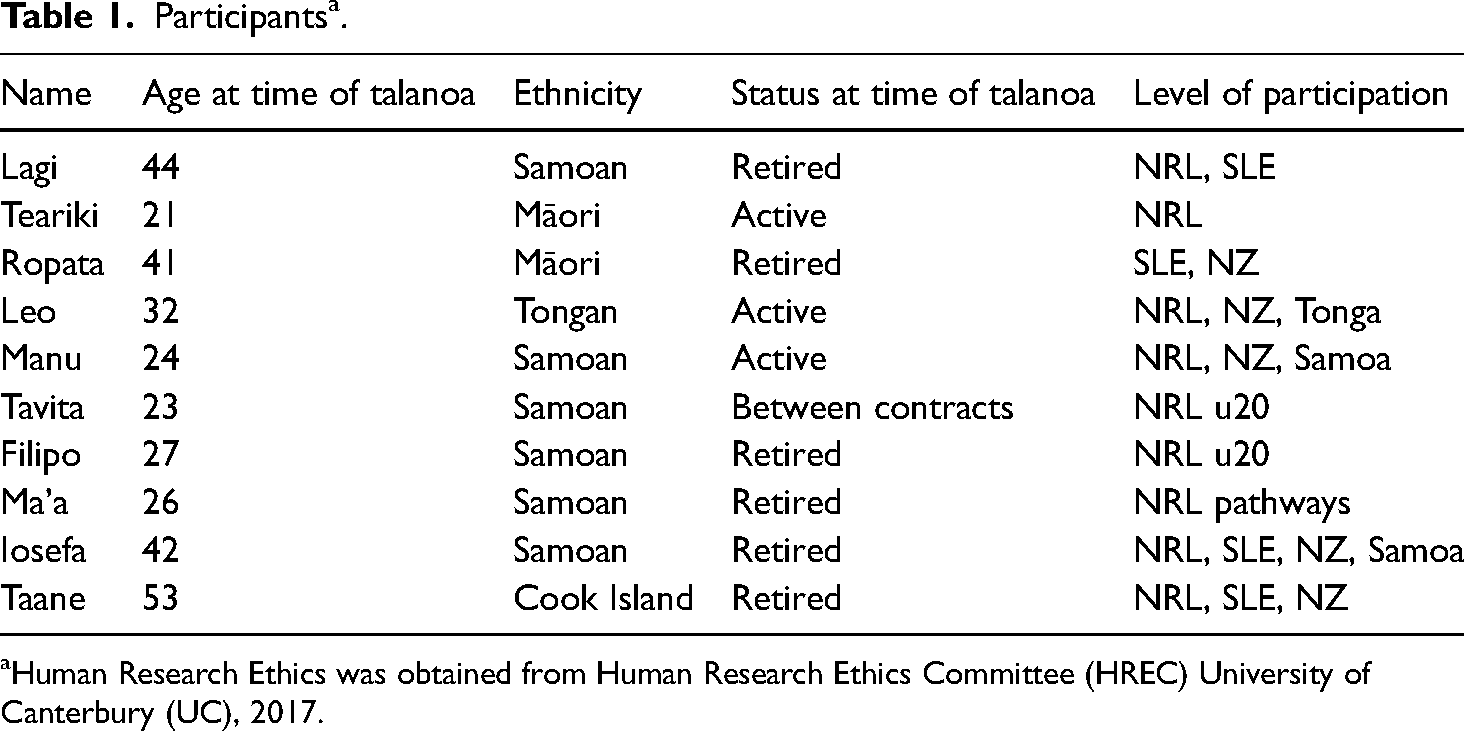
Human Research Ethics was obtained from Human Research Ethics Committee (HREC) University of Canterbury (UC), 2017.
Footnotes
Declaration of conflicting interests
The authors declared no potential conflicts of interest with respect to the research, authorship, and/or publication of this article.
Funding
The authors received no financial support for the research, authorship, and/or publication of this article.
