




Abstract
This article presents the conceptualisation and application of a critical Indigenist methodology founded in Ubuntu (an African philosophy). Methodologies founded in Indigenous knowingness are robust, offering a transformative approach to research and an alternative lens to understand the experiences of minoritised communities affected by the legacies of western research and continue to experience the harmful impacts of colonisation. This methodology is a novel contribution to Indigenous epistemology that privileges all aspects of being Indigenous, creating space for Indigenous theorising for, by and with Indigenous migrant communities residing on the lands of other Indigenous Peoples in a colonial context. The grounding of this work in the values of Ubuntu and te ao Māori (the Māori (the Indigenous Peoples of Aotearoa New Zealand) world), in collaboration with Indigenous African migrants, enabled an in-depth understanding of their lived realities with neurodiversity. Diverse philosophies and theories can collectively be applied to advance decolonising research for and with minoritised communities.
Keywords
Introduction
When Indigenous People migrate to the lands of other Indigenous Peoples, they become minoritised ethnic communities. Most ethnic communities have been impacted by colonisation in their own countries and often migrate to settle in another colonial society. Colonial disruptions have stifled the growth and flourishing of Indigenous knowledges (Chilisa, 2019; Smith, 2013). Ethnic communities experience challenges with western systems that often discriminate against and marginalise them. In Aotearoa New Zealand, hereafter Aotearoa, for example, there is poor visibility of ethnic migrant populations in policy, research, and places where decisions about their lives are made. Research with ethnic migrant populations in Aotearoa is scant. These gaps in understanding the contexts and aspirations of ethnic communities drive inequitable health outcomes.
Given the various experiences of Indigenous and ethnic communities with colonisation, racism and western research, it is imperative to approach research from the lens of the minoritised communities (Coates et al., 2023; Kovach, 2009). Decolonising research and the academy is critical and can be done by focusing on the onto-epistemological foundations. One way of doing this is to conceptualise research approaches that privilege Indigenous theorising and are founded in Indigenous philosophies and epistemologies. This article presents the application of Ubuntu (an African philosophy), as part of a larger study exploring the experiences of neurodivergent Indigenous African migrants and their families. Neurodiversity refers to when a person’s brain deviates from dominant societal conventions of what is considered normal neurocognitive functioning (Walker, 2025). Examples include dyslexia and autism.
In this article, the term Indigenous African migrants refers to a reasonably small population subgroup of culturally, linguistically and religiously diverse communities living in Aotearoa whose ancestors originate from the African Motherland. It was crucial to clearly define this population group of mainly Black people, who often experience disadvantage and endure racism and bias compared to non-Indigenous African migrants (FitzGerald & Hurst, 2017; Maina et al., 2018), most of whom are not Black bodies and are descendants of the European colonisers. Intersectionality plays a vital role in compounding the discrimination and marginalisation of Black people, which can differ from the experiences of non-Black people (Crenshaw, 2013). The intersectionality of social attributes created because of the structures and systems centred around whiteness, white privilege, and white superiority impact negatively on the experiences of people and communities of the Global Majority (Campbell-Stephens, 2021), of which Indigenous African migrants are a part.
The development of this methodology was a continuous process throughout the research and was informed by several factors. These included the primary researcher’s experiences and knowingness as an Indigenous African woman, the journey to connect with her Indigeneity and her interests in decolonial work and interrogating social injustice. The conceptualisation of this methodology was also informed significantly by the primary researcher’s growing understanding of te ao Māori (the Māori (the Indigenous Peoples of Aotearoa New Zealand) world), mātauranga Māori (Māori knowledge), and tikanga Māori (practices and values informed by Māori knowledge) through education and professional experiences, as well as the guidance of the research Advisory Group and participants.
The rationale
As an exploratory study, this research focused on understanding and interpreting the lived experiences of Indigenous African migrants with neurodiversity and exposing societal challenges; thus, a critical qualitative approach was considered the right fit. Basing this research entirely on one worldview and knowledge system would neglect essential values and attributes from the other worldviews and ways of knowing. Leaving out worldviews would not answer the research questions set for this research as intended, creating a missed opportunity to acquire new knowledge (Marczyk et al., 2010).
Identifying suitable paradigms was crucial to anchor the complexities of developing research in which the physical setting and target community originated from disparate worldviews and knowledge systems. The numerous strands of colonial histories from Aotearoa and participants’ native African countries added to the complexity of this research. Given that the research is situated on the lands of other non-African Indigenous People in a western colonial context, centring the research exclusively on African philosophies and ways of doing research was considered impractical. The positionality of the primary researcher as a budding critical Indigenous researcher interested in Indigenous and migrant health in Aotearoa and the world meant that common ground needed to be established through the methodology.
As research at the interface of knowledge systems, Indigenous African philosophy and a western paradigm were fused to produce relevant knowledge that applies to Aotearoa and is appropriate for creating positive outcomes and meeting the needs of neurodivergent Indigenous African migrants and their families. Innovation happens at this interface of paradigms, and novel ideas that inform policy, practice, and research are generated (Chino & DeBruyn, 2006; Durie, 2004, 2005; Nakata, 2010; Singh & Major, 2017).
Epistemological stance
In a research project focusing on the experiences of Indigenous Africans with neurodiversity, who were migrants on the lands of other non-African Indigenous People in a colonial setting, it was critical to consider applicable paradigms carefully. The research sits at the interface of African and western knowledge systems and is sited on whenua Māori (Māori land). Appropriate paradigms needed to be adaptable to embrace the vastness of Indigenous African philosophies and epistemologies and be responsive to Māori.
The primary researcher’s positionality as an Indigenous African, as a migrant, as a mother, and as a budding passionate Indigenous theorist, as tangata Tiriti (a non-Māori person), among the many other identities, influenced the research process and the researcher’s understanding and engagement with this research. The primary researcher was aware of her positionality and biases and continuously consciously reflected on how these factors could affect all aspects of the research process, especially data collection and analysis (Creswell & Creswell, 2017).
Indigeneity and migration
Globalisation and migration have significantly impacted Indigenous communities. Some Indigenous communities still occupy their ancestral lands, while others have been voluntarily or involuntarily uprooted from their territories. The definition of who is Indigenous becomes complicated. After migrating to the land of other Indigenous communities, they no longer claim Indigenous rights to territory and self-governance. Indigenous Peoples who migrate become minority ethnic migrant communities in their new host countries (Champagne, 2008). According to Cunningham and Stanley (2003), the diversity of Indigenous Peoples and the connection to their worldviews is not lessened by geographical distance from their original lands or genealogical distance from their ancestors. Therefore, although the status of Indigenous Peoples changes to minority ethnic groups, they can still hold on to their ways of being and knowing.
The United Nations Declaration on the Rights of Persons Belonging to National or Ethnic, Religious and Linguistic Minorities of 1992, notes that states and territories are responsible for taking measures to protect the existence of ethnic, cultural, religious, and linguistic identities of minority groups and enable their voices to be heard (United Nations, 1992). Ethnic communities can be represented through transformational research that aligns with their values, contexts and aspirations. More approaches to research for ethnic communities that embrace diverse ways of knowing are needed. This methodology, founded in African philosophy, is an example of culturally safe research where trust allows communities to engage without fear of victimisation and benefits communities meaningfully.
Indigenous Peoples who migrate to western countries encounter challenges similar to minority migrant groups. Most challenges relate to adapting to dominant western systems that offer unfair and unjust treatment, impacting access to resources and social services (Wilkes & Wu, 2019; Ziersch et al., 2020). As the world advances and as migration and globalisation continue, elements of Indigenous practice have a place (Absolon, 2010; Champagne, 2008) and should be included in research, policy and practice. Adapting to western contexts would be much easier if the systems and policies were flexible enough to advance diverse communities by accommodating diverse worldviews.
Conceptualising the methodology
The development of this methodology was a continuous process throughout the research and was informed by several factors. These included the primary researcher’s experiences and knowingness as an Indigenous African woman, the journey to connect with her Indigeneity, her interests in decolonial work and interrogating social injustice, as well as the richness and knowingness of the Indigenous African community leaders and the participants and families who contributed to this work. The conceptualisation of this methodology was also informed significantly by the primary researcher’s exposure to and her growing understanding of te ao Māori, mātauranga Māori and tikanga Māori through education and professional experiences.
The conceptualisation was also enabled by the consultations and engagement that the primary researcher made with the Advisory Group, community leaders, and the participants. These people were the knowledge holders and enabled the primary researcher’s understanding and theorising of this methodology to come alive, as “African epistemology begins with community and moves to individuality” (Battle, 2009, p. 135).
Africa is huge. Africa is diverse. Africa is vast and unique and the richness of Africa, its people and their cultures cannot be underplayed. The conceptualisation of this methodology was largely informed by the primary researcher’s past and present experiences of being African (in Africa and as a migrant overseas) and her knowingness of Ubuntu, an African way of life that is far-reaching with its core aspects being related across the common understandings of different African communities. Ubuntu is a fabric that holds African societies; however, the application of Ubuntu as a foundation for this research by no means belittles this richness of knowingness and being of the identities and the positionalities of diverse African cultures and worldviews, but instead enables those diverse realities to be brought together and in the same vein and have the uniqueness of the communities represented being acknowledged, privileged and celebrated. As the primary researcher engaged with the different communities and families, their knowledge and beingness was woven into how the research was carried out. For example, every interview was unique, as was informed by the participants’ cultures and practices. And how they detailed their lived realities and understandings of neurodiversity as informed by their knowingness and being was embraced.
This research was situated in Aotearoa, a land of other Indigenous Peoples and a space with unique ways of understanding and seeing the world. As such, it was essential to acknowledge this reality to ensure this work, though not directly focusing on Māori individuals and whānau (family and extended family relations), the research needed to be responsive to Māori to avoid perpetuating the legacies of colonisation. Acknowledging te ao Māori, recognising and adopting tikanga Māori, and continuing to learn and be nourished by mātauranga Māori were critical in the conceptualisation of this methodology. In this project, we see te ao Māori and Ubuntu values embedded throughout and applied alongside each other.
The philosophy of Ubuntu
Ubuntu is difficult to render into a Western language. It speaks of the very essence of being human. (Tutu, 2000, p. 31)
Ubuntu is familiar across many African societies, both with the African continent and the diaspora (Mugumbate & Nyanguru, 2013). A wide range of terminologies describe Ubuntu across geographical regions, as informed by the diversity of African languages. Although this research was founded on the philosophy of Ubuntu as the fabric that holds African societies, the diverse identities, cultures, and ways of seeing the world of the many African societies are acknowledged—and not unified into a monolithic culture based on a single, rigid worldview.
Ubuntu is at the centre of all relationships—communal, with the physical environment and with the spiritual world (Ewuoso, 2021). Ubuntu stipulates that we are who we are because of who is around us (Mangena, 2016; Swanson, 2007; D. F. P. Taylor, 2014). You can truly understand who a person is by what is around them. As Desmond Tutu puts it, “in the bundle of life, for a person is only a person through other persons” (p. 122). Ubuntu means humanness or humanity (Broodryk, 2006; Mangena, 2016; Swanson, 2007). It is an expression of our everyday living, the philosophy of becoming human (Swanson, 2007), with its spirit and intent asserting that a community’s strength is a product of community support, with generosity, community commitment, mutualism, and empathy fostering dignity and identity (Swanson, 2007).
With globalisation and migration, the structure of Indigenous African communities has evolved remarkably. Indigenous Africans are present on every continent; however, the dynamics of Ubuntu post-migration are not clearly understood. According to Le Roux (2000), a person is incomplete without Ubuntu in the African worldview. Ubuntu emphasises communal existence, unlike individualism in western societies (Mangena, 2016). However, post-migration, what happens to Ubuntu? Ubuntu is vital for every Indigenous African person and speaks to every dimension of relationality and social integration. The impact of migration on African Indigeneity, well-being, and belonging can be adequately understood if explored through the lens of the community. Exploring the experiences of Indigenous African migrants with neurodiversity could be best carried out from an Indigenous African lens by the Indigenous African communities. This research considered Ubuntu the most suitable overarching philosophy, given that knowledge for most African peoples emanates from Ubuntu and that Ubuntu epistemology results from experience (Mangena, 2016).
Following the legacies of colonisation and western research on African communities, it is crucial to understand the relationship that exists between Indigenous African communities and western structures of education, medicine and other societal institutions. Denial of Indigenous knowledge and theorising has been integral to the colonising agenda (Pihama & Penehira, 2005). These theories, emerging cultural frameworks, and Indigenous philosophies are crucial in the struggle against colonisation and cultural genocide (Pihama, 2012). Ubuntu is a guiding philosophy that promises progressive and ethical change for Africa, Africans, and the world. It provides opportunities to challenge and decolonise dominant structures while teaching humans to become human (Swanson, 2007).
Although the notion of Ubuntu emanates from the African continent, it is not only for African people. The values underpinning Ubuntu can be found in other non-African philosophies (Lubombo, 2018; Tomaselli, 2016; Venter, 2004). As such, the theoretical basis of these values can be extended beyond African communities and the African continent. The methodology for this research showcases the dynamic and evolving nature of the philosophical lens of Ubuntu and its applicability outside the African Motherland—highlighting the values that hold communities together, cementing a sense of belonging and togetherness.
A critical Indigenist approach founded in Ubuntu was conceptualised primarily to ensure that the voices and aspirations of Indigenous African migrants were privileged. Realising the role of knowledge and the processes of knowledge production in the western hegemony of academia prompted the need for an alternative research approach that included Indigenous African migrants and their aspirations (Smith, 2013). An Indigenous African researcher conceptualised this methodology in unison with the Indigenous African community. An Indigenous African researcher led the research, which was carried out with and in the interest of Indigenous African communities in Aotearoa. According to Rigney (2001), Indigenist research is “a strategy for Indigenous research by Indigenous peoples, for Indigenous peoples, and in the interest of Indigenous peoples” (p. 8). Indigenist research is a product of Indigenous experience, Indigenous theorising, Indigenous principles and values to address the rights and needs of Indigenous People as informed by Indigenous Peoples themselves (Doyle et al., 2017; Louis, 2007; Putt, 2013). This article presents how a critical Indigenist approach enabled Indigenous African-centred research that privileged Indigenous African philosophy and ways of knowing. It enabled a culturally safe and accommodating space for knowledge creation and intellectual sovereignty for neurodivergent Indigenous African migrants, their families, and their communities in Aotearoa.
The application of Ubuntu as the foundation was adequate for this research; however, as the research was located at the interface of African and western knowledge systems, a western theoretical framework was required for this work to have added relevance in a western academic space. A theoretical framework that aligned with the philosophy of Ubuntu was challenging to find because most western paradigms are not flexible enough to work alongside Indigenous methodologies. Social constructionism was identified to be a good theoretical fit with Ubuntu as it values all knowledge systems from any culture and acknowledges that different perspectives produce different knowledges. It rules out the need to compare knowledge systems and paradigms against each other, thereby challenging the domination of western paradigms on other worldviews (Burr, 2015).
In this research, Ubuntu provided a safe and considerate platform for Indigenous African research for Indigenous African communities residing in Aotearoa. Applying Ubuntu enabled the experiences of diverse Indigenous Africans to be woven together along with their different experiences with neurodiversity. Diversity in theory and practice was provided by applying Ubuntu values and principles as the foundational framework. This application enabled alternative ways of theorising to tackle ethical issues (Ewuoso & Hall, 2019), creating safe spaces for transformative dialogue and comprehensive insights into the positions of dominance and deficit (Swanson, 2007).
Congruence of the methodology
The interface of the different paradigms and ways of knowing in this research can be likened to basket weaving, a skilled art practised over centuries where products are created through conscientiously interlacing strands of material through a frame (Stanfield, 2020). The shape and the size of the product is determined by the design of the frame, and the durability and utility of the product is determined by the type of materials used. Diverse materials with diverse textures can be woven together, and there is no restriction to materials, provided they complement each other. This research shows new knowledge (basket) generated from diverse materials (paradigms and philosophies). Several aspects were considered before the weaving (research process) commenced. For instance, the intended purpose of the basket (new knowledge) determined the frame’s shape, size, flexibility, and sturdiness of the materials required, as well as the weaving technique to be used. The theoretical basis of the research was informed by envisioning the final product.
Exploring and (literally) carrying the experiences of neurodivergent Indigenous African migrants and their families safely and respectfully was the primary purpose of this research. This demanded a methodological framework aligned with Indigenous African cultures and ways of knowing while being relevant and applicable to Aotearoa, the land of other non-African Indigenous People in a western colonial context. The philosophy of Ubuntu was the most suited foundation for this research. In the basket weaving process, Ubuntu is illustrated by the skeleton or the basket’s frame, guiding the shape and direction of this research. Ubuntu values were weaved in from the beginning, contributing to the basket’s sturdiness and the research process’s soundness.
This research was situated on the whenua Māori. It upholds this privilege by acknowledging and recognising Māori and their ways of knowing and being through this work. The tangata Tiriti primary researcher’s exposure to and experiences of te ao Māori, tikanga Māori, and mātauranga Māori, and her knowingness of Ubuntu enabled the values from these two very different worldviews to be woven together. The values of mana (respect for people), rangatiratanga (autonomy), whanaungatanga (collectiveness), whakapapa (relatedness), kotahitanga (unity), and kia tupato (being cautious) were weaved into the processes of this research. They guided its ethical conduct and ensured that this work was responsive to Māori and did not perpetuate the legacies of harm inflicted on Māori by western research. The correlation between these values will be explored further in a separate article.
As noted above, social constructionism was also a strand woven into the research as it complemented the philosophy of Ubuntu and its values, embraced the vastness of Indigenous theorising and was adaptable to allow the critical Indigenist face of this research to shine. This process has highlighted how challenging it is to find flexible western paradigms that align with the values of and can accommodate the vastness of paradigms emanating from diverse worldviews. When considering research at the interface of western and Indigenous knowledges, care should be taken to consider approaches that align with Indigenous values, enabling them to leverage on without being restricted. Figure 1 illustrates the disparate philosophies and paradigms woven together.
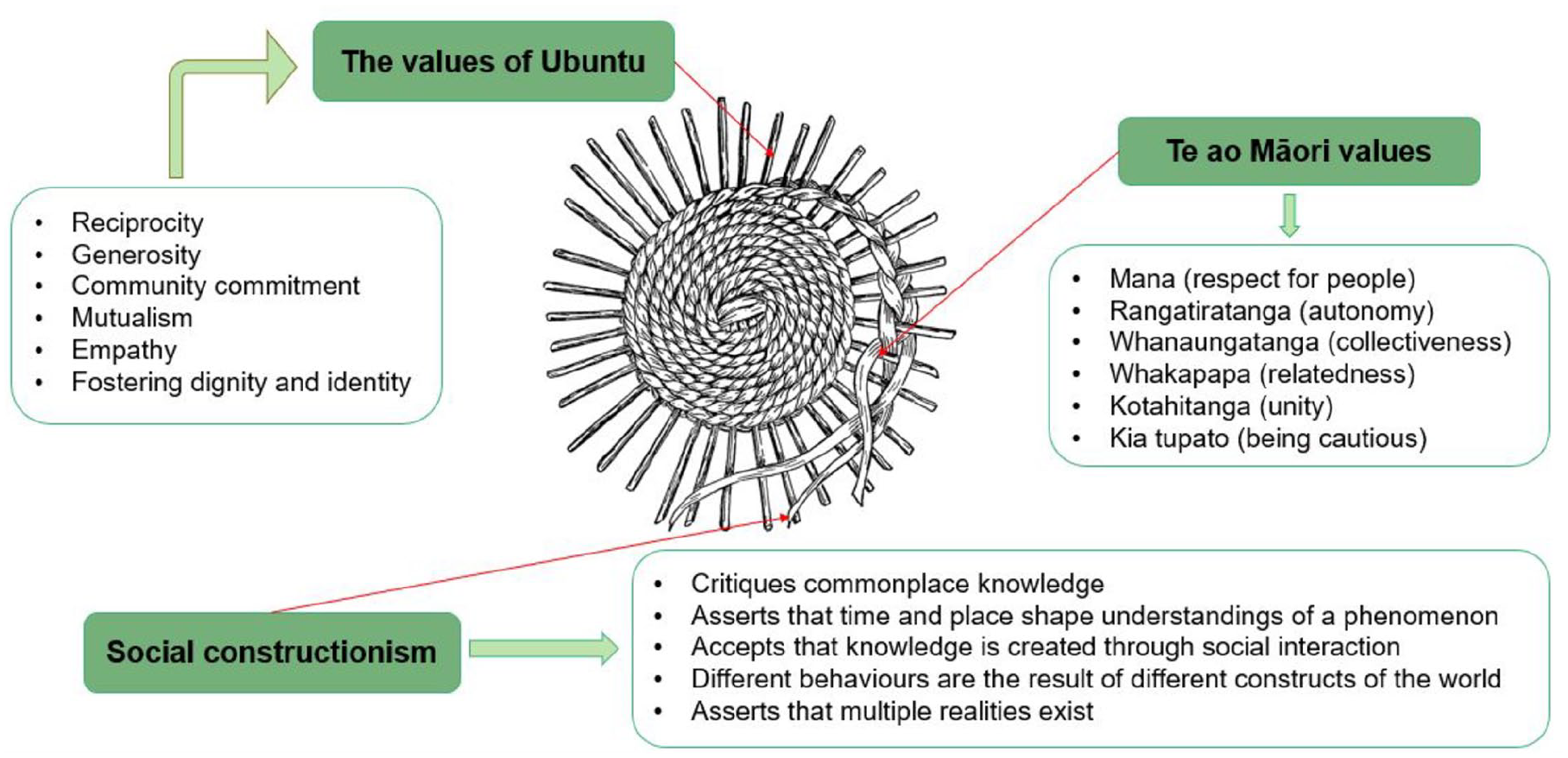
The diverse paradigms woven together.
Weaving together diverse materials was intended to create a durable, versatile, relevant, and usable product. Bringing together very different paradigms informed by different worldviews created a culturally safe and sensitive space for research with, by and for Indigenous African migrants.
At the end of the weaving process, the skeleton or the frame and the materials woven into the basket no longer stand out as separate materials. All the materials are neatly embedded into each other and hold the basket together. Weaving African and western philosophies and paradigms provides opportunities for innovation in informing policy, theory, practice, and future research and benefit neurodivergent individuals and their families in Aotearoa.
The weaving allegory is powerful in this research. It can be extended to how the philosophy of Ubuntu captures and embraces the diverse experiences of Indigenous African migrants from diverse cultural, linguistic and religious backgrounds. Again, Ubuntu is positioned as the frame onto which diverse Indigenous African realities, as informed by backgrounds and tribal affiliations, are woven. Ubuntu is seen bringing together, holding firmly, and shaping knowledge to address the research questions while preserving the integrity of Indigenous diversity. The weaving allegory can be extended to the neurodivergent participants in this research. Although some children have the same neurodiversity diagnosis, no two people are the same, and so are their experiences. Each family and each child had unique realities. This research acknowledges those unique realities and weaves them to amplify their voices and inform solutions for improving their experiences.
Community engagement
Community engagement was continuous from the research development to the end. We acknowledge all the individuals and organisations for the verbal and written endorsements for this research to proceed and all the constructive contributions provided. There was engagement with Māori experts and academics, Indigenous African migrant community leaders, service providers, and child health specialists. Several consultative processes were carried out throughout the research to ensure the research was relevant, respectful and beneficial to the Indigenous African migrant communities. These included establishing a research Advisory Group that provided ongoing input and guidance throughout the research and meetings with African community organisations to provide them with progress updates and seek support with cultural guidance and community engagement.
Recruitment of participants
The epistemological stance of the research is partly based on the premise that knowledge is vibrant and varies by context (C. Taylor, 2013). As such, knowledge was sought from people with lived experiences of raising or caring for neurodivergent children and community stakeholders who engaged with such families. This research focused on people with neurodiversity, a complex phenomenon that has seen significant advances in research diagnosis and treatment in other parts of the world. However, in Aotearoa, it is challenging to comprehend the extent to which neurodiversity occurs, especially so for minoritised population groups like the Indigenous African migrants. The inclusion criteria for parents and primary caregivers were those who self-identified as Indigenous African, having raised or cared for a neurodivergent child and residing in Aotearoa. The community stakeholders included had to be directly or indirectly involved with neurodiversity through their work, directly involved with African communities in Aotearoa and residing in Aotearoa.
Although neurodivergent children could have been included in the interviews, the research aligned with the advice from the Advisory Group and the understanding from an Indigenous African perspective that the parents or primary caregivers often represent their children. They were intimately connected with the day-to-day realities of their children. They were best placed to speak to issues of accessibility and access that children may have a different awareness of.
Snowball recruitment (Naderifar et al., 2017; Parker et al., 2019) was undertaken through community organisations and service providers who sent fliers to their community networks. The relational aspects of Ubuntu were evident in the strategies employed to recruit participants, particularly the support provided by local networks. The fusion of the values of Ubuntu and purposive sampling allowed the primary researcher to approach and engage safely with the organisations supporting the recruitment and, eventually, the participants.
Data collection
The primary researcher contacted participants via phone and email. They arranged 1-hr face-to-face semi-structured interviews in Auckland and Hamilton; however, the travel restrictions imposed by the COVID-19 pandemic hindered broader recruitment efforts. Consequently, some interviews were conducted in person, while others were conducted remotely via Zoom or telephone. Remote interviews were challenging for discerning body language, unlike in-person interviews. Some participants were only comfortable speaking with their cameras off, excluding visual communication. Each participant provided written or verbal consent and, in line with tikanga Māori and the values of Ubuntu, received a token of appreciation for taking the time to share their stories. Six parents of neurodivergent children, seven Indigenous African community leaders, and three child and health specialists participated in the interviews.
Ethical considerations
This research was approved by the University of Auckland Human Participants Ethics Committee. From the early stages of this research, ethical considerations informed the research approach. For instance, conceptualising and articulating the epistemological stance and appraising the methodology’s appropriateness. The relational values of Ubuntu that respect individuals’ autonomy and rights to their own space and privacy and to engage willingly with the research were embedded to avoid ethical problems arising from perceived coercion or involuntary participation. Careful consideration was taken on how the participants were accessed and approached through their community networks and organisations, the interview process, and the data handling.
It was necessary to consider steps to protect the anonymity and confidentiality of the participants. Another aspect of Ubuntu was ensuring that participants were kept safe throughout this research and that any concerns were addressed. Safe in that the information they shared would not be used against them but contribute to making a difference in aspects of their realities with neurodiversity. The possibility of unintentionally causing harm by enkindling trauma or other painful experiences for the participants, resulting in anxiety and distress (Arifin, 2018; Orb et al., 2001; Sanjari et al., 2014) was anticipated in this research, given that they were drawing from their lived realities. Engagement with the participants before the interviews helped build rapport, provide clarification and address concerns where needed.
Concluding remarks
Indigenous and ethnic values and philosophies have a place in all aspects of diverse societies—including in policy, practice, and research. For policies and systems to adequately represent and meet the unique contexts of a population, the diversity of its people should be considered and reflected on. For such policies and systems to be developed, there is an urgent need to diversify the epistemological foundations of research to include and privilege Indigenous and ethnic ways of knowing alongside dominant knowledge systems and paradigms. The reclaiming of Indigenous and the inclusion of migrant epistemologies and spiritual ontologies can be considered in strategic frameworks for counteracting western modernity and creating opportunities for equity for multi-ethnic societies like Aotearoa.
Several lessons have been learnt through the conceptualisation and application of a methodology informed by the African philosophy of Ubuntu has enabled learning to take place. It has demonstrated that the values emerging from diverse paradigms can be applied alongside each other in decolonising research to enabling Indigenist research. We have also seen that it is possible to be responsive to Māori in research that does not directly focus on Māori. This is a step towards denouncing the perpetuation of the legacies of research that have harmed Māori and Indigenous communities across the world. This methodology has highlighted the flexibility and usefulness of the philosophical lens of Ubuntu as a foundation for research and how its dynamic and evolving nature enables its applicability even in places and spaces outside the African Motherland.
Indigenous ways of knowing and being can inform innovative solutions to address social injustice, with philosophies like Ubuntu cementing cohesion and harmony for the greater good of society, irrespective of the multiplicities of peoples represented (Omodan & Tsotetsi, 2019). As such, Indigenous-informed principles such as those applied in this research provide an alternative and innovative lens to interrogate and map out the inequities, their causes, and how to address them and prevent their occurrence. When reflecting on Ubuntu’s social cohesion concept that says a person is who they are because of who is around them, it implies that although some portions of the population are privileged by the dominant systems and structures, while other groups experience inequitable social outcomes due to systemic and cultural racism, overall, that population’s outcomes will always be poor.
Developing a methodology that draws from three paradigms emanating from diverse worldviews is a novel contribution to the ever-evolving Indigenous knowledge systems. Such approaches enable the development of more strength-based tools and frameworks relevant for research for, with and by minoritised communities. Given the various experiences of Indigenous and ethnic migrant communities with colonisation and racism, approaching research from the lens of the minoritised communities is imperative. Focusing on the onto-epistemological foundations of research and privileging Indigenous theorising, as seen in the critical Indigenist methodology applied to this research, is crucial and a priceless contribution to decolonising research.
Footnotes
Acknowledgements
We acknowledge Māori, the Indigenous Peoples of Aotearoa New Zealand, for hosting us on their lands. We acknowledge the participants who generously shared their time, experiences, and insights, making this research possible. We acknowledge the Research Advisory Group for their invaluable contributions and thoughtful recommendations that significantly enhanced the quality and depth of this work.
Authors’ note
Declaration of conflicting interests
The authors declared no potential conflicts of interest with respect to the research, authorship, and publication of this article.
Funding
The authors received no financial support for the research, authorship, and publication of this article.

Glossary
kia tupato being cautious
kotahitanga unity
mana respect for people
Māori the Indigenous Peoples of Aotearoa New Zealand
mātauranga Māori Māori knowledge
rangatiratanga autonomy
tangata Tiriti a non-Māori person
te ao Māori the Māori world
tikanga Māori practices and values informed by Māori knowledge
whakapapa relatedness
whānau family and extended family relations
whanaungatanga collectiveness
whenua Māori Māori land
Ubuntu an African philosophy