




Abstract
There has been little theoretical development concerning the role of housing and the more subjective notion of ‘home’ in supporting desistance from crime. Through narrative interviews with 16 men with histories of imprisonment in Aotearoa New Zealand, this article explores key psycho-social benefits of home that support men to desist from crime. The article expands knowledge on the role of place and space in desistance by emphasising that to fully engage with the desistance process, those leaving prison need more than a roof over their heads; they need a home with psycho-social benefits that enhance their sense of wellbeing and ontological security. It is argued that a home provides a crucial setting for those leaving prison to ‘do’ desistance, and it is imperative that reintegration policy and practice recognise the psycho-social benefits of home.
Introduction
A considerable body of literature recognises the importance of stable housing in reducing rates of reoffending (e.g. Baldry et al., 2006; Lutze et al., 2014; Morrison and Bowman, 2017). Bradley et al. (2001) describe suitable housing as ‘the lynchpin that holds the reintegration process together’. Stable housing can offer many practical benefits to those leaving prison, including a space to parent their children, obtain employment, reconnect with family and networks of support, and engage with treatment services (Growns et al., 2018; Keene et al., 2018). However, within these studies, the mechanism by which stable housing can lead to reduced recidivism remains somewhat unexplored. Literature on the psycho-social benefits of housing recognises that it not only offers material benefits (such as shelter), but that access to a ‘home’ can offer benefits to one’s sense of identity, ontological security and overall wellbeing (Dupuis and Thorns, 1998; Kearns et al., 2000). Conversely, a lack of access to stable housing after prison has been associated with reoffending and negative impacts on health and wellbeing (e.g. Baldry et al., 2006; Rosenberg et al., 2021).
Desistance literature often notes that housing plays a role in desistance, and that barriers to accessing housing can significantly constrain desistance (Farrall et al., 2010; Österman, 2018; Stansfield, 2016). However, there appears to be little theoretical development concerning how housing may support desistance. Housing is often referred to only briefly and as part of a wider study examining other aspects of the desistance process. This article seeks to specifically examine the potential role of housing and the more subjective concept of ‘home’ in desistance. Through narrative interviews with 16 men with histories of imprisonment in Aotearoa New Zealand, it explores the specific psycho-social benefits of ‘home’ that enhance a sense of ontological security and how these may help to motivate, strengthen and reinforce the process of desistance. The implications of this for policy and the provision of post-prison housing are also discussed.
Theorising desistance
Broadly put, desistance is the process of journeying out of crime. Desistance theorists tend to place varying degrees of emphasis on the socio-structural elements of the desistance process (Sampson and Laub, 1993), or the subjective and internal factors that influence change (Giordano et al., 2002; Maruna, 2001; Paternoster and Bushway, 2009). Those in the former camp suggest that key life-events or ‘turning points’, such as marriage and employment, play important roles in facilitating desistance, by providing a source of informal social control and motivation to desist from crime (Laub and Sampson, 2003; Sampson and Laub, 1993). Laub and Sampson (2003) also argue that these life events can lead to changes in daily routine activities, leaving less time or opportunity to offend, and provide opportunities for desisters to ‘knife off’ (or cut ties with) their past and immediate social environment.
For socio-structural theorists, structural ‘turning points’ can lead to desistance by default. That is, desistance is ‘not necessarily [viewed as] a conscious or deliberate process’ (Laub and Sampson, 2003: 278). Contrastingly, identity theorists pay greater attention to the internal changes that take place throughout the desistance process and suggest that the influence of socio-structural changes is contingent on the person making the change. They pay attention to roles of agency and ‘cognitive shifts’ in motivating and facilitating desistance, but recognise that environmental influences can be key ‘hooks for change’ to catalyse or facilitate lasting transformations, helping desisting individuals to envisage or create a satisfying ‘replacement’ self (Giordano et al., 2002).
Most desistance literature now tends to adopt an integrative approach, recognising that internal and external factors both influence desistance and operate through an interactive process. Bottoms (2013) has suggested a theoretical framework termed ‘situational theories’, which draws on both socio-structural and identity theories but places particular emphasis on the role of various places or spaces in constraining or enabling desistance (Flynn, 2010; Hunter and Farrall, 2015). Situational studies have begun to offer some theoretical hints regarding the role of housing in desistance. For example, in their research involving desisting and persisting drug users, Hunter and Farrall (2015) found that desisting individuals were more likely to have structured daily routines around work and family life than those still using drugs. Working life and its associated routines disrupted the time available to socialise and made desisters more ‘home-centred’. Although not centred on the role of housing per se, these findings suggest that a home may provide a base to engage with other factors commonly associated with desistance, such as employment and strong family relationships.
In addition, desistance theorists have suggested that housing may provide opportunities for individuals to relocate and ‘knife off’ from past situations or contexts (the ‘geographic cure’) (Kirk, 2012; Maruna, 2001). For example, Österman (2018) found that an inability to access suitable housing could result in ‘entrenchment in the scene’, where women remained in geographical areas where they had offended and were consequently unable to construct drug/crime free identities. Conversely, geographical relocation could support the women to disassociate from former offending/drug-using networks and provide a setting to construct drug/crime free identities. In addition, the ‘geographical cure’ can involve the avoidance of particular locations or spending less time with associates involved in crime to stay out of trouble (Bottoms, 2013). These strategies are known as ‘self-applied situational crime prevention’ (self-applied SCP) 1 and can include ‘deliberately staying at home a lot of the time’ to reduce the risk of reoffending (Bottoms, 2013: 81).
Despite the potential merits of self-applied SCP and the ‘geographic cure’, it is important to recognise that these strategies can carry substantial costs or ‘pains of desistance’ (Nugent and Schinkel, 2016) for those undertaking change. McNaughton and Sanders (2007: 891) argue that ‘disordered’ situations (such as homelessness and involvement in the criminal justice system) can carry with them certain ‘networks of familiarity’ (including relationships, routines, status, and a place in the community) that can offer a sense of security and familiarity. They suggest that leaving such networks may lead to intense loneliness and isolation. Such feelings – and the related tolls on one’s mental and emotional wellbeing – are antithetical to the desistance process and long-lasting change. To positively influence desistance, any place where individuals stay after release from prison needs to provide social support and wellbeing, or a subjective sense of feeling ‘at home’.
‘Home’ and ontological security
To understand the potential role of housing in the desistance process, it is necessary to move beyond the physical structure of a house and draw upon the more subjective concept of ‘home’. ‘Home’ concerns the social and psychological meanings of place and has been associated with the concept of ontological security (Dupuis, 2012; Dupuis and Thorns, 1998), defined as a feeling of wellbeing that arises from a sense of confidence, trust, and continuity in one’s social environment (Giddens, 1991; Padgett, 2007). Several authors have emphasised various psycho-social benefits of ‘home’ which can provide ontological security, including constancy in the social and material environment, a place to perform daily routines, a feeling of control and autonomy within the environment, freedom from surveillance, and the space and privacy to embark on self-reflection and identity construction (Cram, 2020; Dupuis and Thorns, 1998; Kearns et al., 2000; Padgett, 2007; Rosenberg et al., 2021; Stonehouse et al., 2021).
Literature examining experiences of ‘home’ and ontological security among those leaving prison is limited. A recent exception is Rosenberg et al.’s (2021) research, which examined the residential experiences of people returning from imprisonment in the United States. They suggest that living environments such as residential group settings (e.g. halfway houses), or other people’s homes (e.g. family/friends) were often characterised by impermanence, rules, surveillance, and a lack of control, suggesting a dearth of ontological security for those residing in these settings. Contrastingly, participants’ ideas of ‘home’ emphasised the importance of feeling a sense of privacy and control over this space. Rosenberg et al. (2021) conclude that a lack of ontological security among those leaving prison creates a barrier to their re-entry, preventing them from establishing a secure identity, their own daily routines, and a sense of agency necessary for health and wellbeing. Although this research raises the importance of access to a ‘home’ and ontological security for the wellbeing of those leaving prison, the potential link between ‘home’ and desistance is not examined.
This article integrates these two branches of literature to investigate the potential role of stable housing and ‘home’ in the desistance process. Drawing on interviews with men with histories of imprisonment, it seeks to identify key psycho-social benefits of ‘home’ that support men leaving prison in Aotearoa New Zealand to develop a sense of ontological security and help to motivate, facilitate or reinforce desistance. By examining in detail the connections between ‘home’, ontological security and desistance, which have hitherto been neglected in discussions of desistance, this article presents an important theoretical contribution to desistance theorising, and in particular situational theories of desistance.
Aotearoa New Zealand context
To make sense of the analysis that follows, it is important to situate the current project within the socio-historic context of Aotearoa New Zealand. People leaving prison in Aotearoa New Zealand face a multitude of barriers to accessing housing, including the stigma of a criminal record, limited financial and social support, lack of identity documents, lack of adequate, stable post-prison housing, high private rental costs and long waiting lists for social housing (Mills et al., 2021). Less than half of those leaving prison will settle into long-term accommodation (Johnston, 2018), with most staying with family, friends, or partners (Mills et al., 2021). Although these arrangements can offer supportive living environments, those leaving prison may have fraught relationships with friends and family members, and some families lack the financial resources to support a family member after release. Many stay in transitional housing, including emergency accommodation, typically in a motel for a week at a time (Ministry of Social Development, 2022). Here, residents will have their costs covered by Work and Income 2 for the first seven nights of their stay. They will then pay rent of up to 25% of their income (including benefit payments), while the rest of the costs are paid by the Ministry of Housing and Urban Development (Ministry of Housing and Urban Development, 2023).
Transitional housing also includes supported accommodation, where individuals are provided with housing for up to 3 months and (in theory) receive support to transition back into the community. Once again, residents pay rent of up to 25% of their income, while their remaining costs are funded by government agencies (Ministry of Housing and Urban Development, 2023). However, strict entry criteria, such as having a sentence over a certain length or being convicted of a certain offence, mean that supported accommodation is often unavailable or unsuitable for many leaving prison (Mills et al., 2021). Furthermore, residents are usually not permitted to live with their children or other whānau 3 (Mills et al., 2021).
Difficulties in accessing post-prison housing are especially pronounced for Māori (the Indigenous population of Aotearoa New Zealand) and Pasifika persons (peoples from the Pacific who have settled in New Zealand) who experience racism and discrimination in the housing market in addition to the difficulties discussed above (Harris et al., 2006; Houkamau and Sibley, 2015). Māori and Pasifika are more likely to live in overcrowded, poor-quality, temporary housing, and to experience higher rates of housing mobility (Flynn et al., 2010; Statistics New Zealand, 2016). Māori are four times more likely to experience homelessness than Pākehā 4 and have far lower rates of home ownership (Lawson-Te Aho et al., 2019).
Housing inequalities sit within a wider colonial context in which Māori (and often Pasifika) disproportionately experience socio-economic inequalities, including contact with the criminal justice system. Despite comprising around 17% of the general population, Māori represent over 53% of the prison population (Department of Corrections, 2022; Statistics New Zealand, 2020). This must be understood in relation to the historical and contemporary effects of colonisation and breaches of Te Tiriti o Waitangi (the Treaty of Waitangi), the founding document of Aotearoa New Zealand (Jackson, 1988). Colonial policies which enforced large-scale dispossession of Māori land and cultural assimilation, disenfranchised Māori from their land, language and culture (Jackson, 1988), creating long-lasting inequities. Housing policies emphasised the nuclear family as the standard family unit rather than the Māori concept of whānau. As a result, there was ‘no real planning for accommodation needs of extended family members and a crucial thread in the fabric of whanau support and regulation was broken’ (Jackson, 1988: 79). Whānau support was further eroded through the ‘pepper-potting’ policy which saw public housing for Māori spaced throughout suburbs rather than being placed together (Jackson, 1988).
These historical processes of colonisation have resulted in intergenerational trauma; that is, collective physical, emotional and spiritual wounding passed down through generations (Pihama et al., 2014). Through this, disadvantage has been reproduced so that imprisonment has become negatively but normatively accepted among many Māori communities (McIntosh and Radojkovic, 2012). Socio-economic inequities have been further exacerbated by the advent of neoliberalism, which resulted in cuts to social welfare and public housing (Howden-Chapman et al., 2013). New Zealand’s colonial history and neo-colonial present serve as important context to understand Māori experiences of housing and desistance, and the substantial barriers that they face to finding ‘home’.
Method
The current study is part of a larger research project to investigate the role of stable housing in reducing reoffending by people leaving prison in Aotearoa New Zealand, funded by the Royal Society of New Zealand Marsden Fund. The larger project uses mixed methods and began with a longitudinal quantitative interview study which followed a consecutive sample of just over 200 people released from six prisons from the period just before release from prison to a year after release (see Mills et al., 2022). All of those due to be released in the following 4 weeks were invited to participate in the study. To examine the role of stable housing in desistance from crime, a small sub-sample from the quantitative study were invited to participate in a narrative interview to explore their subjective experiences of stable housing and ‘home’ and how these may facilitate desistance. Potential participants were invited to participate if they had not reoffended within the first year after release and had indicated their desire to desist in previous quantitative interviews. Using contact information provided as part of the larger study, 25 participants were initially contacted via letter or phone call and invited to take part, with seven either refusing to participate or not responding to the initial invitation. Those who were back in prison were excluded from this part of the study.
Narrative interviews
Narrative interviews were conducted with 16 men 14–20 months after their release from prison. The interviews took place either in participants’ current accommodation or a local café, depending on the participant’s preference. At the start of the interviews, the interviewers talked through the study participant information sheet and provided participants with the opportunity to ask any questions, to ensure their informed consent. After the interviewers answered any questions, participants signed a consent form.
Narrative interviews demonstrate how through the creation and use of stories, people interpret and make sense of the social world, and account for their behaviour and experiences, thereby allowing access to the meanings that people attribute to events and actions (Giordano et al., 2002; Riessman, 1993). Participants were asked about their early lives, current lifestyle, post-prison journeys, including housing experiences after their incarceration, and conceptions of ‘home’. Specific questions included: What happened when you left prison? How did you find housing? What does a ‘home’ mean to you? Has your housing situation helped you? Participants were offered a koha 5 in the form of supermarket, petrol or phone top up vouchers, to thank them for their time and contribution to the research. Interviews lasted between 1 and 2½ hours and, with participants’ consent, all were audio-recorded and transcribed verbatim. To ensure anonymity, participants’ names were replaced by pseudonyms. Ethical approval for the research was granted by the University of Auckland Human Participants Ethics Committee.
As can be seen from Table 1, of the 16 men, six identified as Māori, nine identified as Pākehā, and one as both Māori and Pākehā. Their ages ranged from 26 to 68 years, and they lived in various forms of housing including with whānau/family or friends, in mobile homes, and in public, private rented or owner-occupied housing. The majority of the sample described histories of sustained offending and of serving multiple prison sentences. Most of their offending began during adolescence or young adulthood. They described a range of offence types, including property offences, indecent exposure, drug dealing, domestic violence, injuring with intent to injure, wilful damage, drunk driving, aggravated assault, and aggravated robbery. The majority of the sample (n = 14) referred to histories of addiction to, or issues concerning, drugs and/or alcohol. An overview of participant profiles is provided in Table 1.
Participant profiles. a
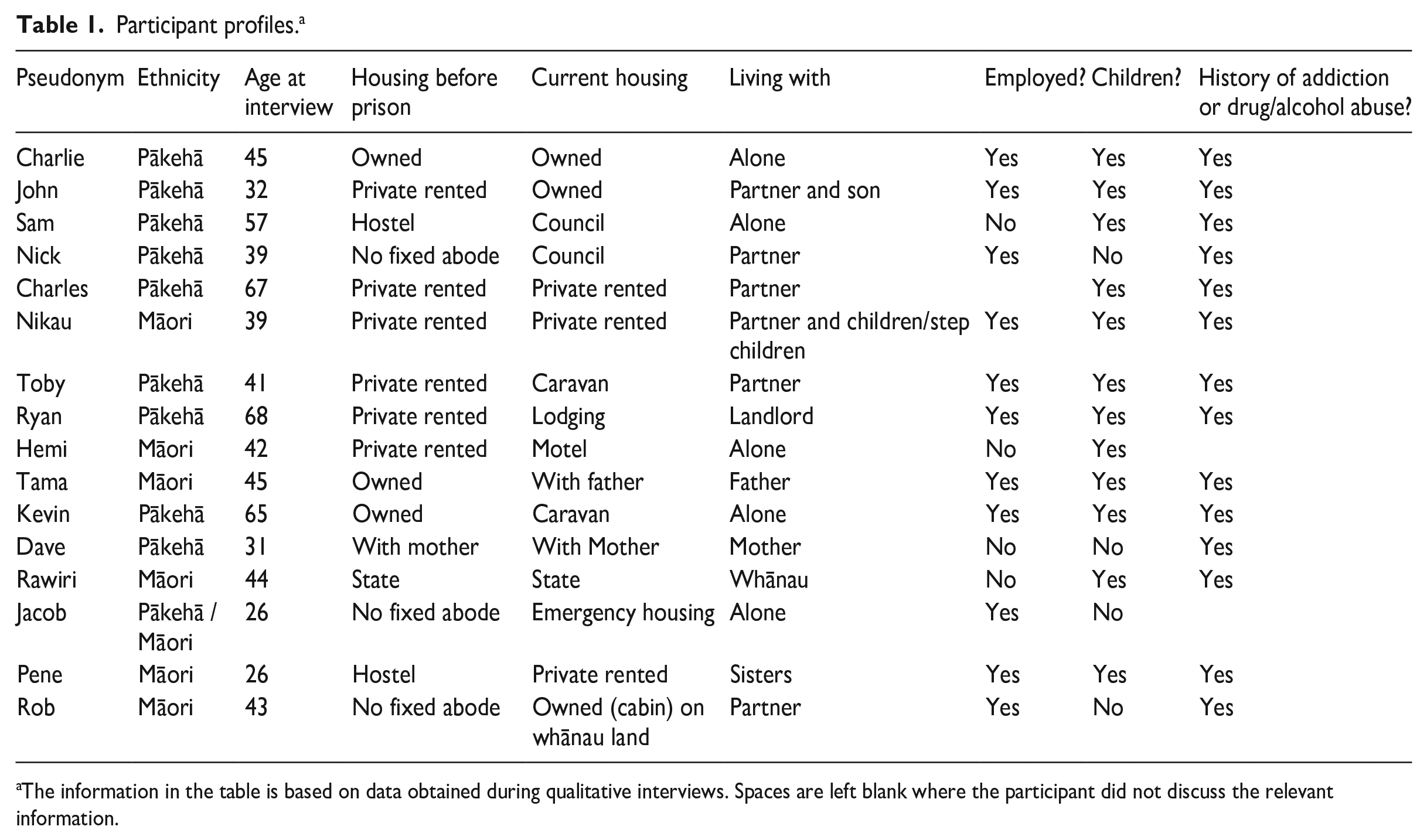
The information in the table is based on data obtained during qualitative interviews. Spaces are left blank where the participant did not discuss the relevant information.
As all participants had not reoffended for at least 14 months, we considered them all to have at least entered the primary phases of desistance (Maruna et al., 2004). However, only half of the group appeared to be ‘thriving’ rather than merely ‘surviving’. These participants were mostly living in permanent or semi-permanent housing and had started to move towards ‘secondary desistance’, assuming the role and self-identity of a non-offender (Maruna et al., 2004). Contrastingly, those who were ‘surviving’ described more precarious desistance journeys and did not appear to have experienced these same identity changes. Our analysis draws on themes of ‘home’ and ontological security from both groups of participants. However, where we refer to specific connections between ‘home’ and desistance, we are mainly drawing from the narratives of those who were ‘thriving’.
Data analysis
Our analysis explored patterns of shared meaning, or ‘themes’ across the data (Braun et al., 2019). Thematic analysis was a suitable analytical tool to respond to our research aims, and thereby highlight key themes concerning the connection between housing, home, and desistance, both within and across interviews. This contrasts to a narrative analytical approach, which would predominantly explore participants’ life histories (Atkinson, 1998). The analysis began with all three authors reading the transcripts to generate initial codes. Some codes were informed by existing desistance literature, such as ‘knifing off’ and ‘the geographic cure’, whereas others were grounded in the data only, such as ‘a place to build for the future’, ‘own space’ and ‘having control’ (Glaser and Strauss, 1967).
Codes were then compared both within and across interviews to establish wider themes and sub-themes concerning participants’ post-prison experiences generally and their experiences of housing, ‘home’ and desistance specifically. Two of the authors then re-coded all the transcripts separately, using the computer software NVivo, and subsequently met to discuss the codes they had applied. In a small number of cases, divergence in coding practices required further discussion before a consensus was reached. This process of collaboration and refinement enhanced the robustness of our findings as we considered multiple potential patterns of meaning within the data. Our analysis attends to the complexities of defining home for those with histories of imprisonment, and acknowledges how these are shaped by sociocultural values and/or marginality. This resulted in the co-construction of the final overarching themes: home as a site of control; as a place for daily routines; as whānau and whakapapa; and as secure base and a stake in conformity. The analysis that follows explores how these psycho-social benefits of home supported the men’s ontological security and worked to facilitate and reinforce their desistance.
‘Home’ as a site to ‘do’ desistance
Home as a site of control
A key psycho-social advantage of ‘home’ which enabled participants to ‘do’ desistance was having control over their own space, which is recognised as being central to a sense of ontological security (Dupuis and Thorns, 1998). Some participants referred to previous living situations in transitional accommodation, often run by support organisations, where they lacked control over the space, and consequently lacked a sense of security, privacy, autonomy, trust and emotional wellbeing. Consistent with Rosenberg et al.’s (2021) research, the men’s experiences in these environments were often characterised by surveillance and the absence of ontological security:
Living in a place where you know that someone’s got a key. They [support workers] were going to knock, but I didn’t have my clothes on yet. It was like they were trying to catch me doing something I wasn’t supposed to. (Nick)
Nick went on to detail how he experienced support workers coming into his room when he was asleep and even climbing through the window to check on him, leading him to distrust the support organisation even after he had moved to independent accommodation. Nick may have been concerned that the support worker was looking to see if he was breaching his release conditions and should therefore be reported to his probation officer. His account speaks to the psychological impacts of not having control in a home space, where the judgements of others can inform not only your own cognitions or emotional wellbeing, but also your journey inside or outside the criminal justice system. Such experiences may inform desistance journeys for those in transitional accommodation as they feel mistrusted or judged in their ‘home’ spaces.
Some participants directly linked their stays in transitional accommodation – and the associated lack of wellbeing and control over their environment – to their risk of reoffending or relapse. Toby, for example, explained that residents in these environments do not feel ‘happy’ or ‘comfortable’ and that drugs can provide a temporary form of escape from this difficult living situation:
You’ve learnt some good skills [in rehab], and then people coming over and they’re just waving it [drugs] in your face, and that shit goes out the window because you’re like, ‘Fuck, why not? I don’t like this prick of a place where I have to live because I’ve got nowhere else to go’. And, if they’re not happy or comfortable being there, then of course they’re going to get high to go, ‘I’m not here right now, I’m high, it doesn’t matter’. (Toby)
In contrast to transitional living arrangements, which were typically characterised by the absence of ontological security, participants considered ‘home’ as a place where they had control over their own space and a consequent sense of wellbeing. A ‘home’ provided participants with the freedom to choose who they did, and crucially did not, allow into their space, and therefore, the autonomy to separate themselves from anyone who was unsupportive of their desistance journeys. As Sam, who had a history of serious offending for over 20 years, explained,
It’s important to me that I make somewhere that’s home because I really love having my own space that I can just sort of take a breath [. . .]. I don’t have to open the door because I don’t encourage a lot of visitors. I really cut . . . most people I know, I won’t associate with crims, not active ones anyway. There are people like me that are changing their lives, but I won’t congregate with people like that [those actively offending] because you can get dragged back into shit. (Sam)
For Sam, his housing (a small public housing unit) provided him with a respite from the outside world and the freedom to choose how to live his life which facilitated the process of ‘knifing off’ (Maruna and Roy, 2007) from former associates who were unsupportive of his desistance journey while allowing him to socialise with friends who were more encouraging. It also provided a secure place for his exercise equipment, allowing him to engage in activities that further supported his health and wellbeing.
Other participants did not completely cut themselves off from others, but spoke of their ‘home’ as a place which allowed them to maintain firm, but gentler boundaries concerning when they allowed others to enter their space:
I tell a lot of people that too. ‘Stop. I don’t want your negativity. You take it back out there. You walk back out my driveway with a smile’. (Nikau)
This allowed Nikau to maintain his relationships with friends while also supporting his efforts to maintain a positive attitude to life and create a safe space for his whānau.
At the time of the interview, Toby had recently relocated to a new region to live with his partner. He explained that his decision to relocate was influenced by the fact that people were constantly ‘turning up’ and offering him drugs. However, consistent with Bottoms’ (2013) research, Toby implied that it was possible to avoid various associates or temptations without geographical relocation through strategies of self-applied SCP by having your own personal space and associated sense of control. He contrasted the experience of having your own ‘home’ to living in a motel room and how it allowed the ‘choice’ to escape to a bedroom and ‘deal with your own thing’:
If people turn up at the house that you don’t want to associate with, then you can go to your bedroom, because that’s your bedroom. But, if people turn up at the motel room, they’re right in your personal space and you can’t kind of go anywhere. [. . .] You’ve got that ability just to go, ‘right, I’m going to bed, or right I’m going to do this?’ [. . .] it’s just a choice really. (Toby)
Having control over personal space and sense of privacy were therefore substantial contributors to a sense of ontological security and a vital part of what made physical shelter a ‘home’ which facilitated and supported participants’ efforts to engage in desistance. Several participants who lived in accommodation they did not consider a home and were at the stage of primary desistance (Maruna et al., 2004), expressed desire for a safe, secure place they could call their own.
Home as a place for daily routines
Literature on the psycho-social benefits of home recognises that it can be a source of ontological security by providing or reinforcing a sense of constancy or predictability of surroundings (Dupuis, 2012). This can manifest as a sense of stability in life and a space to develop daily routines (Dupuis and Thorns, 1998), including activities which can potentially motivate and/or reinforce desistance. After many years of drug use, Rob explained how his ‘home’ provided him with a base to develop routines or to ‘live normal’:
I’m learning to live ‘normal’. Whatever that looks like, everybody is different. So, what normal looks like for me is go have a routine, go work, go to the gym, eat regularly, sleep regularly, be kind to yourself, and be grateful. (Rob)
His home and the constancy it provided therefore supported Rob’s efforts to improve and maintain his physical and mental wellbeing, to engage in meaningful activities and to further support the processes of recovery and desistance.
Many of the men conceptualised ‘home’ as a base to go to and from paid employment and felt it was not possible to gain employment without housing where they felt a sense of stability:
When I haven’t had somewhere to live, or not knowing where I’m going to live, I don’t really want to look for it [employment]. I don’t know how people work and move. (Nick)
Toby similarly explained that it is highly challenging to seek or retain employment without a stable home to return to. He emphasised both the material benefits of housing (e.g. somewhere to sleep, eat and shower), but also psycho-social benefits of home, such as a place to ‘chillax’, and stressed the importance of his home as a place to carry out his daily routines, including going to, and physically and mentally recovering from, work:
Being able to have food in the cupboard and food in the fridge, get up in the morning and make your lunch and then go to work and all that. You can’t work if you haven’t got anywhere to stay. Simple as that. Like, fuck living in a car and trying to go to work every day, like some people are doing. That would do my head in. I wouldn’t cope. I need to be able to come home and throw my shit under the table. Kick my boots off and have a chillax, and then have a shower and make a feed then crawl into bed. That’s just how it rolls; especially when you’re working hard. (Toby)
Employment has long been associated with desistance from offending, although the nature and sequence of this relationship is open to some debate (Skardhamer and Savolainen, 2014). In participants’ narratives, a stable home is seen as essential in enabling engagement in paid employment, which in turn, consistent with Hunter and Farrall’s (2015) research, limits the time and energy available for anything else, including socialising and potentially relapsing, and instead makes lives home-centred.
Home as whānau and whakapapa
For some Māori in our analysis, their sense of being at ‘home’/ontological security is related to being connected with their whānau, whakapapa
6
and whenua
7
(Cram, 2020). When asked what a home meant to him, Tama, a Māori man in his forties who had recently relocated to live with his father and be close to other whānau members, stated it was ‘about whānau, and having those connections and maintaining those connections’. Tama stressed that having those supportive whānau connections in close proximity made him think twice about his actions and their potential consequences:
I actually think about stuff before I do it now. [. . .] If you’re not accountable to anyone then it’s easy to do whatever you want, and to be honest if I was still in [city], I don’t know that I would have made the changes that I’ve made up here, because I wasn’t having to keep anybody happy. Whereas up here I’ve got people, they’re not just watching my back, but they’re also saying to me, ‘Do you think that’s a good idea?’ (Tama)
In the existing literature, family ties and support have been associated with desistance, as they can be a significant source of social bonds and obligations and may provide substantial motivation to desist (Mills and Codd, 2008). Tama’s conception of home as being connected with whānau illustrates how it can help strengthen and maintain such connections, and in turn, hold him accountable for his behaviour.
The material and social environment of a home for Māori can also encompass the wider, constant physical and cultural environment that people inhabit, including the whenua and landmarks (e.g. mountain, river, seas, and marae
8
) which can provide a secure base to which people can return if they are troubled or fatigued to find peace and recharge (Cram, 2020). This is apparent in Nikau’s story, for whom ‘home’ was conceptualised as his whānau, whakapapa, whenua, and marae. He recognised their importance in terms of providing a sense of ontological security and a safety net, and therefore, in preventing a return to prison:
For keeping out of jail, you’ve got to make some real good choices in life. Don’t make the wrong choices. You can always go back home, back to your marae. You can stay inside your marae and feel comfortable, know you’re not going to be kicked out. [. . .] No-one can tell you to get out because you belong there. [. . .] Having the marae for backup, it’s just in the back of your head . . . If you don’t got a house, you’ve always got a home to go to. (Nikau)
‘Home’, in this wider ontological sense, can therefore support desistance through its social, physical, and cultural dimensions. Nikau’s connection to his marae and wider whānau provided him with a sense of acceptance and ontological security; regardless of whether he had a house, he had a constant, secure and comfortable place in which to foster his desistance.
Home as a secure base and a stake in conformity
One final quality of a ‘home’ that may assist with desistance is that it can operate as a secure base around which identities are constructed (Dupuis, 2012; Dupuis and Thorns, 1998). The desire to ‘settle down’, establish a ‘home’ (with the consequent ontological security and sense of wellbeing) could represent a route back into living an ordinary life, enabling participants to adopt the role and self-identity of a non-offender and move towards secondary/identity desistance (Maruna et al., 2004). Rob lived in a cabin on land owned by his whānau. He explained how the desire to create a home on this land and lead a stress-free, ordinary life provided motivation for his desistance:
So I was there and I was writing all these letters to [his partner] ‘I’m sick and tired of being sick and tired, I’ve had enough, I just wanna go home and grow fruit and vegetables, live on my land and ride horses and have a picnic down at the river, having peanut butter and jelly sandwiches, and looking after you with all my heart and providing for us a safe environment, a loving, caring, supportive roof over our head, food in the cupboard and not having to struggle for anything’ and that’s what I’ve done. (Rob)
Rob had put considerable work into clearing, cultivating and transforming the land for himself, his partner and his wider whānau and was very proud of what he had achieved. His vision of his ‘home’ and desire for domesticity became a ‘hook for change’ which provided him with replacement behaviours, facilitating his transformation and allowing him to envisage a satisfying ‘replacement self’ (Giordano et al., 2002).
Having a stable home could also allow participants the space and security for self-reflection, helping them to consider the person they strove to be (one’s possible self Paternoster and Bushway, 2009) and plan for the future:
It’s been the best year I’ve ever had [. . .] From the day that we got this place, we were able to get shared care [of his son] That’s been great. His school reports have improved drastically, and his behaviour has, so it’s just been a really nice year. It’s our space to be a family and to build on things [. . .] It’s the next level of freedom. (John)
Conversely, it was acknowledged that those without housing which provided a sense of stability and control were unlikely to be able to engage in this reflection and planning towards a future self:
Your own space is huge to having a future really. If you haven’t got your own house you can’t plan for the future. You can’t make any plans, because you don’t know where you are going to be. Being in transition all the time is no good for anyone. (Toby)
This is consistent with Pleggenkuhle et al. (2016) who found that those living in permanent, independent housing were more likely to show a commitment to change and hope for the future than those living temporarily with family or friends.
Furthermore, the ‘home’ itself could also provide an important social bond to society and a ‘stake in conformity’ (Toby, 1957) to motivate and reinforce the men’s desistance. Many participants were proud of their homes and the hard work, time and money that they had invested into making them their own. They were aware that reverting to drug use and/or crime could risk losing it all:
This is my house, mate. I’m working for it for thirty years. It’s a mortgage paid. I can’t just write it off and go to jail because the bank will take it. (Charlie)
As Sam, who had put many hours into decorating his small unit and transforming the garden, explained, having a home provides ‘skin in the game’ so that he has more to risk and lose by engaging in crime:
I do feel like it’s a home. I think once you get to this stage too, you’ve got skin in the game. So, rather than make really poor decisions [. . .]. I have to walk away from the situation because it’s going to cost me. I’m not going to lose everything I own because of a muppet. That’s given me a lot more fuse. I’ve got a lot to lose if I misbehave. (Sam)
A home can therefore provide a key stake in conformity which can motivate people with experience of incarceration to envisage and realise a better future and to construct a contented identity. Not only that, but the fact of having a home which they value can motivate individuals not to jeopardise what they already have. In short, a home provides both something to gain and also something to lose.
Discussion
Rather than aligning with one particular theoretical approach, this research found that stable housing supports the desistance process in a multitude of ways, if such housing is subjectively considered to be a ‘home’. A ‘home’ can offer various psycho-social benefits which enhance a sense of ontological security, and provide a supportive space for those leaving prison to ‘do’ desistance, but must include a sense of control over the home environment. A ‘home’ can provide a private space which enables those trying to desist to ‘knife off’ from people that were unsupportive of their desistance (Maruna and Roy, 2007), and to employ strategies of self-applied SCP and remove themselves from situations which can risk them getting into trouble (Bottoms, 2013). However, the potential for these strategies to positively influence desistance is likely to depend on feeling a sense of wellbeing at ‘home’. Without this, relocation or disassociation from former networks may lead to unbearable loneliness and isolation (McNaughton and Sanders, 2007).
Having a ‘home’ can support other processes which are known to reflect ontological security and contribute to successful desistance. For the men in this study, ‘home’ provided the space for routine and ‘normal’ daily activities (or ‘structured role stability’; Laub and Sampson, 2003: 145), but also the stability required to maintain employment. These daily routines kept men busy and motivated when structured around their ‘home’ base. Although in some jurisdictions, temporary accommodation such as halfway or transition houses may also provide a structure and daily routine, such housing is unlikely to provide other psycho-social benefits of a ‘home’, including a place where people can relax, be free from surveillance and maintain a sense of control and autonomy over their environment (Rosenberg et al., 2021).
Indigenous scholars have noted the significance of whānau for Māori wellbeing (Durie, 1994; Jackson, 1988; Workman, 2014). Echoing this, our research found that connections to whānau and cultural resources offered a sense of feeling ‘at home’ and supported culturally meaningful motivations for desistance. Supportive relationships both within and outside of households are integral to long-term desistance journeys and the potential to attain tertiary/relational desistance; that is, acceptance and recognition of their change by others, as well as a feeling of community belonging (McNeill, 2016). This feeling of acceptance and recognition of change by others, or relational/tertiary desistance, may have particular significance for Māori, whose identities are often co-constructed through culturally significant forms of relationality such as connection to whānau or land (Moeke-Pickering, 1996). A home can therefore play a key role in maintaining and fostering these connections in support of desistance. A sense of place is also highly significant for Māori identity and part of what makes a house a ‘home’ (Cram, 2020). This was reflected in Nikau’s story who described the importance of connection to his marae in providing a sense of acceptance and ontological security.
Finally, a ‘home’ provided participants with a secure base around which to construct their identities and realise a desisting future. A ‘home’ supported the development and operationalising of their ‘future self’; a self more fully embedded in a lifestyle free of offending (Paternoster and Bushway, 2009). Although in the existing desistance literature, social bonds are commonly discussed with respect to other people and institutions, such as ‘labour force attachment’ or ‘marital attachment’ (Sampson and Laub, 1993), a ‘home’ (and the associated ontological security) could also provide a key bond or stake in conformity to motivate and reinforce desistance journeys.
Housing that is a ‘home’ can clearly operate as ‘a kind of scaffolding that makes possible the construction of significant life changes’ (Giordano et al., 2002: 1000). However, for a ‘home’ to assist in the desistance process and be a ‘hook for change’, individuals must be open to change, and be able to recognise their living situation as a positive development which can assist in creating a different way of life, which ‘is seen as fundamentally incompatible with continued deviation’ (Giordano et al., 2002: 1056). As one participant remarked, ‘It hasn’t just been a home; it truly has to be a change of attitude as well’.
Sampson and Laub (1993) have argued that it is the quality of experiences such as marriage or employment that is associated with desistance from crime rather than the experience per se. It could therefore be argued that it is not stable housing per se but the quality of the housing and, more crucially, the subjective meaning that it has for people leaving prison that is likely to support desistance and reduce recidivism. In highlighting the importance of the psycho-social benefits of ‘home’, the findings of this research suggest reintegration policy and practice need to support those leaving prison to find housing that meets their subjective as well as their material needs. This will entail moving away from ‘one size fits all’ models of transitional post-prison housing or emergency accommodation which aim to give those leaving prison a temporary roof over their heads, and ensuring that they can find housing, where they can develop ontological security and a sense of wellbeing, alongside material resources if they are to successfully transition into the community (McNaughton and Sanders, 2007: 897).
Conceptualisations of ‘home’ will vary according to demographic characteristics, cultural needs and life circumstances, and therefore a range of various housing options will be required. Recent research has found that Māori are more likely to live in unstable housing and to experience high residential mobility after prison, and are nearly two and half times more likely to find it very hard to find housing after release than non-Māori (Mills et al., 2022). This is likely to be due to the substantial socio-economic inequities and ongoing intergenerational trauma that Māori experience as a result of structural violence, colonisation and neo-colonial policies and practices. To be suitable for Māori, post-prison housing programmes need to account for diverse Māori realities and historical experiences, while being spaces that foster wider whānau wellbeing. This may require ensuring that Māori have space to engage with and accommodate whānau (Cram, 2020) or providing suitable housing for the whānau of those who have left prison rather than just for the individual. Given the importance of place and the wider cultural and physical environment for Māori (Cram, 2020), housing is one crucial dimension in the constellation of elements that contribute to their relational wellbeing and connection to whenua.
The majority of the men in our sample referred to histories of addiction or drug/alcohol abuse, and our findings offer insight into the role of ‘home’ in recovery journeys. Recovery literature recognises that central to recovery are a sense of wellbeing (Best et al., 2017) and a sense of belonging to enable recovery to become stable and sustainable (Best and Colman, 2019; Best et al., 2017). Our research suggests that a ‘home’ is a key site to develop wellbeing and connect with others who can nurture recovery. Through fostering connections to supportive others, a ‘home’ can enhance an individual’s access to ‘recovery capital’ (i.e. the personal, social, cultural and community resources to support their recovery) (Best and Hennessy, 2021). Although recovery literature has recognised recovery housing 9 as key to recovery from drug/alcohol addiction (Best, 2019; Jason et al., 2013), there is little discussion on subjective notions of home (and ontological security), in supporting recovery. Future research could further explore ontological security and home among those recovering from addiction. In particular, such research could consider whether individuals can attain a sense of ‘home’ and ontological security in recovery housing, and implications of this for recovery journeys.
As this study involves a small sample of men, its findings cannot necessarily be generalised to all those leaving prison in Aotearoa New Zealand, nor to prison populations in other jurisdictions. However, our findings support existing literature in New Zealand and internationally which emphasises the significance of accessing stable housing to reduce rates of reoffending (Baldry et al., 2006; Lutze et al., 2014; Morrison and Bowman, 2017). By drawing on the concepts of ‘home’ and ontological security, we provide important theoretical insight into how and why stable housing may facilitate and support desistance when it offers the psycho-social benefits of a ‘home’. We therefore suspect that our key findings are likely to have wider relevance in Aotearoa New Zealand, as well as other jurisdictions (such as the United States and the United Kingdom), where there remain substantial shortages of accommodation, and policy emphasis on the material aspects of housing, rather than the psycho-social benefits of home (Department for Communities and Local Government, 2017; Wilson and Barton, 2023). Future research may further explore the connection between stable housing, ‘home’, ontological security, and desistance in these international contexts, and thereby, further contribute to global and context-specific understandings of desistance from crime.
It is also worth noting that we did not interview those who had returned to prison, to examine the role of housing in this process and the potential barriers to desistance to which it may have contributed. Future research could examine in greater depth how housing that is not perceived to be a ‘home’ may hinder the desistance process, particularly the shift to secondary and tertiary desistance, or create or exacerbate various ‘pains of desistance’. This is likely to be of particular significance to women for whom the ‘home’ may not represent a safe haven but rather a site of oppression due to domestic and sexual violence experienced there, or those whose living situation is overcrowded or in poor physical condition, making it likely to lack a sense of ontological security (Cram, 2020; Dupuis, 2012).
Conclusion
To desist from crime, those leaving prison require a living environment that offers more than physical shelter; they need an environment which they consider home. A home offers important psycho-social benefits for ontological security, and ultimately provides a space for those leaving prison to ‘do’ desistance. Policy and practice must recognise these psycho-social benefits of home and support those leaving prison to find housing that meets both their physical and subjective needs. Such spaces may help those individuals to develop a changing sense of self, and to foster the ‘future-self’ that they can become.
Footnotes
Declaration of Conflicting Interests
The author(s) declared no potential conflicts of interest with respect to the research, authorship and/or publication of this article.
Funding
The author(s) disclosed receipt of the following financial support for the research, authorship and/or publication of this article: This work was supported by the Royal Society of New Zealand Marsden Fund (17-UOA-192).
