




Abstract
Tensions persist in co-designing appropriate forms of digital literacy with Indigenous peoples, particularly in contexts of settler colonialism. Given the historically extractive nature of many institutional research relations with Indigenous peoples, emphasis should be placed on community-led approaches to learn how people are adapting and adopting digital technologies. Through concepts like Niitooii (the same that is real; paralleling), Indigenous peoples offer guidance to ensure projects generate reciprocal benefits for both researchers and communities. In this context, our article documents a multi-year project to co-design a land-based camp blending Piikani (Scabby Robe People; an Indigenous People, prairie regions of Alberta, Canada and northern Montana, USA) First Nation culture with digital literacy pedagogies. Guided by Aapátohsipikáni (Northern Piikani, an Indigenous People, prairie region of Alberta, Canada) scholarship and research on Indigenous-settler relations and methodologies, we illustrate how our long-term, iterative project design generated good relations and moments of tension and transformation.
Keywords
Introduction
This is what truth and reconciliation is. You know, the truthfulness, the honest way. We’re looking at each other equally. We’re not degrading each other. Nobody is outweighing each other. We’re balanced equally on the things that we’re going to [be doing to] be passing knowledge for the betterment of the future generations of our people. (Many Guns, field notes, September 7, 2022)
Surrounded by miles of farmland and prairie pasture to the north, south, and east, and the foothills of the Rocky Mountains to the west, with the Oldman River running through its boundaries, the historical territories of the Piikani (Scabby Robe People; an Indigenous People, prairie regions of Alberta, Canada and northern Montana, USA) are a sacred space located in what is now Alberta, Canada. The name “Scabby Robe” refers to a description of the outside appearance of the fur on the properly tanned buffalo hides used in winter tipi camps that were transformed by the elements like wind, rain and snow. Their land has been home to buffalo jumps and ceremonial sites, and shares reminders that the spiritual traditions of the Piikani have endured centuries of colonialism and cultural genocide. Depending on the time of year, ceremonialists host sweat lodges and guide bundle-opening ceremonies while outside, cattle graze and wild horses run in the fields.
Across the train tracks that intersect the Aapátohsipikáni (Northern Piikani, an Indigenous People, prairie region of Alberta, Canada) First Nation reserve’s main townsite of Brocket, Alberta, Piikani Nation Secondary School (PNSS) is located a few hundred metres off the Crowsnest Highway. At the school, Elders, students, and educators are working to combine Aapátohsipikáni language, culture, and ceremony with Western pedagogical approaches and curriculum. In addition to typical high-school features—a sports field, gym, library, and classrooms—the school has a tipi (cone-shaped tent, traditionally made from buffalo hides and wooden poles) for Elders who hold the life experience and Aapátohsipikáni transfer rights necessary for teaching young people in both Western classes and classes grounded in Indigenous ways of knowing.
A short drive west along the Crowsnest Highway leads out of the reserve and to the Oldman River group campsite. The site is equipped with the barest essentials: a concrete picnic shelter with a wood burning stove and a half dozen picnic tables, two single stall outhouses, and bear-proof garbage and recycling bins. Sitting low in a coulee, like much of the area around the Piikani reserve, the site has limited cellular phone service. Importantly, there is space to set up tipis for sleeping, learning, and ceremony—as well as for youth to film these activities and interview Elders. While stewarded by Alberta’s provincial park service, the campsite is located in Aapátohsipikáni territory—a fact repeated by Elders throughout our time there.
Since 2017, these sites have served as spaces of mutual teaching, learning, and negotiation for our team of Elders, researchers, and educators. These locations situate our project’s research question: How do Indigenous-settler relations shape—and how are they shaped by—digital literacy initiatives? In exploring this question, our work has focused on the co-design and delivery of Iinaaka Siinakupii Tsiniikii (Little Video Storyteller; a land-based model of digital literacy teaching and learning grounded in Aapátohsipikáni language, culture, and ceremony). In partnership with the Peigan Board of Education (PBoE), this project evolved across three pilot summer youth camps in 2017, 2018, and 2019, that combine digital technologies with on-the-land cultural activities; after a brief pause during the COVID-19 pandemic, the camps resumed in 2023 as part of the school’s curriculum. At the camps, Grades 9 to 12 students learn digital literacy skills in the classroom, such as appropriate social media use and how to use digital tools like video cameras. They then use these skills to record cultural activities, from setting up a tipi camp to hearing stories from Elders about people and places that are important for Aapátohsipikáni people. The camp was envisioned by Herman, as a way for youth to connect with Elders and use digital tools to document essential teachings for future generations. Youth involved in the camp also receive formal course credit towards high school Career and Technology Studies (CTS) requirements, as well as opportunities to learn about potential career paths in digital media production. The camp also provides short-term employment for Piikani community members, such as helping set up the camp, preparing food, playing games, and leading cultural and ceremonial activities.
This project has been a profound experience for the team. We have learned a great deal about how to work together in a good way, and how to combine Aapátohsipikáni teachings and protocols with Western practices. Working across cultures is never easy, and so we have tried to generate an ethical space (Ermine, 2007) to guide our project. In this work, we draw on the concept of Niitooii (the same that is real; paralleling), a practice developed by the Aapátohsipikáni when dealing with European traders and the Western researchers that has been adapted for use in sectors as varied as health care, child and family services, and education (Crowshoe & Manneschmidt, 2002). According to Piikani Elder Reg Crowshoe, a Thunder Medicine Pipe Keeper, Sun Dance Ceremonialist, and former director of the Old Man River Cultural Centre, Niitooii has both cultural and a spiritual component; it refers “both to the paralleling of Blackfoot and non-Aboriginal sociocultural practices, as well as the paralleling of entities of the physical world and those of the shadow or abstract world” (Noble, 2002, p. 114). Crowshoe explains further that parallel-making enables the “repatriation” (in the political sense of return to an originating nation) of Indigenous cultural, material, legal and personal rights and authority—or Niitsitapi [Blackfoot People; four Indigenous peoples that make up the Blackfoot Confederacy located in the prairie regions of Alberta, Canada and northern Montana, USA] shadow authority [emphasis in original work], the authority to survive as Niitsitapi, a “Real Person.” (Noble, 2002, p. 114)
In the contemporary manifestations of such projects, Niitooii focuses attention on Indigenous authority and principles of sharing between nations including between Aapátohsipikáni and non-Native people. One way it is practised today is through traditional camps that parallel Aapátohsipikáni governance, ceremony, and decision-making with strategic planning for public services such as police, justice, and health care (Crowshoe & Manneschmidt, 2002). As Noble (2002) writes, The arrangement used [in such camps] brings together the various players, assigns them to appropriate parallel roles, follows appropriate speaking rules, and allows the non-Native and Piikani participants to undertake their discussions and arrive at decisions within the structural terms in which the network of Niitsitapi shadow relations operate. (p. 121)
In this article, we discuss how an Aapátohsipikáni approach to Niitooii guided our efforts to cultivate a long-term, relational approach to the creation of a land-based digital literacy and cultural camp programme. We are writing as a Piikani Elder and ceremonialist, professor and communication studies scholar, and post-doctoral fellow and anthropologist. Our team includes other Piikani Elders and ceremonialists, as well as Indigenous and settler educators and students from post-secondary and secondary institutions. Here, we discuss the iterative development of the curriculum and its incorporation into formal programming at PNSS. We begin with the cultural and historical contexts shaping the project and the scholarship that inspires this work. We then describe our methodological interventions and service-learning approach, reflecting on how Niitooii approaches to governance, pedagogy, stewardship, and digital literacy helped us generate and sustain ethical space and foster positive Indigenous-settler relations. We end with a discussion of project sustainability and lessons learned.
Local context
I told them a story about way back in the beginning . . . [when] non-Native people came into our traditional territory and met each other. Some of it was good, some of it was bad. Some of the documentation and recordings, some of it was misinterpreted, some of it didn’t really talk about the real truth about who we were and what we were. It [was] based about what their research was . . . In the past there were other non-Native people that came in to meet with us, [and] they just got what they wanted and they left. And we’ve never seen them again. (Many Guns, field notes, November 8, 2018)
There is a long history of settler researchers engaging in extractive research in Indigenous contexts. There is also a parallel history of Indigenous peoples taking up, engaging with and critically interrogating work done by settler researchers; for example, Tuck and Yang (2012) calling out “settler moves to innocence,” which they describe as “those strategies or positionings that attempt to relieve the settler of feelings of guilt or responsibility without giving up land or power or privilege, without having to change much at all” (p. 10). This dialectic points to new and better ways of doing community-led research that emphasize Indigenous sovereignty (Gaudry, 2015).
Throughout our time together, Herman pointed to past research conducted with the Aapátohsipikáni and other Niitsitapi that reflects these interactions. For example, after his adoption into the community, Walter McClintock documented ceremonial practices of the Niitsitapi in his book The Old North Trail (1910/1999). More recently, despite criticism among some people for his appropriation of Niitsitapi culture and spirituality, Herman noted that German immigrant Adolph Hungry Wolf is recognized for helping preserve cultural knowledge, practising good relations, and paying close attention to protocol and ceremony. The True Spirit and Original Intent of Treaty 7 (1996) by Walter Hildebrandt, Sarah Carter and Dorothy First Rider presents a collection of testimonies from over 80 Elders belonging to the Treaty 7 tribes, offering a collaborative and multivocal representation of treaty negotiations. Among the Elder voices represented is Herman’s grandmother, who shared stories about his great-grandfather, Sitting Behind Eagle Tail, a signatory to Treaty 7. These and other examples offer an honest retelling of historical interactions between Piikani and settlers that reflects their relational and ethical complexities. While controversial, such as when non-Native people are involved in documenting Indigenous Knowledge or spiritual practices, they also point to the possibility of relations that attend to protocol, honesty and integrity.
More recent settler scholars have demonstrated attempts to parallel Western and Niitsitapi understandings in ways that respect difference while offering points of connection and collaboration. In 1979, Paul Raczka wrote Winter Count: A History of the Blackfoot People, which presents the Nation’s own historical record through symbols painted on tanned buffalo hide and interpreted through stories stewarded and shared by Elders. Theoretical physicist F. David Peat’s (2005) work Blackfoot Physics details his observations of parallels between Blackfoot epistemologies and Western science, as inspired by a Kainai (an Indigenous people, and member of the Blackfoot Confederacy, prairie regions of Alberta and Saskatchewan, Canada, and northern Montana, USA; literally, many chiefs) sundance he attended. Another book, Imagining Head-Smashed-In: Aboriginal Buffalo Hunting on the Northern Plains (Brink, 2008), focuses on the collaborative formation of Head Smashed-In Buffalo Jump, a UNESCO World Heritage Site and interpretive centre co-designed with Niitsitapi Elders including Joe Crowshoe (Brink, 2008).
Other works focus on the repatriation of sacred items, explaining how museum staff and Niitsitapi Elders collaborated to ensure the return of artefacts held by the Glenbow Museum (Conaty, 2015). Ceremonialists, museum staff and government employees describe how the repatriation process encompassed both Niitsitapi ceremony and formal written agreements between the Kainai Nation’s Mookaakin Cultural and Heritage Society and the Glenbow-Alberta Institute. These developments culminated in Alberta’s 2016 First Nations Ceremonial Objects Repatriation Act (Government of Alberta, 2016). Similarly, Peers and Brown’s (2015) collaborative work discusses relations between Niitsitapi Elders and museum curators in the context of the Pitts River Museum’s collection of sacred items such as hairlock shirts. Peers and Brown (2015) describe how they worked to build and sustain ethical relationships with Niitsitapi Elders, who themselves faced hurdles when navigating the curatorial requirements of museums, universities and their own communities.
In interpreting these works, we turn to the insights of néhiyaw (an Indigenous people, Great Lakes region Canada and USA, and the prairies and Northwest Territories, Canada) Elder and scholar Willie Ermine (2007), who examines the possibility of dialogue when seemingly irreconcilable worldviews encounter one another. Ermine argues that during early interactions between Indigenous and European peoples, the groups understood, recognized, and respected the boundaries of their worldviews and cultures. However, this changed after settlers introduced domination and trans-cultural confusion through Western-imposed treaties, reserves, residential schools, and other institutions, beliefs, and actions (Daschuk, 2014). In these unequal spaces, one party sought to dominate the other through manipulation and control.
Yet, these relations continually reform inside a liminal space that scholars have termed a contact zone (Pratt, 2008) or an awkward zone of engagement (Tsing, 2005). As Niitsitapi scholar Leeroy Little Bear (2000) points out, as in all spaces of engagement, boundaries, and relations shift over time. Under the right conditions, this friction can create spaces of possibility “to step out of our allegiances, to detach from the cages of our mental worlds and assume a position where human-to-human dialogue can occur” (Ermine, 2007, p. 202). Noble (2002) writes, Parallel practice can be summed up in the Blackfoot word, Niitooii, “the Same that is Real”—real because it mobilizes shadows, transferred rights, and the authority of people and things. It sets those practices that make things real and authoritative in Piikani terms against those in non-Native civil and political society that similarly give authority and force to people. Reg Crowshoe points out that not just identity, but indeed the entirety of traditional culture in modern venues is being defined and accorded its proper realness and authority through the paralleling work. (p. 122)
For this to happen, participants must acknowledge one another and make an agreement to interact. Like sticks rubbing together to create fire, this generative act can produce new insights and ways of knowing. In the next section, we use these concepts of ethical space and Niitooii to situate our project’s generative research design as an attempt to generate and sustain such interactions—and also note the limitations and shortcomings of our approach.
Methods
Following Herman’s guidance and the principles of community-based participatory research (CBPR), this project sought to parallel two worldviews, Aapátohsipikáni and Western, as we continuously negotiated different understandings of digital technologies and cultural protocols. We understand CBPR as “a collaborative process that equitably involves all partners in the research process and recognizes the unique strengths that each brings” (Minkler, 2005, pp. ii3–ii4). When working with Indigenous communities, CBPR folds in respect, responsibility, reciprocity, and relevance, as well as ownership, control, access, and possession of data (First Nations Information Governance Centre, n.d.). This connects to CBPR’s emergence in response to the history of researchers parachuting into communities to extract research data, only to leave as abruptly as they arrived.
Our team’s adoption of CBPR foregrounds collaboration, validation, and co-production of knowledge, and prioritizes slow relationship building to support trust (Gaudet, 2019). Piikani members drive project development and implementation; they are co-developers of research design, project administration, programme format, and learning resources. Specifically, the Aapátohsipikáni community, represented by Herman and team members at PNSS, is active in all aspects of research and associated educational activities (Halseth et al., 2016). This is reflected on the iterative design process used in research and educational activities, which involved many formal and informal meetings, discussions, and interviews about the camp purpose, goals, format, structure, and resources. Educational resources were piloted in classroom and land-based settings, and reviewed by an accredited teacher and the CTS course manager at PNSS before formal adoption by the school. There are mutual, tangible benefits agreed on by all parties at the beginning of the project (Schensul et al., 2008). Yet we are aware that community involvement is limited to a few champions; beyond those individual connections, we cannot claim to be embedded within the community.
Other tensions arose in our project. All kinds of educational practices, from land-based teachings to the use of digital tools for language learning, can contribute to the continual renewal of Indigenous Nations and communities. But while digital literacy affords us opportunities to contribute to models of education more appropriate to Indigenous ways of knowing and teaching, it also threatens to undermine Indigenous resilience and self-determination by creating new dependencies on technologies, or supporting the extraction and exploitation of Indigenous Knowledge (Duarte, 2017; Iseke-Barnes & Danard, 2007; Loft & Swanson, 2014; Roth, 2005; Todd, 1996; Valaskakis, 1992). We are acutely aware of the potential of digital technologies to displace or commodify cultural knowledge (Ginsburg, 1991; Harry, 2011; Wemigwans, 2018). Therefore, we positioned digital literacy as grounded in Aapátohsipikáni knowledge and cultural activities, while also supporting technical understanding and skills acquisition. However, in doing this, we experienced constant challenges including conflicting goals and approaches, uncertain pacing and sequencing of project activities, and funding and staffing constraints. For example, the project had to carefully navigate different calendars and schedules in both educational and ceremonial settings. As lives changed (with students graduating or teachers moving on to new roles), we had to balance new ideas and energy with already existing plans and goals for the camp programme. Given its focus on slow relationship-building and trust centred on parallel understandings of non-Native and Aapátohsipikáni rules and regulations, we also experienced challenges in demonstrating the importance of this work to funders and others more focused on tangible outputs.
To try and manage these limitations, the team adopted an iterative approach to project co-design that allowed for changes based on ongoing dialogue (Schensul et al., 2008). First Nations are diverse in their creation and use of digital technologies, and in their approaches to and understandings of digital literacy. In our case, this requires a flexible approach grounded in the specific interests and protocols of Piikani First Nation; a position Herman articulated during a 2018 camp pipe ceremony: What I was saying is that we’re just at the beginning of all this, you know? . . . We’ll all get back together down the road, and we’ll regroup again, and we’ll discuss, and iron out what needs to be ironed out again. But at the end of the day, of the three years, we’re creating a model. And this model, we’re creating it, and we’re transferring it to the education board. . . . So, we still have a long way to go. (Many Guns, field notes, July 17, 2018)
Herman recommended flexibility in the curriculum and camp to ensure the school’s long-term stewardship of the project. He asked how the school might respond to the changing desires and interests of young people in 2, 5, or 10 years. Recognizing it is untenable for a university-funded research project to run indefinitely, Herman oriented our work to a time-bounded design that was nonetheless adaptable and sustainable. Table 1 presents a timeline of the iterative development of the project’s activities from 2017 to 2023.
Summary of digital literacy camp activities.
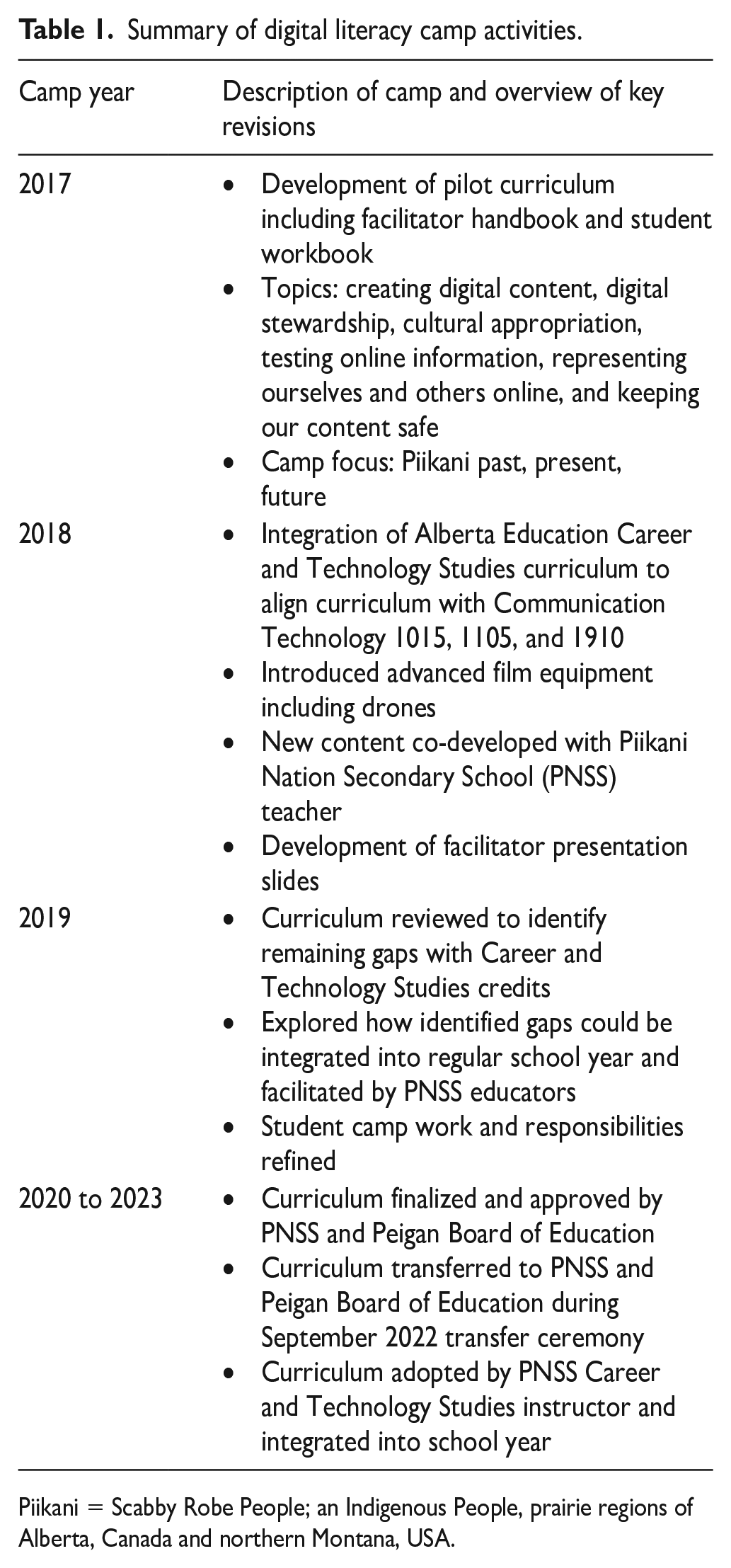
Piikani = Scabby Robe People; an Indigenous People, prairie regions of Alberta, Canada and northern Montana, USA.
With respect to formal data collection, the research referenced in this article utilized a mixed-method approach that includes data from semi-structured interviews, surveys with participating youth, participant observation at the camps, and ongoing project discussions with team members. Specifically, we conducted eight interviews with Elders and educators in 2017, seven Elders and three youth in 2018, two Elders in 2019, and three Elders in 2023; we note that several Elders were interviewed multiple times. Interview questions asked for perspectives on digital literacy and the land-based camp, including community and ceremonial aspects, as well as advice for the project and for making and sustaining good relations. We used inductive content analysis to make sense of these data, and followed up with Elders and educators to verify preliminary findings as well as the direct quotes used in this article.
We collected further feedback about the camp and course materials from youth through four surveys in 2017, seven in 2018, and eight in 2019—a total of 19 youth surveys. Finally, we took extensive field notes during participant observation of teaching and learning activities in classrooms and at camp, and after receiving permission to document our observations, at ceremonies and meetings with educators. These field notes include our own reflections as well as quotes from conversations; when presented here, quotes have been confirmed and approved by speakers. We also took notes during many planning activities, conversations, and visits held during the project. The university ethics board approved these activities and all project participants received honoraria, and sometimes also gifts, for sharing their time and expertise.
Our approach was far from perfect. As Vine Deloria (1999) argues, Western researchers face inherent limitations in their understandings of Indigenous epistemologies, and any imposition of Western explanatory frameworks must be interrogated. In our project, this entailed constant reflection between the possibilities of ethical space and the risk of undermining community leadership and sovereignty (Hall & Tandon, 2017). In the next section, we document these interactions alongside the tentative insights that grew from the project.
Findings and discussion
Governance
To return to Ermine’s (2007) work and Piikani protocol, the project co-leads began by acknowledging one another and agreeing to speak. This meant formally marking the project’s intentions by Herman as project Elder, Rob from the University of Alberta, and PBoE. Each party represented their respective community’s desires and approval systems. Herman needed the blessings of the Piikani Elders, which included offerings, ceremony, and a Blackfoot language presentation. Rob sought approval from the university system in the form of external funding and ethical approval. PBoE required the Board of Directors and Elders Council to approve the project and provide resources and support. This formal acknowledgement was paralleled with a pipe ceremony, during which Herman and Rob articulated their intentions (Figure 1). This pipe ceremony was followed by a written agreement initiated by PBoE and the University of Alberta in 2019 to reaffirm the commitment of the partners. This agreement was requested by the grant funders, and signed by Herman, Rob, the PBoE Superintendent, and the PNSS Principal.
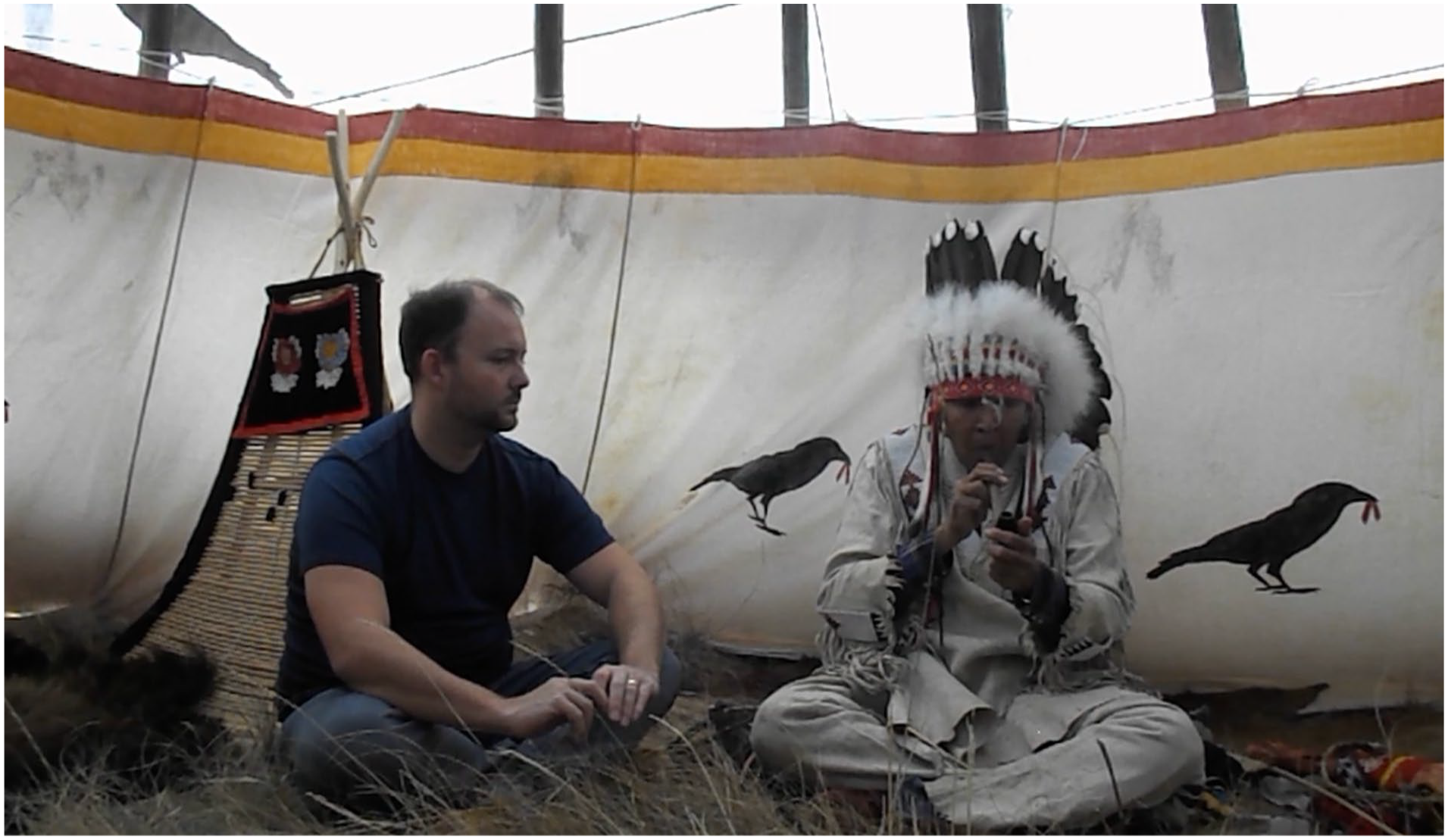
Following Piikani protocol, Herman and Rob participate in a pipe ceremony to articulate their intentions for the project (Photo by Jesse Little Bear).
During the 2017 pipe ceremony, Herman and Rob expressed their commitment to the students, to Piikani First Nation, and to good collaborative relationships. They also agreed that this project would affirm the sovereignty and authority of Piikani First Nation while also benefitting others. As Piikani Elder Reg Crowshoe notes in his conversations with Noble (2002), Niitsitapi practices have often been given respect, but not necessarily authority. However, this is shifting as more projects, universities, and funding agencies integrate Indigenous sovereignty and governance frameworks into their activities. This shift is slow, and the degree to which these frameworks actively reshape existing systems varies from institution to institution (Gaudry & Lorenz, 2018).
Governance is also about ownership and control. There is increasing attention to the OCAPTM principles and data sovereignty by organizations like the Alberta First Nations Information Governance Council (AFNIGC) as well as local groups like Elders Councils (Wemigwans, 2018). We met several times with AFNIGC to ask their advice, and in 2017 and 2018, Herman presented the project to the Elders Council. Both groups expressed concerns regarding where and how the project stewarded digitized community data. For the Elders Council, it was vital that the camp’s cultural and spiritual educators held the proper teaching credentials such as transferred rights. Piikani differentiate between Elder knowledge keepers with life experience and Elders with transferred rights within their spiritual traditions (Crowshoe & Manneschmidt, 2002). They also asked Herman to report on how non-Piikani team members followed protocol to demonstrate commitment to Piikani governance structures and sovereignty.
Classroom engagements
So making a safe space, is, in our traditional way, it looks after everything. It looks after the venue, it looks after the person, it looks after the people. That’s why making relations is very, very important, because that’s where you begin to learn how to hold yourself accountable. (Heather Crowshoe, Aapátohsipikáni Elder)
Starting in 2017, we developed the pilot curriculum in two physical spaces in southern Alberta that paralleled Blackfoot and Western modes of learning. The first was a classroom at PNSS. During the summer, the school hosts the federally funded Youth Employment and Skills Strategy (YESS) programme, which is meant to help young people find meaningful employment or post-secondary opportunities. In early years, the camp was integrated into the YESS programme; however, we quickly learned that every day spent in our curriculum meant one less day for YESS. This required careful balancing of the two programmes.
In 2018, we refined the pilot digital literacy curriculum to fit the requirements of the school’s CTS programme. The provincial CTS curriculum presents a pathway for students to earn CTS credits in media and design through classroom learning focused on fundamentals of media and design, practicing with audio-visual equipment, and then putting those skills to use by recording teachings and other activities at camp (Alberta Education, n.d.). These changes involved revising modules to fit a schedule of 3 days in the classroom, 4 days at camp, and 3 days after the camp. Following suggestions from students and educators to incorporate more hands-on activities, we set aside time to practice with cameras and other film equipment. We also made technological changes, including digitizing the content and sharing it online, and providing low-cost tablets to the students. We did not, however, consider young people’s attitudes towards digital devices. The low-cost tablets proved clunky and unpopular, and the simple point-and-shoot style practice cameras contrasted unfavourably with the professional-grade camera and drone used at the camp. Many students opted to take pictures with their own smartphones.
Educators, particularly those working in under-funded spaces, are often required to take up multiple roles and hold responsibilities far beyond their commitments to a research project. Rapport and trust building, as well as day-to-day communication, may therefore move at a slower pace (Gaudet, 2019). Researchers must be mindful of the extra work that CBPR projects place on community members and local experts. The 2019 classroom work involved a recently hired teacher from Piikani, who was a former colleague and friend of Amy. Their relationship improved the flow of information between the university and the school.
The project’s deepening collaboration provided another opportunity for paralleling in team structure. Blackfoot ceremonial structure involves an Elder with transferred rights, as well as helpers training to become ceremonial Elders (Crowshoe & Manneschmidt, 2002; Noble, 2002). In our project, Herman suggested that he and Rob had been validated in their own systems: Herman through ceremonial transferred rights and Rob through the Western academy. Amy and her Piikani teacher colleague functioned as helpers who had not yet reached the status of Elders but took on tasks and responsibilities in the classroom and when working with students. In practice, this delineation of tasks and expertise allowed for spaces of exchange and learning among equals. Together, we participated in cross-cultural and cross-institutional learning and teaching, building on years of similar exchanges. Through this slow relationship-building process, we learned not only how to engage with one another ethically, but also marshalled their identities to generate conversations with different audiences (McMahon, 2020). The activities of both pairs, Elders and Helpers, paralleled Aapátohsipikáni and settler systems, and highlighted the collaborative potential that can emerge from these spaces.
Despite these connections among team members, we observed a disconnect between instructors and youth. Many students appeared quiet and seemingly disengaged. This was unsurprising given that they were teenagers meeting new people for the first time at summer school. During short post-class debriefs, the university instructors and graduate research assistants discussed their shared difficulties in the classroom. These concerns were echoed by our teacher-collaborators who, while Piikani themselves, were meeting the young people for the first time.
The importance of cultivating ethical spaces for youth was highlighted by the Aapátohsipikáni Elders on the team, one of whom gently articulated, I am who I am, you are who you are, we exist, and we’re equal. So that value of respect will come into play at that later stage: Am I going to control you, like a colonizer? Or am I going to enable you and encourage you, like the environment enables us? (Heather Crowshoe, Aapátohsipikáni Elder)
This guidance called attention to the violence of settler colonialism while noting the possibility of ethical space. It directed our thinking towards the land and ceremonial practices of smudging and cleansing before learning could begin, and also towards fun engagement. As noted in one of Amy’s reflections from a post-teaching debrief in 2019: [H]aving a non-content day before we start doing content to get to know the youth—I think it would go so far. A day picking sweet grass or choke cherry picking or whatever. You could even do like the traditional knowledge on the land kind of approach. That way, it’s not us standing up there being like, “Okay. Let’s talk about digital stewardship.” (Mack, field notes, July 17, 2019)
During that year’s camp, a spontaneous waterfight proved to be a cathartic space that broke through the awkwardness. Under the scorching prairie sun, the students took a break from the pre-planned digital literacy camp activities. The tranquil space cracked when seemingly from nowhere, waterguns emerged and instructors found themselves in the crosshairs. It was a moment of joyful, unstructured play—and of rapport building. Anthropologist Clifford Geertz (1972) noted decades ago the role of joking and humour in qualitative research. To be teased, he argued, was to be accepted. It would seem the same logic applied to the group of young people who doused the uptight Western researchers.
Following the 2019 camp, the team went through another round of debriefs and conversations, but because of the COVID-19 pandemic, put the camp on hold. Video-conferencing the camp did not seem appropriate, particularly given its focus on land-based learning and in-person interaction, and it quickly became clear that PNSS students and staff faced significant challenges given the pandemic and associated lockdowns. During this pause, we worked with a teacher to finalize the curriculum, in preparation for its transfer to the community.
Land-based learning
Because if nobody takes in the teachings to your generation, your generation can lose that. And because you’re young today, one day you’re going to have a family and your children might ask you, “What about this? What happened? How come it was lost in your generation?” and you’ll say, “Well, it was offered to us but we never did take any interest in it.” (Pat Provost, Aapátohsipikáni Elder)
For Elders, young people will 1 day become teachers and stewards of Piikani cultural knowledge. The land-based camp provided a space led by Elders and members of Piikani ceremonial societies to demonstrate this lesson. The university team stepped back as Herman and others led land-based Blackfoot and Piikani traditions, culture, and protocol inside tipis and picnic shelters. Hands-on activities included setting up the teaching tipis, making lodges for the sweat ceremonies that began our camps, and learning to start fires and play traditional games (Figure 2).
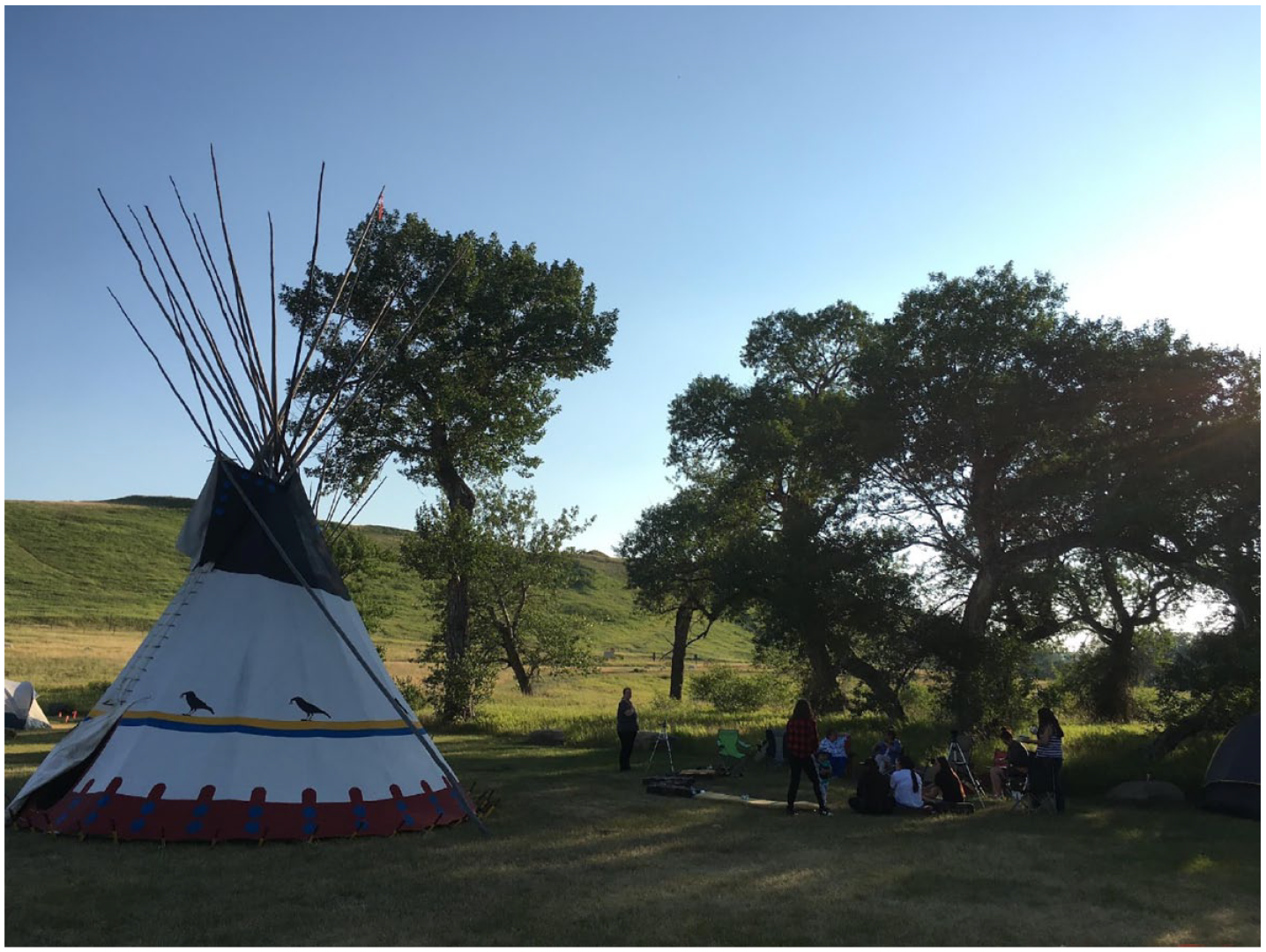
Piikani digital literacy camp at sunset (Photo by Rob McMahon).
The camp encouraged students to put their classroom-based knowledge into practice. Students recorded the camp—from tipi raising to storytelling—to use as footage in their final projects (Figure 3). Many took up this challenge with rigour and amassed hundreds of photographs and hours of video that ranged from the everyday moments of breakfast, water fights, and walks along the river, to more formal settings like ceremony, teachings, and storytelling. They were particularly fond of the drone, which gave them an eagle-eyed view of the campsite, landscape, and their home territory.
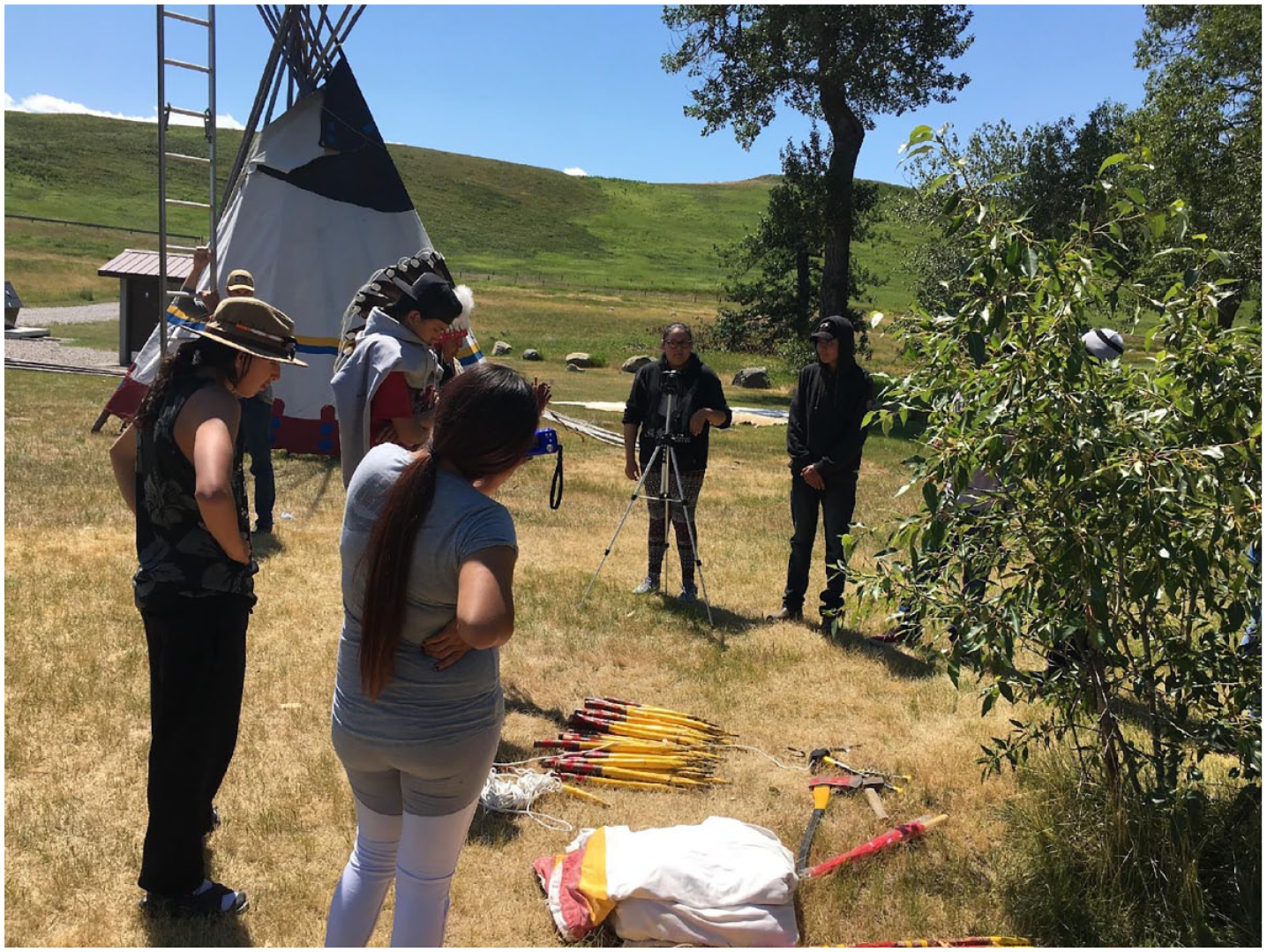
Students learn to put up tipis and document the process on video. From left to right: Turique Crazy Boy, Brayden Crazy Boy, Dawn Many Guns, Kiernan Cross Child, and Callum Yellow Wings (Photo by Rob McMahon).
Members of Piikani spiritual societies facilitated the spaces where these teachings took place. The Niipomakiiks (Chickadees or Little Bird Youth Society), which focuses on helping Piikani youth learn age-appropriate culture, history, and spirituality, supported the camp as volunteers and helpers. The Brave Dogs Society, which is in charge of policing ceremonies, managing camps and enforcing law and government decisions, broke camp, set up tipis, cooked meals, and shared their songs and drumming during sweat lodges and knowledge transfers. These societies also guided the university team in our theorizing of appropriate digital literacy in the Piikani context.
We also travelled to important cultural and historic sites. At each site, Herman and other Knowledge Keepers shared stories of how these places fit into Aapátohsipikáni culture, history, and cosmology. Students listened attentively and recorded the stories, introducing a thread of practice into a curriculum that at times could be abstract and theoretical. It also provided opportunities to build on the rapport slowly developing in the classroom and camp.
Throughout, students were encouraged to think about how what they were learning from Elders paralleled their classroom learning. For example, during a classroom visit students heard from Herman about Niitsitapi collectivism and how these ideas corresponded, and sometimes conflicted with, Western notions of copyright and ownership. Students also discussed consent, permission, and ethics when filming. What is appropriate to film? How would they gain permission to film? Who would they ask? Through these reflections, we worked through the parallels of offering tobacco to Elders and signing media release forms, and discussed the role of cultural and ethical practices in the provision of consent.
Over time, the camp activities became a space to fold in networks of community expertise that blended Indigenous Knowledge with digital technologies (Duarte et al., 2022; Lithgow et al., 2022). For example, in the 2019 camp, we introduced more defined roles for students to take on and paired them with mentors from the university. This allowed for smaller group work and encouraged students to focus on skills they wanted to develop. For example, some students worked with a filmmaker and graduate student who is néhiyaw on using the film and sound equipment. Others worked with a graduate student and photographer from Mexico on collecting photographs and b-roll. The third group worked with Amy on practicing interview skills (Figures 4 and 5).
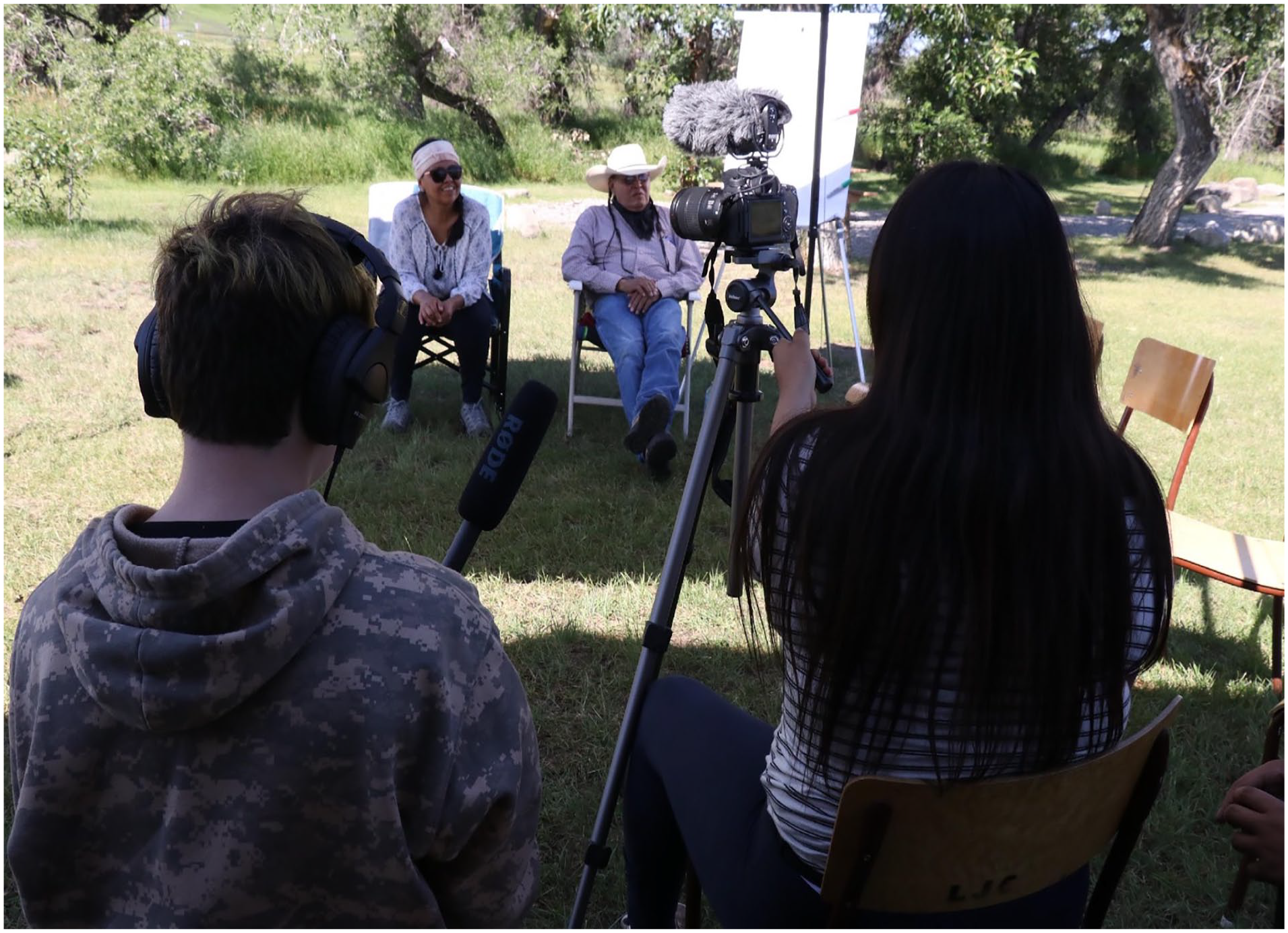
Students interview Aapátohsipikáni Elders Heather Crowshoe and Herman Many Guns during the camp (Photo by Rob McMahon).
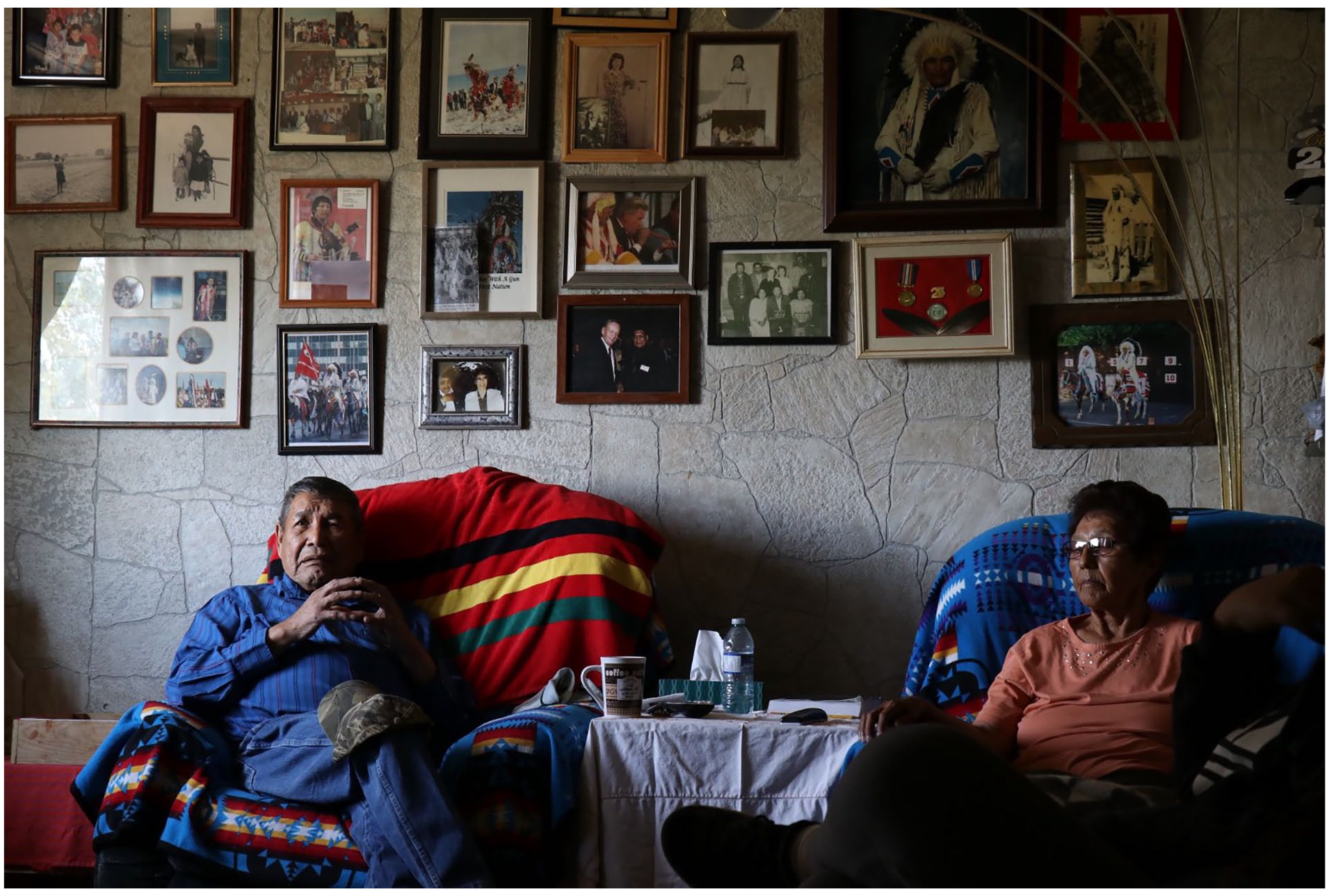
Students interview Elders Peter Strikes With A Gun and Jeanie Provost (Photo by Maria Alvarez Malvido).
During these activities we observed the youth exerting increasing control over their learning. One powerful moment involved the young people showing the camp Elders a series of Blackfoot memes that they had found online. They used these memes as prompts in their interviews, while their peers used the film and sound equipment to capture reactions—a Piikani riff on Elders React to Memes (Know Your Meme, n.d.). Humour-infused teaching and learning strengthened bonds between the young people and Elders, many of whom had met for the first time at the camp, as well as between the young people and the research team.
In the afternoon and evening, community members showed the students and university team how to play traditional games, drum, and sing. These activities modelled traditional ways of teaching young people, leading us to consider not just what appropriate digital literacy is, but also our pedagogical approach. As explained by Elder Heather Crowshoe, this parallels Piikani ways of teaching and learning: So how I learned was working side by side with my Elder. And we worked on something. And then a topic would come up. And then, from that point, if it is traditional knowledge being accessed, then you could go from the tales that are being told, or you can talk about whatever it is you’re engaging in, and you can talk about the technical, historical pieces. From there, you get introduced to a process of how to do something. Once you understand the process of how to do something, then you get into the hands-on skill building. And after you acquire the skill building, the learning actually begins. Because when you have a little bit of time to interact with the skill, then you turn around and you teach somebody, and then you turn around again and you’re teaching somebody.
This networked approach to learning reshaped our intentions for the camp. We wanted young people to engage in hands-on activities that teach practical skills. We also wanted to encourage peer learning and community-building through digital literacy activities. But it was the community members who guided the camp as a space for young people to lead hands-on activities that documented the Elders’ cultural teachings. Camp Elders and students demonstrated to us how important peer learning and community-building are in the appropriate organization of digital literacy teaching and learning. Elder Heather Crowshoe continued, So that’s sort of the system that was built, where you have a whole network of people taking on the acquisition of knowledge, and it’s a living thing. The application of certain processes or technical skills adapts, given our changing environment. . . . If you understand a process or a skill, and you’re able to acquire that abstract level of understanding, then the leap to technology or digitizing is much easier. And it’s abstract thinking, right? So if you’re understanding a process in traditional ways, you begin to abstractly think about that concept. . . . That’s where it starts to merge with the possibilities in digitizing or technology.
Here, she highlights parallels between Piikani pedagogies and digital literacy. Start with a hands-on or technical skill, and then move to more abstract levels of understanding. This process is grounded in relationships among learners, teachers, and even the spiritual world: I think that this method of acquiring knowledge, [this] process, is traditionally a very strong way of doing things. It’s very succinct, it’s very simple, and it’s adaptable to many, many things. So that’s why I can be a traditionalist, and still live in the city. (Elder Heather Crowshoe)
Many of our conversations at camp concerned the stewardship of the digitalized teachings. Stewardship is an abstract topic, but the camp related it to the practical action of recording. Recording ceremony, and everyday cultural experiences, can be challenging for many Elders and community members. In the next section, we discuss how we observed a shift over the years in the ways that the team held conversations around digital recording as a means of preserving Piikani culture. Stewardship came to be defined about caring for something, whether it be land, culture, curriculum, or one another.
Post-camp engagements
When I was in my teenage years, a lot of the ceremonies you weren’t supposed to record. But I think it is changing, because the Elders are realizing that we are starting to lose a lot of stuff, especially sometimes our protocols of how we do, and the right ways of doing things. I think they’re allowing the recordings to happen that way . . . . You still have those Elders out there that are very strict with the protocols. They probably will let you record to a point, but if they say it’s time to shut that down, you just got to basically listen, and try and learn from there, right? Because they always say the only way you learn is doing. (Jaron Weasel Bear, Aapátohsipikáni ceremonialist)
Every year following the land-based camp, we returned to the classroom for reflective evaluations with the youth. What did they enjoy about camp? What had they learned? What could we have done better? We also spent time working on their final projects, including a visit to the University of Lethbridge computer labs to edit footage and meet professors. Amy followed up with these youth in the fall to conduct focus groups asking their hopes, desires, and perspectives on appropriate digital literacy (Mack et al., 2019). Youth reflections included their observations and thoughts about the camp: [I filmed] the land, my peers, the mountains, the water, and liked sleeping in a tipi as [my] ancestors did, as well as the idea of recording [my] community’s traditions. (Piikani high school student) It’s cool that we are videotaping our culture and going to be sharing the video with other people. (Piikani high school student) I learned more about myself and I feel like I’m not as shy as I was; I also learned more about my culture and how my people used to do things back in the day. (Piikani high school student) It taught me a lot about my cultural background; I am more interested in it and it makes me really proud to be native. (Piikani high school student)
It was a rewarding discussion that demonstrated not only the retention of what students were taught, but also their reflections of what the camp meant to them. This perspective was echoed repeatedly by Herman, who also noted the power of digital technology to help young people navigate their way through their culture as Blackfoot youth. He explained, “Now, you guys are told to record things, and to edit these things and make short videos that are positive. Because whatever you guys are going to edit now is going to be stored away for the future.”
Many projects concerning Indigenous-settler relations and digital technology focus on resurgence and preservation, whether that be linguistic, cultural, or spiritual. But this adoption of digital technology also carries risks—Elders and others often express concerns that technologies can displace the very offline activities at the heart of cultural practice. As Jesse Plain Eagle, an Aapátohsipikáni ceremonialist active in his cultural and spiritual traditions, put it, [I] have some concerns because it [technology] takes away from, like I said, doing other things, like the day to day outside activities . . . . For example, my family, this is the season where they pick berries, like right now, and they’ve been doing that, because now is the only time you get them when they’re ripe, but there’s some that won’t be doing it, because I think technology’s taken over . . . If you’re going to be filming, going to get the material to do that sweat [lodge], you know, well, what are you going to be doing with the stuff you’ve filmed? Are you going to be selling it? . . . [If so] then okay, no, I don’t want anything to do with it.
These anxieties are further expressed in the long history of the extraction of Blackfoot cultural and spiritual knowledge into Western and capitalist spaces for the benefit of non-Indigenous people and institutions. Yet, some Elders, including Herman, hold a more positive approach to technology, noting that the Aapátohsipikáni have always had ways of recording their culture. Jaron Weasel Bear, a Piikani community member who works at Piikani Traditional Knowledge Services, told us that the Winter Count is a media technique used to record and steward community knowledge for future generations: Where certain people back then, if they could, if they had technology to record it for our future generations, I think they would, definitely. Because I think that our people back then were almost like fortune tellers. They were powerful because they suffered, they succeeded, they lived off the land, and they were in close contact with the animals . . . A lot of people back then had a way of basically recording what they were doing, so that the future generations could carry it on.
These tensions forced us to move carefully; recognizing the Faustian bargain Indigenous peoples face given the risk and potential of media and communications technology (Ginsburg, 1991). While we strongly resist any normative position on this matter, we do see it as a symbol of our continuing work using Niitooii to parallel Piikani and Western modes of digital literacy teaching and learning in ethical spaces. We conclude by reflecting on these issues in the context of the ceremony that formalized the stewardship of the curriculum and transferred the digital recordings back to the Piikani Nation.
Conclusion
The protocol requirements and intentional practice of Niitooii discussed throughout this article culminated in a transfer ceremony we held in Fall 2022 to publicly demonstrate the transfer of rights and responsibilities associated with stewarding, accessing, and teaching the resources generated through this project. By the time the transfer ceremony was complete, some 5 years after Herman’s first presentation to the Elders Council, the project had gained the support of the Elders and the school. Furthermore, we could formally validate the learning according to Piikani protocol.
Over the years, the school had taken on increasing responsibility for camp programming; this included both facilitation and organization. The school was the primary recruiter for participation in the camp, and managed all transportation and insurance work. In 2019, the school took over catering and ran a fundraising drive to cover costs rather than continuing to rely on research funds. PBoE hired an educational assistant to facilitate the camp, which freed up instructors to focus on educational delivery. The school also committed to provide CTS classroom instructors and, in future years, a counsellor. Following the 2019 camp, the school worked with students to complete their CTS credits and associated assignments. While the university researchers continued to be involved in summer and fall 2023, the school had taken on most service delivery, with support from Herman. As of summer 2024, the entire camp is run by the school, through Digital Blackfoot media classes, and two land-based camps are planned for July and August. Our collaboration continues through ongoing research on these activities, as well as a new project focused on co-designing a Piikani Digital Archive to house recordings and photos created by students.
In 2020 and 2021 during the COVID-19 pandemic, we focused conversations on project sustainability, and specifically what would happen once the university funding concluded. Herman once again brought up the concept of Niitooii. The teachers had earned the rights or the credentials to teach the Western curriculum. They had gone to school and been awarded advanced degrees to teach the CTS courses. Similarly, Piikani Knowledge Keepers held transferred rights to teach the cultural material. To validate the young people’s learning, they were gifted a song by Herman. Similar to high school credits, the song legitimized their work.
To mark Niitooii, the paralleling of traditional and contemporary forms of Blackfoot authority, as well as the conclusion of this stage of the project, Herman suggested a formal transfer ceremony. This would involve passing the curriculum from the research team to the school and the teachers. Planning for this ceremony began in 2021, when the school suggested it be held on September 26, 2022—a day marking the beginning of the school’s Reconciliation Week. The team felt holding the ceremony on that day would present a strong symbol of our project’s reconciliation goals. This was an important statement; to return to our opening quote from Herman, this project has always been about standing together as equals, for the benefit of future generations.
Herman created the container for the curriculum out of deer hide and had it engraved with the logos of the school and the university. He placed print and digital copies of the finalized curriculum inside the container, and then led a sweat lodge to bless the container (Figure 6).
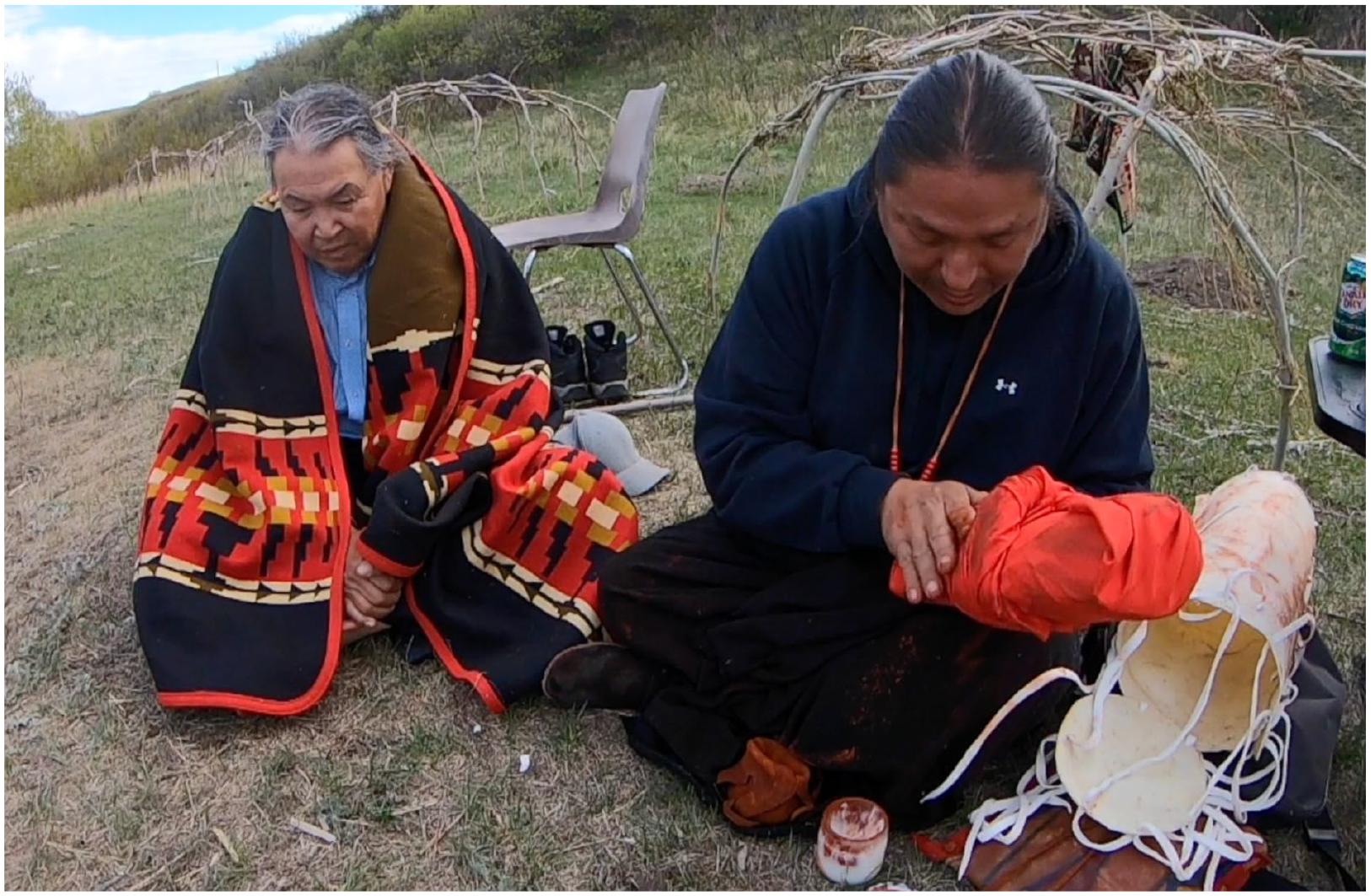
Ceremony with Herman Many Guns (left) and Cameron Chief Calf (right) blessing the container that will house print and digital copies of the curriculum (Photo by Rob McMahon).
During the ceremony, the container was blessed and transferred to the school. It now hangs in the main hallway, a reminder of the curriculum and marking the ethical space generated through our collaborative process (Figure 7). This location also indicates that the curriculum is now under the care of the school, on behalf of the community. While we have come to see the camp as a liminal space where worldviews collide and create possibilities for conversations, learning, and change, the container serves to ground the project in time and space—and points to its future. As this phase of the project comes to an end, we are excited about who will continue to steward the curriculum, the camp, and these ethical spaces in years to come.
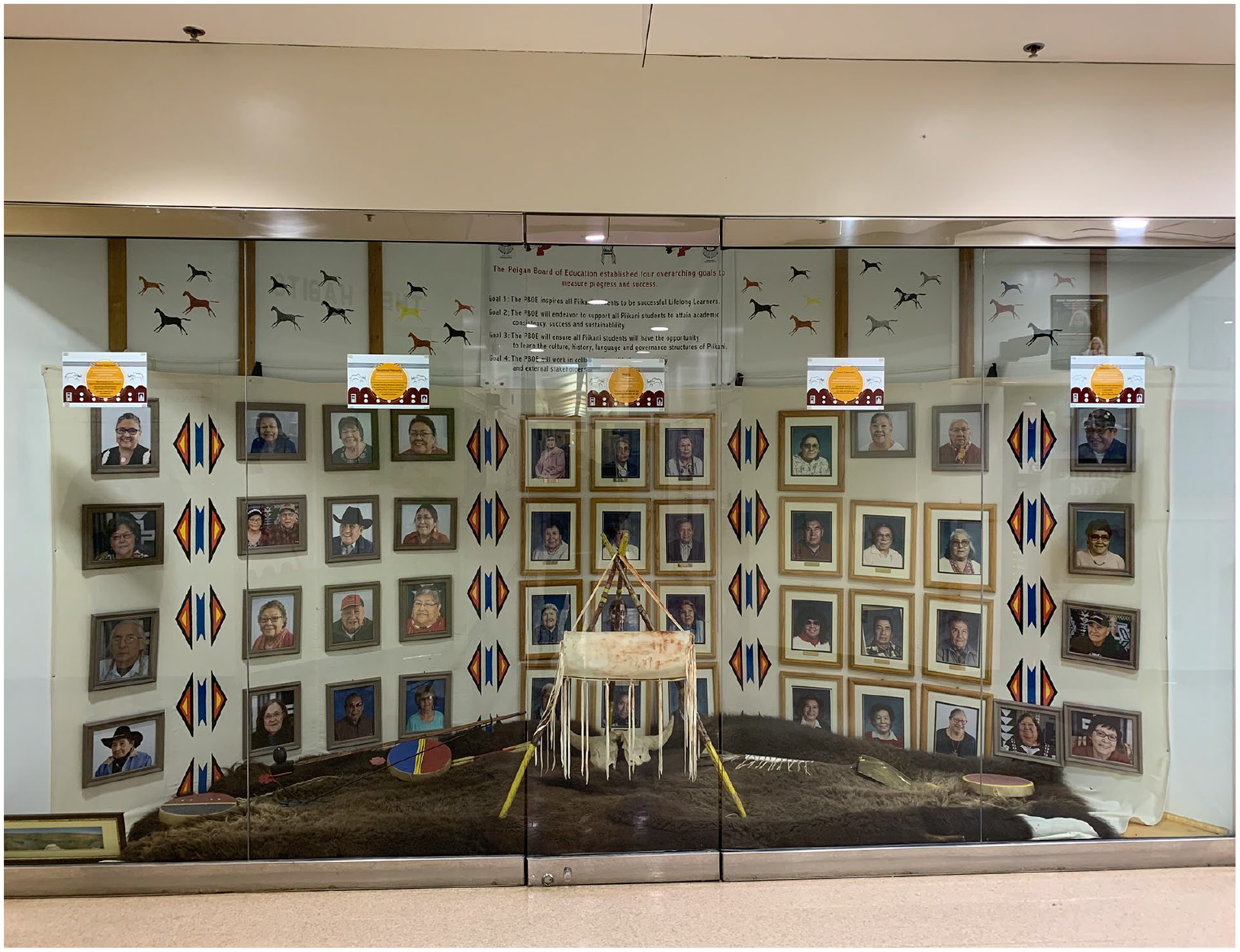
The container is now displayed at Piikani Nation Secondary School (Photo by Rob McMahon).
Footnotes
Acknowledgements
The authors acknowledge and thank the many Elders, students, and educators who supported and participated in this project. They thank them for sharing their time and expertise with them, and for ensuring that their project was done in a good way. They also thank the funding agencies that supported their work, including the Social Sciences & Humanities Council of Canada, the Internet Society’s Beyond the Net funding program, and the Mastercard Foundation’s EleV Program.
Authors’ note
Declaration of conflicting interests
The authors declared no potential conflicts of interest with respect to the research, authorship and publication of this article.
Funding
The authors disclosed receipt of the following financial support for the research, authorship and publication of this article: Internet Society (RES00038400); Social Sciences and Humanities Research Council (435-2018-0596); University of Lethbridge (65376).

Glossary
Aapátohsipikáni Northern Piikani, an Indigenous People, prairie region of Alberta, Canada.
Iinaaka Siinakupii Tsiniikii Little Video Storyteller; a land-based model of digital literacy teaching and learning grounded in Aapátohsipikáni language, culture and ceremony
Kainai an Indigenous people, and member of the Blackfoot Confederacy, prairie regions of Alberta and Saskatchewan, Canada, and northern Montana, USA; literally, many chiefs
néhiyaw an Indigenous people, Great Lakes region Canada and USA, and the prairies and Northwest Territories, Canada
Niipomakiiks Chickadees or Little Bird Youth Society
niitooii the same that is real, paralleling
Niitsitapi Blackfoot People; four Indigenous peoples that make up the Blackfoot Confederacy located in the prairie regions of Alberta, Canada and northern Montana, USA; real person
Piikani Scabby Robe People; an Indigenous People, prairie regions of Alberta, Canada and northern Montana, USA
tipi cone-shaped tent, traditionally made from buffalo hides and wooden poles