




Abstract
While English as a second language is a component of the education programme in Nunavik, Canada, Inuit (Indigenous people of the Arctic) need to protect Inuktitut (Inuit language) as they navigate an online world where English is often the lingua franca on social media. Inuit qaujimajatuqangit (traditional knowledge) could provide the framework for decolonizing English as a second language education, as it has guided Inuit through centuries of change. This narrative literature review with commentary analysed 50 studies and related resources, summarizing Nunavik’s colonial history of linguistic imperialism and how some Indigenous communities resisted colonialism by decolonizing their education programmes. This analysis found a gap in studies specific to decolonizing English as a second language education in the Inuit context; therefore, the findings extrapolated that Inuit can decolonize by decentralizing colonial practices and centralizing Inuit qaujimajatuqangit and Inuktitut. The literature review offers pedagogical recommendations for decolonizing English as a second language education in Nunavik and other Indigenous communities.
Introduction
Inuit in Canada are in a race against globalization to protect our culture and language amid ongoing colonialism and the ubiquitousness of English. As a PhD student in English second language (L2) education focusing on the intercultural communication through social media of Inuit (Indigenous people of the Arctic) youth in Nunavik—Arctic Quebec, Canada, I am compelled to articulate why and how we should decolonize English as a second language (ESL) education. My mother was Inuk (a member of Inuit people), and my father was of Scottish heritage, so I grew up with both cultures; consequently, understanding and honouring interculturality has always been a part of me. In Nunavik, Inuktitut (Inuit language) is still the primary language spoken by the majority of Nunavimmiut (people of Nunavik). This is evidenced in the 2021 census indicating that 100% of the population over the age of 65 and 98% of children below 15 years speak Inuktitut (Statistics Canada, 2021), Inuit Nunangat (the four Inuit regions in northern Canada) is home to the vast majority of all Inuktut (the Inuit language specific to Inuit Nunangat) speakers. The regional school system teaches English and French, as the L2; however, the region’s priority is maintaining a balance between Inuktitut and English, or French. The vision of the regional school system is clear: “Nunavimmiut are empowered, proud, and self-sufficient members of healthy communities grounded in Inuit values, language, and culture, where they are inspired to achieve their full potential within a global context” (Kativik Ilisarniliriniq, n.d.-d, p. 4). Through colonialism, English and French have been forced on Inuit without consultation or choice (Nungak & Curley, 2017; Vick-Westgate, 2002), but Inuit are cognizant of the global reality and call for bilingualism grounded in Inuit values as evidenced in our national Inuit education priorities (Inuit Tapiriit Kanatami, 2011). In this era of globalization and online communication, it is a challenge to maintain our Inuit language, culture, and knowledge when ESL acquisition is necessary, but decolonizing the process can reassert our agency within the education system. The North is our home and the centre of our reality, whereas the rest of the world has always existed at a remote distance from us. Today, those distances shrink because Inuit also participate in the global digital world. Our survival will continue because Inuit have and will continue to appropriate technology to meet our needs (Vick-Westgate, 2002).
Through Inuit qaujimajatuqangit (traditional knowledge) (IQ) Alexander, 2009; DeCouto, 2020; H. E. McGregor, 2012; Tester & Irniq, 2009), our traditional knowledge has guided us through the centuries and must continue to do so. IQ is part of the mandate of the regional school board in Nunavik. They describe it as “Instilling the values and skills needed for the lifelong process of becoming an able, whole human being. Nurturing this process happens through stages that are based on knowing about how one learns” (Kativik Ilisarniliriniq, n.d.-c, “Inunnguiniq and Inuit Qaujimajatugangit (IQ)” section). Within this framework, seven of the eight guiding principles for education in Nunavik include the following:
a. Inuuqatigiitsiarniq—respecting others, relationships and caring for people,
b. Tunnganarniq—fostering good spirit by being open, welcoming and inclusive,
c. Pijitsirniq—serving and providing for family or community or both,
d. Aajiiqatigiinniq—decision-making through discussion and consensus,
e. Pilimmaksarniq/Pijariuqsarniq—development of skills through practice, effort and action,
f. Piliriqatigiinniq/Ikajuqtigiinniq—working together for a common cause,
g. Qanuqtuurniq—being innovative and resourceful (Kativik Ilisarniliriniq, n.d.-a, “Critical Skills” section).
This article aims to provide an overview of the literature on Nunavik’s past and current colonial systems and constructs and how they affect culture and language using a relational approach. The focus then shifts to exploring studies on decolonizing English language learning; however, due to a significant gap here as few studies were found specific to the Inuit context. As a result, this study then closes by outlining the decolonial measures implemented in other colonized communities and extrapolates their applications to the L2learning context in Inuit communities. This involves maintaining IQ through pedagogical activities incorporating intercultural communication and social media. Figure 1 outlines the path followed in this literature review from describing the colonial past and present in Nunavik, exploring decolonial practices used in colonized communities, and finally offering practical pedagogical implications for Nunavik.

Path to decolonizing ESL education in the Inuit context.
Methods
In this non-systematic narrative literature review with commentary, I employed a qualitative approach to analysing the prevailing knowledge and research (Rother, 2007) on colonialism, IQ, and the path towards decolonizing ESL education in the Nunavik context. I utilized an Indigenous relational approach to present “holistic epistemology . . . [with] reference to personal preparations involving motivations, purpose, inward knowing” (Kovach, 2009, p. 34) to establish links in the research to ESL education in Nunavik. The search for sources began with any resources specific to decolonizing ESL education in Nunavik, particularly from Inuit authors and researchers, and due to a lack of direct results, the search expanded to other Inuit contexts, broader Indigenous contexts and then other colonized communities. Throughout the search, Inuit and other Indigenous authors were prioritized for their emic perspectives on decolonization. Findings were then extrapolated to the Nunavik ESL context. For this study, the term Inuit refers to the people of Nunavik specifically unless otherwise apparent, as the linguistic situation in Inuit Nunangat (the four Inuit regions in northern Canada) is complex and varies between regions.
Results
Preserving our ontologies, ways of being, and our epistemologies, ways of knowing, is a priority for maintaining who we are as Inuit. Lisa Koperqualuk, president of Inuit Circumpolar Council Canada, explains that this focus on preservation began with the political movement starting in the 1960s when Inuit started to mobilize and unite (Koperqualuk, 2009). Through the principle of piliriqatigiinniq/ikajuqtigiinniq, this consciousness is still true today as we strive to protect our knowledge and culture. We also understand that we are no longer isolated but are connected to the rest of the world through various technologies, including online communication. Koperqualuk (2009) interviewed an Inuit elder who cautioned that “we know that we are not going to be able to practise our traditional ways. But we know that the next generation will be able to read and know what our ancestors suffered to keep us alive” (p. 17). How to find a balance where we can retain our traditions and pass them down to the next generation while also thriving in a modern world is a crucial question in this literature review and requires the guidance of the qanuqtuurniq principle. Zebedee Nungak, a signatory of the land-claim agreement governing Nunavik, emphasizes that it is time for reconciliation in Nunavik to preserve Inuit language, culture and identity (Nungak & Curley, 2017).
Imperialism in Indigenous communities
Imperialism was an ontology and epistemology tied to the British empire during its global expansion in the 1700s and 1800s (Pirbhai-Illich et al., 2017). Wherever the British empire extended, so came the English language (Pennycook, 1998; Shin, 2011). Settler colonialism saw the expansion of imperialism onto Indigenous lands through the Doctrine of Discovery, and was designed by the Catholic church (Miller, 2012; Smith, 1999). Colonialists appropriated Indigenous lands and imposed Anglo-European systems of government, education and society onto the First Peoples (Pirbhai-Illich & Martin, 2019), leaving a carnage of destruction and a life of subsistence (Smith, 1999).
For Nunavik (Figure 2), imperialism arrived with the Hudson Bay Company (HBC) when they entered the region for fur trade with Inuit and opened its first trading post in 1830. By 1872, missionaries arrived, converting Inuit to Christianity premised on the belief that Inuit ways of being had no cultural, spiritual, or linguistic value (De Souza, 2006) which went against the principle of inuuqatigiitsiarniq. By the 1950s to 1960s, many HBC trading posts became permanent settlements due to federal policies and the declining fur trade (Vick-Westgate, 2002). The federal government installed four English day schools in the region, which caused the separation of Inuit children from their families. By 1962, each community had a federally run school, which my mother went through. Then by the 1970s, students were sent out of province for high school or vocational training. The Quebec province also began asserting control in Nunavik by installing French schools (Nungak & Curley, 2017).
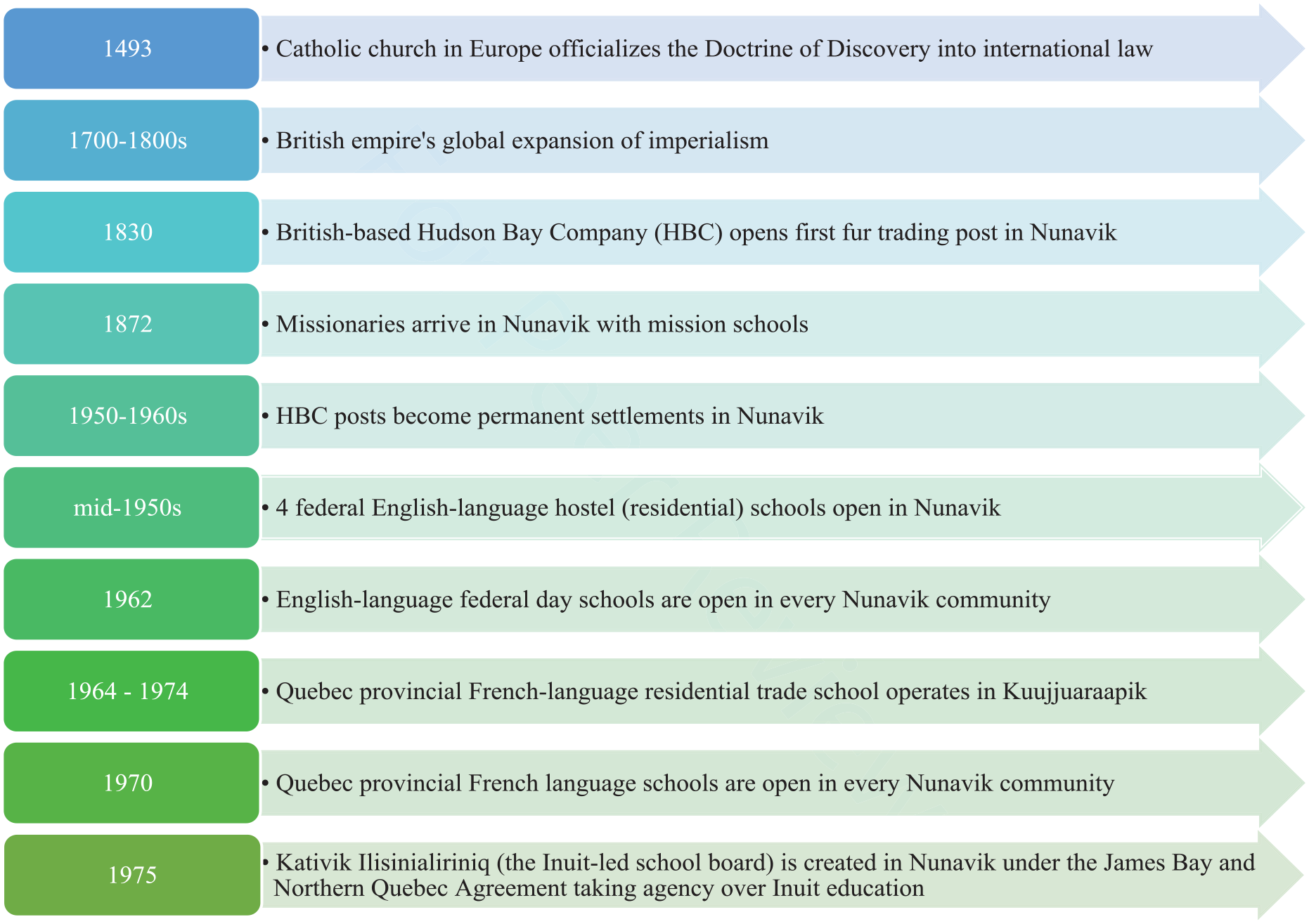
Timeline of colonialism and linguistic imperialism in Nunavik.
Throughout this brief period, Inuit were never consulted on the changes imposed on their lives, including education and which language of instruction, English or French, would be used. This disregard was an affront to the Inuit way of decision-making under our principle of aajiiqatigiinniq. During this time, children were also separated from their families to attend federal day and residential schools. Whether it was the HBC, the missionaries, or the provincial or federal governments, the colonial educational systems were designed to erase the Inuit language, culture, and identity (Grenoble, 2018; Pirbhai-Illich et al., 2017; Smith, 1999). Today, the intergenerational pain of colonialism is still felt (Alexander, 2009). The question of how to decolonize ESL education in the Inuit context is complicated. Pennycook (2007) best outlines the dilemmas in the strife to decolonize: How can we teach English and teach about English teaching in a way that acknowledges the colonial and neocolonial implications of ELT [English language teaching] yet also allows for an understanding of the possibilities of change, resistance, and appropriation? . . . Is it a contradiction to try to teach English or teach about English teaching in a way that promotes appropriation? Can we teach in order to be resisted? (p. 22)
Constructs of colonialism
To understand what decolonization represents, we must understand the constructs through which colonialism presents itself. From the literature, the notions of colonial difference, colonial modernity, coloniality, and othering are distinct but are interrelated. Each colonial construct flouts the very principle of inuuqatigiitsiarniq. First, colonial difference assigns a value to human life based on a Western worldview (López-Gopar & Sughrua, 2014), where in the past, imperialists were the superior, and the colonized were the subjugated due to their inferior knowledge, culture, and language (De Souza, 2006). Today, colonial differencing can be seen in Inuit communities when Western knowledge is elevated over Inuit traditional knowledge. Even inadvertently, both Inuit and non-Inuit educators may erect this barrier, even if the concept of colonial differencing is not acknowledged and mitigated.
The next construct, colonial modernity, purports to bring imperial enlightenment to the inferior. In López-Gopar et al. (2021), the authors explain that in the Indigenous context, colonialists believed that the people required Christian deliverance from their heathen beliefs and must be brought into Western enlightenment. Indigenous populations were seen as primitive, living in the past until colonization brought modernity through a Western belief in universal science and knowledge (De Souza, 2006). Today, it is evidenced in what López-Gopar and Sughrua (2014) refer to as the geopolitics of knowledge, where Eurocentric knowledge and languages, including English, derive from the First World, that is, the Western world, and are considered primordial. In the Inuit context, the concept of colonial modernity can be perpetuated by both Inuit and non-Inuit educators and can be observed in two ways: on one hand, Inuit knowledge is decentralized because it is perceived as somehow inferior. On the other hand, Eurocentrism is centralized and purported to be universal. Inuit decolonize education when we place value on our own knowledge.
The notion of coloniality has an even darker undertone, and it is where discrimination and marginalization thrive. It represents the practices and footprints of the colonial social hierarchies of race-based differentiation (Pirbhai-Illich & Martin, 2019). Through coloniality, western onto-epistemology is imposed through control and domination (López-Gopar et al., 2021). Pirbhai-Illich and Martin (2019) assert that coloniality exists in education where culture, they explain, is determined by one’s race. Coloniality will continue in our education if we pedestalize the qallunaat (non-Inuit, typically white people) world as somehow more knowledgeable. Decolonization, again, would involve the veneration of our own traditional knowledge.
Similarly, the construct of othering is a highly pervasive but more subtle remnant of colonialism still seen globally today. It is the practice of depicting colonized peoples as less than the colonizers and can be described with the race-based binary us versus them (De Souza, 2006; Lin et al., 2002; Motha, 2006; Pirbhai-Illich & Martin, 2019). In Canada, the colonial us versus them dichotomy of othering is apparent in our history books. Indigenous people are repeatedly depicted as savages (López-Gopar et al., 2021; Smith, 1999) with no significant language or livelihood, them, but who were then lifted out of ruin by the benevolent colonialists, us (D. McGregor, 2018). Inuit have had an established knowledge system for centuries, and we learned by listening, observing, and modelling (Alexander, 2009; Stevenson, 2014). However, through othering, we and many other Indigenous cultures were deemed irrelevant, naïve, and uncivilized. Today, decolonizing this construct would require that Inuit assert our worth and global presence as we transmit our knowledge using methodologies suitable to us.
Linguistic imperialism and ESL education
So far, we have examined how colonialism in education presents itself in Nunavik, and now we will focus on ESL education. Through the teaching of English to speakers of other languages (TESOL), European and Western powers, including Canada, have attained political, economic, and cultural power (Pennycook, 2007) through the dissemination of Anglo-centric knowledge (Lin et al., 2002). Even the very title of TESOL denotes othering where teaching of English represents superiority and self, while speakers of other languages imply inferiority and other (Pennycook, 1998, 2007; Lin et al., 2002; Shin, 2011). Whether it is teaching English to speakers of other languages, as a second language or as a foreign language, educators must caution that English is not presented as the superior language and that the principle tunnganarniq be respected.
In today’s globalized world, the concept of social capital is tied to English language learning, whereby its value is determined by its perceived ability to bring upwards mobility (Kramsch, 2019). Around the world, English language learners are looking to gain social capital, that is cultural and economic advancement through the promise of better jobs (Hinton & Putra, 2020; Kramsch, 2019; Lin et al., 2002; López-Gopar, 2014; Pennycook, 2006; Waller et al., 2017). This notion of social capital also exists in Inuit Nunangat, where some of the young people see English as a positive gateway to success at home and outside of their region (McCarty & Wyman, 2009).
Despite the promise of social capital, there are barriers to accessing better education and careers for those who may be less proficient in English (Pennycook, 2007). The colonial residue of English language teaching lies in valuing Western English, which is usually British, American, and Canadian, as superior to other languages and English accents (Macedo, 1999; Motha, 2006; Pirbhai-Illich & Martin, 2019; Shin, 2011). In English language teaching, othering through the native versus non-native proficiency dichotomy is regularly perpetuated (Lin et al., 2002; Motha, 2006). This differentiation is concerning, considering ESL or English as a foreign language (EFL) dominate language learning in an increasingly multicultural globalized world (Kramsch, 2019). However, with online communication and more access to travel, English is now becoming a lingua franca (Kramsch, 2019) in social media, where most speakers of English are now non-native speakers (NNSs) who communicate for comprehension, not for native-speaker (NS) proficiency.
For Inuit in Nunavik, our access to the world primarily comes through online communication, for which we generally need English because we live in an isolated Arctic region. To slow down and stop a language shift towards English (Grenoble, 2018), we need to find a balance where ESL education does not detract from our power, identity, and language. One way to achieve this balance is to understand that English is just an invented linguistic system, and once we change our perspective on its value, we can also adjust how ESL is taught (Pennycook, 2006).
Decolonizing English second language education
To decolonize L2 education, Karetak et al. (2017) best frame the process through IQ by insisting that decolonization requires Inuit first know their colonial history. Strategies found in the literature review to support IQ through decolonization include resistance, developing agency, appropriation, and provincializing. D. McGregor (2018) describes resistance as a reclamation of our Indigeneity. This process involves questioning the colonial legacies and stereotypes that have been perpetuated (Pennycook, 1998). In ESL education, through the principle of pijitsirniq, we can develop our agency as we determine what languages and pedagogical content we want to incorporate. In this manner, we shift ourselves into the centre and move the colonial priorities to the periphery (De Souza, 2006). From there, we begin to provincialize the historically universalized colonial epistemology by resituating it; that is, provincializing it, to whence it came (De Souza, 2006).
Other paths towards decolonizing ESL education outlined in the literature include Shin (2011), Cupples and Glynn (2014), and H. E. McGregor (2012), who advocate for actively favouring Indigenous knowledge and teaching in pedagogy. Waller et al. (2017) suggest carefully integrating Indigenous identity into the learning programme. Donovan (2015) offers culturally responsive pedagogy to centralize indigeneity. D. McGregor (2018) and Waller et al. (2017) advocate providing culturally safe classrooms where Indigenous students feel comfortable and accepted and the principle tunnganarniq is respected. These are explored in more detail later, but whichever of these or other strategies educators use, the guiding teaching curriculum must first be re-evaluated (Abele, 2010; Cupples & Glynn, 2014; Semali, 1999) using aajiiqatigiinniq (decision-making through discussion and consensus), so that priorities reflect the common good. In that way, our schools can take back our history, culture, and identity through critical dialogue (Cupples & Glynn, 2014) so that they can also offset the effects of residential schools that are felt intergenerationally today (Abele, 2010).
Teachers, Indigenous and non-Indigenous alike, have a significant role to play in decolonizing education in our communities. This involves becoming informed about colonialism in education, recognizing their systemic privilege, and understanding that English, as a colonial language, comes with much baggage for Indigenous people (Pirbhai-Illich & Martin, 2019). Through pilimmaksarniq/pijariuqsarniq, all educators employ IQ in their own learning as they teach through the same concept. It also includes devaluing the colonial concept of native English speakers so that non-native English speakers have the space to learn and use the language safely and authentically (Lin et al., 2002; Pennycook, 2007; Shin, 2011). From there, language learners develop their agency and can begin to appropriate the tool of English for their own capital (Lin et al., 2002).
The reality is that young people in Indigenous communities have to navigate when to use their mother tongue or the colonial language (McCarty & Wyman, 2009). For Inuit students in Nunavik, choosing when to use Inuktitut, English, or French is a daily reality. We will empower them by ensuring that Inuktitut is always the mainstay, and that will come through decolonization. In Abele (2010), the authors explain that over the last half-century, Inuit in Inuit Nunangat have asserted their political will to have bilingual education in their regions as an effort towards decolonization to maintain cultural and linguistic integrity.
Bilingual education
Bilingual education programmes have been used as a tool for decolonization (Cupples & Glynn, 2014) in many Indigenous communities worldwide to prevent Indigenous language loss (Grenoble, 2018). Abele (2010) explains that bilingual education policy is common in Inuit Nunaat (Inuit arctic circumpolar regions), where many Inuit regions have pushed for protective language policies within their countries to ensure linguistic survival. For the Sami, Abele (2010) evidenced the 1992 Sami Language Act in Norway to protect the Sami language as well as the movement in 1979 by Greenlandic Inuit to reintroduce their language as the country’s primary language. Other Indigenous populations have done the same, including the Māori in New Zealand, who took measures in the 1970s to protect their Indigenous language through bilingual education (Hill, 2016). In Canada, the Official Languages Act of 1969 and the Charter of Rights and Freedoms of 1982 were introduced to promote bilingual education for the two official languages (English and French). These legislations also led to the adoption of bilingual education in Indigenous communities to protect their languages (Grenoble, 2018). Usborne et al. (2009) and Wilson et al. (2018) assert that bilingual education programmes develop proficiency in the L2 while supporting and strengthening the first language at the same time.
One of the goals of bilingual education is to foster a level of biliteracy where students can engage bilingually in real-life and school settings (Hill, 2016a). Bilingual education first promotes literacy in the Indigenous language and gradually develops a level of literacy in English or other languages (Wilson et al., 2018). One study by McCarty and Wyman (2009) on bilingualism and Indigenous youth posits that there are four measures of a good bilingual education programme: (a) the ability to use one’s Indigenous language successfully, (b) the ability to engage in the culture of the L2, (c) the ability to understand and make links between the cultures of both languages, and (d) the ability to choose which language to use in any given context. For Inuit, Tulloch et al. (2010) propose that learners are considered bilingual when they can skillfully use either or both languages in personal, educational, and professional contexts.
In Nunavik, the linguistic reality is quite complex as we struggle to maintain our own linguistic identity within a French-only province. Nunavimmiut have to navigate municipal, regional, provincial, and federal services in Inuktitut, English and French daily. Within this linguistic jigsaw puzzle, the regional school board governed by Inuit provides a curriculum mandated by the Quebec Ministry of Education but adapts it to the Inuit context (Stevenson, 2014) guided by IQ. The school system offers a modified bilingual education programme where students are taught in Inuktitut until grade 4. English, or French, instruction is introduced gradually in grade 1 or 2, and then the students shift into the English, or French, L2 programme; however, instruction in Inuktitut does continue with weekly classes in culture and religion (Kativik Ilisarniliriniq, n.d.-b). Taylor and Wright (2003) examined the bilingual education programme and noted that we fortify the value and importance of Inuktitut for both the students and the educators when used in the classroom. Usborne et al. (2009), who examined the efficacy of the bilingual education programme in Nunavik, determined that if students have a strong foundation of skills in Inuktitut and the L2 by grade 3, their language proficiency in both languages in later grades was more likely. Inuit can succeed in ESL learning while keeping Inuktitut strong.
For Inuit, bilingual education is not just about language proficiency but also about the development of biculturality (Abele, 2010). Bicultural students are at ease and able to navigate life in the Inuit culture and in that of the country’s dominant culture (DeCouto, 2020). Within bilingual education, biculturalism allows the space for IQ. In the quest to understand how to decolonize ESL learning, the literature examined here demonstrated that bilingual education allows Inuit to maintain our language while learning English, a colonial language. It also allows students to become bicultural, where we maintain our Inuit culture while being able to navigate our way in another culture.
In ESL education, the cultural aspect is critical and incorporating intercultural communication into language learning can offer another approach to decolonization. Hinton and Putra (2020) frame this approach through a quote from Amina J. Mohammed, the Deputy Secretary General of the United Nations, which states, “Intercultural and multi-lingual education are necessary to prevent irreparable loss. Failure to provide multilingual and inter-cultural education puts Indigenous people at a disadvantage, threatening their very survival” (p. 30).
Intercultural communication, when incorporated into L2 learning programmes, allows a space where a student learns a second language using their culture (Wilson et al., 2018). The colonialistic act of othering is supplanted as interlocutors from different cultures interconnect and learn relationally (Shin, 2011). When the students navigate the similarities and differences between the cultures in English, language learning is elevated from acquiring grammar and cultural facts to gaining sociocultural knowledge and awareness of each other through communication (Pirbhai-Illich & Martin, 2019). With intercultural communication, language learners develop a set of intercultural commu-nicative competencies (Byram, 1997), which include cultural awareness and a sense of valuing culture (Kramsch, 2019). In Nunavik, developing these competencies would allow the students on both ends of the communication process to value their own culture and that of the other when communicating in English, thus engaging in inuuqatigiitsiarniq. In this way, the constructs of colonial difference, colonial modernity, coloniality, and othering lose their power. The colonial nature of English language education ought to be acknowledged, as demonstrated in other languages in the acronym TESOL if we want to shift the colonial mind-set in language teaching; a more appropriate term might be Teaching English Decolonially through Intercultural Communication (TEDIC) which both acknowledges the colonial history while respecting the cultures of the learners and inuuqatigiitsiarniq, as a measure of decolonizing the process.
Discussion
Curricular and pedagogical implications
EFL education can be contrasted with ESL education. In traditional EFL education, English is not one of the country’s languages, as in Greenland or Russia. In ESL education, English is the country’s language, as in Canada or the USA. In traditional EFL education, Siqueira (2020) and Kramsch (2019) explain that the colonial paradigm of EFL education fosters the dichotomizing of NSs and NNSs. It perpetuates the concept of affluence that can be attained with NS status. However, there is a post-colonial paradigm shift that has begun in the way that people perceive English as a lingua franca (ELF) to communicate for comprehension and not for NS proficiency. In a post-colonial paradigm, ELF focuses on developing authentic communicative competence where learners engage interculturally.
Siqueira (2020) advises that to decolonize ESL teaching, educators need to understand that English now traverses across cultures worldwide and should ensure that they provide learning opportunities for students to experience realistic intercultural interactions in the classroom. In the Nunavik classroom, educators can address the colonial difference associated with ESL learning through critical teaching (López-Gopar & Sughrua, 2014; Motha, 2006). For the ESL teacher, this means recognizing and affirming cultural identity by building authentic relationships with Inuit students (Donovan, 2015; López-Gopar, 2014). It also means that teachers use English as a vehicle for fostering intercultural communication rather than as a goal of achieving a colonial ideal of English NS proficiency.
Not all teachers, Indigenous and non-Indigenous alike, may have critical awareness or socio-culturally responsive pedagogical tools, so offering teacher training in these areas would be essential (Donovan, 2015; Motha, 2006; Stevenson, 2014). Part of that professional development should focus on developing a sense of reflexivity by examining their own beliefs and understandings. Educators ought to question what they may have learned in colonial history books and traditional teacher training programmes and how these factors may contribute to or counter the coloniality of ESL education (Pirbhai-Illich & Martin, 2019; Waller et al., 2017). Learning that Indigenous communities have established their own ways of learning and knowing for centuries is key. Educators would see that a Western worldview is not the only worldview. This would enable the teacher to build their socio-culturally responsive pedagogy and ensure that language and culture are effectively reflected in the learning (Lee & Quijada Cerecer, 2010). This ensures that inuuqatigiitsiarniq and tunnganarniq are part of the learning process. In Garakani’s (2016) study on education in Nunavik, the author found that many L2 teachers had training in education but were not specialized in L2 education, where the focus is on methodology for language learning. Offering teachers professional development on critical teaching, intercultural communication, and socio-culturally responsive pedagogy would be significant steps towards decolonizing ESL education in Nunavik.
With globalization, using social media for language learning engages learners by tapping into their interests (Hinton & Putra, 2020; Kramsch, 2019). Online communication provides a space where youth can communicate authentically with interlocutors who have different varieties of English (Kramsch, 2019). Although there is a gap in research on intercultural communication in L2 learning through social media in the Inuit context (MacDonald, in press), Inuit communities are employing social media to decolonize by sharing Inuit knowledge, language, and culture (Alexander, 2009). For ESL education in Nunavik, incorporating intercultural communication in ESL education offers an opportunity to decolonize the process, and utilizing social media as the vehicle further extends that opportunity. This embrace of social media to decolonize ESL education clearly reflects the principle of qanuqtuurniq, where Inuit adapt by being resourceful and innovative.
When we followed the path towards decolonizing English language education in the Inuit context (Figure 3), we saw how, historically, the HBC, as an extension of the British Empire, the church and the government aimed to efface Inuit language and culture. We saw that colonialism and its different constructs are still alive today, as evidenced by the centralization of Western epistemologies in many of our communities. Through decolonization, Inuit can exert their agency and resist the dominance of colonialism by centralizing IQ in our own epistemology and utilizing tools such as bilingual education and intercultural communication to learn English while protecting language and culture. To decolonize teaching, educators can teach English for comprehension and not perfection and engage their students in intercultural communication. They should be reflexive about any colonial biases and teach critically through culturally responsive pedagogy. In this way, Inuit decentralize colonialism and centralize IQ and Inuktitut as they appropriate the English language for their own benefits.
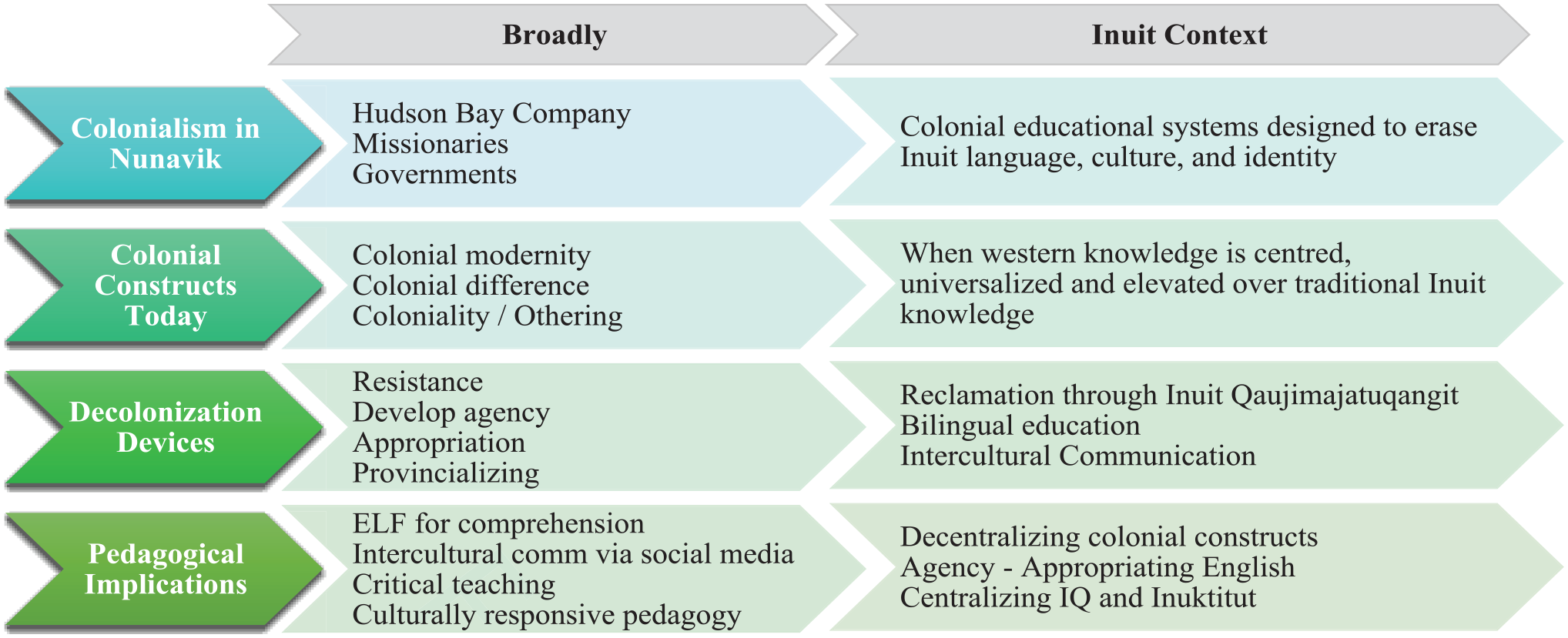
Decolonizing ESL education in the Inuit context.
Conclusion
As we have seen through this literature review, the challenge for Inuit in Nunavik is maintaining culture, identity, and language in a world where the colonial language of English is dominant. The research indicates that to resist colonialism, Inuit must take agency of our culture and language while driven by IQ (Koperqualuk, 2009). Tester and Irniq (2009) explain that “definitions of IQ should also make reference to the social spaces and places, the contexts where IQ is articulated, debated, and developed” (p. 58). From this perspective, intercultural communication on social media is an apt medium for asserting Inuit cultural identity and decolonization. Alexander (2009) explains that IQ is constantly evolving, and to continue to thrive, Inuit should align it with their appropriation of any technology. Social media do not define Inuit culture but evolves with it (Johnson & Callahan, 2013) as we endeavour to assert our Inuit onto epistemologies. In Alexander’s (2009) study, he noted that Inuit elders, our knowledge holders and revered teachers, expressed their understanding that their teachings could continue on with the aid of media technologies. Stevenson (2014), in his examination of culture in the Nunavik classroom, aptly noted that although the concept of IQ came from Nunavut, it delivers a path to decolonizing systems, including education, where Inuit culture is at the forefront. In this time when globalization and online communication have permeated into our small isolated arctic communities in Nunavik, Inuit have adapted. We decolonize our ESL education system by decentralizing its colonial constructs, appropriating the tool of the English language for our own needs, and centralizing the value of our IQ and Inuktitut. For this literature review, most of the studies found focused on non-Inuit colonized communities and were extrapolated to our context. This gap in the research demonstrates that there is a necessity for future research on decolonizing ESL education that could be conducted by and with Inuit communities.
Footnotes
Acknowledgements
The author acknowledges and thanks Richard Budgell, Assistant Professor at McGill University and Inuk from Nunatstiavut, for his support and confidence.
Author’s note
Declaration of conflicting interests
The author declared no potential conflicts of interest with respect to the research, authorship, and/or publication of this article.
Funding
The author received no financial support for the research, authorship, and/or publication of this article.

Glossary
Aajiiqatigiinniq decision-making through discus-sion and consensus
Inuit Indigenous people of the Arctic
Inuit Nunangat the four Inuit regions in northern Canada
Inuka member of Inuit people
Inuktitut Inuit language
Inuktut the Inuit language specific to Inuit Nunangat
Inuuqatigiitsiarniq respecting others, relationships and caring for people
Kativik Ilisinialiriniq the Inuit-led school board
Nunavimmiut people of Nunavik
pijitsirniq serving and providing for family or community or both
pilimmaksarniq/pijariuqsarniq development of skills through practice, effort, and action
piliriqatigiinniq/ikajuqtigiinniq working together for a common cause
qallunaat non Inuit, typically white people
qanuqtuurniq being innovative and resourceful
qaujimajatuqangit traditional knowledge
tunnganarniq fostering good spirit by being open, welcoming and inclusive