




Abstract
This scoping literature review examines the extent of research in second-language learning through intercultural communication on social media, specifically in Inuit (Indigenous people of the Arctic) communities. The investigation maps out gaps in the literature and explains the need for research in the Inuit context. Forty-seven studies and related resources are examined through a conceptual lens focused on the intersections between intercultural communication, social media, and Indigenous peoples, revealing concentrations on authentic interaction, Indigenous identity, language revitalization, and maintenance. Particular to the Inuit context, the analysis identifies the following gaps: (a) intercultural communication in second-language learning and Inuit; (b) second language learning through social media and Inuit; and (c) intercultural communication in second-language learning via social media and Inuit. None of the studies reviewed describe pedagogical applications for Inuit. This scoping literature review suggests future research and curriculum development that could be implemented in the Inuit context, particularly in Nunavik.
Introduction
Today, we exist in a hyperconnected world in which access to social media through constantly evolving information and communication technologies permeates nearly every society (Brubaker, 2023). This reality is also true for Inuit, the Indigenous people of the Arctic, living in Inuit Nunangat, the four Inuit regions in northern Canada. As an Inuk, a member of Inuit people, and a researcher, I am keenly interested in the influence of social media on second-language (L2) learning in my home region of Nunavik, Inuit region in northern Quebec. With access to social networking comes the need to connect with people from other cultures using a common language, often English, the online global lingua franca.
Amid fields of enquiry in education, such as applied linguistics and sociolinguistics, lies the discipline of intercultural communication (ICC). When incorporated into L2 learning, it is best described as “communication where cultural and linguistic differences are perceived as salient to . . . the interlocutors . . . in understanding the interaction” (Baker & Sangiamchit, 2019, p. 473). While research on L2 acquisition and social media has been around for a while, a more recent focus is surfacing on ICC within those studies. A competence in ICC aids language learners in navigating through the global reaches of popular social media, dodging impending linguistic and cultural misunderstandings and misinterpretations. For Inuit in Nunavik, the primary language firmly remains Inuktitut, while English or French is the L2. As anywhere else, Inuit are connected to the rest of the world by social media, generally through their L2. Therefore, in this context, the aspect of ICC is the significant focal point.
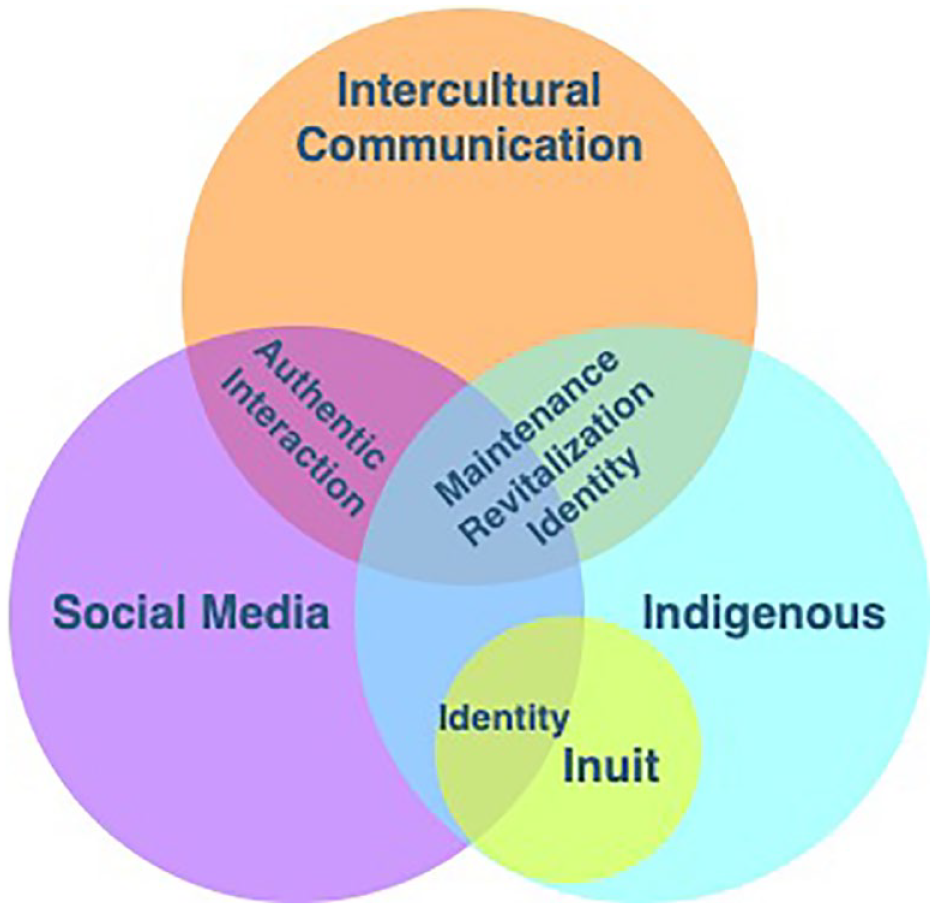
For this scoping literature review, I developed a conceptual lens (Figure 1) based on my field of research to assess the extent of existing studies on ICC in social media within the context of L2 learning in Nunavik communities. I identify research gaps and emphasize the significance of future research in these areas. Overall, this review reveals that in any research in L2 education encompassing all three areas—ICC, social media, and Indigenous communities—no research related explicitly to Inuit is identified.
The conceptual lens.
To determine more specific gaps in research on L2 learning in the Inuit context, I explore the overlap in research between ICC and social media. The research here centers on the affordance of authentic interaction, but none involves Inuit L2 learners. When narrowing the lens to examine ICC through social media in Indigenous communities, the focus of the research shifts toward language maintenance, revitalization, and Indigenous identity. However, no studies within this context include Inuit and L2 learning. For more context, we require a more detailed look at the current linguistic situation in Nunavik.
The linguistic context in Nunavik
Within Canada, Inuit are one of three distinct Indigenous peoples, the other two being First Nations and the Métis, who are of mixed First Nations and European ancestry. Nunavik is one of the four separate land-claim regions in Inuit Nunangat. In Nunavik, there are 14 isolated fly-in villages with a population of just over 12,000, 90% of which are Inuit (Nunavik Regional Board of Health and Social Services, n.d.).
Inuktut refers to the Inuit language specific to Inuit Nunangat, but each region may have one or more different dialects (Inuktut Tusaalanga, n.d.). In Nunavik, the dialect is Inuktitut and has the highest native speaker rate, with more than 99.2% of the Nunavik population, according to Statistics Canada (2017). The other regions vary in percentage of native speakers of Inuktut, with 89.1% in Nunavut, the northernmost territory in Canada, 21.4% in Nunatsiavut, the easternmost region in Canada, and 22% in the Inuvialuit region, located in northwestern Canada. Overall, 83.9% of Inuit continue to speak their dialect of Inuktut in Inuit Nunangat (Statistics Canada, 2017). This is significant in a globalized world where Indigenous languages are going extinct. As this literature review focuses on Inuit in Nunavik, I refer to Inuktitut as the first language (L1), and any reference to Inuit in Inuit Nunangat collectively, the L1 means Inuktut generally.
Due to the strength of Inuktitut, still spoken by most of Nunavimmiut (Inuit of Nunavik), English and French remain L2s, despite being situated inside the primarily French-speaking province of Quebec. A key to the predominance of Inuktitut in the region is that language protection is a significant priority for the regional school system (Wright & Bougie, 2007).
In Nunavik, the school plays a pivotal role in preserving culture and language within each small community. Kativik Ilisiniariliriniq, the regional school board, currently provides an adapted bilingual education program (Usborne et al., 2009), beginning with Inuktitut as the language of instruction from kindergarten to Grade 3. In Grade 2, English or French L2 is then gradually introduced through content-based instruction. Students move into the English as a second language (ESL) or French as a second language (FSL) content-based program by Grade 4, with Inuktitut-based classes included throughout the week (Kativik Ilisiniariliriniq, n.d.).
The goal is to safeguard Inuktitut while at the same time affording opportunities for post-secondary education (Usborne et al., 2009), which is mainly available to students outside Nunavik. To better understand the drive to preserve Inuktitut, we must look at the interconnections between colonialism and English as an L2 in Indigenous communities.
Colonialism and language
According to the United Nations Permanent Forum on Indigenous Issues (UNPFII), approximately 4,000 Indigenous languages worldwide exist, but an estimated 26 are lost yearly due to colonialism (United Nations Permanent Forum on Indigenous Issues [UNPFII], n.d.). Pennycook (2007) examined the interconnectedness of English language teaching and colonialism and elucidated how ESL learners were historically relegated to other. As the international lingua franca, they sought to learn English for all its affordances of societal and economic advancement. At the same time, this linguistic imperialism led to considerable barriers for many who may not attain colonial perceptions of linguistic proficiency for better employment or higher education (Pennycook, 2007).
For Inuit, colonialism is also evident in their displacements from a traditional nomadic lifestyle to forced habitation in stationary villages instigated by the Canadian Government up until the mid-twentieth century. The Inuit culture and language endured incredible strains on their integrity during this time of accelerated colonialism (Alexander, 2011). Even today, colonialism is still evident, as seen in Dunn and Gross’ (2016) examination of food-sharing practices in Nunavut. Their study notes a marked disparity in the living conditions between Inuit and the non-Inuit residing in the same community, where the cost of living is significantly greater than in the rest of Canada. They note that non-Inuit garner considerably higher wages than Inuit, thus contributing to food insecurity, where 70% of Nunavut Inuit in preschool have limited or uncertain access to enough food compared with 8.3% of the national average. This imbalance in the quality of life is evidenced by the linguistic divide. To illustrate, due to Inuit land-claim treaties, owning land and property is reserved for Inuit, so generally, English or French-speaking non-Inuit come to the north through employment, where their employers provide housing, salary, and other benefits. For Inuit, as wages are considerably low and the cost of living is exorbitantly high, they have to rely on renting social housing from their municipality, and due to the housing shortage crisis in the north, homes are often overcrowded and in disrepair, resulting in numerous social and economic challenges (Inuit Tapiriit Kanatami, 2016).
Although Inuktut remains vital as a whole, colonialism has presented challenges to its survival. For example, Castleton (2016) reported that language loss did occur for some Inuit who were taken out of their communities and forced to endure Canada’s residential school system, which Christian churches had administered. His study on cultural identity and community in the North describes that with their cultural and linguistic assimilation policies, these residential schools disrupted the passing down of language and culture for some. Moreover, though some religious institutions that established churches in each Inuit village may not have run the local schools, they still promoted English as the superior language (Pennycook, 2007). In Nunavik today, the Inuit-led school system has confronted colonialism head-on by preserving Inuktitut as the primary language and designing their ESL and FSL programs on their terms and for their own advantages. Pennycook (2007) describes this approach as an empowering form of defiance against colonialism.
As we acknowledge the colonial history of ESL, we need to understand what this means today in L2 learning for Inuit. In the context of the current information age and the prevalence of social media, English has become a global lingua franca. Most users do not share the same L1, and many are not native L1 English speakers (Baker, 2022; Baker & Sangiamchit, 2019). Castleton’s (2016) study on Facebook and Inuit identity confirms that the lingua franca used in social media in Inuit Nunangat is English.
Today, English is evolving into various forms of communicative constructs created online between users (Lantz-Andersson, 2018). Byram and Wagner (2018) illustrate this progression as different speakers negotiating communication in English by employing their cultural and linguistic systems. This is a distinct shift from the traditional L2 learning method, where learners would try to adapt their thought processes to those of the L1 English speakers. In social media, people use English as a lingua franca (ELF) to navigate the culture–language space (Baker & Sangiamchit, 2019). Teaching ESL today in Nunavik would benefit from an understanding of the intercultural nature of ELF in online communication, and any research should reflect that accordingly.
Methodology for scoping the literature
For this scoping literature review, I focus my conceptual lens to examine the extent of the studies found on ICC in social media within the L2 learning context, specifically in Inuit communities. The investigation maps out the gaps in the literature and then explains the importance of the research needed to fill those spaces. The exploration is conducted using a staged approach:
To frame the study, I first examine ICC and what that means in L2 learning.
I survey the studies found at the intersection of ICC and social media.
I then look into the studies at the intersection of ICC, social media, and Indigenous communities.
Finally, I focus the conceptual lens on the Inuit context to determine the extent of the research found there.
Throughout the exploration, gaps uncovered in the literature regarding Inuit are discussed. As the analysis is based on L2 learning, the pedagogical implications reported in these studies are also identified.
Scoping the literature
The definition of ICC apropos to this literature review we will recall is “communication where cultural and linguistic differences are perceived as salient to . . . the interlocutors . . . in understanding the interaction” (Baker & Sangiamchit, 2019, p. 473). In this context, the simplest explanation of culture is that it is evident in the similarities and differences in how we communicate our customs, jargon, common practices, products, and worldviews (Daniel Jr., 2017; Özdemir, 2017; Palaiologou, 2009).
Examining the connection between culture and language in L2 learning, it is vital to understand that language does not define culture (Baker & Sangiamchit, 2019). For instance, the French language does not represent the entirety of culture in Quebec, just as Inuktitut does not epitomize culture in Nunavik. Instead, Inuktitut is a part of Inuit culture. While language and culture do not determine each other, they can mutually transform through communication (Krachu, 1999) and become inextricable (Cortazzi & Jin, 1999).
The culture we are raised in shapes our L1 and influences how we perceive ourselves and the world around us, impacting our understanding and awareness of the culture in the L2 (Hinkel, 1999). Growing up in both Inuit and western cultures, I am cognizant of the different epistemologies that shape my worldview. This consciousness of cultural differences and similarities within myself influences my understanding of each culture.
In traditional language teaching, the concept of culture is often associated with learning about countries and their national languages. Language learning through ICC emphasizes the interconnectedness of languages among speakers from different cultures rather than between individuals from different countries. (Kramsch & Zhu, 2020). For Inuit, ESL learning with ICC could occur with English L1 speakers in England or English L2 speakers in South Korea; it is not the country that matters, but the interactions through English where the cultural differences and similarities are a part of the learning experience. This interplay between cultures is a crucial concept for this literature review, and I examine how that contributes to language learning. At present, social media lends itself well as a conduit to this interchange (Özdemir, 2017), which is why it is also central to this literature review.
Kramsch (2011) explains that language learners need to develop intercultural competence to facilitate their ICC. Elboubekri (2017) best defines intercultural competence: “When knowledge about the other world is coupled with the knowledge and ability to explain one’s own cultural behaviors, one then is said to develop a cultural awareness that is central to intercultural competence” (p. 527). In other words, intercultural competence is not the knowledge of cultural facts but the consciousness of one’s own and the other’s culture (Byram & Wagner, 2018).
In the literature so far, we can see that developing the language learner’s intercultural competence is becoming imperative. This can be facilitated by supporting the learner to build their cultural awareness and use that to evaluate the parallels and the differentiation in the cultures of other speakers (Elboubekri, 2017). With L2 learning in Nunavik, helping students develop intercultural competence would involve teaching them the skills to actively notice the dichotomies between their own Inuit culture and that of the other interlocutor. Inuit can focus on applying their cultural and linguistic knowledge to engage in ICC, never having to compromise the integrity of who they are or sound like something they are not.
ICC and social media
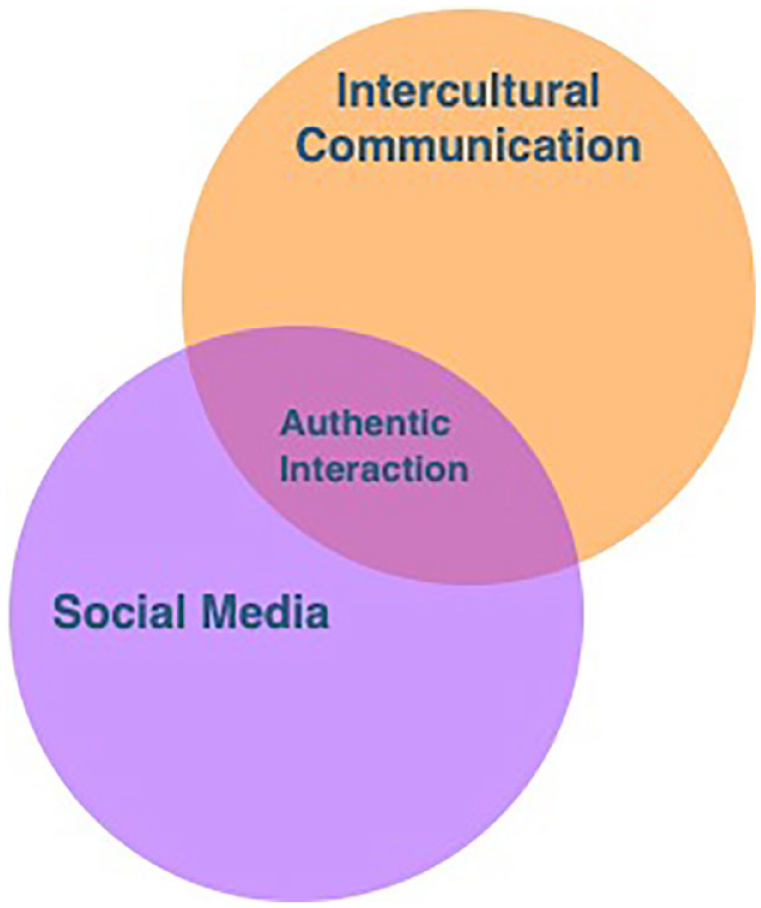
In the first stage of the scoping literature review, I examined the literature on ICC in L2 learning to establish a foundation for our conceptual lens. Next, I concentrate on the current literature found at the intersection of ICC in L2 learning when using social media (Figure 2).
Exploring the conceptual lens: intercultural communication and social media.
In the 1990s, Web 1.0 technologies such as email and web-based discussion forums emerged, and the ability for mass communication exploded. However, the interactivity between users was still relatively asynchronous and detached (Jin, 2015), and opportunities for authentic interaction—meaning real-life communication in L2 learning that is more naturalistic and informal (Reinhardt, 2019)—were limited. Since the mid-2000s, Web 2.0 advanced communication into the synchronous, interactive, globalized realm (Dooly, 2011). Web 2.0 technologies such as social media platforms come in popular forms such as Facebook, Instagram, and Twitter (Jin, 2015). Through them, users can get exposure to authentic communication instantaneously and in real-time. This is particularly relevant for Inuit living in isolated communities with limited access to genuine L2 interaction. Through ICC via social media, language learners in Nunavik could engage in linguistic exchanges to construct meaning in partnership with other online interlocutors in a free-flowing social space (Baker & Sangiamchit, 2019).
In Özdemir’s (2017) study on Facebook and ICC among English foreign language students, the research asserts that Facebook allows students to participate in genuine communication, develop positive viewpoints on their language learning, and advance their language learning skills. The author asserts that actuating ICC through Facebook to interact with others from diverse cultures is more effective than traditional classroom communicative activities (Özdemir, 2017). Giupponi (2013) adds that language learners get exposure to a broader array of linguistic and cultural norms with social media and have more opportunities for language practice. Again, this exposure would greatly benefit English language learners in Nunavik, where access to other speakers in the communities is limited.
In social media, how we can communicate meaning is also changing. Lantz-Andersson’s (2018) research on linguistic repertoires demonstrates that communication through social media is mutating into a composite of the written and oral, developing into a new kind of literacy on its own. An example involves the emoticon, which on the exterior could be a literal smile or frown, but when employed in social media, it becomes a part of the user’s linguistic repertoire to represent different contextualized meanings.
In L2 education, social media has brought the English language learner outside the textbook and into an interconnected network with live English speakers. The quality of interactions can level up from artificial to genuine communication when engaging in social media (Giupponi, 2013). This authenticity, which is optimal for language learning, surfaces from the informal nature of spontaneous online interactions (Lantz-Andersson, 2018). Giupponi (2013) summarizes some benefits of utilizing social media, such as “an increase in writing confidence, a facilitation of the use of writing strategies, an enhancement of writing skills, a potential for increased interaction and output, increased motivation and interest, increased cultural knowledge and competence, and increased awareness of audience” (p. 13). While such gains are exciting, more empirical research is still needed as social media may not offer adequate in-depth exposure to ICC unless the teacher carefully plans and guides the learning experience (Lantz-Andersson, 2018; McGregor, 2020; Özdemir, 2017). Nevertheless, social media has become a mainstay in our daily lives, and for L2 learning, the affordance of authentic ICC is a strong advantage. The benefit would be particularly relevant for isolated communities in Nunavik that rely on the global network.
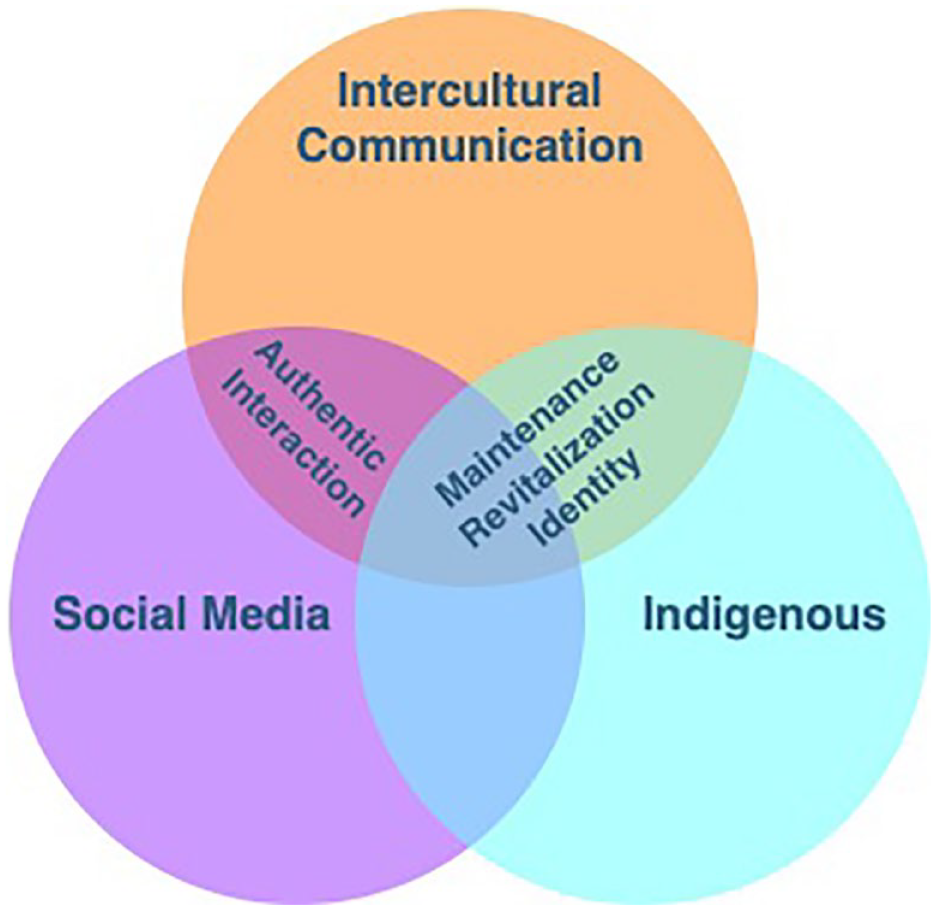
Continuing to the next stage of this exploration of the literature through our conceptual lens (Figure 3), I now delve into the intersection of the L2 research on ICC via social media conducted with Indigenous communities. As so few studies that I have found encompassed these concepts altogether, I take a two-step approach by first examining the studies observed on ICC in Indigenous communities and then narrowing the focus on the studies that incorporated social media.
Exploring the conceptual lens: intercultural communication, social media, and Indigenous communities.
ICC in Indigenous communities
In Lopez-Gopar’s (2014) study on teaching English to minority multilingual Indigenous and mestizo, meaning a person of European and Indigenous American ancestry, children in Oaxaca, Mexico, the focus is on critical intercultural teaching methods to support Indigenous identity. The author asserts that critical ICC can be achieved in English L2 classrooms when we integrate Indigenous languages and identity.
García and Velasco’s (2012) study on language policy in Mexico and its impact on the Indigenous languages describe the need for better intercultural bilingual education programs. They call for recognition and cultivation of the distinctiveness of the diverse Indigenous cultures and languages in Latin America. Here, interculturality plays a role in their self-determination and language maintenance. Moreover, Schissel et al. (2021) assert that a lack of support for Indigenous languages, usually in the minority in Mexico, leads to lower educational success. They emphasize that unilingual education policies do not reflect the reality of multilingualism within Indigenous communities or a linguistically diverse world. In these studies on ICC in Indigenous communities that I have identified, two themes that they have in common emerge: Indigenous identity and L1 maintenance. The L2 concept moves out of focus, likely due to the reality of language loss experienced in many Indigenous communities. This contrasts with the experience in Nunavik, where Inuktitut remains the predominant language.
ICC via social media in Indigenous communities
Looking now at the research that integrated social media, Cru’s (2015) study on the Indigenous language revitalization of Yucatec Maya, the Mayan language spoken mainly on the Yucatan Peninsula in Mexico, using Facebook observed that the social media platform enabled Indigenous youth to express their culture and language. The study found that Spanish still dominates due to Mexico’s ineffective language policies despite institutional attempts to promote multilingualism by including Indigenous languages. Cru (2015) maintains that revitalization will arise through heteroglossia, where plurilingual authentic ICC could take place on social media through socio-political discourse. When Indigenous communities start using their own language for different types of speech, they strengthen its vitality (Cru, 2015).
In another study, Hinton and Putra (2020) explore the link between ICC and social media for language revitalization in Indonesian and Nicaraguan Indigenous communities. They report on Indigenous students utilizing social media and engaging in ICC. They determined that those in the Indigenous communities were, in effect, recapturing their cultural identities, which had historically been dampened through colonialistic education systems. Similarly, Carlson (2013) found that Indigenous people in Australia used Facebook to establish their cultural identity, language, and self-representation. However, neither ICC nor language learning was a factor in this study.
The limited research uncovered here through the conceptual lens centers on the concepts of Indigenous language maintenance, revitalization, or identity. The gap in research at this intersection is ESL learning, which is understandable considering there is likely a priority on addressing Indigenous language loss rather than focusing on learning English. Although limited in volume, this research is vital to understanding the colonialist language pedagogy, cultural assimilation, and language erasure experienced by many Indigenous communities worldwide. More empirical studies are needed to analyze the online global context of Indigenous L1 and cultural preservation.
Applying the conceptual lens to Inuit
For the Inuit context, specifically in Nunavik, the region has taken substantive and successful measures to preserve its linguistic and cultural identity against the historic crush of colonialism. As noted earlier, the education system developed by Nunavimmiut prioritizes Inuktitut and Inuit identity while providing English L2 bilingual education under their own terms. We now focus on the Inuit context through our conceptual lens (Figure 1). As we will see, the research uncovered involving Inuit does not intersect with ICC at all. Therefore, I examine what literature could be found through the conceptual lens and discuss the gaps in research.
To situate Inuit identity and education, Annahatak (1994), an Inuk and retired educator from Nunavik, wrote a critical autoethnographic study from an Inuit epistemological lens on balancing cultural identity amid the influx of the outside world during her lifetime. She describes this balancing as a necessitated adaptation in Inuit society in which Inuit must hold on to cultural values in the presence of modern change. Davidee Niviaxie (2009), an Inuit elder from Nunavik, also discusses Inuit culture, identity, and language and recollects: We have a different language today, different from what my parents spoke. If I actually spoke in that way, I would not be understood today. Our language is changing, even among us the Inuit. We are becoming closer to other Inuit and more numerous, and our language is beginning to lose its sense. We have to be vigilant so as not to lose it. (p. 12)
As we have seen in this literature review, Inuit in the education system in Nunavik have effectively prioritized identity and language in the face of globalization and colonization.
In Alexander’s (2011) study on technology and Inuit cultural identity, the author argues that resilience and versatility are inherent to Inuit and have led to their continued survival. She adds that this ability to appropriate, that is, negotiate the evolutions of practical technologies such as rifles and skidoos, has allowed Inuit to sustain who they are. Looking through an Inuit epistemological lens, Castleton (2016) demonstrates that social media is yet another modern technology that Inuit have seized as they strive to maintain their culture and language in the online world.
Within his research on social media, culture, and Inuit, Alexander (2011) claims that there is a connection between digital media and liberation from colonialism. Inuit now use the online space to present themselves to the world unconditionally and reconstruct the colonial ideation of Inuit identity and culture. In a hyperconnected world, Inuit and other Indigenous communities are endeavoring to assert their distinctiveness, and social networking is aiding that process (Alexander, 2011; Castleton, 2018).
For many Inuit, Facebook has become integrated into everyday life despite the barriers of high internet costs, access, or internet connectivity that persist in many remote communities of the North (Castleton, 2018). Dorais’ (2011) ethnographic study notes that Inuit youth extensively use social media platforms, such as Bebo and MSN at that time, and have vast networks of connections, no differently than youth elsewhere. Significantly, CBC News (2017), Canada’s publicly owned news and information service, reported that Inuit in Canada utilize Facebook at a higher rate than the rest of the country. It also stated that Facebook had become the dominant form of communication in the North. This can undoubtedly be attributed to the remoteness of the communities drawing out the need to connect just as I am wont to do with family and friends living in Nunavik.
As I examine how Inuit make use of social media, I apply the conceptual lens in this literature review to Inuit, and the overall theme in the research concentrates on cultural identity. In each of Castleton’s (2016, 2018) ethnographic studies on social media usage and Inuit culture, he identifies various significant applications. These include maintaining connections and communication both in and out of the region, offering community assistance, accessing entertainment, and posting photos and videos of the land as a part of cultural identity sharing. While Inuit have always had a social nature, social media enables them to reach out past the remoteness. He adds that a particularly notable usage of social media is preserving identity with membership in culture-based Facebook groups related to hunting practices or food sharing, thereby forming a distinct online community. As an Inuk living outside my home region, I can maintain a connection to my culture through such groups. Castleton observes that though Inuit make these Facebook groups accessible to the world, clear cultural borders are demarcated by Inuktut language use and visual cultural icons. I see these reminders of where I come from daily in my social media network, keeping me grounded and enveloped in the culture. By preserving culture and traditional knowledge online, Inuit can continue to transfer identity to the youth. Through visual and textual storytelling, they can hold on to and be proud of their identity as Inuit (Alexander, 2011; Castleton, 2018).
Alexander’s (2011) study found that Inuit identity has become well integrated into the international online Indigenous community. Inuit maintain their cultural integrity when they take their authentic identities, not colonialist representations, and share them for the world to see (Carlson, 2013; Castleton, 2018). Using social media, Inuit can counter the typecasts and prejudices long misrepresented in history. That is evidenced daily through my own Facebook newsfeed as the Inuit artists, hunters, and parents I know share their authentic daily lives. Inuit are re-educating the world by communicating authentically on the global network (Alexander, 2011; Castleton, 2018).
For Inuit, social media has offered a space for connections within and between the isolated communities and throughout the globe. Online, Inuit can control the message and impart their own definitions of who they are. For this reason, one of the motivations for conducting this scoping literature review was to see how Inuit from my region of Nunavik engage in an L2 on the global stage with their cultural identity and L1 firmly in place.
Results: the gaps in the conceptual lens
In the first two stages of our exploration in this literature review, I looked at the research on ICC in L2 learning through social media, and the number of studies I observed in this intersection is quite robust. As I shifted the lens to focus on Indigenous communities within the conceptual lens, I detected a distinct transition in the research away from L2 learning toward language revitalization and maintenance and cultural identity. As I culminated the scoping by narrowing the lens on Inuit, therein I found three significant gaps:
No research on ICC in L2 learning with Inuit.
No research on L2 learning through social media with Inuit.
No research on ICC in L2 learning via social media with Inuit.
This scoping literature review has demonstrated that Inuit, particularly in Nunavik, have not endured the same level of language loss as other Indigenous communities, and that is due to the progressive labors of the Inuit-led school system. However, as L2 learning in Nunavik is determined a priority, these wide gaps in the research are worth exploring, considering the prevalence of social media use in Inuit communities and the integrity of Inuktitut and cultural identity.
Pedagogical practice involving ICC
From a pedagogical standpoint, throughout the studies in this literature review, there are theoretical and practical examples of implementing ICC in L2 learning via social media in the classroom. However, there are no studies in the Inuit context despite the target-rich linguistic environment in which culture, the prevalent use of social media, and the desire for L2 learning are substantial factors.
Discussion
Canale and Swain (1980) emphasized that fostering learner communication is key to L2 learning. This can be achieved through effective teaching methods by providing practice opportunities in the L2. Today, in our hyperconnected world, in which learners have more exposure to interlocutors from multitudes of linguistic backgrounds, incorporating ICC into L2 programs offers learners those communicative learning opportunities (Baker, 2022). As we have seen, social media is a prime conduit. There, learners are encouraged to be inquisitive about learning the other’s culture (Daniel Jr., 2017) and making connections to their own to develop the skills needed to create meaning from the language used from multiple cultural viewpoints (Elboubekri, 2017).
Jin (2015) cautions that language programs must keep sight of the vital function of the teacher as a facilitator, one who must prepare well-structured lessons and employ the right tools when utilizing social media for language learning purposes. Keating et al. (2018) also argue for the need to ensure that teachers are empowered with clear frameworks to encompass culture and language. Introducing such a program in Nunavik would require curriculum development on incorporating the aspect of ICC through social media to best support the educators, particularly those with lower comfort levels with using technology in the classroom.
Some of the literature (Byram & Wagner, 2018; Daniel Jr., 2017; Darhower, 2006; Gilsan, 2012; White, 2016) refers to the World Readiness Standards for Language Learning (National Standards Collaborative Board, 2015) as a practical resource for language teachers on integrating five key standards: communication, cultures, connections, comparisons, and communities. Springing from these objectives, notably culture, the American Council on the Teaching of Foreign Languages (ACTFL) and the National Council of State Supervisors for Languages (NCSSFL) designed a set of Can-Do statements to guide language teachers in helping their students develop their ICC. The statements explain that ICC forms through a “process of intentional goal-setting and self-reflection around language and culture and . . . is essential for establishing effective, positive relationships across cultural boundaries, required in a global society” (National Council of State Supervisors for Languages, & American Council on the Teaching of Foreign Languages [NCSSFL & ACTFL], 2017, p. 1). The World Readiness Standards for Language Learning and the Can-Do statements are pragmatic resources for language teachers searching for a framework for cultivating ICC in a globalized world and could readily be applied in the Nunavik context.
Another consideration for language programs is to use content-based instruction. Byram’s intercultural communicative competence model (Byram, 1997) recommends content-based instruction to foster critical thinking, enabling students to understand the function of language on an interconnected global level (Byram & Wagner, 2018). Developing critical thinking skills in ICC is key here. Language learners begin to form a consciousness about language, culture, and discourse to negotiate meaning and use their curiosity to connect to the world around them (Baker, 2022; Byram & Wagner, 2018). The school board in Nunavik already employs content-based instruction for L2 learning, and integrating ICC could be the next step.
Finally, as observed in this literature review, authenticity is a common link between ICC and social media. Language programs can move beyond mere communicative exercises (Lantolf, 1999) to meaningful and authentic communication accessible through social media (Daniel, 2017). Online ICC that is contextualized to the learner’s world is made relevant as they can then relate and make connections to the content (Baker, 2022). It affords that social network of authentic language, elevating their intercultural awareness and competencies (Giupponi, 2013). Applied to the Nunavik context, motivated and well-supported L2 learners would become empowered and equipped to engage as true global citizens (Daniel Jr., 2017).
Conclusion and implications
This scoping literature review documented the path toward uncovering the significant gaps in L2 research related to Inuit when applying a conceptual lens on ICC through social media in Indigenous communities. Significantly, any research found using the lens that focused on Inuit and social media resulted in studies on cultural identity, not L2 learning. Furthermore, no research was uncovered on Inuit together with ICC. The scoping also revealed that when the conceptual lens was applied more broadly to Indigenous communities, the limited number of studies that were found concentrated not on L2 learning but on Indigenous language revitalization, maintenance, and cultural identity. These results are explicable, considering that language loss is high for many Indigenous communities, while Inuktitut continues to endure and thrive in Nunavik. As English is often the lingua franca in global communication, particularly in social media, L2 learning for Inuit would benefit from focusing on competency development in ICC.
Within these gaps lie considerable opportunities for new research that could also contribute to L2 curriculum development. Most of the studies found that concentrated on ICC and social media could be replicable or adapted to the L2 learning context in Nunavik. Concerning the gaps I have uncovered, the research on L2 learning through ICC in social media should be approached with an Inuit epistemological lens where Inuit knowledge, identity, and language are strengths. In this scoping literature review, we have seen that Inuktitut is still vibrant in Nunavik, mainly due to the vision of the regional school system in designing a tailored additive bilingual program. As social media is more prevalent in Inuit Nunangat than in the rest of Canada, Inuit could utilize its benefits to maintain their cultural identity amid the influences of globalization. Through these realities, studies implemented in Nunavik could contribute valuable insight to the broad research on ICC via social media in L2 learning and benefit Inuit L2 programs.
Footnotes
Acknowledgements
The author acknowledges and gives thanks to the Inuit Elders and researchers who have shared their knowledge, which has guided this work. This study may be making fresh footprints on clean snow, but not for long as Inuit continue to take agency and develop emic-based research.
Author’s note
Declaration of conflicting interests
The author declared no potential conflicts of interest with respect to the research, authorship, and publication of this article.
Funding
The author received no financial support for the research, authorship, and publication of this article.

Glossary
Inuit Indigenous people of the Arctic
Inuit Nunangat the four Inuit regions in northern Canada
Inuk a member of Inuit people
Inuktitut a dialect of Inuktut and used in Nunavik
Inuktut the Inuit language specific to Inuit Nunangat
Kativik Ilisiniariliriniq the regional school board in Nunavik
Nunavimmiut Inuit of Nunavik
Métis Indigenous people of Canada who are of mixed First Nations and European ancestry
Mestizo a person of European and Indigenous American ancestry
Yucatec Maya the Mayan language spoken mainly on the Yucatan Peninsula in Mexico