



Abstract
This study espoused lessons learnt from Indigenous root and tuber farmers’ responses to Climate Change in Nigeria. Situated Learning Theory and Participatory Phenomenology framed the study. Data were generated using focus group discussions, in-depth interview and participant observation. An inductive thematic analysis was applied on the data. The experience of Climate Change by the farmers has been change in rainfall pattern and other indicators were identified. The farmers respond to Climate Change using their Indigenous knowledge of water conservation by making mounds, maintain soil fertility by practising crop rotation, use compost made from household wastes and sustainable use of natural resources. The farmers’ preference for adapting to Climate Change using Indigenous knowledge was attributed to Indigenous knowledge being effective, easily accessible and inexpensive along with their apathy to scientific interventions. The study recommended possible ways of including the documented Indigenous knowledge into mainstream adaptation strategies and Agricultural Curriculum in Nigeria.
Introduction
Climate Change is becoming problematic all around the globe, with evidence all around us in the physical and biological systems. Rising temperatures due to global warming has resulted in various changes in the flora and fauna and farming systems around the globe have had to adjust in so many ways to the resultant change in weather patterns (Tompkins & Adger, 2004). Many farmlands are lost to flooding due to rising water levels as the Arctic melts leading to coastal flooding in some parts of the world and drought in other areas. Climate Change has been attributed to human activities and natural climate variability (Cooper et al., 2008; Parry et al., 2007). Agriculture is becoming increasingly vulnerable to the effects of Climate Change especially the rain-fed farming system in Africa, which is highly dependent on the rain to provide water for its crop. It is adversely affected by change in the rainfall pattern, drought and the attendant increase in incidences of pest and diseases as the whole system try to adapt to the change around them (Mongi et al., 2010; Pereira, 2017).
Evidence and impacts of Climate Change in Nigeria have been well documented by previous authors as change in rainfall pattern, which varies based on the location in the country (Ebele & Emodi, 2016; Enete & Amusa, 2010). For example, an increase in the amount, duration and intensity of rainfall in the southern part, while reduction of the aforementioned variables is being experienced in the northern part. Prolonged dry season and drought, desertification and drying up of rivers have also been reported, which affects the farming system negatively, and subsequently, the people’s livelihood, as majority of people in the rural areas of Nigeria are involved in agriculture. Land degradation, water and air pollution due to oil exploration activities in the Niger Delta and it resultant effect on farming, fishing and general livelihood have also been reported (Idowu et al., 2011). These experiences of Climate Change have adverse effects on the rural farmers of Nigeria and they have had to respond to the phenomenon to preserve their source of livelihood. These responses otherwise known as adaptation are the methods used by communities to cope with the adverse effects of Climate Change by adjusting their systems of doing things and carrying out reparatory activities that salvage the situation (Adesina & Odekunle, 2011). In responding to Climate Change, the root and tuber farmers have been deploying their Indigenous knowledge (IK), which is the readily available and affordable tool at their disposal to sustain their production, which has been steadily on the increase in spite of Climate Change and underinvestment in research on that crop group (Petsakos et al., 2019).
Most of the conventional responses to Climate Change originated from the scientific and western world and are not culturally adapted to the Indigenous peoples and their locations, hence minimal success has been achieved in seeking to alleviate Climate Change, and, hence the need to decolonize Climate Change adaptation strategies. This involves a paradigm shift from imposing presumed solutions on seemingly helpless Indigenous people to a collaborative effort in proffering solutions to the menace of Climate Change (Berkes & Jolly, 2002). Root and tuber production in Nigeria is on the increase in spite of Climate Change; this is despite the fact that the farms are only rain-fed (Oluwatayo & Ojo, 2016). This increase shows that root and tuber farmers are successful in adapting to Climate Change using their IK. By exploring their use of IK, we can seek deeper understanding of how they adapt or coexist with Climate Change. This study explores these Indigenous practices of root and tubers farmers to understand their consistent use and evaluate the outcomes with a view to documenting the IK and projecting such for inclusion in mainstream Climate Change adaptation plans. The root and tuber crops under study were cassava, yam, sweet potato and cocoyam. Three research questions were crucial to achieving this:
What are Nigerian root and tuber farmers’ experiences of Climate Change?
How do Nigerian root and tuber farmers use IK to respond to Climate Change?
Why do Nigerian root and tuber farmers respond to Climate Change the way they do?
The study was located in six rural villages of Kwara State, Nigeria where the major occupation is farming with root and tuber crops being farmed extensively in such areas. The study was a qualitative one with Participatory Phenomenology being the methodology for data generation that used focus group discussions, key informant interviews and participants’ observation methods.
Methodology
Participatory Phenomenology is an attempt to merge two methodologies so as to get a methodology that is culturally relevant to the participants of the study and elicit rich responses from them without being too clinical or rigid. It is blending the best of both worlds to create a methodology that best fit the study. Phenomenology was employed to get the participants’ perceptions and lived experiences of Climate Change, while Participatory Research methodology was used to engage them actively in the study as they reveal their responses in diverse ways to the phenomenon using their IK (Bush et al., 2019; Kaivo-oja, 2017).
The merger of the Phenomenology and Participatory Research referred to as Participatory Phenomenology in this study helped to not only get the root and tuber farmers’ lived experiences of Climate Change, but it also provided a deeper understanding of the decision-making processes when responding to the phenomenon. Approval for the study was received from the university’s Ethical committee and Kwara Agricultural Development Programme: the organization in charge of Agricultural extension services in the state and permission was sought from the farmers group.
The theoretical framework for the study was Situated Learning Theory (SLT) which posits that learning occurs in situ as students learn within the context of what is being taught and relate such to their real-life situations. Situated Learning Theory views the mind, lived world, relations among person, activity and situation as they are given in social practice. And advocates for proper socialization of students by exposing them to interactions with masters in the field, artefacts and identities as they acquire the intended skills of their apprenticeship and apply it. Situated Learning Theory emphasizes context which refers to the social settings in which learning occurs, this may be in the classroom or while selling oranges on the streets to make ends meet and engaging in mathematical reasoning within the social circumstances. Situated Learning Theory is suitable for this study. IK is learnt by doing, and learning within the context aids the learners in gaining mastery of the subject rather than an accumulation of facts and concepts (Donaldson et al., 2020; Fox, 1997). This study took all the tenets of SLT into cognizance particularly paying attention to the notion that no knowledge should be overlooked and the site of instruction should not determine the importance of any educational activity. The divide between formal and informal education was also removed as all forms of education are valid and useful irrespective of the medium of instruction, location and the tutor. The documentation and learning of IK practices in root and tuber production was done on the farms.
A semi-structured interview protocol and focus group discussion guide were the researcher’s recourse during the field study. Focus group discussions were held at six villages comprising root and tuber farmers who had being resident in the villages for at least 30 years and were conversant with the changes in the weather pattern to elicit the farmers’ experiences of Climate Change. The number of participants each discussion group ranged from 5 to 12, due to the ongoing farming activities in the season and the ability of the contact farmer to rally his counterparts for the meeting. It is noteworthy that there was only one female participant and she was there as the contact farmer for that village although she was not a root or tuber farmer. On enquiry, the researcher was told that root and tuber production was a male-dominated system and the female folk are more involved in the post-harvest processing although they may help in harvesting if need be. Key informants with broad repository of IK on root and tuber production were identified during the focus group discussions were purposefully selected either by recommendation of the group members or the intuition of the researcher for follow-up interview and participant’s observation to document the requisite IK. The focus group discussions were held at various venues in the villages, for example, town hall while the interviews and observations held on the farms.
The study sought to elicit farmers’ views about Climate Change and some of the questions asked were: Are they aware of the phenomenon of Climate Change? If yes, how did they become aware? What are their perceptions of Climate Change? What are the notable changes observed over the years regarding changes in the environment? The farmers’ response to these and other questions are discussed in the course of the article and form the basis for answering Research Question 1.
Data were in the form of audio recording and field notes. Communication was in the farmers’ language, hence the recordings were in Yoruba (a tribe in southwest Nigeria) language, and the data were transcribed and translated into English language by the Indigenous researcher. The data were analysed by listening to the recordings and reading the transcripts repeatedly, thus identifying recurring significant statements that answer each research question. These were categorized into themes using Inductive Thematic Analysis, which were validated by the secondary researcher who studied the transcripts and gave useful suggestion on coding. Inductive thematic analysis is the process of generating themes from raw data by making sense of the data and generating codes from them (Boyatzis, 1998; Cohen et al., 2018; Fereday & Muir-Cochrane, 2006).
A Yoruba language expert also checked for correspondence between the audio data and the transcribed data to ensure no meaning was lost during translation, a test and measurement expert conversant with the language also checked the data and the eventual codes and themes for correlation, finally one of the extension agents went through the transcripts to ensure the field work was properly documented, in a bid to ensure trustworthiness of the study. All the identified gaps by the aforementioned people were noted and rectified.
Research findings
In presenting the findings, direct quotes are used to support the categories where necessary and model developed by the researcher to give a panoramic view of the farmers’ experiences and a table showing their responses to Climate Change across the six villages are also included.
Research question 1: what are Nigerian root and tuber farmers’ experiences of Climate Change?
The study established that the farmers are aware of Climate Change and were able to articulate the changes they had noticed in the weather pattern in the past 30 years of being resident in that location and identified change in rainfall pattern as a major change experienced over the years and it was expressed in varying degrees from early to late onset of rainfall, reduction in the amount, intensity and duration of rainfall to early and late cessation of rainfall which affected their crops in different ways explained in the respective chapters from stunted growth to spoilage during harvest. The other indicators of Climate Change identified were, prolonged dry season and drought, floods, whirlwinds, pest and diseases and destruction of farm produce by cattle of herdsmen who moved down south in search of green pasture for their animals. This is due to deforestation caused by Climate Change in the northern part of the country which led to violent clashes between the farmers and the herdsmen. Excerpts from the data buttressed some these points, pseudonyms were used for the respondents and some of the responses are in Yoruba language.
How was the rain back in those days and now? What have you noticed that has been different about the climate?
For instance, back then if the rain should start falling from the month of April, it will fall regularly that even if you plant yam on a stony land, the land will become tender. But now, rain is falling truly, but if the rain should fall heavily today within a month the rain may still be falling in between but it won’t be heavy. The intensity has reduced.
Àkókò tí ó ń sọ̀rọ̀ rẹ̀, òjò máa ń bẹ̀rẹ̀ láti oṣù kejì ọdún (Èrèlè) títí di oṣù kẹta (Ẹrẹ̀nà) ni àsìkò yìí làwọn àgbẹ̀ yóò gbin èso kan tí wọ́n ń pè ní Bàrà. Lẹ́yìn náà òjò yóò rọ lati oṣù kejì si oṣù kejìlá (Ọ̀pẹ́). To fí jẹ́ pé nígbà tí a bá gbìn jéró, òjò yóò si tun rọ̀ sórí rẹ̀, ṣugbọn nisisiyi ohun gbogbo tí yípadà. Àwọn ìgbà kán wà tí àwọn àgbẹ̀ yóò ti ṣe ìṣirò ìgbàtí òjò yóò bẹ̀rẹ̀ àti ìgbà tí yóò duro lẹ́yìn náà, òjò yóò kàn ṣíwọ́ rírọ̀ ní ìdajì ọ̀nà lójijì, ìdí nìyẹn tí àwọn àgbẹ̀ fi bẹ̀rẹ̀ sí í gbin lẹ́sẹ̀kẹsẹ̀ tí òjò náà bá bẹ̀rẹ̀ sí rọ̀ [The period that he is talking about, rainfall begins from the second month of the year (February) till the third month (March) and around this period the farmers will plant a crop called melon. Then the rain will fall from that February till December. Even when we plant millet, the rain will still fall on it, but now everything has changed. There are times that farmers would have calculated when the rain will start falling and when it will stop. Then the rain will just suddenly stop falling half way, which is why farmers start planting immediately the rain starts falling].
Do you experience flood?
Yes, we do experience it; especially for those of us that plants rice.
And flooding doesn’t happen before, right?
It never used to happen before, but it started few years ago and the flood use to wash away all the rice that are planted on the farm. The previous year around July ending till August, all the farm crops like the yams that are planted on the upland, rice and cassava were washed away by the flood from July till August last year.
The change in the rainfall pattern has hydra-headed implications to the farmers in the form of unpredictable rainfall, delayed rainfall and frequency of rainfall. They explained that before the advent of Climate Change, the seasonal calendar was regular and their fathers knew exactly when the rain will start and stop which helped them in decision-making on their farming activities. Unpredictable rainfall is a situation where the farmers are not sure when the rains will start or end within the year. Since agriculture in Nigeria is rain-fed that is they depend on rain solely to water their crops, any delay or change in the amount, duration and time of rain has adverse effects on the farm produce.
Research question 2: how do Nigerian root and tuber farmers use IK to respond to Climate Change?
In their bid to continue their production in the face of glaring change in the weather pattern, the root and tuber farmers had to resort to using their IK by drawing from the rich repository of knowledge passed down by the forebears, they have been able to cope with the adverse effects of Climate Change and sustain root and tuber production thereby ensuring their source of livelihood is protected. The study found out that the farmers make mounds and mulch it as a method of conserving water for their crops in the mound (Figure 1).
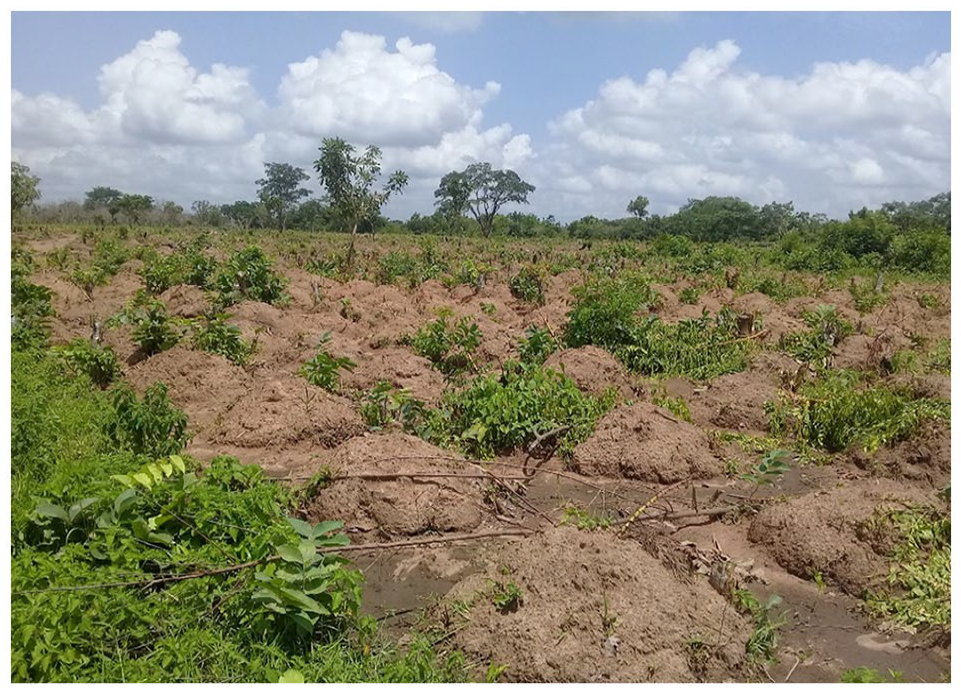
Mounds made for planting yams and other crops (Photo by authors).
They also use compost made from domestic waste in lieu of commercial fertilizers, practice crop rotation to conserve soil fertility and pest control, use some plants to prepare herbs that serve as pesticides and insecticides (Figure 2), plant different crops of various maturity dates and nutrient requirement on the same plot or mound to reduce cost of labour, maximize land use and suppress weeds, constructed drainage systems and live barriers at riverbanks to prevent flooding. They also reserve and plant trees to serve as windbreaks, use charms, dogs, bells, scarecrow to protect their farms from thieves and animals and plant animal repellent plants to keep cows away from their farms.
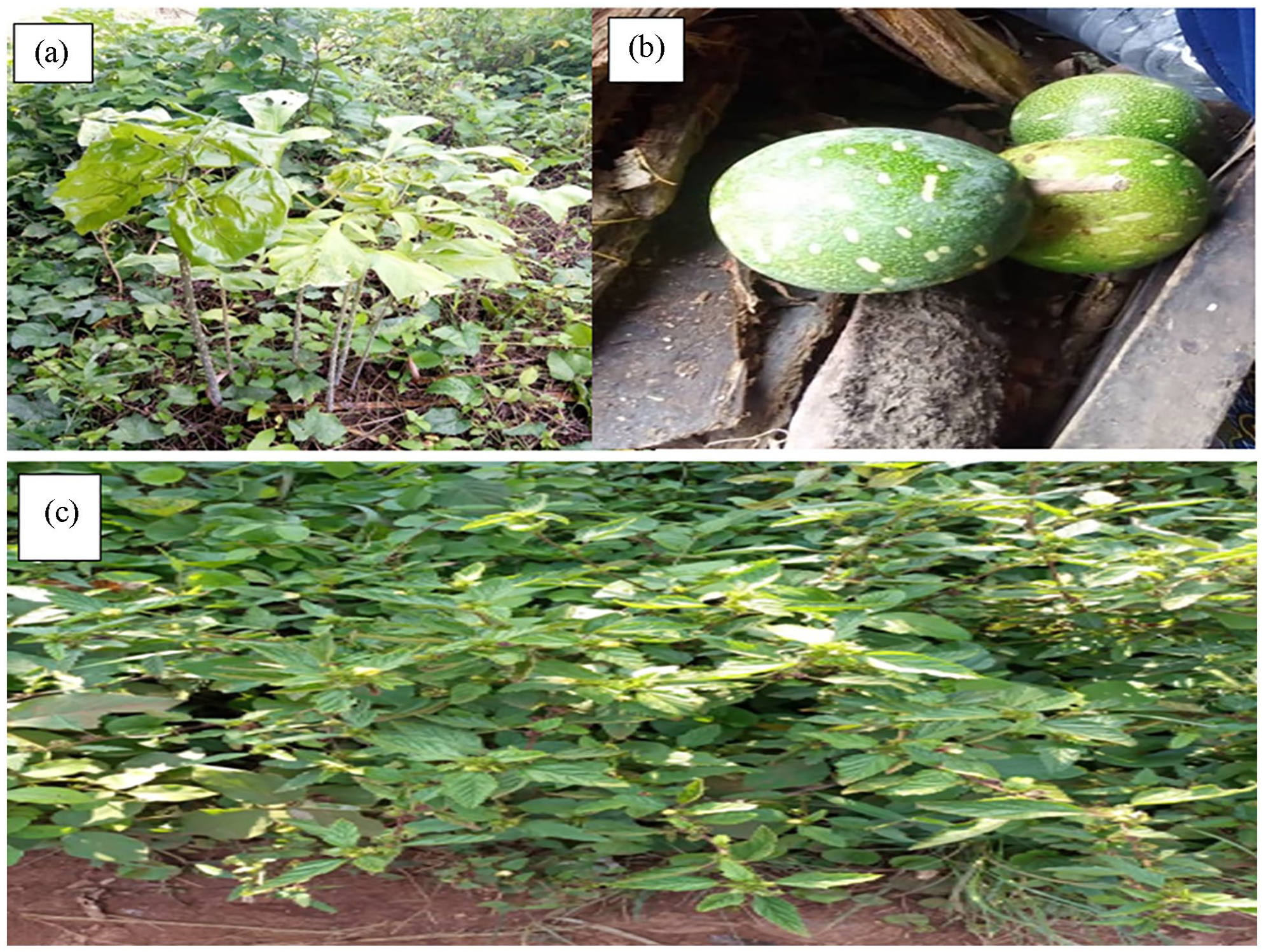
Constituents of herbal mixture used to prevent pests attack: (a) ògìrìṣákọ́ (children’s umbrella, Anchomanes difformis), (b) ìtagìrì (Christmas melon, Adenopus brevifloris) and (c) Olọ́ọ̀sẹ́ǹpètu (wire weed, Sida acuta) (Photos by authors).
What have you done about flood?
About the issue of flood, what we have been able to observe is that we make passage way for water by the side of the river and we block its banks. Like the workshop we both went for some times back, vetiver grass was mentioned.
Kò sí ohun tí a ṣe si o. Ohun tí o ṣẹlẹ̀ ni pé, agbára kìí wọ́ oko kúrò lọdọọdun, eyi ma n ṣẹlẹ ni awọn ọdun ti ojo ba rọ̀ púpọ̀. A kìí fi ilẹ̀ oko sílẹ̀ nitori ọdún tí ènìyàn kò gbìn nkan síbẹ̀ lè jẹ́ àkókò tí ènìyàn míìran yóò ní ìkórè púpọ̀ nígbàtí wọ́n bá gbin síbẹ̀. [Nothing was done to it. What happened is that, erosion doesn’t wash the farm away yearly, this only happen in years when the rain fall is much. We do not abandon the farmland because the year one doesn’t plant there, might be the time another person will get a bumper harvest when they plant there].
So, as a community what have you been able to do concerning whirl wind?
We pray and we also keep trees, we don’t cut down all trees we reserve them.
How do you take care of your crops during long drought?
For the yam in long drought, it is the mulch that is on the yam heaps that protect the yam so that the penetration of sunlight will not distraught the yam. In a cassava farm, the cassava won’t be weeded at all so that the moisture content will still be there so that there won’t be any problem.
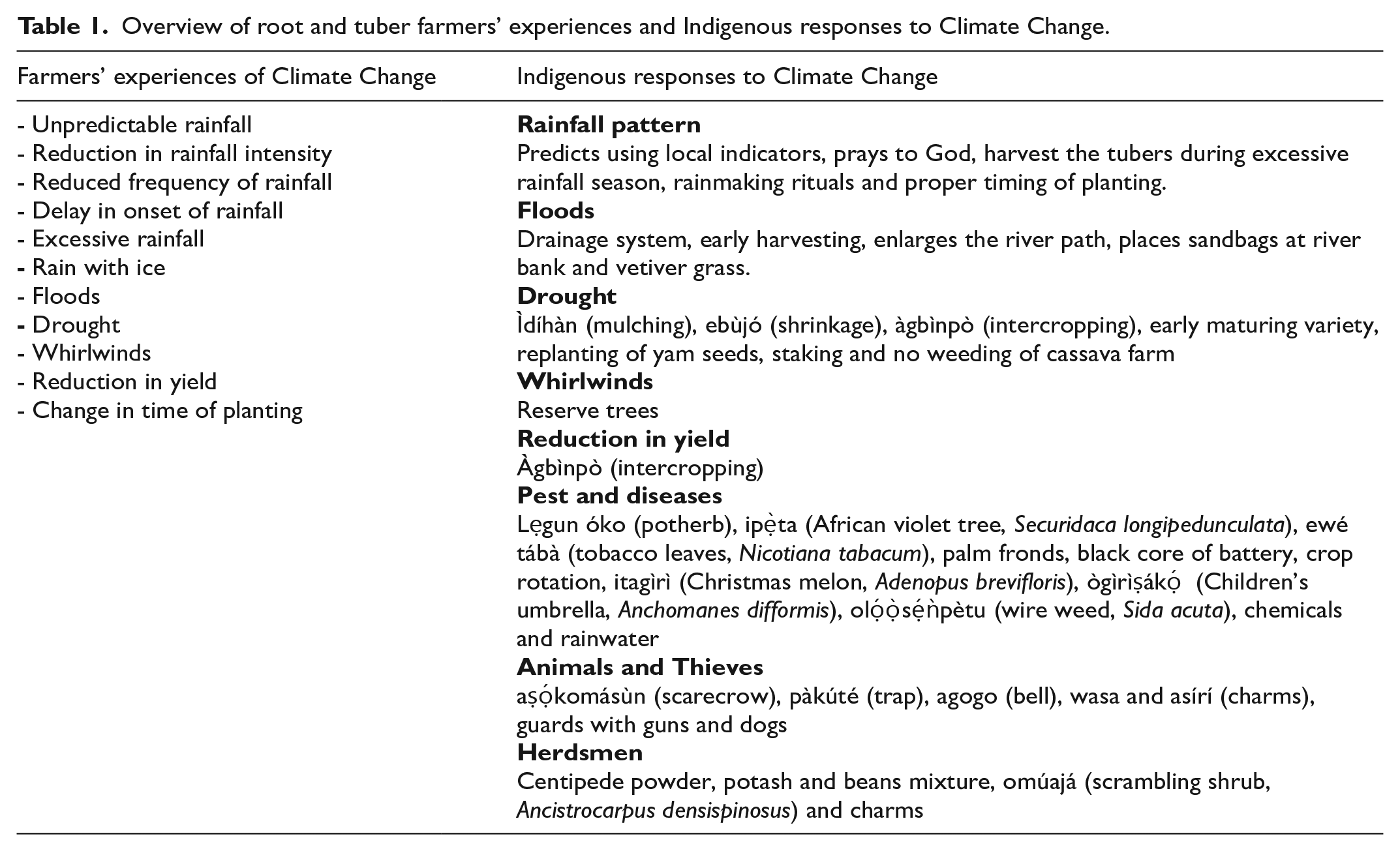
An overview of the responses to Climate Change across the six villages is presented in Table 1.
Overview of root and tuber farmers’ experiences and Indigenous responses to Climate Change.
Research question 3: why do Nigerian root and tuber farmers respond to Climate Change the way they do?
The farmers employ IK in responding to Climate Change rather than western knowledge and reasons deduced from the data were that IK is effective, easily accessible, inexpensive and apathy for top-bottom approach of science where the scientists identify the problem, formulate solutions and offer to the farmers without taking into consideration their economic capacity, cultural values, views and beliefs hence non-adoption by the local farmers.
Discussion
Research question 1: what are Nigerian root and tuber farmers’ experiences of Climate Change?
First, change in rainfall pattern- this is a major issue for the farmers when it comes to Climate Change as their farming activities depend on the rainy season. They identified that rainfall has become unpredictable as the rainy season sometimes start earlier than expected and gets delayed too. They also noted that the rainfall intensity which they referred to as owó òjò has reduced compared with before when the ground will be soaked. Local people in Kwara State understand that irregularities in the timing, amount, duration and onset of rainfall are on the increase. The responses of the farmers are in agreement with previous studies of Uyigue and Ogbeibu (2007) where they reported that there have been a change in the rainfall pattern of Nigeria and farmers previously could predict the rainfall and know the best time to plant but the change in the pattern resulted in many farmers suffering losses due to delayed rainfall and incorrectly predicted timing of planting (Ishaya & Abaje, 2008; Tunde & Ajadi, 2019).
Second, prolonged dry season and drought is a major problem as the farmers identified that there had been incidences of no rain at all some years past but now changed to prolonged dry season which affect their crops. This they noted does not happen every year but when it does it has debilitating effects on their crops, even yam that seems to be resilient to other effects of Climate Change. The only root and tuber crop exempt from this effect was cassava as pointed out by the farmers. Previous studies had reported increase in temperature with the resultant effect of drought because of the change in rainfall pattern in Kwara State and other parts of Nigeria (Ladan, 2014). Enete and Amusa (2010) also stated that when the temperature rise exceeds what the plants can bear during prolonged dry season, the crops are stressed which leads to a drop in their growth rate and eventual yield.
Third, security was a complex problem as herdsmen were destroying farmlands. The farmers noted that there has been an increase in the influx of cattle herdsmen into the area from the northern part of Nigeria and some West African countries because their cattle have nothing to eat over there. This had led to conflicts as the cattle enter into farms and eat up the growing crops. They alleged that the herdsmen sometimes set the cattle loose intentionally on farms owned by people that challenge them and cases of people being attacked and even killed on their farms by these herdsmen are being reported daily. Various studies have reported an increase in clashes between farmers and herdsmen. This is occasioned by farmers’ encroachment on grazing routes and herdsmen setting their cattle loose on farmlands and consuming the growing crops. Many lives and properties have been lost in reprisal attacks on both sides. The struggle for land use was exacerbated by dwindling vegetation due to overgrazing and Climate Change in the north and competing land usage by other sectors in the south which has reduced the land available for farming (Ikezue & Ezeah, 2017; Ukamaka et al., 2017).
Research question 2: how do Nigerian root and tuber farmers use IK to respond to Climate Change?
In responding to Climate Change, the root and tuber farmers did not have to invent new methods or practices but adapt their Indigenous agricultural practices to address the phenomenon. Practice like making mounds which has been found to conserve water for plant use, mulching which prevent direct penetration of sunlight to the crops hence keeping them safe, intercropping serves as safety net in case one of the crops fail or is affected by the effects of Climate Change. The use of herbal concoction as pesticides produces a good yield while protecting the environment from harmful effects of agrochemicals which are usually inorganic and residual in the soil for years. Protecting their farms from animals and herdsmen with the use of charms as the added advantage of reducing conflicts and loss of lives and properties.
Rainmaking which is exclusively in the purview of a select few is carried out in cases of extreme drought, while the other members of the community use local indicators to predict the weather and plan the farming activities accordingly. Indicators like igi òrí (shea butter tree) whose leaves start blooming when the rainy season is about to start and igi Ọdán (Ficus thonningii) whose leaves starts falling off as the rainy season approaches to predict the onset of rain and the behaviour of some animals like àṣá (hawk), will be seen in the sky staying still in one spot with its wings spread out when the rain is about to stop falling. All these are done in response to change in rainfall pattern.
Mulching: This is the practice of placing grasses, leaves and crop residues on the mound and placing a stone on top after planting the yam which helps to protect the sett from direct penetration of the sun and regulates the temperature in the mound during the period of prolonged dry season or drought.
Intercropping: This is the practice of planting different crops with varied maturity dates and nutrient requirements on the same mound which helps reduce the cost of labour for making mounds, maximizes the land available for farming, ensures the farmer has something to harvest at the end of the farming season in cases of extreme weather conditions, thus serving as a safety net for the farmer. This practice is useful in responding to drought and cushion the effect of reduction in yield occasioned by Climate Change.
Herbs and herbal concoction: The farmers make use of plants like ìtagìrì (Adenopus brevifloris), ògìrìṣákọ́ (Anchomanes difformis) and olọ́ọ̀sẹ́ǹpètu (Sida acuta) among others to debar insects and other pests from infesting their crops. This has the added advantage of protecting the environment from non-biodegradable substances found in agrochemicals and provides a relatively cheaper alternative for responding to increase in incidences of pest and diseases due to Climate Change.
Some Indigenous ways of securing their farms are planting animal repellents such as ewé láà (castor, Ricinus communis) and làpá (Jatropha curcas) at the edges which keeps the cows out of the farms, and the use of scarecrows that keep the monkeys away as it gives an illusion of the presence of human beings on the farms. Also, the use of charms which makes a thief disoriented and roam around the farm till he or she is caught turns to a snake and bites the intruder or brings the person back to the farm with the crops stolen has led to reduction in theft and animals destroying their farms with resultant effect of less clashes between the farmers and herdsmen.
The aforementioned along with changing planting dates and varieties planted are in agreement with previous authors who studied farmers’ perception and adaptation to Climate Change across the globe (Ayanwuyi et al., 2010; Makhado et al., 2014).
Research question 3: why do Nigerian root and tuber farmers respond to Climate Change the way they do?
In dealing with the changes occasioned by Climate Change the farmers had to navigate what is known to deal with the unknown hence the use of their inherited knowledge to respond to Climate Change. Most of the farmers had access to extension services so they get introduced to improved varieties, new farming technique or methods, and agricultural inputs like chemicals, fertilizer and the likes but these are majorly on cereals very little on root and tuber crops, which they stopped doing after a while because they preferred their Indigenous practices. This preference for their local knowledge learned from their predecessors rather than the scientific knowledge introduced by the extension agents, was explored and the following reasons were deduced from the data:
IK is effective: The effectiveness of IK in sustaining the environment and crop production over the years has contributed to its enduring use by farmers and more recently in their responses to Climate Change. The farmers believed that their responses to Climatic Change using IK, for example, the practice of intercropping helps to sustain their production by providing a cushioning effect in times of extreme weather pattern and forestall total crop failure. Several authors had reported the effectiveness of IK in maintaining soil fertility, weed control management, handling pest and diseases and other aspects of farming, while the Indigenous people could articulate clearing their perceptions of Climatic Change from their local ways of observing the weather (Adekunle et al., 2002; Husain & Sundaramari, 2011).
IK is easily accessible: Another reason for sticking to the use of IK is its availability and accessibility. The materials needed to carry out any IK are usually available within the community, thus accessibility is guaranteed. Just as farmers in this study reiterated that they do not use fertilizer for root and tuber production because the yield would not be good for eating so they use the waste generated in the house, crop residue and animal dung as manure to maintain soil fertility. This ability to make use of resources within their reach to solve their problems makes IK relatable and accessible to everyone interested in it. Farmers use locally available resources in their farming and are willing to continue using such because of its accessibility and they do not have to pay for it, while modern technology was not readily accepted because it is not original and they have to pay for it. The Indigenous resources are usually well suited for that environment and farmers continue to use these resources because they are familiar with them thus putting the knowledge of things around them to good use in their day-to-day living. Most of the scientific innovations are usually not available in the rural areas or too costly for them to procure (Ajala et al., 2016; Oniang’o et al., 2004).
IK is inexpensive: The use of resources around them to solve local level problems by Indigenous people makes IK inexpensive. One does not have to go to school and pay tuition to learn IK about farming, for example, it is freely learnt as you watch the elders do the farming itself and in situations of apprenticeship like that obtainable for blacksmiths, a little token is paid and the master sets up the apprentice in the trade after graduation. This in itself makes acquisition of IK inexpensive as Bapfakurera and Nduwamungu (2020) noted that IK provides a cost-effective option for development interventions if fully explored in a collaborative manner. This may arise from the fact that the inputs cost little or nothing, and when it costs more the farmers maximize the value for money. For example, the cost of labour for making mounds is offset by planting many crops with varying maturity dates on the same mound. This is in agreement with other scholars who reported that IK is cost effective as it is less expensive than using the conventional knowledge thus reducing cost of production while making use of natural resources with minimal inputs and maximum outputs (Aluko, 2018).
Apathy to top-bottom approach of science: The usual top-bottom approach employed by science in proffering solutions to agricultural problems has led to such not being adopted by the farmers or show little enthusiasm when they do. Scientists in research institutes and universities observe a problem and go ahead to search for a solution without consulting the farmers, such is then presented to them by the extension agents which informs their apathy demonstrated over time. The usual practice has been that the scientists identify the problem, formulate solutions and offer to the farmers without taking into consideration their economic capacity, cultural values, views and beliefs hence non-adoption by the local farmers. Not taking into consideration the local culture, skills and knowledge were identified by Warren and Cashman (1988) as reason for failure of technological solutions, which were intended to solve rural problems. They proposed that local people should be carried along when planning and implementing projects that concern them and IK competent individuals are best suited to engender participation by the Indigenous people (Kolawole, 2001). Collaborating with the local people will engender acceptance of the strategy and subsequent dissemination of such will occur within the villages organically. It is important to promote and encourage collaboration as worsening Climate Change effects may lead to the farmers being overwhelmed and in need of outside help especially from scientific interventions in battling with addressing Climate Change conditions.
Implications of the findings
Incorporating the lessons learnt from the root and tuber farmers on adaptation to Climate Change into the Agricultural education curricula at all levels will facilitate what Zidny et al. (2020) submitted will improve the relevance of science as the topic makes more sense to the students because they are familiar and relatable and what they are being taught is based on their real-life experiences, hence the town meets the gown in a confluence of knowledge. This will reduce drastically the misconception students have about science as it becomes interesting to note that science abound around them though termed Indigenous Science by the academy. The integration of IK alongside scientific knowledge in adaptation strategies has become expedient as Climate Change is a problematic issue that needs to be given much attention, so that life on Earth as we know it can be sustained or face the risk of extinction of flora, fauna and humans. Action has to start from each person and hence the need to teach the younger generation what has been proven to work. Blending the versatility of IK and the reliability of science will produce an effective approach to adapting to Climate Change, as the two worldviews merge to a hybrid that makes use of all available resources to sustain food security, live and livelihoods in the era of global warming (Nyong et al., 2007). The IK custodians may be brought in to the classrooms to teach the students with practical sessions done on the school farm or a field trip taken to the villages for the students to learn on site, thereby fulfilling the tenets of SLT explained previously as IK is learnt by doing.
Conclusion
The root and tuber famers of Nigeria practice sustainable agriculture in their use of natural resources and farming in a manner that maintains soil fertility and protects the environment at large with the minimal use of chemicals that are harmful to all. This also ensures their source of livelihood is preserved reducing unemployment and dependency. The study concluded that Nigerian root and tuber farmers’ deployment of IK in responding to Climate Change has ably sustained their production in the face of adverse weather conditions occasioned by the phenomenon, hence the need to incorporate these practices into Climate Change adaptation strategies as well as the Agricultural Curriculum in Nigeria to engender participation by all members of the society to mitigate and adapt to Climate Change.
Footnotes
Acknowledgements
The authors acknowledge the University of KwaZulu-Natal for the bursary for the PhD study from which this article was extracted and the Indigenous community in Kwara State for their support by availing the authors the privilege of engaging with them in their homes and farms. They also appreciate the sacrifices of the extension officers as well as the Director Extension Services, Kwara Agricultural Development Programme during the field study.
Authors’ note
Declaration of conflicting interests
The authors declared no potential conflicts of interest with respect to the research, authorship and publication of this article.
Funding
The authors received no financial support for the research, authorship and publication of this article.

Glossary
àgbìnpò intercropping
agogo bell
àṣá hawk
asírí charms
aṣọ́komásùn scarecrow
ebùjó shrinkage
ewé láà castor, Ricinus communis
ewé tábà tobacco leaves
ìdíhàn mulching and capping
igi òrí shea butter tree
igi ọdán strangler fig, Ficus thonningii
ipẹ̀ta African violet tree
ìtagìrì Christmas melon, Adenopus brevifloris
làpá physic nut, Jatropha curcas
lẹgun óko potherb
ògìrìṣákọ́ children’s umbrella, Anchomanes difformis
olọ́ọ̀sẹ́ǹpètu wire weed, Sida acuta
omúajá leaves scrambling shrub, Ancistrocarpus densispinosus
owó òjò rainfall intensity
pàkúté trap
wasa charms
Yoruba a tribe in the southwestern part of Nigeria; the third largest ethnic language in Nigeria