




Abstract
This article contributes to Indigenous literature on Intergovernmental Panel on Climate Change (IPCC) Assessment Reports (ARs) for an exploration of the science–policy–politics interface at the global scale. It presents findings from the systematic review of the latest AR6, conducted by the Knowledge Justice Collective, that examined Indigenous content in the report and the scientific knowledge base AR6 is based upon. It shows that paying attention solely on numerical increases of Indigenous content rather than the uneven Indigenous representation in the IPCC knowledge base produced in the English language by researchers largely in environmental science-related disciplines at elite institutions limits our understanding of the nuances of Indigenous lived realities in the ARs. Therefore, without an intervention at the knowledge base level, Indigenous Peoples and Indigenous Peoples’ Knowledges will continue to be legible only through extractive relationships in the IPCC AR processes while continuing to promote epistemic Eurocentrism.
The Sixth IPCC Assessment Report (AR6) and the knowledge justice collective
In the summer of 2021, the residents of Mustang district in Nepal experienced a devastating flood. Ancestral homes were damaged, culturally important ancient sites were irreplaceably destroyed, and fully grown trees directly tied to local livelihoods were lost overnight. This was also around the time when the preparations for the 26th UN Climate Change Conference (COP26) climate summit in Glasgow, Scotland were underway, and the Sixth Intergovernmental Panel on Climate Change (IPCC, n.d.). Assessment Report (AR6) would be released just a few months later. In his remarks as the COP26 President, Alok Sharma, called upon the global community to protect and restore critical ecosystems and to champion the move toward “sustainable, resilient and nature positive agriculture” (Fransen, 2021, para. 8). With images of the Mustang flood engulfing 250 apple trees and around 100 juniper and pine trees still circulating on social media and fresh on my mind, I wondered about the relevance of the climate summits and the IPCC ARs to the villagers in Mustang. Sharma’s aspirational call did not reflect the reality of many Indigenous Peoples whose already sustainable and resilient agriculture was being washed away right in front of their eyes. It was an omission of Indigenous realities of living with climate change and Indigenous contributions to understanding climate change at the science–policy–politics interface. This realization motivated me, as a Sherpa (Indigenous people of Nepal) anthropologist from the high mountains of Nepal, to examine how the AR6 engaged with Indigenous Peoples and Indigenous Peoples’ Knowledge. Having contributed to the AR6, it was clear that there was interest within the IPCC to engage with Indigenous Peoples and their Knowledges, but it was not clear at that point how effective the AR6 had been. I was further motivated to understand the scope of IPCC engagement with Indigenous Peoples and their Knowledges because global climate change negotiations on adaptation and mitigation measures rely heavily on the latest science presented by the IPCC. The AR informed climate change negotiations that take place at COPs directly impact communities’ capacity to adapt to climate change. The negotiations between heads of states at Glasgow (COP26), Sharm-El-Sheikh (COP27), Dubai (COP28) and Baku (COP29), for example, have relied on AR6 and influenced how national level adaptation policies, programs and resource allocation will take place in Least Developed Countries (LDCs), like Nepal. A direct engagement with the science–policy–politics interface at the global scale is thus crucial to ensure that Indigenous Peoples at the community level in the Himalayas, like Mustang, have the material and financial resources needed to respond to the dramatic impacts of climate change that are altering lifeways irreversibly. The IPCC ARs are one of these venues.
In 2021, Ritodhi Chakraborty and I published critical reflections on the IPCC based on our experiences as contributing authors to AR6 (Chakraborty & Sherpa, 2021). Our continued conversations of the IPCC AR6 then led us to conduct a systematic review of the document and the references cited in them with support from our colleagues and students. The collective, that began with the two of us, initially consisted of researchers based in the USA and New Zealand working on environmental justice issues in different parts of the Himalayas. As our focus turned global from regional, other colleagues joined. Our partner, Kristyn Gillis, at the United Nations Foundation was instrumental in providing crucial insights needed to understand the IPCC processes. Students and interns at the University of British Columbia, Lincoln University and the United Nations Foundation assisted with the systematic review.
The Knowledge Justice Collective, as we call ourselves, pursued an understanding of the global landscape of climate knowledge production and the ways in which Indigenous Peoples and Indigenous Knowledges have been engaged. This article is part of a series of planned publications based on the findings of the review. It contributes to the growing body of Indigenous studies that have engaged with the IPCC, including many referenced in this article, for an exploration of the science–policy–politics interface and its relevance to Indigenous lived realities. Since its inception more than 30 years ago, IPCC has served as a field of social enquiry attracting multidisciplinary research into the institution (de Pryck and Hulme, 2022). The direct implications of the IPCC ARs to Indigenous Peoples globally make it an important space for exploration from an Indigenous lens. This article begins with an overview of the IPCC structure that produces the ARs and the systematic reviews of Indigenous content followed by a discussion of sections dedicated to Indigenous Peoples in the AR6. The issue of extraction in the IPCC knowledge base is discussed next before offering actionable steps the IPCC can take in the AR7 cycle to produce a relatable and usable reports for Indigenous Peoples, including a plural approach to the physical science basis of climate change in the Working Group I report and a move away from engaging with Indigenous Knowledges in extractive ways.
Overview of the IPCC structure
The IPCC was created in 1988 by the United Nations Environment Programme (UNEP) and the World Meteorological Organization (WMO) to assess the science related to climate change. The IPCC (n.d.) describes its role in the following way:
Through its assessments, the IPCC determines the state of knowledge on climate change. It identifies where there is agreement in the scientific community on topics related to climate change, and where further research is needed. The reports are drafted and reviewed in several stages, thus guaranteeing objectivity and transparency. The IPCC does not conduct its own research. IPCC reports are neutral, policy-relevant but not policy-prescriptive. The assessment reports are a key input into the international negotiations to tackle climate change. (para. 1)
Despite the claims of the IPCC that their reports are neutral and objective, the criticism that it faces includes organizational and functional biases such as geographical bias favoring experts from the global north, gender bias favoring males, disciplinary bias favoring natural sciences over the humanities and social sciences, and epistemological bias favoring Euro-centric science over Indigenous approaches to the sciences and Indigenous science. In addition to the policy sphere, the IPCC reports are also important to climate researchers who use it as the scientific benchmark on climate change.
The assessment cycle begins with the election of the IPCC Bureau by the 195 Member Governments. The Bureau comprises 34 members: the IPCC Chair, the IPCC Vice-Chairs, the Co-Chairs and Vice-Chairs of the Working Groups and the Co-Chairs of the Task Force. There are three Working Groups and a Task Force. The three Working Groups include WG I, The physical science basis that assesses the physical scientific basis of the climate system and climate change; WG II, Impacts, adaptation, and vulnerability that assesses the vulnerability of socio-economic and natural systems to climate change, negative and positive consequences of climate change and options for adapting to it; and WG III, Mitigation of climate change that assesses options for mitigating climate change through limiting or preventing greenhouse gas emissions and removing greenhouse gases from the atmosphere.
The Bureau selects the experts to prepare the IPCC reports from nominations made by the Member Governments and Observer Organizations. The experts volunteer their time as IPCC authors to assess the thousands of scientific papers published each year to provide a comprehensive summary of what is known about the drivers of climate change, its impacts and future risks, and how adaptation and mitigation can reduce those risks. The first AR was produced in 1990. The ARs constitute Working Group Reports and a Synthesis Report (SR) along with any Special Reports on specific issues agreed upon by the Member Governments. The AR6 included Special Reports on the “Ocean and Cryosphere in a Changing Climate,” “Global Warming of 1.50 C,” and “Climate Change and Land.” The AR7 cycle, which formally started in July of 2023 with the election of the new Bureau, includes a Special Report on “Climate Change and Cities.” Besides the Working Groups, the Task Force on National Greenhouse Gas Inventories has the mandate to develop and refine a methodology for the calculation and reporting of national greenhouse gas emissions and removals. This article does not cover the report by the Task Force.
Overview of the systematic reviews of Indigenous content in AR5 and AR6
In addition to the Knowledge Justice Collective, at least two other research clusters have examined Indigenous content in the IPCC ARs. Through a brief discussion of each of our reviews and findings, this section shows how the conversation around including Indigenous content in the ARs has changed over the last two cycles: The first cluster reviewed the inclusion of Indigenous content AR5 WG II (Ford et al., 2012, 2016); the second cluster also reviewed the inclusion of Indigenous content, with special attention to how Indigenous Peoples were recognized in the AR6, drawing upon the experience of some of the co-authors, who were contributing authors to AR6 WG I and WG II and observers of the IPCC as members of Government delegation in the approval plenaries of the WG I, WG II, and WG III (Carmona et al., 2022a, 2022b, 2023); and the Knowledge Justice Collective as the third cluster. I provide a brief description of each of the clusters below for a comparison.
Research cluster 1: AR5 review
In 2016, Nature Climate Change published an article by Ford et al. (2016) titled, Including Indigenous knowledge and experience in IPCC assessment reports. The authors had analyzed how Indigenous content was covered and framed in the WG II of the Fifth Assessment Report (AR5). They found that
although there is reference to Indigenous content in WGII, which increased from the Fourth Assessment Report, the coverage is general in scope and limited in length, there is little critical engagement with Indigenous knowledge systems, and the historical and contextual complexities of Indigenous experiences are largely overlooked. (Ford et al., 2016, p. 349)
In a separate publication that reviewed the publishing history of 309 chapter authors from the AR5 WG II, Ford et al. (2012) showed that nine of the 309 authors had published on topics related to climate change and Indigenous populations and were involved as authors in six out of 30 chapters. It is unclear how many of the authors are Indigenous. Expertise of the chapter authors on Indigenous issues represented: Polar Regions; Africa, Livelihoods and Poverty; Human Security; Terrestrial and Inland Water Systems, and Adaptation Needs and Options (Ford et al., 2012). They also highlighted the absence of authors with Indigenous expertise in AR5 WG II chapters that cover regions with large Indigenous populations including Australia, Asia, Central and South America, and chapters focusing on sectors where Indigenous peoples have unique vulnerabilities and needs including Human Health, Adaptation Opportunities, and Emergency Risks and Key Vulnerabilities (Ford et al., 2012).
Research cluster 2: AR6 review
In 2023, Carmona et al. published findings of their analysis of the AR6 WG I, WG II, WG III, and the SR. They showed that the document contains 1,356 references to Indigenous Peoples and 45 references to colonialism in the AR6. Compared to the findings by other researchers studying previous cycles, this is an increase. However, they argued that the IPCC still perpetuates a reductionist approach in research and reporting that reinforces harmful stereotypes of Indigenous Knowledge and Indigenous Peoples (Carmona et al., 2023). The majority of the references to Indigenous Peoples and Indigenous Knowledge Systems in the AR6 (83%) appeared in the WG II (1,130 references), followed by WG III (74 references) and WG I (20 references; Carmona et al., 2023). All 18 AR6 WG II chapters and 5 of 7 cross-chapters have references related to Indigenous Peoples (Carmona et al., 2023). A detailed review of each chapter in WG II led Carmona et al. (2023) to identify extensive evidence of the contributions of Indigenous Peoples to adaptation across the report. They recognize that the WG II acknowledges Indigenous Peoples’ climate justice movements and calls for more flexible and rights-based climate governance. The authors further highlighted that the AR6 WG II acknowledges the structural and ongoing impacts of colonialism for the first time in the history of the IPCC but lacks in-depth analysis of how colonialism in its different forms influence how Indigenous Peoples experience climate change impacts, or how climate change adaptation and mitigation actions are influenced by colonial narratives (Carmona et al., 2023).
In AR6 WG I, Carmona et al. (2023) find a drastically different picture. The 20 references to Indigenous Peoples in AR 6 WG I come from three chapters: Chapter 1: Framing, Context and Methods; Chapter 10: Linking Global to Regional Climate Change; and Chapter 12: Climate Change Information for Regional Impact and for Risk Assessment. These references recognize that Indigenous Peoples’ knowledge complements scientific information on the evidence for climate change and highlight that Indigenous Peoples’ knowledge has played a growing function in climatology, but that it is still challenging to integrate Indigenous Knowledge with science (Carmona et al., 2023). They also note that the WG I report mentions Indigenous Knowledge is at risk because Indigenous Knowledge holders are, in researchers’ own terms, passing away (Carmona et al., 2023). This trope of Indigenous Peoples’ knowledge as extinct or on its way to being extinct is perpetuated Without any context or specificities of which Indigenous People and which Indigenous Knowledge, such representation in WG I perpetuates the racist trope of disappearing Indigenous Peoples and Indigenous Peoples’ Knowledge.
Research cluster 3: AR6 review
The Knowledge Justice Collective review consists of two parts. The first reviewed all mentions of the terms “Indigenous” and “Local” in AR6 WG I, WG II and WG III in our attempt to understand the inclusion of Indigenous content. Unlike the first two clusters, we expanded the search to include local because the IPCC processes were using the Indigenous Peoples and Local Communities as a framework during the AR6 assessment cycle and also because the scientific literature AR6 relied upon use the terms Indigenous and local interchangeably. Furthermore, we did so in consideration of the reality that not all Member Governments recognize Indigenous Peoples in their countries and as such local stands as a surrogate term. The second part of our review focused on the references cited in the AR6, around 80,000, with support from geographer Eric Nost and student assistant Declan Taylor. This second part was useful in better understanding the landscape of climate knowledge production the AR7 will rely upon and the inclusion of Indigenous content in it.
The Knowledge Justice Collective’s review highlights three key points related to the assessment of Indigenous content in the ARs. First, close attention should be paid to who the lead authors for each of the chapters in the ARs are. The lead authors determine the extent of meaningful inclusion of Indigenous content and who gets cited in the chapters. Similar to Carmona et al. (2023), we also found Indigenous references across the WG II chapters but our two-part review showed that the citation levels varied across the chapters. Whereas chapter 4 has the greatest number of references to literature with Indigenous content, chapters 14 and 18 arguably have had the most impact on centering Indigenous perspectives, voices and experiences in the WG II report. I discuss chapters 14 and 18 in detail in the proceeding section. Second, the IPCC structure that includes the Bureau and their selection of the experts as well as the knowledge outputs is limited in what they can achieve for meaningful inclusion of Indigenous Peoples globally. The institutional structure and the internal mechanisms of the IPCC, by design, marginalizes Indigenous Peoples. Here, Euro-Western climate science is centered and the authority to approve the AR 6 lies with the Member Governments. Therefore, an over-reliance on ARs for climate science with direct implications to Indigenous lived realities needs to be reassessed. Third, the IPCC’s approach to Indigeneity is based on existing literature produced in the Global North and largely from climate change research that have been found to access Indigenous Peoples’ knowledge in extractive ways (David-Chavez & Gavin, 2018; Klenk et al., 2017; Petzold et al., 2020). Thus, paying attention solely on numerical increases of Indigenous content rather than the uneven Indigenous representation in the IPCC knowledge base produced in the English language by researchers largely in environmental science-related disciplines at elite institutions limits our understanding of the nuances of Indigenous lived realities in the ARs.
Indigenous-focused sections of the AR6
Here, I review three sections of the AR6 WG II with explicit mention of Indigenous Peoples. WG I and WG III do not have sections dedicated to Indigenous Peoples and Indigenous Peoples’ Knowledge. The first two sections come from chapter 14—North America, and the third comes from chapter 18—Climate Resilient Development Pathways. Chapter 14 includes a visual box (14.1) that is titled, “Integrating Indigenous Responsibility-Based Thinking into Climate Change Adaptation and Mitigation Strategies” (Hicke et al., 2022, p. 1943) and a section (14.4) titled “Indigenous Peoples and Climate Change” (Hicke et al., 2022, p. 1942). Chapter 18 includes a cross-chapter box on what is titled “The Role of Indigenous Knowledge and Local Knowledge in Understanding and Adapting to Climate Change” (Schipper et al., 2022, p. 2713). In addition to meeting the expectation of summarizing the latest climate knowledge, these sections are also speaking to and informing WG I and WG III. They show the significance of engaging with Indigenous Knowledge whether the goal is to understand climate science as WG I aims for, to understand impact, vulnerability and adaptation as WG II aims for, or to develop climate mitigation strategies as WG III aims for. The cross-chapter box also notes the use of dominant language as a challenge for meaningful engagement with knowledges produced in diverse linguistic contexts.
The visual box (14.1) discusses responsibility-based philosophies of Indigenous Peoples from across the Turtle Island—the North American continent. The authors state,
given successive failures in adequately and effectively responding to climate change, it has become urgent for the rest of the human collective to (re)learn from Indigenous cultures to (re)consider our responsibility/ies to the land—the world over—and to reorient our societal imperatives to better respond and react to change. (Hicke et al., 2022, p. 1944)
The authors highlight that it is possible and beneficial for their societies, although most of the inhabitants of the continent are non-Indigenous, to learn to think and act in a more responsibility-based way about their relations to the land, and by extension, about climate change. Readers are reminded that a collective commitment to protecting and advancing Indigenous territorial rights, so Indigenous Peoples can continue to reassert their spiritual duty as stewards of their traditional territories, is important for the benefit of all human and other-than-human Peoples (Hicke et al., 2022).
In section (14.4), the authors make five key points with “very high confidence” (Hicke et al., 2022, pp. 1942, 1944–1945) about Indigenous Peoples and Climate Change. The confidence level in the report refers to the quality of evidence and scientific agreement. These points, shown in Figure 1, refer to the significance of Indigenous Peoples’ Knowledge and science to understanding climate change impacts and adaptive strategies, the disproportionate harm to Indigenous Peoples from climate change, harmful effects of climate change on overall health of Indigenous Peoples, the dramatic effects of climate-related disasters and other climate related extreme environmental events on Indigenous Peoples, and Indigenous self-determination and self-governance as foundations of adaptive strategies that improve understanding and research on climate change, development of actionable community plans and policies on climate change and the design and allocation of national, regional, and international programs relating to climate change. The section thus makes it clear that the issue of Indigenous Peoples and climate change is multifaceted. Whereas harm is one of the key points to address when it comes to climate change effects on Indigenous Peoples, they also point out that it is important to not lose sight of Indigenous self-determination and self-governance as foundations of adaptive strategies. Addressing one without the other can lead to ineffective results and even be detrimental to overall Indigenous well-being.
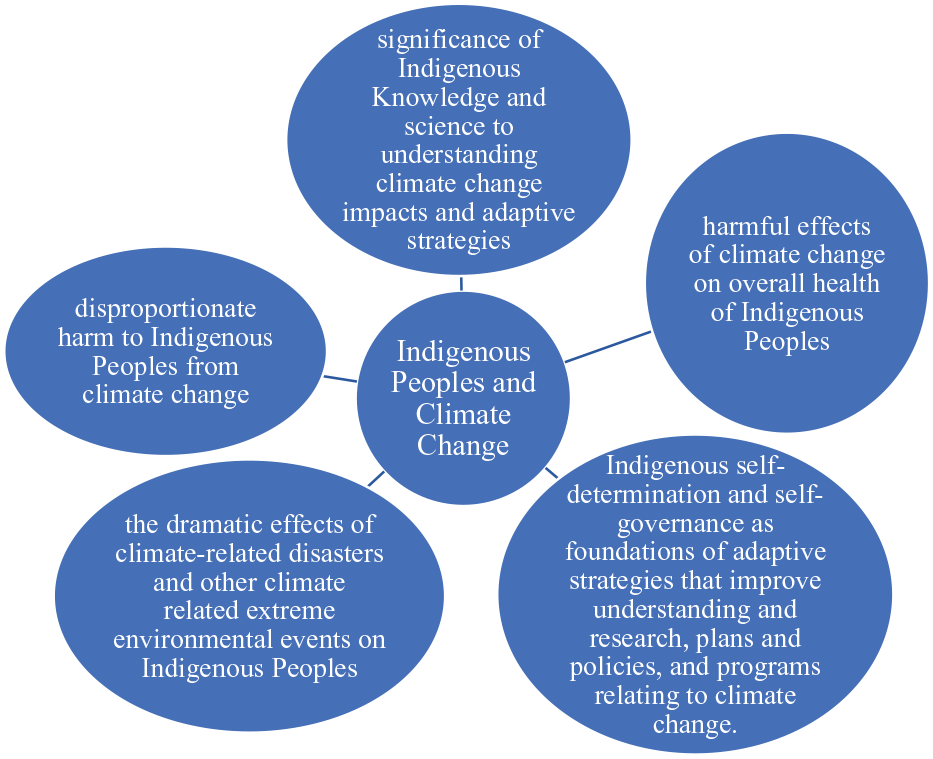
A diagram based on the five key points from the AR6 WG II chapter 14, section 14.4 (Hicke et al., 2022).
The cross-chapter box presents a global scale perspective on terms referenced like Indigenous Knowledge and local knowledge. The authors of this section state with very high confidence that adaptation efforts have benefited from the inclusion of Indigenous knowledge and local knowledge (Hicke et al., 2022). Examples of Indigenous Knowledge and local knowledge about climate change used in the AR6 WG II are included here to illustrate the significance of Indigenous Knowledge and local knowledge in understanding and adapting to climate change. Regional case study summary from Africa, Arctic, Latin America, Māori (Indigenous people of New Zealand) and Skolt Sámi (Indigenous people of Finland) included here further highlight the significance of Indigenous Knowledge to the ARs.
This section describes the pluralism of knowledge that emerge from oral traditions, local engagement of multiple spaces, and Indigenous cultures. They alert the readers to the inaccurate portrayals of Indigenous Knowledge as inferior to science when the questions of data validity are raised and the use of dominant language to communicate Indigenous Knowledges is required. They state with very high confidence that Indigenous Knowledge and local knowledge can shape how climate change risk is understood and experienced and express the possibility of developing climate change solutions grounded in place-based experiences and the development of governance systems that match the expectations of different Indigenous Knowledge and local knowledge holders. They also mention the importance of free and prior-informed consent but point out that ongoing consent is necessary for co-production of knowledge.
Ethically and equitably widening the IPCC knowledge base
The IPCC knowledge base consists largely of peer-reviewed and internationally available academic literature with very few selected non-peer-reviewed ones. Orally transmitted knowledge that do not appear in international peer-reviewed academic journals are not included in the ARs. The knowledge base is assessed through Euro-Western scientific lens to produce the ARs (van Bavel et al., 2022). It is clear that the increase in Indigenous-focused content over time in the IPCC does not necessarily equate to ethical and equitable engagement with Indigenous Knowledge Systems across chapters or across WG reports of the ARs. There is still much that needs to be done (van Bavel et al., 2022). The current global framing of climate change is not sufficient to understand the uneven and divergent responsibilities, knowledges, impacts and capacities to respond to climate risks (Carey et al., 2014). Diversity of experience and voice are both necessary to understand climate change (Rout et al., 2024; Standring, 2022). Yet, “in practice, the commitment to diversity is often reduced to a box-ticking exercise in which the benefits of diversity are left unreflected upon in favor of numerical targets or quotas” (Standring, 2022, p. 70). The IPCC cannot claim to offer a comprehensive account of the challenges posed by climate change, its root causes, drivers, and different possible strategies for addressing it without taking a plural epistemological approach that considers the knowledges and experiences of those who are systematically marginalized and directly affected by climate change. Numerically increasing Indigenous mentions does not mean there is an ethical and equitable engagement with Indigenous Peoples and Indigenous Peoples’ Knowledge.
To ethically and equitably widen the knowledge base of the IPCC, van Bavel et al. (2022) describe a two-pronged approach. They stress that widening the knowledge base is about engaging with diverse knowledge systems and forms of evidence rather than simply including more diverse peer-reviewed literature. The first approach involves engaging with Indigenous Peoples directly and providing opportunities for partnership and direct participation in the IPCC process. They write, the “starting points would be having IPOs [Indigenous Peoples Organizations]; supporting Indigenous authorship/leadership early and often in the assessment cycle; recognizing Indigenous peer-reviewed processes; and citing Indigenous-led materials in reports” (van Bavel et al., 2022, p. 123). Their second approach involves prioritizing co-production of knowledge, where multiple distinct and separate paradigms are applied simultaneously at all stages of knowledge generation (Tengö et al., 2014; van Bavel et al., 2022). Discussing Indigenous authorship, they recognized that
ensuring the integrity and robustness of a contribution can be very challenging when facing word limits, restrictions to peer-reviewed sources, requirements to fit into a Western framing, and comments from other authors, expert reviewers or government representatives who do not understand Indigenous Knowledge systems, Indigenous Peoples or Indigenous rights. (van Bavel et al., 2022, p. 122)
van Bavel et al. (2022) point out, and I agree, that the burden of furthering understanding between Indigenous Knowledge Systems and Western science has largely fallen on the shoulders of Indigenous Peoples and Indigenous academics who understand the distinct cultural context of the Indigenous world and who are trained in the Western or non-Indigenous academic realm, and therefore have an understanding both systems. These individuals can act as bridges, but they are rare and usually fill multiple roles (van Bavel et al., 2022). There should also be an active outreach to IPOs to become accredited members if IPCC expects more Indigenous participation. So far, by the summer of 2025, the Inuit Circumpolar Council and the Assembly of First Nations are the only two IPO members in the IPCC with abilities to nominate workshop participants, authors and reviewers.
Building on the progress made in AR6, the next cycle has an opportunity to deepen and expand its commitment to Indigenous authorship: (a) by creating dedicated spaces within the ARs for Indigenous climate change studies; (b) by inviting Indigenous authors with relevant expertise (not restricted to academic qualification) to lead and contribute to chapters in WG I, WG II and WG III; and (c) by allocating institutional resources to support participation of authors at all levels especially those joining from non-elite, Global South contexts. Tokenistic inclusion of Indigenous authors will amount to performing inclusion without meaningful participation in the overall AR7, overshadowing even those chapters that make significant progress in centering Indigenous voices, aspirations, experiences and wisdoms. Review of the AR6 shows that inviting Indigenous climate experts and knowledge holders to contribute to chapters in a leading influential role paves the way to meaningful inclusion of Indigenous content. Inviting Indigenous authors without any space dedicated for Indigenous Peoples’ expertise and epistemologies limit their level of engagement and impact. To encourage participation of Indigenous experts and knowledge holders from Global South contexts, adequate resource needs to be allocated by the IPCC bureau. The AR authors are currently not compensated for their contribution. This process thus privileges institutions and individuals in a position to redirect their time and resources to author the ARs, leaving out those who cannot.
I now turn to AR7 to further the goal of widening the IPCC knowledge base, The AR7 assessment cycle began in July of 2023 with the election of the new Bureau. The targeted completion date is 2030. It can be expected that the AR7 cycle will continue to include more Indigenous content with greater calls for inclusion of Indigenous authors and Indigenous Knowledges in the AR processes—scoping, authoring, reviewing, and editing, supported by the extensive expertise within and readiness from Indigenous Peoples to engage with the IPCC (van Bavel et al., 2022). With that prospect, the open question now is: What will the increase in Indigenous content look like, and will it be both ethically sourced and intentionally inclusive of Indigenous Peoples?
Against extraction
When Indigenous Peoples’ Knowledge is accessed by dominant climate change research, studies have shown that they are largely extractive in nature with significantly less that are co-produced (David-Chavez & Gavin, 2018; Klenk et al., 2017). David-Chavez and Gavin (2018) note that Western scientists too often re-enact the extractive nature of colonialism through the dominance of the Western positivistic approach over different worldviews by writing on behalf of Indigenous communities, or trying to interpret their adaptation approaches without invitation (Liboiron, 2021; Smith, 2021). In their introduction to the special issue of Climate and Development focusing on Indigenous knowledge, AR6 lead authors Caretta and Morgan (2021) argued that while there has been a push for evidence-based approaches in the integration of Indigenous Knowledge in formal academic assessments similar to the IPCC, for example, the Intergovernmental Science-Policy Platform on Biodiversity and Ecosystem Services (Tengö et al., 2014, 2017), practitioners of positivist Western science still tend to devalue Indigenous Knowledge and neglect its centrality to the ongoing process of adaptation to climate change. Petzold et al. (2020) noted that “future primary research with Indigenous Peoples and about Indigenous Knowledge should engage with the decolonization agenda, in order to avoid an extractive approach to knowledge generation” (p. 14). They concluded that international assessments such as the IPCC need to consistently assess existing evidence across regions, acknowledge the diversity of types of adaptation, attributes of Indigenous Knowledge, and include research approaches with diverse conceptual backgrounds relevant to Indigenous Knowledge (Petzold et al., 2020).
The literature on the Himalayas helps us illustrate the need for consistently assessing existing evidence across regions. There is no lack of international peer-reviewed academically produced papers involving Indigenous Peoples and Indigenous Peoples’ Knowledge from the Himalayas that will meet the IPCC knowledge base requirements. It is very likely that the AR7 will find a rich pool of literature from the Himalayas for its Indigenous content if they are uncritically and tokenistically engaged with. Petzold et al. (2020) found that the strongest clusters in the existing academic literature on Indigenous Knowledge on climate change adaptation are in rural areas in the tropics, subtropics, and drylands, especially in East and Southeast Africa and the Himalaya. David-Chavez and Gavin (2018) had previously found that the most prominent geographic clusters where Indigenous Knowledge systems have most often been accessed for climate research were in the North American Arctic, Sub-Saharan East Africa, and the Tibetan Plateau region of the Himalayas. But they also found that on a global scale the vast majority of climate studies (87%) were found to practice an extractive model in which researchers use Indigenous Knowledge systems with minimal participation or decision-making authority from communities who hold them (David-Chavez & Gavin, 2018). In Khumbu, the Mount Everest region of northeast Nepal, where I come from, Maicen Stuart (2024) showed that Sherpa are rarely involved in climate change research besides tokenistically representing them as recipients of the science or as high-altitude assistants for the research team. Using extractive climate change research in the AR7 magnifies initial harm done to Indigenous Peoples by climate change studies due to IPCC’s elevated status as the authoritative body that summarizes climate science for the global community. The AR7 should involve a mechanism to identify the types of literature they are relying upon, and be transparent about their choices of literature across all chapters of the three Working Group reports. The rationale for choosing the literature needs to be outlined clearly in the main reports, the SRs and especially in the summaries for policy makers. Klenk et al. (2017), David-Chavez and Gavin (2018) and Petzold et al. (2020) illustrate how the extractive nature of the literature could be identified. Without an intervention at the knowledge base level, Indigenous Peoples and Indigenous Peoples’ Knowledges will continue to be legible only through extractive relationships in the IPCC AR processes while continuing to promote epistemic Eurocentrism. The Knowledge Justice Collective is currently devising a knowledge justice protocol to test the quality of Indigenous content of each of the chapters in the AR7. The objective of the protocol is to enable the readers to know where each chapter sits within the knowledge justice framework. This protocol will be made available through a subsequent publication.
Carmona et al. (2023) point out that the limitation of the IPCC to an ethical, value-based and epistemological commitment to Indigenous Peoples in the AR6 could be attributed to “a misunderstanding of what Indigenous Knowledge is, an inability to discuss respectful knowledge co-production frameworks and the near absence of Indigenous scholars across AR6” (p. 29). At the time of writing this article, the IPCC has already moved forward with the general outline for AR7. There has been no indication from the IPCC in adopting a plural epistemological approach to understanding, adapting or mitigating climate change. The physical science basis of climate change will continue to uphold epistemic Eurocentrism with reductive approach to engaging with Indigenous Peoples’ Knowledge, if any. As such, AR7 is expected to center Euro-Western science and most of the Indigenous content can be expected to appear in the WG II report with significantly less in WG I and WG III. This pattern is a reflection of the IPCC’s misunderstanding of Indigenous Knowledge as only useful to understand Indigenous Peoples’ vulnerability or to support Euro-Western scientific studies with case studies, and not as credible bodies of knowledge in their own right to diagnose the problem and find solutions to better living with climate change. Measuring Indigenous Peoples’ Knowledge against the Euro-Western standard, and ignoring contributions of Indigenous climate change studies (Callison, 2024; Whyte, 2017, 2020) leads to the misunderstanding of Indigenous Knowledge.
Returning to the Himalayas
Three years after the flood in Mustang, closer to my home, in Khumbu, a glacial lake outburst flood (GLOF) destroyed Thame, one of our culturally vibrant and historically important Sherpa villages. The source of this GLOF was a recently formed glacial lake, which had not even appeared on the radar of earlier climate studies. Even if it had, the relatively smaller size of the lake would not have warranted a scientific study in this high-mountain environment that also has bigger lakes, considered to be highly critical. Some community members who had traveled through this area had noticed the growing risk but the inability to regularly monitor the area meant that there was no way to properly address it. The villagers in Thame and others downstream are still dealing with the cascading effects of the GLOF from August, and many are still waiting for relief, months later. Further below, in the lower lands, Nepalis experienced 2024 as the year of fires and floods. Green hills turned brown; moisture in the soil evaporated; and smoky haze covered the sky for weeks in the spring. Autumn began with heavy rain flooding in September that killed more than 200 people and destroyed countless homes in the capital city. Outside the city, road connectivity to rural villages in the mountains was cut off as bridges got washed away and landslides blocked the roads. Families were unable to reunite for the important annual Dashain (a Hindu religious festival). If we pay attention to Indigenous climate sciences, done for and by Indigenous Peoples and grounded in Indigenous worldviews, ontologies, and values (Stein et al., 2024), from communities living with firsthand experience of climate change impacts and the past IPCC ARs, we know that the likelihood of extreme weather events and climate change related natural disasters occurring is high. In 5 years, when the AR7 comes out, Indigenous communities from the Himalayas will have experienced more disasters, lost more, and continued to grieve possibly without a respite. It is likely that the Himalayan knowledge base for AR7 would be plenty of Indigenous content that reflect the priorities of Euro-Western science and not the lived realities of Indigenous Peoples. So, the question is: What would meaningful inclusion of Indigenous content in the AR7 from the Himalayas and places like it look like, where extractive climate research is plenty and peoples’ lived realities are shifting rapidly?
Footnotes
Acknowledgements
I acknowledge all Himalayan community members I have learned from over the years in the Himalaya and the diaspora. Laxmi Gurung and Yungdung Tsewang taught me how climate change was impacting their communities in Mustang. My community in Khumbu taught me how to live with climate change. I also acknowledge members of the Knowledge Justice Collective. Without their contribution, this article would not have been possible. Thank you, Charlotte Taylor, Declan Taylor, Eric Nost, Kristyn Gillis, Ramudi Samarasakera, Ritodhi Chakraborty, Sayano Izu, and Thanh Le.
Author’s note

Funding
The author received no financial support for the research, authorship, and publication of this article.
Declaration of conflicting interests
The author declared no potential conflicts of interest with respect to the research, authorship, and publication of this article.
Glossary
Dashain a Hindu religious festival
Māori Indigenous people of New Zealand
Sherpa Indigenous people of Nepal
Skolt Sámi Indigenous people of Finland