



Abstract
Strength-based approaches with Indigenous populations are recognized as empowering and promoting change, but there are minimal published explicit examples in Indigenous health in Canada. Working with three First Nations community partners in Alberta and the Northwest Territories, we explored an Indigenous strength-based application of Forum Theatre as a tool for mental wellness. Forum Theatre is differentiated by the interactive participation of the audience, who can change the play outcome. Collectively, community members were trained as community facilitators and used an Indigenous strength-based approach to indigenize Forum Theatre activities. We share strengths highlighted in our approach including inclusivity, relationality, language revitalization, intergenerational connectivity, team facilitation, partnerships, protocols, safety, empowerment, resilience, community connection, community-specific strengths, and relational responsibilities. An Indigenous strength-based approach must include the Indigenous group leading the project and has multiple benefits to the participants, facilitators, and community at-large, particularly when intertwined with relational, communal, and cultural assets.
Keywords
Introduction
In Canada, the Truth and Reconciliation Commission’s 2015 Calls to Action triggered academic indigenization and decolonization, particularly in the health, education, and social work research fields (Tamburro, 2013; Tuck & Yang, 2012). Indigenizing and decolonizing research opens dominant Western and Euro-centric conversations to include Indigenous worldviews, knowledge, and epistemologies (Kuokkanen, 2008; Smith, 2012). Indigenous scholars qualify health approaches as decolonial when Indigenous partners are supported to indigenize wellness interventions by strengthening and building on unique cultural and communal assets (Monchalin et al., 2016). Decolonized research includes collaborating with Indigenous partners, indigenizing interventions according to distinctive characteristics of an Indigenous population—such as language, knowledge, and cultural protocols and values, and utilizing a strength-based approach.
In 2018, we commenced a community-based research project with First Nation community partners to use techniques of Forum Theatre in promoting mental wellness—as a form of suicide prevention. We aimed to explore indigenizing Forum Theatre across different Indigenous communities using a decolonized approach. Our secondary aim was to understand how communities approached this project from a strengths-perspective. Using a community-based participatory research approach through an Indigenous research lens, our partnering communities supported trained community facilitators in leading the Indigenous strength-based application of Forum Theatre activities. Community facilitators and researchers co-authored this article to reflect both experiential and academic insights and perspectives. Our focus in this article is on how we indigenized Forum Theatre based on community assets, built strengths to promote mental well-being, and recognized benefits of the process.
Background
Forum Theatre
Forum Theatre, which falls under the umbrella of Theatre of the Oppressed, was developed by Augusto Boal (1985), who was a Brazilian educator, cultural activist, and dramatist. Boal was inspired by the work of the educator and theorist Paulo Freire (1993), specifically his critical Pedagogy of the Oppressed. Critical pedagogy builds on individuals practicing critical consciousness through political acts and social justice to liberate themselves and others from oppression (Freire, 1993). Oppression is defined as both a state and process where one group or person is more privileged or powerful than another and uses that influence to maintain their dominance (David & Derthick, 2014).
Boal commonly depicted the elements and process of Theatre of the Oppressed as a tree (Boal, 2006). The soil consists of the ethics, philosophies, politics, histories, and economies which have shaped the lives, worldviews, and perspectives of participants and their communities. The activities are rooted in the images, sounds, and words that emerge from this soil. The base of the trunk—the foundation of Theatre of the Oppressed and Forum Theatre—are the games which “bring together [the] essential characteristics of life in society” (Boal, 2006, p. 4) by combining rules with creative freedom and laughter. At the top of the trunk is Forum Theatre, which is the foundation for all forms of Theatre of the Oppressed. While Forum Theatre is the best known and most practised form of Theatre of the Oppressed, other forms are commonly depicted as branches of the tree. As the activities we describe in this article were specifically done in preparation to produce a forum play, we refer to them as Forum Theatre activities rather than Theatre of the Oppressed activities.
Forum Theatre builds on use of games and image work to produce a short play, which is structured to reflect an oppressive situation of concern that has emerged (Boal, 2002). The production is shown to a community, where the Joker, the on-stage link between the play and the audience, encourages the audience to interact with the actors as spect-actors to find alternative outcomes to multiple oppressions (Boal, 2002). This presents an opportunity to imagine solutions collectively using available resources and community strengths.
The context and facilitation process has emerged as crucial in shaping the success of the Forum Theatre activities, particularly with Indigenous populations (Goulet et al., 2011). In addition, Forum Theatre activities have been postulated as a multipurpose tool for Indigenous communities to use in language restoration and acquisition and healing from historical and individual traumas (Driskill, 2003).
Strength-based approaches
Strength-based approaches are premised on applicable ideas that have worked well or are currently working for a community (Tsey et al., 2007). Utilizing a strength-based approach supports community decision-making power in research (Smith, 2012), empowerment of participants and partners, and social change (Anderson et al., 2011). These approaches do not lessen or overlook issues (Sasakamoose et al., 2017), but rather shift focus away from individual deficits towards causative structural or contextual roots (Snowshoe & Starblanket, 2016). However, despite the acknowledged benefits of strength-based approaches, deficit-based approaches are more commonly used in health research and with Indigenous Peoples (Blodgett et al., 2013). Such approaches focus on individuals’ shortcomings, impeding their capacity to address problems (Sasakamoose et al., 2017) and forcing a dependency on external resources for solutions. In contrast, strength-based approaches are used to recognize and engage the multifaceted assets and resources of individuals, families, and communities to prevent and tackle challenges (Kana’iaupuni, 2005; Sasakamoose et al., 2017). Although strength-based approaches are recommended in Indigenous community research to challenge health inequities (Thurber, 2019), they are vaguely defined and explained (Fogarty et al., 2018).
Indigenous strength-based approaches to wellness should facilitate indigenizing and decolonizing practices. Everyday actions that perpetuate indigenization and decolonization kindle community resurgence efforts for transformative change, including in health (Corntassel & Scow, 2017). Addressing colonialism is a key determinant in addressing Indigenous ill health (de Leeuw et al., 2015). Forum Theatre with Indigenous youth has been specifically identified as a health intervention that could provide the space necessary for decolonizing experiences (Goulet et al., 2011).
Research design and methods
Research design
Although this article is focussed on our strength-based approach, we will briefly describe the overall research design to provide context. Our research was conducted with community partners and members from Heart Lake First Nation, Frog Lake First Nation, and Yellowknives Dene First Nation in Alberta and the Northwest Territories, Canada. Our approach was based on the belief that Forum Theatre implementation and adaptation needed to be directed by communities. Community partner organizations played an active role in deciding the duration, location, and goals of each training session. They recommended community members for facilitator training based on availability, background in mental wellness programming, connection with youth, and other locally relevant assets.
Regular Forum Theatre facilitator training sessions were held over a 2-year period. Approximately 45 different community members were trained, and about half of these actively facilitated Forum Theatre activities in their community at least twice following training. Those who did not continue facilitating either preferred to support the initiative as a community member or had changes in careers or life circumstances. The participants who actively facilitated in their communities provided feedback to the strength-based process, with a core group committing to fully exploring the process and authoring this article.
As part of tracking the process of an Indigenous strength-based approach, community partners, community facilitators, and researchers debriefed after each training session and shared any insights in sharing circles, in-depth conversations, and storytelling or conversational interviews following an Indigenous methodology. We used audio recordings, photos, and videos to track the progress and effectiveness of the training sessions and community facilitation. In addition, some community facilitators, including the authors of this article, took on co-researching roles and regularly wrote personal reflections and field observations and participated in the analysis process. Data analysis was reflexive, iterative, and collective and in line with an Indigenous methodology (Wilson, 2008). We finalized themes of the assets we used in indigenizing the Forum Theatre process through a combination of interpretive meaning-making analysis and modified collaborative story analysis (Hallett et al., 2017), where we emersed ourselves in the training sessions data and made meaning through group discussion and our analysis notes.
Community facilitators worked with different types of participants in the communities varied as community partners integrated activities into existing events—such as cultural camps—and programming—such as schools, family nights, and adult courses. Although, we largely targeted youth aged 12 to 20 years, participants also included Elders, families, teachers, adult learners, parents, elementary children, and toddlers.
Forum Theatre training cycle
Our Forum Theatre training process followed that originally proposed by Boal (2002) and adapted by Michele Decottignies of Stage Left Productions (personal communication, December 6, 2018) as shown in Figure 1.
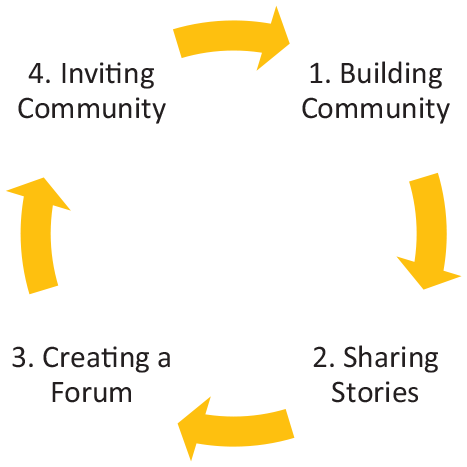
Forum Theatre training cycle (M. Decottignies, personal communication, December 6, 2018).
Introducing Forum Theatre techniques in a typical community facilitator training workshop started with playing games to develop relationships, trust, and communication in the Building Community stage. We first focused on reinforcing respect and safety for ourselves and the group through games that helped us learn each other’s names, introduced touch, and got everyone involved. Setting respectful and safety boundaries was followed by de-mechanizing from our daily routines, which got us out of our head and into our body. This was accomplished by playing games relating to using different senses, ways to deal with nerves and discomfort, and building trust to get to know ourselves and others as a group. For example, de-mechanizing and settling into our bodies might occur in a game like this is an ear where you would touch a body part on your partner such as an ear and call it a different name such as a foot and then your partner would touch your foot and call it something different such as an elbow. After we felt comfortable working as a team, a shift took place in our group dynamics. We unconsciously let down our walls and created an authentic environment where we developed powerful, genuine connections with each other. The change of environment created opportunities to discover our collective strengths through games that had us share group responsibility. This was where we spent most of our time in our training.
The second stage, Sharing Stories, involved making images through individual and group sculpting where participants modelled their bodies into images, like clay, using a variety of techniques. Participants usually shared their images with the larger group and focused on what resonated with them. They then made a collective image where they discovered the scene characters, interior monologues, actions, and dialogues. This process of adding movements, sounds, and words to an image is called dynamization. In this stage, we learned about story characters, topics, conflicts, plots, and dialogues. We focused on identifying protagonists with allies, antagonists with sidekicks, and bystanders in oppressive situations, and how these characters interacted in creating and solving problems.
The third stage, Creating a Forum, entailed making an anti-model play based on our image work. The play involved realistic problems facing the characters but did not have resolutions. Traditionally, this stage includes moments where catharsis occurs through dynamization, or bringing still images to life. For Boal, the only way for a participant to reach catharsis, and true liberation, was to purge internal fears relating to oppression (Schutzman, 1994). This was practised through acting within a similar situation to rehearse for real life (Boal, 2008). Boal assumed catharsis occurred when audience members actively suggested alternative actions during the forum, as they built motivation to tackle problems as a test run (Meisiek, 2004). Although Boal initially rejected the idea of catharsis as a goal or outcome of Theatre of the Oppressed because this implied an end to a process intended to be ongoing (Boal, 1985), he later acknowledged that catharsis—if interpreted as a removal of obstacles, and not the Aristotelian or coercive concept of removal of desires—(Boal, 1995) (Boal, 1995) is an integral part of the process. Achieving catharsis would occur through enacting one’s own experiences with oppression in the body during dynamization of images, typically in either creating the anti-model play or performing the forum. When creating the play, participants relied on their body and its self-knowledge to convert the images into a model. During this stage, we built a forum by playing with images of oppression to find what resonated among us.
In the last stage, Inviting Community, we invited a group of people to a forum play that we created. The play was facilitated by the Joker who introduced the actors and moderated the play. The Joker also facilitated the interactions between the audience and actors, thereby changing the audience from spectators to spect-actors who were involved in the play. The play was performed multiple times. During the first performance, the audience observed, identified, and resonated with scenes and characters. During the second performance, the audience participated by becoming a character to change the outcome. The rest of the actors remained in character and reacted to the spect-actor accordingly. The spect-actor would act out their idea, such as calling a spectator over to help during a bullying incident, and the Joker would work with the spect-actor and the audience to see what had changed and if they were satisfied with the new outcome. This may be done several times with different spect-actors for the same scene, until the audience feels satisfied with exploring the outcome or scene. The aim of the audience feedback and actions is to collectively determine solutions, which can then become action plans that are integrated into community programmes. The cycle restarts with a new group of people, commonly from the audience.
Results: indigenizing Forum Theatre through a strength-based lens
Below, we describe the general sequence of how we, as a team, and alongside other community facilitators, indigenized the Forum Theatre process customized to the strengths of each Indigenous community. We also provide insights of benefits we identified as we implemented our process.
Inclusivity and relationality
In preparation for community delivery, we wanted the Forum Theatre name to be more welcoming to not only those interested in theatre. The name should also suit the unique localities and culture of each community. However, we could not collectively agree on a suitable singular name as the tools were being multipurposed in several programmes in each community. Instead, we incorporated the activities under existing programming to draw an interest and be inclusive of many different participants, such as summer student training, school family night, community family night, youth night, and local celebrations. Although re-naming Forum Theatre was continuously open to discussion, one community facilitator’s input on changing the common reference of games to energizers was promptly accepted.
Today, [one community facilitator] expressed that the word games might perpetuate a childish connotation and may leave some adults and Elders not wanting to participate or feeling excluded. She suggested “energizers” instead and the rest of the team immediately agreed. She said that energizers also more closely explained what we were doing—“giving energy, giving life”. Tonight, the team consistently used the new terminology while facilitating. (L-A. Lines’ Field Notes, October 23, 2019)
During our training, we expanded on Forum Theatre introductions by including common First Nations practices that foster familial and communal relations. Our facilitator trainer focused largely on the individual participant’s characteristics and experiences. However, even in our training, we organically re-focused strengths beyond singular participants and acknowledged the strengths of participants’ relations to work, people, or communities:
Why are you here? Why did you choose to come to this workshop?
I really like hearing how people can use it after or in their own communities and I really like to see all the communities come together, work together too.
We use the tools in our training centre with our young Elders and older adults. I want to see our youth learn more. We had some really good times with the people from other communities.
The reason I am here is because back : home there are a number of youth getting lost in their thinking. What I do back home now is something I put upon myself to work with the youth to keep them out of trouble and open a recreation centre. I supervise probably 15 people every night, sometimes more. I am back to refresh on the games, so I could bring it back.
(Community Facilitator Sharing Circle, July 20, 2019)
Language revitalization and intergenerational connectivity
Indigenizing Forum Theatre by re-focusing on our relational strengths encouraged strengthening all our relations including people, experiences, spiritual connections, land, and environment. This was demonstrated when one community facilitator indigenized an energizer for connectivity using language revitalization techniques: The gift is my language. Before, I never used my language as much after residential school, I just used English. Only in the last ten years, I have started using my language more. [Using the language] in the group felt good. I felt in control. And I felt myself. When we came back in here [this afternoon] our energy was really low. I didn’t think we would last through the day. But right now my energy is really high [after facilitating the energizer in the language]. We are giving the gift to each other. That laughter, love, respect, and being together. That is where I see the gift of each one of you to have my energy high [because you all participated in speaking the language]. (Community Facilitator 2, July 21, 2019)
Following this moment, we shifted to facilitating what we could in our First Nation languages, which was a smooth transition because non-verbal language cues in Forum Theatre are universal and can be paired with any language. We modelled speaking in our traditional languages in the activities and found familial and community language resources. For example, we worked with local language teachers and Elders, incorporated more language activities, and supported local language revitalization efforts. Facilitating in our languages became a pillar of our indigenized Forum Theatre. When we facilitated energizers in our language, we changed the interactions, largely because of relationality and connectivity values built into our languages. For example, in our Indigenous languages, the way we referenced people in a group depended on our relationship with them. In English facilitation, we commonly referred to people as you, her, or them, or called them by their first name, but in Indigenous language facilitation, we referred to people as my friend or their cousin. These changes were simple but meaningful steps in language revitalization. For example, we easily added in language in one energizer where you pass bean bags to learn each other’s names. Before passing to someone named William, we added sàgįą meaning my friend in front of the name, so it would be sàgįą William. In our language, this was funny if the person you were throwing a bean bag to was someone with a different relation like a grandmother or boyfriend, but everyone understood it was to learn and practice different words. Language-based activities strengthened connections between different relations, particularly within families and between youth and Elders. For example, many youth connected with Elders by practicing their own language in a safe environment and felt proud of who they are, as explained by one community facilitator: The Forum Theatre activities really helped bring the youth and Elders together in a good way. They had so much fun. It closed the gap between them, like traditional activities used to do back in the day. They got to know one another a little better and youth practiced our language more. Trust became stronger between them. Youth left feeling a sense of community and more secure in who they are. (Community Facilitator 4, January 7, 2019)
Joint strengths, team facilitation, and community connection
As compared to common Forum Theatre practices, we increased the frequency of activities that focused on participants appreciating their strengths collectively. For example, we played many energizers where the youth worked as a group to achieve a goal. Appreciation of joint strengths led us to gravitate towards group facilitation. It dawned upon us that it was not only the youth working together that brought strengths to our communities but also us working as a team as well. People kept noting that we worked together like a well-oiled machine and we realized we preferred group facilitation in every Indigenous community. We indigenized the Forum Theatre facilitator from an individual or star to a group or constellation. After we team facilitated in one First Nation community, organizers noticed the similarities between their wellness team and our Forum Theatre team: The community said we functioned similarly to their [wellness] team where “each member of the team has different strengths, which lets us tackle issues more effectively”. (L-A Lines’ Self-Reflection, December 5, 2019)
Another community facilitator captured the personal transformational changes that led to her appreciating team facilitation in First Nation communities: I am stronger than I have ever been. I realized my own strengths and am being appreciated by others for my strengths. I am part of a team and our strengths fit within each other and make us stronger. Stronger for our communities, for our People. (C. Marty’s Self-Reflection, November 30, 2019)
We noticed our relational interactions as an Indigenous facilitation team brought strength to the community and inspired other groups to utilize their strengths. Community participants often commented that we complemented each other’s strengths, recognized our interconnectedness through our relations, and collectively created a sense of community. Our indigenized Forum Theatre process extended beyond participant involvement and built on our relations through familial, communal, and regional networks. Our work strengthened relational accountability and community connection, aiding in decolonization, as described in our team’s discussion below (October 25, 2019):
This made me realize what we are doing is bigger than what I thought it was.
What we are doing in our communities is beyond what we were trained to do.
We are developing new tools without even realizing it.
We have been stronger through making connections. We are decolonizing the process and through it, decolonizing ourselves. Indigenized Forum Theatre also means that this is for the people—we work for the people. That is the difference when it is in an Indigenous community, we are collectively decolonizing as a whole community.
Because even people that are not in attendance hear about what we are doing and add to our decolonizing efforts. We are also forming unique long-lasting bonds between communities in our efforts.
Community partners and protocols of respect
Travelling to each other’s communities sparked conversations about entering other communities appropriately. For instance, upon returning to one community, we were welcomed with excitement and advice that for longevity, it is necessary to understand local historical contexts and current political atmospheres. We grasped that indigenizing Forum Theatre must include traditional protocols of building relations between our team and each community. In taking this approach, we heavily relied on our partnering communities, who selected community members with specific strengths to encourage harmony and discourage tensions. For instance, all community partners purposefully included different gendered viewpoints and roles, particularly in deciding implementation in communities. In this manner, we brought balanced gender knowledge to indigenize activities in a culturally appropriate way. For example, certain activities introduced in our training were adjusted or not carried into the community because they were incompatible with our teachings about gender roles and respect, such as a game where you pile participants’ shoes. Most of these adjustments happened behind the scenes because the lessons entangled in different gender protocols are related to a First Nations’ way of life and providing an explanation of why the activity was inappropriate could be easily misinterpreted by someone not raised in this way.
We naturally followed common First Nations protocols of respect when entering new communities and honoured the important roles Elders held. In each community, we respectfully arranged a demonstration of the Forum Theatre activities specifically for Elders, honoured their advice with small gifts, and listened to their narratives of their community in relation to the past, present, and future. It felt right that we shared our Forum Theatre tools, sought advice from community Elders about the stories that youth communicated, and learned how we could best support the youth. As in many First Nations communities, Elders are respected story keepers and gatekeepers to new members in the community and assist them in understanding the changing political and historical atmospheres. The Elders’ involvement was key to facilitating effectively because they provided appropriate context around our activities.
Safety for empowerment and resilience
During our training, we started to dynamize images to create a forum that was inspired by our collective stories. As we were taught, Forum Theatre workshops have dynamization activities that encourage participants to replicate a cathartic moment to “[release] desires which societal constructions (such as family, school, or work) had imprisoned” (Boal, 1995, p. xxi). For example, during training, we participated in one activity that prepped us for dynamization. We had to find our own space in the room, think of a past moment of conflict, and vocalize how we were feeling in that moment. Many participants were yelling or crying as they relived moments of conflict. Some participants left the room with a co-facilitator and the majority that stayed found this activity and similar dynamization activities concerning. Most community facilitators felt this could be unintentionally harmful if done without the right safety, resources, and capacity training, as described below.
This type of work should not be done casually in our community. People could be triggered and require a lot of emotional support and follow-up. (Community Facilitator’s Self-Reflection, December 8, 2018)
We stopped the dynamization process and rethought how we could get similar results but with a higher level of safety for communities with their available resources. From our community perspective, when we worked with youth before learning dynamization, we indigenized the process by instinctively building safe environments. For example, instead of building images focused on problems, we focused on building positive images of strengths, love, and cooperation. We reflected on how and why we incorporated the safety of the group into the indigenized process as described below: As a team we aim to leave the youth with feelings of hope, positivity, and empowerment after each workshop. As facilitators and community members it is our responsibility to make sure our activities do that. (S. Anderson’s Self-Reflection, July 23, 2020)
At the next workshop, we repurposed a facilitation activity that used objects, rather than our bodies, as symbolic images to represent power and strength. We explored symbolic images and the dynamization process in the great game of power, where we used three chairs, one table, and one bottle of water to make images that demonstrated power differentials. Next, we changed the objects’ positions from representing images of oppression to images of strength. We felt safer making images out of objects to represent commonly witnessed oppressive moments. Using the objects, we discussed images and characters, and then used our bodies to mimic those images. By experimenting and moving the position of the same objects, we understood the influence a person with or without power has in a variety of situations as explained by the community facilitators below.
It’s empowering. You are working in the body and the mind. You feel this connection that demanded to be felt. The greatest thing about this whole thing is the feeling of being whole. Not empty. (C. Marty’s Self-Reflection, January 7, 2020) I feel drained, but at the same time, stronger than I’ve ever felt in a long time. (P. Stanley’s Self-Reflection, October 25, 2019)
We decided to facilitate dynamization in communities by only using objects. In our training, we Jokered one forum play alongside our trainer and performed as characters. We continue to more fully explore training and facilitating play development. However, we felt the activities leading up to developing a play were in themselves powerful in building empowerment and resilience among us, as community facilitators, during training.
Tailoring tools locally
We finished facilitating with a sharing circle, where we often heard of plans to utilize our activities. Through our indigenized model, we purposefully did not direct, control, or force the tools in a community. Instead, as visiting Indigenous members in another Indigenous community, we respectfully held time and space so community members could discover tools experientially, process our indigenized Forum Theatre model, and decide if and how these tools worked for their community. There was a natural tendency for continued community planning while we collectively cleaned up the venue. Community members combined the community’s prioritized issues with our indigenized Forum Theatre tools to meet their community goals. We saw how quickly and intelligently community members planned when they had the reigns:
I could do Forum Theatre with the Elders here [in the community], then I could do Forum Theatre with the kids in care, and that’s including the foster parents, the social workers, the supervisors, and the kids.
Ya. And making those relationships even stronger?
Yes. And even the senior citizens home and extended care [in the nearby town that houses some of their members] and playing some energizers.
So you are including them in it?
Yes.
We could also work together with the Elders and the Headstart [early childhood] program.
Yes we can do that.
(Community Facilitator Interview, December 13, 2019)
Holding space for each community to lead activities led to us tailoring the energizers, for example, by age—such as Elders or children, outcomes—such as enhanced family connection or language development, and location—such as an on-the-land camp.
Sustainability: responsibilities to our relations
Beyond the stages we learned in our formal Forum Theatre training, our collective critical dialogues underlined that our work must be sustainable in Indigenous communities. Indigenizing Forum Theatre required solidifying our relational strengths, which extends beyond the life of this research project. When we partnered with a new community, we understood the responsibilities we took on as Indigenous community facilitators, such as building supports and capacity.
In our work, we navigated these waters carefully in communities and constantly nurtured our new relations to ensure communities felt supported in our absence. This was different with the common Forum Theatre process where, particularly in developed countries, an outside Joker or facilitator works with a group of people, teaches the Forum Theatre cycle and leaves (Driskill, 2008). For the team, the traditional Joker, who comes into a community as a saviour and departs, was a Western construct and potentially could cause unintentional harm in Indigenous communities, as depicted in the conversation below.
When being a Joker, it is important to know the responsibility to be positive, the responsibility for what we do for people.
[Our Indigenous community facilitators] team is more trusted than other non-Indigenous facilitators. This is not about race; it is about truth.
It feels odd when other facilitators talk about implementing Forum Theatre in our communities.
Because they don’t have the same connections.
It is a job to those type of facilitators and that’s all it is. We see these types of facilitators faking relationships when they meet new clients, but not putting in the time to connect afterwards.
Like how you [all] connected to my community, by volunteering and cooking for the Elders. And, also made sure you kept in touch with relations you made previously in my community.
(Community Facilitator Sharing Circle, 25 October 2019)
Discussion
Our Indigenous strength-based approach honoured all our relations and built on our relational strengths. We saw this by who was invited into the work, how we introduced ourselves, and how we interacted. We indigenized the beginning of our Forum Theatre workshops by incorporating more time to explore our relational strengths. This approach encouraged appreciation of each person’s relational strengths and formulation of how these strengths could overcome adversities as a team. Further strengths we drew from in our indigenized process were language revitalization, multiple generations, inclusivity, team facilitation, and protocols of respect. We strengthened relations between generations, nations, and cultures through our shared histories, cultural and communal assets, and future goals.
In creating forum stories from our images, two central themes to indigenize this process involved our assets of understanding community safety and creating empowering opportunities for youth and community. The traditional dynamization of images through a cathartic moment was unsuccessful and met with concern from community facilitators. This was concerning because these kinesthetic activities opened wounds of colonization for healing (Driskill, 2008), which must be conducted safely when these activities are run without the supports and resources of a research project. Forum Theatre offers opportunities for decolonization, but only on the premise of having a safe and creative space (Goulet et al., 2011). We indigenized the dynamization process by more heavily focusing on using objects rather than bodies to make symbols. In this way, people felt secure to tell their stories, use their self-knowledge, and share common grievances and feelings in experiences where power was misused in a less deeply personal manner. Most importantly, this could be readily replicated by community facilitators with available community supports. Similar to another group working with Indigenous youth (Goulet et al., 2011), opportunities for employing strengths in a safe way encouraged participant empowerment to have power over oppressions.
Our brief participation in developing a forum play provided us with insights on the potential of this work to build resilience within youth and community, particularly when activities are indigenized to include more context, relations, and language. Our team delivery of indigenized activities strengthened community connections and built on relational accountability in the communities. These social communal dimensions, in part, form resilience and are used as markers in resilience assessments (Jefferies et al., 2019).
Questioning our common situations with power imbalances may have supported individual internal reflection, recognition, and resistance to the asymmetrical dynamics of the colonial mentality concept. A colonial mentality is an internalized oppression where the colonizer has been characterized as superior and the colonized as inferior (David & Derthick, 2014). Theatre work offers opportunity for participants to “learn what decolonization and healing feel like” (Driskill, 2008, p. 155). Although our work indigenizing Forum Theatre is a good start, we recognize we have just scratched the surface of the potential decolonizing benefits, as postulated in other uses of Theatre of the Oppressed (Driskill, 2003).
After community facilitators participated in the indigenized Forum Theatre, they saw immediate benefits and planned, modified, and incorporated the activities custom to their community’s specific resources, goals, and needs. Community facilitators tailoring the tools are aligned with recommended mental wellness strategies in Indigenous communities that prioritized community voice in community implementation (Ninomiya et al., 2020).
Indigenized Forum Theatre included our commitment to growing our relations by investing and upholding our community responsibilities. Many Indigenous communities commonly have Jokers or tricksters told in stories as lessons. The commonality among these tricksters is that they are usually connected to the community. Indigenized Forum Theatre extends beyond an intervention and instead supports Indigenous relational accountability, where Indigenous community facilitators take on new relational responsibilities.
Conclusion
The active involvement of Indigenous community partners and facilitators in leading the development of indigenized Forum Theatre exemplified an Indigenous strength-based approach in promoting mental wellness. We established strengths of the participants and their relations, built on those strengths in community application, and combined those strengths to encourage elements of self-advocacy and community resistance. In turn, using this Indigenous strength-based approach not only promoted indigenization of the research process but also strengthened our resurgence efforts alongside our respective communities. We became stronger in language revitalization, community connection, and incorporating our values, such as inclusivity and respect, as strengths in interventions. We recognized the power of an Indigenous strength-based approach in mental wellness to both address and overcome oppressive issues through employing and building on community assets.
Indigenizing Forum Theatre from a strengths-based approach shifted the focus of an extremely difficult topic to discuss, suicide prevention, to an actionable mental wellness intervention. Together with our community partners, we highlighted strengths including Indigenous traditional knowledge, ways of being, values, relationality, community assets—including people and existing programmes—protocols, responsibilities, and community goals that formed our strength-based approach. Recognizing, utilizing, combining, and building on the strengths of not only those participants directly involved, but also their relations, reinforced community facilitators’ and members’ efforts towards decolonization and resurgence. Our indigenized Forum Theatre activities provided tools to community members to develop and practice skills potentially transferable to individuals manoeuvring through the tangled emotional tensions in mental wellness.
An Indigenous strength-based approach must include leadership, voice, and direction from Indigenous members continuously throughout the project. Our project worked with a specific group of people from each community, as both partners and participants, and built on these relations. These voices are not representative of the entire communities, youth, or Indigenous populations. Our experiences were unique with the relations we brought together, and our indigenized Forum Theatre process is a starting point from a strength-based perspective. In further studies, we expect to see other ways of indigenizing the process and other strengths that were not yet recognized through our continued practice. Working with Indigenous people is key to Indigenous strength-based approaches, particularly because of the complex traditional knowledge and history gathered over thousands and thousands of years. Indigenous strength-based approaches are not a one-size-fits-all model. They must be developed in concert with Indigenous people who can relay the strengths relevant to the activity, relations, resources, places, and time for when, where, and why the approach is needed. In turn, utilizing a unique cluster of strengths for a specific purpose, such as mental wellness, will build on strengths, and will likely have unintentional benefits, such as strengthening language revitalization, intergenerational connections, or resurgence efforts.
Driskill (2008) questions the use of westernized Theatre of the Oppressed in Indigenous communities and noted the need to adapt “or create new techniques, that embrace the complexities and struggles” of Indigenous lives (p. 157). Our efforts in decolonizing Forum Theatre tools are a start to creating an indigenized Forum Theatre model for our communities that may find relevance to Indigenous communities elsewhere.
Footnotes
Acknowledgements
We would like to extend our sincerest thanks to all our fellow Forum Theatre community facilitators who helped us navigate our way through indigenizing Forum Theatre and grounded us in our Indigenous strengths. We would also like to thank all the Elders, research assistants, and community workers from the Yellowknives Dene, Frog Lake, and Heart Lake First Nations who made this research possible. In particular, we are grateful to Morning Sky Wellness, Yellowknives Dene First Nation Dechı̨ta Nàowo Post-Secondary Education Department, Yellowknives Dene First Nation Community Wellness Department, and Heart Lake Health Centre for their support and facilitation of our efforts. Thank you to Michele Decottignies and Stage Left Productions for teaching us about Forum Theatre and incorporating different teachings from other First Nations that opened the doors for us to feel comfortable to indigenize the work further. We thank the reviewers for helping us improve this article and their positive feedback about our research.
Declaration of conflicting interests
The author(s) declared no potential conflicts of interest with respect to the research, authorship, and/or publication of this article.
Funding
The author(s) disclosed receipt of the following financial support for the research, authorship, and/or publication of this article: This research was funded by the Canadian Institutes of Health Research (CIHR) under their Pathways to Health Equity for Aboriginal Peoples opportunity (Funding Reference Number OP2-151322). L-A.L. received scholarship funding support from the Vanier Canada Graduate Scholarship.

Glossary
sàgįą my friend