




Abstract
This article examines how older Tayal, an Indigenous people in Taiwan, regain, reclaim and renegotiate their identities by reconnecting to Hmali’ (the Tayal language), rgrgyax (mountains) and Gaga (the Tayal Law). A critical qualitative design informed by Tayal hermeneutics was used. In total, 14 bbnkis (elders) were interviewed, and the data were thematically analysed. The aim of this article is to contribute to the ongoing revitalization processes in Taiwan. Such revitalization processes often tend to reinforce the quest for authentic Indigenous identities, as if indigeneity could be reduced to a pale reproduction of how things used to be in the old days. Our findings show that indigeneity is not about returning to a fixed past. Instead, it is about writing back against the colonial framework that was imposed on the Indigenous peoples and, in that way, healing from trauma.
Introduction
Colonialism frames Indigenous peoples’ contemporary experience (Smith, 2012). From land management to education, from religion to identity, colonialism is part of the everyday lives of Indigenous peoples (Chi, 2005). In Taiwan, where this study takes place, Indigenous peoples have survived a multitude of colonial invasions, including Dutch, Spanish, Japanese and Han Chinese settlers (Kuan, 2016). In particular, from 1895 onwards, the Indigenous peoples in Taiwan have been dehumanized, their knowledge and traditions ridiculed, and their elders’ teachings eradicated by the colonizers (Hola, 2013; H.-J. Wu, 2019). Even today, many Indigenous communities continue to experience political colonization compounded with economic colonization, such as mass tourism, including the community examined in this study (Chang, 2003; Hsia, 2010).
In 2016, the Taiwan government officially apologized for imposing militaristic expansion, assimilative policies, economic exploitation and commenced the process of transitional justice (Office of the President Republic of China (Taiwan), 2016). This marked a milestone of recognition politics and opened more space for Indigenous peoples to gain a larger share of political, social and cultural rights. There are 16 Indigenous peoples recognized in Taiwan (Gao, 2021). The Tayal, comprising some 93,900 persons, are the third largest group (Council of Indigenous Peoples, 2022). As part of the ongoing revitalization process among Indigenous peoples, the concept of indigeneity is becoming increasingly topical. Originally, the term indigeneity was coined to distinguish between those who were Indigenous and the others (Merlan, 2009). However, while indigeneity may be useful to form solidarity among Indigenous peoples, defining indigeneity as a coherent and homogeneous group with one unified voice is certainly problematic (Toivanen, 2019). From a critical perspective, in line with the Mohawk scholar Audra Simpson, one could argue that the settler states have made indigeneity into a condition marked with dispossession and despair, where recognition and reconciliation are mere fallacies used to direct our attention away from Indigenous sovereignty (Simpson, 2014, 2017).
In Taiwan, the notion of indigeneity as a category is institutionalized in the Status Act 2001, in which an arbitrary line was drawn between two categories of Indigenous peoples: mountain people and plains land people (T.-S. Wang, 2015). The former refers to those who have an ancestral connection to the mountain administrative zone, whereas the latter refers to those who have an ancestral connection to the plains administrative zone (Gao, 2021; T.-S. Wang, 2015). As a result of this categorization, Indigenous peoples are treated as residents in certain geographical locations that are controlled by non-Indigenous authorities; thus, their inherent sovereignty and rights are effectively stripped.
There has been limited scholarship from the standpoint of the Tayal. Some publications by Tayal scholars do exist, however, such as a study on Tayal oral history (R.-S. Wu et al., 2014), a study on natural Tayal farming (Lo, 2016), and studies about the interconnection between the Tayal’s sense of space and the landscape (Chen et al., 2018; Kuan, 2013). There is also an ongoing activism-based project on how long-term care and the Tayal way of life are interlinked (Fang, 2017). As only very few Tayal know how to transcribe their hmali’ (language) in written form, most of the above-mentioned studies were published in Mandarin Chinese. The two first English volumes focusing on Tayal knowledge were published as late as 2021 (Gao, 2021; Shih & Tsai, 2021).
However, the subject of how Indigenous people in Taiwan negotiate their identities after having survived the harsh colonization has not yet been highlighted. In this article, we address this knowledge gap by examining the ways in which yutas (older Tayal men) and yaki (older Tayal women) reconnect to their own language, mountains and law as a way to reclaim their Indigenous identity. The aim of this article is to contribute to the ongoing revitalization processes in Taiwan. As illustrated in this article, indigeneity and revitalizing Indigenous cultures are not about returning to a fixed past. Instead, they are about writing back against the colonial framework that was imposed on the Indigenous peoples and thus healing from trauma. In order to better understand how such a revitalization process may take place, it is important to listen to the voice of the bbnkis (elders).
The Tayal context
Indigenous peoples, speakers of the Formosan branch of the Austronesian language family, have lived for more than 6,500 years in Taiwan (Blundell, 2009; Kuan, 2016). The Austronesian languages spoken in Taiwan had great diversity and features of proto-Austronesian (Li, 2008); therefore, it is assumed that Taiwan is one of the earliest human settlements—or conceivably the Austronesian homeland (Blundell, 2009; Li, 2008).
This article focuses on the experiences of the Tayal people. The word Tayal is composed of mita (look after) and rhzyal (land), meaning “to look after and care for the land” (Gao, 2021, p. 67). The gaga (moral order) and the Utux (Omnipresent Spirits) constitute the core of Tayal law (Hwa et al., 2010; M.-H. Wang, 2003). Traditionally, to be a Tayal balay, a real Tayal, you had to follow the Gaga from birth to death, and beyond (Gao, 2021). Moreover, a Tayal balay was allowed to have ptsan, a facial tattoo, which indicated one’s family background as well as status in the community (Gao, 2021; Yapu, 1999). In the Tayal mythology, only persons with ptsan can walk the bridge made of a rainbow to join the ancestral spirits (Yapu, 1999). Moreover, if you follow Gaga, you can maintain a balanced relationship with the Utux, a kind of life energy existing in the land, mountains, rivers, trees and animals. The societal order based on Gaga and Utux, and the meaning of being Tayal, were systematically eradicated by the colonizers (Barclay, 2017; Kuan, 2016). Examples of the eradication processes include policies that divided and thus weakened the Tayal communities (Yap, 2016), and expropriation of Tayal lands (Chang, 2003). During the colonization, however, the teachings of bbnkis have been increasingly marginalized. Traditions such as ptsan were turned from a symbol of glory into an embarrassment, and people were told that the Tayal language and culture had no practical use (Barclay, 2017). These social sufferings deepened the trauma across generations and not only estranged Tayal youth but delegitimized bbnkis, as illustrated by Hsia (2010). Rebuilding the Tayal sovereignty and Gaga have been central at the grassroot level in recent decades, as illustrated by the work of the documentary filmmaker and cultural educator Pilin Yapu (2005) and others (Siku, 2021).
Methodology
This study examines how the bbnkis reclaim their Indigenous identities by reconnecting to their hmali’, rgrgyax (mountains) and Gaga (sacred law and cosmology). We employ an Indigenous research paradigm in the form of Tayal hermeneutics to strengthen the relational commitment in exploring the perspectives of the bbnkis. This requires a process of decolonizing both the research topic and the researcher (Datta, 2018). Moreover, we consider that anthropologists “entering the field” and extracting what they need for their own research purposes “is not only rude, dismissive and disrespectful, but also unethical” (Gao, 2021, p. 160). Thus, in this project, we not only obtained formal ethical permissions (project number 577949), but the first author grounded herself in relationships through which accountability was upheld (Smith, 2012; Wilson, 2008). In a similar vein, data were produced in close collaboration with bbnkis. This was made possible by spending time in the community, allowing cultivation of respectful relationships and by giving space to the participants to talk about their own aspirations and worries related to the research theme, rather than focusing on our predefined questions. Also, we will share some of our findings with the community in different ways.
To collect data for this study, home visits and semi-structured qualitative interviews were conducted (Leech, 2002). Eight yutas and six yaki shared their stories. Ranging from 60 to 90 years of age, they all self-identified as Tayal and all of them had experiences traversing between the Tayal lifeworld and the world dominated by the colonial system—be it Japanese or Chinese. The bbnkis were asked to talk about themselves and their everyday experiences, focusing on what Tayal identity meant to them. They were also asked to share their views on well-being, as well as what they missed about the way of life of the past. As a form of collecting data in this study, qualitative interviews are compatible with the Tayal’s traditional cisan, or storytelling. Moreover, drawing on the perspective of a constructivist-grounded theory (Charmaz, 2005, 2006), we consider the conversations with the participants not simply as a way to collect data, but rather as a process of co-creation of knowledge in partnership between researcher and participant(s). The culturally appropriate forms of this kind of co-creation of knowledge in Tayal include cisan, meaning going for a visit, telling a story and engaging in storytelling, entailing a way of life as well as an informal, rapid and overlapping fluvial way of telling about everything; sli’, meaning rivers coming together and people gathering together; and malahang, which means care and caring between people, humans and animals, and, most importantly, with land.
To analyse the data and the lived experiences of the bbnkis, we used a reflexive thematic approach (Braun & Clarke, 2006) based on Indigenous foundations (Denzin et al., 2008; Kovach, 2009; Smith, 2012). In practice, this entails that it is important for us, the research team, to account for our relations to the field (Wilson, 2008). Thus, first, the authors grounded themselves in cultural protocols, read the transcripts and summaries of the interviews, and discussed key issues. Second, the research team joined in a collaborative analysis workshop to discuss the data and potential analytical foci for our article (Braun & Clarke, 2006, 2019). We agreed that the ways of reclaiming, regaining and renegotiating Tayal identities seemed to resonate with the voices of our bbnkis. We gave ourselves time to absorb the entirety of the stories by thoroughly rereading our data several times while trying to remember the rhythms and breathing of the community.
Findings
Each bnkis (Elder)’s experience comprises a piece of the wholistic tapestry of being Tayal. The three main ways for the bbnkis to reclaim, regain and renegotiate their identities will be elaborated in the following, focusing on how they reconnected to the following: (1) hmali’ sinbilan na bikisan, the tongue of their ancestors, which was partly lost due to harsh assimilation policies during colonial rule; (2) rgrgyax—the surrounding mountains where they grew up and (3) Gaga, the Tayal Law.
Losing and reconnecting with the Tayal language—Hmali’
The weakening of Hmali’ was identified by the bbnkis as a key area of loss. A cumulative emotional and psychological wounding across generations of the Tayal community can be identified in militaristic conquests, the assimilation policies enforced in schools where only the national language was allowed, tourism and interethnic marriages. As is illustrated below, reconnecting to the hmali’ was a means of resisting colonialism and a way for the people to reclaim their Indigenous identity.
In order to shed light on how Hmali’ was attacked in recent colonial history, a bnkis whose grandfather had been a local chief shared the following story: My grandfather and his people lived in the mountains, where there were a lot of cypress trees. Those trees were so huge, one could sleep on the tree stump. The Japanese wanted to make weapons out of those cypress trees, so they started attacking us. We Tayal people did not have any good weapons, and we were few in number. The Tayal men fought bravely, but they could not win. In the end, my grandfather was afraid that his people would be annihilated, so he decided to give my father—he was 10 years old at the time—to the Japanese police. This was followed by a negotiation between my grandfather and the Government-General [the government of Taiwan during the Japanese rule in 1895–1945]. The battle ended with the condition that my father would consent to receive a Japanese education. (Biru)
In this way, the participant’s father had become fluent in Japanese and, in the same vein, lost some of his familiarity with the hmali’. Most of the bbnkis we interviewed had learned to speak some Japanese, as well as other foreign languages, due to the explosion of tourism in the Tayal area from the 1930s and onwards. To make a living, several of the bbnkis in this study had engaged in tourism already when they were young, either in shops selling local delicacies and souvenirs or in the food industry, running local cafes and bistros. One of the bbnkis said, As a matter of fact, I learned to speak Tayal, and later Japanese, Chinese and even English to attract tourists! I had a photography booth and I employed 10 guys and 10 ladies working for me. The number of Japanese tourists was crazy! They swarmed into the village like ants! (Tali)
Since 1945, Mandarin Chinese was implemented as the only legal language in Taiwan. Many bbnkis remember being taught Chinese language in schools, as Hmali’ was not allowed. This experience of survival and adaptation played an important role in shaping their identities. One of the bbnkis said, Before, everyone spoke Tayal, our own language, but in school things changed. We had to speak Guó Yǔ [Mandarin Chinese]. The goal of the school was to make everyone speak Guó Yǔ. (Ciwas)
Mandarin Chinese became the norm not only in school but also in the society as a whole. One of the bbnkis who had worked for many years as a teacher at the local school noted, I worked my whole life as a teacher in the elementary school here, and most of the time at school I spoke Guó Yǔ [Mandarin Chinese]. After work, I practiced Tayal with the elders. Since the opportunity to speak our mother tongue [Tayal] was limited, I tried to speak it at home and in my daily life. It is still important that we do not forget our mother tongue. (Maray)
The conscious decision to speak—and thus maintain—Hmali’ at home can be seen as a form of resistance. However, this was primarily an option for families where both parents had Tayal as their mother tongue. However, interethnic marriages have been very common in the Tayal area over the past generations. Thus, several of the bbnkis in this study were married to a partner from China or parts of Taiwan where languages such as Hokkien or Hakka are spoken. In interethnic families, Hmali’ was often not spoken to the next generation. One participant noted, I used to speak Tayal all the time with my parents. I still remember I could not speak Guó Yǔ [Mandarin Chinese] before my first year at the elementary school. But I did not speak Tayal with my children. We spoke Guó Yǔ among ourselves. I think it was a good compromise and a reasonable standard; as I did not speak my husband’s mother tongue and he did not speak mountain tongue [Tayal], we chose to speak Guó Yǔ. All my children only speak Guó Yǔ. (Ciwas)
Behind this veil of practical compromise, however, it is not hard to speculate that the main reason for the language shift in the village was far more politicized, namely, involving the prevalence of Chinese as the norm.
A key reason in the weakening of Hmali’ today is that compared to the national language, it has not been considered useful for several generations. This conception has had very concrete consequences on the bbnkis’ lives. A bnkis in her 80s explained that already when she was a child, “Tayal was like old paint peeling off the wall. Everything was Guó Yǔ [Mandarin Chinese]” (Masako). She added, The government did not want us to speak anything else but Guó Yǔ. . . . I remember our elders who had not gone to school to learn how to speak proper Guó Yǔ. They were sneered at and laughed at wherever they went. What should we do? We had to go to school. (Masako)
Speaking Tayal continued for decades to be a reason to be subjected to punishment. A bnkis who was almost two decades younger than Masako shared his memory from primary school, during which the assimilationist monolingual policy that promoted Mandarin Chinese was in full swing: I could not speak Tayal language at school when I went to elementary school. I would be told to stand in the back of the class to have my time out while carrying a wooden sign that said “I do not speak dialects.” . . . You couldn’t even speak Taiwanese, only Guó Yǔ. . . . The committee told my mother not to teach me Tayal. Indeed, she didn’t. (Hakaw)
In addition to the situation where Mandarin Chinese was forced on them, many bbnkis talked about losing Hmali’ as a type of collateral damage while struggling to better succeed in society. For them, in order to climb the education and career ladders, one needed to have good performance in schools where only Mandarin Chinese was allowed. Thus, the bbnkis who tried to forge a good future for themselves ended up drifting further away from the hamli’.
The data show that despite the difficulties of retaining Hmali’, many bbnkis asserted that they considered the ability to understand and speak Hmali’ as key to their own well-being, as well as key to their own identity as a Tayal. One bnkis reflected on how her Tayal identity was tied to Hmali’: I am a Tayal. The Tayal are different from the Chinese, Japanese and Americans. We Tayal speak a different language. Each village speaks its own language. Some speak English, some speak Japanese, and we speak Tayal. (Ciwas)
An important way to make the bbnkis feel fulfilled and happy was for them to become grounded in their Tayal identity by relearning the hmali’. One bnkis shared that he decided to start learning Tayal because it resonated with something he held dear from his childhood memories: When I was in elementary school, all my mother’s cousins and families spoke Tayal. I heard Tayal everywhere on the street. When people visited my mother, they were all speaking Tayal. I sat quietly in the corner, listening to them. Especially when I had shorter school days, I would come back home to find a whole village of people speaking Tayal. I listened. That’s why I love the sound of Tayal—I am familiar with how it sounds. (Hakaw)
Hakaw started to relearn Tayal as an adult and found a profound strength in it, which supported his motivation to continue learning. Interacting with other Tayal speakers was mentioned as an important reason to remember and relearn the language. One of the bbnkis explained, Interaction is key. When I started to go back to the mountains, Tayal people came up to me and they spoke with me in Tayal. I understood what they said, and my memories were triggered automatically that I should have replied in a certain way. If I had lived in that environment, I’d say my Tayal language ability would have slowly but steadily come back. (Tamu)
In sum, we explore the way in which the bbnkis reclaim, regain and renegotiate their identities while focusing on how they reconnected to hmali’ sinbilan na bikisan, which was partly lost due to harsh assimilation policies during colonial rule. Our data indicate that revitalizing the hmali’ is not simply about returning to a fixed past, but rather about negotiating one’s identity and resisting multiple forms of colonialism.
Rgrgyax—reconnecting to the mountains
As hinted at in the citation earlier, the bbnkis explained that they have a special and important relationship with their land. Several explained that they viewed the geographical landscape around them as a way to reconnect to themselves and as a way to reclaim their Indigenous identities despite the partial loss of knowledge of Hmali’. Thus, going up to the mountains was a key expression used by most of our participants. As a bnkis succinctly noted, My happiest moment is to go to the mountains! To go up to the mountains and down to the rivers, to set traps in the mountains! I love to go to the mountains because I can catch boars, goats and muntjacs. My dad taught me how to fish when I was small, but not hunting because he was busy in local politics. I learned how to go up to the mountains to hunt and set traps from people around here after my military service. (Yukan)
The bnkis told that he liked to go into the rgyax (mountain) not only to catch fish and hunt boars, but also to try beekeeping, weeding and building a tatak, a traditional Tayal house, for his family. When asked why he wanted to build a tatak out of wood, he answered, “Because that is a house that defines who we are as Tayal” (Yukan).
Moreover, many bbnkis talked about their childhood memories of parents and grandparents working in the rgrgyax, growing vegetables, planting trees, fishing, hunting, gathering around the fire and eating together. As they grew up, many yutas moved from the mountains in pursuit of education, while many yaki stayed in the community and got involved in the tourism business. In both cases, childhood memories triggered a sense of peace and well-being grounded in the Tayal way of being. They also seemed to strengthen their connection with their parents. Thus, one bnkis stated that self-grown food brought back memories of helping his mother pound rice with taro, sweet potato and corn together in a luhung, a traditional Tayal cooking mortar. He noted, We planted our own peanuts, we planted our own sehuy [taro]. . . . The sweet potatoes and millet were planted by ourselves; we did not need to buy them from outside. It brought a warmth to my heart because this food came from my father and mother’s hard work. (Tamu)
The childhood memories from the mountains should not be romanticized, however. One bnkis described that childhood was like “living in the ancient times” (Noly), whereas others explained that they did not always have enough food. In addition, they had no electricity or reliable source of water back then. One remembered that she used a head strap to help carry loads of firewood, which were so heavy that it still gave her a headache just to think about it.
Going back to the rgrgyax meant for the bbnkis a continuation of this Tayal way of being. One bnkis, soon 90 years of age, noted how he enjoyed his daily routine of riding his motorcycle up into the rgyax early in the morning to work in the field. Often, he would come back to attend Day Club, before going back to his land in the afternoon. He said, I love working in the mountains. I am used to it! I was in the mountains when I was small, and it is good for my body. It gives me a sense of continuity. What makes me happy is to see all the vegetables growing. (Tali)
The bnkis explained that they felt a special relationship with their land through the food they grew and enjoyed. For them, food was not just a source of nutrients, but also a relational anchor to their own bbnkis and the land that their ancestors had lived on. Some bbnkis, however, were no longer able to work on the land and take care of their allotment. This meant that they felt deprived of a central part of their culture. One of the bbnkis with a frail body noted, My heart ached when I saw that the weeds were taking over. Without the weeds being pulled up, in a matter of one or two months, the vegetables cannot grow tall. Sometimes my children saw me climbing up [to the allotment]. They immediately stopped me because they worried, what if I fell down? “Dangerous!” they said. (Maray)
The experiences from the bbnkis demonstrate the key components of revitalization are embedded in the rgrgyax—animals, wooden house, taro, sweet potatoes, trees, fish, fire—both materially or practically, but also mentally through the memories of Tayal ways of living and being (Figure 1).
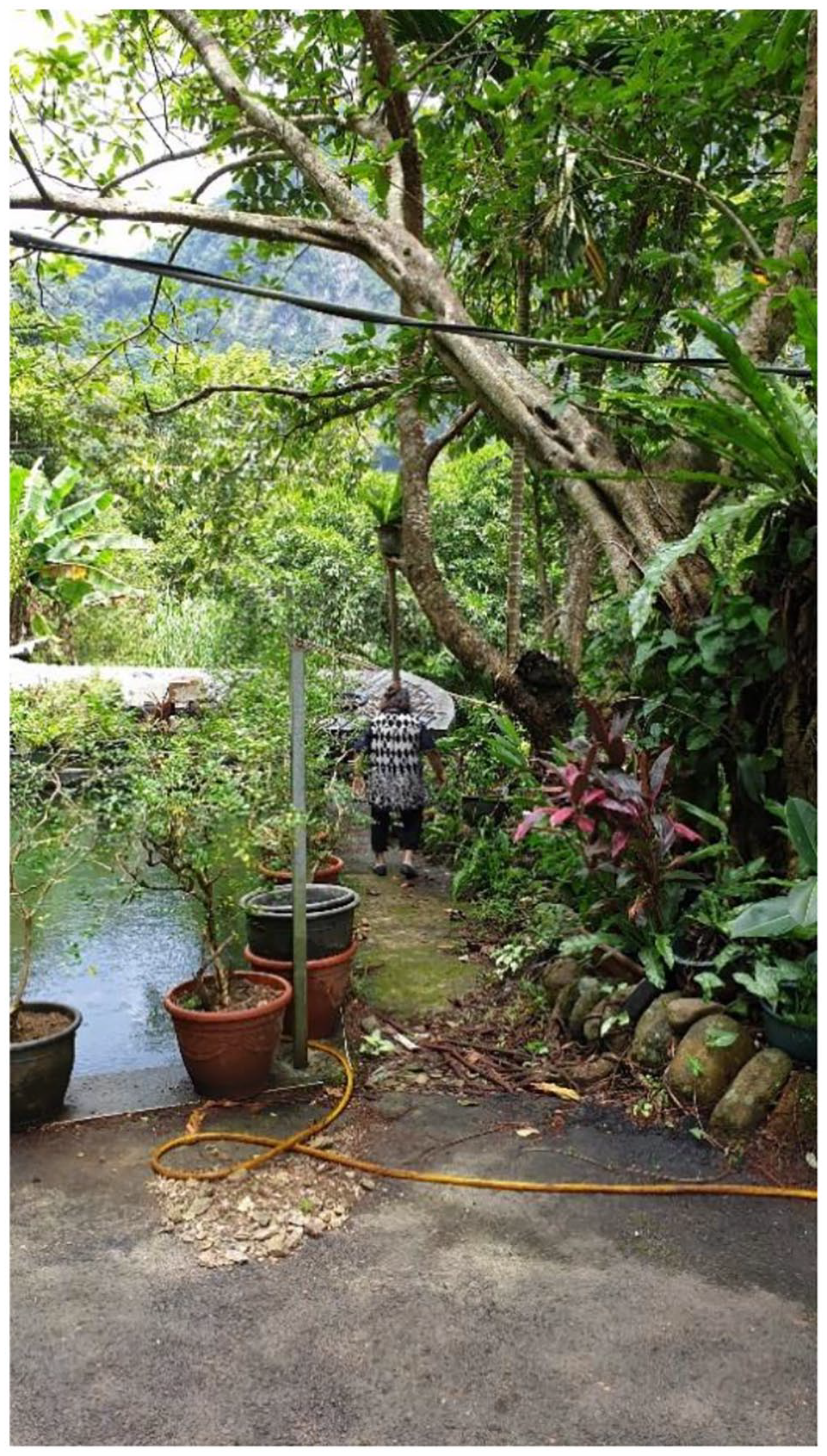
Going back to the rgrgyax (mountains) and reconnecting with the surroundings are important for bbnkis (elders) (Photo by Wasiq Silan, August 2020).
Gaga—reconnecting to the Tayal law
Gaga is at the centre of life of the Tayal. It is connected to ancestral and natural spirits, bringing a sense of purpose, morality and the criteria of being Tayal. Gaga is embedded in the rgrgyax and passed down orally through the hmali’. As a bnkis noted, Gaga was good for us Tayal. Gaga was good like the Bible’s Ten Commandments; it held us together. We always helped each other, and it was good. Sometimes we were exhausted because of work, but in our hearts we were happy, really happy. We came home happy. Life was simple and happy. Because of Gaga, there were no thieves. Even if you left the doors open, no one would take away your pila’ [money]. (Tali)
The bnkis described Gaga in terms of a source of order, which is closely linked to a sense of happiness. Within this understanding of Gaga, hard work is tolerable, and even to be celebrated. Hence, several of the bbnkis spoke of the importance of being responsible, working hard and caring for the family and for the land as a prerequisite for being a good Tayal. One bnkis explained, [For us Indigenous people] you have to work hard to survive. If you do not work hard, how can you expect your life would be good? . . . Our Tayal way of life is simple, yet we put a lot of effort and are committed to everyday work. . . . Like fathers used to go up to the mountains to hunt, our mothers used to stay on the land to take away weeds and plant vegetables. Their mountain used to be a vast area. (Ciwas)
The bnkis furthermore pointed out that working hard is also the core of qnxan (Tayal way of being and living). For one bnkis, Qnxan is the Tayal’s way of being and living. In one’s life, one must work hard. Working hard is like breathing for us. (Ciwas)
The Tayal term qnxan encompasses the act of doing: doing a range of things, doing for yourself, doing for others, and making sure to do it well. While Gaga was described as inherent in rgrgyax and Hmali’, it was also present in continual resistance and the renegotiation in the everyday lives of the bbnkis. A bnkis recalled, Gaga was the best. We were poor but very happy, and we did not need to worry about thieves. When we had food, young people gave to the elders to eat first. With Gaga in mind, Tayal helped each other and stayed united. When I was small, the elders told me that I shall not be lazy, speak no nonsense and shall work hard. One shall not deviate from Gaga. (Tali)
What happens if Gaga is weakened? A bnkis contrasted the current way of life in the community to the good old Tayal way of life where Gaga was strong: Back in the day, elders were very important. You could not speak nonsense to them. When you saw an elder, you needed to walk on the side to let them pass. The old days were good because there was respect, and one would never scold the elders like nowadays. . . . In the past, the Tayal had better manners, unlike the kids now who only want pila’. Now the parents are beaten by their children when they ask the children to work hard and find jobs. Young people only care about asking more money from their parents; if not, they’d hit the parents. They have no conscience. (Tali)
The weakening of Gaga is manifested in the dissolving of Tayal societal order. Does it mean that the Tayal just look the other way and let Gaga disappear? Indeed not. Resistance can be observed from the ongoing struggle of those who have the power to decide what is knowledge. One of the bbnkis who had worked his whole life as a teacher said, I went to the state-supported normal school and trained to be a teacher. What was taught to us was the Three Principles of the People, the ancient Chinese doctrine of Confucius and Mencius. That made me completely forget who I was. It was not until I returned to the community and started to develop textbooks in the Tayal language that I slowly realized, and it dawned on me, that I had been cheated by the government for 40 years! (Abaw)
With the strengthening of his Tayal standpoint, Abaw became reflexive about what others told him about Tayal identity and knowing. He explained that he was especially cautious about Han Chinese academics, who present themselves as Indigenous experts, and he asserted that the problem of his people is that they are no longer authentic. He said, I do not agree with what they [the Han Chinese experts] claim, that the Tayal language spoken here has been severely influenced and that therefore people here are not real Tayal anymore. I don’t think this is true. For me, Tayal is embedded in our everyday life; you cannot say that others are not pure, or the Tayal spoken here in the village is not so good. (Abaw, emphasis in original statement)
The frustration Abaw noted earlier was closely connected to the gap between the fixed past that colonial framework imposed, and the more fluid perceptions of Gaga.
The bnkis shared that returning to the rgrgyax (Figure 2), speaking Hamli’ and reconnecting to Gaga play a crucial role in defining what being Tayal means for them. These three aspects are crucial in understanding how to live well in the Tayal context, and they give context and direction to the concept of indigeneity.
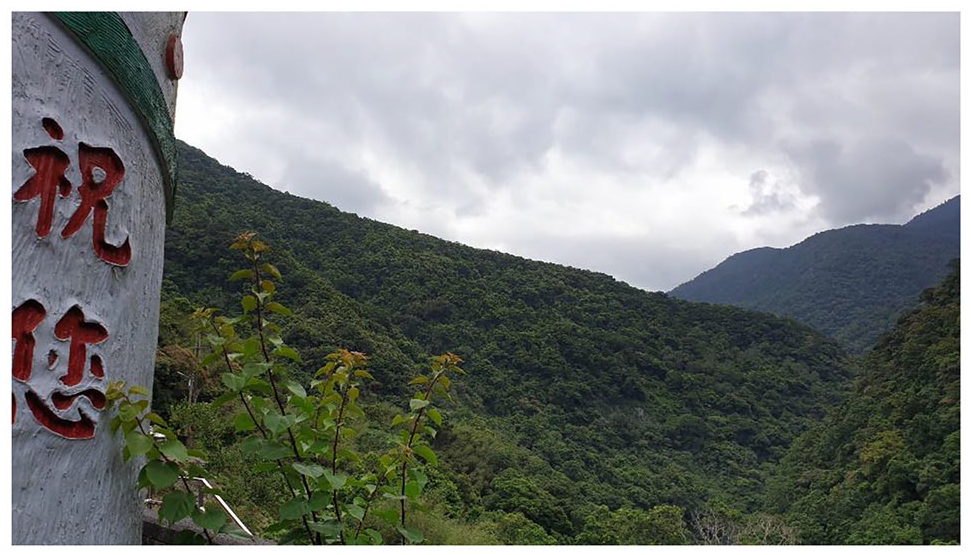
Mountain scene and Chinese language road sign wishing travellers a safe journey (Photo by Tamu).
Discussion
This article has addressed how Tayal bbnkis reclaim their Indigenous identities by reconnecting to Hmali’, rgrgyax and Gaga. In the following, we will discuss in what ways the bbnkis’ efforts to renegotiate their identities are significant as a bottom-up contribution for the ongoing revitalization processes in Taiwan.
First, our study shows that the harsh assimilation the Tayal people have suffered continues to manifest today, not the least in how they relate to Hmali’. Hmali’ comes from hmali’ sinbilan na bikisan, which literally means tongue coming from the ancestor. Our study indicates that adapting to changes while staying connected to Hmali’ in the increasingly multilingual everyday life is central to the identity as a Tayal. The colonizing processes imposed by the Japanese invasion, Chinese rule and the tourism boom impacted traditional practices and identities (Hsia, 2010). Today, however, mainstream society and school can easily challenge the linguistic value of Indigenous languages and lead to Indigenous pupils dismissing their own languages and cultures (Lakaw & Friedman, 2022). This echoes the argument of Harris et al. (2013), who assert that the question of Indigenous authenticity is deeply colonial. While elders are crucial for Indigenous communities to regain their identity in a positive manner (King et al., 2009), the idea that Indigenous rights should be preserved only if their cultures and identities remain unchanged and pure is highly problematic (Kuan, 2013; Povinelli, 2002; Simpson, 2014). For the bnkis in this study, their resistance to colonialism through active adapting, reclaiming and renegotiating the Tayal language and Tayal ways of being remains an active part of their consciousness and identities.
Second, this study indicates that the bnkis have a strong link with their ancestral territory, and that they currently reconnect to the mountains in a number of ways. In fact, many Tayal words for body parts have dual meanings for the environment. The term hbun means the centre part of the chest where it is sinking inward, and it also means confluence; kalaw means both a human rib and a mountain ridge; l’ux means shinbone, and also mountain slope; qolu means throat and crossroads; punga means the navel and stone caves in a mountain wall. (Kuan, 2013, pp. 87–88)
The connected ways of seeing one’s body through the frame of the environment signify relationality between multiple spaces: bodily, geographical and societal spaces overlap for the Tayal people. The expression musa’ saku’ rgyax (going to the mountain) is an important concept repeated again and again among the bbnkis. The expression musa’ saku’ rgyax without cultural context may seem confusing, however. What is so special about going up to the hills and woods? Musa’ saku’ rgyax is meaningful because it captures the core of Tayal identity. The Tayal see rgyax as central to their way of being and their identity. The relationship with the mountains is important, as being in this environment reminds the bnkis of their connection to their parents and ancestral land, but also to practices such as growing vegetables, planting trees, fishing, hunting and gathering around the fire, as well as the Tayal sense of community and language. This illustrates the power of attachment to place as territory from the Tayal perspective (Lerma, 2012). Indigenous revitalization is ultimately about reconnecting to the land-based knowledge systems and activities.
Third, and related to this, our study indicates that for the Tayal, musa’ saku’ rgyax, or reconnecting with the mountains, is simultaneously an indispensable part of qnxan na Gaga, which literally means life following the teaching of Gaga. For the bbnkis, Gaga is still central to their identities as Tayal and thus key to the question of what indigeneity means in today’s revitalization process. For the Tayal, Gaga comprises morality, law and a balanced relationship between people and the environment. It entails the ethical responsibility between different beings. In Tayal language, there is the saying, “kwara gnxan ta ita tayal hiya ga siki maki Gaga nya,” which means, for all our life as Tayal, Gaga shall be followed (M. Pasang, personal communication, May 29, 2021).
It should be noted that these processes are taking place in a society where colonialism is not a thing of the past but an ongoing process that continues to shape Indigenous-state relations even today (Wilson et al., 2020). This is evident for the bnkis in this study. As the national language has been promoted as the only viable solution for a successful life, for some of them, the Tayal language was experienced as old paint peeling off from the wall. Fortunately, however, some of the bnkis we met in this study were critically aware of the dominance of the national language and its subjugation of Tayal culture. As a means of local resistance and revitalization, they reconnect not only with rgrgyax—including the surrounding mountains and practices belonging to the mountains, such as fishing, hunting, trapping and growing fruits and vegetables—but also to Gaga. The conscious choice of reconnecting to the hmali’ sinbilan na bikisan, rgrgyax and Gaga also opens the door for their children to renegotiate and reclaim their own Indigenous identities.
Several studies indicate that colonialism is disruptive to Indigenous health (Czyzewski, 2011; Juutilainen et al., 2014; King et al., 2009; Walker & Behn-Smith, 2018). We therefore argue that the process of challenging colonialism by reclaiming cultural identity—that is, reconnecting to hmali’ sinbilan na bikisan, rgrgyax and Gaga—may play a key role in increasing Tayal bnkis’ well-being at the individual and collective levels.
After the official apology made in 2016, Indigenous languages were recognized as national languages, experimental education was promoted and the development of long-term care adapted to the local circumstances of Indigenous elders was emphasized in Taiwan (Gao, 2021). Despite the positive developments of recent years, this study shows that the covert naturalization of monolingualism and monoculturalism in favour of Mandarin Chinese is still manifest in the bnkis’ everyday lives. This is not only the case for the Tayal people but also applies to other Indigenous peoples in Taiwan, such as the Amis (Lakaw & Friedman, 2022). In this vein, Sawmah Lasong (2020) observes the Amis elders’ anxiety as the Taiwanese education system denies their own knowledge and limits their capacity of teaching their grandchildren.
Conclusion
This study has examined how bbnkis, who survived harsh colonization in Taiwan, negotiate their identities through reconnecting to Hmali’, rgrgyax and Gaga. Our findings allow for more subtle and nuanced understandings of Indigenous identities and the role of bbnkis, especially when Taiwanese society has much to learn from encounters with its colonial legacy. Revitalization is more about genuinely listening to the bnkis than reinforcing an imagined authenticity from the past. Moreover, it is about writing back against the colonial framework that was imposed on the Indigenous peoples and, in that way, healing from past and ongoing trauma.
To conclude, our research points to the need for future research on how bnkis reconnect to their identities and their sense of well-being in the Tayal context. Future studies that examine Indigenous revitalization and indigeneity should include elders’ voices and concerns. Moreover, knowledge from the elders of the different Indigenous peoples should be documented and implemented, in particular in the development of culturally safe education and public services. Nourishing the relationship with elders entails embarking on a healing ritual, both individually and collectively. We have to take responsibility for the injustices that have taken place for so long. Together we can forge a new future.
Footnotes
Authors’ note
Declaration of Conflicting Interests
The authors declared no potential conflicts of interest with respect to the research, authorship, and publication of this article.
Funding
The authors disclosed receipt of the following financial support for the research, authorship, and publication of this article: The project number for funding is 287301. The project number from Norway Centre for Research Data is 577949.

Glossary
Amis an Indigenous people in Taiwan who speak the Amis language
bbnkis elders
bnkis elder
cisan going for a visit, telling a story, and engaging in storytelling
gaga; Gaga, Gaga Tayal the Tayal Law; moral order; sacred law and cosmology, which entails balanced relationship between people and the environment; the centre of life
Guó Yǔ Mandarin Chinese
hbun centre part of the chest where it is sinking inward; confluence
hmali’ language
Hmali’ the Tayal language
hmali’ sinbilan na bikisan the tongue of their ancestors; literally, tongue coming from the ancestors
kalaw human rib; mountain ridge
kwara gnxan ta ita tayal hiya ga siki maki Gaga nya
luhung a traditional Tayal cooking mortar
l’ux shinbone; mountain slope
malahang care and caring between people, humans, animals and with land
mita look after rhzyal (land)
musa’ saku’ rgyax going to the mountain; I go (up) to the mountain, I go do hill work
ptsan facial tattoo
punga the navel; stone caves in a mountain wall
qnxan Tayal way of being and living: the act of doing
qnxan na Gaga life following the teaching of Gaga (the Tayal Law)
qolu throat; crossroads mountain wall
rgyax mountain
rgrgyax mountains
rhzyal the land
sehuy taro
sli’ rivers coming together and people gathering together
tatak a traditional Tayal house
Tayal an Indigenous people in Taiwan who speak Hmali’ the Tayal language; look after and care for the land: also used interchangeably to refer to Hmali’ the native language of the Tayal people
Tayal balay a real Tayal person
Utux Omnipresent Spirits
yutas older Tayal men or man
yaki older women or woman