




Abstract
In this article, a newly hybrid nature-inspired approach (MGBPSO-GSA) is developed with a combination of Mean Gbest Particle Swarm Optimization (MGBPSO) and Gravitational Search Algorithm (GSA). The basic inspiration is to integrate the ability of exploitation in MGBPSO with the ability of exploration in GSA to synthesize the strength of both approaches. As a result, the presented approach has the automatic balance capability between local and global searching abilities. The performance of the hybrid approach is tested on a variety of classical functions, ie, unimodal, multimodal, and fixed-dimension multimodal functions. Furthermore, Iris data set, Heart data set, and economic dispatch problems are used to compare the hybrid approach with several metaheuristics. Experimental statistical solutions prove empirically that the new hybrid approach outperforms significantly a number of metaheuristics in terms of solution stability, solution quality, capability of local and global optimum, and convergence speed.
Keywords
Introduction
Numerous natural and biological processes have been influencing the methodologies in technology and science in a growing manner in the past few decades. Population-based techniques become increasingly popular through the improvement and exploitation of intelligent paradigms in advanced information systems design.
A number of most well-liked, population-based, nature-inspired algorithms, when the task is optimization within complex domains of data or information, are techniques developed from successful microorganisms and animal team behavior, such as swarm or flocking intelligence (Particle Swarm Optimization [PSO] inspired from fish schools or birds flocks), 1 artificial immune systems (that mimic the biological one 2 ), and optimized performance of ant colonies or bees (ants’ foraging behaviors gave rise to Ant Colony Optimization algorithm [ACO]3–5). A number of population-based nature-inspired tools have been applied to supply chain management problems and to solve very diverse operations, such as vehicle routing problems, organization of production, and scheduling. All these algorithms are mainly dependent on 2 characteristics: exploration and exploitation.
Exploitation is the convergence capability for a best solution near a good solution, whereas exploration is the capability of an approach to search whole parts of function space. The main goal of all population-based nature-inspired approaches or heuristic optimization techniques is to balance the capability of exploration and exploitation efficiently to search for global optimum. According to Eiben and Schippers, 6 exploration and exploitation in evolutionary computing are not clear due to lack of a generally accepted perception. However, by strengthening one ability, the other will weaken, and vice versa.
As mentioned above, the existing nature-inspired approaches are capable of solving a number of functions. It has been proved that there is no technique which can perform general enough to solve all types of real-life and nonlinear problems. 6 Hybridizing the optimization techniques is a way to balance the overall exploitation and exploration capabilities. Particle swarm optimization is one of the most commonly used evolutionary techniques in hybrid techniques due to its simplicity, capability of searching for global optimum, and convergence speed. Furthermore, there are some studies in the literature which have been done to synthesize PSO with other metaheuristics.
Liu et al 7 have developed a novel hybrid algorithm named PSO-DE, which integrates PSO with Differential Evolution (DE) to solve constrained numerical and engineering optimization problems. Unlike Standard Particle Swarm Optimization (SPSO), it has the capability to force PSO to jump out of stagnation because of its strong searching ability. The hybrid algorithm speeds up the convergence and improves the algorithm’s performance. On the basis of numerical results obtained for benchmark test functions and engineering optimization functions, the authors concluded that the proposed approach is superior to the existing ones.
Niknam and Amiri 8 proposed a hybrid evolutionary variant, namely, FAPSO (Fuzzy Adaptive PSO)-ACO-K, to find a solution to the nonlinear partitioning clustering problem. This variant was obtained by hybridizing 3 different evolutionary approaches, namely, k-means, ACO, and FAPSO. The efficiency of the proposed variant was tested on a set of benchmark classical functions. It was concluded that the proposed variant was better than other existing variants for partitioning clustering problem.
Nasab and Emami 9 proposed a Hybrid PSO (HPSO) to find a near-optimal solution to the Dynamic Facility Layout Problem (DFLP). They have used a coding and decoding technique that permits one-to-one mapping of a solution in discrete space of DFLP to a PSO particle position in continuous space. The developed PSO has been hybridized with a simple and fast annealing technique for further improvement. The algorithm has the capability to extend it for general cases. The results demonstrated the efficiency of the proposed algorithm over other variants.
Mirjalili and Hashim 10 presented a newly hybrid population-based variant called Particle Swarm Algorithm-Gravitational Search Algorithm (PSOGSA). It is proposed with a combination of PSO and GSA. The main idea is to integrate the capability of exploitation in PSO with the capability of exploration in GSA to synthesize both variants’ strength. Some standard functions are applied to compare the existing variant with other metaheuristics in evolving best possible solution for the problem in the search space. The numerical solutions prove that the existing variant possesses a superior ability to escape from local optimum with faster convergence than other metaheuristics.
To improve the performance of SPSO, an HPSO algorithm (Hybrid Particle Swarm Optimization with Mutation [HPSOM]) has been proposed by Esmin and Matwin 11 using mutation process. The idea behind developing this algorithm was to integrate PSO with the genetic mutation method. An automatic balance between global and local searching abilities is established in this process. On the basis of numerical experiments, they concluded that the proposed method significantly outperformed SPSO in terms of solution stability, solution quality, and convergence speed.
Deep and Bansal 12 proposed a new variant of PSO, namely, mean PSO. This version was constructed by replacing the 2 terms of velocity update equation of SPSO by 2 new terms based on the linear combination of personal best and global best. The performance of proposed variant was tested on many benchmark functions and results were compared with those obtained with SPSO. On the basis of numerical results, they observed that the proposed variant outperformed the standard PSO in terms of reliability, stability, efficiency, and accuracy.
Meng et al 13 proposed a newly modified variant of PSO, namely, Quantum-inspired Particle Swarm Optimization (QPSO). The quality of modified variant was tested on 5 benchmark problems and 3 system cases and compared with results obtained using immune algorithm, Genetic Algorithm (GA), and evolutionary programming, and other variants of PSO were given. On the basis of results obtained, they concluded that it could be used as a reliable tool for solving Economic Load Dispatch (ELD) problems.
Bhattacharya and Chattopadhyay 14 proposed a Biogeography-Based Optimization (BBO) variant to find a solution to both convex and nonconvex ELD problems of thermal plants. The proposed methodology can take care of Economic Dispatch (ED) problems involving constraints such as prohibited operating zones, transmission losses, multifuel options, ramp rate limits, and valve-point loading. The performance of the present algorithm was tested on 4 different test systems and compared with other existing variants of nature-inspired algorithm. Considering the quality of the solution obtained, this variant seems to be a promising alternative variant for finding the solution of ELD problems in practical power system.
Deep and Das 15 had solved the ED problem using original PSO algorithm and 2 of its improved variants, namely, quadratic approximation PSO (qPSO) and Laplace Crossover PSO, to locate better quality of solutions than reported in the literature. Experimental solutions were also compared with the earlier published recent results.
Park et al 16 had modified the HPSO approach used for finding a solution to ED problems with valve-point effects. The existing approach was implemented and combined with 2 different approaches, ie, conventional PSO and GA. The simulation numerical results revealed that the proposed approach outperforms other state-of-the-art algorithms as well as the conventional PSO method in solving ED problems with valve-point effects.
Singh and Singh 17 have proposed a new modified version of PSO known as Modified Standard Particle Swarm Optimization (MSPSO) algorithm. This approach has been developed by updating the new equation of the particle. This approach has been tested on a number of benchmark problems and compared with a number of metaheuristics in terms of minimum value of objective value, mean function value, standard deviation, number of clocks, and rate of success.
Harish 18 had developed a hybrid approach called PSO-GA for finding a solution to constrained optimization functions. In this approach, PSO operates in the direction of improving the vector, whereas GA has been used for modifying the decision vectors using genetic operators. The balance between the exploration and exploitation abilities has been further improved by incorporating the genetic operators, namely, crossover and mutation in PSO algorithm. The obtained experimental solutions are compared with the recent techniques existing in the literature.
In this study, we have proposed a new hybrid model combining Mean Gbest Particle Swarm Optimization (MGBPSO) and GSA algorithms named MGBPSO-GSA. The performance of proposed algorithm has been tested on 23 standard functions by comparing the results with those obtained through other hybrid algorithms.
Particle Swarm Optimization
The PSO algorithm was first introduced by Eberhart (Electrical Engineer) and Kennedy (Social Psychologist) 1 in 1995, and its fundamental judgment was primarily inspired by the simulation of the social behavior of animals, such as bird flocking and fish schooling. While searching for food, the birds are either scattered or go together before they settle in a position where they can find food. While the birds search for food moving from one position to another, there is always a bird that can smell the food very well, that is, the bird is observable of the position where the food can be found, having the correct food resource message. Because they transmit the message, particularly the useful message, at any period while searching for food by moving from one position to another, the birds finally flock to the position where food can be found.
This approach from animal behavior is used to calculate global optimization functions/problems, and every partner of the swarm/crowd is called a particle. In PSO technique, the position of each partner of the crowd in the global search space is updated by 2 mathematical equations. These mathematical equations are as follows:


where
Gravitational Search Algorithm
Rashedi and Nezamabadi-Pour 19 presented a new optimization variant based on the law of gravity and mass interactions. In this approach, the searcher agents are a collection of masses which interact with each other based on the Newtonian gravity and the laws of motion.
The GSA was mathematically modeled as follows.
Consider a system with

where
The gravitation force from member

where

where
The total force acting on a member

where
The acceleration of all the members should be calculated using equation (7):

where
The velocity and position of members are mathematically calculated by equations (8) and (9):


where
The inertial mass


MGBPSO Algorithm
Singh 20 introduced a newly modified approach of PSO called MGBPSO. This is proposed by modifying the original velocity update equation of PSO by mean. Its performance is compared with several metaheuristics by testing it on a number of classical and real-life functions. Numerical and graphical analyses of results show that the existing approach outperforms the other metaheuristics in terms of efficiency, reliability, accuracy, and stability.
The MGBPSO was mathematically modeled as follows:


where
The Hybrid MGBPSO-GSA Algorithm
Talbi 21 has developed a number of hybridization techniques for heuristic approaches. Based on the idea of this research, we present a new hybrid approach by hybridizing MGBPSO and GSA. The hybrid is of low level because we combine the functionality of both approaches. It is coevolutionary because we do not apply both approaches one after another.
As such, the results are computed in parallel. It is heterogeneous because there are 2 distinct approaches that are involved to produce final solutions.
Mathematical model
The MGBPSO-GSA is mathematically modeled as follows.

The inertial mass


The total force acting on a member

The acceleration of all the members should be calculated using equation (18):

The velocity and position of members are computed using equations (19) and (20):


In MGBPSO-GSA, the quality of results is measured in the updating procedure. The members of the population near the best optimal solutions try to attract other members which are exploring the search area. When all the members of the crowd are near the best optimal solution, they move very slowly. In that case,
The pseudocode of MGBPSO-GSA algorithm is shown below:
Initialize the particle.
Evaluate the fitness for all members in the search space.
Update
Calculate mass, force, and acceleration for all members of the crowd in the search space using equations (15) to (18).
Update velocity and position or all members using equations (19) and (20) .
If the stopping criteria are satisfied, stop, else go to step 2.
END
Testing Functions
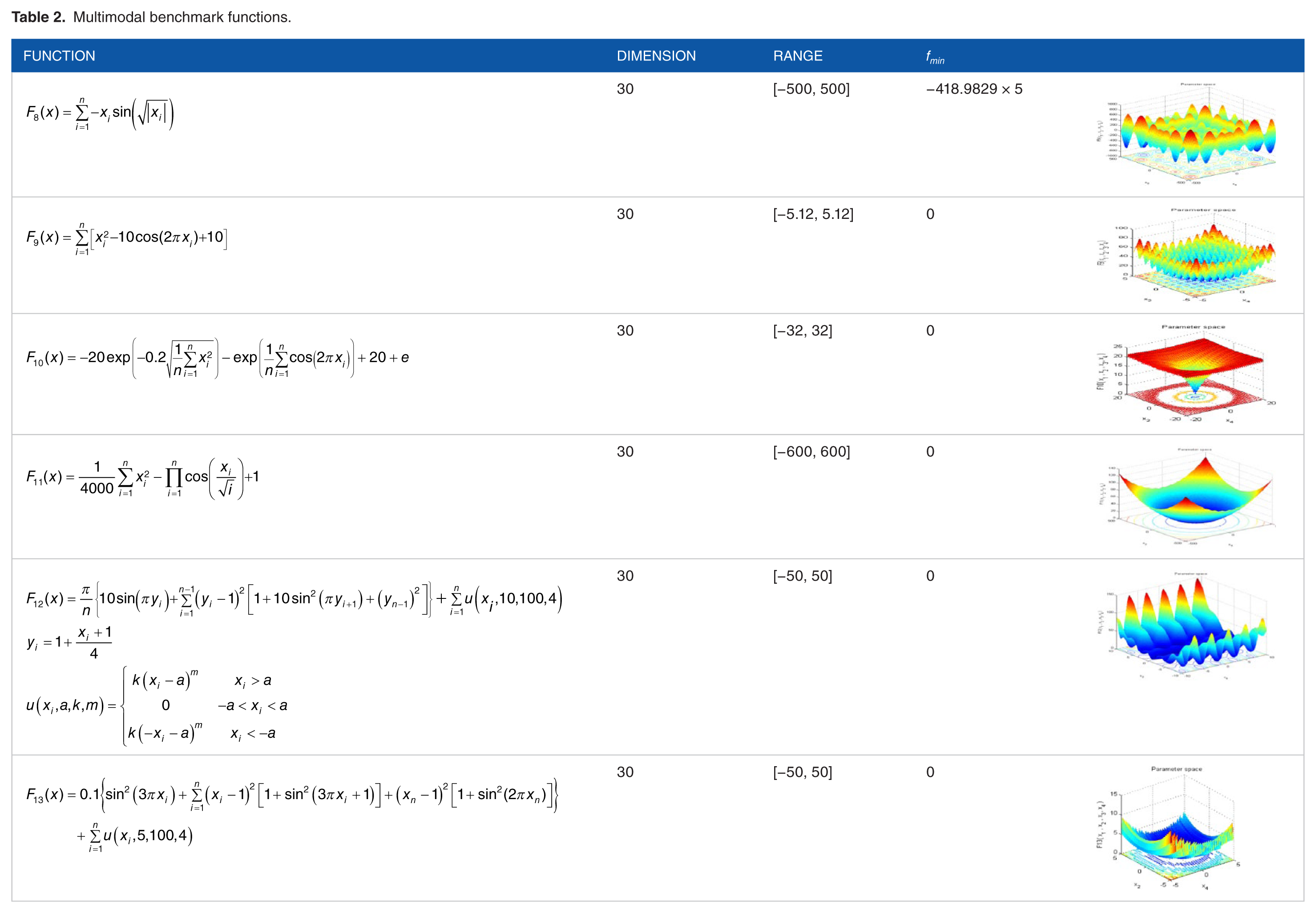
In this section, 23 classical functions are used to test the ability of MGBPSO-GSA. These functions can be divided into 3 different groups: unimodal, multimodal, and fixed-dimension multimodal functions. The exact details of these test functions are shown in Tables 1 to 3.
Unimodal benchmark functions.

Multimodal benchmark functions.
Fixed-dimension multimodal benchmark functions.

Analysis and Discussion of the Results
The PSO, PSOGSA, and MGBPSO-GSA pseudocodes are coded in MATLAB R2013a and implemented in Intel HD Graphics, 15.6″ 3 GB Memory, i5 Processor 430M, 16.9 HD LCD, Pentium-Intel Core (TM) and 320 GB HDD with size of swarm (30), maximum number of iterations (1000),
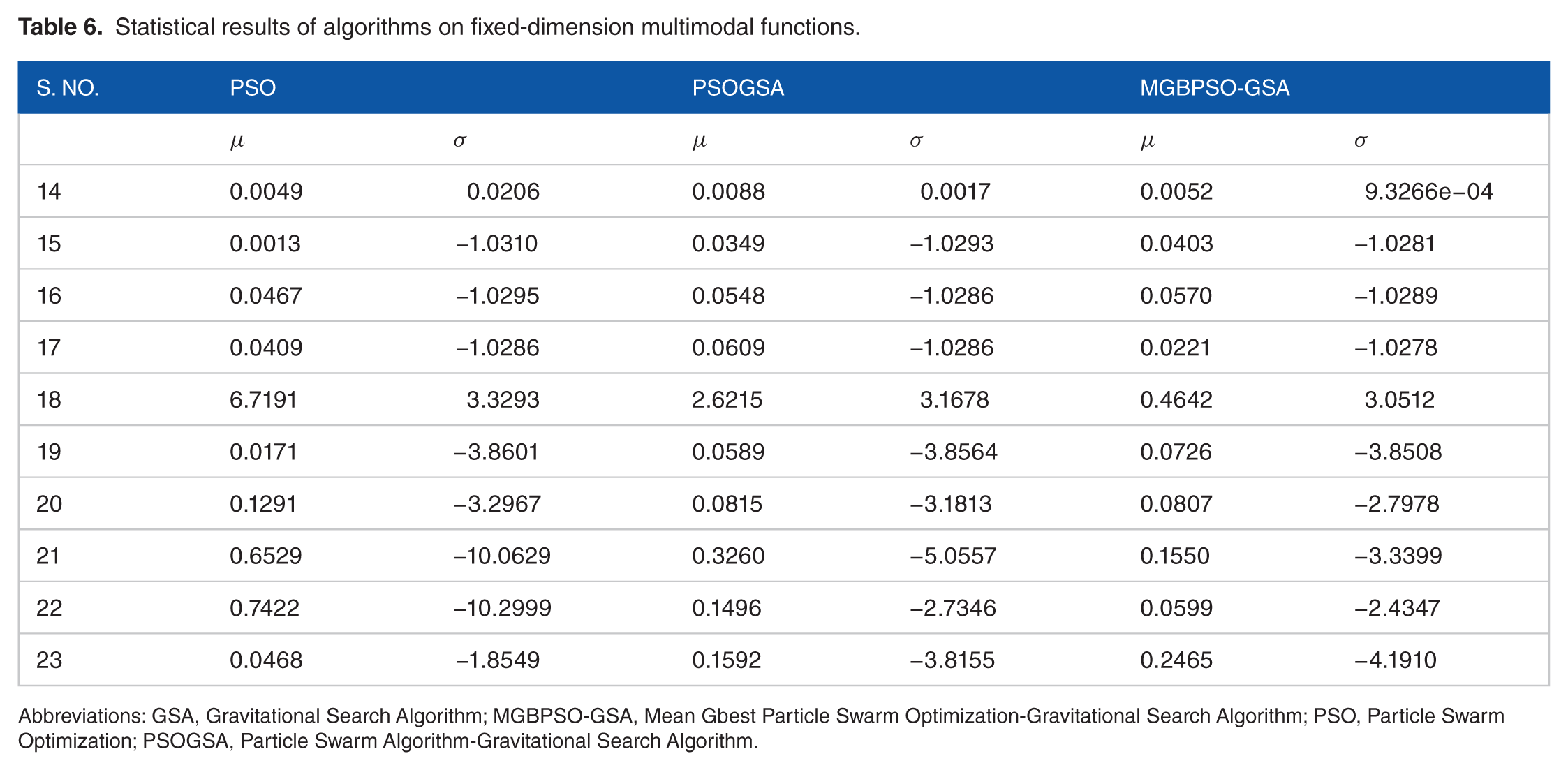
The new hybrid variant was run 30 times on each classical function. The statistical results (standard deviation and average) are reported in Tables 4 to 6. The feasibility of proposed variant has been tested by comparing the results with those obtained through other existing variants such as PSO, GSA, and PSOGSA. It is clear from all the results given in Tables 4 to 6 that the proposed approach outperforms the existing PSO, GSA, and PSOGSA algorithms. In addition, the performance of existing variant has been tested on Iris data set real-life problem and compared with PSO, GSA, and PSOGSA algorithms.
Statistical results of algorithms on unimodal functions.

Abbreviations: GSA, Gravitational Search Algorithm; MGBPSO-GSA, Mean Gbest Particle Swarm Optimization-Gravitational Search Algorithm; PSO, Particle Swarm Optimization; PSOGSA, Particle Swarm Algorithm-Gravitational Search Algorithm.
Statistical results of algorithms on multimodal functions.

Abbreviations: GSA, Gravitational Search Algorithm; MGBPSO-GSA, Mean Gbest Particle Swarm Optimization-Gravitational Search Algorithm; PSO, Particle Swarm Optimization; PSOGSA, Particle Swarm Algorithm-Gravitational Search Algorithm.
Statistical results of algorithms on fixed-dimension multimodal functions.
Abbreviations: GSA, Gravitational Search Algorithm; MGBPSO-GSA, Mean Gbest Particle Swarm Optimization-Gravitational Search Algorithm; PSO, Particle Swarm Optimization; PSOGSA, Particle Swarm Algorithm-Gravitational Search Algorithm.
From the results of Table 4, it is clear that MGBPSO-GSA is able to provide very effective solutions compared with other nature-inspired algorithms. This hybrid approach outperforms all other variants in benchmark functions F1, F2, and F7. It may be noted that the unimodal functions are fitted for benchmarking exploitation. Consequently, these solutions provide a proof for the better performance of the new hybrid approach in terms of exploiting the optimum (Figures 1 to 3).
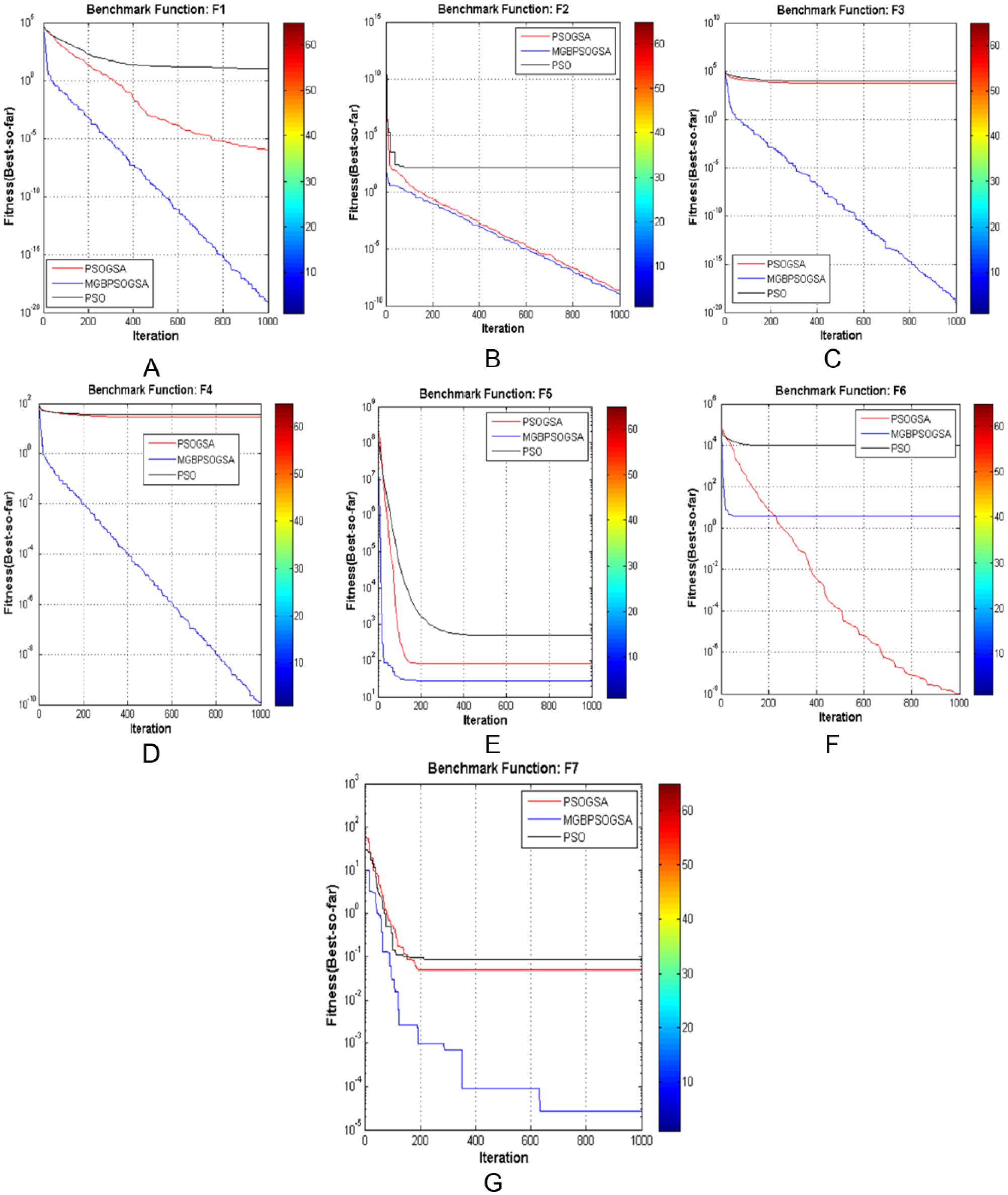
Convergence curve of Particle Swarm Algorithm (PSO), Particle Swarm Algorithm-Gravitational Search Algorithm (PSOGSA), and Mean Gbest Particle Swarm Optimization-Gravitational Search Algorithm (MGBPSO-GSA) variants on unimodal functions. (A) Benchmark function F1, (B) Benchmark function F2, (C) Benchmark function F3, (D) Benchmark function F4, (E) Benchmark function F5, (F) Benchmark function F6, and (G) Benchmark function F7.

Convergence curve of Particle Swarm Algorithm (PSO), Particle Swarm Algorithm-Gravitational Search Algorithm (PSOGSA), and Mean Gbest Particle Swarm Optimization-Gravitational Search Algorithm (MGBPSO-GSA) variants on multimodal functions. (A) Benchmark function F8, (B) Benchmark function F9, (C) Benchmark function F10, (D) Benchmark function F11, (E) Benchmark function F12, and (F) Benchmark function F13.

Convergence curve of Particle Swarm Algorithm (PSO), Particle Swarm Algorithm-Gravitational Search Algorithm (PSOGSA), and Mean Gbest Particle Swarm Optimization-Gravitational Search Algorithm (MGBPSO-GSA) variants on fixed-dimension multimodal functions. (A) Benchmark function F14, (B) Benchmark function F15, (C) Benchmark function F16, (D) Benchmark function F17, (E) Benchmark function F18, (F) Benchmark function F19, (G) Benchmark function F20, (H) Benchmark function F21, (I) Benchmark function F22, and (J) Benchmark function F23.
In contrast to the unimodal function, multimodal benchmark functions have many local optima with the number increasing exponentially with dimension. This makes them suitable for benchmarking the exploration capability of a variant.
It is clear from Tables 5 and 6 that the proposed variant is competent to provide very effective solutions to the multimodal standard functions as well. This approach outperforms PSO and PSOGSA on most of the multimodal functions. These solutions prove that the MGBPSO-GSA approach has merits in terms of exploration.
Iris Data Set
This data set is another well-known testing data set in the test. It consists of 4 attributes, 150 training samples, 150 test samples, and 3 classes (Mirjalili 22 ).
We observe that these variants give the classification rate as MGBPSO-GSA (98.7767%), PSOGSA (98%), GSA (96.6667%), and PSO (95.3333%), respectively. The newly hybrid approach gives a competent classification rate compared with other metaheuristics.
The solutions obtained illustrate that MGBPSO-GSA approach has superior local optima accuracy and avoidance simultaneously (Table 7).
Experimental results for the Iris data set.

Abbreviations: GSA, Gravitational Search Algorithm; MGBPSO-GSA, Mean Gbest Particle Swarm Optimization-Gravitational Search Algorithm; PSO, Particle Swarm Optimization; PSOGSA, Particle Swarm Algorithm-Gravitational Search Algorithm.
Heart Data Set
The Heart data set is another most popular data sets in the test. This data set has 187 testing samples, 22 attributes, 2 classes, and 80 training samples, respectively (Mirjalili, 2015). The numerical solutions of training these algorithms are shown in Table 8. The low average and standard deviation show the superior local optima avoidance of the variant.
Experimental results of the Heart data set.

Abbreviations: GSA, Gravitational Search Algorithm; MGBPSO-GSA, Mean Gbest Particle Swarm Optimization-Gravitational Search Algorithm; PSO, Particle Swarm Optimization; PSOGSA, Particle Swarm Algorithm-Gravitational Search Algorithm.
The numerical results of Table 8 reveal that MGBPSO-GSA has the best performance in this data set in comparison with other recent metaheuristics in terms of classification and convergence rate.
ED Problem
The comprehensive information of parameter selection of test system is power system input data of 40 generating units, and the total demand has been considered as 10 500 MW, and the remaining parameters as reported in literature are as follows: population size (200), dimension (40), confidence constants:
The performance of mean PSO, Hybrid Genetic Particle Swarm Optimization (HGPSO), Hybrid Genetic Algorithm-Particle Swarm Optimization (HGAPSO), HPSOM, PSO, qPSO, GSA, BBO, HPSO, QPSO, MSPSO, PSOGSA, and MGBPSO-GSA approaches in terms of generation cost, average, and standard deviation has been tested. The results obtained are also compared with newly published ED problem solutions. From Table 9, it is clear that MGBPSO-GSA approach provides a superior and competent solution and signifies MGBPSO-GSA’s higher efficiency to find a solution to ED problem compared with other metaheuristics (Figure 4).
Comparison of experimental results obtained from 13 different modified variants of nature-inspired algorithms.

Abbreviations: BBO, Biogeography-Based Optimization; GSA, Gravitational Search Algorithm; HGAPSO, Hybrid Genetic Algorithm-Particle Swarm Optimization; HGPSO, Hybrid Genetic Particle Swarm Optimization; HPSO, Hybrid PSO; HPSOM, Hybrid Particle Swarm Optimization with Mutation; MGBPSO-GSA, Mean Gbest Particle Swarm Optimization-Gravitational Search Algorithm; MSPSO, Modified Standard Particle Swarm Optimization; PSO, Particle Swarm Optimization; PSOGSA, Particle Swarm Algorithm-Gravitational Search Algorithm; qPSO, quadratic approximation PSO; QPSO, Quantum-inspired Particle Swarm Optimization.
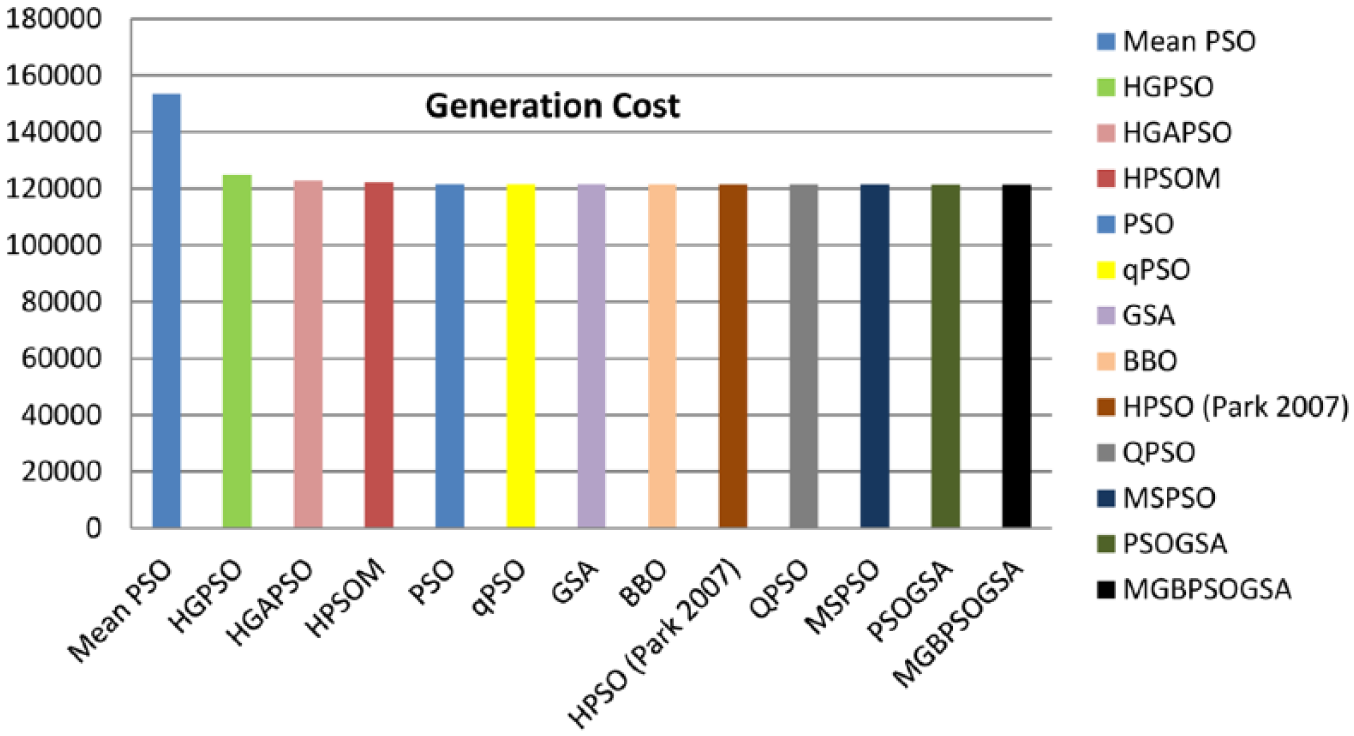
Comparison of generation output of each generator using 13 different metaheuristic techniques.
Conclusions
In this article, a new hybrid variant is presented using the strengths of MGBPSO and GSA. The main idea is to integrate the abilities of GSA in exploration and MGBPSO in exploitation. The proposed algorithm has been tested on 23 classical functions, Iris data sets, Heart data sets, and ED problems. The performance of the existing approach has been compared with several metaheuristics. The authors conclude that the proposed variant outperforms all other metaheuristics.
The MGBPSO-GSA is more reliable in providing better quality solutions with reasonable generations because the hybrid strategy avoids premature convergence of the search process to local optima and provides better exploration of the search process.
Footnotes
Peer Review:
Three peer reviewers contributed to the peer review report. Reviewers’ reports totaled 631 words, excluding any confidential comments to the academic editor.
Funding:
The author(s) received no financial support for the research, authorship, and/or publication of this article.
Declaration of Conflicting Interests:
The author(s) declared no potential conflicts of interest with respect to the research, authorship, and/or publication of this article.
Author Contributions
SBS conceived the idea to develop a new variant of nature inspired technique which can outperform other metaheuristics in terms of solution quality and convergence. NS designed the numerical experiments, developed code. NS and SS jointly prepared first draft of the paper. All authors made critical revisions and finalized the manuscript. SBS and NS critically examined the final draft of the paper.