



Abstract
Accusations of political passivity are often directed towards citizens, especially the youth. This study challenges the prevailing narrative by exploring the latent dimensions of political participation, and in particular the role of ‘standby citizens’, that is, those who are politically interested yet non-participatory. We propose that these individuals engage in behavioural activism when they perceive governmental actions as failing to meet their needs and demands. To test this hypothesis, we utilized a longitudinal sample of adolescents, classifying them into four distinct groups: active, standby, unengaged and other. We examined the transitions between these groups over time. Our findings indicate that standby adolescents are significantly more likely to shift towards active participation and less likely to become completely disengaged. Specifically, those who moved from standby to active status reported a significant decline in satisfaction with government performance over time, while their counterparts who remained in the standby mode did not show such changes.
Keywords
Introduction
The question of younger generations’ engagement in politics has sparked considerable debate in contemporary social science literature. A prevalent perspective, supported by various studies suggests that youth are disengaging from formal political activities, thereby fostering a pessimistic narrative about young people’s commitment to democratic processes (Foa et al., 2020; Putnam, 2000; Ross, 2018). Engagement with traditional political parties and voluntary associations among young people has waned, accompanied by reports of political alienation and scepticism concerning politics and democracy (Belchior & Teixeira, 2024; Weiss, 2020). These issues are further compounded by broader challenges facing democracies today, such as inequalities in political participation, eroding trust in institutions and escalating political dissatisfaction among youths and the broader electorate (Sloam, 2014; Wuttke et al., 2023).
However, this pessimistic view is not unchallenged. Opposing the notion of political passivity and alienation, several scholars argue that today’s youth are not inherently less politically engaged than previous generations (Dalton, 2015; Grassi et al., 2024; Henn et al., 2022; Norris, 2002). They suggest that young people practice a form of ‘standby’ citizenship, where they remain politically aware and ready to participate when circumstances require (Amnå & Ekman, 2014). This more optimistic view argues that young people are not apathetic, but selectively engaged, becoming involved when they see their participation as essential. While the concept of ‘standby citizens’ has gained traction in the literature (e.g., Arya & Henn, 2023; Boulianne, 2023; Tzankova et al., 2022), the empirical evidence on when and under what conditions these standby citizens transition to active political participation remains limited. In particular, the mechanisms that facilitate the transition from passivity to active engagement are poorly understood.
This study aims to fill this gap by examining the factors that influence such a transition. Particular attention is paid to the influence of democratic institutions, which are fundamental to governance, structuring the political landscape and influencing both the operational aspects of political life and behavioural norms (e.g., Almond & Verba, 1963; Dalton, 2015; Kitanova, 2020). Using data from two waves of a longitudinal political socialization study conducted in Sweden, where participants were 16 years old at the time of the first survey (Amnå et al., 2009), we analyse how changes in attitudes towards various levels of the political system, such as trust in institutions and satisfaction with government performance, are associated with shifts in political participation, specifically from standby to active participation. Our findings suggest that young individuals who become politically active over time report a decline in satisfaction with government performance, indicating that dissatisfaction may act as a trigger for political participation.
Political Participation Among Contemporary Youth
Youth political participation spans a range of activities that enable young citizens to influence democratic processes. While traditional forms such as voting, campaigning and running for office remain foundational, many youth are increasingly drawn to unconventional methods such as protests, demonstrations and digital activism. These activities often reflect their preference for more immediate and impactful engagement (Amnå & Ekman, 2014; Anderson & Hoff, 2001). Additionally, young people contribute through less-visible means such as community service and involvement in civil society organizations, which subtly shape public policy. They also participate in public debates and use their consumer choices to express political and ethical stances (Micheletti & Stolle, 2004).
The more pessimistic view on youth political participation, prominently advocated by Robert Putnam (2000), suggests that today’s youth are increasingly disengaged from traditional forms of political participation, such as voting and party involvement, with significant declines observed in various indicators of civic and political engagement (Pattie et al., 2004; Putnam, 2000). This narrative is supported by descriptors such as ‘political apathy’ and ‘partisan dealignment’ (Marsh et al., 2007), portraying youth as politically passive. In contrast, an optimistic perspective contends that the nature of political engagement among youth has evolved. Scholars such as Norris (2002) and Dalton (2015) argue that young people today engage differently, favouring actions such as extra-institutional participation, volunteerism and digital activism (Grassi et al., 2024; Henn et al., 2022; Stolle & Hooghe, 2011). These modes of engagement suggest a shift rather than a decline in political activity, challenging the notion of youth political apathy and highlighting a more dynamic form of political participation among contemporary youth (Lieberkind & Bruun, 2021).
These perspectives are well established in the literature and provide a foundational reference for numerous subsequent studies. However, to gain a more nuanced understanding, there is a need for approaches that transcend the above dichotomous categorization (Ekman & Amnå, 2012; Loncle-Moriceau & Pickard, 2023). Indeed, several studies highlight the variability of political activity within youth groups, offering a nuanced position between the pessimistic and optimistic extremes (e.g., Hustinx et al., 2012; Sherrod & Lauckhardt, 2009).
The concept of the ‘standby citizen’ contributes to addressing this need by emphasizing the relevance of latent political engagement in understanding contemporary political participation (Amnå, 2010; Amnå & Ekman, 2014). Such an approach overlooks critical underlying factors that shape contemporary political participation, including structural transformations in political systems (Almond & Verba, 1963; Berger, 2009; Gamson, 2004; Martin, 2012; Oser & Hooghe, 2013) and the operational dynamics of politics (Wicks et al., 2014). Furthermore, the developmental phase of youth is characterized by limited opportunities and rights for behavioural participation (McIntosh & Youniss, 2010; Stepick et al., 2008), underscoring the importance of considering the latent aspect of political engagement (Ekman & Amnå, 2022). In other words, a more comprehensive understanding of youth political orientation can be achieved by simultaneously considering both latent and manifest aspects of political engagement. The standby citizen concept, which captures a politically promising group previously overlooked by a conventional focus on manifest participation, suggests that further exploration of this concept is likely to be built upon and expand the existing literature that addresses the participatory realities of contemporary youth.
Theoretical Premises Concerning Standby Youth
There are three main theoretical premises regarding standby youth. First, there should be a distinct group of young individuals who exhibit political interest, but do not consistently engage in behavioural participation—‘standby youth’. Second, standby youth should be qualitatively different from genuinely passive youth, possessing democratically desirable characteristics that align them closer with active youth. Third, standby youth are expected to engage in the political arena when necessary. Taken together, these propositions suggest that contemporary youth are still fulfilling their political role within society, albeit in an adaptive manner.
Research supports the first two premises. Specifically, the existence of standby youth has been confirmed in samples from two Western countries: adolescents in Sweden (Amnå & Ekman, 2014) and a British adult sample that included youth aged 18 and over (Hansard-Society, 2013). The Swedish study showed that standby youth share many democratic characteristics with active youth, rather than resembling genuinely passive youth. Similarly, the British study found that standby citizens share similar characteristics with manifest citizens—the category conceptually equivalent to active citizens. This evidence supports a more optimistic view of youth political engagement.
Moreover, research by Tzankova and colleagues (2022) using data from Italy found that many young individuals exhibit a ‘standby’ form of engagement characterized by low active participation but high interest in civic and political matters. This indicates a nuanced relationship in which political interest and trust, or the lack thereof, shape their level of engagement. They suggest that distrustful youth may critically monitor the system, while those who are more trusting may prefer to observe from the sidelines. These findings emphasize that low participation does not necessarily equate to disengagement, as some youth remain attentive and ready to engage when conditions warrant.
However, it is premature to fully endorse the optimism suggested by the standby youth concept until the third contention that these youth indeed become active when necessary is empirically supported. Due to the cross-sectional nature of previous studies, it remains uncertain whether standby youth will exhibit participatory tendencies under certain conditions, highlighting the need for further empirical investigation. Although standby youth have reported personal intentions to become active (Amnå & Ekman, 2014), this could merely reflect ‘lip service’ to socially desirable democratic norms. Nevertheless, considering the latent aspect of political engagement is a critical focus of this perspective, and the optimistic assessment of youth political engagement depends on the transitional nature of standby youth. Therefore, an observable transition from standby to active mode is expected over time.
Institutional Factors in Triggering Youth to Step In
What might drive the transition from standby to active positions? Drawing on the extensive literature on political socialization, multiple factors are recognized as potential activators of political participation (Quintelier, 2015; Weiss, 2020), especially in combination with youth’s own early set engagement goals and political intentions (Lundberg & Abdelzadeh, 2024; Stattin, 2024). A politically vibrant family environment often fosters early discussions and involvement, normalizing political participation from an early age (Fitzgerald & Bacovsky, 2024). Additionally, peers and social networks significantly amplify political interest among youth through political discussions (Quintelier, 2015; Stattin, 2024). The research on the role of civil society organizations and educational institutions in fostering and promoting political participation has also been highlighted in the literature (Deimel et al., 2021; Lundberg & Abdelzadeh, 2024).
While several factors can influence youth activation towards political participation, our hypothesis suggests that young individuals’ decision to become active hinges on their perception of the necessity of their involvement within the democratic structure of society’s realities. This perspective is motivated by the idea that the transition of standby youth to active participation depends on their realization of being needed by society (Amnå, 2010; Amnå et al., 2010). Democratic institutions, forming the bedrock of governance, provide a framework that structures the political landscape and influences both the operational aspects of political life and behavioural norms (e.g., Dalton, 2015; Kitanova, 2020). We propose that the decision by youth to step in and become politically active is based upon their evaluation of various institutional factors, including their perception of the responsiveness of political institutions to citizens’ needs (system responsiveness), their belief in the democratic system’s effectiveness in reflecting their will and adhering to democratic principles (satisfaction with democracy), their trust level in political institutions (institutional trust) and their assessment of government competence and success in improving citizens’ lives (satisfaction with the government performance). This framework underscores the importance of institutional perception in motivating young individuals to transition from passive observers to active participants in the political domain.
Empirical research offers various insights into how perceptions of the political and institutional environment relate to political participation. When political systems are perceived as responsive, a clear linkage between individual participation and policy outcomes bolsters participation by instilling a sense of efficacy (Norris, 2002; Sjoberg et al., 2017). Responsive governance enhances involvement in voting, campaigning and other participatory activities, as citizens feel their engagement is consequential (Dalton, 2015). Additionally, satisfaction with democratic functioning often correlates with higher participation rates, underpinned by the belief that such involvement is meaningful and impactful (Ezrow & Xezonakis, 2016; Norris, 2002).
Furthermore, perceptions of effective government performance could lead to increased satisfaction and a higher likelihood of political engagement among young people, as they perceive their government as competent and beneficial to their lives. When governments are seen as competent and successful in improving citizens’ lives, youth are more likely to engage in the political process. In addition, high levels of political trust and satisfaction have generally been suggested to relate to high levels of political participation (Almond & Verba, 1963; Uslaner & Brown, 2005). When citizens perceive their government as competent and effective, they are more likely to engage in traditional forms of political participation such as voting, supporting political parties or participating in civic organizations. Studies by Easton (1975) and Norris (2011) suggest that governments that perform well enjoy higher levels of public trust and support, which in turn fosters political participation.
However, paradoxical, low levels of political trust, satisfaction with democracy and effective government are also suggested to be driving forces of political participation (Cain et al., 2003; Tzankova et al., 2022). Dissatisfaction can lead to disengagement or, alternatively, spur protest and non-conventional forms of participation aimed at changing the system (Abdelzadeh, 2014). Additionally, when citizens perceive government performance as poor, marked by inefficiency, corruption or unresponsiveness, it can lead to political disengagement or spur alternative forms of participation, such as protests or support for opposition movements. Research shows that dissatisfaction with government performance often motivates citizens to participate in protests, social movements or other forms of non-conventional political activities (Kriesi et al., 2012). These seemingly paradoxical arguments may be understood by considering their specified effects in terms of the forms and functions of participation (Hooghe & Marien, 2013). That is, when higher levels of these factors are related to higher participation, the forms of participation usually centre on institutionalized, conventional forms of participation that serve to maintain the political status quo. Conversely, when lower levels of these factors are related to higher participation, participation centres on extra-institutional, unconventional forms of participation that serve as forces to change the political status quo.
The specified effects of institutional factors on political participation raise the question of which case constitutes a more relevant basis for anticipating the transition of standby youth to an active mode. Regarding established democracies, we believe that the second scenario (i.e., low responsiveness, trust, satisfaction and government performance) would better explain the transition of standby youth than would the first scenario (i.e., high low responsiveness, trust, satisfaction and government performance). That is, between the forces for maintenance and for change, we would expect standby youth to be closer to the latter. Since standby youth are already equipped with democratic skills and willingness to participate, if they want to serve as a maintaining force, there is little need for them to be inactive.
Conversely, if standby youth step up only when changes are needed, their assumed occasional activism will seem reasonable. Indeed, standby youth reported high levels of political trust and satisfaction (Amnå & Ekman, 2014; Hansard-Society, 2013). In contrast, active youth, whom we expect standby youth to become when the need arises, exhibited lower levels of political trust and satisfaction than did standby youth. Accordingly, we suggest that declining levels of responsiveness, trust, satisfaction with democracy and government performance will cause standby youth to believe that they need to step in and become active, triggered by mistakes, failures or other disappointments regarding their commonly well-functioning democratic system. In other words, standby youth will transition to an active mode once the democratic institutions fail to meet their needs and demands.
All in all, building on these theoretical perspectives, the current study examines the trajectories of youth political engagement, with a particular focus on the transition from standby to active participation. More specifically, the study aims to investigate how adolescents’ initial levels of engagement predict later political activity and to identify factors that influence this transition over time.
Method
Participants and Procedure
The sample consisted of late-adolescent students from a large Swedish city (approximately 135,000 inhabitants) that was close to the national average for several demographic factors, such as population density, income and unemployment, at the time of data collection (Statistics Sweden, 2010). Participants were recruited from three upper schools in order to include participants of both genders, from different social and ethnic backgrounds, and from both vocational and theoretical programs. More specifically, the current study uses two waves of questionnaire data from PSP, a longitudinal project on political socialization (Amnå et al., 2009). In the project, an age cohort of 16-year-old adolescents was followed up when they were 18 years old (2012, T2). Data were collected during school hours through surveys administered by trained research assistants. Participants were informed of the nature of the questionnaire items and the approximate time required to complete the survey. They were assured that their participation was voluntary and that no one—parents, teachers or anyone else—would see their answers. Each class was paid approximately €100 for their participation. Parents were informed about the study in advance and could refuse their children’s participation by returning a letter in a prepaid envelope. The target sample consisted of 1,063 adolescents aged 16 (2010, T1), and our analytical sample, which included data on the study measures at T1, consisted of 854 individuals (approximately 80% of the initial sample, 50.8% females; Mage = 16.62, SD = 0.72). Of this sample, 583 participants (68.2%) took part in the data collection at age 18.
Missing Data and Attrition Analysis
Missing data were examined and addressed throughout the analysis. The variables were averaged across the available items. This allowed participants with partial responses to be included. Moreover, to test whether the adolescents who dropped out over time differed from those participating at both time points, we applied a logistic regression where the attrition (dropout = 1, retention = 0) was regressed on all other variables included in the study. Specifically, those who participated in both T1 and T2 were compared with T2 dropouts. The results indicate that younger individuals (Wald = 6.89, p < .009, Exp(B) = 1.35), those with higher levels of system responsiveness (Wald = 4.07, p < .05, Exp(B) = 1.14) and those with lower levels of satisfaction with democracy (Wald = 5.49, p < .05, Exp(B) = 0.69) were more likely to drop out. However, the included variables accounted for only a small portion of the variance in attrition (Nagelkerke, R² = 0.051). To further elucidate these results, we converted the significant odds ratios for age (Cohen’s d = 0.17), system responsiveness (Cohen’s d = 0.07) and satisfaction with democracy (Cohen’s d = 0.20) into Cohen’s d estimates. Overall, considering the low Nagelkerke and effect sizes (Cohen, 1988) for these three variables, we conclude that attrition had only a minimal impact on our findings.
Measures
Political Participation
Political participation was measured using 10 items adapted from Amnå and Ekman (2014), assessing engagement over the past 12 months. Items included, for example, attending meetings on political or societal issues, contacting politicians, boycotting products, participating in demonstrations and donating to political groups (see Table 4 for a full list). The response options ranged from 1 (no, never) to 3 (yes, several times). Cronbach’s α was 0.89 in 2010 and 0.79 in 2012.
Political Interest
As an index of latent forms of engagement, two items about participants’ general interest in politics and societal issues were used: ‘How interested are you in politics?’ and ‘How interested are you in societal issues?’ The participants gave their ratings using a 5-point Likert scale ranging from 1 (not at all interested) to 5 (very interested). The correlations between the two items were 0.59 in 2010 and 0.70 in 2012.
Institutional Measures
System Responsiveness
Young people’s attitudes towards the responsiveness of the political system were measured using an index comprising the following three items: ‘Those in power in our society listen to and care about people’s suggestions and views’, ‘there are great opportunities to participate in and influence political decisions’ and ‘there are great opportunities for ordinary people to get their views across to those in power in society’. The response scale ranged from 1 (does not apply at all) to 4 (applies perfectly). Cronbach’s α for this measure was 0.80 in 2010 and 0.76 in 2012.
Satisfaction with Democracy
The participants responded to the following statement regarding their satisfaction with democracy: ‘On the whole, how satisfied are you with the way democracy works in Sweden?’ Response options ranged from 1 (not at all satisfied) to 4 (very satisfied).
Institutional Trust
The participants reported their level of trust in the following institutions: the parliament, the government, the courts, the police, the political parties and the European Union. Responses ranged from 1 (no confidence at all) to 4 (a lot of confidence). Cronbach’s α for the scale was 0.90 in 2010 and 0.88 in 2012.
Satisfaction with Government Performance
Respondents’ satisfaction with government performance was measured with the following item: ‘How satisfied are you with the way in which the sitting government is handling its tasks?’ The response scale ranged from 1 (not at all satisfied) to 4 (very satisfied).
Control Variables
In the current study, we also controlled for several important variables: sex (1 = female, 2 = male), age, subjective socio-economic status (SES), immigrant status and political efficacy. Subjective SES was measured using the following five questions: ‘If you want things that cost a lot of money (e.g., a computer, skateboard, cell phone), can your parents afford to buy them if you want them?’, ‘If you compare yourself with others in your class, do you have more or less money to buy things?’ and ‘Does your family have more or less money than other families where you live?’ Cronbach’s α reliability for this scale was 0.81 in 2010. Internal political efficacy was measured with nine items taping on young people’s belief in their own capacity to engage in civic and political actions (Sohl & Arensmeier, 2015). After the stem, ‘If I really tried, I could manage to …’, the participants responded to statements, such as: ‘take on responsibility in a political youth organization’, ‘discuss politics with people with more experience than I have’, ‘be an active member of a political organization’ and ‘help to organize a political protest’. The response scale ranged from 1 (I could definitely not manage that) to 4 (I could definitely manage that). Cronbach’s α was 0.93 in 2010.
Analytical Strategy
The statistical analyses in this study were carried out using a structured two-step process to ensure a comprehensive exploration of the data and to achieve the study’s objectives effectively. The first step involved the use of cluster analysis, a data-driven technique that identifies natural groupings within a data set by analysing patterns of similarity among individuals. To do this, the measures of interest and participation were entered into the analyses as clustering variables. Prior to this, both measures were standardized. Two common clustering methods were then applied sequentially: Ward’s method (Ward, 1963) and k-means clustering (MacQueen, 1967). Ward’s method was used to obtain an appropriate number of clusters and seed values for the iterative k-means clustering. Following the suggestion of Bergman et al. (2003) that the final cluster solution should account for a minimum of 67% of the explained error sum of squares, the number of appropriate clusters from Ward’s method was set as the smallest number that would explain at least 67% of the explained error sum of squares. The subgroups identified through cluster analysis were then compared on measures of political participation and interest over time using a multivariate analysis of variance (MANOVA).
In a second step, changes in group membership over time were analysed by performing an exact cell-wise examination of a contingency table. This analysis was performed using the EXACON module of the SLEIPNER statistical package (Bergman & El-Khouri, 1995). The aim was to identify significant transitions, with a particular focus on the movement from the ‘standby’ mode to the ‘active’ mode. In these analyses, patterns that occur more frequently than would be expected by chance are referred to as ‘types’, while patterns that occur less frequently than expected are referred to as ‘antitypes’. To ensure the reliability of these findings, cross-tabulations were performed, and a Bonferroni-adjusted p value of .05 was applied. This adjustment helped to take into consideration the increased likelihood of Type I error that can result from multiple comparisons, ensuring that the identification of types and antitypes was statistically robust. By applying this stricter significance criterion, the analysis provided a clearer and more accurate understanding of which patterns were truly significant, rather than due to random variation.
In addition, to investigate whether changes in the group membership were associated with changes in presumed triggers, a series of repeated measures ANOVAs were conducted. This analysis allowed for an assessment of how changes in key variables over time might be related to transitions in group membership. Finally, to provide an overview of the study variables, the means and standard deviations of all the variables were calculated, as were the correlations between them.
Results
Youth Groups with Distinct Interest and Participation Patterns
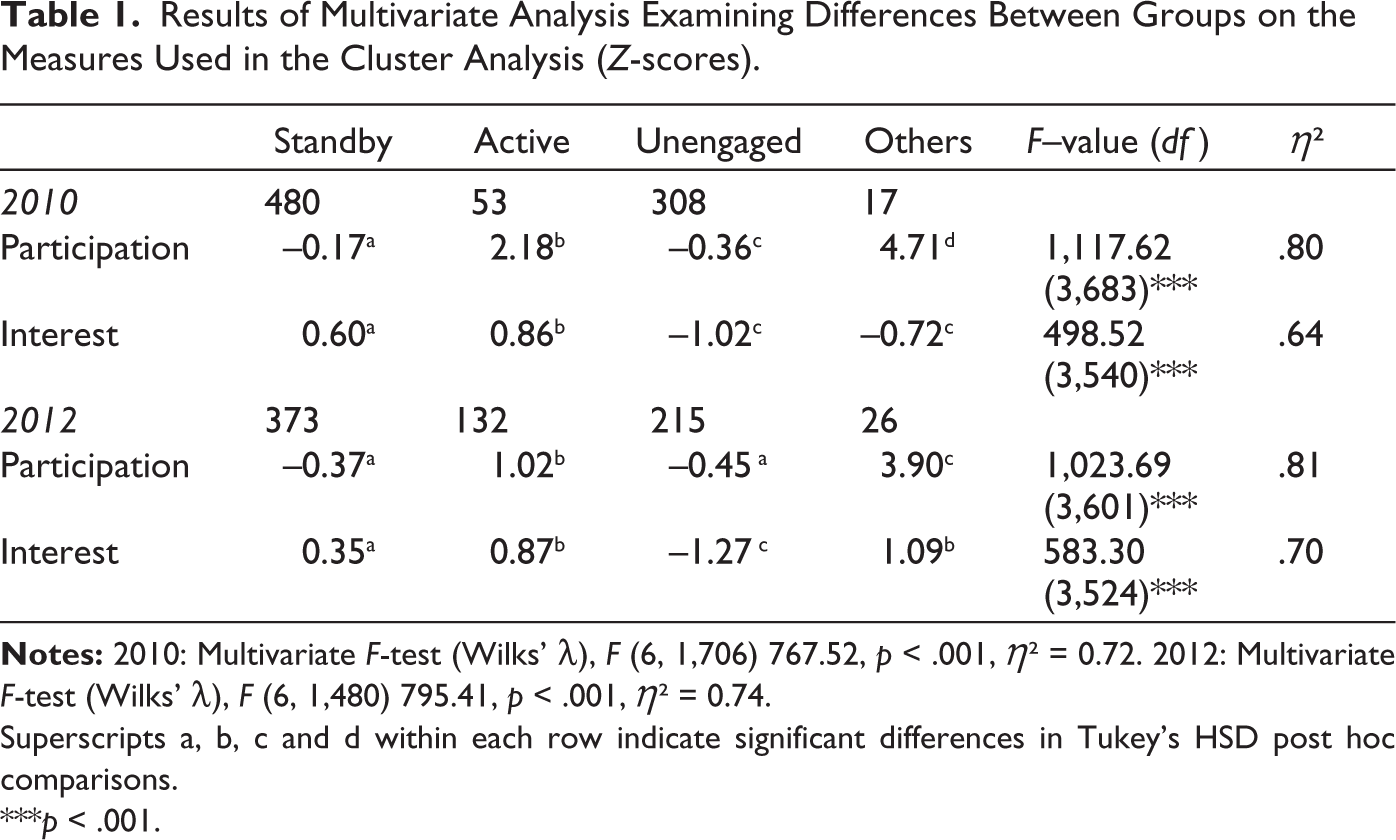
To identify naturally occurring groups of young people with distinct patterns of political interest and participation, separate cluster analyses were conducted for each time point. The results of these analyses are shown in Table 1. Initially, a three-cluster solution was explored, explaining approximately 63% and 65% of the variation at time points 1 and 2, respectively. However, these solutions were considered implausible. Instead, a four-cluster solution emerged as the best fit at both time points, accounting for approximately 73% and 72% of the total sum of squares at time points 1 and 2, respectively. We named the groups: active, standby, unengaged and others.
Results of Multivariate Analysis Examining Differences Between Groups on the Measures Used in the Cluster Analysis (Z-scores).
Superscripts a, b, c and d within each row indicate significant differences in Tukey’s HSD post hoc comparisons.
***p < .001.
To determine whether the clusters differed significantly on the dimensions of political interest and political participation, two MANOVAs were conducted with both dimensions entered simultaneously as outcome variables. The multivariate F-tests revealed significant differences across clusters for both dimensions at time point 1, F(6, 1,706) 767.52, p < .001, η² = 0.72, and 2, F(6, 1,480) 795.41, p < .001, η² = 0.74. Post hoc comparisons showed that the clusters had significantly different means on both measures. However, at time point 1, the disengaged and other clusters did not differ on political interest. Similarly, at time point 2, the unengaged and standby groups showed no significant difference in political participation. Overall, these findings suggest that the groups were distinct in terms of their political interest and political participation.
As can be seen in Table 1, youth in the active group were characterized by a high level of participation and interest. Youth in the standby cluster were characterized by a high level of interest and a moderate level of participation. Unengaged youth were characterized by low-to-moderate levels of participation and interest. The fourth cluster consisted of a small group of young people exhibiting varying levels of participation and interest. In terms of percentages, the standby cluster represented the majority of young people at both time points, with approximately 56% in 2010 and 50% in 201. In addition, descriptive statistics from time point 1 (2010) show that around 53% of the standby group are female, a higher proportion than in any other cluster. In addition, about 82% of them have a Swedish background, defined as being born in Sweden with at least one parent also born in the country, compared to 72% of the active youth and 86% of the uninvolved group.
Transitions Between Clusters over Time
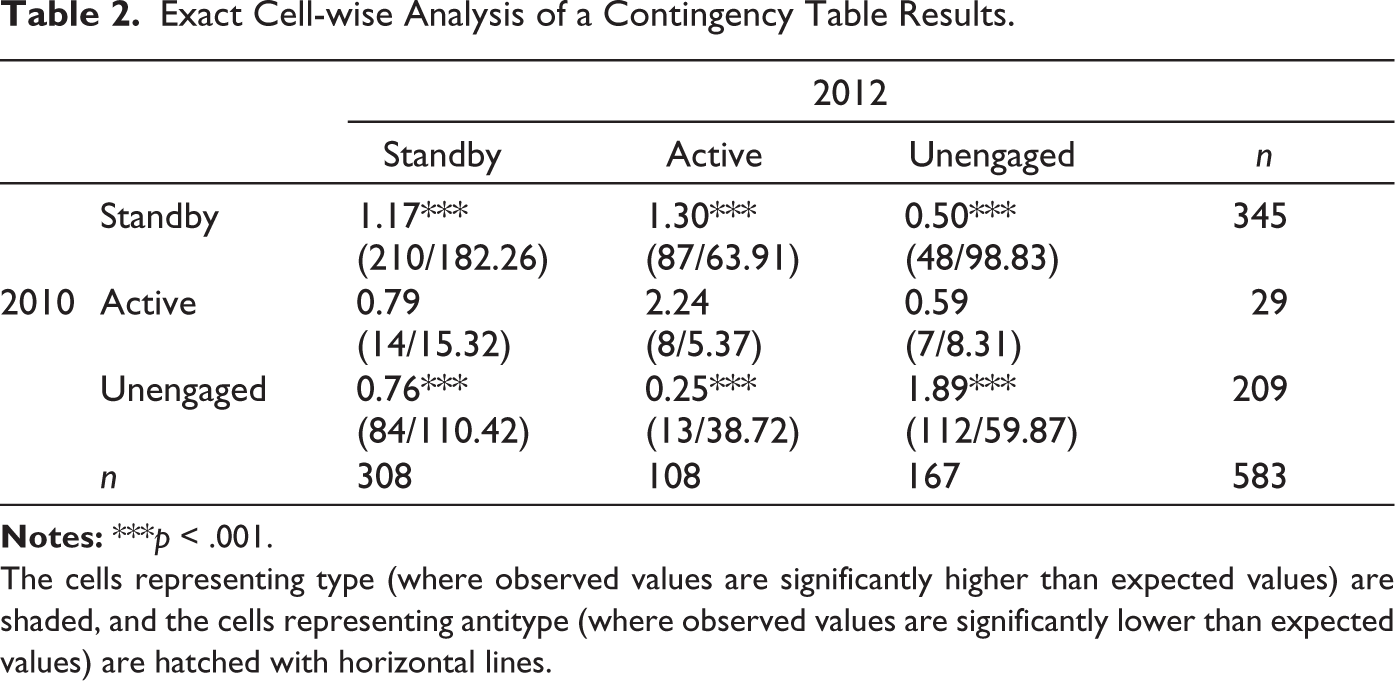
To examine the transitions between clusters over time, an exact cell-wise analysis of the contingency table was performed. The results are shown in Table 2. The analysis revealed considerable stability, with many young people remaining in the same cluster over time. Specifically, about 61% of the standby youth and 54% of the unengaged youth remained in their respective clusters. In contrast, only 28% of active young people remained in the same cluster between 2010 and 2012. A significant shift in political orientation was observed among standby youth, with 25% moving from standby to active status. This means that standby youth were 1.30 times more likely to become active than expected by chance. Furthermore, standby young people showed a significant tendency to resist moving to the more passive, unengaged group. Instead, when they did move, they were more likely to move to a higher level of engagement, joining the active cluster rather than becoming unengaged. This trend suggests that standby youth are more likely to increase their political participation rather than retreat into passivity.
Exact Cell-wise Analysis of a Contingency Table Results.
The cells representing type (where observed values are significantly higher than expected values) are shaded, and the cells representing antitype (where observed values are significantly lower than expected values) are hatched with horizontal lines.
No statistically significant transitions were found in the active youth cluster. This may be due to the limited number of individuals in this cluster. Nevertheless, the results suggest that active youth tend to remain active and are less likely to become disengaged, although these results are not statistically significant. Finally, regarding the unengaged cluster, we observed that individuals in this cluster were 1.89 times more likely to remain unengaged than to move to the standby cluster, and they were even less likely to become politically active participants. This finding suggests a strong tendency for unengaged young people to maintain their level of disengagement over time. Cluster 4 was excluded from this and the subsequent analyses due to its lower number of participants.
Socio-demographic Characteristics and Engagement
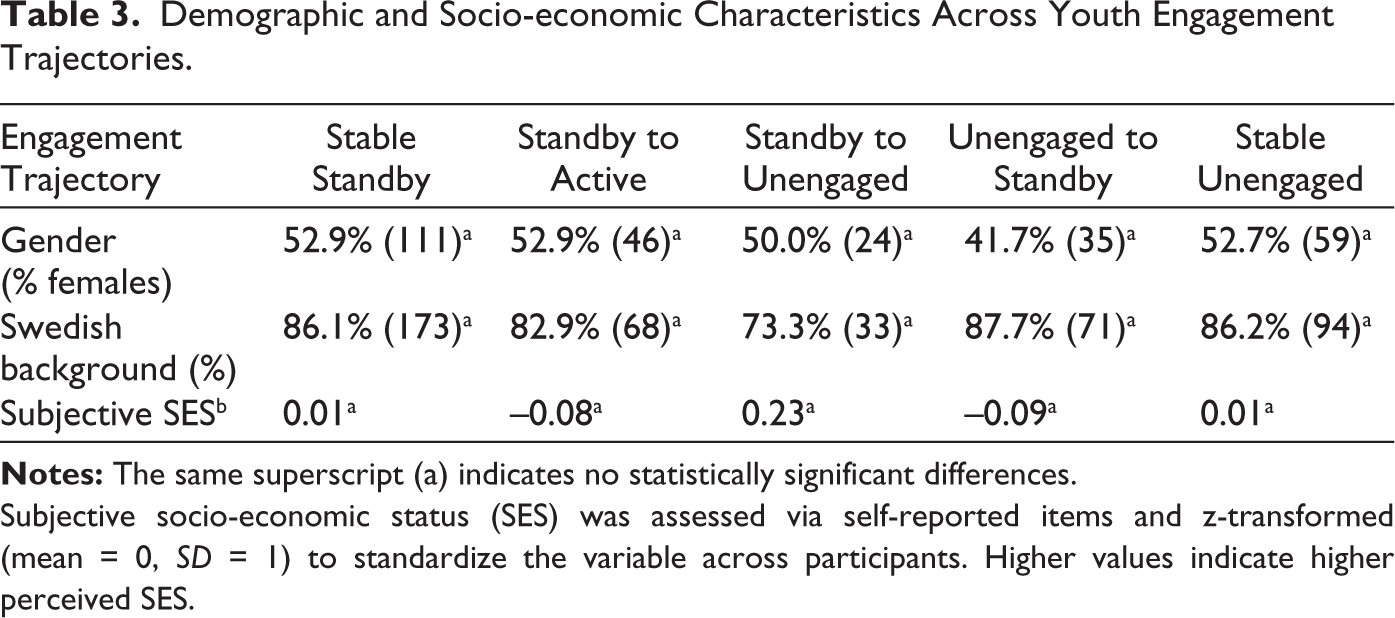
Before analysing the institutional triggers of youth political participation, it is important to examine the socio-demographic characteristics of youth who remain in or transition between engagement categories, as well as the types of political activities in which activated standbys are involved. As shown in Table 3, the proportion of females did not differ significantly across the groups, ranging from 41.7% to 52.9%, as indicated by a χ2 test. Similarly, the proportion of participants with a Swedish background was comparable across all trajectories, ranging from 73.3% to 87.7%. Subjective SES did not differ significantly across groups either. Overall, these results suggest that gender, Swedish background and subjective SES were comparable across all engagement trajectories.
Demographic and Socio-economic Characteristics Across Youth Engagement Trajectories.
Subjective socio-economic status (SES) was assessed via self-reported items and z-transformed (mean = 0, SD = 1) to standardize the variable across participants. Higher values indicate higher perceived SES.
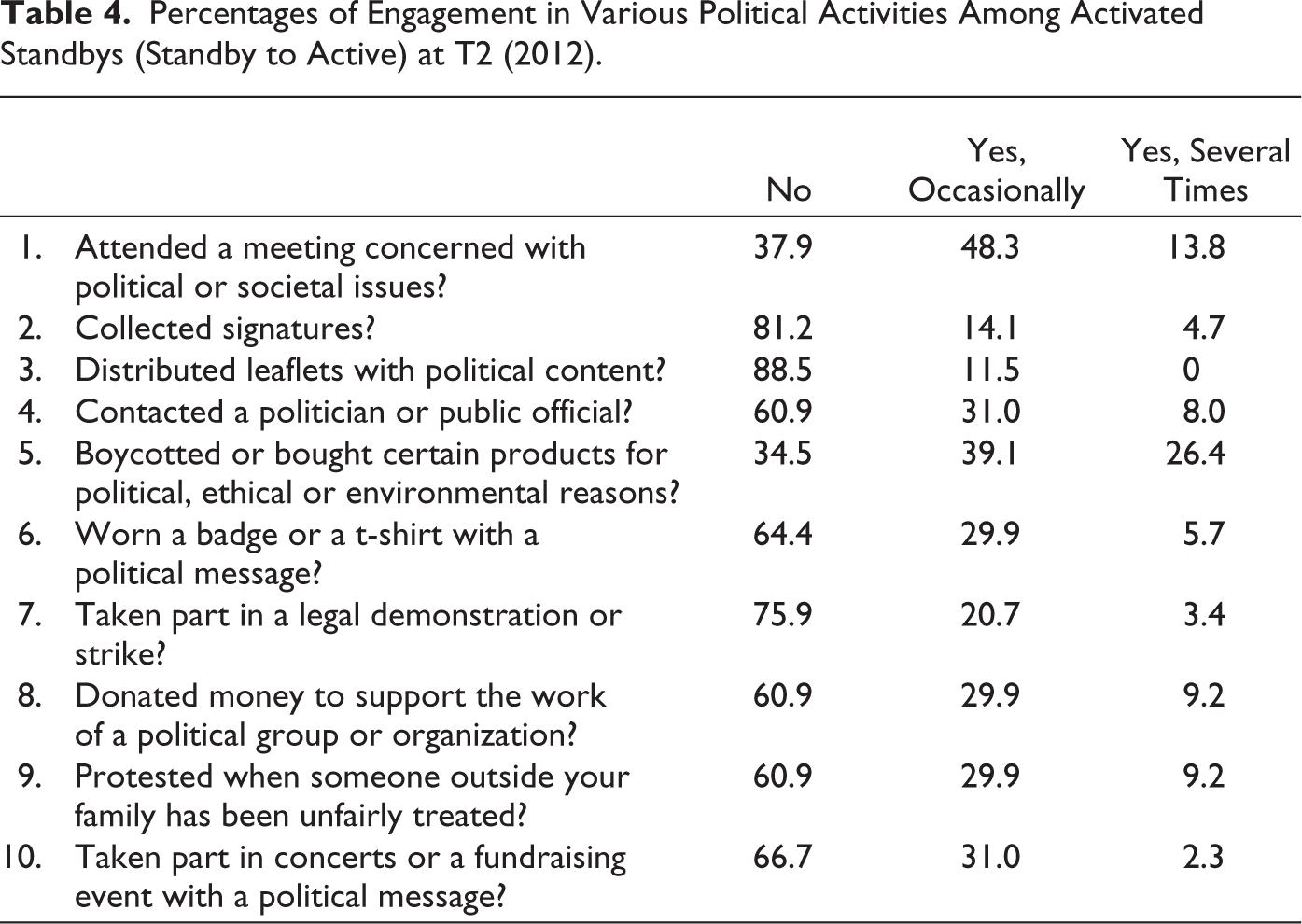
Furthermore, young people who transitioned from standby to active mode were the most active in attending meetings, boycotting or purchasing products for political reasons and participating in concerts and fundraising events. In contrast, activities such as distributing leaflets and collecting signatures had relatively low rates of repeated participation. Overall, activated youths participated in a variety of activities, though the intensity and type of involvement varied (Table 4).
Percentages of Engagement in Various Political Activities Among Activated Standbys (Standby to Active) at T2 (2012).
Institutional Triggers of Youth Political Participation
Finally, we examined whether transitions from the standby and unengaged clusters over time were associated with changes in their levels of system responsiveness, satisfaction with democracy, trust in institutions and satisfaction with government performance over the corresponding period. It is important to note that we excluded the active cluster from this analysis, as well as transitions from unengaged to active, due to the smaller number of participants in these groups. The results of these analyses are shown in Table 5. As expected, there were only a few statistically significant findings. However, pairwise comparisons with a Bonferroni adjustment revealed significant changes in institutional trust over time for two groups. Participants who transitioned from the unengaged group to the standby group experienced a notable decrease in institutional trust from time point 1 to time point 2 (MD = 0.32, p < .001, 95% CI [0.18, 0.46]). Similarly, participants who remained in the unengaged group showed a significant decline in institutional trust (MD = 0.21, p < .01, 95% CI [0.09, 0.34]). To evaluate the practical significance of these changes, we calculated Cohen’s d for each group. The decrease in institutional trust among participants who moved from the unengaged group to the standby group represented a medium effect size (d ≈ –0.52), while the decline among participants who remained in the unengaged group corresponded to a small-to-medium effect size (d ≈ –0.36). These effect sizes indicate that the changes in institutional trust are statistically and practically significant.
Results from Repeated Measure ANOVAs.

More importantly for our study, youth who transitioned from the standby cluster to the active mode reported a significant decrease in satisfaction with government performance from time point 1 to time point 2 (MD = 0.37, p < .001, 95% CI [0.19, 0.54]). In contrast, participants who remained in the standby, unengaged or other groups did not show significant changes in satisfaction over time. To assess the magnitude of these changes, we calculated Cohen’s d for each group once again. Those transitioning from the standby cluster to active engagement showed a medium effect size (d ≈ –0.48), reflecting a meaningful decrease in satisfaction. Changes in the other groups were negligible, with effect sizes ranging from d ≈ 0.02 to d ≈ 0.17, indicating minimal practical change over time. Overall, these effect sizes suggest that the most substantial and meaningful change occurred among those transitioning from standby to active engagement, while other groups experienced minimal and non-significant changes over time.
All in all, only two of the four examined institutional factors appear to be associated with the movement of young people between clusters: changes in institutional trust and satisfaction with government performance. Decreases in satisfaction with government performance had the greatest impact on the transition from standby to active engagement, underscoring its significant influence on youth engagement. This suggests that, although some aspects of institutional dynamics play a role, others may not have a significant impact.
Discussion and Conclusion
The question of younger generations’ engagement in politics has long sparked debate in social science. Much of the literature emphasizes political apathy and disengagement, portraying young people as increasingly detached from democratic processes. In contrast, a more optimistic strand highlights the notion of standby citizenship, suggesting that many youth remain politically aware and prepared to act when circumstances demand it. Research has shown that standby youth constitute a distinct group, different from genuinely passive youth, who display political interest and democratically desirable orientations, even if they do not consistently engage in behavioural participation (Amnå, 2010; Amnå & Ekman, 2014; Tzankova et al., 2022). Yet, a critical gap persisted: Under what conditions, and in response to which triggers, can standby youth be expected to transform their latent readiness into active political participation (Amnå & Ekman, 2014, p. 277)? This study is the first to address that gap with longitudinal evidence, demonstrating when and why standby youth transition into active political participation.
Using data from two waves of a longitudinal political socialization study conducted in Sweden, where participants were 16 years old at the time of the first survey, we found a significant movement from standby to active mode. Standby adolescents were more likely to become politically active over time compared to youth who were unengaged from the beginning. Equally importantly, however, the results of this study showed that standby youth were less likely to move into the truly disengaged cluster of youth. These patterns, observed through the longitudinal design of the study, provide a deeper understanding of the concept of the standby citizen. Rather than being a fixed state, standby status appears to be a dynamic phenomenon, characterized by the potential for change and movement towards greater political engagement. This dynamism highlights the importance of continued monitoring and analysis of the standby citizen phenomenon to understand better the factors influencing this transition over time.
Furthermore, by comparing those who moved from standby to active engagement with those who remained in standby mode, we found that the transition to active participation was associated with a significant decline in satisfaction with government performance over the study period. In contrast, those who remained in the standby category did not show such a decline in satisfaction with the government’s performance. This suggests that, as expected, standby youth are moved to active participation when they perceive that the political system is underperforming or failing to meet societal needs. Standby youth may not see themselves as passive guardians of the status quo, but rather as a potential force for change. Thus, when their assessment of government performance suggests a need for action, they are likely to mobilize and participate politically.
In other words, standby youth appear to become actively engaged when they perceive a gap between societal expectations and government action and see themselves as agents who can help bridge that gap. This observation might also explain why government performance specifically emerged as significant in the analysis. Essentially, it is the tangible changes related to observed government actions or inaction, rather than a broad evaluation of democracy and responsiveness, that spur youth to engage. This suggests a direct and pragmatic assessment of governmental effectiveness as a crucial factor for youth participation, highlighting their readiness to act when they see an immediate and specific need for their involvement.
In addition, young people who transitioned from standby to active mode participated in a variety of activities, though the intensity and type of involvement varied. They were most active in attending meetings, boycotting or purchasing products for political reasons and participating in concerts and fundraising events. By contrast, activities such as distributing leaflets and collecting signatures had relatively low rates of repeated participation. Thus, those who moved from passive to active engagement did not confine themselves to a single form of political participation, such as low-threshold activities, but instead displayed a broader pattern of involvement.
Moreover, although gender, subjective SES and immigrant background are generally considered important predictors of youth political participation (e.g., Barrett & Pachi, 2019), our longitudinal analyses indicate that these factors did not significantly influence transitions between engagement trajectories (e.g., standby to active). This finding highlights the potential for standby youth to become politically active regardless of their demographic or socio-economic background. Besides, it nuances assumptions about the role of demographic factors, suggesting that they may matter less for transitions between standby and active trajectories. Instead, such transitions may be more strongly shaped by contextual and motivational factors (cf. Karkdijk et al., 2025). This underscores the importance of focusing on structural and psychological determinants when designing programmes or policies to foster youth political participation.
This study offers several important strengths, alongside some limitations, that warrant attention. Most notably, it addresses a core question regarding standby youth that, until now, had gone untested: whether these youth eventually transition to active political engagement. Examining this question is crucial, as it provides a basis for an optimistic or pessimistic assessment of the state of current youth political engagement (Gamson, 2004). The current study is the first to demonstrate that standby youth may eventually present behavioural activism. Equally importantly, our results indicate that standby youth were less likely to become unengaged over time. By offering longitudinal evidence of the transitional nature of standby youth and their tendency to avoid complete disengagement, this study underscores the potential of standby youth as a participatory reservoir within a democratic context. Despite their limited regular political activity, these individuals may serve as a latent but critical component of civic participation, ready to engage when conditions or motivations align. This insight challenges the perception of passive youth as entirely disengaged and emphasizes their role in sustaining the vitality of democratic engagement over time.
The current study has at the same time some limitations that deserve attention. One limitation of the study relates to the data. We used a two-wave longitudinal data set, with approximately 2 years between the measurement points. From a longitudinal perspective, one might question whether this timeframe and the limited number of measurement points are sufficient to capture the dynamics of the phenomena under study. However, given that adolescence is a crucial period characterized by rapid developmental changes and a formative and critical period for the development of political attitudes (Hooghe & Wilkenfeld, 2008; Stattin, 2024), it is important to recognize that shorter or more frequent intervals might provide a more nuanced understanding of these changes. Regardless, future research could benefit from employing more frequent measurement points to better track the evolution of attitudes and behaviours during this formative stage.
Another limitation is its primary focus on institutional factors. While we acknowledge that multiple catalysts could potentially activate political engagement, our emphasis on institutional factors stems from our theoretical framework. This posits that the evaluation by youth of their necessity in societal roles is closely linked to their perceptions of the democratic structure and reality of their environment. Additionally, we control several key socio-demographic factors and youth’s internal political efficacy, which have been shown to play a significant role in shaping individuals’ political participation and engagement. Despite accounting for these variables, future research should also explore other potential triggering factors that may influence political behaviour. These could include elements, such as social networks, media consumption and community involvement, which might affect young people’s political engagement. By broadening the scope of analysis, future studies could offer a more comprehensive understanding of the dynamics that drive political participation among youth.
Finally, while these findings provide important insights into the transitional nature of standby citizenship, caution is warranted when generalizing beyond the Swedish context. Sweden is characterized by comparatively high levels of political participation, strong traditions of active citizenship and a relatively equal welfare state. Moreover, the school system has long played an active role in reducing inequalities in civic competencies. These institutional and cultural conditions may create a particularly favourable environment for standby youth to transition into active political engagement. Future research should therefore examine whether similar dynamics can be observed in political systems outside the Nordic countries with lower levels of participation, weaker welfare institutions or greater socio-economic inequalities.
The implications of the current study converge into one message. Although there are understandable difficulties defining seemingly passive citizens as either agentic or apathetic (Felicetti, 2022; Hay, 2007), the overall pessimism regarding political engagement among contemporary youth seems overstated. There is a non-ignorable portion of youth in society who view the political affairs of society with critical eyes while being equipped with favourable democratic aptitudes, namely standby youth. More importantly, when the need arises in society, their democratic potential can be actualized in behavioural participation. For this reason, a simple cross-sectional analysis of only the manifest political actions of either an entire citizenry or individual citizens appears to be insufficient to identify democratic qualities.
Consequently, the transitional nature of standby youth calls for reflection on the ideal level/form of political engagement. As a case in point, in societies where democratic cultures and practices are well established, the standby mode of engagement may rationally serve in terms of both effectiveness and autonomy. Indeed, some scholars suggest that the persistent robust democracy in Scandinavian countries may not necessarily be attributable to their citizens’ constant manifest participation but rather to the absence of passivity (Anderson & Hoff, 2001). Although political interest seems stable (Prior, 2010; Russo & Stattin, 2017), political participation may vary meaningfully. To be more certain, it is necessary to test whether and how the mechanisms passivating and activating standby citizens operate across democracies of different qualities. Although initially counterintuitive, it seems plausible that comparatively successful democracies may gradually transform the participatory norm from being highly active to being intermittently involved when necessary. In this way, the reactive behaviour of contemporary youth lies somewhere between two democratic ideals (Teorell, 2006): they are too inactive to live up to the ideals of participatory democrats; at the same time, they are too politically aware, impatient and volatile to passively await the next election as elitist democrats would prefer.
Footnotes
Declaration of Conflicting Interests
The authors declared no potential conflicts of interest with respect to the research, authorship and/or publication of this article.
Funding
The authors disclosed receipt of the following financial support for the research, authorship, and/or publication of this article: We gratefully acknowledge the financial support of the Swedish Research Council, which funded this research under grant number 2022-01891.