



Abstract
Youths have responded to the unprecedented socio-economic impact of COVID-19 pandemic through civic and political participation. However, knowledge gaps exist with documenting specific motivations and forms involved in participation, as well as the implications for subsequent engagement. Using public podcast episodes produced by the author during Singapore’s nine-day election campaign held under lockdown, youth perspectives were analysed thematically to understand youth motivations, participation forms and how participation shapes future sociopolitical engagement. Findings suggest that Singaporean youth were motivated to build awareness and activism and take action between elections and during GE2020. Youth participation was a mix of conventional and non-conventional activities with seamless digital transitions. That any form of participation during the election resulted in youth resolve to continue or expand their engagement beyond GE2020, with awareness and activism and action perceived as mutually reinforcing motivations, has implications for future political behaviours and activities and issues in which youth are engaged.
The coronavirus pandemic (COVID-19) has impacted elections and influenced youth civic and political participation. While some elections were postponed (Landman & Splendore, 2020), Singapore was one of the earliest countries to hold elections under lockdown (Beech, 2020; Tan, 2020). Besides necessitating increased social media and Internet usage for political engagement (Rusu, 2020), the pandemic also exacerbated existing socio-economic challenges. Problems like rising income inequality and social discontent are likely to increase and shape youths’ present and future political participation (Campbell, 2020; Gabriel et al., 2020; Pavarini et al., 2020; Talmage et al., 2020). Together with the pandemic’s persistent and deleterious impact, youth are likely to confront political actors and/or structures perceived to be responsible for the problems. Even before COVID-19, despite concerns over low youth participation in conventional electoral politics (Farthing, 2010; Kitanova, 2020; Putnam, 2001), youth were already more likely to be engaged through non-conventional political activities (Mycock & Tonge, 2012; Sloam, 2016). The pandemic is likely to further that trend.
Moreover, lockdown and physical distancing measures accelerated existing use of social media and Internet tools, and the consumption and production of political information. While past crises like the 2008–2009 global financial crisis prompted more youth to be more politically engaged (Hessel et al., 2011; Pickard & Bessant, 2018), disruptions caused by COVID-19 have been unprecedented in scope and length (Bryant et al., 2020; Lancker & Parolin, 2020; Nicola et al., 2020; Patel et al., 2020). Before COVID-19, youth political participation influenced future engagements in democratic politics (Flanagan, 2013; Hooghe, 2004). With the pandemic, youth appear poised to challenge the efficacy of conventional political structures through conventional and unconventional participation forms across a range of socio-economic and political issues.
However, while recent research studies have broadly affirmed the continuation of youth civic engagement and/or political participation during COVID-19, knowledge gaps exist with documenting specific motivations and forms involved in participation, as well as the implications for subsequent engagements. Therefore, Singapore’s 2020 general election (GE2020), a period of intense political activity, presents an interesting site for study. The government’s handling of COVID-19 and how the most vulnerable have disproportionately borne the brunt of COVID-19 were scrutinized. Although voting was compulsory, voter turnout hit a 23-year high (Tan, 2020), signalling strong political interest despite or because of the pandemic. Turnout increased even in the absence of physical rallies, which historically drew tens of thousands (Skoric & Zhu, 2016). Because of the short nine-day campaign and lack of physical outreach (Beech, 2020), online campaigning created even more opportunities for youth participation. Furthermore, the historic swing against the ruling party was partly attributed to the voting patterns of young Singaporeans, many of whom disapproved of its pandemic performance and conduct throughout the electoral campaign (Yong & Iau, 2020).
Drawing upon public podcast episodes produced and published by the author during the nine-day GE2020 campaign, capturing youth perspectives at the height of the election and not in retrospect, this exploratory study seeks to describe different motivations for and forms of youth civic and political participation associated with Singapore’s pandemic election, as well as to understand how youth participation may shape future socio-political engagement. Identifying participation motivations and forms across GE2020 will not only be instructive for how youth might sustain their political behaviours and activities but could also illustrate how COVID-19 could influence continued youth participation and the issues in which the youth are engaged beyond the pandemic.
Literature Review
Youth civic and political participation can be broadly categorized as conventional and unconventional (Kitanova, 2020; Norris, 2002). Conventional forms, centred on mass electoral politics (Mair, 2013), include voting, party membership, campaign work for political parties and electoral contests. Non-conventional forms include online activism, public protests or demonstrations, and other advocacy forms, including civic engagement and social involvement (Ekman & Amnå, 2012). There is growing consensus that democratic engagement is not limited to conventional forms of participation, for youth are predisposed to participate in diverse non-conventional activities to influence political outcomes (Mycock & Tonge, 2012; Sloam, 2016).
Earlier studies were critical of low youth electoral turnouts, decreased engagement with sociopolitical institutions and reduced youth participation in conventional political activities (Putnam, 2001). However, more recent scholarships have found that the youth turn away from traditional politics when they feel excluded from or are disenchanted with existing political systems and social structures (Harris et al., 2010; Sloam, 2013), consequently, engaging in politics outside of traditional institutions through non-conventional activities (Sloam, 2016). Relationships within more fluid social networks are prioritized over formal and more hierarchal organizations (Bennett & Segerberg, 2012), and non-conventional participation—also characterized as non-electoral or non-institutionalized—may be preferred because it allows the youth to choose issues of interest and determine advocacy modes (Sloam & Henn, 2019).
There is some evidence from Singapore that the youth prefer non-conventional participation. While 65% of the youth in 2016 were involved in at least one civic activity (National Youth Council [Singapore], 2017), they were most likely to repost and/or like content online about sociopolitical issues (35%), support social causes through donations (33%) and participate in environmental conservation efforts, activities which could be classified as more non-conventional. Conversely, they were least likely to send a ‘letter to the editor’ to a newspaper/magazine (1%), attend political rallies or speeches (4%), and work with citizens to solve a problem in the community (4%), all more conventional activities.
However, conventional and non-conventional forms of civic and political participation are not immutable or mutually exclusive. The youth might adjust their interest and participation in different contexts (Amnå & Ekman, 2014); engage in traditional politics or vote when they are more directly invested in specific issues championed or highlighted by candidates, political parties or election cycles (Sloam & Henn, 2019); and shape their participation based on values or ideology with which they identify (Henn & Foard, 2014). In other words, participation forms interact and evolve under different conditions, including during election campaigns when conventional forms of participation are traditionally dominant.
A continuum of conventional/non-conventional participation forms is not the only theoretical lens through which civic and political engagement can be understood. The Internet’s proliferation has also increased and diversified opportunities for participation through platforms such as Facebook, Instagram and Twitter (Loader et al., 2014). Under COVID-19 lockdown, the youth relied heavily or almost exclusively on digital tools for engagement and education as political parties moved canvassing efforts online. Before the pandemic, social media usage was positively associated with online and offline political engagement (de Zúñiga et al., 2014; Vromen et al., 2014), with the youth using social media to seek information and express political opinions (Skoric & Zhu, 2016). In other studies, social media usage correlated with more frequent online interactions and consumption of political information, but not necessarily with the production of information or collective action (Ekström & Shehata, 2018). Hence, it would appear that the production of political information was preceded by consumption of similar information, with the youth seeking to identify political or policy positions and marshal evidence before sharing their positions privately and/or publicly.
The relationship between social media usage and political participation in the opposite direction has also been demonstrated, that the youth who are already politically engaged are more likely to use Internet tools to further interests and causes, instead of Internet accessibility, leading to increased participation. A study of young British adults found that political interest predicted higher online political engagement among those who were already engaged, whereas new youth were not mobilized (Keating & Melis, 2017). Similarly, a meta-analysis of survey-based studies found a positive association from engagement in civic and political life to digital media use (Boulianne & Theocharis, 2020).
Besides accelerated use of social media and the Internet, COVID-19 as a crisis could further shape the youth civic and political participation. The widespread disruption caused by COVID-19 has been unprecedented (Bryant et al., 2020; Lancker & Parolin, 2020; Nicola et al., 2020; Patel et al., 2020). The youth are aware of and could personally live through emerging problems and inequalities, thereby creating impetus to mobilize politically and improve their own well-being (Campbell, 2020; Gabriel et al., 2020; Pavarini et al., 2020; Talmage et al., 2020). Under lockdown and with time to spare, the youth were more likely to participate virtually, with those adversely affected by COVID-19 potentially more outspoken in calls for change. In the aftermath of past disasters and crises, young people became more involved in politics and political action (Hessel et al., 2011; Pickard & Bessant, 2018). Consistent with grievance theory, rising European unemployment between 2008 and 2010 was related to greater non-institutionalized political participation, including, but not limited to, the youth (Kern et al., 2015). Nevertheless, others have documented that dissatisfaction with political and economic systems may not necessarily be linked to increased political participation (Ontas et al., 2013).
The COVID-19 pandemic appears to have motivated greater youth civic and political participation in Singapore. GE2020 was a pandemic election not only because it was held under lockdown with strict physical distancing measures but also because the government’s handling of COVID-19 and the plight of vulnerable communities were front-and-centre. While voting was compulsory, 95.81% of eligible voters cast ballots, marking the highest voter turnout rate in 23 years (Tan, 2020). Turnout was almost 3 percentage points higher than the 2015 election despite the cancellation of physical rallies, an especially important campaign strategy for opposition parties (Skoric & Zhu, 2016). The very short nine-day campaign created intense campaign activity as political parties primarily produced online programmes and content (Beech, 2020), thus creating more opportunities for the youth to engage. Finally, while the ruling party retained its parliamentary supermajority, its overall vote share slid from 69.9% to 61.2%, a historically poor performance. The ruling party—which has remained in power since Singapore’s 1965 independence—acknowledged that it needed to better engage and incorporate the perspectives of young voters, many of whom were thought to have voted for the opposition as a sign of their disapproval (Beech, 2020; Yong & Iau, 2020).
During such an intense general election held in the middle of an unprecedented pandemic, levels of the youth civic and political participation were high. Intense political GE2020 activity during COVID-19 prompts important questions for the study: What were their motivations and in what forms of conventional and non-conventional participation were young Singaporeans engaged? With COVID-19, how did the youth use social media and Internet tools to participate or consume and produce political information? And how will their GE2020 engagement shape their future civic and political participation?
Method
Analysing 17 public podcast episodes with 20 individuals while GE2020 was ongoing, this study aims to describe different motivations for and forms of the youth civic and political participation associated with GE2020, as well as understand how their participation may shape future sociopolitical engagement. At the time of the recordings, the average age of the youth respondents was 24.4 years (range = 19–28 years). Most were male (65%) and Chinese (60%), and there was a roughly even split between those who were studying (45%) and working (55%). Respondents did not declare their political orientation or the party for whom they were voting because the emphasis was their participation and perspectives on GE2020’s broader issues. They were not asked about their socio-economic status, though it can be inferred from their involvement and/or sharing that most grew up in middle-class households. The episodes were published on socialservice.sg (
Questions were designed to ensure a conversational and semi-structured flow. Given his experience with the podcast medium, the author hosted the podcast and made sure that the tone was relaxed, and the overall setting was comfortable so as to elicit more in-depth reflections. In addition, questions were also customized for each respondent based on publicly available information of their civic and political participation. Questions were shared with respondents ahead of the recordings. Question design was broadly guided by the theoretical categorization of conventional and non-conventional participation and how digital tools were used, while ensuring that the interviews still primarily centred on the respondents’ views and experiences.
While they varied for each respondent, questions were broadly organized into two categories. Questions in the first category were designed for respondents who were leading or part of groups of other youth. They included conception of the group and motivations for joining it; description of its activities before and during GE2020; processes through which the group planned and executed activities, especially with pandemic-imposed constraints; challenges the group faced; and future plans. Questions in the second category focused on respondents’ observations of and thoughts on the election. Some respondents were voting in hotly contested constituencies, and questions included campaign issues, which mattered most to them; how they were consuming or producing information; their impressions of or interactions with parties; and comparisons of candidates contesting in their constituencies. In both categories, wherever appropriate, there were follow-up questions and prompts.
The public nature of the podcast merited additional considerations since respondents would ultimately be speaking to a public audience. Besides a relaxed tone and comfortable setting, the author was not antagonistic and did not seek to challenge or contradict the respondents. No recordings were edited for content to ensure that nothing was taken out of context. Additionally, it was understood that respondents were likely to be more comfortable, sharing their perspectives, and thus to be more civically and politically engaged. For those representing youth groups, raising awareness of their groups and/or causes was likely a key motivation. These considerations were consistent with the increased use of podcasts as research and/or teaching resources (Harris, 2019; Lepikhova, 2021), especially in public sociology (Gans, 2016). The ability to reach a wider audience and to communicate community initiatives and research projects was positive, but selection bias was a potential threat with the podcast medium because participants were more likely to be confident orators and active participants in their respective fields.
The podcast episodes were recorded and published between 30 June and 11 July 2020, a period which directly overlapped with the election. The Parliament was dissolved on 23 June, and the election campaign lasted from 30 June to 8 July. Because of lockdown measures, which prevented face-to-face meetings, interviews were conducted over Zoom. The interviews were produced on Anchor, a free creation and hosting platform—adding brief preambles and jingles and fixing any audio-quality issues—and episodes were distributed to platforms such as Apple Podcasts, Google Podcasts and Spotify. Conversations were recorded and published during the GE2020 campaign but before the election results were announced, which meant that respondents described their participation as the election was happening instead of doing so in retrospect.
Sampling was purposive to sample for heterogeneity and diversity, based on group types, issues in which they were interested, and their constituencies. In the beginning, open calls for participation were published on social media, primarily Facebook, Twitter and Instagram. The author also approached young Singaporeans with whom he had worked or known. Initial episodes covered youth volunteering directly for the political parties and those interested in issues of environmentalism, lowering the voting age and raising sociopolitical literacy. Calls for participation continued with additional episodes, but the scope was narrowed to topics not previously covered. Subsequent episodes covered Lesbian, Gay, Bisexual, Transgender, Queer or Questioning, Intersex, Asexual or Ally (LGBTQIA+) issues and mid-campaign performance of the political parties and candidates, especially those receiving greater attention in the mainstream media, like the Aljunied and Holland-Bukit Timah group representation constituencies. Finally, there was some snowball sampling as listeners sent in suggestions or volunteered themselves. Final episodes centred on how respondents were discussing GE2020 with family and friends and how they followed developments as the election concluded.
Guided in the qualitative methodology of thematic analysis (Braun & Clarke, 2006; Terry et al., 2017), data were analysed, patterns identified and themes reported through a systematic six-step process. First, all the podcast episodes were transcribed, read and re-read so as to develop familiarity with the text. Second, initial codes were generated by coding the data systematically. Significant initial codes included motivations for participation, comparisons of respondent activities between general elections and during GE2020, and expressions of self-doubt that they were not doing enough. Third, these initial codes were collated into themes with relevant data in ATLAS.ti. Fourth, themes were reviewed by checking themes to coded extracts and the data set so as to generate an analytical thematic map, which eventually took the form of a two-by-two matrix. Fifth, themes were defined and labelled by refining its specifics to generate definitions and names for each theme, following which representative excerpts were identified for each theme. Sixth, evocative exemplars were chosen.
To ensure the quality of data analysis and research, the author gained familiarity through multiple readings of all transcribed podcast episodes and coded initial episodes line by line. Some episodes were re-coded and listened to again. A journal of detailed notes and analytical interpretations was kept. As initial codes and data features emerged and saturated with no new codes emerging (Morgan, 1993), coding categories were generated in ATLAS.ti before they were sorted into potential themes. Thematic maps were iterated, and the most frequent and significant themes were reviewed against the raw interview data, such that clear links between themes were articulated. Additionally, themes were further checked for recurrence, repetition and forcefulness before themes and sub-themes were named (Owen, 1984). Finally, the overall standard of referential adequacy was met through a constant comparison process across all 17 episodes (Lincoln & Guba, 1985), while both the journal of notes and interpretations, as well as memos penned after each episode, ensured an audit trail that facilitated exemplar identification, wherein evocative exemplars were selected (Lincoln & Guba, 1985).
Results
A thematic analysis revealed four themes (Table 1). Youth motivations were categorized as ‘Building awareness and activism’ and ‘Taking action’. Forms of civic and political participation occurred ‘Before GE2020 and between general elections’ and ‘During GE2020’. In both instances, awareness and activism were built through the consumption and production of content. Between elections, the youth acted through correspondence with political leaders and direct involvement in civic or political events. During GE2020, they acted through engagement of candidates and their parties and direct party volunteerism. Respondents were involved in a range of conventional and non-conventional activities, and transitioned into or expanded online participation without difficulty.
A Summary of the Relationship Between Youth Motivations and Different forms of Civic and Political Participation
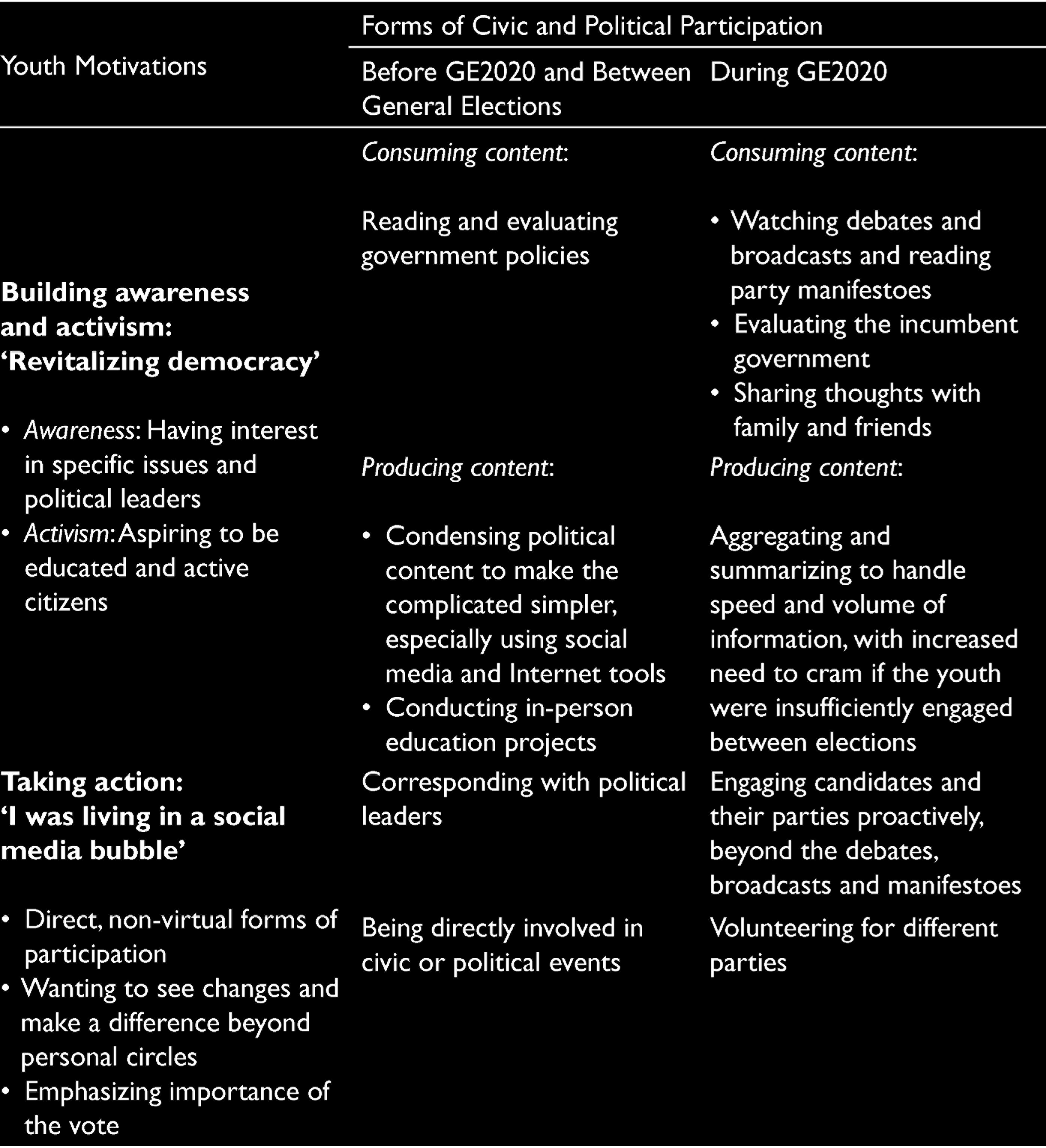
In addition, any form of civic and political participation during the election resulted in respondent resolve to continue or expand their engagement after GE2020 and between future general elections. Respondents stressed that participation should not only occur during elections, and that building awareness and activism and taking action were mutually reinforcing motivations. Those who consumed and/or produced political content during GE2020 committed to acting even after the election, while those already involved in action resolved to harness and take advantage of heightened interest in politics of other youth.
Motivations
Building Awareness and Activism: ‘Revitalizing Democracy’
Respondents had interest in national issues and aspired to be active citizens, wishing to change perceptions of the youth political apathy by building awareness and activism. Issues included care for the elderly, help for the disadvantaged, lowered voting age and other challenges like education and housing. They took specific interest in politicians if they volunteered for or corresponded with them and/or shared issues of interest. A 23-year-old environmentalist spoke about climate change as an issue for which she cared strongly and how it shaped her motivations:
But we have started to realize that climate change affects many other issues especially like the economy, jobs, even social well-being. I think I started to see and started to care about other issues from that lens of climate justice and climate change.
In addition, respondents raised awareness of different advocacy sources and explained how progress could be achieved. By keeping others informed, they also personally kept up with news updates. Besides having opinions on and/or being aware of policies, they wanted to expand awareness to others because keeping individuals and communities well informed was seen as an important precursor to action. For instance, a 23-year-old leading a meta-advocacy group encouraged more ‘to not be scared, to not just share our content, but to discuss with your friends, discuss with your family’. The long-term goal of the advocacy group, articulated by his 19-year-old female co-leader, was the revitalization of democracy in Singapore.
Taking action: ‘I was living in a social media bubble’
In wanting to make a difference, respondents stressed the need to go beyond personal or social media ‘bubbles’, a metaphor employed by a male 25-year-old political party volunteer. They wanted to be involved in initiatives that translated socio-political awareness and activism into action, including emphasizing the importance of voting. Respondents believed that the end-goal of achieving systemic or political change started with ground movements, through which individuals gradually pushed for progress. ‘More than just awareness’, a 21-year-old coordinator of a student-run elections resource explained, Singaporeans must be aware of the consequences of their vote. He added: ‘If your [parliamentarian] is not voting or saying what you voted them in for, then you have to speak up and talk to them’. While acknowledging the challenge of encouraging political involvement, the female environmentalist described how she thought change could be achieved:
The mindset that people have is that change only happens on the inside. If you really want change, you must join the civil service or join a corporation and rise to the top to make a change. But they forget that their duty as an active citizen, be it writing to the [parliamentarians] telling them if they can ask this question in parliament… You must be a bit more involved with your political leaders on social issues.
Beyond social media, respondents stressed the need to act by reaching out to others beyond personal circles. The male party volunteer acknowledged that because he was surrounded by ‘the voices of people very much like me’, he was detached from those holding differing views. Whereas his own social circle championed greater parliamentary diversity, he realized through party volunteerism that other Singaporeans with whom he was interacting were more worried about ‘bread-and-butter’ issues or making ends meet.
In taking action through civic and political education, the male resource coordinator wanted to go beyond those already interested in politics. Moving forward, his goal was to get more youth engaged through school workshops, providing information on politics and governance. Respondents identified that voting determined the composition of a government, which would, in turn, enact policies, and, thus, some called for changes to the political status quo. The male party volunteer desired greater parliamentary checks and balances. A 23-year-old first-time voter in the hotly contested Aljunied constituency described his vote as determining ‘not just who your elected [parliamentarians] are, but what kind of opposition momentum there would be in Singapore’, where one party has dominated politics post-1965.
Forms of Civic and Political Participation
There was consensus on the importance of elections and voting, yet civic and political participation were described as ongoing endeavours actively fostered between and beyond elections. Many respondents expressed this similarly: ‘Democracy and active citizenship are not just about the elections’; ‘Your vote does not just die after Polling Day’; ‘Learning about politics does not happen just during elections’; and ‘It is a mistake to think that elections or democracy are only a once-in-a-five-years affair’. In describing perceived ‘voter apathy’, a 29-year-old male historian said:
Over the decades, we have developed the kind of mentality that politics only matters during election campaigns. We just have this frenzy of political activity for one or two weeks and then everyone goes back to what they were doing before that.
Between elections, activities to foster awareness and activism included tracking parliamentary debates and national issues, reading the news and engaging in online discourse. Respondents scrutinized policies while producing or aggregating content to help others stay informed. Activities to encourage action included meeting with and volunteering for parliamentarians. Hence, awareness and activism were antecedents to action. Participation between elections reinforced similar participation forms during GE2020 and vice versa, even if activities were more intense during elections.
Before GE2020 and Between General Elections
Building Awareness and Activism
Content consumption centred on the reading and evaluation of government policies and issues of interest. Sources of information included parliamentary debates, ministerial speeches, newspapers and websites, and research or party publications. Examples of policies raised by respondents included metrics for academic success, public housing and calls for a Freedom of Information Act.
Content production centred on generating and condensing content to make the complicated simpler through the Internet and/or conducting in-person education projects. In a media environment saturated with news, respondents made complex content more accessible by simplifying and using aesthetically pleasing designs, thereby reaching more youth and keeping their attention. Some respondents tracked the performance of parliamentarians and researched parliamentary attendance, voting records and demographics of political figures. Additionally, respondents processed and explained academic literature, statistics and esoteric concepts for a wider audience. A 29-year-old producer of LGBTQIA+-related content explained his approach:
How do you present it in a convincing and easy to understand way without sounding like you are writing [an] university academic paper that no one actually can understand… People do not have 30 minutes to read blog posts. A lot of thought went into how to carve out this piece this is accessible, comprehensive, and accurate.
Relatedly, an important feature of accessibility was visual appeal, so that the youth were drawn to and more likely to read the content. Respondents were adept at using Facebook and Instagram posts and stories to explain, condense and encourage viral sharing. Finding the right balance between important content and creative visualization required experimentation. The same content producer explained a trade-off between content amount and shareability:
The more information you present on the social media post, the less likely people are to click to read. Because they have everything, they think they have everything. The less you present on a post, some people might not share it, because they will just click through, and then they read, and then they are done.
To build awareness, respondents also organized in-person projects like community-building sessions, public workshops and school-based activities. Programme content spanned advocacy and activism, parliamentarian interactions and Singapore’s electoral system. Participants also learnt about petitions and cause-based groups.
Taking Action
Acting between elections meant corresponding with politicians and being directly involved in civic and/or political events. Passive correspondence occurred at party or community events, during which respondents listened to speeches or struck up conversations with parliamentarians. They assessed communicative style and substance to gauge politicians’ affability and electability. Describing a minister who visited his housing estate during festivals as ‘charismatic’ and ‘eloquent’, a 28-year-old male working professional observed: ‘He is really good at quickly striking up a conversation, getting some information out of you, and sharing a bit about himself’.
More active or proactive correspondence occurred when respondents took the initiative to contact parliamentarians. Some attended meet-the-people sessions (MPS) to register concerns over national issues or submit letters or petitions. Virtually, they wrote to parliamentarians about issues for which they cared. Respondents also sent direct messages or tweets to politicians’ Facebook, Twitter and Instagram platforms.
Respondents got directly involved when they organized community events and when they assisted politicians to advance party interests or shape legislative agenda. Another 25-year-old party volunteer described his journey of ‘learning the ropes’ to better help the marginalized through the weekly MPS between elections:
Residents come in and we write appeal letters for them. [Parliamentarians] say, ‘Okay, let us look at it. Let us write to the agency and let us see how we can tackle this issue’. …Any issue that has anything to do with any statutory board or ministry in Singapore, I think all MPS locations will take care. And the [parliamentarians] will write a letter on your behalf to the respective agency.
During GE2020
Building Awareness and Activism
During GE2020, content consumption centred on watching debates and political broadcasts and reading party manifestoes, evaluating the government, and sharing thoughts with family and friends. Because of the large number of parties, respondents paid more attention to contesting parties in their constituencies. In particular, they analysed and compared manifestoes, considering their length and substance and whether party promises aligned with respondents’ beliefs. For many, COVID-19 and post-pandemic recovery were prominent themes:
Within COVID recovery, there have been talks about a green recovery, which is needed for a more resilient economy… From that lens, I start to see when we talk about economic recovery, who exactly are we recovering? Or who are benefiting from our policies? Is it the people who are most affected? (23-year-old female environmentalist)
Issues were not confined to national politics. Respondents were concerned about municipal issues, including local development plans, upgrading projects and public transportation. They also considered the candidates’ appeal: Their predisposition, personal and professional backgrounds, and issues for which they advocated and how they could be held to campaign promises after GE2020.
Because of its long-standing dominance as the incumbent government, there was additional scrutiny of the ruling People’s Action Party (PAP). Respondents focused on how the government dealt with COVID-19, GE2020’s timing and the safety of holding an election during a pandemic. They noted that the PAP had itself framed the election as a ‘COVID election’, that voters ‘are going to vote for the government that will take you out of this crisis’. Some respondents argued that the election was a mandate on the government’s COVID-19 performance, evaluating the PAP’s campaign to be ‘simple’, ‘consistent’ and speaking to their concerns. Others thought the plans were ‘passé’ and not adequately radical. They were especially critical of the poor response to outbreaks in the foreign workers’ dormitories.
Finally, respondents engaged with family and friends during GE2020. Under lockdown, political interactions with family members occurred in person, while those with friends occurred in closed messaging groups. With family, respondents highlighted the age and voting experience of their parents and the opportunity to learn how policies were perceived dissimilarly. ‘It has been exciting because now, instead of my dad being the most politically active one at home’, the female environmentalist said, ‘now we have someone to spar with on his hot takes on certain manifestoes’. A 23-year-old first-time voter shared how conversations with his father gave him insight into working-class Singaporeans:
Not so much in disagreement, but because their generation is the one that is feeling certain impacts of COVID that my generation is lucky to not feel, because we are currently mostly still studying… My dad has been telling me about what is going on in his workplace, what has been going on with how regular workers are being impacted.
In contrast, his conversations with friends featured more in-depth analysis about the campaign and policies:
We pretty much talked about where we see the political parties are coming from. What they are pitching, what their target audiences, what might be their electoral strategies… ‘How feasible is this actually? How much can you realistically achieve this? Does this make sense, does the math add up?’
Content production centred on aggregation and summaries to handle the speed and volume of information, with a greater need to ‘cram’ information if respondents were insufficiently engaged between elections. Respondents noted that too much information was produced during the nine-day campaign and many felt overwhelmed. Voters may not have the time or bandwidth to peruse manifestoes, watch broadcasts and/or research candidates’ backgrounds and policy positions. Some cited lengthy or content-heavy manifestoes, which were difficult to digest. First-time voters who were not engaged before GE2020 reported feeling insecure, and even the most engaged respondents felt that ‘trying to cram everything before [GE2020] is just impossible’.
Consequently, some respondents summarized party manifestoes and daily campaign developments and communicated news in bite-sized formats. They used websites, blog posts, aggregated updates from the mainstream media and directories with links to resources. To increase political participation, the initiatives covered basic information about how to vote and the contesting candidates and parties. For those wishing to dig deeper, there were compilations with more detailed content. Some respondents compiled issue-specific resources so that the youth could manageably compare party positions across issues before voting.
Taking Action
Respondents acted by engaging candidates and parties proactively or by volunteering for different political parties. Whereas some thought it was ‘enough’ to rely on debates, broadcasts and newspapers, ‘because they will summarize [the party’s platforms] for you’, others wanted to be more involved. They sought out candidates and used social media to amplify their own content or to reach more youth. Under lockdown, physical rallies and large gatherings were disallowed. Parties instead produced online content and events: Townhalls, question-and-answer sessions, and Reddit or Twitter ask-me-anything threads. Respondents sent direct messages and emails and questions to candidates. The 28-year-old working professional who tweeted questions at one of these sessions was surprised by the speed of responses he received, reflecting: ‘I am glad that they are quite active and trying to engage people’. Respondents who supported candidates would also amplify campaign messages by sharing content so as to help trend topics of interest. Small walkabouts were allowed, and thus some met with or had short conversations with candidates.
The most direct form of action was volunteering for the parties on the campaign trail. Volunteers for different parties were tasked with similar responsibilities, trailing candidates on door-to-door home visits and canvassing at public locations and/or walkabouts. The aim was ‘to cover every single HDB block in the entire [constituency], which is a tall order’. The 26-year-old male volunteer added:
What we do is we take a whole stack of flyers, we take the lift to the top floor of the HDB, and we just work our way down. Every floor, down the stairs, and we would knock on the door, talk to the residents and if they are not home, we just slip it under the door.
A 25-year-old male volunteer of another party echoed this physically exhausting process of ‘pounding the ground’, managing communications, walking with the candidate and putting up banners. ‘Keeping up the momentum for nine days’ was challenging for all party volunteers:
Even between our lunch and dinner, we do not really have a long time. It is more of planning what is next and there are lots of changes along the way. Every day the schedule changes for the next day. You have got to react quickly, and it drains you. It drains you.
Discussion
While extant research has demonstrated that the youth remained civically engaged and politically participative throughout the pandemic, this study goes further to document the youth motivations, participation forms and future involvement intentions. The Singaporean youth were motivated to build awareness and activism and take action before GE2020 and between elections and during GE2020. Cognizant of the limitations of each, youth participation was a mix of conventional and non-conventional activities, including the constant consumption and production of political content, corresponding with politicians and/or attending events between elections, and engaging candidates and/or volunteering for parties during GE2020. Additionally, transitions to social media and the Internet were seamless. Any form of participation during the election resulted in youth resolve to continue and expand their engagement beyond GE2020, with awareness and activism and action perceived as mutually reinforcing motivations.
Both between elections and during GE2020, awareness and activism were built through the consumption and production of predominantly online content, and during the election, COVID-19 and post-pandemic recovery were especially prominent issues of interest. During GE2020, also because of the pandemic, the youth consumed content under lockdown by watching debates and broadcasts and reading manifestoes, evaluating the incumbent government, and sharing thoughts with family and friends. They produced content by aggregating and summarizing information throughout the election campaign. Respondents transitioned seamlessly to online forms of social media and Internet participation, a phenomenon consistent with extant research, documenting the usage of digital tools for political participation (de Zúñiga et al., 2014; Loader et al., 2014; Vromen et al., 2014). Patterns of information consumption and production and how they relate to direct, non-virtual action have previously been demonstrated (Ekström & Shehata, 2018; Skoric & Zhu, 2016), and in this study, respondents who consumed and/or produced political content during GE2020, similarly, committed to taking action in the long term, including through in-person activities. Given that the pandemic confined most forms of participation to the Internet, future studies should examine whether online engagement consistently translates into offline involvement (de Zúñiga et al., 2014; Vromen et al., 2014), and if the growing availability of online political content motivates youth non-participants to be involved or engaged.
As COVID-19 increased digital engagement, the youth in this study emphasized the importance of civic and political participation beyond elections per se, signalling a continued mix of online/offline and conventional/non-conventional participation. Respondents diversified their participation because they were aware of the limitations of each participation form (Harris et al., 2010; Mycock & Tonge, 2012; Sloam, 2013, 2014, 2016), which may translate into more strategic and coordinated future efforts. Non-conventional, Internet-based activities were adopted because of physical distancing measures and the potential to reach a wide audience, yet many youth were cognizant that social media engagement alone may trap them within social ‘bubbles’ or echo chambers. At the same time, respondents acknowledged the importance of conventional political participation in addition to voting. During GE2020, they acted through engagement with candidates and their parties and party volunteerism. Between elections, action was taken through correspondence with politicians and involvement in civic or political events. Extant research has explored bidirectional associations between social media usage and political engagement (Boulianne & Theocharis, 2020; Keating & Melis, 2017), and this study further highlights dynamic interactions across different participation forms. Nevertheless, more research is needed on the youth who do not act despite being politically aware as well as how they could be mobilized through virtual and/or physical initiatives.
Finally, civic and political participation during Singapore’s pandemic election resulted in the resolve among respondents to continue or expand their engagement in the long term. In particular, building awareness and activism and taking action were mutually reinforcing motivations beyond GE2020. In neo-authoritarian Singapore where politics has been largely dominated by the PAP, respondents desired greater political and parliamentary diversity and wanted to be more personally involved. Political participation during GE2020 intensified because of the short nine-day campaign, and the unprecedented impact of COVID-19 further increased interest in socio-economic and political issues (Bryant et al., 2020; Lancker & Parolin, 2020; Nicola et al., 2020; Patel et al., 2020). Realizing their potential to bring about political change, recognizing the socio-economic impact of the pandemic and weighing the pros and cons of participation forms, respondents committed to political participation beyond elections. Subsequent studies should focus on the long-term impact of GE2020 and COVID-19 on participation patterns over time and the extent to which pandemic-related concerns continue to inform future participation.
With the limitations, the focus on the Singaporean youth results in limited generalizability. In particular, the fact that voting is compulsory in Singapore may compel more youth to vote and to be involved in more conventional forms of political participation as compared to contexts where voting is not mandated. In addition, because of the public nature of the podcast medium, the respondents were more likely to be actively involved in the community, and, thus, the findings may not apply to those who are less politically engaged. Respondents were also likely to hail from middle-income backgrounds. Finally, despite cognizance of personal assumptions when recording the podcast episodes, that the author conducted all the interviews may have amplified bias. Findings should be read as tentative interpretations.
Footnotes
Declaration of Conflicting Interests
The author declared no potential conflicts of interest with respect to the research, authorship and/or publication of this article.
Funding
The author received no financial support for the research, authorship and/or publication of this article.