




Abstract
Children and adolescents are particularly vulnerable to warfare and military violence. In this study, we aim to shed light on adolescents’ experiences during times of war in a natural help-seeking environment. We use survey data obtained from two real-time online chat services designed for Ukrainian-speaking children and adolescents and explore young people’s (n = 1,471) personal experiences during Russia’s war of aggression against Ukraine. It was found that the most common topic that the adolescents wanted to talk about was mental well-being (30%), followed by the topic of personal relationships (29%) and home and family (22%). It is alarming that over 130 adolescents in our sample talked about self-harming or suicidality, and over a hundred expressed an unwillingness to live. As the war continues effective ways to support the mental well-being of young people and to treat mental health problems should be sought.
Introduction
As of 2021, over 235 million people worldwide have required humanitarian assistance due to various crises, including wars, disasters and displacement (UNICEF, 2022). Children and adolescents living in areas affected by war and armed conflicts face myriad challenges that can have profound and lasting effects on their development, mental health and overall well-being. Indeed, research indicates that witnessing or being exposed to violence may have a deleterious effect on adolescents’ adaptive psychological and social functioning and increase their antisocial and behavioural problems (Lee et al., 2020; Sargent et al., 2020). In this study, we aim to shed light on young people’s own experiences during times of war in a natural help-seeking environment. We specifically seek to identify the main themes of conversations with supportive adults among Ukrainian adolescents during an active war.
Adolescence as a Developmental Stage
The definition of adolescence varies but most often it is the phase of life between childhood and adulthood, from ages 10 to 19 (Blum et al., 2017; Singh et al., 2019). Adolescence is marked by significant social and emotional milestones, including gradual separation from one’s family, forming romantic connections and exploring one’s sexual orientation and identity (Branje, 2022). These rapid changes and growth make youth sensitive to heightened stress in various life domains (Steinberg, 2014). The ability to effectively regulate emotions during times of stress and violence positively contributes to adolescents’ psychological well-being (Lea et al., 2019; Ringdal et al., 2020). In the best case, a young person is able to manage heightened stress and dramatic emotions, both positive and negative (Crone & Dahl, 2012; Heinze et al., 2017), and finally attain a balance between emotional regulation and expression followed by a realistic and coherent sense of identity (Esnaola et al., 2017). However, extreme stress can have an effect on these adaptive capabilities, challenging positive adjustment and even leading to adverse health outcomes (McMahon et al., 2020). Studies have shown clear associations between stressful life experiences and an increased risk of depression, anxiety, behavioural problems (Li et al., 2016; March-Llanes et al., 2017) and even suicidal behaviour (Serafini et al., 2015).
Adolescents’ transition to healthy adulthood hinges upon the social relationships at the communal and societal levels, as well as the cultural milieu in which they reside. Through significant and supportive social relationships and networks, they acquire the skills to reshape their perspectives and gain a heightened awareness of cultural scripts, values and norms (Finkenauer et al., 2019). Indeed, peer relationships play a crucial role in the healthy emotional functioning and overall well-being of adolescents (Raboteg-Šarić & Sakic, 2014). Research indicates that the ability to form and engage in friendships fosters social skills, personal competence and life satisfaction, fortifying individuals’ capacity to cope with stressors (Holt et al., 2018). A comprehensive meta-analysis of 34 studies revealed that peer support and warmth were associated with lower levels of anxiety and depressive symptoms (Gorrese, 2016). Conversely, another meta-analysis showed that experiences of bullying and victimization were linked to heightened levels of anxiety, depression and non-suicidal self-injury, as well as thoughts of and attempts at suicide (Moore et al., 2017).
War as a Developmental Context
Children and adolescents in war conditions are affected by the social upheaval caused by military actions; this includes risks of death or injury and risk of socioeconomic hardship. These experiences are caused not only by the destruction of social and health infrastructure but also by the dispersal and breakup of family units and community systems as the result of displacement, migration and insecurity (Spitzer & Twikirize, 2013). Consequently, children and adolescents are deprived of a nurturing environment, disrupting their foundational support system, which is detrimental to psychosocial well-being and overall development (Betancourt & Khan, 2008). Spaas et al. (2022) found that perceived discrimination and daily material stress were associated with lower levels of mental health and overall well-being among refugee adolescents in various European host countries.
Children and adolescents exposed to armed conflicts often grapple with multiple layers of loss, separation and violent events. Slavich (2020) suggests that these experiences result in a loss of safety at multiple levels, from individual feelings of security to physical separation from friends, homes, cities and even countries. These experiences contribute to a loss of cognitive schemas related to social safety, imparting self-appraisal, perceptions of the social world and envisioning a protected future.
Separation from one or both parents, as highlighted by Waddoups et al. (2019) and Jones-Maison et al. (2020), negatively affects children’s social–emotional development and mental well-being. Even if families are able to stay together, parenting capacities are strained in situations in which the whole family and even the community are affected. Eltanamly et al. (2021) conducted a meta-analysis and qualitative synthesis on war exposure, parenting and child adjustment, revealing that adjustment in highly dangerous settings can lead to hostility, inconsistency and reduced warmth among parents toward their children. This exacerbates the vulnerability of children living in conflict-affected regions. However, Eltanamly et al. (2021) also noted that in settings with less severe threats, parenting may even exhibit more warmth and overprotection. Among refugee adolescents, family separation is associated with both posttraumatic stress disorder (PTSD) and internalizing behavioural difficulties (Spaas et al., 2022). However, using the same data, Verelst et al. (2022) identified protective factors in the sample. Adolescents reporting more social support from family and friends demonstrated higher overall well-being and less emotional distress. The significance of close and intimate relationships was also evident in Peltonen et al.’s (2014) study of children and adolescents living in the Gaza Strip. In contrast, Punamäki et al. (2018) demonstrated that Gazan children and adolescents experiencing insecurity and problematic family relationships exhibited higher levels of internalizing, externalizing and depressive symptoms, along with dysfunctional posttraumatic cognitions, than children and adolescents enjoying secure and supportive family relations.
Finally, individual traumatic events in war, often involving violence and sometimes imprisonment, torture and various forms of abuse, have the potential to traumatize individuals (Peltonen & Kangaslampi, 2019; Peltonen et al., 2014). Numerous studies, including a recent systematic analysis by Blackmore et al. (2020), underscore the elevated occurrence of mental disorders and psychopathological conditions among child and adolescent refugees and asylum seekers. Blackmore et al. (2020) disclosed a prevalence of 22.7% for PTSD, 13.8% for depression and 15.8% for anxiety disorders within these populations. Children affected by wars face significant barriers to accessing necessary healthcare and treatments due to the devastation of social amenities and critical public services, such as medical facilities, sanitation and water infrastructure, resulting from armed conflicts (Weitz, 2012). In the recent article of Slone and Shoshani (2021), personal political violence exposure history of 6,254 adolescents together with psychiatric symptoms, emotional and behavioural problems, and subjective well-being was assessed. Results confirmed positive relations between severity of political violence exposure and psychiatric symptoms, emotional and behavioural difficulties and lower subjective well-being. The authors emphasized taking into account the personal political violence exposure history and the subjective interpretations of impact of the events to accurately identify the mental health risks to youth who are chronically exposed to protracted political violence.
Situation in Ukraine
On 24 February 2022, Russia launched a full-scale invasion of Ukraine. Ukraine has not officially published its population since 1 February 2022, when, according to the State Statistics Service, there were 7,348,531 children aged from birth to 18 living in Ukraine, which was 17.9% of the total permanent population of Ukraine. Compared to 2021, the number of children in Ukraine decreased by 111,100 people (1.5%) (State Statistics Service of Ukraine). The war resulted in a humanitarian crisis, as millions of Ukrainians were internally displaced or fled abroad. The actual war started in 2014 and from 14 April 2014 to 29 February 2024, the Office of the United Nations High Commissioner for Human Rights (OHCHR) recorded a total of 14,085 conflict-related civilian deaths (7,057 men, 4,313 women, 449 boys, 323 girls and 1,915 adults and 28 children whose sex is not yet known). These are the recorded casualties, but thousands of settlements are in proximity of the front lines or in the territories occupied by Russia where international organizations have no access. Therefore, the actual number of casualties can be significantly higher.
By May 2024, about 6.5 million people have fled abroad from Ukraine (UNCHR, 2024). According to the International Organization of Migration (2024), as of February 2024, about 3.7 million people are internally displaced in Ukraine, and almost 6.5 million are worldwide. More than 4.5 million returned home from evacuation from abroad or from other regions of the country.
In this study, we use survey data obtained from two real-time online chat services designed for Ukrainian-speaking adolescents and explore young people’s personal experiences during Russia’s war of aggression against Ukraine.
Research Questions
What are the main themes specific to early adolescence (age 10–12 years), middle adolescence (13–15 years) and late adolescence (16–17 years) among Ukrainian users of the real-time online chat services during the war?
Are there differences in these themes between those adolescents who during the large-scale war remained in Ukraine and those who moved abroad?
How do worries related to war compare with other themes in the conversations?
Methods
The dataset comprises survey data obtained from two real-time online chat services designed for Ukrainian-speaking children and adolescents aged 7–17, Let’s Chat (Давай поспілкуємось) and Domashka (Домашка). Both of these services are provided by SOS Children’s Villages Finland. This study analysed survey data from conversations that occurred between 1 March 2023 and 20 September 2023 (N = 1,568). For the analysis, chat users were categorized into age groups. One per cent of chat users were classified as being in their childhood, aged 7–9 years (n = 16). Five per cent of chat users were over 17 years old (n = 78), and the ages of less than 1% were unknown (n = 3). Due to the limited number of chat users aged 7–9, they were excluded from further analysis, as were those over 17 years old and those whose age was unknown.
Let’s Chat offers an anonymous and confidential platform for young people to discuss their experiences and concerns with trained chat service workers and volunteers. Domashka, a chat service working in association with Let’s Chat, is designed to help children with their schoolwork. Professionals and volunteers help children do their homework or understand the Finnish school system better. After each interaction, chat workers complete a form, recording information such as the child’s age, location, the subject of conversation and the situation at the conversation’s conclusion. The chat workers report the conversation topics using a multiple-choice matrix. In the matrix, topics are divided into 14 main categories and 57 subcategories. One chat conversation can be categorized on one or several main subcategories. The matrix was created based on the most general topics that conversations in the chat have traditionally been about. All of the main categories are the ones often used by children, and subcategories reflect the specifications of the main topics. The categorization was originally constructed by SOS Children’s Villages Finland for the use of chat workers. The researchers in this study were unable to change the categorization of the data. The analysis was done as part of the ACElife, research project, in which adverse childhood experiences are studied broadly. The research design was ethically approved by the Ethics Committee of the Tampere Region (103/2023).
The data were analysed by descriptive methods using frequencies (main topics of conversation) and cross-tabulations (how worries related to war compared with other major themes in the conversations). The Pearson chi-square test was primarily used to test differences between groups. In categories where the conditions for this test were not met, Fisher’s exact test was used. As a sensitivity analysis, we also conducted a principal component analysis with varimax rotation for the subcategories of the three most common main categories, as well as the category that reflected conversations related to the war (Table A1, in the Appendix section). Inclusion of all subcategories (n = 57) was not possible because of the high number of variables and the correlation among them. With this analysis, we wanted to determine how much the conversation fluctuated across different themes within one chat conversation.
Results
Descriptives
During the chat sessions, 82% (n = 1,210) of users were located in Ukraine, while 17% (n = 247) were in other countries. Most of those outside Ukraine were situated in European countries, with Germany (7%) and Poland (3%) being the most common locations. Only 2% (n = 30) of chat users were in Finland, where Let’s Chat operates.
Eighteen per cent were categorized as early adolescents, aged 10–12 years (n = 283). The majority of chat users fell into the middle adolescent group, aged 13–15, constituting 42% of the dataset (n = 664). Thirty-three per cent were in late adolescence, aged 16–17 years (n = 524).
Main Themes of the Conversations
Among the 1,471 conversations of the early, middle and late adolescents, the most common topic was mental well-being (30%, n = 509), followed by the topic of personal relationships (29%, n = 424). The third most common topic was home and family (22%, n = 327). There were small differences depending on where an adolescent took part in the conversation. Among early, middle and late adolescents in Ukraine, the most common topics were mental well-being (36%, n = 434), personal relationships (28%, n = 339) and home and family (24%, n = 292), whereas among adolescents outside of Ukraine, the most common topics were personal relationships (34%, n = 85), mental well-being (30%, n = 75) and school and learning (22%, n = 55) (see Table 1).
Prevalences of the Main Topics in the Chat Conversations.
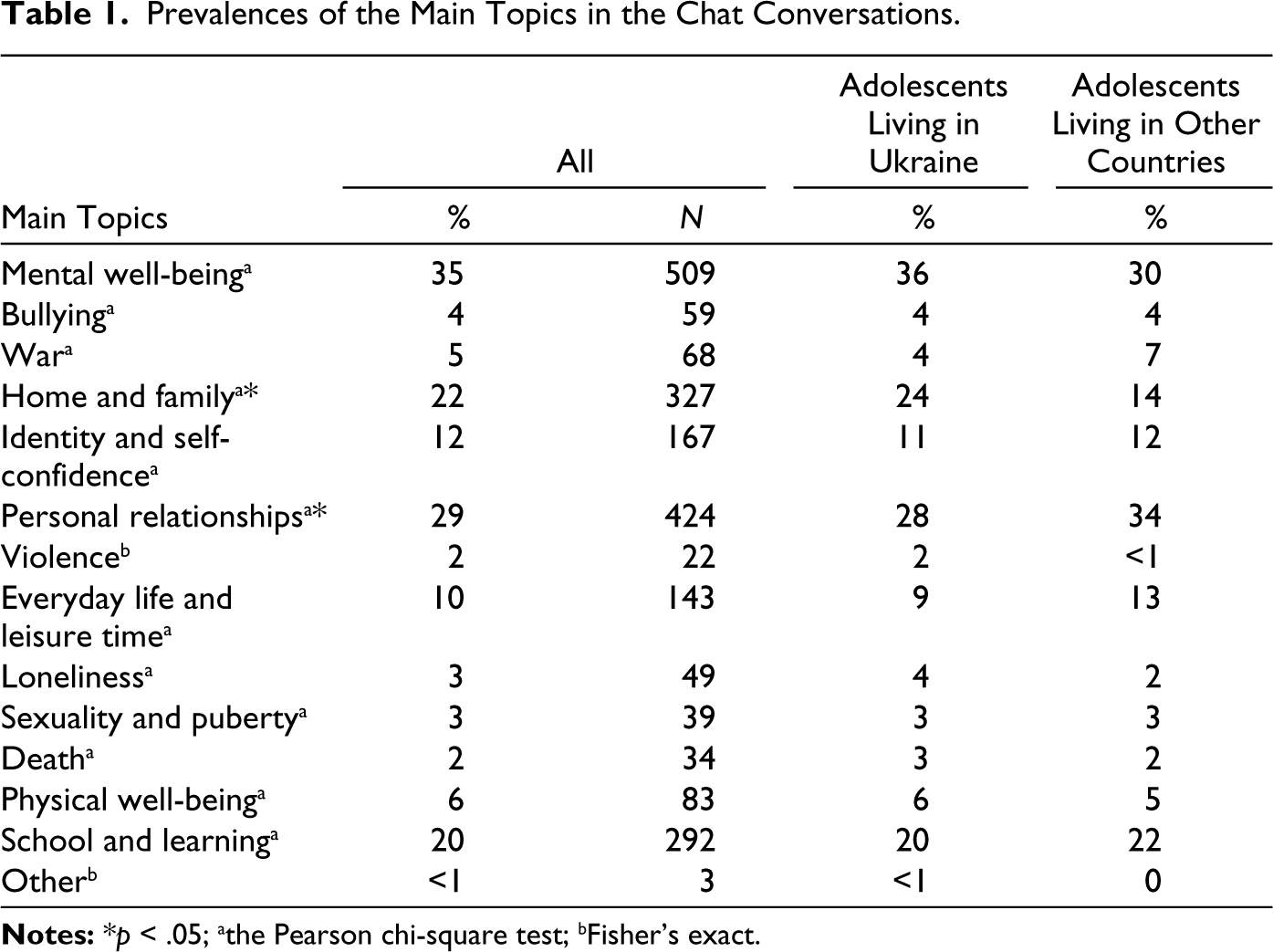
Regarding the age differences, among early adolescents, 10–12 years old, the most common conversation topics were personal relationships (19%, n = 53), daily life and leisure (17%, n = 47) and mental well-being (16%, n = 45). For the middle adolescents, the most common topics were mental well-being (38%, n = 251), personal relationships (31%, n = 207) and home and family (24%, n = 161). For chat users in their late adolescence, 16–17 years old, the conversations were most often about mental well-being (42%, n = 218), personal relationships (32%, n = 167) and school and learning (26%, n = 136).
Five per cent of early adolescents, 4% of middle adolescents and 5% of late adolescents wanted to talk about war in particular. It is noteworthy that, according to the chat workers, war as a topic was very often in the background (e.g. ‘I couldn’t go to see a psychiatrist because of the war’), but in this war category, adolescents were specifically talking about that issue.
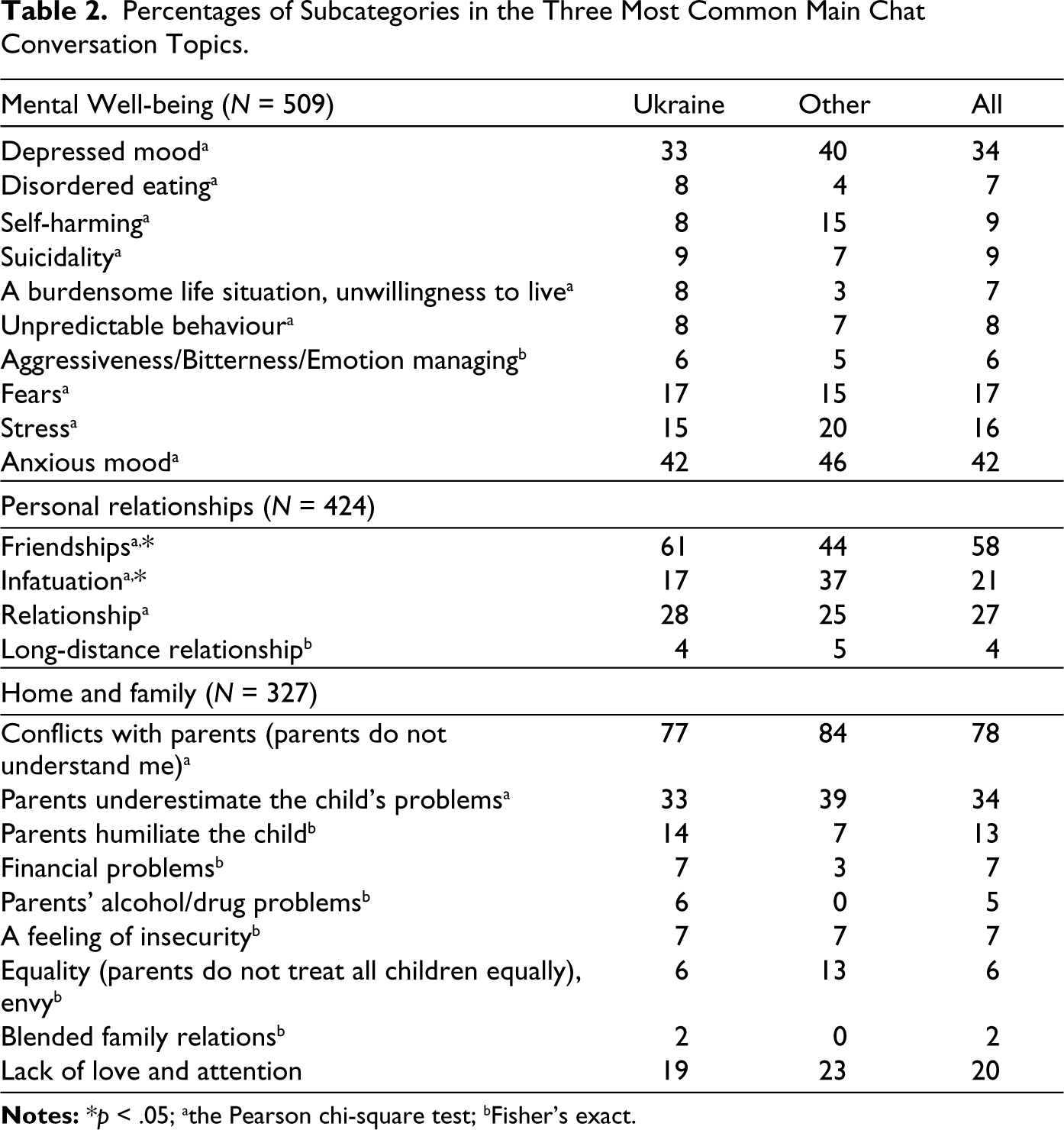
Table 2 further presents the subcategories of the three most common topics (mental well-being, personal relationships and home and family) according to the place where the adolescents were chatting. Within the topic of mental well-being, the most common theme of conversations was anxious mood (42%), followed by depressed mood (34%). Notably, 7–9% of adolescents reported self-harming thoughts or behaviours, such as an unwillingness to live, self-harming or suicidality. Within personal relationships, the most common topic was friendships (58%). Within home and family, the most common topic was conflicts with parents (78%). Notably, 13% of adolescents reported verbal violence in the family (parents humiliating their children).
Percentages of Subcategories in the Three Most Common Main Chat Conversation Topics.
How Did Worries Related to War Compare with Other Themes in the Conversations?
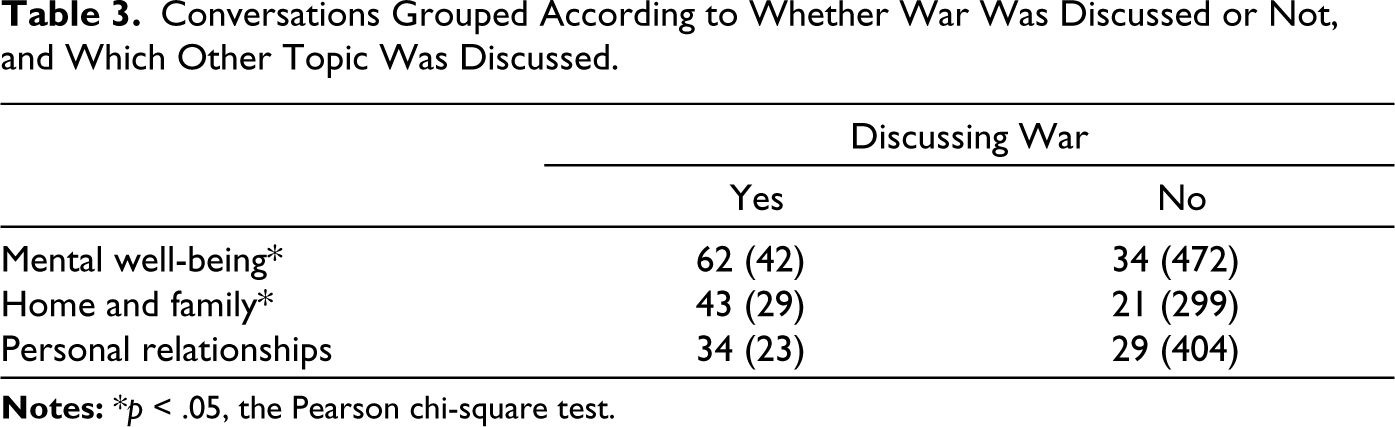
There were 68 adolescents in the sample who wanted to talk, in particular, about war with a chat worker. We wanted to know what other topics were important to those adolescents who were especially worried about the war. The proportion of those who wanted to talk about the main categories of mental well-being, home and family or personal relationships among those valued in the main category of ‘war’ is presented in Table 3. Of those valued in the main category of war, 62% also wanted to talk about mental well-being. Forty-three per cent also wanted to talk about home and family, and 34% about personal relationships. All of these proportions were larger than among those adolescents who did not discuss war as a specific topic.
Conversations Grouped According to Whether War Was Discussed or Not, and Which Other Topic Was Discussed.
Discussion
We conducted an analysis of chat conversations during the ongoing Russia’s war of aggression against Ukraine, to examine the concerns expressed by Ukrainian children in early, middle and late adolescence. By utilizing data routinely collected by chat facilitators, our study offers an opportunity to examine chat topics and themes across various age groups in a large sample of war-affected youth. The strength of our study lies in the unique data that reflects the purely voluntary help-seeking behaviour of Ukrainian adolescents living either in Ukraine or in other countries as refugees. Being able to include adolescents living both in Ukraine or other countries and to separate different stages of adolescence in terms of the worries enrich the knowledge of concerns and interpretations of the current situation.
Addressing the needs and concerns of children and adolescents can be particularly challenging among active war due to the limited accessibility of psychosocial support resources. In these circumstances, communication technologies can provide an effective way to cope with distress. It has previously been shown that Ukrainian refugee children have quickly developed means of digital coping, innovatively integrating smartphones into their lives and employing them for emotional regulation, meaningful social connections and the preservation of identity (Khvorostianov, 2023). This is particularly important since the rapid changes and growth in adolescence make youth sensitive to heightened stress in various life domains (Steinberg, 2014).
The most common topic of chat conversations initiated by the adolescents was mental well-being, followed by personal relationships, and home and family. Mental well-being was the most pronounced concern among adolescents living in Ukraine and among young people in middle and late adolescence. The high prevalence of worries related to mental well-being (especially depressed and anxious moods) provides important information to health care and social services not only in Ukraine but also in the countries where Ukrainian children seek asylum.
It is alarming that over 130 adolescents in our sample talked about self-harming or suicidality, and over a hundred expressed an unwillingness to live. As the war continues and the humanitarian crisis worsens, effective ways of helping young people with serious mental health problems and suicidal behaviour should be sought. The findings are particularly concerning due to the protracted nature of the conflict in Ukraine, which has spanned for a decade in certain regions. Prior to the 2022 expansion of war, adolescents in war-ridden regions of Ukraine exhibited evidence of enduring psychological impacts from the conflict, including heightened risks of PTSD, severe anxiety and depression (Osokina et al., 2023).
Furthermore, the finding that conflicts with parents were reported by a large majority of adolescents and that more than every tenth adolescent had reported verbal violence in the family (parents humiliating the child) reflects the well-documented challenges of parenting in highly stressful situations (Eltanamly et al., 2021; Peltonen et al., 2023). Support for parental well-being and parenting practices is important, not only among families with young children, but also among older children. Both practical and mental social support have been found to be important for parents’ resilience (Sim et al., 2018).
Despite the circumstances, environments and contexts in which the adolescents are living, their topics of interest and worries are quite similar. In this study, Ukrainian adolescents wanted to discuss their friendships, school and leisure-time activities. Thus, adolescents affected by the war engage in conversations that extend beyond the immediate context of the conflict. These conversations may reflect adolescent’s active attempts and strategies to cope amid the conflict and maintain faith and hope (Cicchetti, 2010; Tol et al., 2013). Because peer relations and their quality are important predictors of resilience among children and adolescents in war contexts (Peltonen et al., 2014), conversations that support adolescents’ friendships amid conflict can be seen as protective.
Especially among those adolescents who expressed worries about the war, such as being separated from family members and other harmful experiences, having anxiety and a depressed mood were also important topics in the conversations. In line with Bürgin et al. (2022), the results indicate that we should support mental health professionals in Ukraine, Russia and the countries where people are finding refuge by providing practical help, establishing new funds and resources and launching large-scale programs to address the mental health crises of children.
In addition to what has been discussed by the adolescents, we also want to draw attention to things that have been left unsaid. Only 4–5% of the conversations were war-related. It is possible that the relatively low occurrence of war-related conversations reflects avoidance behaviours that are central post-traumatic symptoms among war-traumatized minors (Scharpf et al., 2023) and occasionally act as protective mechanisms to enhance psychosocial adjustment (Cherewick et al., 2016; Harnisch & Montgomery, 2017). However, these mechanisms are typically considered dysfunctional coping strategies in mental health paradigms (Pfefferbaum et al., 2013) and are therefore important to take into consideration. On the other hand, more than a year of expansion of war (by the time of the data collection) is a long time in adolescent’s lives. As cruel as it is, children also in the areas that were not affected before, might have ‘got used to’ the war, in terms of cruelties no longer being part of everyday conversations. The low amount of specifically war-related conversations does not though mean that war was not in any way part of the conversations, since the war can manifest itself in the conversations in more subtle ways.
Limitations and Future Research Directions
The primary limitation of the study lies in its reliance on the classification established by SOS Children’s Villages Finland for internal statistical purposes. Consequently, the classification of conversation topics is not fully optimized for scientific research needs. For instance, the subjective opinions of chat service employees might have influenced the categorization of conversations, and variations may exist among different employees’ classifications. The use of a worker as an intermediary for data collection may not capture the adolescent’s perspectives as effectively as obtaining data directly from the adolescents themselves. Another point of limitation lies in the unknown status of chat users from Ukraine. We do not know if chat users in Ukraine belonged to the group of internally displaced persons or not, nor if they were living in the proximity of the front line or in relatively safe central and western parts of the country.
In the future, we should gain even more information on children’s and adolescents’ experiences in war, especially about the interpretations and the vulnerability it produces in different developmental stages in life. In order to plan targeted interventions to alleviate harmful cognitions and further the mental health symptoms, we must have detailed information about how children of different ages interpret and experience different events during the war, and which factors emerge as the most central concerns and on the other hand as the most essential things in terms of survival. In the second article, based on qualitative analysis of the same data, we shed light on the topics related to war among the Ukrainian children (Hakala et al., in press).
Conclusion
The high prevalence of worries related to mental well-being (especially for depressed and anxious moods) provides important information to healthcare and social services in Ukraine, but also in the countries in which Ukrainian children seek asylum. We must continue to promote a societal atmosphere in which vulnerability can be discussed openly and demonstrated safely. This research shows that promoting help-seeking behaviour through various means that are close to young people is important. It provides information on topics that adults should pay attention to in order to support the well-being of their youth.
Supplemental Material
Supplementary material for this article is available online.
Footnotes
Declaration of Conflicting Interests
The authors declared no potential conflicts of interest with respect to the research, authorship and/or publication of this article.
Funding
The authors disclosed receipt of the following financial support for the research, authorship, and/or publication of this article: ACElife project is funded by the Strategic Research Council (SRC) established within the Academy of Finland (352543).
Appendix
References
Supplementary Material
Please find the following supplemental material available below.
For Open Access articles published under a Creative Commons License, all supplemental material carries the same license as the article it is associated with.
For non-Open Access articles published, all supplemental material carries a non-exclusive license, and permission requests for re-use of supplemental material or any part of supplemental material shall be sent directly to the copyright owner as specified in the copyright notice associated with the article.
