




Abstract
Armed conflicts violate young people’s rights by exposing them to violence and trauma, disrupting their sense of safety. This study examines how Russia’s war against Ukraine affects Ukrainian adolescents’ lives. The study utilizes data from Let’s Chat, a free, low-threshold support service for Ukrainian-speaking children and youths. We analyzed 185 chat conversations between chat workers and Ukrainian adolescents using data-driven thematic analysis. The war emerged roughly every fourth conversation, affecting discussions on forced relocation, school disruptions, and social relationships. Although youths rarely initiate war-related conversations, its effects are evident. This study highlights the complex impact of war on youth development, adding to other stressors in their lives. War often emerges as an added burden, complicating their already delicate development. Digital channels like Let’s Chat can help adolescents cope with these challenges and plan their futures in a culturally sensitive manner across borders, providing crucial support in difficult times.
On 24 February 2022, Russia launched a full-scale war of aggression against Ukraine, and millions of children and adolescents in Ukraine faced the shock of their whole lives changing in a matter of hours. Two years later, the war is still active and continues to affect the lives of Ukrainian children and youths in and out of the country, exposing them to death, injuries, and intense fear, horror, and insecurity (Badanta et al., 2024; Khvorostianov, 2023; Lopatovska et al., 2022).
Children and adolescents are particularly vulnerable in times of war, and the acute and chronic effects of armed conflicts on well-being are among the greatest child rights violations of the 21st century. Exposure to violence and conflict can have profound effects on growing person’s health, leading to injury, illness, and the breakdown of essential services (Badanta et al., 2024; Devakumar et al., 2014). Additionally, war can lead to psychological trauma and disrupt the sense of safety, potentially leading to serious physical and mental health problems (Badanta et al., 2024; Devakumar et al., 2014; Oberg et al., 2022). Children and adolescents who are affected by war have an increased prevalence of post-traumatic stress disorder (PTSD), depression, anxiety, and behavioral and psychosomatic complaints (Betancourt et al., 2013; Osokina et al., 2023). They are also vulnerable to abuse, exploitation, and limited access to lifesaving help and education because of the destruction of infrastructure, impacting their overall well-being (Basham, 2020).
Badanta et al. (2024) found in their systematic review that Russia’s war of aggression against Ukraine has had a serious impact on Ukrainian children and adolescents’ lives and health, resulting in poorer mental and physical health outcomes and the perpetuation of deprivation. Khvorostianov (2023) and Lopatovska et al. (2022) reported that Ukrainian children and adolescents described the first 2 weeks of the war as a period full of stress and anxiety, indicating feelings of fear and helplessness, and disbelief. These experiences can have various effects on well-being and normal development (Slavich, 2020; Spitzer & Twikirize, 2013). Because the war has been prolonged, Ukrainian children and adolescents are living a significant portion of their youth under threat.
War also interferes with normal development. Adolescence is full of significant changes in all circumstances. Together with the hormonal and biological changes associated with puberty, adolescence is also a time of social transformation (Orben et al., 2020). Adolescents form new friendships and romantic relationships and at the same time explore their own identities (Lam et al., 2014). Some are on the threshold of a new era, facing graduation and separation from their childhood homes. Parental influence is usually reduced during this time, increasing the role of peer relationships, and this transition is known to cause emotional difficulties such as depression and fear. Altogether, these changes and developments make young people sensitive to heightened stress and contribute to a more complex experience of trauma caused by war (Lam et al., 2014; Orben et al., 2020).
Along with fear, children and adolescents have had to adapt to forced relocation and separation from their friends and families. Leaving their homes, and perhaps their home country is one of the first crises children and adolescents face in times of war (Denov & Blanchet-Cohen, 2014; Lopatovska et al., 2022). Because of forced relocation, many children and adolescents have been separated from familiar surroundings, friends, and relatives. Disrupting this support system may affect psychosocial well-being and normal development (Badanta et al., 2024; Spaas et al., 2022). Separation from one or both parents may negatively affect young people’s social-emotional development and well-being (Jones-Mason et al., 2021; Waddoups et al., 2019). Even if families manage to stay together, war can affect parenting capacities and parents’ mental health, potentially leading to hostility and reduced warmth toward their children (Eltanamly et al., 2021, p. 106). According to Punamäki et al. (2018), problematic family relationships exhibit internalizing, externalizing, and depressive symptoms, along with dysfunctional post-traumatic cognitions. However, in situations in which less severe threats are present, parenting might also turn to overprotection (Eltanamly et al., 2021).
After the massive and rapid changes to life, Ukrainian children and adolescents have had to adapt to living in unfamiliar surroundings without their normal social infrastructure and without knowing when or how the war will end. In these situations, children and adolescents are usually excluded from the decision-making process because of the life-threatening circumstances, causing resentment and ambivalence (Denov & Blanchet-Cohen, 2014). In times of war, many children and adolescents change schools within or outside of the country or start virtual learning (Denov & Blanchet-Cohen, 2014; Khvorostianov, 2023; Lopatovska et al., 2022), resulting in potential language barriers further alienating them from peers and aggravating new friendships. Even though children and adolescents continue schooling, they may lose motivation or lack moral resources, resulting in long-term consequences for their futures that can prevent them from pursuing careers or earning better wages. These changes in schooling may also be associated with deteriorations in mental and physical health and reduced social adaptation (Badanta et al., 2024; Khrapatyi et al., 2023; Zamkowska, 2024).
Exposure to armed conflict has social and psychological ramifications that endure long after relocating from a war zone to a safer location (Badanta et al., 2024; Betancourt et al., 2013). News and media coverage of war are available daily (Götz et al., 2023), and they are associated with PTSD symptoms (Pfefferbaum et al., 2003). Children and adolescents whose relatives are in battle have higher rates of emotional and behavioral problems and substance abuse (Siegel et al., 2013). As with physical health, mental health in these safer surroundings is dependent on multiple factors, including mental health status before the conflict, the nature of the conflict, exposure to stressors, and cultural and community contexts (Fazel et al., 2012).
Addressing the rising needs and concerns of young people can be challenging in a war situation, both inside and outside the country, due to difficult circumstances and language barriers. Therefore, little is known about how Ukrainian children and adolescents have adapted to their lives in and out of Ukraine. Furthermore, to date, many of the studies examining the effects of war on children and adolescents specifically focus on war themes and ask young people directly about their experiences with war (Denov & Blanchet-Cohen, 2014; Götz et al., 2023). This kind of approach does not necessarily bring out youth’s experiences organically. This study contributes to the existing literature by examining chat conversations in which adolescents freely and voluntarily bring up war-related topics along with other topics in their everyday lives. In our data, questions about this topic were not asked: adolescents freely expressed their thoughts and worries to the chat workers. This provides important information about the issues and topics adolescents themselves find important and meaningful, without adult gatekeeping. This study provides insight into the daily lives of Ukrainian adolescents growing up amidst active warfare.
We utilized data from a Finnish chat service operating in the Ukrainian language to examine the ways the war affects the lives of Ukrainian adolescents. Our research is guided by the following question; How does the war emerge in Ukrainian adolescents’ one-on-one chat conversations with support and counseling offering adults? By examining the chat conversations in the Let’s Chat service, we shed light on the topics related to Russia’s war of aggression brought up by Ukrainian adolescents.
Methods
Data
The data were obtained from the real-time online chat service Let’s Chat, which was designed for Ukrainian-speaking children and adolescents aged 7 to 17. Let’s Chat offers an opportunity for Ukrainian children and adolescents to chat in their native language about their experiences and worries one-on-one with a trained support worker. In Let’s Chat, children and adolescents can talk anonymously and confidentially about the questions or issues that bother them with professionals and trained volunteers. The purpose of the service is to offer help to children and adolescents who feel unsafe or threatened. The chat workers offer support, advice and, if necessary, can guide children and adolescents forward to the help they need. The chat is provided by SOS Children’s Villages Finland, and though its original purpose was to provide help for Ukrainian children and adolescents fleeing to Finland, the chat has managed to reach children and adolescents around the world, including those living in Ukraine. Let’s Chat can be used via smartphone, tablet, or a computer with an internet connection. It is free of charge and does not require any referrals. The chat is open on weekdays from 12 am to 5 pm Kyiv time. As a client enters the chat, they are first asked automated, preliminary information such as their age, country of location, and the topics they want to discuss. After this the chat employee enters the chat and the conversation can start. There is no time limitation for the conversations within the opening hours. The topic of each conversation is determined by the client and one conversation can include one or multiple topics. The employees primarily offer listening and support but can also give clients advice if asked. The conversation ends when the client leaves the chat or at the chat’s closing time. The clients are free to visit the chat as often as they wish. Conversations last an hour on average, but the duration varies widely. In 2023 there were 2,813 conversations in Let’s Chat.
This study analyzed 185 conversations that occurred in 2 weeks, between 4th and 16th September 2023. A total of 328 conversations were translated into English with help from the European Commission’s eTranslation tool. After translation, conversations with children under 13 years old (N = 26) were eliminated from the data. Young children were excluded due to ethical concerns since it would have been difficult to obtain informed consent to use their conversations in research. It is also known from previous research, that support offering chat services are more popular among adolescents than younger children (Efe et al., 2023). Empty conversations (N = 117) were also eliminated. Conversations without reciprocal communication were considered as empty. For example, if the client left the chat before or immediately after the employee entered or if the client entered the chat near the chat’s closing time and there was no time for conversation. In these cases, the client was often advised to come back the next day. The research procedure was approved by the Ethics Committee of the Tampere Region.
Analysis Procedure
The data were analyzed with Atlas.ti 23 software using qualitative, data-driven thematic analysis. First, the conversations were encoded based on whether they included any indications of war. These indications could be war-related vocabulary, for example, war, occupation, missile, frontline, bombing, military, or shelling. Also, mentions of distance learning were interpreted to relate to the war, since a significant part of Ukrainian adolescents attend virtual or mixed schooling due to the war (Khvorostianov, 2023; Lopatovska et al., 2022; Save the Children, 2023). Relocating was considered war-related if war was mentioned as the cause or relocating had taken place after the beginning of the full-scale war.
Of the 185 conversations, 48 were found to imply the war. After the initial coding, the conversations found to imply the war were coded in a second round of coding. This time the coding was done in more detail, specifying how the effects of the war were implied. A descriptive coding technique was used (Saldaña, 2014).
The coding in the second round was done by two researchers. The first researcher coded two-thirds of the data, while the other analyzed the rest of the conversations as a means of validating the first researcher’s work. After the second round of coding, the coding was adjusted to make sure it was consistent and suitable.
Once the coding was completed, the codes were outlined and organized as a thematic map (Saldaña, 2014). The codes were grouped into nine main themes and 33 subthemes. An example of the grouping is provided in Figure 1. Each theme depicts a way in which the war emerges in adolescents’ conversations in Let’s Chat.
An example of grouping codes into subthemes and themes.
Results
The nine main themes identified were relocating, school and learning, relationships, war and daily life, feelings, health, losing control of one’s life, war as a disciplinary tactic, and survival tactics (Table 1).
Themes and Subthemes.

Relocating
One of the most notable indications of the war in the chat conversations was the concept of relocating. The conversations included adolescents discussing worries and problems related to moving within Ukraine, abroad, or back to Ukraine after living abroad.
what would you like to talk about today?
About friends
so, what about friends?
I don’t have them, so I feel lonely.
has it always been so?
No
how was it before?
I had enough friends, it was fun to spend time with them.
something happened?
Yes, because of the war we moved to a village, so there I was isolated from all, there were new interests that did not go together with the interests of former friends
Many of the adolescents brought up that they had been separated from their friends. This could have been due to the adolescent moving to a new country or due to friends moving away. In some cases, adolescents tried to keep in touch, but because of the distance, they realized their bond was not strong to begin with. Many also spoke about loneliness as they had difficulties finding new friends in a new living environment, or after all their previous friends had left the area they were living in. Some found that cultural differences made it hard for them to get to know people in a new country, and some wished to find a Ukrainian community abroad.
Several chatters reported having issues at school after relocating. Some were nervous about going to or making friends in a new school, or they described depressive symptoms the new school was causing. Relocation also caused language barriers as some had difficulties learning and communicating in a new language, or they felt ashamed that they did not pick up the new language as quickly as others.
Relocating also emerged as chatters referring to themselves as refugees during the chat conversations. Some adolescents stated that they were or had been living in refugee camps and that refugee status caused them various extra difficulties. Some found that the new locations lacked prospects, either in the form of community and support or in the form of career options.
School and Learning
Subjects related to school and learning were common among adolescents as the war changed schooling in different parts of Ukraine, whether they fled abroad or not.
But in my old school, I got laughed at when I stuttered or said something.
They could also pull the backpack from behind or tug on clothes, for example, a skirt. But they mostly laughed. [– –]
no one deserves that, everyone has the right to study in a safe environment
Yes, now I am studying in another country at school, and everything is fine here. And I’m pleased with that.
Many conversations dealt with distance learning. Several chatters talked about the problems distance learning caused as they found it difficult or had problems concentrating while studying at home. One chatter explained that their class would be switching to in-person teaching after a bomb shelter was finished and it was safe to go to school again. Some observed difficulties with learning after the war started. This was described as difficulty learning and remembering things since the beginning of the war. One chatter stated that they had missed half a school year because of the war. However, for some adolescents, the war had positive effects concerning school. For some, bullying stopped after the war started, for example, due to changing schools or distance learning. One chatter also stated that they were enjoying distance learning and finding it to be a better alternative for them.
As with conversations about relocating, language barriers were also reported in relation to school and learning among adolescents who fled abroad. They talked about a lack of translators and help from teachers in schools, which made it difficult to follow classes. Some also felt uncomfortable because of the language barrier and because they were the only Ukrainians in the school, thus lacking opportunities to study and communicate in their native language.
Some adolescents described issues related to the war, learning, and mental health. For one chat user, the attacks caused severe anxiety, which in turn affected their learning. Another chatter was afraid that the issues they were facing in a new, foreign school would provoke their old mental health issues. One described how foreign schooling exhausted them. Some also described practical difficulties, such as lack of electricity or attacks preventing attending school for a prolonged period.
Relationships
The war influences adolescents’ relationships in various ways.
do you have any relatives with whom you could share?
unfortunately no
I would definitely have stayed with them, but there is no way
and any adults or friends, with whom you could talk about it?
there is one grandmother, but she is now in the occupied territory, and cannot help me in any way, she is very old, but I often visited her when there was no war
Chatters often said that war had influenced their friendships. Some implied that their friendships had changed due to their new long-distance status; many chatters or their friends moved around and had problems communicating with friends elsewhere due to lack of in-person contact. Sometimes difficulties were described as related solely to the war, without further explanations. One chatter stated that the occupation and its restrictions caused them to be trapped in the same environment with a former friend who had betrayed them, causing emotional trauma and excess stress.
On the other hand, adolescents brought up the care and support they wanted to offer their friends who were having exceptionally hard times. One chatter asked the chat worker for advice on how they could try to cheer up their friend, whose father had died in the war. Another brought up how they were trying their best to support their friend in the military, even though there was distance between them.
In addition to friendships, adolescents’ romantic relationships were sometimes strained due to the war. Long-distance relationships bring difficulties to dating. The exact ways in which the war influenced these relationships were not always made clear, just that the relationship had changed. One chatter described how dating abroad was different and that the boys there thought differently about girls. In one conversation, the chatter brought up how their significant other had died in the war, and they were having a hard time adapting to the loss.
War also came up when discussing relationships with family and relatives. A few adolescents brought up their parents’ worries about the war. One stated that their parents were afraid of letting them go to school for fear of attacks. Another mentioned that their father was afraid to go to a city to meet a doctor since the city is a more dangerous place to be. Some chatters talked in the chat about war-related conflicts with their families. A few brought up that their parents did not understand them or support them with their problems. For one chatter, the problems were related to moving to a new country, and for another problems arose when moving back to Ukraine. In one case, the chatter already had strained relationships with their family members due to family violence and their parents’ substance use problems. Their grandparents’ house, to which they had earlier fled from the tense and violent environment at home, is now located in the occupied territory and out of reach. Hence, the war destroyed safety networks, leading to even more difficult situations for the chatter. For another chatter, moving due to the war took them away from their relatives, whom they were now only able to visit occasionally.
Some adolescents brought up that their relatives and family members were currently or had been in the war. One chatter was trying their best not to come across as brazen while discussing their problems with parents since they already had a hard time with the father being injured in the war. For another chatter, listening to someone speaking of Russia in a positive light made them feel uneasy since their relatives were currently fighting in the war. One had lost their significant other and their uncle on consecutive days, leaving them in a state of “not living, just existing” for months.
Adolescents also experienced conflicts with Russians or Russian speakers. A few chatters brought up that they were not willing to make friends with any Russian-speaking classmates, Russians, or anyone from “Russia’s friend”-countries. One chatter described how their teacher only used the Russian language in class and promoted Russian culture and values despite parents’ and adolescent’s opposition. One spoke about defending a Ukrainian-speaking classmate and later being bullied because of it. Another was having a conflict in the family since their sister was communicating with Russians.
War Affecting Everyday Life
The data showed that the war affects adolescents’ everyday lives in multiple ways.
I have nowhere to go
and take a walk
Because all the places I used to go are destroyed or dangerous, because of the front line
War in the vicinity emerged in conversations about living in a frontline city or in a town that was now occupied. One chatter described how dangerous it was to walk on the streets. War-related vocabulary, terms such as bomb shelters, shelling, or air alarms, were present in several conversations in which adolescents were discussing otherwise non-war-related topics. For example, a school-related conflict with teachers or peers could take place in a bomb shelter during shelling.
Adolescents also talked about being bored because there was currently nothing to do in Ukraine. As hobbies and leisure time activities are suspended due to the war, there is not much to do outside of school and home. Additionally, local curfews constrain going out.
Many adolescents used the war as a measure of time when describing various topics, both related to the war and not. In these adolescents’ lives, war seems to have become a dividing event: there is a time before and after the full-scale war started. One chatter used the timepoint of occupation of their hometown in a similarly.
The war often came up when adolescents were discussing their future plans, especially planning their locations and overall place in society. They were deliberating between wanting to move back to Ukraine and the uncertainty of Ukraine’s future. Many wondered which country would provide them with the best opportunities for the future. Chatters also discussed their overall place in society, including topics such as future professions and plans to provide for themselves. The war emerged as a reality according to which adolescents were forced to plan their future lives.
War also affected many families’ finances, which adolescents recounted. One chatter described how their parents’ business was suspended due to the war, and thus the family was in financial trouble. Some felt like financial burdens and tried their best not to cause any excess strain by asking for things, such as expensive healthcare interventions. For some families, finances kept them from moving to a desired location, such as away from the frontline of the war or back to Ukraine.
Feelings
War evokes various feelings in chat users.
I knew I couldn’t miss anyone anymore. I realized this when my father was at the front for a year, and I was not sad, my great-grandfather died, I did not miss him, there was no reaction. My mother is very nervous, constantly reading news on Telegram channels, etc., and I’m embarrassed. When very close to our house [– –] drones attacked and destroyed a factory, I was also embarrassed, I just wanted to see what it was like in there, but again I pretended to be scared.
Expectedly, adolescents described fear caused by the war. Chatters described being afraid of explosions and air alarms. Some feared not finding a bomb shelter or not waking up to air alarms. They also described being afraid of dying in the attacks. A common fear was the war reaching or becoming worse in their area. Some talked about being scared to travel to school or being afraid of being sent to the army. However, some described concern and embarrassment because they were not afraid and hence not feeling as expected, lacking emotional reactions to difficult events. One chatter described a lack of emotions related to their father being in the military and being embarrassed of not being scared but curious about the destruction near their home. They also felt embarrassed for their mother’s fearful and stressed reaction to events.
Adolescents also had feelings of hopelessness or being stuck, seeing no way out and not being able to stay optimistic about the future. Jealousy was described in relation to seeing others doing normal things and living their lives, while they were not able to do that anymore. Adolescents also talked about longing for the past and missing their old lives, describing how they felt that everything was good before the war and that nothing was ever going to be the same again.
Health
Adolescents described the war as affecting their mental and physical health.
Could you tell your dad about your health problems that you need to see a doctor?
he promised me that he would take me to the doctor in August [– –]
maybe you could remind him of that? [– –]
I can remind him about the doctor, but now there is simply no way to go to another city, and in that city, it is more dangerous than in ours, dad is a little afraid to go there
Many discussed the war affecting their mental health and causing various symptoms. They described multiple mental health problems, such as difficulty sleeping, severe anxiety, suicidal thoughts and attempts, excessive fear of loud noises, emotional problems, hallucinations, and losing interest in previously enjoyable things. Some had had mental health problems before the war, and they described them becoming worse or being afraid that they would get worse. Some chatters could trace their symptoms to the beginning of the war, some described shelling and leaving home as traumatic events, and some recognized emotional problems and anxiety related to the attacks. One chatter described recurring intrusive thoughts of war-related disasters, such as imagining themselves dying in a missile attack. Another had developed binge eating habits to cope with the stress the war had created. One described how they had isolated themselves after losing a loved one in the war.
War also affected adolescents’ access to healthcare. Chatters recognized their need for psychologists, psychiatrists, doctors, nutritionists, or other healthcare professionals, but they had not been able to access them or had not tried, finding them inaccessible. Chatters who had fled abroad were not able to meet healthcare professionals abroad because of the language barrier, because they lived in a refugee center, or because they did not know where to find one in a new country. One stated they were waiting to go back to Ukraine to receive help.
For the adolescents staying in Ukraine, there were also obstacles. One found it too dangerous to travel to a city where services would be available, and for some the nearest specialist was just too far to reach. Another chatter was worried about their family’s financial situation, reporting that due to the war, they had not received the healthcare they felt they needed.
Losing Control of One’s Life
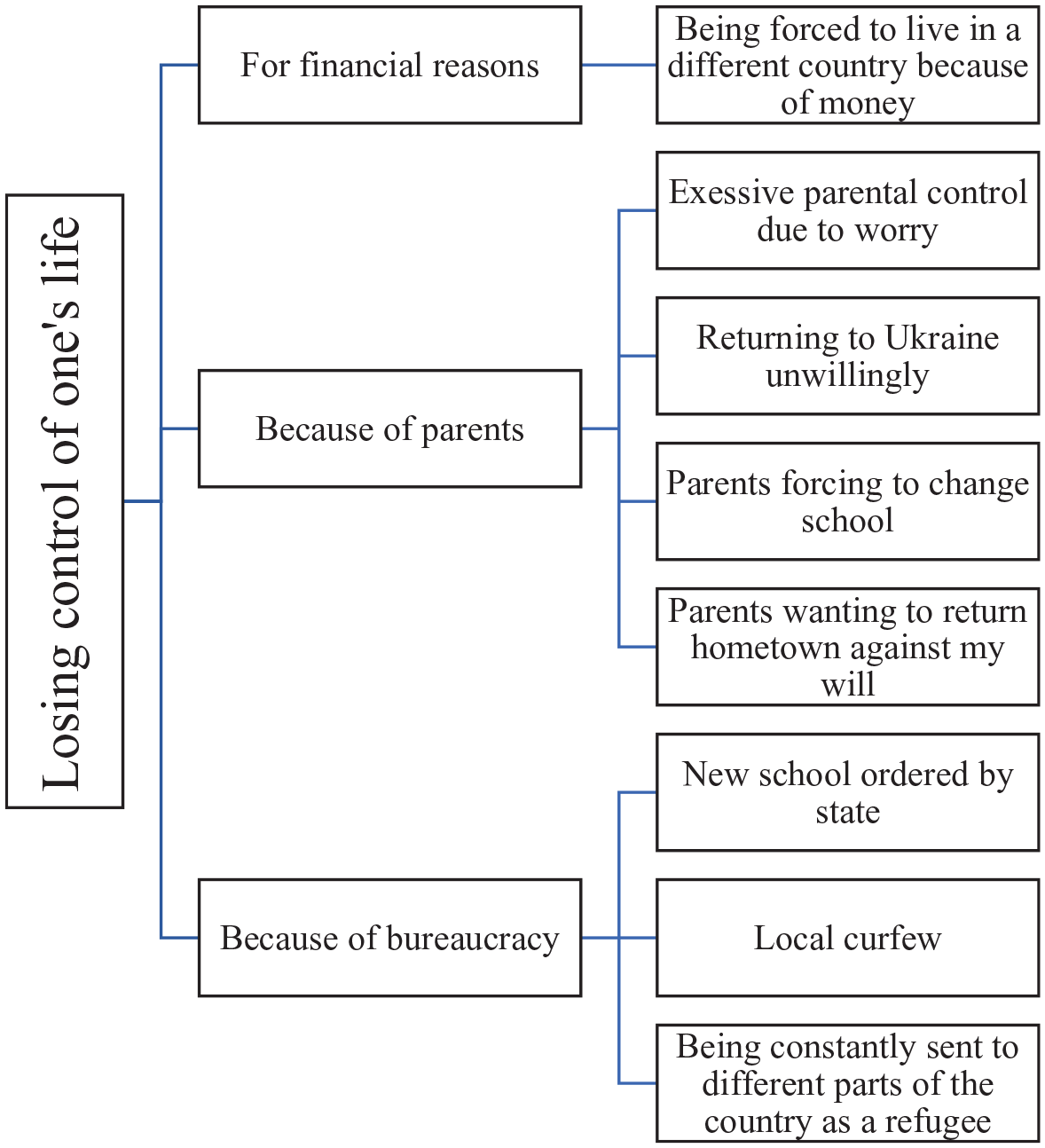
Many adolescents described their difficulties with being forced to do things they did not want.
I lived a year and a half without my parents, under the care of my older sister. Recently my mother came to see me, but already in the first days, I started feeling bad. It felt uncomfortable to be with her, she constantly crossed my boundaries, I understand that she missed me, but I didn’t feel the same about her. [– –] My parents decided to take me back to Ukraine. I’ve been here for 4 days, and every day I cry or have tantrums.
Some of these coercive measures were because of their parents. Parents made chatters move back to Ukraine or their hometowns against their wishes or made them change schools. One chatter described their mother’s overbearing and controlling behavior because of fear for the child’s safety.
Some adolescents who had fled abroad experienced coercion in the form of bureaucracy. Such coercion emerged as not being able to change schools since they were ordered by the state to study in a certain school or being constantly sent to a different part of a new country due to their refugee status. For some, financial reasons prevented them from moving back to Ukraine as they wanted.
War as a Disciplinary Tactic
On two occasions, chatters described the war being used as a disciplinary tactic. In one instance, a chatter described a relative threatening to send them to a boarding school and their older sibling to the military if they did not obey. Another was afraid of being sent to the army if they did not get good enough grades at school.
Survival Tactics
In the chat, adolescents indicated having found survival tactics or were contemplating them with chat workers. Several chatters discussed adapting to the difficult situation in various ways, such as trying to romanticize the war, keeping themselves busy with chores or hobbies, and finding safety with those close to them. Some talked about taking action to help their country by volunteering for the army or pursuing a profession that could help rebuild Ukraine.
Discussion
Previous research has shown that Ukrainian adolescents have managed to find digital channels to help them cope with the challenges caused by the war (Khvorostianov, 2023). This study supports this conclusion, and the adolescents’ conversations in the Let’s Chat service, were versatile and informative. Our results represent themes related to war brought forth voluntarily by adolescents, emphasizing the importance of their own perceptions.
Even though the war itself was rarely the main topic of conversations (Peltonen et al., in press), the war was present in the chat conversations in varying, often subtle ways. Most often, the war emerged in the form of forced relocation, difficulties or changes in schooling or learning, or changes in human relationships. Forced relocation is a common crisis in times of war, ripping adolescents not only from familiar locations but also from their friends, relatives, and other social connections. According to Khvorostianov (2023), Ukrainian adolescents have quickly learned to rely on smartphones and social media to keep in touch with friends and relatives during the war. This study reveals that though many adolescents have managed to keep in touch with their friends through social media, they miss face-to-face contact, and many described how their friendships have worsened because of the long distance. Additionally, romantic relationships were in some instances greatly affected. Adolescents’ need for face-to-face social contact should not be underestimated, and it should be seen as a coping tactic and protective factor against the isolation caused by war. Meaningful social contact and community acceptance have protective effects on mental health outcomes and adaptive behaviors in adolescents who have experienced war (Badanta et al., 2024; Fazel et al., 2012).
Blanchet-Cohen and Denov (2015) also highlight the significance of connections and communal activities among young war-affected immigrants in their settlements. Their research underscores that official support systems often overlook cultural nuances, leaving young immigrants feeling misunderstood and unsupported. This sentiment is endorsed by support workers who also express a lack of tools for helping young people who are fleeing war. Identifying gaps in existing support frameworks, both youths and service providers emphasize the necessity of safe spaces where stories can be shared comfortably. Without such environments, there is a reluctance to disclose experiences, deepening feelings of isolation and potentially exacerbating mental health challenges. It seems to be an important aspect of Let’s Chat that the service is provided in users’ native language by Ukrainian adults who personally understand the experiences of these adolescents. Sharing a common cultural background and understanding of Ukraine’s current reality creates a tailored service in a specific cultural context, just as has been proposed in previous studies (Dubow et al., 2012; Miller & Rasmussen, 2010).
War can alter family roles fundamentally and change adolescent’s needs for care and protection. Denov and Blanchet-Cohen (2014) noted that after relocating, parents may have difficulties meeting the complex and changing needs of their children. Similar findings were indicated in this study since several adolescents discussed disagreements with their parents and reported feeling like their parents did not listen to or understand them. These results emphasize the need for support for parental well-being and parenting practices during war. Parents also face the effects of war and are forced to deal with material poverty and financial challenges while trying to care for their children’s needs to the best of their ability.
According to our study, loss of control in life was to some extent associated with conflicts in the family. This result is in alignment with the results of Denov and Blanchet-Cohen (2014), who similarly found that adolescents report being excluded from decision-making, for example when leaving their home country. Loss of control was also brought up in conversations about bureaucracy and finances because adolescents realized they were out of choices as a result of the situation. It is no surprise that a crisis such as war evokes these kinds of feelings in people, but adolescence adds another layer of being out of control. Parental control, sometimes excessive, can create an additional barrier to an adolescent’s agency. Adolescents also felt bored without hobbies and trapped either because of immediate danger or lack of prospects. The lack of available leisure time activities has negative effects since being able to continue with casual activities, such as playing or visiting friends, has been found to help adolescents cope amidst war (Badanta et al., 2024). School, as a central feature in the lives of adolescents, can offer a familiar and safe surrounding in uncertain times. Thus, it is not a surprise that changing schools or switching to distance learning was such a central theme in the adolescent’s conversations.
Mental health issues were well represented in the conversations, and many adolescents reported struggling to sleep or having anxiety and emotional problems. Furthermore, the most severe mental health problems, such as suicidal thoughts or attempts and depression, combined with difficulties accessing healthcare, were prominently featured in the conversations. These results are in line with earlier studies (Blackmore et al., 2020; McElroy et al., 2023) finding that PTSD, anxiety, and depression are elevated among war-affected children. In addition, this study further emphasizes that adolescents face significant challenges when seeking healthcare in war zones (as also found by Badanta et al., 2024). Either it is too dangerous to travel to healthcare clinics or there are no specialists available due to attacks, relocation, language barriers, or other war-related factors. For many adolescents, internet-based services such as Let’s Chat seem to be the most accessible form of service due to financial, geographical, or safety concerns.
Miller and Rasmussen (2010) highlight the direct impact of daily stressors on mental health in war-affected communities. They argue that targeting particularly impactful stressors can lead to reduced distress and improved psychosocial functioning. Moreover, they emphasize the crucial role of strengthening social support networks, which may mitigate the development of negative mental health outcomes. Dubow et al. (2012) suggest transcending the conventional trauma-focused model in interventions for youth exposed to war. They advocate for a comprehensive psychosocial model that encompasses a broader collection of adverse conditions beyond war-related violence, emphasizing the importance of considering potential protective factors like social networks. This approach acknowledges the complex interaction of ecological factors affecting youth development in conflict-ridden settings, taking a thorough assessment of both war- and non-war-related stressors within specific cultural contexts.
As these conversations in Let’s Chat demonstrate, war often emerges as an added burden to other stressors and problems. It also creates complex and multidimensional situations, interfering with the already delicate development of adolescence. This study found that adolescents rarely come to Let’s Chat to talk specifically about the war, but it is present in conversations in more subtle ways. Although it is widely known that war has a broad range of both direct and indirect effects on the well-being of adolescents and that ways to mitigate and treat these issues are limited, digital channels can help users cope with the situation, as well as find strength to plan their futures and make decisions related to education and work in a situation in which familiar and safe foundations have been shattered. Via these digital platforms, we can help and support adolescents in a culturally sensitive manner across geographical borders.
Footnotes
Declaration of Conflicting Interests
The author(s) declared no potential conflicts of interest with respect to the research, authorship, and/or publication of this article.
Funding
The author(s) disclosed receipt of the following financial support for the research, authorship, and/or publication of this article: This study was supported by the Strategic Research Council (SRC) established by the Academy of Finland under Grant 352543.

Data Availability Statement
The research data used in this study is sensitive in nature and cannot be shared for ethical reasons. Metadata is available by request from the corresponding author.