



Abstract
This article deals with the perspectives that European-level youth policy take on young people and youth as a life stage. Drawing on considerations from discourse theory, the Foucault-inspired dispositive of age, we use a combination of content, metaphor and thematic analysis to examine documents published by the EU and the Council of Europe. Our study aims to comparatively reconstruct implicit and explicit understandings of young people and youth as a life stage contained in youth work related and strategic policy documents. We conclude that both perspectives are characterized by the fact that youth is the future of society, but is supposed to shape this future in accordance with contemporary adult society. In this role attributed to youth, young people are described as particularly vulnerable to negative influences and, therefore, need the protection by adults. Youth as an autonomous life stage is only attributed little significance in these perspectives.
Keywords
Introduction
Over the last 20 years, European youth policy has undergone an enormous development, intertwining youth policy and youth discourse in European societies. The European Union (EU) has continuously developed its youth policy cooperation since 2001, placing the concerns of young people and their role in society at the centre of attention (Council of the EU, 2018). Similarly, the Council of Europe, through its youth policy reviews, has developed a common understanding of youth policy in Europe, culminating in its Youth Sector Strategy 2030 (Council of Europe, 2020).
These developments have in common that they put youth at the centre of political actions and decisions. Rather than just an age cohort, we understand the concept of youth as being a life stage in its own right that succeeds childhood and segues into adulthood. Following the concept of ‘emerging adulthood’, this life stage includes both classical concepts of ‘youth’ up to the age of legal maturity as well as the life stage thereafter, in which young people are already considered adults according to the law, but are not yet so due to their life situation because they are still in the life stage of ‘emerging adulthood’ (Arnett, 2000, 2016). It is associated with normative ideas about what constitutes this phase and how young people should be. This leads to the question, What is actually meant by ‘youth’ apart from an age cohort? Who are the people that political decisions and strategies are aimed at?
In youth (policy) research, attempts have been made in recent decades to classify different views on young people and resulting youth policies in Europe, whether as welfare policy (Wallace & Bendit, 2009), citizenship policy (Chevalier, 2019) or participation policy (Walther et al., 2020). What they all have in common is that they classify national youth policy, often against the background of European research and policy in European states, but without including developments at the European level. The demands and attributions of European society and politics regarding young people, however, are only to a limited extent a subject of research.
Taking a look at existing studies dealing with the question of the idea of youth and the life stage of youth in Europe, there are different examples at the national level from Italy (Mazzoni et al., 2018), the United Kingdom (Mejias & Banaji, 2019) and Finland (Mertanen et al., 2020), or studies comparing national and European narratives (e.g., Nikunen, 2017, comparing Finland and the EU). Other studies explicitly focus on youth policy at the European level from different angles. Whereas Huang and Holmarsdottir (2015) take a positive human rights perspective and focus on the notion of young people’s citizenship in the EU and the Council of Europe, Olsson et al. (2011) problematize the EU narrative of young people being a ‘driving force’ in education and youth policy.
Together, the findings of these studies lead to the conclusion that European documents see young people as the future of European society. They are a resource for the future that needs to be shaped, thus creating a new European citizen adapted to the contemporary European political narrative, representing European values and fulfilling their civic duties. However, young people first have to learn how to fulfil this role (Huang & Holmarsdottir, 2015; Nikunen, 2017; Olsson et al., 2011). This view on young people leads to the normative assumption that without this learning process, young people would not acquire the necessary competences, could not be integrated into society and the life stage ‘youth’ may become a risk for society as young people are seen as vulnerable to negative influences. It follows that youth policy, according to these studies, is mainly concerned with ensuring that young people acquire competences and that irresponsible or risky behaviour on their part should be avoided (Huang & Holmarsdottir, 2015; Mertanen et al., 2020; Nikunen, 2017). The underlying neoliberal rationality of exclusivity and competition seems so self-evident that it goes largely unquestioned (Mertanen et al., 2020; Nikunen, 2017; Ostrowicka, 2019).
However, the youth work perspective has hardly been taken into account in these studies. This seems surprising, as youth work is considered one of the core fields of action in which youth policy is implemented. Hence, our study takes an explorative and complementary approach to existing research by reconstructing the image of young people found in youth work– related documents, then verifying this image by comparing it with the image of young people reconstructed from the central strategic documents of the EU and the Council of Europe. Using the dispositive of age (Ostrowicka, 2019) as a contextualization, the study reconstructs implicit and explicit understandings of young people both in youth work and in youth policy documents, demonstrating how the narratives emerging from these documents differ from each other. As this differentiation has so far not been accounted for in existing literature, this study is intended as a first step towards addressing this gap, complementing existing knowledge of political and societal views on young people.
The aim of the study is thus to empirically reconstruct the implicit and explicit understandings of young people and youth as a life stage in both European youth work and youth policy documents and then, on this basis, to draw conclusions about how a dispositive of age is effective in discourses of European youth policy. Such research is important because it provides insights into the foundations of European youth (work) policy, how it is developing and can be developed. At the same time, it raises the question of what the perspectives found mean for the European discourse on youth, on youth work and on the role ascribed to young people in European politics.
To lay out our arguments, the article is structured along four sections. First, we discuss the dispositive of age as the theoretical background of our article. We then describe the methodology of the study (second section). The third section presents the findings and links these to the theoretical framework. In the fourth section, conclusions are drawn.
Dispositive of Age: A Theoretical Framing
To contextualize the reconstruction of implicit and explicit understanding of youth theoretically, we rely on the discourse-theoretical approach of Ostrowicka (2019). Building on Michel Foucault’s discourse theory, Ostrowicka developed Foucault’s model of the dispositive in discourse theory further with regard to discourses on youth and youth policy, coining the phrase ‘dispositif of age’ (Ostrowicka, 2019, p. 54).
Discourse theory takes a social constructionist view in assuming that discourses, that is, practices that produce the objects of which they speak or on which they act (Foucault, 1969, p. 54), shape reality. Discourses make use of (written or spoken) language and other symbolic forms, while their use of symbolic orders is subject to re-constructible rules of interpretation and action (Keller, 2011, p. 9). A central component of discourse theory is the dispositive (original: dispositif), which Foucault defines as ‘a thoroughly heterogeneous ensemble consisting of discourses, institutions, architectural forms, regulatory decisions, laws, administrative measures, scientific statements, philosophical, moral and philanthropic propositions – in short, the said as much as the unsaid’ (Foucault, 1980, p. 194). The dispositive has a predominantly strategic function, representing the interweaving of the discursive elements, that is, what is considered thinkable and sayable at a certain time in a certain society, with social practices and objects that are significant for these practices, and in response to an emergency (‘urgent need’) (Foucault, 1980, pp. 194–195). Hence, the discourse on young people, of which the European documents examined in this article are a part, reflects the views on young people in Europe, while at the same time creating realities by defining spaces of interpretation as well as being integrated into a broader structure. These views and realities can be reconstructed scientifically.
To Ostrowicka, the core of the ‘dispositif of age’ is its characterization by distress or an urgent problem. This can be a crisis, a threat, a social problem or the surplus or lack of socially important values or resources, related to young people. Every dispositive has a temporal component, which quite simply consists in the fact that the said distress or urgent problem which results from the past is to be eliminated in the future. The dispositive counters the predicament with discourse-specific semantics and strategies of action. In identifying a problem and solving it with the help of the dispositive, two mechanisms come into play.
The first mechanism is generalization, where an acute (individual) problem must be turned into a general problem. Consequently, if an individual young person is unemployed, that is not the problem, but youth unemployment in general is a problem, both for the generation of young people and— potentially— for society, and thus requires action. The second mechanism to tackle the problem is that of apparatization. Accordingly, knowledge, concepts, institutions, technologies and logics within discourses as well as in non-discursive elements of the dispositive have to be linked through some kind of apparatus, for example, setting up a network or a think tank.
Ostrowicka identifies three discourses that are decisive for the constitution of the dispositive of age. The first discourse is The Discourse of Cartography (Ostrowicka, 2019, p. 85) and defines youth as a life stage of transition. It describes the paths of people’s lives to emphasize that these are not free, but are mapped out. Here, according to Ostrowicka, the political strategy is to prepare young people to take on social responsibility. Young people are put in a problematic place because it represents a ‘not yet’ that needs to be given direction in order to fulfil the socially assigned tasks associated with future adulthood.
Additionally, Ostrowicka describes The Discourse of Competence (Ostrowicka, 2019, p. 76), which is about the development of young people’s competences to unfold resources for society. Well-organized and planned education of the young generation is seen as a recipe for solving the problems of the past and a source of expectations for the future.
The third discourse, The Discourse of Condition (Ostrowicka, 2019, p. 94), is about young people and risk, and focuses on the emotional dimension. It addresses social conditions that generate insecurity and fear among young people. In general, this narrative is characterized by the fact that young people are described as a particularly difficult, complicated and attention-demanding generation.
All three discourses are united by their inherent reference to the future, which goes hand in hand with the expectation of what comes after the youth life stage. This expectation encompasses not only the expectations placed on young people but also normative ideas about how society should look like in the future.
By contextualizing the results of the study, that is, the implicit and explicit understandings towards young people in youth work and youth policy documents, within Ostrowicka’s discourse theory, it is possible to draw conclusions about the discourse analysed. In particular, the study underlies the assumption that political strategies and documents are the results of political negotiation processes between member states. Without mirroring the views of states on youth policy and young people in detail, the statements in these documents contain a certain level of consensus. They thus provide a European view on the topic, rather than an accumulation of views of member states. Against the background of discourse theory, this means also considering questions about the challenges and conditions that have shaped discourse.
When it comes to reconstructing the understandings of young people and youth as a life stage in European youth (work) policy documents, the use of discourse theory and the ‘Dispositive of Age’ offers advantages in that it provides a theoretical-analytical contextualization for dealing with the complexity of the issue.
Multistage Method Triangulation of Content, Thematic and Metaphor Analysis
In focus of our empirical research is the discourse on young people, as well as the youth stage of life, as it manifests in European youth (work) policy documents. The empirical units of analysis are thus the ‘narrative schemes’ communicated in discourses that are one of their ‘central structuring regulatory systems’ (Viehöver, 2001, p. 178). At the start of the study, we assumed that documents on youth work and youth policy issues implicitly or explicitly contain statements, embedded in narrative schemes, about young people as the target group of youth work and youth policy, and that these statements can be reconstructed with qualitative analytical methods. To analyse a European understanding of young people, youth work and youth policy documents produced by European institutions offer an initial impression.
To answer the research question of this study, which implicit and explicit understandings about young people and their life stage are embodied in European youth work and youth policy documents, the selection and analysis of documents is based on a multi-phased research procedure, characterized by a combination of analytical methods.
The first step consisted of document selection and clustering. Rather than taking all documents published by the EU and the Council of Europe into account, we initially focussed on youth work documents in English, published between 2015 and 2020 (Hofmann-van de Poll et al., 2020). This selection is based on the assumption that between the second and third European Youth Work Conventions, youth work was established as a European policy field. Youth work is thus understood in its European context (cf. Council of Europe, 2017). The audiences of the documents varied. Some documents were explicitly directed towards decision-makers in member states (EU and Council of Europe policy documents), whereas others targeted a wider audience, including decision-makers, youth work practitioners and researchers (reports and Youth Partnership publications). The 39 selected documents (see Annex) were coded according to the method of content analysis (Mayring, 2017; Mayring & Fenzl, 2014). This approach helped to identify the density of statements about young people and made initial patterns visible. In preparation for an in-depth analysis of the texts, documents were categorized according to the document type (political or professional) and the European institutions (as author, editor or funder) and then ordered according to the density of statements about young people. Based on these criteria, two documents were selected for a deeper analysis: the EU Council Resolution on Youth Work (Council of the EU, 2010) as an example of a policy document and the research ‘Youth Work Studies in Europe’ (Panagides et al., 2019) as an example of a professional document. Through this extensive selection process and strong reduction of the material, an in-depth multi-method analysis, as opposed to a broad single-method analysis, was possible. It was precisely because of the intended reconstruction of the implicit understandings about young people and their life stage that an in-depth analysis was chosen.
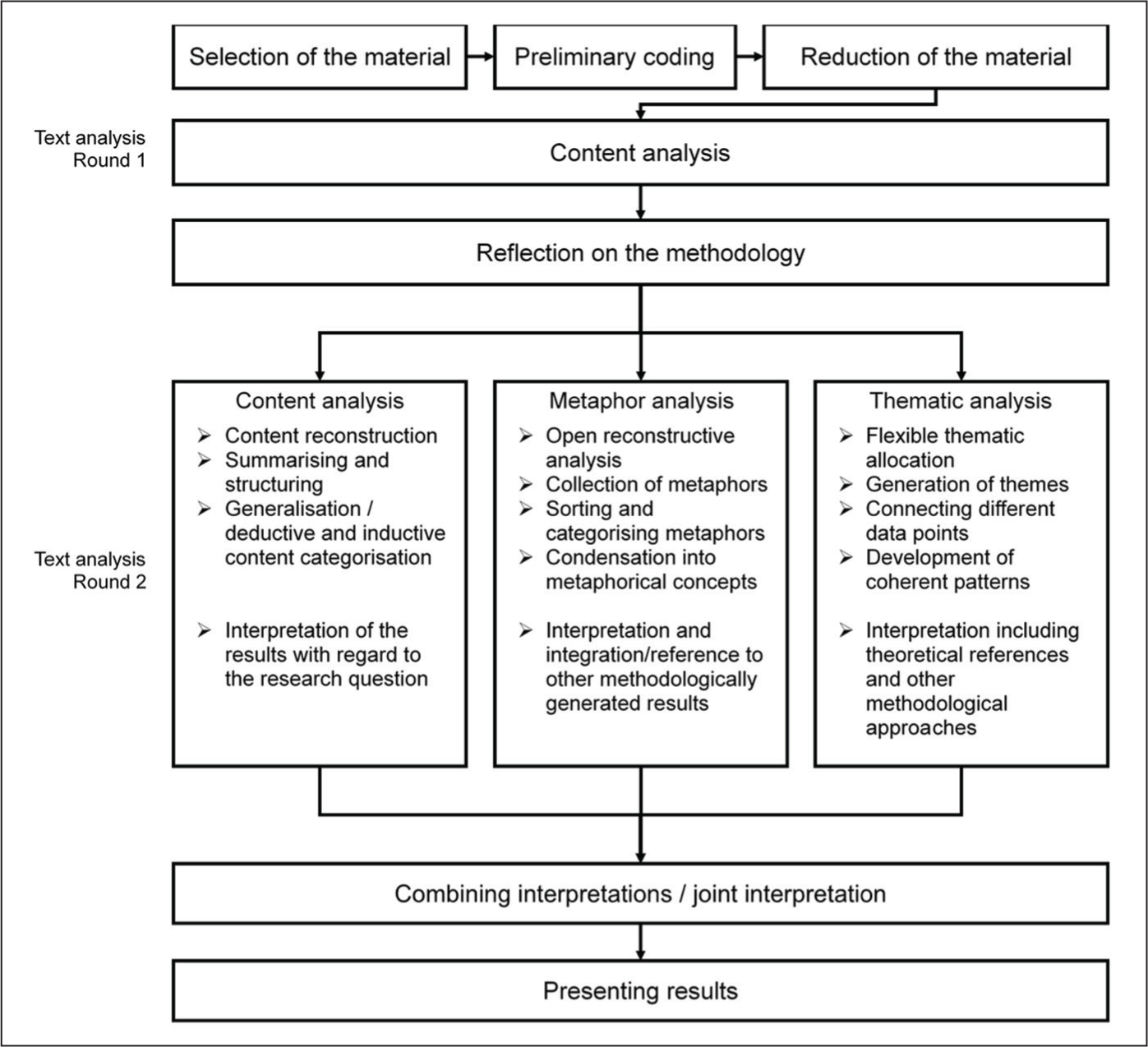
The second step was the in-depth analysis of the documents. The in-depth analysis was based on a complex multi-method analytical procedure, involving content analysis (Mayring & Fenzl, 2014), thematic analysis (Braun & Clarke, 2012) and metaphor analysis (Schmitt, 2017) (see Figure 1). These three methods were chosen because they all look at different aspects of a document. While content analysis looks at the explicit content of individual sentences and paragraphs, thematic analysis looks at the general themes of the text and relates these to existing knowledge about how the texts were written. Metaphor analysis complements these two methods by focusing more on the implicit understanding of young people found in the text. The combination of these different methods offers a holistic view of the discourse depicted in the documents, which would not have been possible through each individual method. The contextualization of the results in the discourse theory introduced above, without taking it as an analytical starting point, is particularly helpful because it also enables a complementary reflection on the emergence and further development of the documents, and thus of the discourse. Although these different methods are used to reconstruct the discourse present in the documents, we are not strictly referring to discourse analysis here, as discourse analysis does not reconstruct a discourse on the basis of individual texts so much as it analyses the functions of the text within the discourse (Parker, 2017). The benefit of this holistic approach is that it provides a broader and more comprehensive picture of which ideas about young people can be found in the texts by merging the analytical results.
Based on these results, a third step was taken by deciding to analyse further empirical data. In doing so, the analysis of the EU youth work policy document was complemented by a corresponding document from the Council of Europe (2017). In addition, the two policy documents in which the EU and the Council of Europe present their general strategy for youth (sector) policy were included in the analysis (Council of Europe, 2020; Council of the EU, 2018). This in-depth analysis was also carried out as described in the previous step. The advantage of this extended analysis is that it allows us to analyse the extent to which the findings from the youth work documents can be generalized to youth policy documents.
Methodological Procedure and Tabular Comparison of Analytic Methods.
The Notions of ‘Youth’ and the Dispositive of Age
The analysis revealed three important findings. First, the documents contain understandings about young people as well as about youth being a life stage. Second, these understandings are sometimes explicit, but more often implicit. Thirdly, two substantially different narrative schemes about young people and the youth life stage emerged from the analysis: one for youth work documents and one for youth policy documents. In this section, these results are discussed and contextualized in Ostrowicka’s dispositive of age.
The Concept of ‘Young People’
Throughout the youth work documents, the metaphor of young people being ‘architects of their own life’ appears. Other examples of identified methaporic concepts are ‘shaping the youth’, ‘equipping’ and ‘inviting’ them, as well as young people having ‘spirit’. Furthermore, the references to young people by the authors of the documents can be assigned to four different categories: Who are young people, which characteristics are attributed to young people, which needs are assumed to young people and how is the relationship between young people and society portrayed.
Who are young people and who is actually addressed as young people in the analysed documents? In the documents focussing on youth work, young people are addressed and understood both as a collective and as individuals. It is repeatedly and explicitly emphasized that young people do not represent a homogeneous group, but are characterized by great diversity in terms of their life situations and needs, and in this sense are addressed as being individuals:
[A]cknowledging that young people are not a homogenous group, and thus have diverse needs, backgrounds, life situations and interests. (Council of the EU, 2018, p. 3)
At the same time, reference is made to particular groups of young people. These groups are referred to on the basis of characteristics for social differentiation. For instance, young people affected by racism and intolerance face particular risks and generally go unheard by society.
This indicates that within the texts, the influence of society as a whole and its particular structures are taken into account with regard to the situation of young people. Young people are referred to neither as being detached from nor as being individualized from society.
In many respects, the strategic youth policy documents make similar statements about who young people are. They emphasize diversity among young people and sometimes refer to specific subgroups, for example, ‘those from minorities’ (Council of Europe, 2020, p. 4) or ‘disadvantaged groups’ (Panagides et al., 2019, p. 7).
Nevertheless, the overall picture is much more generalized. Despite affirmations of diversity, young people are addressed as if they exist as an undifferentiated group.
The analysis shows that as an initial impression there is a diverse and fluctuating understanding of who is actually meant by ‘young people’. In the context of Ostrowicka’s dispositive of age, it becomes apparent that both elements of generalization and the Discourse of Condition are mirrored in the documents. Social conditions affecting specific subgroups of young people are explicitly highlighted, pointing towards an existing Discourse of Condition. Young people do not form a homogeneous group being all in the same situation, but rather require a differentiated view. At the same time, however, the documents generalize, pointing out that young people are not a homogeneous group without specifying what differentiates them apart from social conditions. In the documents, there clearly emerges a need for generalization in mentioning young people as the target group for youth work and general youth policy.
Apart from the question who the young people are, the related question is, ‘Which characteristics are explicitly or implicitly attributed to them?’ The analysis identified two main characteristics, namely, vulnerability and disadvantage.
The image of what we will call vulnerability is one of the main characteristics found in all the documents analysed. Young people are considered a particularly vulnerable group as they are both confronted with and strongly shaped by a multitude of external factors and influences, such as globalization and climate change, technology, demographic and socioeconomic trends, populism, discrimination, social exclusion and fake news (Council of the EU, 2010, p. 1). The analysis shows that the texts contain a conception of vulnerability in which external factors have a shaping and form-changing influence on young people. A notion of an interactive exchange between young people and society, in which young people are attributed a stronger self-designing character based on which they deal with such external influences, cannot be found.
Despite this characteristic of vulnerability, young people are repeatedly described as being the ‘architects of their own lives’ (Council of the EU, 2018, p. 2), seizing opportunities. This is at odds with the previously drawn picture of young people threatened and shaped by external influences. After all, it is the fundamental task of an architect to plan, design and construct according to their own ideas and within certain framework conditions. This contrast between young people as dependent, clearly vulnerable and in need of protection by others, on the one hand, and as independent with a formative role as architects of their own lives, on the other hand, appears throughout the documents examined. These contrasts are neither explicitly addressed nor dealt with. They may be due to the previously described political negotiations proceeding the adoption of the analysed documents, thus being indications of different attributes ascribed to young people in different countries, or even at European level, pointing towards contradictory and possibly context-dependent different understandings of young people.
The second dominant characteristic attributed to young people, besides vulnerability, is that of disadvantage. Being young is generally recognized as being a disadvantaging factor by the fact that they are not yet fully fledged members of (adult) society. Following this logic, the documents implicitly point out that to become a full member of society, it is necessary to become an adult. Thus, being disadvantaged is an inherent characteristic of young people, who by definition cannot be young and adult at the same time. In addition to this disadvantage, which applies to all young people, social disadvantages of particular groups of young people are also addressed, such as ‘those experiencing any form of discrimination and exclusion’ (Council of Europe, 2020, p. 15).
The two characteristics ‘vulnerability’ and ‘disadvantage’ allude to the question of securitization (Discourse of Condition), that is, social conditions that generate insecurity and fear. At the same time, the Discourse of Competences also comes into play when it is stated that young people have to learn something so they will be able to fulfil their unique role in society. This is especially pointed out in the documents with regard to vulnerability, where young people are shaped by external factors, thus having to develop specific competences in order to be available to society in the future. Young people are thus being projected as a resource in a positive sense:
Encourage and equip young people with the necessary resources to become active citizens, agents of solidarity and positive change inspired by EU values and a European identity. (Council of the EU, 2018, p. 2)
Regarding the aspect of disadvantage, the Discourse of Cartography clearly comes to the surface, with disadvantage being defined as not yet being part of adult society.
Furthermore, young people are considered to be in a certain position of need. These needs are particularly addressed in the documents with a youth work focus. The two dominant attributed needs can be summarized as ‘support’ and ‘(protected) space’: Both needs must be met for young people to flourish. According to the documents, young people are dependent on adults for need fulfilment, leading to an image of young people needing support and being recipients of offers. Besides support, the relevance of a (protected) space as a prerequisite for young people’s development is underlined. Only if young people have this protected space at their disposal, they can develop in a way that is deemed to be positive by adult society. Youth work is understood as a relevant structure that provides both support and space.
Overall, the image of young people reconstructed from the documents with regard to their needs is one that is more closely related to the life stage of childhood, in which the dependency and need for support of young people is strongly highlighted. In contrast, an emancipatory image of young people with self-efficacy who are actively creative is hardly found in the analysed texts.
The needs described are not needs in the classical sense of the basic needs of human beings. Rather, they describe what young people need to be provided with by adult society. This support and (protected) space to which the documents refer serve to enable young people to acquire competences (Discourse of Competences), preparing them for the transition into adult society (Discourse of Cartography).
Finally, an important perspective on young people expressed in the documents is their relation to (adult) society. This perspective goes beyond describing what young people are to what they should be in relation to society. In all the documents analysed, young people are referred to as a resource for society. Young people are expected to become part of (adult) society, to help shape and further develop society, from the perspective of how adults view society. This includes the adult assumption of normative ideas about society. Young people are then handed the responsibility for implementing these ideas.
The detailed understanding, however, of what kind of resource young people are, differs significantly between the youth work documents and youth policy documents. While youth work related documents do address the question of the future transformation of society by young people, the focus is rather on what young people need in order to be empowered to fulfil this role. Despite the high expectations placed on young people in this context, namely, to shape society in the sense of the adult authors and their ideas, it is the young people themselves to whom attention is paid. In the documents related to youth policy, there is a much stronger instrumentalized view on young people. Young people are the future of society, without whom there can be no positive change. The focus is on social change that is to be achieved through young people. Being a resource is the primary guiding motive, with young people being portrayed as bearers of hope for the positive further development of society as a whole.
Here, the Discourse of Cartography and the Discourse of Competences show themselves in a special way with a strong orientation towards the future. Youth is not considered for its own sake, but rather as a transitional or preparatory phase for adult society. In addition, as in Ostrowicka’s dispositive of age, a problem is assumed to be solved in the future by young people. This assigns them a special role in society in that they are endowed with enormous responsibility as the ‘future’ of society.
Youth As a Life Stage
In addition to reconstructing the image of young people in the analysed documents, statements on youth as a life stage are also of guiding epistemological interest. These form the second overarching metaphor that could be identified in the texts. Intermediate between childhood and adulthood, youth is a distinguishable life stage with its own attributions. Several insights into the conception of youth as a life stage can be reconstructed from the documents.
Both the youth work documents and the youth policy documents contain statements regarding the distinction of youth from other life stages. Documents referring to youth work focus more on the linkages to childhood. Rather than projecting youth as an independent life stage, transitions between the two stages are blurred and often linked. An example of a clear linkage between the life stages of childhood and youth is the collective referencing to ‘all children and young people’ (e.g., Council of the EU, 2010, p. 2). On the other hand, the life stage youth is clearly demarcated from adulthood. Being an adult is a goal that is to be aspired to by young people, but not yet achieved. Rather, young people are in a transitional space. In the general strategic youth policy documents, this demarcation is most clearly stated. Youth as a life stage is defined as the stage before adulthood, with a clear focus on the future. These demarcations between childhood, youth and adulthood are drawn by attributing developmental tasks, on the one hand, and transitions, on the other, to the life stage of youth.
Although youth as a life stage is described by distinguishing it (or not) from childhood and adulthood, no specific and explicit statement is made that it is an independent life stage and no characteristic features are described. Nevertheless, in distinguishing it from adulthood, a conception of youth as a life stage is found that is very similar to the Discourse of Cartography. The preparations for transition to adult life are primary characteristics both in the documents and in the Discourse of Cartography. Consequently, it is not about the life phase itself, but about transitions, independent of a utilitarian perspective.
The documents repeatedly refer to the special developmental tasks and life situations of young people that are specific to this life stage. Certain developments as well as the mastering of certain developmental tasks are expected of young people in this life stage. Mastering these tasks enables young people to become active members of society. These developmental tasks are located on an individual level, such as becoming shapers of an inclusive society. Specifically, youth work– related documents also refer to developmental tasks in a professional way:
It [youth work] contributes to their personal development, but also facilitates social and educational development. It enables them to develop their voice, influence and place in society. (Panagides et al., 2019, p. 8)
The overarching goal attributed to all developmental tasks is the empowerment of young people. By completing certain developmental tasks, young people should be able to actively represent and strengthen certain values in society. Empowerment is thus not encouraged without purpose. Finally, a further characteristic of the life stage youth, according to the documents, is the motif of transition. Being a young person is referred to as being closely linked to preparations for becoming a member of adult society. This transition is prepared through experimentation in safe developmental spaces and the gradual assumption of roles in society. This preparation for taking on an active role in adult society is the primary goal of the youth life stage.
These developmental tasks can be understood as a specification of what has already been described. They serve as preparation for adulthood and are an inherent part of the Discourse of Cartography as well as the Discourse of Competences. These developmental tasks are not conceived of on an individual level, for each young person themselves and for their sake, but for young people as a group. Young people are located in a developmental phase that represents an investment for the future and (adult) society in general.
The Narrative Schemes of Youth Work and Youth Policy
As already mentioned in the introduction to this section, a third core result of the analysis was the emergence of two narratives, linking young people and (adult) society. Although the analysis shows that this linkage can be found in documents, the nature of this linkage differs substantially between youth work documents and youth policy documents.
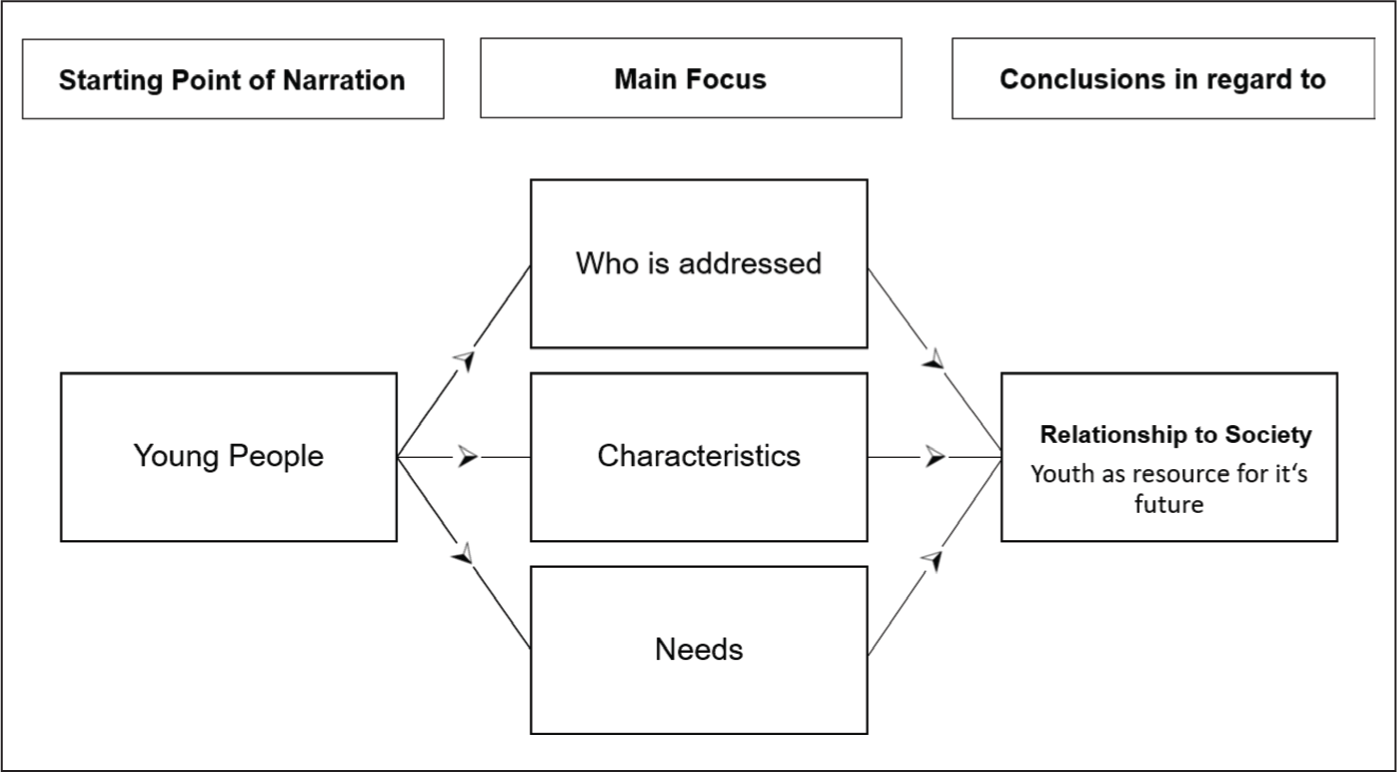
Youth work documents take young people as a starting point and focus on who they are, what characterizes them and which needs are attributed to them. From this focus, conclusions are drawn about young people’s relation to society (Figure 2). An example of such a narrative scheme can be found in the EU Council Resolution on Youth Work (Council of the EU, 2010), which argues that the development of young people is central to the life stage of youth. However, young people need support to become independent and to develop their own voice. Youth work plays an important role in providing this support and in ensuring that this development takes place in a positive way according to society’s ideas. It is this characterization that defines the relationship of young people with society, in the sense that society specifies the framework in which young people’s development should take place. Young people’s development, to which youth work can contribute, is thus in focus. This development, if properly supported, should then lead to young people positively contributing to society. However, the starting point of this narrative is young people’s development, and not the contribution they are supposed to provide to society, and thus their relationship to it.
Youth Work-Related Documents.
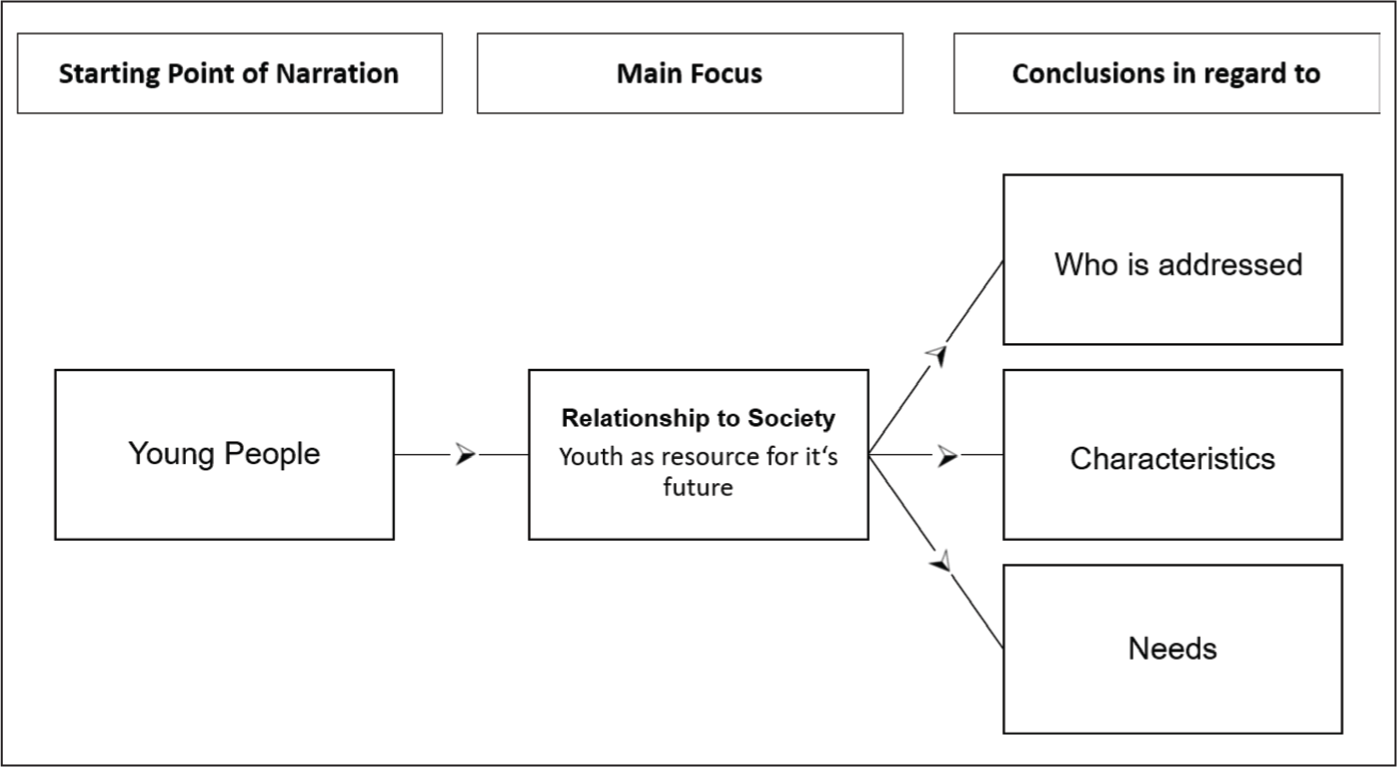
The youth policy documents, on the other hand, place the relationship between young people and society at the centre of the argumentation. Rather than discussing who young people are and what characterizes them, the focus is on what young people need in order to assume a positive role in relation to society (Figure 3). This becomes clear in the example of the narrative ‘young people as the future of society’. This relationship to society is the basis for deriving that which characterizes young people (they are not adults) and what they need – in this example, support, so that they ascribe to and spread the political values on which the documents are based. For youth as a life stage, the focus is thus more on transitions in the lives of young people and the spaces they need for their development towards taking a positive role in society.
General Strategic Youth Policy Documents.
Although the narratives underpinning the view on young people in the analysed youth work and youth policy documents differ, the reconstruction shows that the images of young people found in the documents are rather similar. They fit with the findings of the studies elaborated in the introduction, even though these studies and the documents on which they are based have different foci. Young people are considered to be a resource for European society, economically, educationally and normatively. Accordingly, it is the task of this society to empower young people in such a way that they can fully develop their potential and fulfil adult society’s expectations.
Conclusions
The findings of our study show that both the youth work and the youth policy documents have their own unique way of referring to young people. Depending on the narratives used, the concepts of young people and youth as a life stage are used in terms of political goals and strategies, each with different ideas about young people. In particular, the analysis of the youth work documents in comparison to the youth policy documents has shown that the contextualization of the debates in which young people are referred to is of great importance when it comes to ideas regarding young people but also youth work as a structure created especially for young people.
A strong and recurring motif is the dependency of young people on adult society for supporting their development and having their needs fulfilled. At the same time, young people are referred to as being the future of (adult) society and are thus given an almost heroic status in which responsibility for future human society is attributed to them. As society’s future, young people can perfect the European society shaped by today’s adults and fix the not- yet- reached political goals. However, they should not (try to) fundamentally change either society or the set political goals. In this sense, it gives the impression that young people are being guided on how to develop themselves so that society can achieve its goals. What is not clear from the documents is to what extent young people themselves have an influence on the future of society and/or the political goals. The appeals in the documents towards young people to participate in society do not contain much information about how deep this participation should go.
Within this responsibility, their vulnerability, in the sense of being confronted with and strongly shaped by a multitude of external (negative) factors and influences, in their current life situation is emphasized, particularly in the sense that without support from adult society, young people might adopt the ‘wrong’ values. This narrative strongly argues towards a need for influence and control by (adult) society. Young people should think and act in the (political) sense of the (democratic) majority – if they do not, they are seen as a danger for society in general.
To summarize, the results of the analysis presented confirm to a large extent the results obtained in the earlier research mentioned above. Young people are seen by policymakers as the ones who should continue societal developments that have already begun. In this sense, they are both a resource to continue these developments and a risk, as they may not continue these developments in the ways whished by society. Thus, to establish a European citizenship that lives the European values of democracy and competitiveness, young people need to be shaped and controlled by adult society. This leads to the crucial realization that the so prominent declarations to take young people and their rights of self-determination seriously are considerably weakened when one looks at the documents in depth.
Furthermore, it also became apparent that the discourse-analytical theoretical approach, which Ostrowicka developed on the basis of Foucault’s theory, could prove its analytical potential in our study. The discourses postulated by Ostrowicka and the mechanisms of the dispositive of age could also be identified in the data we analysed. In this sense, the documents analysed are part of ‘governing youth’ (e.g., Banjac, 2016; Grasso & Bessant, 2019), where the dispositive of age shows a strong tendency to control young people (i.e., representing the hegemonic view of society) and to instrumentalize them (young people are responsible for the future of Europe).
Thus, we find in our study that the dispositive of age is effective in youth policy discourses by excluding other ways of thinking and speaking about young people (discourse as exclusion of knowledge). In the performativity of the discourse, this puts pressure on individuals and the maintenance of their subject positions and provides the framework for youth policy already described.
The findings of the study are also of great relevance for the further development of youth work and youth policy.
First, the findings show that contextualization of the documents, including the authors’ intentions and the policy goals pursued, has an effect on how young people are addressed in the documents. Thus, the image of young people that an international organization or a member state actually assumes within European youth policy negotiation processes is of importance and should not be underestimated. It is precisely this relevance of contextualization that reveals a need for further research. Further research could look into the attitudes of the authors of the texts, the political rationale behind the drafting process (like the unanimity principle, the Open Method of Coordination in the EU, the use of experts, etc.) and their influence on the drafting of the texts. Such research can contribute to a better understanding of how the found ideas regarding young people, which are to be understood as the result of negotiation processes, come into being.
Second, youth policymakers who want to strengthen youth policy and youth work policy goals should not lose sight of the conceptual ideas they have about young people. This poses the question to what extent young people themselves and their needs should be the central focus of youth policy, rather than societal needs and goals to which young people and youth policy can contribute. It would be advisable if decision-makers were aware of the power of these perspectives when developing youth policy and would question them from time to time.
Third, the results show that there are hardly any passages in the documents that describe youth policy as a policy that offers young people the space to unfold their autonomous intrinsic development in terms of self-realization. By focusing on the perspective of a future-oriented role of young people in relation to society, including access to education and the labour market as an instrumentalized contribution of young people to society, there are accordingly hardly any ideas and concepts in the documents on how the life stage of youth can be (further) developed as an independent concept. Questions about what constitutes ‘youth’ as an independent life stage or what young people need in their youth, detached from future perspectives in the here and now, are hardly touched upon. Yet the importance of granting young people this moratorium of an independent youth stage, as a complement to childhood and adulthood, has long been documented in the literature (e.g., Hurrelmann & Quenzel, 2016).
Despite these findings, this study also has limitations. The most important one is that it presupposes the contextualization of the creation of the documents as an important premise for the documents, but does not consider its consequences. This leaves room for further research. An analysis of how the documents came into existence, including the social and power-related practices that take place in the background of negotiations, could certainly contribute to a better understanding of the documents themselves and correspondingly enrich the results based on them. Additionally, it would be interesting to compare the findings of this study with an analysis of further documents. A comparison with national documents would be helpful in order to understand how national views are reflected in European youth policy. Similarly, a comparison with international documents such as the UN Youth Strategy could explore how images regarding young people presented here have relevance beyond Europe. In such comparisons lies the potential to further elaborate the specifically European perspective on youth presented in this study.
Footnotes
Acknowledgements
We would like to thank our former colleague Stephanie Riedle for her contributions to the development of the methodological design and the analysis in the early stages of this project and the two anonymous reviewers for their valuable comments to this article.
Declaration of Conflicting Interests
The authors declared no potential conflicts of interest with respect to the research, authorship and/or publication of this article.
Funding
The authors received financial support for the research, authorship and/or publication of this article from the project ‘Centre for European Youth Policy’, which is funded by the German Federal Ministry for Family Affairs, Senior Citizens, Women and Youth.