



Abstract
For young people, a first encounter with criminal justice can have lasting effects. While perceptions of equitable treatment can generate feelings of belongingness and acceptance, treatment perceived as unfair or prejudicial can generate experiences of dissonance and exclusion. However, little research has examined young people’s appraisals of justice system encounters. The purpose of the study was to examine perceptions of criminal justice among young people suspected of a first, non-serious offence. Using an intensive longitudinal design, young people suspected of criminal activity (n = 21) were interviewed during a justice process. Using subjective procedural justice as an analytical framework, a theory-driven thematic analysis was conducted. Results revealed how the actions of crime-prevention professionals were mostly appraised as proportionate and beneficially intended. However, some participants reported negative encounters and lacking opportunities for agency. Findings are evaluated in relation to the long-term consequences of a first encounter with criminal justice.
Introduction
Since the 1990s, youth crime has generally been in decline. This is especially so in Western countries, where crime rates have fallen significantly (Svensson & Oberwittler, 2021; Tcherni-Buzzeo, 2019). However, a decline in youth crime is far from uniform. In groups that include disadvantaged young people, crime has not fallen (Fernández-Molina & Bartolomé Gutiérrez, 2020). To stem juvenile crime and to prevent young people from commencing on a criminal trajectory, the early intervention of criminal justice has become increasingly common, not least in Northern Europe and the Scandinavian countries (e.g., McAra & McVie, 2018).
In Sweden, for example, there has been an increase in the judicial processing of non-serious offences. Often taking the form of programmes that involve police, prosecutors and social workers, youth justice procedures seek to steer young people away from future criminal activity (Johansson, 2014). Even if an offence might be non-serious—and in the normal course of events considered low-priority—the police will often open a case and a coordinated response chain will be set in motion. To rapidly deal with the case, input from the involved professionals can be extensive. However, little is known about the experiences of young people who encounter these justice procedures.
Young People and Criminal Justice
Despite resources directed to the research of juvenile crime (e.g., Alstam & Forkby, 2024), there is limited understanding of the effects that police attention and the processing of a first, non-serious offence can have on a young person. In a study exploring young people’s encounters with the police in the four Nordic countries, in-depth interviews were carried out with a large sample of young people (n = 121) recruited from city centres and disadvantaged neighbourhoods (Saarikkomäki et al., 2021). Findings revealed ambivalent attitudes toward the police and their role in crime prevention. On the one hand, young people could express a sense of being under surveillance and suspicion. This could cause them to doubt the impartiality of the police. On the other hand, participants could describe communication with police officers that was friendly, well-intentioned and respectful. In creating a sense of trust and fairness—even in situations where a young person had been suspected of wrongdoing—such encounters were regarded as important in improving perceptions of the work and role of the police. However, in situations where respect was lacking, feelings of resentment and perceptions of a lack of belongingness could arise. This was particularly the case for participants with minority backgrounds. As Saarikkomäki et al. (2021) made clear, ‘[d]isrespectful treatment from a police officer can communicate an attitude of “out group” status, a sense of not belonging, which can result in a feeling of distance between a minority individual and the wider society’ (p. 399). In a companion study, Saarikkomäki et al. (2023) identified variation in the ways that young people can respond to police attention. While the interviewed young people could understand the logic behind the intensity of policing in particular areas, they demonstrated resistance by seeking to avoid contact with the police. In a French–German survey on young people’s experiences of being stopped by the police, it was found that national patterns of policing can play an important role (Oberwittler & Roché, 2022). For the young people in France, policing was perceived as aggressive, coercive and strongly biased against certain minorities. Similar findings emerged in an interview-based study of 76 young adults aged between 16 and 25 living in ‘ghetto-labelled’ neighbourhoods in Denmark (Birk Haller et al., 2020). Here, young people described encounters with the police in terms of ‘moral violence’. Violence was not only physical—having an arm twisted or being pressed to the ground—but also involved assaults on the young person’s integrity and dignity.
With regard to experiences of justice processing, research has predominantly taken place in relation to adult criminal justice. Recently, however, studies have begun to focus on the experiences of younger people (e.g., Trinkner et al., 2020). In a systematic review of the findings of 39 qualitative studies examining young people’s experiences of encounters with representatives of criminal justice and justice support systems, De Boer et al. (2023) concluded that adolescents were aware of and could describe justice experiences. In expressing views about the reception and treatment received from authority figures, the young people in these studies could relate a positive or negative experience to attitudes about the justice system. The review highlighted two major findings: the importance of trustful relationships, and the desire for influence in decision-making (De Boer et al., 2023).
In relation to trust, findings from the systematically reviewed research demonstrated the importance of trusting relationships for justice-involved young people. For example, in a study by Jack et al. (2015), participants highlighted how understanding, recognition and respect were central to the construction of a trustful relationship. Regarding influence, the review emphasized the importance of agency and the value placed on choice, participation and involvement. As De Boer et al. (2023) make clear, in justice procedures, young people need to feel that they are involved in decision-making.
Stemming from their systematic review, De Boer et al. (2023) identify several areas where knowledge is currently deficient. First, very few studies have been carried out where focus is directed to in situ interactions with justice system representatives. Second, few studies have been carried out with young people under 15, especially girls. Third, there is hardly any research on young people who encounter the justice system for the first time and/or who are suspected of committing a non-serious offence. Fourth, few studies have been carried out in non-anglophone countries. Finally, as De Boer et al. (2023) also emphasize, further qualitative studies are needed. This is important not only to understand how experiences of justice affect the attitudes of young people, but also to support service providers in developing evidence-based practices.
Study and Purpose
In a changing climate of youth justice, and with a focus on early detection and crime diversion, minor crimes are now being treated more seriously (McAra & McVie, 2018). However, young people’s experiences of criminal justice are poorly understood. While studies conducted so far provide important insights, they have the common limitations that it is rarely established whether (a) participants have first-hand experiences of justice procedures or (b) they have been suspected of an offence (Birk Haller et al., 2020; Oberwittler & Roché, 2022; Saarikkomäki et al., 2021, 2023). Moreover, as De Boer et al. (2023) make clear, there is a lack of research on the experiences of young people suspected of committing a first, non-serious offence. With the recognition that positive justice experiences can support feelings of inclusion and that negative experiences can lead to feelings of exclusion and isolation (Tyler & Blader, 2003), the purpose of this study is to investigate the justice experiences of young people suspected of committing a first, non-serious offence. The research was guided by the following question:
How do young people suspected of a first-time, non-serious offence experience treatment by criminal justice professionals?
Analytical Framework
For young people, especially those with experiences of marginalization, the sense of belonging to and feeling accepted by wider society is important for healthy socialization (Blader & Tyler, 2009; Tyler & Blader, 2003). In encounters with authority figures—such as police and social workers—belongingness and acceptance are critically appraised. The concept of procedural justice captures these assessments. It explains how appraisals of justice form the antecedents of identity judgements that foster or discourage investment in group norms and practices. While perceptions of equitable treatment can foster connections to wider social groups and can generate experiences of belongingness and acceptance, treatment experienced as unfair or prejudicial can generate experiences of dissonance, cynicism and exclusion (Tyler, 2017; Tyler & Blader, 2003). Highlighting perceptions of trust and legitimacy, subjective procedural justice can be understood as a holistic experience that involves the person’s acceptance of discretionary decisions and can help explain why people defer to authority (Tyler, 2017; Tyler & Blader, 2003).
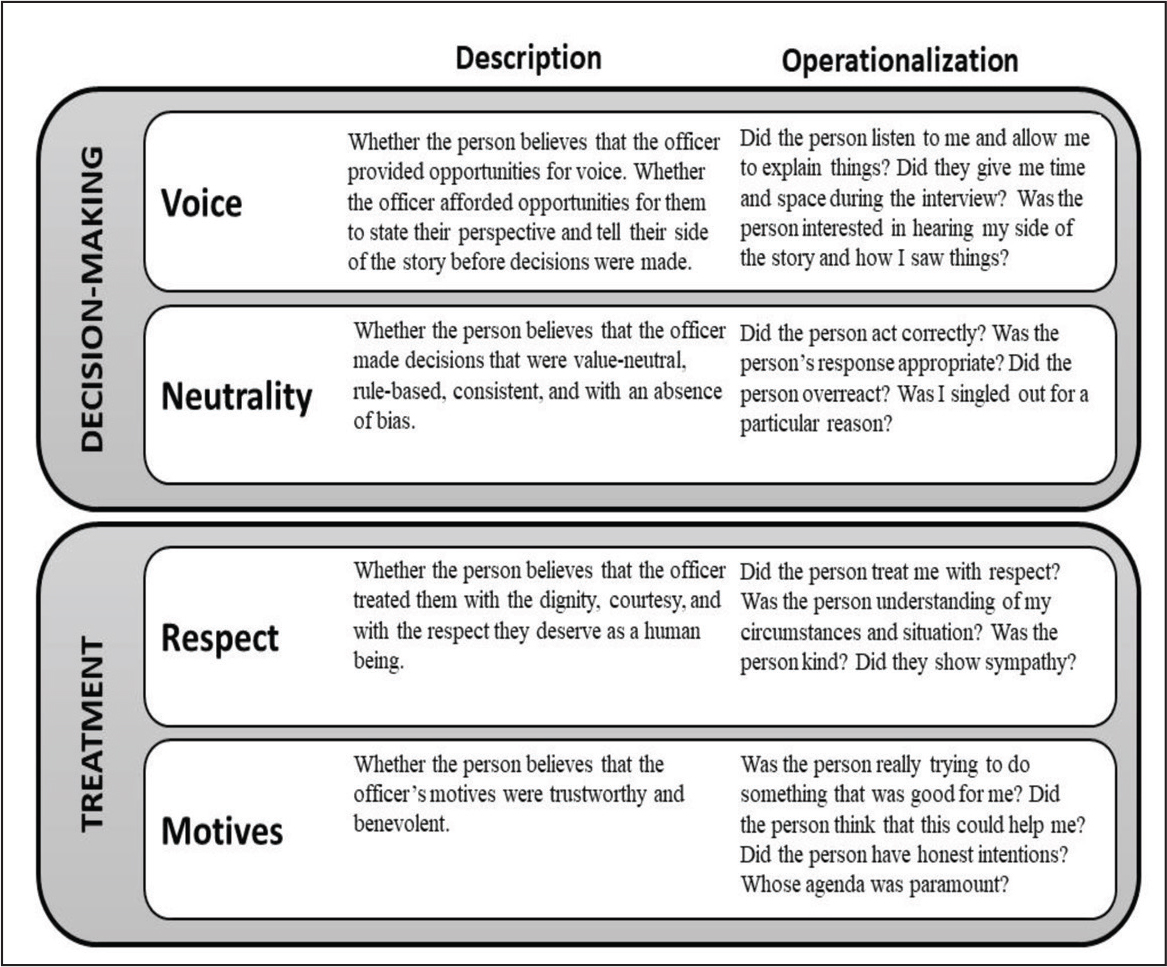
To explore participants’ perceptions of procedural justice, a theoretical model described by Tyler (2017) was used (Figure 1). Premised on judgements about the legitimacy of action, the model provides a systematic framework with which to explore people’s experiences of the practices of justice professionals. People will judge the actions of police and other justice professionals to be legitimate if: (a) they perceive that they are accorded space in decision-making (i.e., whether they feel they have voice); (b) they feel that they are fairly treated (i.e., whether they think procedures are neutral); (c) they feel that they are treated with understanding (i.e., whether they feel they are treated with respect); and (d) they perceive that the person exercising power is trustworthy (i.e., whether their motives are sincere). While the first two conditions involve decision-making, the second pair involve treatment (Figure 1).
Setting
Sweden has a long-standing history of crime prevention initiatives targeted toward the early detection of youth engaged in crime or who are on the fringes of criminality (Forkby, 2020; Johansson, 2014). Landmark crime prevention programmes include the 1997 Everybody’s Responsibility initiative, and the 2017 Together Against Crime programme. In both programmes, inter-agency collaboration is strongly emphasized (Alstam & Forkby, 2024). At the operative level, collaboration around youth crime and crime prevention primarily involves social services and the police. These bodies collaborate with schools, youth centres and local prosecution services. As Forkby (2020, p. 581) noted, a ‘common denominator’ for local crime prevention strategies is the trust placed in collaboration between cross-sectoral partnerships, where initiatives are frequently set up and facilitated by social services.
Method
Study Design
Qualitative analyses of young offenders’ perceptions of justice procedures can provide important insights into the processes through which justice-involved youth make sense of their situations. As De Boer et al.’s (2023) systematic review revealed, young people with justice experiences ‘are able to reflect on and express their opinions on numerous topics, including the underlying causes of their delinquency and their perceptions of life events in general’ (p. 153). In the current study, we used an intensive longitudinal design (Neale, 2021) to study young people’s experiences in proximity to justice encounters that took place in closely spaced time intervals. Interviews were carried out at each stage of a justice process, and in close proximity to an interaction with a justice professional.
The Programme
Participants were recruited from a crime diversion programme in the west of Sweden. In line with the aims of (a) according higher priority to non-serious offences, and (b) ensuring a coordinated procedure, the programme was designed to provide a timely response following the detection of a crime (Bolin et al., 2023). Prosecutors, and social services worked collaboratively in a tightly coordinated sequence of stages (Figure 2).
Organizational Structure and Processing.
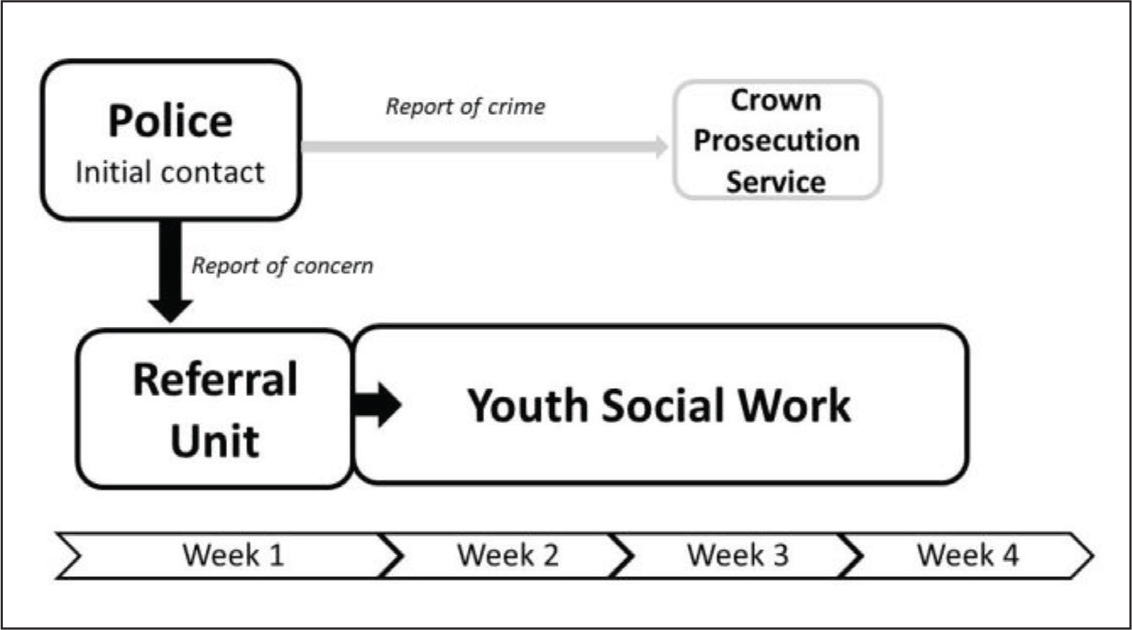
Although the exact timing varied for each case, on average it took 1–3 days between initial contact with the police (following the detection of a crime) and reporting to the referral unit. Thereafter, a further 1–2 days elapsed before a meeting with a youth social worker. Subsequently, a justice trajectory could take anything between 1 week (in cases where a single session with the youth social worker was deemed sufficient) to up to 6 weeks (in more serious cases).
Participants
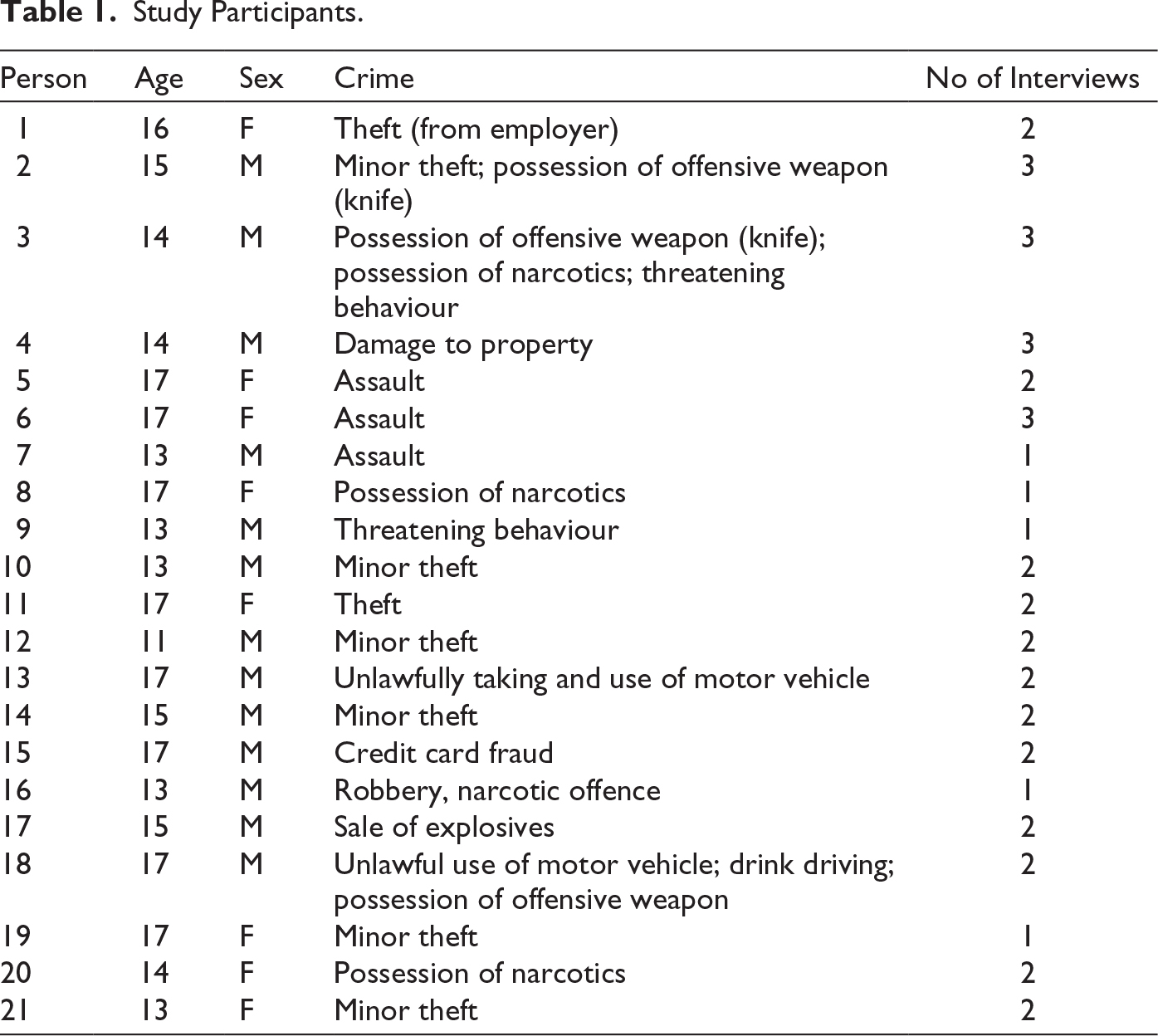
The study participants were 21 young people suspected of having committed a non-serious offence and who had not previously been suspected of criminal activity. Information about the participants is provided in Table 1.
Study Participants.
Recruitment
Before a young person was invited to participate in the research project, the youth social worker was asked to assess whether participation would be appropriate. Ethically, this functioned as an important inclusion criterion. Varying reasons could mitigate against participation. These could be that the referring social worker made the appraisal (a) that the young person and/or their family were experiencing some form of crisis, and/or (b) that there was a high degree of conflict between the young person and a parent/parents, and/or (c) that the young person was highly resistant to the programme (with participation coerced by parents).
Once a positive assessment had been made, the youth social worker informed the young person and their parents about the project and its purposes. Written information was provided. For young people who expressed interest in participation, names and contact information were passed on to the researcher (the first author). Thereafter, contact was made via text messaging. This was followed by a video call (using Facetime) or a face-to-face meeting. On these occasions, information about the project and the nature of participation was again provided (orally and in writing). Once participation was agreed (by the young person alone if over 15, and with their parent if under 15), ongoing contact with the researcher was maintained through text messaging. On each occasion an interview took place, consent from the young person was re-obtained.
Interviews
Interviews were carried out by the first author. In five cases, the young person no longer wished to continue participation and only a single interview took place. In line with the methodological strategy of interviewing young research participants using familiar digital applications (Gibson, 2022), participants were given the choice of an in-person interview or an interview using a digital medium. With one exception, participants chose to be interviewed using Facetime. Interviews took place at times convenient for the young person (often weekends). On all occasions, no other person was present (as far as could be ascertained). For the youngest participant (aged 11), the first interview took place with a parent initially present.
Generally, interviews lasted between 20 and 30 minutes, with the final interviews tending to be shorter. The focus of an interview was directed to (a) events surrounding apprehension, the actions of the police and subsequent contacts with the social workers, and (b) experiences and reflections on these events and interactions. Participants were invited to describe their perceptions of actions taken by the justice professionals and to consider whether responses felt reasonable, equitable and proportionate. Furthermore, they were invited to reflect on opportunities to voice perspectives, influence actions, impact unfolding events and participate in decision-making. In the second and third interviews, opportunities for further reflection were provided.
Analytical Approach and Procedures
A theory-driven thematic analysis was conducted. A theory-driven approach enables researchers to explore theoretically derived proposals in qualitative data (Braun & Clarke, 2006; Hayes, 1997). It is appropriate when the research draws on robust psychological constructs. Like other thematic analyses, a theoretical analysis aims to identify themes or patterns in a dataset (Braun & Clarke, 2006). However, unlike inductive methods, theory is used throughout the research process. Theoretical propositions inform the research questions, drive the data collection and structure the analyses (Hayes, 1997). The interviews were transcribed and entered into Nvivo12. Coding was carried out in relation to each of the three elements of the justice programme (Figure 2) and in accordance with the four dimensions of the subjective procedural justice model (Figure 1). First, each data segment was initially coded in relation to the justice programme element. In a second stage, coding of segments was made in relation to (a) voice (perceptions of agency and space), (b) fairness (perceptions of fair/unfair treatment), (c) respect (perceptions of being treated with empathy and understanding) and (d) motives (perceptions that power is exercised in a trustworthy manner).
Ethics
Approval for the study was obtained from the Swedish Ethical Review Authority, Decision 2021-00098). The study was conducted in accordance with regulations set out by the Swedish Research Council. Potential participants (and when under 15 their parents) were provided with information about (a) the aim of the research, (b) inclusion criteria and (c) the names and contact information of the interviewing researcher. In this information, it was explained that (a) they could terminate participation at any time, (b) information provided would be confidential, (c) their name would not be revealed in any report, and (d) that interview transcripts would be stored in a secure archive.
Results and Discussion
The results are set out in accordance with the model of procedural justice (Tyler, 2017) (Figure 2). Participants’ experiences of interactions with police and social workers are examined in relation to the dimensions of decision-making and treatment.
Decision-making: The Police
There was wide acceptance that the police had acted appropriately. Participants recognized why the police had apprehended them, and why the officers needed to respond in the way they did:
They were kind. They handled it in a good way. They’d taken us and brought us in. /…/ They did nothing wrong. They did it in the right way. (P11) They did their job. Like, they weren’t violent, but did their job. (P14) There was one. The interrogating officer. And she did her job. She was not unpleasant or anything. She just did her job. I felt that she handled the job well and asked me questions, as she is supposed to do. (P15) Nothing they did was out of the ordinary. I handled my part and they handled theirs. It was easily handled. (P19)
Generally, participants believed the actions of the police were neutral and without bias. However, for some participants, the legitimacy of police action was questioned. Some felt that the response was an overreaction. Others experienced being singled out. A boy (P18) who had been arrested for riding a stolen motorbike while under the influence of alcohol, described how he felt the police had been unjustifiably heavy-handed when arresting him, reflecting on the actions of the police in two (of the three) interviews:
First, they rammed me from behind. And then, on a straight stretch, they drove past me and then kind of forced me off the road. Then… the weird thing was that I knew one of the police. And he is a giant! He’s like two meters tall. And he wrestled me to the ground. Otherwise, they handled themselves well. They drove into me twice. First from behind and then they rammed me. If I had crashed when they drove into me the first time, it could have gone really badly. They could have run me over. I was driving legally, doing 30. [They arrested me] just because I didn’t have lights. Brutal.
At the time of her apprehension, another participant (P3) similarly felt the actions of the police were unjustified in relation to the triggering incident (threatening behaviour), and that they had overreacted:
P3: I was on my way home and I hear a policeman behind me shouting, ‘Police! Get on the ground!’. And then I became stressed and started jogging. Then I became even more panicked and started to run. And I couldn’t see him. At first I got away from him. But then I couldn’t keep running and I realized there was no point, and he took me. /…/ He pointed his pistol at me and told me to get on the ground. And I did. And then he put his knee on me and pushed my head into the asphalt. /…/ He like put his knee on my head, on the asphalt. I got grazes and stuff. /…/ I: Do you think that he acted with too much force? P3: Yes, totally. And I am so small compared to him.
While participants could be critical of police actions, they could also understand why the police had reacted in that way (even if they felt it was not justifiable). This is in line with other studies where young people react negatively to perceived violence and heavy handedness, but recognize that in some cases, it might be necessary (Saarikkomäki et al., 2023). For a girl suspected of having committed an assault (P5), the perception of an overreaction was tempered by an understanding of why, in her interpretation, the police had reacted in this way:
P5: Well, I understand the police. There were a lot of people and that’s why I tripped and fell onto the girl. In the eyes of the police it looked like it was me who was being threatening, which meant that they grabbed me got me down on the ground. In fact, this wasn’t what happened. I got pushed. There were lots of young people there. So, I felt that they were a little unfair, when you think that I was pushed to the ground while she was able to stand up quite normally. And then one thing led to another, and I was put in handcuffs. They put them on me and put me in the police car. I thought that this was a bit of an overreaction. /…/ I didn’t think it was necessary to push me into the ground, with their feet on me. It would have been enough to separate us. And there shouldn’t be two police on me. If there are two police, then one on her and one on me. I should have had one policeman, not two. It is not reasonable to be singled out like this. I: What do you think about the police putting handcuffs on a seventeen-year-old who they have previously had lying on the ground? P5: I don’t think it’s okay. A seventeen-year-old. It was a man and a woman. They were two. And a seventeen-year-old can’t be so threatening that you need to use handcuffs. I really think it was an overreaction. They are exploiting the power they have. Putting handcuffs on…No, it’s not okay to put handcuffs on a seventeen-year-old. And absolutely not okay to be pushed into the ground with a knee on top of you.
In circumstances where the apprehension and police interview took place simultaneously or in close succession (as was the aim of the diversion programme), few participants talked about perceptions of having voice. Rather, in these encounters, they experienced having little opportunity to explain or to influence events. As the girl suspected of assault (P5) reflected, at the time of her arrest, the police did not listen to her:
They don’t even listen to you either when you say ‘Let go of me’. They don’t. I think it just escalates things even more. /…/ I’m like ‘Can you take off those handcuffs?’ They are really unnecessary. ‘Can I get my face off the ground?’ I had grass in my face. And they said, ‘No. We can’t do that. We can’t do that’.
Later, however, when things had calmed down, she felt that she had more of an opportunity to give her side of things:
They spoke with me and asked me what had happened. And I explained. /…/ And they asked if there was a special reason why I didn’t want to spend time here, and I said, ‘No. I just don’t like being here’.
Decision-making: The Social Workers
There was wide acceptance among the participants that the social workers had acted in appropriate and correct ways. There was a perception that decisions were value-neutral and rule-based. In the diversion programme, an important site of decision-making was the interview that took place with social workers from the referral unit (Figure 2). Depending on this interview, different courses of action could follow. Either the young person would receive the intended intervention or, if the young person’s case and surrounding circumstances were judged to be serious, they would become the subject of an in-depth child protection investigation. In extreme cases, an immediate care order could be applied for. In reflecting on these meetings, participants described how they felt that the social workers had acted impartially. Given that the issue involved a suspected crime, they recognized that the social workers had a responsibility to ensure that an appropriate course of action was pursued:
They don’t all maybe know, but many do. They do their job in a good way. And she worked with social something….I don’t remember exactly. Something with social services. She said that she had a duty of confidentiality, and mases of stuff like that. /…/ Then she said like, ‘There are a lot of people I meet who have committed crimes and other stuff’, and that it’s her job to help them. So it’s nothing unusual. I’m not the first young person on the planet to commit a crime. (P1) They are really just doing their job. Taking action. It was something that is not allowed, you could say. (P2) She explained, ‘What we do is to receive young people who have done criminal things, and have been in prison and have come out, and we talk with them. But in your case it’s not quite like that. But we will talk with you anyway’. (P17)
One exception to the sense that the referral unit social workers were acting without bias can be found in the perceptions of P6. This girl felt that the interview was prejudicial. Rather than being treated as an individual, she felt that she had been treated as a person from the area in which she lived (a disadvantaged neighbourhood):
It was like ‘What?’ But if that’s what they want to believe, okay, go ahead. Think that. But I just get so angry. And I am thinking that this is what people really say. When you live in [neighborhood] they group you all together. It makes me heartbroken. But maybe it’s true. It becomes so. (P6)
In relation to the youth social workers, there were no participants who experienced that actions were inappropriate. Rather, there was a high level of acceptance that the social workers were carrying out their work without bias. As one participant put it ‘They did the job well. They asked good questions’ (P12). With regard to voice, the participants spoke frequently about how they were afforded space to give their version of events, to express their opinions and to tell their side of the story. They felt that the social workers had been engaged when listening to their version of events. In a similar way, they were open to discussing the participant’s expectations about the intervention, and about the future:
I got to choose. Got to talk about how I feel and what I think. So that it was not just thoughts from their side, so to say. I am not quite sure, but I think that you become a little more comfortable when you also get responsibility. (P2) We did this ‘network assessment’ and then I got to say a lot. I got to influence the process, what was going to happen and so on. (P12) I talked about what I’d thought before, and when I did it, and stuff. Very open. Not just saying something, but you could explain. (P15)
There were few exceptions to the experience of being able to have a positive influence in decision-making processes. When a perception of not being afforded space to articulate opinions and to influence matters was expressed, the interaction involved social workers from the referral unit:
She tried to put words in my mouth. She didn’t let me talk. I told her one thing, and she changed it. Or, not changed it. But there was something strange. I couldn’t talk with her so I talked with [other social worker]. And I am an open person. Can talk to anyone about anything. But with her it wasn’t possible. It was really hard to talk with her. (P1) No, it was like, so-so. With [social worker] it was more like, we don’t need to talk too much about what happened, but more like general things. (P 4) She’s like ‘You have to go to the Youth Services’. And so I did. (P16) I had no choice. She said that she’d already booked a time. She didn’t say ‘if you want I can book a time.’ (P17)
In accordance with the aims of the diversion programme, social workers in the referral unit were tasked with making a speedy assessment as to whether the young person should proceed onwards in the programme, or if the circumstances of their social and family situation were such that a protection order was needed. (In such cases, a more extensive investigation would be commissioned, and a preliminary care order might be sought). Consequently, it may be that participants’ perceptions of lacking opportunities for voice are related to the nature of the investigative task and the time constraints imposed by the goal of rapid processing.
Treatment: The Police
As we have seen, the participants understood why the police had apprehended them. For the most part, they accepted that the police needed to act as they did. Generally, participants felt that the police had acted appropriately, and that decisions had been correctly made. Participants mostly took the view that the police had treated them with respect and understanding:
Well, they didn’t have attitude or anything. They said it in a good way. They didn’t force us to go in. We were like free, but at the same time not. They didn’t restrain us. They didn’t force us. He said it in a good way, like, respect. (P11). They did their job. Simple as that. They were pleasant. There was nothing strange about it. Nothing that stuck out. /…/ They were very pleasant. Smalltalk before my guardians came. They did their job. It wasn’t friendship, like, but they did their job. Pleasant. They were respectful. (P19)
For a few participants, however, treatment by the police was seen as demeaning and threatening. As one participant made clear, the problem with denigrating behaviour is its bidirectionality. Perceiving the police to be combative in their approach, he was prompted to respond in a similar manner:
The police were very unfriendly. They told me to ‘shut up’. And they put my head against the asphalt. Using their knee. /…/ I told them that I couldn’t breathe so well. But they just, ‘shut up and lie still’. /…/ I mean, I was cooperative, and so I should have got something in return /…/ Why should I be decent to them if they are not decent to me? (P3)
For another participant, a confrontational response from a police officer was interpreted as the exercise of power:
I felt that he was really angry. He was clearly angry. I can fully understand that he was angry. But I felt that his attitude to me left much to be desired. Because my first reaction was fear. And he knew that. But all I could see was that he had the authority of his position over me. You understand? That was pretty low, I thought. Because he claimed that I had attitude when I didn’t. And he started mentioning in a general way that he was down 1500 crowns a month because of people like me. Etc. Etc. It wasn’t a nice atmosphere. (P19)
Interestingly, several participants drew attention to how among a group of officers, responses could vary. While some police officers were perceived as treating them with respect and understanding, others were perceived as antagonistic. A participant who had been apprehended by a group of officers singled out one of them as unpleasant and negatively minded:
Well, you get a picture from social media. That they are hard. But when you actually meet them. I was really pleasant towards them. And they were pleasant to me, I felt. We had a normal conversation. We could talk about all sorts of stuff. We joked with each other and stuff. I was very happy with the way they treated me. /…/ But the fourth policeman didn’t even talk to me. And I got the feeling that he wasn’t friendly. /…/ I sat in the car. He opened the door and stared me out. I stared back at him. And then he closed the door without saying anything. I didn’t get a good impression of him. /…/ He maybe has another opinion of me. I don’t know. Or it could have been that they had been involved in something. He’s maybe used to people who commit these types of crimes being unfriendly, and so he thought I was unfriendly too. (P13)
Another participant with a similar experience described how two officers had been tolerant and understanding, but how the third had been aggressive and confrontational:
Two of them were really kind, and one was really mean. So I can’t say that they were all bad. But one of them was bad. He was really cocky. Really, really, cocky. When he spoke with me in this way I felt that he was just exploiting his power. /…/ First it was just two of them. And then came the one who was really cocky. Like, he was really cocky. First two, and then the third policeman came. I’ve still got adrenalin in my body and I can’t keep still and I’m just generally angry. And then the policeman comes and ‘What’s happened?’ And I’m, ‘It was self-defense. Nothing more than that’. And then he shouts at me. And I say to him that he has no right to shout at me. If I don’t want to say anything, then I don’t have to. [He said] ‘Self-defense. That’s not what happened’. Then ‘You know that I’ve recorded you on camera’. I’m like ‘If you’ve recorded it on camera go ahead and look at the film. If you already know what happened then you don’t need to ask me’. He was pretty cocky. So I was like cocky back. Because he was not pleasant. That was it. The other police were petty kind. (P6)
With regard to motives and whether the response of the police was perceived to be underpinned by good intentions and in the young person’ long-term best interests, nearly all participants felt that the police had acted in good faith:
They just did their job. They are not there to be my friend. (P2) I think that they were completely OK. They could see that they had got it wrong, and they tried to help with it. Like actually help. (P17) They were concerned that I would end up getting into something similar in the future and wanted to put a stop to things before they escalated. /…/ It was not wrong that they reacted in this way, definitely not. It was a crime after all. And there are no exceptions for anybody. (P19) They were very kind. Kind and friendly. And they did their job and tried to help. (P21)
However, the recognition that the police had acted with integrity could be tempered by the attitude and behaviour of individual officers. As P6 explained, the perception that the police have honest intentions can be offset if the behaviour of an individual officer is unfriendly or antagonistic:
I think, as a policeman, someone whose job it is to protect society, to protect us, he should be able to handle situations like this. Be, in a sense, mature. Not come and shout at me. /…/ We will end up hating each other. And then he tried to force me to talk. But I told him I didn’t know anything. (P6)
Treatment: The Social Workers
While participants could sometimes experience how a certain police officer had not demonstrated a balanced understanding of the situation, and that they had been treated in a manner where respect and empathy were lacking, similar perceptions did not emerge when talking about meetings with social workers. Unsurprisingly—given the nature of the social workers’ task, and the calmer circumstances in which interactions took place—participants described how they were treated kindly and with understanding. This is noticeable in the meeting with social workers from the referral unit (a meeting that would normally take place within 2 to 3 days of the triggering incident):
They were both very pleasant. Good attitude. Nice. They didn’t put any pressure on me either. Met me in a really good way actually. (P2) The difference was that he said it in a nicer way. The police were more… He was like more careful. Like, he took things easy whereas the police fired off questions. (P11) They were kind. They spoke slowly. They were kind to me at that meeting. (P12) The woman at social serves, she said that she thought that I wouldn’t be doing it again. So an investigation was not necessary. /…/ It felt good. You think like, treat others as you yourself would like to be treated. (P13) She seemed really respectful. And she said that she would close the investigation and that there wouldn’t be any mention of a theft. (P15) It was a little nervy, but it went over after a while. Like I said, she was kind. She asked a lot about school and stuff, so it went after a while. (P19)
Progressing onwards in the programme, participants spoke exclusively of respectful and empathic responses:
The first impression sets the tone for how it will be later. Like whether or not you go back. And I felt that when I met [social worker] I could, like, I noticed by her body language and the way that she spoke, that she was very, that I could feel secure with her. (P5) She spoke really calmly, you could say. And these meetings, they helped a lot actually. (P5)
Participants felt that the social workers had acted in good faith. They believed that the actions of individual social workers were motivated by the goal of steering young people away from activities which could get them into trouble in the future:
They don’t want you to steal again. They want society to work. So it’s like they take kids so that they don’t continue. (P2) They want to meet young people who have already done something bad and try to get them to stop. (P10) Early intervention. That’s what it’s about. And you go there and talk. They check how things are with you. If there’s something worrying me, and what it would have had for consequences and stuff. (P12)
While participants felt that the social workers showed understanding, that they were treated with respect and that their own long-term interests were paramount, some took the view that the diversion programme was disproportionate to the triggering incident. This was expressed by P1, a girl who had stolen money from her employer:
I met [social worker]. Then she said that we should have some meetings, to check how things were, and to talk and stuff. So we talked a lot about everything. Not just what I had done. We talked about everything. Everything. After that, I don’t know. It became a bit of a big thing. And I’ve been tired of it, so many times. We just seem to talk about the same thing again and again. Actually, I’m tired of this.
As this participant further reflected, the reason for the drawn-out process was probably political. In her view, the municipality needed to demonstrate that youth crime was taken seriously. For this girl—the only participant who had negative experiences of interactions with the social workers—the programme of meetings was seen as a ‘punishment’. Attending repeated meetings, she felt the ‘punishment’ to be excessive. The programme was not for her own benefit, she felt, and that the social workers’ motives were shaped by a broader agenda:
P1: Actually, I don’t think that a young person can just like quit. It’s they who decide, I think. The managers at the Council, or whatever. I think so, although I’m not certain. But it makes no difference. They don’t listen anyway. If you say like, ‘Well, look, young people can get tired of talking about the same thing again and again’. They would have thought directly ‘Yes, OK, but what should we do about it?’ You get the message that you have to do this, from like a manager or something. It’s not them themselves who have thought this up. /…/ I did something and now I’ve had my punishment. This was like two, three months ago. I understood. And I am sorry. I can’t do anything more and I have accepted my punishment. Why should we continue with all this? And make it into such a big thing? I took the punishment. That’s it. I can’t do anything more about it. I: And what would you say the punishment was? P1: The punishment was, I don’t actually know what the punishment was, but like meeting the social workers, and those from youth services, and talking and stuff.
Conclusion
Using the model of procedural justice (Tyler, 2017) to engage with the experiences of justice-involved young people in Sweden, findings from the study reveal a general acceptance of the decision-making practices of justice professionals. Of course, it should be borne in mind that the results can be affected by sampling bias. Diversion programme participants with less positive perceptions of treatment may have chosen not to take part in the research. It should also be recognized that the sample included participants with negative experiences of encounters with both police and social workers. Nevertheless, results indicate that perceptions of treatment were generally positive. This is an important finding. When the actions of authority figures are perceived to be appropriate, proportionate, fair and beneficially intentioned, positive identity judgements are made. As predicted by the theory of procedural justice (Tyler & Blader, 2003), judgements of this sort can lead to a greater sense of belongingness and societal affiliation. For young people whose backgrounds and social identities mean that they can be more likely to have experiences of socially prejudicial treatment, positive identity judgements in a crime prevention context can have importance for societal engagement.
The study has important implications for practice and policy. It indicates that early-action programmes can generate positive experiences of first-time justice. Equally, and in line with previous research, findings point to the importance of communication skills for justice professionals (De Boer et al., 2023). In situations where young people can experience anxiety, tension and uncertainty, and when adrenaline can flow unhindered, it is important that decisions are calmly explained. As participants’ experiences indicate, an otherwise positive perception of equitable treatment can be overshadowed by an individual incident where fairness is not observed, and where understanding is not demonstrated.
Finally, while participants generally expressed a high acceptance of the actions of the police and social workers, some felt that the justice process was unnecessarily intense. Others regarded the programme as unduly prolonged, and as a form of punishment itself. For young people suspected of committing a first-time non-serious offence, there is a risk that they can experience stigmatization in having the offence processed in a manner which can seem disproportionate to the transgressive act. In the current climate of youth justice policy, this is a risk that requires careful consideration.
Future Research
Based on the findings of this study, several avenues for future research emerge. One important direction would be to study the downstream effects of justice experiences over longer periods. In quantitative research, it would be of value to investigate how justice experiences among first-time justice-involved youth might relate to future transgressive behaviour. Equally, given the bidirectionality of relationships that arise in youth justice contexts, it would be of value to explore a justice trajectory within a relational dyad.
Footnotes
Declaration of Conflicting Interests
The authors declared no potential conflicts of interest with respect to the research, authorship and/or publication of this article.
Funding
The authors received no financial support for the research, authorship and/or publication of this article.