



Abstract
Objectives
Effective pain management is essential for feline patients, particularly those undergoing elective procedures such as ovariohysterectomy (OVH) and orchiectomy. Despite the availability of objective validated pain scales and multimodal analgesia, there is significant variability in pain management practices across veterinary practices.
Methods
The aim of this prospective study was to assess the current use of objective pain scoring systems, analgesic protocols and owner education in the management of pain for feline patients undergoing OVHs and orchiectomies. An anonymous online survey was distributed to veterinarians and veterinary technicians in Ohio, evaluating pain management practices that included an analysis of the use of pain scoring systems, perioperative analgesia and the education provided to owners on ways to evaluate pain in their cats at home.
Results
Only 20.5% of respondents used objective pain scoring systems preoperatively. Three hours postoperatively, 23% of respondents reported using an objective pain scoring system and only 14.2% reported using objective pain scoring systems before discharge. While opioids and non-steroidal anti-inflammatory drugs were the most commonly used analgesics, female cats were more likely to receive analgesia during recovery compared with male cats (P = 0.01). In addition, 80.5% of OVH patients were discharged with pain medications, compared with 54.9% of orchiectomy patients (P <0.001). Only 8.8% of respondents provided owner education on objective pain scales for use at home, while 76.1% offered education on recognizing subjective pain cues.
Conclusions and relevance
These findings highlight significant gaps in the implementation of objective pain scoring systems and a lack of owner education on the use of objective pain scoring tools, underscoring the need for greater adoption of objective pain assessment tools and more comprehensive owner education. Future research should focus on identifying barriers to the use of pain scoring systems and evaluating the long-term impact of improved pain management on recovery outcomes and welfare.
Plain language summary
It is important to know if cats are in pain before and after they undergo surgery to prevent them from being able to reproduce. There are a few ways to tell if cats are in pain and we wanted to know how often vets and their assistants use them. To find out this information, vets and their assistants in Ohio were asked a few questions. They were asked what they used to look for signs of pain in their feline patients when they arrived at the hospital and before they left after their operation, and what medications they gave to the cats while they were at the hospital for their operation. They were also asked if they taught owners how to tell if their cats were in pain after they went home from the hospital. The results showed that few cats were checked for pain when they arrived at the hospital. We also found that even fewer cats were checked for pain before they went home after their operation. Female cats more often went home with pain medication compared with male cats. The study also found that very few owners were taught specific ways to tell if their cat was in pain after their operation. However, more owners were given less specific signs to look for to tell if their cat was in pain. It is important that vets use these ways to determine if cats are in pain. They also need to teach more cat owners particular ways to tell if their cats are in pain at home after their operation. These tools will help ensure that cats have a good quality of life before and after their operation.
Introduction
Ovariohysterectomy (OVH) and orchiectomy are common procedures performed in cats to prevent reproduction and mitigate certain health risks. These procedures are primarily performed to manage feline overpopulation, to reduce feral or abandoned animal suffering, and to halt the transmission of potentially zoonotic diseases. 1 In addition to their role in reproductive control, OVHs and orchiectomies are associated with reduced risks of certain diseases and adverse behaviors. Cats spayed before the age of 6 months had a 91% reduction in the risk of mammary carcinoma development compared with intact cats. 2 Castrated kittens had significantly lower incidences of sexual behaviors, urine spraying and aggression toward veterinarians. 3
Assessment of pain in cats can be challenging because of the subtle behaviors they display when they are in pain that can negatively impact how they perceive, experience and sense pain over time.4,5 Uncontrolled pain negatively impacts patient quality of life by triggering physiologic effects that can lead to tissue swelling, reduced blood flow, increased risk of infection and delayed wound healing. 6 Despite the challenges associated with pain recognition and assessment, it is important for veterinary professionals to recognize if pain is present and to formulate an appropriate analgesic plan.
Methods to assess pain were developed largely based on behavioral observations. These were further refined and gave rise to multidimensional pain scoring systems that assess both the sensory and afferent components of pain.7 –9 Subjective assessment of pain in cats can be misleading since objective criteria are better in detecting the subtle signs of pain displayed by cats. 4 The development of validated objective pain scoring systems, such as the Glasgow Feline Composite Measure Pain Scale, the Feline Grimace Scale and the Colorado State University Feline Acute Pain Scale, have equipped veterinary professionals with an objective pain assessment tool for cats.5,8,9 These pain scoring systems provide veterinary clinicians and technicians with tools that allow them to continuously monitor pain in their feline patients and adjust analgesic plans as needed. A previous study conducted in the UK aimed at veterinary nurses involved in pain assessment and management discovered that only 8.1% of practices included in the study used a formal pain scoring system even though 80.3% of the veterinary nurses agreed that a pain scale was a useful clinical tool. 10
Perioperative pain management in cats has been addressed using opioids, non-steroidal anti-inflammatory drugs (NSAIDs), alpha-2-adrenergic agonists and local anesthetics. 11 A multimodal approach using different analgesics can be used to provide adequate pain relief and decrease the need for rescue analgesics postoperatively while minimizing intraoperative complications. 12
The objectives of this study were to determine the following: (1) the frequency at which objective or subjective pain scoring of feline patients was performed during their appointment for an elective OVH or orchiectomy; (2) if the use of analgesics differs between OVH and orchiectomy procedures perioperatively; (3) if cats are more likely to be discharged with analgesics after OVH vs orchiectomy procedures; and (4) if owners are educated on how to assess postoperative pain in their cats.
Materials and methods
Survey distribution
An anonymous online survey was created and distributed via the Qualtrics survey platform. It was distributed via email to 2500 veterinarians and 5100 veterinary technicians working at veterinary clinics in the state of Ohio, USA. The survey was made available to participants during 7–26 October 2024.
Inclusion criteria
Participants were included if they gave consent to taking the survey, were either a licensed veterinarian or veterinary technician, and were involved in the management and/or surgery of cats presenting for OVHs and orchiectomies within the last year of receiving the survey.
Survey design
A pilot survey was created and distributed to six individuals with and without a veterinary background. Feedback helped to improve the content and design of the survey. The survey consisted of 38 questions with the following formats: multiple choice (n = 15); multiple choice with open-ended questions (n = 10); select all that apply (n = 11); and open-ended questions (n = 2). There were five main sections in this survey: (1) veterinary professional demographic information; (2) pet demographic information including sex, breed and age group at the time the OVH or orchiectomy was performed; (3) a pain section asking if and when cats were pain scored, using either objective or subjective assessment of pain during their scheduled surgical appointment; (4) a section asking when and which analgesics were administered during their surgical procedure; (5) a section asking if cats were discharged with analgesics; and (6) if owners were educated on how to assess pain in their cats at home.
Statistical analysis
Survey responses were collected and annotated as categorical variables. Continuous variables collected in the survey were annotated into categorical age/time intervals. All data were imported and analyzed using Stata version 14.1 (Stata Corp). Frequency counts and proportions were calculated for each categorical variable and stratified by survey response. Statistical associations between responder demographics, patient demographics, procedure conducted, OVH vs orchiectomy, and pain management were analyzed using Pearson’s chi-square test. If expected cell counts were ⩽1 or if 20% of expected cell counts were ⩽5, Fisher’s exact test was conducted. Associations between the age of the respondent and whether a pain scoring system was used were assessed as described above, but were stratified on profession, veterinarian and veterinarian technician, as a potential confounder. Blank responses to survey questions were excluded from the data analysis for the specific associations tested, as respondents did not respond to all questions. Statistical significance was set at P <0.05.
Results
A total of 7600 emails were distributed to veterinarians and veterinary technicians with an active license in Ohio. From them, 402 responses were received, giving an overall response rate of 5.3%. Responses from 364 veterinary professionals fit the inclusion criteria and were included in the survey: 160 (44%) veterinarians and 204 (56%) veterinary technicians. Some participants chose not to answer all questions and as a result all available data were analyzed and reported.
Veterinary professional demographic data
The majority of respondents identified as female (320/364, 87.9%), followed by male (39/364, 10.7%), non-binary/third gender (3/364, 0.8%) and those who preferred not to disclose their gender (2/364, 0.5%). When stratified by profession, 129/160 (80.6%) veterinarians and 191/204 (93.6%) veterinary technicians were female. Regarding age group distribution, the largest age groups were 25–34 years (102/364, 28.%) and 35–44 years (113/364, 31%). Fewer respondents were in the other categories: 45–54 years (75/364, 20.6%); 55–64 years (34/364, 9.3%); and 65 years and older (17/364, 4.7%). When stratified by profession, veterinarians were generally older, with most veterinarians being in the 35–44-year age group (56/160, 35%) followed by the 45–54-year age group (44/160, 27.5%). In contrast, veterinary technicians were mostly in the 25–34-year age group (75/204, 36.8%) followed by the 35–44-year age group (57/204, 27.9%).
Frequency of procedure being performed
A total of 355 respondents answered the question of which elective procedure was performed most frequently at their veterinary practice. Most respondents (243/355, 68.5%) indicated that an equal number of both OVH and orchiectomy were performed, 87/355 (24.5%) respondents reported OVH was the most frequently performed, 17/355 (4.8%) reported orchiectomy was performed more frequently and 8/355 (2.2%) respondents were unsure. There were no statistically significant differences in the age group of cats presenting for an elective OVH vs an orchiectomy (P = 0.07) (Table 1).
Age group of female and male cats on presentation to the veterinary practice for an ovariohysterectomy (OVH) or orchiectomy procedure

Data are n (%)
Use of objective pain scoring systems
When asked about the use of objective pain scoring systems, 65/317 (20.5%) respondents indicated that objective pain scoring systems were routinely used preoperatively. A majority of respondents (252/317, 79.5%) reported not using any type of objective pain scoring system before an elective OVH or orchiectomy. There were 73/317 (23%) respondents who stated that a pain scoring system was used within 3 h of cats recovering from anesthesia; however, at discharge, only 45/317 (14.2%) of respondents indicated that an objective pain scoring system was utilized.
Hospitalization and pain management
Cats receiving OVHs remained hospitalized longer than those receiving orchiectomies (P = 0.007) (Table 2). There were more male cats being discharged within 2 h of surgery compared with female cats, and female cats were more likely to remain in the practice for over 4 h compared with male cats.
Postoperative time in hours in which female vs male cats remained at the veterinary practice after their ovariohysterectomy (OVH) or orchiectomy procedure

Data are n (%)
Intratesticular blocks were used more frequently for orchiectomies than line blocks for OVHs (P = 0.002). Intratesticular blocks were reported as having been used for orchiectomies by 117/316 (37%) respondents, whereas 191/316 (60.5%) respondents did not use the block and 8/316 (2.5%) reported that the block was occasionally used. Line blocks were used less frequently for OVHs, with 84/316 (26.6%) respondents reporting its use, 228/316 (72.2%) reported not using it and 4/316 (1.3%) reported that it was occasionally used.
Opioids and NSAIDs were the most frequently used analgesics for perioperative analgesia. Preoperatively, opioids were the most commonly administered analgesic for orchiectomies and OVHs, followed by NSAIDs. During the intraoperative and immediate postoperative periods, NSAIDs were administered more frequently compared with opioids. In the recovery period, opioids were administered more frequently to female cats, while male cats were reported to have received NSAIDs more often. Gabapentin and transdermal buprenorphine were less frequently administered during the immediate postoperative and recovery periods compared with the preoperative period for both procedures (Table 3). Only one respondent said they administered amantadine to female cats before an OVH; however, that respondent also reported using NSAIDs and opioids.
Analgesics administered to female and male cats presenting for an ovariohysterectomy or orchiectomy procedure during the preoperative, intraoperative, immediate postoperative and recovery periods
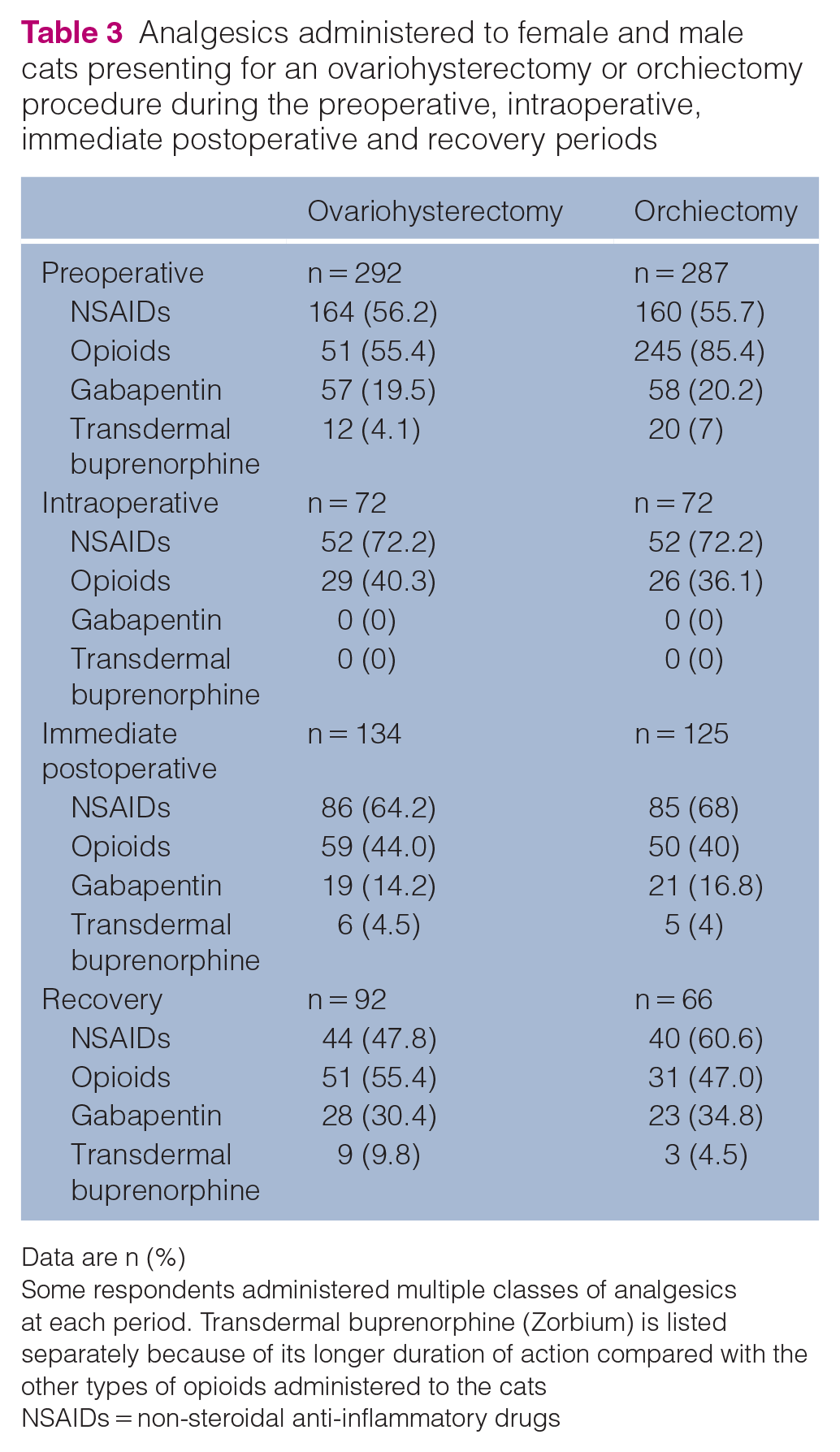
Data are n (%)
Some respondents administered multiple classes of analgesics at each period. Transdermal buprenorphine (Zorbium) is listed separately because of its longer duration of action compared with the other types of opioids administered to the cats
NSAIDs = non-steroidal anti-inflammatory drugs
Female cats were significantly more likely to be prescribed analgesics for use at home (80.5%) compared with male cats (54.9%) (P <0.001) (Table 4). After OVHs and orchiectomies, cats were most frequently discharged with NSAIDs followed by gabapentin and then opioids. A total of 11 female cats received transdermal buprenorphine (Zorbium) while male cats did not. Female cats were more likely to be prescribed analgesics for use at home for a longer duration of time (P <0.001) compared with male cats. More female cats received analgesics for 4–7 days vs male cats (Table 4).
Summary of the provision of analgesics for home use, type of analgesics prescribed and duration of use of analgesics at home for female and male cats presenting for an ovariohysterectomy or orchiectomy procedure
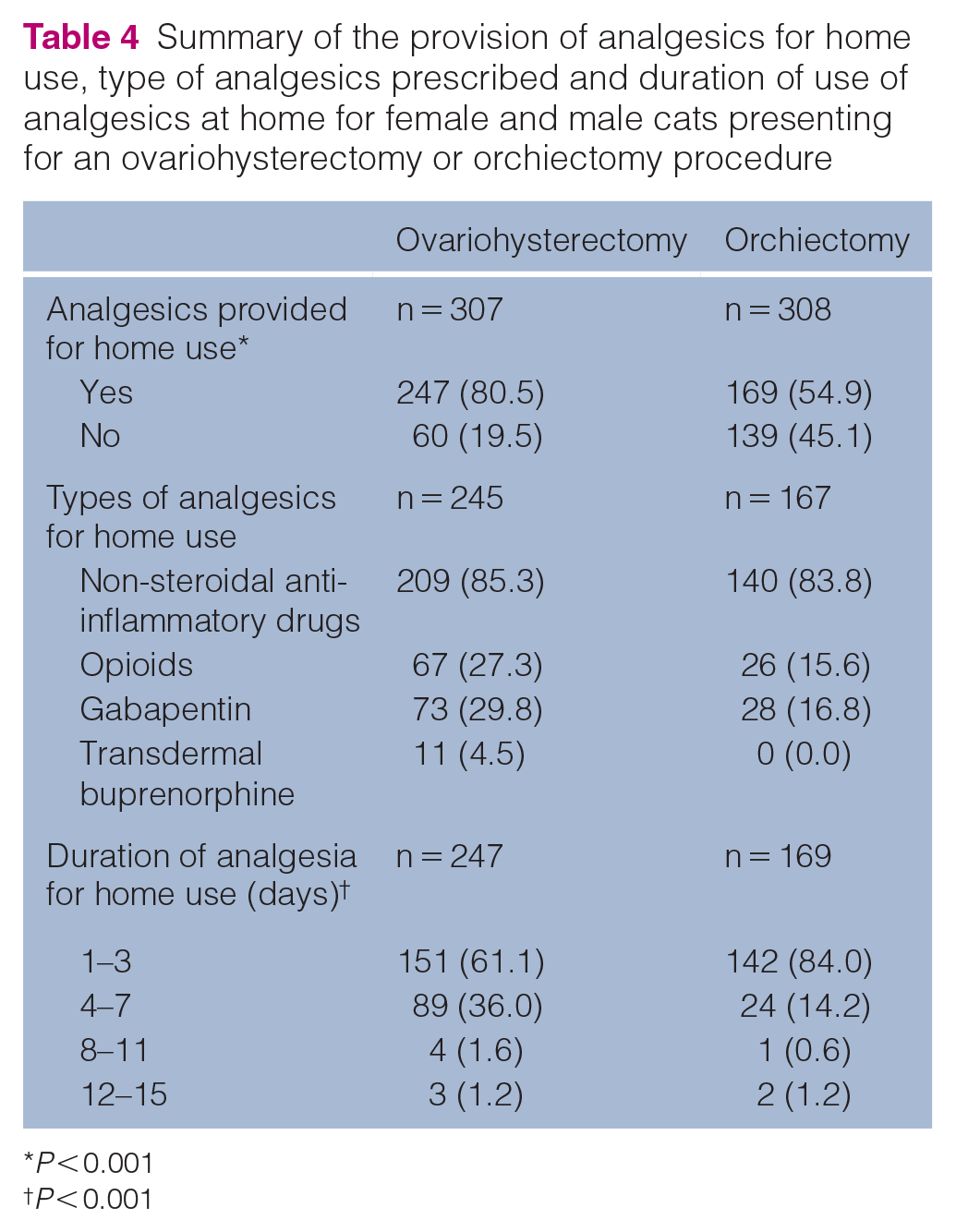
P < 0.001
P < 0.001
Of the 364 respondents, three (0.8%) and six (1.6%) stated that female cats and male cats, respectively, did not receive any postoperative analgesics either in the hospital or at home.
This study found that owner education regarding the use of objective pain scales was limited, with only 27/306 (8.8%) respondents stating that owners were educated on the use of objective pain scales to assess pain in their cat at home. Of these 27 respondents, 21 recommended the following pain scales: the Feline Grimace Scale was used most often, by eight (38.1%) respondents, followed by the Colorado State University feline pain scale, used by seven (33.3%) respondents and the Glasgow Pain Scale, used by five (23.8%) respondents. The other six respondents did not report the scale they used. The majority (n = 276/306, 91.2%) of respondents did not offer education on objective pain scoring systems to owners. Of the 276 respondents, 210 (76.1%) provided owners with subjective means to assess pain in their cats, such as vocal or behavioral pain cues, whereas 66 (23.9%) did not offer any information.
When asked about implementing objective pain scales in their practice, most respondents were unsure, followed closely by those in favor. Only 9% of respondents indicated they would not use an objective pain scoring system in their veterinary practice (Table 5).
Licensed veterinarians and veterinary technicians (n = 267) interested in implementing an objective pain scoring system at their veterinary practice

Discussion
This study found that only 20.5% of respondents utilized an objective pain scoring system preoperatively, 23% used one within 3 h postoperatively and 14.2% used one before discharge. The identification of pain is inherently a challenge due to cats’ ability to hide or display subtle signs of pain. 4 The limited use of objective pain scales, especially within 3 h postoperatively, is alarming. This is the period in which the effects of preoperative opioids may be wearing off and the cats are able to perceive painful stimuli as they are no longer under anesthesia. Prompt identification and management of pain during this period are essential to ensure the cat’s well-being and support a smoother recovery. Although several validated and objective pain scales are available, their use in clinical practice remains low. These findings were similar to those of a Canadian study that reported only 10% utilization of objective pain scales postoperatively. 13 In contrast, a study from the USA found that 50% of 147 veterinary practices assessed pain in small animals; 7 however, this figure includes both objective and subjective scoring systems, likely explaining the higher reported rate. 7 The findings of the current study are significant given the potential negative impact that unmanaged pain can have on recovery quality and welfare. The relevance of these findings is supported by information from a review article that commented on the association between inadequate pain control, longer hospitalization times and poorer clinical outcomes. 14
Pain management for cats undergoing OVHs and orchiectomies was generally similar, with opioids and NSAIDs being the most commonly administered analgesics. However, female cats were more likely to receive additional analgesia during the recovery period compared with male cats. These findings align with a previous study that recommended a multimodal approach to pain management and suggested that cats undergoing OVH are more likely to require additional analgesics postoperatively compared with those undergoing orchiectomy. 15 It is important to note that cats in that study were assessed for pain postoperatively. 15
The current study also examined the use of local anesthetics and found that intratesticular blocks were more commonly employed than line blocks for OVHs. The authors presume that this analgesic technique was performed more frequently in orchiectomies compared with OVHs, given that male cats received fewer postoperative analgesics than female cats. Previous studies have shown that local anesthetics administered during OVHs and orchiectomies provide effective analgesia and reduce the need for additional anesthetics.16,17 The combination of local anesthetics and systemic analgesics has been shown to lower the minimum alveolar concentration requirements of inhalants, reduce drug dosages and decrease postoperative pain, providing additional benefits for the cat. 18 Although it is possible to monitor responses to surgical stimulation to assess block effectiveness under anesthesia, determining its effectiveness postoperatively may be challenging without the use of objective pain scales, both for veterinary professionals and for pet owners unless they are properly trained.
Cats were found to be more likely to be discharged with analgesics – and for a longer duration – after an OVH compared with an orchiectomy. A previous study found that female cats are more likely to need rescue analgesia after an OVH than male cats after an orchiectomy. 15 In that study, the authors reported that the procedures were performed rapidly by an experienced surgeon, and that pain scoring was conducted multiple times postoperatively. They recommended that pain assessments be performed within at least 2 h after an OVH; however, no guidance was given regarding pain scoring frequency after an orchiectomy. 15 In the present study, most respondents stated that pain scoring was not performed during the cats’ hospital stay, missing key opportunities to identify and manage pain. In addition, the ability to subjectively determine if cats are in pain can be challenging, as they have often display subtle signs that are easily overlooked. This may result in heightened sensitivity to both painful and non-painful stimuli. 4
Only 8.8% of respondents reported educating owners on the use of objective pain scales at home. This is an important finding, as previous research has highlighted the critical role of owner education in accurately identifying pain in the home environment. 19 Although 76.1% of respondents stated they educate owners on recognizing subjective pain cues, this approach may be less reliable. According to the 2022 ISFM Management of Acute Pain task force, subjective assessments are likely to be less precise than objective pain scales and may result in inconsistent or incomplete detection of pain in their pets. 20
Interestingly, our data showed that 41.1% of respondents expressed interest in implementing objective pain scales in their practice, suggesting a growing awareness of the value these tools can provide. However, 49.4% of respondents were unsure about using an objective pain scale. The reasons behind this uncertainty and lack of use were beyond the scope of this study. That said, a previous study reported that veterinary professionals found pain scales time-consuming to learn and apply, and considered them unreliable. 7
The present study has some limitations. The low response rate may limit the generalizability of the findings to the broader population of veterinary professionals and could have introduced bias, as those who chose to participate may have had a greater interest in pain management. In addition, the use of self-reported data introduces the possibility of recall bias or inaccuracies in responses. Finally, the study focused solely on practices in Ohio, which may not reflect practices in other geographic regions.
Conclusions
The findings of this study offer insights into current pain management practices for feline patients undergoing OVHs and orchiectomies. Despite the critical importance of effective pain management in veterinary practice, the results highlight notable gaps in the use of objective pain scoring systems. Future research should explore the barriers to implementing these systems and investigate the long-term effects of improved pain management on feline welfare.
Footnotes
Conflict of interest
The authors declared no potential conflicts of interest with respect to the research, authorship, and/or publication of this article.
Funding
The authors received no financial support for the research, authorship, and/or publication of this article.
Ethical approval
This work did not involve the use of animals and therefore ethical approval was not specifically required for publication in JFMS.
Informed consent
This work did not involve the use of animals (including cadavers) and therefore informed consent was not required. No animals or people are identifiable within this publication, and therefore additional informed consent for publication was not required.
