



Abstract
Objectives
The aim of the present study was to systematically compile and analyze the available evidence from studies that have explored factors associated with feline chronic gingivostomatitis (FCGS).
Methods
An electronic search was conducted using four databases (OVID/MEDLINE, PubMed, SciELO, Redalyc), as well as proceedings from the European Veterinary Dentistry Forum and the Veterinary Dental Forum, when available. The inclusion and exclusion criteria were predetermined and maintained throughout the systematic process, focusing exclusively on articles published in peer-reviewed journals.
Results
A total of 17 articles met the definitive inclusion criteria. All were published in English, in 11 journals, and between 1984 and 2023. The relevant articles reported a global frequency of FCGS of 10.9% (747/6881 cats). Six studies reported the exploration of factors inherent to the cat (eg, age, sex, reproductive status), two reported the exploration of factors related to the cats’ environment, feeding and management (eg, type of confinement, number of cats in the household, vaccination status) and 15 reported the exploration of factors related to infectious agents (eg, feline calicivirus [FCV], feline leukemia virus [FeLV], feline herpesvirus type 1 [FHV-1], Bartonella species, Pasteurella multocida subspecies multocida) and microbiome profiling.
Conclusions and relevance
Although the specific etiology of FCGS remains unknown, factors involved in the disease suggest that oral microbiome dysbiosis and the presence of infectious agents such as Fusobacterium nucleatum, Porphyromonas species and P multocida, as well as FCV and FHV-1, play crucial roles in its pathogenesis. In addition, factors involving the cat’s immune status, including coinfection with feline immunodeficiency virus and FeLV, have been associated with an increased risk of developing FCGS. Microbial dysbiosis and the alteration of local and systemic immune responses emerge as key elements that perpetuate chronic inflammation. Furthermore, the relationship with non-infectious factors must be considered to understand the complex origin of the disease.
Keywords
Introduction
Feline chronic gingivostomatitis (FCGS) is a disease that affects the oral mucosa of cats. A cat with this condition develops widespread inflammatory lesions in the oral cavity, including the folds surrounding the palatoglossus. Two clinical phenotypes of FCGS have been identified: ulcerative and proliferative, and some cats may present with both clinical manifestations simultaneously. These lesions are associated with decreased or absent appetite, lack of grooming, reduced or absent socialization, and weight loss. A lack of resources or insufficient response to treatment often leads to the euthanasia of cats with FCGS. 1
Dental pathologies are common in cats and can significantly impact their health and wellbeing as they can experience dental and orofacial pain similar to humans. 2 Cats’ teeth are highly innervated, supplied by branches of the maxillary and mandibular nerves. 3 Detecting pain in cats presents a unique challenge, as behavioral changes are often subtle. Physiological signs of acute pain include activation of the sympathoadrenal system, which can manifest as increased blood pressure, elevated heart rate and peripheral vasoconstriction, evidenced by pale mucous membranes and sometimes a stress leukogram. Many cats tend to hide when in pain, may squint their eyes, refuse to move or change position, and although vocalization is uncommon, some cats may display protective behaviors over the affected area, such as licking or chewing at the site of pain. However, none of these signs is specific to pain, and although scales adapted from human medicine to veterinary medicine are available, no single reliable and objective measure of pain exists. Few correlations have been documented between subjective impressions and actual laboratory indices of pain-induced stress in cats. 4 In addition, owing to their nature as both prey and predator, cats often do not show obvious signs of pain or discomfort associated with dental diseases. 2
FCGS is a complex disease with an unknown etiology. Although multiple causes have been attributed, ranging from infectious to environmental, none has been definitively proven. This contributes to the confusion among veterinarians regarding timely diagnosis and treatment, which in turn exposes cat owners to high monetary costs without necessarily resolving the issue. 5
Despite affecting up to 26% of domestic cats, 6 because of the lack of established causality for the disease, there are few studies related to risk factors for the presentation of FCGS. 7 Therefore, we aimed to systematically compile and analyze the available evidence from studies that have explored factors associated with this important disease.
Materials and methods
This systematic review (SR) was planned, conducted and reported in compliance with the PRISMA guidelines. 8 The study question, method of conducting the literature search, study inclusion/exclusion criteria and checklists for conducting relevance screening, baseline characterization, methodological assessment and data extraction of relevant primary research were all developed according to an established and pretested SR protocol.
Search strategy
Our specific research question was: What are the factors associated with or related to FCGS in cats? Therefore, relevant studies needed to be identified and assessed. The initial search took place on 6 February 2024.
Four databases (OVID/MEDLINE, PubMed, SciELO, Redalyc) were searched. The topic was divided into components and the following search terms were used to find relevant studies on the platforms: (‘risk factors’ OR ‘risk factor’ OR ‘factor associated’ OR ‘associated factor’ OR ‘factor involved’ OR ‘involved factor’ OR ‘related factor’ OR ‘factor related’) AND (‘chronic gingivostomatitis’ OR gingivitis OR estomatitis OR stomatitis OR ‘GECF’ OR ‘FCGS’ OR ‘oral ulcer’) AND (feline* OR cat OR cats OR kitt=).
Eligibility screening
The inclusion criteria solely encompassed original articles published in peer-reviewed journals and written in English, Portuguese, French or Spanish. Neither the publication year nor the country of origin were restrictive factors.
The initial citation selection process, conducted by two of the authors, relied on information provided in the titles. Citations were chosen based on their potential relevance to the study topic. Subsequently, two authors screened the list of acceptable citations using their abstracts while adhering to the inclusion and exclusion criteria established during the title screening phase. After this, two authors thoroughly examined the full text of the remaining citations to ensure they contained pertinent data to address the research question. Kappa coefficients were calculated for each of the three selection stages to estimate agreement. The materials, methods and results sections of each full text were scrutinized. Any conflicts were resolved through consensus among the authors.
The proceedings of the European Veterinary Dental Forum, spanning 1992–2024, when accessible on its website (https://evdf.org/), and the Veterinary Dental Forum, from 2004–2023 (https://www.veterinarydentalforum.org/), were manually examined for any published primary studies. In addition, as a final step, two authors manually searched the references cited in the pertinent articles identified during the full-text screening, a process commonly referred to as snowballing, to uncover additional published sources.
Data extraction
After the compilation of all relevant publications, a descriptive summary was provided that considered the information (when available) on the country of the study, population (n/features), cats with FCGS (n, age [in years], breed), explored factors and P value, prevalence/frequency of FCGS and the case definition.
Results
The electronic search, combining results from all search engines and after removal of duplicated studies, yielded 108 eligible citations possibly associated with the subject of this SR. The citations to be reviewed were published between 1984 and 2023. After reading the titles, 80 were considered unrelated (agreed by two authors). The final number of citations by title screening was 28 (retained by at least one author). After reading the abstracts of the articles, seven were excluded (by both authors) and 21 original articles remained for the full-text review. The full text of 15 articles was completely reviewed and kept for data extraction, after excluding six articles at this stage. The snowballing strategy was then applied through the reference lists of the 15 definitive articles and three citations were retained after title screening. After the abstract screening, the same three citations were retained. The final selection of articles from the snowballing method consisted of two results. In total, 17 articles met the eligibility criteria and were included in the qualitative synthesis. Figure 1 describes the SR protocol and the selection of relevant articles.
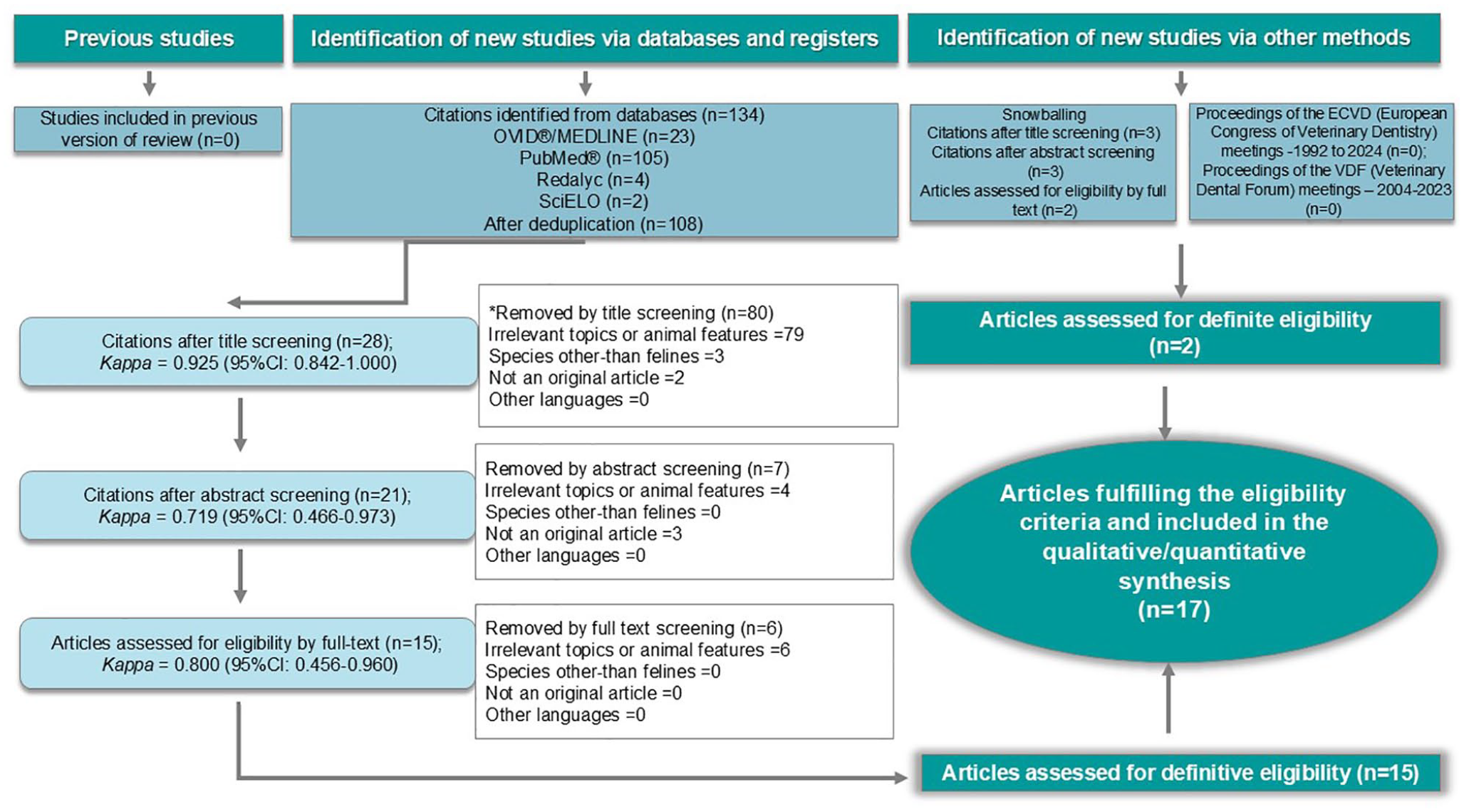
Preferred Reporting Items for Systematic Reviews and Meta-analyses (PRISMA) flow chart, 8 describing the progress of the citations through the systematic review. *Some titles’ content met more than one exclusion criteria
All the articles were written in English; they were published in 11 journals between 1984 and 2023. Most of the studies originated from the USA (10/17) followed by Spain (2/17) and Australia, the UK, South Korea, Japan and Brazil (1/17 each).
The 17 relevant articles reported a global FCGS frequency of 10.9% (747/6881 cats). According to the most detailed definition of the disease available, 9 the case definition for a cat diagnosed with FCGS considers five points: (1) inflammation of the mucous membranes of the oral cavity, which includes at least one of the following five areas: periodontal area, gingival mucosa, buccal mucosa, palatoglossal folds, soft palate and pharynx; (2) when present, gingivitis usually extends beyond the mucogingival junction; (3) the severity of the inflammation is worse than what would be expected in the context of visible dental disease; (4) the affected areas are often edematous, proliferative or ulcerated; and (5) the inflamed areas are usually bright red and often bleed spontaneously with very mild trauma (eg, rubbing of the gum).
Six studies reported the exploration of factors inherent to the cat (eg, age, sex, reproductive status).7,10 –14 Two studies reported the exploration of factors related to the environment, feeding and management (eg, type of confinement, number of cats in the household, vaccination status).7,10 A total of 15 studies reported the exploration of factors related to infectious agents (eg, feline calicivirus [FCV], feline leukemia virus [FeLV], feline herpesvirus type 1 [FHV-1], Bartonella species, Pasteurella multocida subspecies multocida) and microbiome profiling.10 –13,15 –25 Detailed information extracted from the articles included in this SR is presented in Table 1.
Systematic review research question-related findings obtained from the 17 relevant articles (chronologically and alphabetically)

P ⩽0.05
With periodontal disease
Age was known for 291 cats
Included 40 cats with FORL
Included 11 cats with FORL or periodontitis
FCGS = feline chronic gingivostomatitis; FCV = feline calicivirus; FeLV = feline leukemia virus; FHV-1 = feline herpesvirus type 1; FIV = feline immunodeficiency virus; FORL = feline odontoclastic resorptive lesion; NGS = next generation sequencing; NR = not reported
Discussion
This SR describes the current literature on factors associated with FCGS, a disease with an unknown etiology. Exploring such factors will provide starting points for future research aimed at understanding the origin of the disease. The review retrieved 17 studies published between 1984 and 2023 where infectious and non-infectious factors were identified, highlighting those that were statistically significant but without neglecting those that were not, given their biological relevance to the disease. In addition, we aimed to identify knowledge gaps and opportunities for future research.
FCGS has been attributed to several conditions and infectious agents without proof of causation. This review found several key concepts within the literature. Regarding factors inherent to the cat, previous studies have reported significant associations between FCGS and sex and breed, 10 age10 –12 and weight. 7 However, a recent study (conducted after our primary search date) reported no association of these factors with the disease, based on a sample of 3109 medical records of domestic cats. 31
A second concept explored in the literature related to environmental, feeding and management factors. It has been reported that cats sharing a home with more than one other cat are more likely to develop FCGS. 10 Similarly, cats with outdoor access or those living with other cats that have outdoor access are at higher risk.7,10 Vaccination status has also been suggested as a factor, with unvaccinated cats or those with incomplete vaccination schedules potentially at greater risk of developing the disease.10,32 This may underscore the need for research aimed at fully understanding how vaccines influence the oral microbiota and immune system of cats and how these interactions can be optimized to prevent or mitigate the disease.
A third approach explored in the literature is the association between infectious agents and FCGS. This has been the subject of multiple studies, revealing a complex and multifactorial relationship. Recent studies have identified a range of bacterial, viral and, to a lesser extent, fungal pathogens that could play a crucial role in the pathogenesis of the disease. FCV has been associated with FCGS in studies using microbiological cultures11,17,22 and genomic sequencing. 24 The association of Bartonella species with the disease has been controversial. Sykes et al 18 found a significant association between Bartonella species infection and FCGS through isolation (culture), although in the absence of seropositivity. Other agents explored, such as FHV-1 16 and feline immunodeficiency virus (FIV), 20 not only contribute to local inflammation but also interact with the host’s immune system, exacerbating the inflammatory response.
The exploration of the microbiome using genetic sequencing techniques has enabled a detailed characterization of the oral microbiome in healthy cats vs cats with FCGS, demonstrating greater diversity in those animals with the disease. 13 In addition, other agents such as P multocida subspecies multocida have been related to FCGS. 19 This highlights a significant alteration in the microbial composition compared with healthy cats, with a decrease in bacterial diversity and a proliferation of these pathogenic species. These results suggest dysbiosis, which can trigger and perpetuate chronic inflammation. Such findings support the hypothesis that alteration of the oral microbiome is a key factor in the development and progression of FCGS, acting not only as a conducive environment for pathogen colonization but also modulating the local immune response.
Tongue lesions have been associated with FCGS. 14 These lesions can present as ulcers, erosions or areas of severe inflammation and are common findings in cats diagnosed with the disease. Tongue lesions indicate an exacerbated systemic and local inflammatory response, and their relevance is related to the fact that they can increase the cat’s discomfort, affecting its ability to eat and drink, which in turn can result in its nutritional and overall health status deteriorating.
This SR revealed several knowledge gaps in the literature worthy of further research. First, the association of FCGS with inherent factors such as the sex, age, breed and reproductive status of the cat is unclear, partly because some of the studies found in the review were not specifically designed to understand the disease. Second, although an association with FCV has been demonstrated, the causality and exact mechanisms of how this virus contributes to FCGS need to be elucidated. Research on bacterial infections and their potential interaction with viruses is also essential. Third, the influence of environmental factors, such as stress and diet, on the development of the disease is relatively unknown. Studies are needed to examine how these factors may alter the immune response and contribute to oral inflammation.
Our SR offers several advantages. We followed a formal procedure based on a well-defined research topic, previously reported and approved by experts in health-related SRs. To identify potential studies, we conducted a thorough literature search across numerous databases and sources, including general-purpose databases, search engines, journals and conference proceedings, capturing information dating back to 1984. We imposed no geographic or chronological restrictions, minimizing the risk of bias. In addition, the information extracted from the initial searches was meticulously defined. One author created a matrix of findings, which was then reviewed by a second author to ensure consistency, considering the variation in quality and techniques among the relevant studies. As limitations, one relevant document identified through abstract filtering was not obtained 32 and we did not fully consider the gray literature. To mitigate this, we employed snowballing techniques.
Conclusions
This SR has explored existing research on the factors associated with the occurrence of FCGS, analyzing various studies and concluding that it is likely to be a multifactorial disease, since after the review of relevant articles, its etiology is still unknown. There is no single factor that causes FCGS; rather, its development is influenced by a complex interaction of predisposing, triggering and perpetuating factors. Oral microbiome dysbiosis and the presence of infectious agents such as Fusobacterium nucleatum, Porphyromonas species and P multocida, as well as FCV and FHV-1, appear to play crucial roles in the pathogenesis of the disease. In addition, factors such as the cat’s immune status, including coinfection with FIV and FeLV, are associated with an increased risk of developing FCGS. Microbial dysbiosis and the alteration of local and systemic immune responses emerge as key elements that perpetuate chronic inflammation. Furthermore, the relationship with non-infectious factors must be considered to understand the complex origin of the disease. These factors include health status, cohabitation with other cats, environmental stress, type of diet and comorbidities that can compromise or worsen the clinical signs of FCGS. Non-infectious factors, together with pathogens, create a complex environment that requires comprehensive evaluation and management to effectively address the disease in affected cats. Further investigation is required to comprehensively grasp the elements linked to the development of FCGS. This includes delving into novel stress triggers specific to domestic cats, particularly in comparison with canine care practices. There is also a need to examine other potential influences, including the protein composition of feline diets. Ultimately, a more thorough understanding of these various aspects will contribute to our knowledge of FCGS and its underlying causes.
Footnotes
Author note
A file showing the systematic process of collection and selection of citations is available upon request to the corresponding author.
Conflict of interest
The authors declared no potential conflicts of interest with respect to the research, authorship, and/or publication of this article.
Funding
The authors received no financial support for the research, authorship, and/or publication of this article.
Ethical approval
This work did not involve the use of animals and therefore ethical approval was not specifically required for publication in JFMS.
Informed consent
This work did not involve the use of animals (including cadavers) and therefore informed consent was not required. No animals or people are identifiable within this publication, and therefore additional informed consent for publication was not required.
