




Abstract
Objectives
The aim of this study was to evaluate the inter- and intra-observer reliability of quantitative sensory testing performed with the SMall animal ALGOmeter (SMALGO) in healthy cats and in cats with chronic gingivostomatitis (CGS), and to evaluate the SMALGO as a tool to detect and quantify pain in cats with CGS.
Methods
Thirty cats from a private shelter were included and assigned to one of two groups: group C (healthy cats; n = 15) or group CGS (cats with CGS; n = 15). In all cats the mechanical thresholds were measured with the SMALGO, with the sensor tip applied to the superior lip above the canine root, by two independent investigators (A, experienced; B, unexperienced), on two different occasions (day 1 and day 2) with a 24 h interval. A CGS scale was used in the diseased cats to assess the severity of the condition. For the reliability analysis, intra-class correlation coefficients (ICCs) were calculated. Other statistical tests used were Pearson correlation coefficient and a paired t-test.
Results
The inter- and intra-observer levels of agreement were fair (ICC = 0.50) and good, respectively (ICC = 0.73 for investigator A; ICC = 0.60 for investigator B). However, the thresholds measured in healthy cats (169 ± 59 g) did not differ from those obtained from diseased cats (156 ± 82 g; P = 0.35). There was no correlation between the scores of the CGS scale and the thresholds measured in diseased cats (Pearson correlation coefficient = 0.047; P = 0.87).
Conclusions and relevance
Quantitative sensory testing performed with the SMALGO in cats is repeatable and reliable, regardless of the expertise of the investigator. However, the findings of this study suggest that the mechanical thresholds measured with the SMALGO may not be a valuable indicator of pain in cats with CGS.
Keywords
Introduction
Feline chronic gingivostomatitis (CGS) is a severe inflammatory disease of the oral cavity that can affect cats of every age. It is different from gingivitis in that inflammation extends not only to the mucogingival junction, but also to the oral mucosa. 1
The condition may involve different areas such as the gingiva, alveolar mucosa, fauces, pharynx, tongue, palate, and labiobuccal and caudal oral mucosa. 2 It is characterised by: painful, swollen, ulcerated or bleeding gums; hypersalivation; halitosis; anorexia; dysphagia; weight loss; and enlarged submandibular lymph nodes. It can severely affect the quality of life of affected cats, as well as their behaviour.3,4 The prevalence of the disease is high, seen in 0.7–12% of the cats in the USA. 1 Although the exact aetiology of feline CGS is still unknown, it is widely recognised that many factors, namely environmental factors, dental disease, various bacterial and viral infections, immune response and stress, contribute to its development.3–5
Cats with CGS are likely to experience pain. Unfortunately, pain can easily go underdiagnosed in feline patients, and quantifying pain in cats can be extraordinarily challenging, even for the most experienced veterinarian.6,7 The scales currently available to evaluate pain in cats have been developed to assess acute surgical pain, and may not be adequate to evaluate chronic, non-surgical conditions.8,9 Therefore, there is a need for valid and reliable methods to detect and measure chronic pain in cats.
Quantitative sensory testing (QST) is a semi-quantitative method to assess dysfunctions of the sensory system, and the use of mechanical thresholds has also been described in cats to evaluate chronic pain.10–15 Various pressure algometers have been designed for use in animals within the past two decades, of which two are specific for cats.11,12
The SMall animal ALGOmeter (SMALGO; Bioseb) is a pressure-based algometer designed to measure allodynia and hyperalgesia in laboratory rodents. 16 The device has also been used to evaluate chronic and neuropathic pain in small animals, 17 and to perform QST in dogs with osteoarthritis. 18 The first reports in small-sized companion animals seem to suggest that the SMALGO may be a useful tool to measure various types of pain in clinical feline patients. 14
If the measurement of mechanical thresholds with the SMALGO could be proven to be an effective tool for the assessment of CGS-associated pain, this finding may potentially represent a step forward in the recognition and management of feline chronic pain.
The primary objectives of this study were therefore: (1) to evaluate inter- and intra-observer reliability of QST performed with the SMALGO in healthy cats and in cats with CGS; and (2) to determine whether the SMALGO is a useful tool to differentiate, on the basis of the mechanical sensory thresholds, between healthy cats and cats with CGS.
A secondary objective of this study was to determine whether there was any association between the mechanical thresholds measured with the SMALGO and the scores of a CGS scale, developed by the authors based on previous publications,19,20 to evaluate the severity of the clinical condition in cats.
We hypothesised that the SMALGO would provide reliable and repeatable measurements of the sensory thresholds, regardless of the level of expertise of the investigator, and that the thresholds measured in cats with CGS would be lower than those obtained in healthy cats.
Materials and methods
Ethical approval
The study was conducted with the permission of the Clinical Research Ethical Review Board of the Royal Veterinary College (license number: URN 2017 1709-3). Written informed consent was obtained by the owner of the cat shelter prior to commencing the trial.
Animals and determination of sample size
Thirty rescue cats from a private cat shelter (Associazione di Promozione Sociale Amici di Poldo, Udine, Italy) were enrolled in this study.
Based on medical history and physical examination, performed by the veterinarian in charge of routine medical procedures in the shelter, the cats were assigned to one of two groups: group CGS (cats with CGS) or group C (control: healthy cats). Each group was comprised of 15 cats. Exclusion criteria were the presence of other systemic disease or condition other than CGS potentially associated with pain, recent admission to the shelter that would have resulted in limited medical history, administration of analgesics or other medication that could potentially have influenced the assessments, and fractious behaviour. All cats included in the study were comfortable with the presence of humans and were used to being handled.
Sample size was based on a calculation performed with a program available online (https://www.stat.ubc.ca), with the following setting of variables: mean mechanical threshold of cats in group CGS was 100 g; mean mechanical threshold of cats in group C was 150 g (50% more than diseased cats); SD was 50 g; alpha (α) value was 0.05; and power was 0.80. This resulted in 13 cats being the minimum number required for inclusion, similarly to previous studies that evaluated the use of QST in dogs with osteoarthritis, in which the sample size was calculated based on pilot data. 18
Diagnosis of CGS
Besides the physical examination and detailed revision of the medical history, a scale developed by the authors was used to discriminate between healthy and diseased cats, to confirm group assignment and to quantify the severity of the clinical condition (CGS scale; Table 1). This scale was derived from two previously published scoring systems, adjusted to match the specific research setting and combined: the Feline Chronic Gingivostomatitis Veterinary Surgeon’s Questionnaire and the scale developed by Lommer to evaluate the degree of buccal inflammation in cats with chronic stomatitis.19,20 Some descriptors of both scales that were considered unfeasible by the investigators for use in the non-sedated cats, for example the stomatitis index of the original Lommer scale, were excluded. The total CGS scale score used in the current study ranged from 0 to 24. One of the investigators (HM) completed the scale with the help of the shelter volunteers, who fed and handled the cats routinely.

Total score 0–24
Measurements
The measurements were carried out in an area of the shelter the cats were familiar with, and where they normally spent most of their time (ie, free to roam). An acclimatisation period of 15 mins was allowed before the beginning of the trial so that the cats could get used to the presence of the investigators. Additionally, one of the shelter volunteers with whom the cats were very familiar was present during each measurement, in order to try to minimise stress related to handling.
During the acclimatisation, the SMALGO was prepared and checked for accuracy as follows: the sensitive probe was equipped with the 3 mm tip and the unit selected (g). Thereafter, the control unit was zeroed and the key ‘max’ pressed, to enable the algometer to store the maximum force value recorded during the measurement.
During the measurements, the cats were allowed to choose the most comfortable position for them (either sitting or standing), and were minimally restrained in order to minimise stress. The SMALGO’s sensor tip was applied on the right superior lip, at a level right above the canine root, of each cat, with a steadily increasing force until a positive behavioural response was elicited; at that point, the sensor tip was removed and the last force measured was recorded as the threshold. In this study, vocalisation, head withdrawal/turning, hissing or growling, attempt to escape and/or aggression/attempt to bite were defined as positive behavioural responses. In each cat, the measurements were carried out by two investigators with different levels of expertise in pain assessment: a resident in veterinary anaesthesia and analgesia (HM) and a medical student with no previous experience in pain evaluation in animals (SP).
For each cat, the investigator who started the measurements was chosen randomly by flipping a coin. Each investigator obtained three threshold values from every cat included in the study; a minimal interval of 30 s was allowed between subsequent measurements carried out by the same investigator, in order to avoid temporal summation. 21 The means of the three measured values were used for statistical analysis. A 1 h break was allowed before the second investigator started recording measurements in the same cat. The entire trial was repeated after 24 h, with an inverted order of the investigators compared with the previous day.
Statistical analysis
Data were analysed with commercially available software (IBM SPSS Statistics 24; and SigmaPlot 10 and SigmaStat 3.5 [SYSTAT Software]). P values <0.05 were considered statistically significant.
Data distribution was analysed with the Shapiro–Wilk test. Paired t-test was used to assess normality of the data.
Intra- and inter-observer reliability were assessed by calculating the intra-class correlation coefficient (ICC), with a two-way mixed Cronbach’s alpha model and 95% confidence intervals (CI; upper and lower bounds); the type of agreement selected was absolute agreement. The level of agreement (both inter- and intra-observer) was scored as follows: ICC <0.40 = poor; ICC 0.40–0.59 = fair; ICC 0.60–0.74 = good; ICC 0.75–1 = excellent. 22
A paired t-test was used to compare the thresholds measured in the two groups of cats (healthy vs diseased). Pearson’s correlation coefficient was calculated to identify any correlation between the mechanical sensory thresholds measured with the SMALGO and the scores of the CGS scale.
Results
Data are presented as either mean ± SD or median (range), depending on data distribution.
Thirty cats, of which 14 were spayed females and 16 were castrated males, completed the trial. Their estimated age ranged from 1 to 18 years and their body weight was 4 kg (3–5 kg). Of the 15 cats with CGS, six were both feline leukaemia virus and feline immunodeficiency virus positive.
The mechanical sensory thresholds were normally distributed when each set of measurements was analysed separately; however, data distribution was not normal when all values were pulled together. The CGS score obtained from the diseased cats was 7 (3–12).
Inter-observer reliability was fair (ICC = 0.50), whereas intra-observer reliability was good for both investigators A (HM; ICC = 0.73) and B (SP; ICC = 0.60). The details of reliability analysis are presented in Table 2. Data pertaining to sensory thresholds measured by the two investigators on days 1 and 2 are shown in Figure 1.
Details of inter-observer (investigator A vs investigator B) and intra-observer (day 1 vs day 2 for investigators A and B) reliability analysis of the SMall animal ALGOmeter (SMALGO), used to detect and quantify pain associated with chronic gingivostomatitis in cats

ICC = intra-class correlation coefficient; CI = confidence interval; Alpha = Cronbach’s alpha
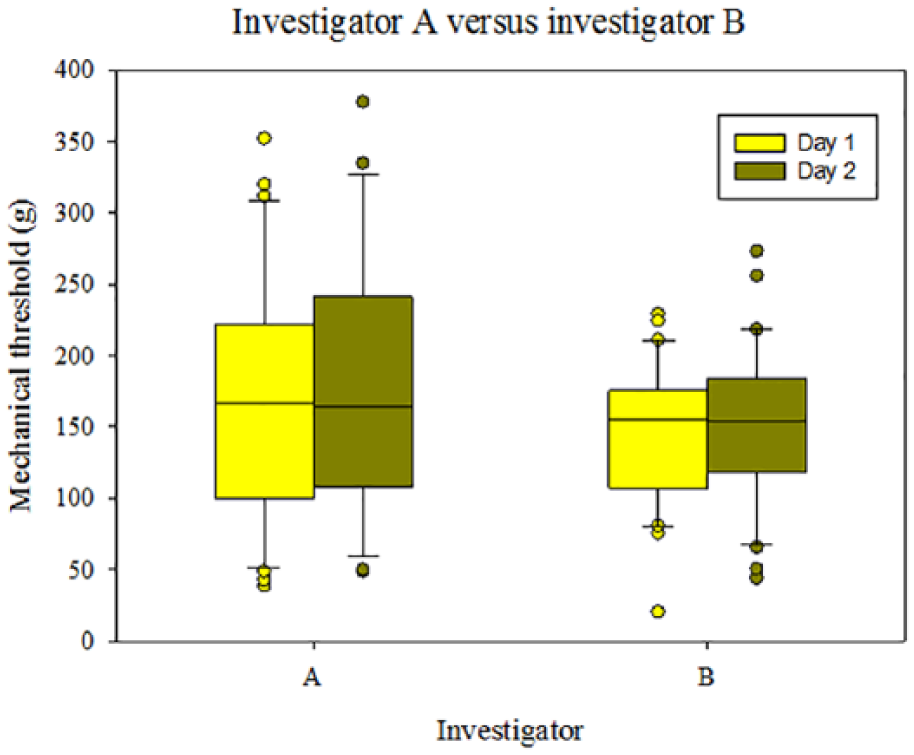
Mechanical sensory thresholds (g) measured with the SMall animal ALGOmeter by two independent investigators (investigator A and investigator B) in 30 shelter cats. Each investigator performed the measurement twice, with a 24 h interval between the two measuring sessions. The boxes represent the second and third quartiles, with the horizontal line inside the boxes indicating the median value. The lower (25%) and upper (75%) quartiles are shown as horizontal lines either side of each box. The circles represent the outliers
There was no statistically significant difference between the thresholds measured in the cats with CGS (156 ± 82 g) and those measured in healthy cats (169 ± 59 g; P = 0.35; Figure 2). There was no statistically significant correlation between the scores of the CGS scale and the mechanical thresholds measured with the SMALGO in the group of cats with CGS (Pearson’s correlation coefficient: 0.047; P = 0.87).

Mechanical sensory thresholds (g) measured with the SMall animal ALGOmeter in 30 shelter cats, of which 15 had chronic gingivostomatitis (group CGS) and the remaining 15 were healthy (group C; control). The boxes represent the second and third quartiles, with the horizontal line inside the boxes indicating the median value. The lower (25%) and upper (75%) quartiles are shown as horizontal lines either side of each box. The circles represent the outliers
Discussion
The main finding of this study is that the SMALGO is a reliable tool to measure mechanical thresholds in cats, regardless of the expertise of the investigator and repetition of the measurements. However, as demonstrated by a lack of difference in thresholds between healthy and diseased cats, the QST performed with the SMALGO failed to detect and quantify pain in cats with CGS.
There may be various reasons for this outcome. The number of animals used in this study may be too small, the application site of the sensor tip may not be the most appropriate to detect chronic pain associated with gingivostomatitis, the mechanical thresholds may not decrease in cats with gingivostomatitis or, alternatively, the SMALGO may not be sensitive enough to differentiate between buccal pain and normal sensory response.
The sample size was determined based on the assumption that healthy cats would have thresholds of about 150 g, and that in cats with gingivostomatitis this value may increase by approximately 50 g. The data obtained from the study cats suggest that such differences in thresholds may be much smaller than expected, as indicated by the similar threshold values recorded in the two groups of cats. This suggests that a larger sample size may be needed to differentiate between healthy cats and cats with gingivostomatitis by means of QST.
Regarding the application site for the sensor probe, this could also carry a risk of bias. A previous study that investigated the use of algometers other than the SMALGO in healthy cats concluded that the sensor probe applied at the mouth carries the potential for misinterpretation of the results, owing to the discomfort of the cats when the device is applied near the head and can therefore be directly seen, or when the whiskers are mechanically stimulated. 13 Applying the sensor probe directly over the buccal mucosa, however, was found by the investigators unfeasible in untrained cats.
It is also possible that, although this study proved its reliability, repeatability and simplicity to use, even for investigators with no previous experience in pain assessment, the SMALGO is not a sensitive enough instrument to detect a difference in thresholds between cats with normal and diseased buccal mucosa.
One interesting finding of this study is that the mechanical sensory thresholds not only failed to discriminate between healthy and diseased cats, but also failed to serve as a measure of the severity of the disease, as demonstrated by their lack of correlation with the CGS scale score. The CGS scale was used by the authors to quantify the severity of the gingivostomatitis. With the attempt to obtain a more comprehensive evaluation of the clinical condition, two different scoring systems were combined to obtain a single scale, which was used in the current study to quantify the severity of the CGS in the diseased cats.19,20 The modified version excluded a number of questions regarding certain details, such as the specific location of the lesions within the oropharynx, which would have been impossible to answer without sedating the cats. The scale used in the current study, however, is not validated and might not be a sensitive instrument with which to quantify the severity of feline CGS.
One considerable limitation of this study is that cats with different stages and degrees of CGS were recruited. This implies that the population was poorly standardised with respect to the severity of the clinical condition and, presumably, to the degree of pain and discomfort in the cats. To complicate this picture, pain assessment in cats has always been considered extraordinarily challenging, 6 and feline gingivostomatitis is a chronic condition subject to recurrent episodes, in which the associated pain is likely to be complex, with both chronic and acute components.3,4
Quantitative sensory testing in non-verbal patients has an important intrinsic limitation. Although the idea of quantifying and measuring pain is fascinating, this semi-quantitative method relies on the subjective evaluation of the investigator, who classifies behavioural responses to mechanical stimulation as either ‘positive’ or ‘negative’. The cat may, indeed, turn its head because it is distracted by the surrounding environment or in an attempt to escape a painful stimulus. As a result, the force values recorded as the threshold may be affected by procedural variabilities, as well as by the level of attention of the cats.
Conclusions
QST performed with the SMALGO failed to detect any differences in mechanical thresholds between healthy cats and cats with CGS. Although the SMALGO provided reliable and repeatable measurements, regardless of the level of expertise of the investigator, its use cannot be recommended for evaluating pain associated with feline CGS.
Footnotes
Acknowledgements
The authors would like to thank Dr Simone Kirby, a Diplomate of the European Veterinary Dental College, for helping with this study; Ms Sonia Delle Case, owner of the private cat shelter of the ‘Associazione di Promozione Sociale Amici di Poldo’; the volunteers of the cat shelter; and all of the cats enrolled in this study.
Conflict of interest
The authors declared no potential conflicts of interest with respect to the research, authorship, and/or publication of this article.
Funding
The authors received no financial support for the research, authorship, and/or publication of this article.
