



Abstract
Objectives
Several anaesthetic protocols for caesarean section (c-section) have been described in dogs; however, anaesthesiological studies in cats undergoing c-section are lacking. The aim of this study was to assess the viability and outcome of kittens born from queens undergoing emergency c-section and receiving propofol or alfaxalone for anaesthetic induction and isoflurane for maintenance of general anaesthesia.
Methods
All cats admitted to the Veterinary Teaching Hospital of the University of Bologna between January 2014 and December 2022 for dystocia that had undergone an emergency c-section were analysed in this retrospective study. The queens received propofol 2–6 mg/kg IV (group P) or alfaxalone 1–3 mg/kg IV (group A) administered slowly; general anaesthesia was maintained with isoflurane. Survival of all the kittens was evaluated at birth and after 24 h; in addition, heart rate, respiratory rate and mucous membrane colour were evaluated in the kittens at birth.
Results
Of the 14 cats included in the study, eight received alfaxalone (group A) and six received propofol (group P) for induction of the general anaesthesia. A total of 50 kittens were born by c-section: 30 kittens in group A and 20 in group P. The overall survival of the kittens was 90% at birth: 96.7% (29/30) for group A and 80% (16/20) for group P. The 24 h survival rate was 93.1% for group A and 87.5% for group P.
Conclusions and relevance
The results of the present study demonstrated that in cats undergoing c-section, both alfaxalone and propofol are feasible for the induction of general anaesthesia.
Introduction
Dystocia has been reported in cats with an incidence in the range of 0.4–9.3%, with Siamese and Persian breeds being those most commonly affected.1,2 Of the cats presenting with dystocia in the Swedish feline population, 56% underwent a caesarean section (c-section). 3
Several anaesthetic protocols for c-section have been described in dogs;4–6 however, anaesthesiological studies in cats undergoing c-section are lacking. 7 Ideally, the anaesthetic management for c-section should provide minimal neurological and cardiorespiratory depression of the fetus and of the mother. 8 In a survey investigating perioperative risk factors for puppies born after c-section, the authors suggested the use of propofol for induction and isoflurane for maintenance of the general anaesthesia since this protocol correlated with a better viability of the litters. 9 More recently, some authors have reported that the use of alfaxalone for the induction of anaesthesia in pregnant dogs results in an improved Apgar score or vigour after delivery compared with propofol administration. 10
In healthy cats, both propofol and alfaxalone are widely used, not only for induction but also for the maintenance of general anaesthesia, being characterised by a short duration of action, providing a smooth induction, and having similar rates and quality of recovery.11,12 The effects of propofol or alfaxalone as induction agents in isoflurane anaesthetised cats undergoing c-section have never been described. Therefore, the aim of this retrospective study was to assess the viability and outcome of kittens born from queens undergoing emergency c-section and receiving propofol or alfaxalone for anaesthetic induction and isoflurane for maintenance of general anaesthesia.
Materials and methods
The study was conceived as a retrospective clinical trial in which privately owned cats requiring anaesthesia were enrolled. It was carried out in accordance with the Ethics Committee of the University of Bologna, conforming to the Dl.vo n. 26/2014 of the Italian government. Informed consent for the anaesthetic and surgical procedures was obtained from the owners of all animals included in this study.
An electronic patient database (Fenice software; Zakasoft) was used to identify the cats admitted to the Veterinary Teaching Hospital (OVU) of the University of Bologna, Italy, for dystocia between January 2014 and December 2022. Those cats that had undergone a c-section and for which complete clinical records were available were included in the study. Of those cats, only cats in which tracheal intubation had been achieved with the administration of rapid acting hypnotic agents (propofol or alfaxalone) without previous premedication were taken into consideration. The anaesthetic records of these patients were collected and the data reported below were considered.
Anaesthetic and surgical procedures
Upon arrival, the cats underwent a physical examination; an abdominal ultrasound evaluation was carried out to evaluate the viability of the fetuses. In particular, the presence or absence of a heartbeat was assessed for each fetus and the heart rate (HR) was quantified using the Doppler method, with less than 180 beats per minute (bpm) considered fetal distress. 13 The decision to perform a c-section was based on a diagnosis of dystocia not resolvable by manipulative and/or medical treatment. The cats then underwent an anaesthetic evaluation, including a cardiovascular and respiratory assessment; the HR and the respiratory rate ( f R) were recorded on the anaesthetic records and were considered baseline values. Blood samples were also collected to obtain a haematobiochemical panel. Based on the preoperative evaluations, the cats were assigned an American Society of Anesthesiologists (ASA) physical status. The weight of the queens was obtained before the surgical procedure and was used as a reference for drug calculation and fluid administration. An intravenous (IV) catheter was placed in the cephalic vein after aseptic preparation of the area. Five minutes before anaesthetic induction, the queens were pre-oxygenated at 2 l/min using a face mask. For the anaesthetic induction, the queens received propofol (Proposure; Boehringer Ingelheim Animal Health Italia) 2–6 mg/kg IV or alfaxalone (Alfaxan; Multidose Jurox) 1–3 mg/kg IV administered slowly; lidocaine 2% was sprayed onto the arytenoids 60 s before attempting intubation. General anaesthesia was maintained with isoflurane (Isoflo; Zoetis Italia) in an oxygen and air mixture using a paediatric rebreathing system. As is standard practice in the authors’ clinic, the isoflurane percent was adjusted intraoperatively to maintain a surgical plane of anaesthesia based on the following evaluations: the presence or absence of a palpebral reflex; rotation of the eye globe; relaxed jaw tone; and no movement in response to surgery. Lactated Ringer’s solution 5–10 ml/kg/h IV was administered. Soon after induction, the queens were maintained in lateral recumbency for preparation of the surgical area and were then moved into dorsal recumbency for the surgical procedure. The c-section was performed through a ventral midline incision of the abdominal wall, from cranially to the umbilicus to near the pubis. The uterus was completely externalised and the uterine wall was incised on the dorsal side between the body and the uterine horn. From that single incision, the fetuses and their respective placentas were extracted. The uterus and the abdominal wall were then sutured. Of the 14 cats included, 10 cats were spayed at the request of the owners. The ovariohysterectomy was performed as previously described. 14
The following parameters were recorded intraoperatively every 5 mins using a multiparametric monitor (S5; Datex-Ohmeda): HR from an electrocardiogram (ECG); f R; end-tidal carbon dioxide tension (EtCO2); end-tidal fraction of expired isoflurane (EtIso%) from a side stream capnograph; haemoglobin oxygen saturation (SpO2) using a pulse oximeter; and body temperature using an oesophageal probe. Non-invasive blood pressure was also measured using an oscillometric device (Pettrust; BioCare). A forced-air warming blanket (Bair Hugger; 3M) was used to maintain body temperature within a physiological range. Bradycardia was defined as HR <90 bpm and hypotension was defined as a mean arterial pressure (MAP) <60 mmHg.15,16 For statistical purposes only, the data collected every 10 mins during the first 60 mins of anaesthesia were taken into consideration as a comparison between the two groups (T10, T20, T30, T40, T50, T60). Buprenorphine 0.015 mg/kg IM was administered soon after the delivery of the last kitten. At the end of the surgery, the isoflurane was discontinued and the queens were monitored until completely recovered. The following data were collected: anaesthesia time, defined as the time in minutes from intubation to extubation; surgery time, defined as the time interval from the skin incision to the end of the skin closure; and time required for extubation.
Evaluation of the neonates
Immediately after delivery, specialists in the Reproduction Unit assisted the kittens with resuscitation procedures; each neonate was warmed, promptly towel dried and vigorously rubbed in order to stimulate neonate breathing, and the airways were cleaned of fluids using suction bulbs. When necessary, other resuscitation strategies were performed. Resuscitation manoeuvres were continued for at least 30 mins if a heartbeat was present. A clinical examination was carried out, and the following data were taken into consideration: viability at birth and after 24 h; HR, using a phonendoscope; f R, by observation of the thoracic movements; and mucous membrane colour. For the statistical analysis, the HR and the f R were divided into three intervals: <180 bpm, 180–220 bpm or >220 bpm, and <6 breaths/min, 6–10 breaths/min or >15 breaths/min, respectively. The mucous membranes were classified as cyanotic, pale or pink. In addition, the overall number of kittens and the number of live or dead kittens were considered.
Statistical analysis
The data were analysed using Excel for Mac version 16.66 (Microsoft) and statistical software Stata/SE version 17.0 (StataCorp).
The data were evaluated for normality using a Shapiro–Wilk test. Normal data were expressed as mean ± SD, while not normally distributed data were expressed as median and range. The data were compared between the two groups using a Student’s t-test or a Mann–Whitney U-test as appropriate. Within each group, comparisons of HR and fR at baseline with each time point were carried out using a one-way ANOVA followed by a Bonferroni test. Dichotomous variables as well as the correlation between the neonatals’ parameters and the group were compared using a Fisher’s exact test. P <0.05 was considered statistically significant.
Results
A total of 28 cats were admitted to the OVU between 2014 and 2022; of these, only 14 were considered eligible to be included in the study. One was excluded because of an incomplete clinical record. Two cats were excluded because they had received fentanyl as a co-inducer and another two were excluded because sevoflurane was used for induction of the general anaesthesia. Five other cats were excluded because they had received epidural anaesthesia in addition to general anaesthesia. Another cat was excluded because of septic shock and another three were excluded for polytrauma before the term of pregnancy. Of the 14 cats included in the study, eight received alfaxalone (group A) and six received propofol (group P) for induction of the general anaesthesia.
The mean age of the queens and their body weights did not differ significantly between the two groups. The mean age was 2.8 ± 1.8 years in group A and 3.3 ± 2.3 years in group P (P = 0.602). The mean body weight was 5.0 ± 1.2 kg in group A and 4.8 ± 0.8 kg in group P (P = 0.776). The median ASA physical status of the 14 cats was 2 for both group A and group P. The domestic shorthair cat was the most represented breed in both groups (three in group A and four in group P). In addition, group A had one British Shorthair, one Chartreux, two Maine Coons and one Siberian cat. Group P also had one Maine Coon and one Siberian cat. The distribution of breeds among the two groups was not statistically significant (P = 1). The 14 cats underwent c-section for the following indications: fetal malpositioning (group A, n = 1); uterine inertia (group A, n = 6; group P, n = 4); anatomical abnormalities (group A, n = 1); single puppy syndrome (group P, n = 1); and prolonged birth due to previous spinal cord injury (group P, n = 1). Of the 14 cats included, 10 were spayed after the c-section (group A, n = 6; group P, n = 4).
Kitten parameters
A total of 52 kittens were born from the c-sections: 31 kittens in group A and 21 in group P. However, in group A, one kitten was euthanased soon after birth because of congenital anatomical abnormalities and was not taken into consideration in the following evaluations. Therefore, 30 kittens were considered in group A. In group P, at the ecographic evaluation carried out upon arrival, one cat had nine kittens with at least one already deceased. The death of the kitten was confirmed at birth. Therefore, only 20 kittens in group P were considered for the statistical analysis. At admission, fetal distress was observed in 4/30 fetuses in group A and in at least 6/20 fetuses in group P.
The overall survival of the kittens was 90% at birth: 96.7% (29/30) in group A and 80% (16/20) in group P; therefore, the overall survival was higher in group A compared with that of group P, even though the difference was not statistically significant (P = 0.1). In the first 24 h, two kittens in group A died. The 24 h survival rate referred only to kittens considered to be alive at the initial ecographic evaluation and after c-section; this was 93.1% (27/29) for group A and 87.5% (14/16) for group P without significant differences between the two groups (P = 0.6). In group A, one kitten did not respond to the resuscitation procedure at birth and two kittens experienced a deterioration of their clinical condition in the first 24 h after birth and were therefore euthanased. Of these two kittens, one also had gastroschisis, which was corrected after birth; however, other congenital abnormalities were not investigated. In group P, two kittens died at delivery, two kittens did not respond to reanimation and two kittens died within 24 h due to a deterioration of their clinical condition.
The mean body weight of the kittens did not differ significantly between the two groups (group A, 105.8 ± 19.8 g; group P, 105.1 ± 19.9 g; P = 0.9).
The HR, fR and mucous membrane colour of each kitten are summarised in Table 1; there was no statistical association between these parameters and the groups. In group A, one kitten was excluded from this evaluation because it died at delivery before its vital parameters could be collected. In this case, fetal distress (HR <180 bpm) had already been evaluated at admission.
Heart rate values, respiratory rate values and mucous membrane colour of kittens born from queens undergoing emergency caesarean section and receiving alfaxalone (group A) or propofol (group P) for anaesthetic induction and isoflurane for maintenance of general anaesthesia

Data are reported as mean ± SD (for the weight) or as number of kittens (n) and percentage in brackets. A P value <0.05 was considered statistically significant
Anaesthetic parameters
The induction and maintenance of the anaesthesia were uneventful in all the cats. The mean dose of alfaxalone for induction was 2.1 ± 0.6 mg/kg (group A) and the mean dose of propofol was 3.5 ± 1.4 mg/kg (group P). The mean duration of the anaesthesia was 62.1 ± 8.6 mins in group A and 79.8 ± 16.7 mins in group P, with a statistically significant difference between the two groups (P = 0.023).
After induction of the anaesthesia, the HR and fR values were lower than baseline in both groups; in group P, the intraoperative HR was significantly lower compared with the baseline at T40, T50 and T60. The HR and fR did not differ significantly at any time point between the two groups (Figures 1 and 2, see Table S1 in supplementary material). None of the 14 cats experienced bradycardia during the procedure.
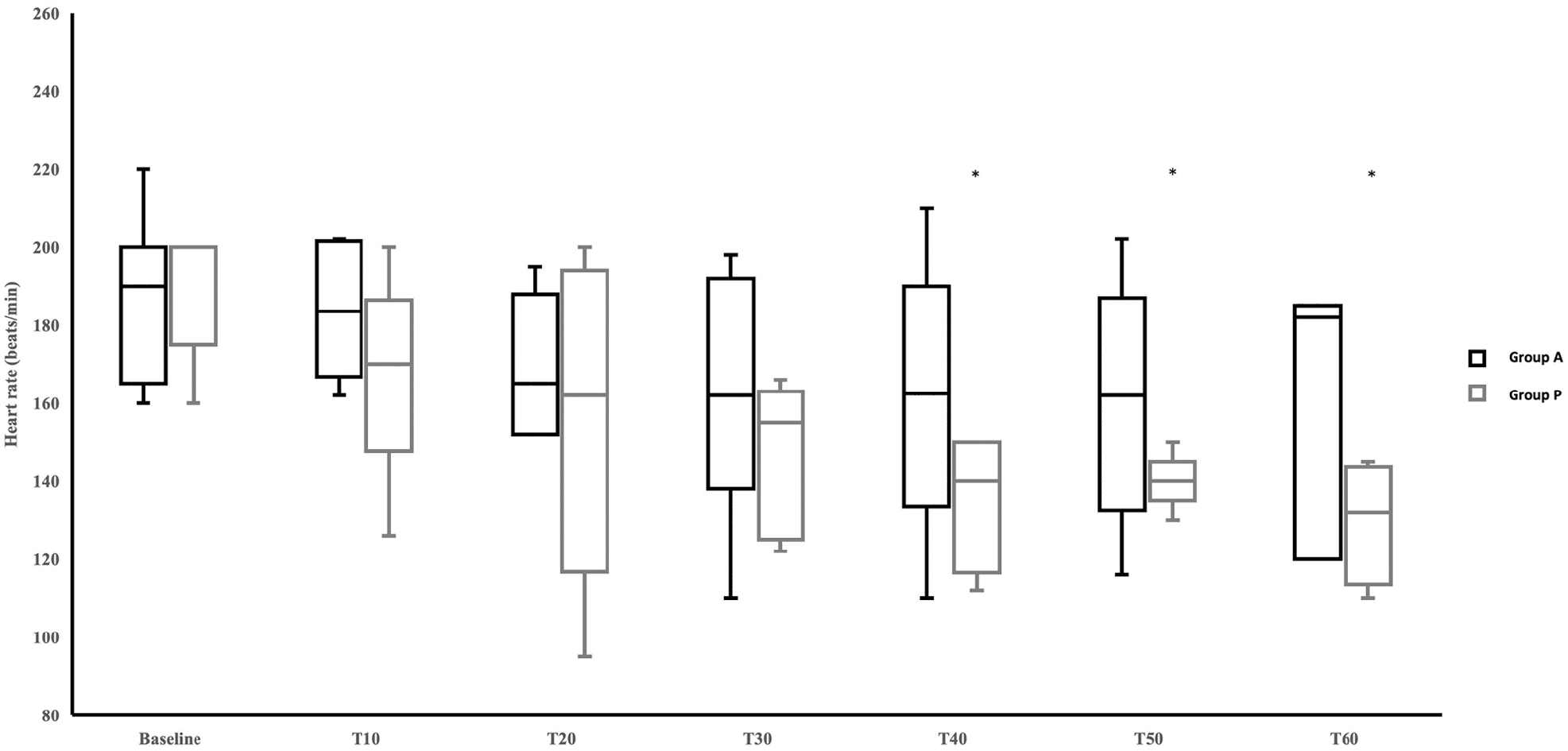
Box and whisker plot representation of the heart rate (HR) in the queens undergoing emergency caesarean section and receiving propofol (P; n = 6) or alfaxalone (A; n = 8) for anaesthetic induction, and isoflurane for maintenance of the general anaesthesia. The HR was recorded at the initial visit (baseline) and every 10 mins during surgery (T10–T60). *Statistically significant differences compared with baseline. A P value <0.05 was considered statistically significant

Box and whisker plot representation of the respiratory rate (f R) in the queens undergoing emergency caesarean section and receiving propofol (P; n = 6) or alfaxalone (A; n = 8) for anaesthetic induction, and isoflurane for maintenance of the general anaesthesia. The fR was recorded at the initial visit (baseline) and every 10 mins during surgery (T10–T60). A P value <0.05 was considered statistically significant
Mean MAP values were lower in group P throughout the procedure, with a statistically significant difference at T50 (P = 0.036) (Figure 3, see Table S1 in supplementary material). Transient hypotension occurred in four queens (three in group P and one in group A). However, the association between the groups and the incidence of hypotension was not statistically significant.

Box and whisker plot representation of the mean arterial pressure (MAP) in the queens undergoing emergency caesarean section and receiving propofol (P; n = 6) or alfaxalone (A; n = 8) for anaesthetic induction, and isoflurane for maintenance of the general anaesthesia. MAP was recorded every 10 mins during surgery (T10–T60). §Statistically significant differences between the two groups. A P value <0.05 was considered statistically significant
The mean fraction of expired isoflurane (EtIso%) was higher in group P, with a statistically significant difference between group A and group P from T10 to T50 (P = 0.0139, 0.0478, 0.003, <0.001 and 0.039, respectively) (Figure 4, see Table S1 in supplementary material).

Box and whisker plot representation of the exhaled fraction of isoflurane (EtISO%) in the queens undergoing emergency caesarean section and receiving propofol (P; n = 6) or alfaxalone (A; n = 8) for anaesthetic induction, and isoflurane for maintenance of the general anaesthesia. The EtISO% was recorded every 10 mins during surgery (T10–T60). §Statistically significant differences between the two groups. A P value <0.05 was considered statistically significant
The mean extubation time was 7.8 ± 3.7 mins in group A and 10.0 ± 6.3 mins in group P, with no statistically significant differences (P = 0.416). Data relating to the mean times of extraction of the kittens were recorded for 11/14 cats, six in group A and five in group P. Statistically significant differences were reported on the times of extraction of the first kitten: 7.8 ± 3.5 mins in group A and 21.4 ± 7.2 mins in group P (P = 0.002). The mean extraction times of the last kitten were 18.5 ± 9.5 mins in group A and 23.3 ± 9.1 mins in group P, with no statistically significant differences between the two groups (P = 0.497).
Recovery was rapid, smooth and unremarkable in all cats.
Discussion
The results of the present study demonstrate that both alfaxalone and propofol are feasible for obtaining a smooth induction in cats undergoing c-section.
Propofol and alfaxalone are widely used as induction agents in cats since they both provide effective and smooth induction in this species. 11 In the present study, the doses used for induction were lower when compared with those previously reported in premedicated cats.11,17 In fact, a range of 5.3–7.5 mg/kg of propofol18,19 and 4.7–5 mg/kg of alfaxalone are the recommended doses for induction of general anaesthesia in cats.11,17 The different dosages could be related to endorphins during pregnancy, which reduce the doses of anaesthetic needed for induction of general anaesthesia.20,21 These same drugs are also widely used for the induction of general anaesthesia in bitches undergoing c-sections, and their effects on puppies have been described.5,10,22 These previous studies show that the survival rate of the puppies did not differ significantly, regardless of which of the two drugs was used; however, the administration of alfaxalone was associated with a higher Apgar score after birth in both emergency and scheduled c-sections compared with that of propofol.5,10,22 The results of the present feline study also highlighted that the survival rate did not differ significantly between the two groups, even if it was higher for alfaxalone when compared with propofol. The inclusion of a larger population could highlight a statistically significant difference. The results of the effect of the anaesthetic protocol on the vital parameters of the newborn can be more difficult to compare with other studies in which an Apgar score was applied. The Apgar score was introduced into veterinary medicine as a tool for the clinical evaluation of newborn puppies, assessing their viability and estimating survival prognosis to guide resuscitation manoeuvres. 23 The application of the Apgar scoring system in the field of anaesthesia allows a more objective evaluation of the effects of the anaesthetic protocol used during c-sections on newborns. However, at the time during which the anaesthesia was utilised, the Apgar scoring system for cats was not available. Since it has only recently been described in cats, the evaluation of the newborns was therefore based on clinical evaluation. 24
The overall survival of the kittens was 90% at birth with a mortality rate of 10%, which was lower than that previously reported in cats (14–16%).24–26 The mortality rate at birth and in the first day of life in this species is still high, and it is expected to be higher in the case of a c-section compared with a natural delivery. Another variable affecting the neonatal survival rate is emergency; in fact, in canine patients, emergency c-sections carry a higher risk of neonatal mortality when compared with scheduled procedures. 27 In the present study, the majority of the cats were referred to the veterinary hospital after being in prolonged labour; fetal distress was observed in some of the cats at admission, which might have compromised the condition of the kittens, even before commencing anaesthesia.8,28 In addition, several other factors can affect the viability of newborns during an emergency c-section. In dogs, previous studies have identified a significant association between the increased duration of anaesthesia and neonatal mortality; a duration >80 mins increased the risk by three-fold 28 and a duration >120 mins increased the risk by 6.7-fold. 27 In the present study, the mean duration of anaesthesia in group P was 79.8 ± 16.7 mins, which was significantly longer than that of group A. Therefore, this prolonged duration cannot be ruled out as a contributing factor to the higher mortality rate. The spaying performed on 10 cats contributed to the longer anaesthesia time. The mean extraction times of the first kittens were also significantly longer in group P than in group A (21.4 ± 7.2 mins vs 7.8 ± 3.5 mins, respectively). Based on the retrospective nature of the study, it was not possible to identify the causative factors of this difference. Some canine studies found that a longer time interval from induction to the start of the surgery was associated with increased odds of neonatal mortality, with a cut-off duration of >45 mins. 29 This is not the case of the present study, but causative effect cannot be excluded.
The anaesthetic protocols applied to the queens induced reductions in HR and fR compared with the baseline values and were similar between the two groups. Similar findings have previously been described in cats when propofol or alfaxalone were used for the induction of general anaesthesia.11,17 In any case, the decrease in HR did not result in episodes of bradycardia or arrhythmia. On the contrary, transient episodes of hypotension occurred in both groups; however, overall, blood pressure was lower in group P, even if the statistical difference was observed only at T50. Severe and protracted hypotension might negatively affect the uteroplacental blood flow perfusion, thereby compromising neonatal viability at birth; therefore, stable physiological parameters in the queens must be guaranteed. 20 Episodes of hypotension are not uncommon in animals undergoing emergency c-sections.19,27 In a previous study involving bitches, hypotension was the most prevalent complication during c-section, accounting for 93% of all anaesthetic complications, affecting 66% of the population included. 27 In fact, the haemodynamic alterations reported during pregnancy, such as dehydration, hypovolaemia and pre-existing low blood pressure, could contribute to intraoperative hypotension. As soon as the animal is placed in dorsal recumbency for surgery, the enlarged uterus might also compress the caudal vena cava and the aorta with a subsequent decreased venous return. However, in the present study, group P required a higher dose of isoflurane for maintenance of the general anaesthesia than group A; this likely contributed to decreasing systemic vascular resistance, accounting for the lower blood pressure.
A limitation of the present study is its retrospective nature; however, this fits well for investigating conditions characterised by a low prevalence, such as dystocia in cats, as in the present study. Nevertheless, the analysis described herein can be considered for developing additional prospective clinical studies. In fact, in dogs, multimodal anaesthetic protocols, including opioids as part of the premedication, and local anaesthetic techniques for c-sections have been described more recently.4,6,20,30–33 Pain associated with caesarean delivery is both somatic and visceral in nature, and adequate perioperative pain control improves the quality of the mother’s recovery and increases the likelihood that she will be able to nurse the offspring. Neuraxial anaesthesia is considered to be the gold standard for managing perioperative pain during c-sections in humans and, for the same purpose, this technique has been described in canine patients.30,33 A limitation of these techniques is that they require a learning curve before they can be performed safely and may not be indicated in urgent cases as they are time-consuming. Other suggested local anaesthetic techniques for ovariectomy/ovariohysterectomy are the incisional anaesthesia and the intraperitoneal block; these latter techniques are easy to perform, cheap, safe and effective for providing perioperative analgesia after abdominal surgery in small animals. 34 In the present study, intramuscular (IM) buprenorphine was administered for the management of perioperative analgesia. Buprenorphine in cats reaches its maximum concentration (Cmax) 5 mins after IM injection, 35 despite the peak at the cerebral site and the antinociceptive effect being delayed (within 0.5 and 4.0 h when administered subcutaneously). 36 It is therefore important to strictly monitor patients after administration to ascertain the adequacy of analgesic treatment or otherwise provide a multimodal analgesic intervention. The recovery scores concerning postoperative pain evaluation were not systematically collected; however, the queens included in the present study were kept under observation after surgery, and none of them required rescue medication in the postoperative period. Nevertheless, pain is an individual experience and its assessment in the postoperative period is imperative to provide adequate pain relief if needed. 15 Additional investigations are required to evaluate the effects of multimodal anaesthetic protocols for cats undergoing c-sections; however, the findings of the present study can be useful when choosing an induction agent.
Conclusions
The present study demonstrated that both alfaxalone and propofol are feasible for the induction of general anaesthesia in cats undergoing c-section, even if alfaxalone is associated with a lower isoflurane requirement. This might potentially account for more stable cardiovascular parameters in the queen.
Supplemental Material
sj-docx-1-jfm-10.1177_1098612X241275270 – Supplemental material for Retrospective evaluation of the induction of anaesthesia with alfaxalone or propofol in cats undergoing caesarean section
Table S1: Heart rate, respiratory rate, mean arterial pressure, expired fraction of isoflurane, expired fraction of CO2 and temperature values in queens undergoing emergency caesarean section and receiving propofol or alfaxalone for anaesthetic induction and isoflurane for maintenance of general anaesthesia
Footnotes
Acknowledgements
The authors would like to thank all their colleagues at the Servizio di Anestesia e Rianimazione who performed the anaesthetic procedures, and the staff at the Unità operativa di Riproduzione of Servizio clinico piccoli animali for their assistance with the kittens (Department of Veterinarinary Medical Sciences [DIMEVET], University of Bologna, Italy).
Author note
The preliminary results of this paper were presented at the 76th Congresso della Federazione Italiana delle Società Scientifiche di Medicina Veterinaria (SISVET; 21–23 June 2023, Bari, Italy) and also as a veterinary degree thesis. Data are available upon request to the corresponding author.
Supplementary material
The following file is available as supplementary material:
Table S1: Heart rate, respiratory rate, mean arterial pressure, expired fraction of isoflurane, expired fraction of CO2 and temperature values in queens undergoing emergency caesarean section and receiving propofol or alfaxalone for anaesthetic induction and isoflurane for maintenance of general anaesthesia
Conflict of interest
The authors declared no potential conflicts of interest with respect to the research, authorship, and/or publication of this article.
Funding
The authors received no financial support for the research, authorship, and/or publication of this article.
Ethical approval
The work described in this manuscript involved the use of non-experimental (owned or unowned) animals. Established internationally recognised high standards (‘best practice’) of veterinary clinical care for the individual patient were always followed and/or this work involved the use of cadavers. Ethical approval from a committee was therefore not specifically required for publication in JFMS. Although not required, where ethical approval was still obtained, it is stated in the manuscript.
Informed consent
Informed consent (verbal or written) was obtained from the owner or legal custodian of all animal(s) described in this work (experimental or non-experimental animals, including cadavers, tissues and samples) for all procedure(s) undertaken (prospective or retrospective studies). No animals or people are identifiable within this publication, and therefore additional informed consent for publication was not required.

References
Supplementary Material
Please find the following supplemental material available below.
For Open Access articles published under a Creative Commons License, all supplemental material carries the same license as the article it is associated with.
For non-Open Access articles published, all supplemental material carries a non-exclusive license, and permission requests for re-use of supplemental material or any part of supplemental material shall be sent directly to the copyright owner as specified in the copyright notice associated with the article.
