



Abstract
Objectives
The aim of the study was to assess cat guardians’ concern levels and veterinary care decisions pertaining to behaviors that might signify pain before and after receiving brief pain-related educational information. The secondary aims were to evaluate cat guardians’ perceptions of the usefulness of a modified version of the Colorado State University Feline Acute Pain Scale (CSU-FAPS) in identifying their cat’s pain level, determining if they should take their cat to the veterinarian and describing their cat’s pain to their veterinarian.
Methods
Participants were recruited through Prolific. An electronic survey was created in Qualtrics and distributed via a link offered in Prolific.
Results
A total of 362 surveys were completed by participants who resided in the USA and were the primary caretaker of at least one cat. Significant differences between participants’ concern levels before and after pain-related educational information were found for two of the three scenarios. Significant differences were found between participants’ veterinary-related behavior choices before and after pain-related educational information for all three scenarios. The most common reasons for not seeking immediate veterinary care included elements related to cost and stress for guardian and cat during veterinary visits. The majority of participants reported finding the CSU-FAPS useful for identifying their cat’s pain level (90%), determining if they should take their cat to the veterinarian (86%) and describing their cat’s pain to their veterinarian (92%).
Conclusions and relevance
Guardians’ interpretations of and subsequent actions to behaviors that might suggest pain carry great implications for feline health and wellbeing. After exposure to brief pain-related educational material, guardians in our study reported significant increases in stated concern related to their cat’s change in behavior and intention to seek veterinary care. These findings suggest that even very brief pain-related educational material can have a positive impact on cat guardians’ perceptions of feline behavior changes and increase the possibility they obtain appropriate veterinary care.
Plain language summary
In this study, researchers wanted to understand how cat guardians perceive and respond to behaviors that might indicate their cat is in pain. They also wanted to see if providing cat guardians with educational information about recognizing pain would change their behavior. They used an online survey to gather information from 362 cat guardians in the USA. They found that after receiving educational information about recognizing pain in cats, the cat guardians showed more concern about their cat’s behavior changes and were more likely to consider taking their cat to the veterinarian. The study also assessed the Feline Acute Pain Scale. Most participants found this tool helpful for identifying their cat’s pain level, deciding whether to go to the veterinarian and describing their cat’s pain to the veterinarian. Overall, the study suggests that providing even brief education about recognizing pain in cats can lead to better care for cats by their guardians.
Introduction
Pain is considered the fourth vital sign in veterinary care and its assessment is essential during physical examinations.1,2 Recognizing and assessing feline pain remains a major challenge for veterinary practitioners, 3 and is even more formidable for guardians. 2 Veterinarians integrate physiological, behavioral and emotional factors with guardians’ interpretation of their animal’s behaviors to assess pain. 4 Measures commonly used by veterinarians for assessing feline pain include the Feline Grimace Scale (FGS), 5 Glasgow Composite Measure Pain Scale-Feline (CMPS-F), 6 UNESP Botucatu Multidimensional Feline Pain Assessment Scale-Short Form (UFEPS-SF) 7 and the Colorado State University Feline Acute Pain Scale (CSU-FAPS). 8
Before a pain assessment by a veterinarian, a guardian must initially recognize cat behaviors that signify pain and decide that the behavior necessitates veterinary consultation. Most guardians have high levels of attachment to their cat and want to nurture its wellbeing,9,10 yet many are unable to accurately interpret their cat’s body language.2,11 A guardian’s ability to accurately identify their cat’s pain and, as a result, seek veterinary care, is critical for the cat’s welfare and quality of life.4,5,12 Thus, it is imperative for cat guardians to understand and correctly interpret behaviors that may indicate pain and the need for veterinary care.
The objectives of our study were to assess cat guardians’ concern levels and veterinary care decisions pertaining to behaviors that might signify pain before and after receiving brief pain-related educational information. Our hypothesis was that a minimal amount of guardian education regarding pain-suggestive behaviors would increase cat guardians’ concern levels and likelihood of seeking veterinary care.
The study was also designed to evaluate cat guardians’ perceptions of the usefulness of a modified version of the CSU-FAPS 8 in identifying their cat’s pain level, determining if they should take their cat to the veterinarian and describing their cat’s pain to their veterinarian. The CSU-FAPS is a composite scale derived from two behavioral scales developed at the universities of Melbourne and Glasgow13,14 and uses a numeric rating scale for pain from 0 (no pain) to 4 (most severe pain). The original scale included, for each of the five levels, drawings of a cat to exemplify the pain level, possible psychological and behavioral signs, possible responses to palpation and body tension. The modified version we used in the study removed the responses to palpation and body tension, retaining the images and the possible psychological and behavioral signs (see Appendix – Survey, available as supplementary material).
Materials and methods
An online, anonymous, cross-sectional survey was developed using Qualtrics (Qualtrics). Ethical approval was obtained from the Colorado State University Internal Review Board (IRB #5168). Survey respondents were cat guardians aged 18 years or older who resided in the USA and were the primary caretakers of at least one cat. Participants were recruited between 16 and 19 December 2023 through Prolific, an open online marketplace whereby respondents receive small monetary compensation for completing surveys. 15
Survey
The survey (see supplementary material, Appendix – Survey) began with an introduction that explained the study’s purpose and gave instructions regarding how to complete the survey if the respondent had more than one cat. Participants were asked questions about pet guardianship and veterinary care and given an attachment scale (Lexington Attachment to Pets Scale [LAPS]). 16 The LAPS scale Cronbach’s alpha in the current study was 0.947 (omega = 0.947) with a possible range of 0–69.
The next section of the survey consisted of three scenarios with noted changes in the cat’s behavior. The three scenarios were created to depict common behavioral changes that may result in pain but could be misinterpreted by pet guardians. All the scenarios began by stating ‘You have a 5-year-old female domestic shorthair cat that has been happy and healthy since she was a kitten’. These three scenarios were presented in random order. After each scenario, participants were asked to indicate their level of concern about the change in behavior using a four-point Likert scale. They were then asked to indicate their veterinary-related response (ie, ‘I would call the veterinarian right away’, ‘I would wait to call the veterinarian’ and ‘I would likely not call the veterinarian about this change in behavior’).
If participants responded with any response other than calling their veterinarian right away for each of the three changes in behavior, they were asked to indicate the impact of 24 potential factors in their veterinary-related decision using a four-point Likert scale.
After the participants had answered the questions related to each of the three scenarios, they were then given pain-related educational information about each scenario. They were then presented with the same three scenarios and asked to indicate their concern level and veterinary-related response.
Participants were then asked to look at a modified version of the CSU-FAPS. 8 After viewing the CSU-FAPS, participants were asked to indicate the usefulness of the scale, using a four-point Likert scale, in identifying their cat’s pain level, determining if they should take their cat to the veterinarian and describing their cat’s pain to their veterinarian. The last question on the survey asked participants to rate how likely they were to seek medical care for themselves if they were to be in significant pain, using a four-point Likert scale (‘not at all likely’ to ‘very likely’).
Statistical analysis
Descriptive statistics, Wilcoxon signed-rank test, ordinal regression and χ2 analyses were conducted using SPSS Version 28 (IBM). Descriptive statistics included responses to questions related to veterinary care, ability to read their cat, ability to detect pain in their cat and the usefulness of the CSU-FAPS. The Wilcoxon signed-rank test was used to assess differences between participants’ responses regarding their concern levels and veterinary-related responses before and after being given pain-related educational information. Ordinal regression was used to assess the potential predictive value of the LAPS attachment score, confidence in detecting pain in their cat, number of cats they had as an adult and participants’ likelihood of seeking medical care for their own pain on participants’ concern level (before being given pain-related educational information) for each scenario. Ordinal regression was also used to assess the potential predictive value of the LAPS score, confidence in detecting pain in their cat, number of cats they had as an adult, participants’ likelihood of seeking medical care for their own pain, relationship with their veterinarian and the frequency with which they took their cat to the veterinarian on participants’ veterinary-related responses (before being given pain-related educational information) for each scenario. The χ2 test was used to assess the relationship between perceived usefulness of the CSU-FAPS and participants’ stated ability to detect pain in their cat. The significance level was set at P = 0.05 for all analyses.
Results
A total of 376 completed surveys were submitted; of these, 362 were from participants who resided in the USA and were the primary caretaker of at least one cat. There were 229 (63.3%) cat guardians only (no dogs), while 133 (36.7%) respondents reported having at least one dog and one cat. The largest number of participants (n = 90, 24.9%) had two cats, followed by one cat (n = 71, 19.6%) and three cats (n = 62, 17.1%). A total of 38 (10.5%) respondents reported having 10 or more cats. The participants were primarily white (n = 292, 78.7%), had a mean (± SD) age of 43.29 ± 12.34 years and included 183 (50.6%) women and 179 (49.4%) men. The mean score of the LAPS scale was 51.62 ± 12.83. The majority (n = 297, 82.0%) of participants reported having a primary veterinarian, with most reporting a good (n = 145, 48.8%) or excellent (n = 98, 33.0%) relationship with their veterinarian. When asked how often they took their cat to the veterinarian, 114 (31.5%) reported less than once a year, 140 (38.7%) reported once a year and 128 (29.8%) reported taking their cat to the veterinarian twice a year or more. When asked about the last time they had taken their cat to the veterinarian, the largest number of respondents reported within the past 6 months (n = 145, 40.1%), followed by within the past year (n = 92, 25.4%) or more than 1 year ago (n = 92, 25.4%). A total of 33 (9.1%) respondents reported having taken their cat to the veterinarian within the past month.
Participants were asked how well they felt they could ‘read’ their cat’s behaviors and most reported ‘good’ (n = 209, 57.7%) or ‘great’ (n = 127, 35.1%). Only 26 (7.2%) reported ‘somewhat poor’. When asked how confident they felt about detecting pain in their cat, 67 (18.5%) reported feeling ‘very confident’, 215 (59.4%) reported feeling ‘moderately confident’, 76 (21.0%) reported ‘minimally confident’ and four (1.1%) reported ‘not at all confident’. Participants were asked how likely they would be to seek medical care for themselves if they were in significant pain. The most common response was ‘very likely’ (n = 170, 47.0%), followed by ‘somewhat likely’ (n = 153, 42.3%) and ‘not at all likely’ (31, 8.6%); eight (2.2%) reported they ‘did not know’. Further analysis combined ‘not at all likely’ and ‘somewhat likely’.
Before/after concern levels and veterinary-related behaviors
Significant differences were found in participants’ levels of concern before and after being given pain-related educational information for the ‘snappy’ (P <0.001) and ‘ear’ (P <0.001) scenarios. The difference between before and after for the ‘walk’ scenario was not significant (P = 0.349) (Table 1).
Participants’ reported before and after concern levels about changes in behavior for three scenarios

Data are presented as n (%)
Before/after change is significant (P <0.001)
Wilcoxon signed-rank test results between participants’ veterinary-related behaviors before and after pain-related educational information resulted in significant differences for all three scenarios: ‘snappy’ (P <0.001); ‘ear’ (P <0.001); and ‘walk’ (P = 0.004) (Table 2).
Participants’ reported before and after veterinary-related decisions about changes in behavior for three scenarios

Data are presented as n (%)
Before/after change is significant (P <0.001)
Concern levels
We ran three ordinal regression analyses to examine the predictive ability of attachment, confidence in detecting pain in their cat, likelihood of seeking medical care for themselves if they were in significant pain and number of cats they had as an adult on participants’ levels of concern before being given pain-related educational information for each scenario. All variables were entered simultaneously.
Attachment score, guardians’ confidence in their ability to detect their cat’s pain and guardian seeking medical care for themselves if they were in significant pain were all positive predictors of guardians’ concern level for the ‘snappy’ scenario (P <0.001, R2 = 0.139).
Attachment score and guardians’ confidence in their ability to detect their cat’s pain were positive predictors of guardians’ concern level for the ‘ear’ scenario (P <0.001, R2 = 0.201).
Attachment score and guardian seeking medical care for themselves if they were in significant pain were positive predictors of guardians’ concern level for the ‘walk’ scenario (P <0.001, R2 = 0.217).
Veterinary-related response
We ran three ordinal regression analyses to examine the predictive ability of attachment, confidence in detecting pain in their cat, number of cats they had as an adult, likelihood of seeking medical care for their own pain, relationship with their veterinarian and how often they took their cat to the veterinarian on veterinary-related responses before being given pain-related educational information for each scenario. All variables were entered simultaneously.
Attachment score and guardian seeking medical care for themselves if they were in significant pain were both positive predictors of guardians’ veterinary-related response for the ‘snappy’ scenario (χ2 = 40.07 [df =10], P <0.001, R2 = 0.232).
Guardians’ confidence in their ability to detect their cat’s pain was a positive predictor of guardians’ veterinary-related response for the ‘ear’ scenario (χ2 = 26.02 [df =10], P = 0.004, R2 = 0.161).
Guardians’ confidence in their ability to detect their cat’s pain and guardian seeking medical care for themselves if they were in significant pain were positive predictors of guardians’ veterinary-related response for the ‘walk’ scenario (χ2 = 25.56 [df =10], P = 0.004, R2 = 0.161).
Factors influencing veterinary-related decisions
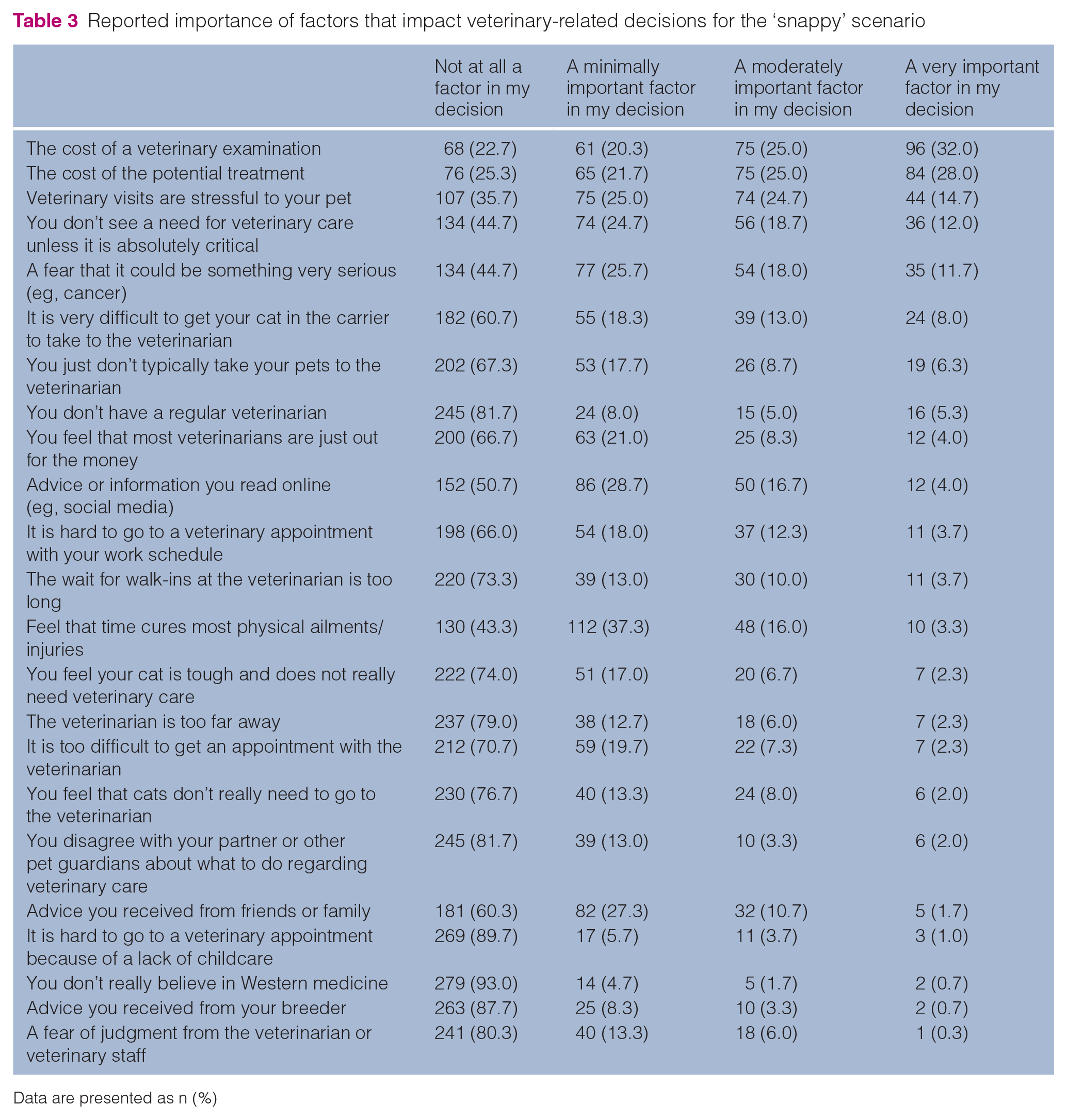
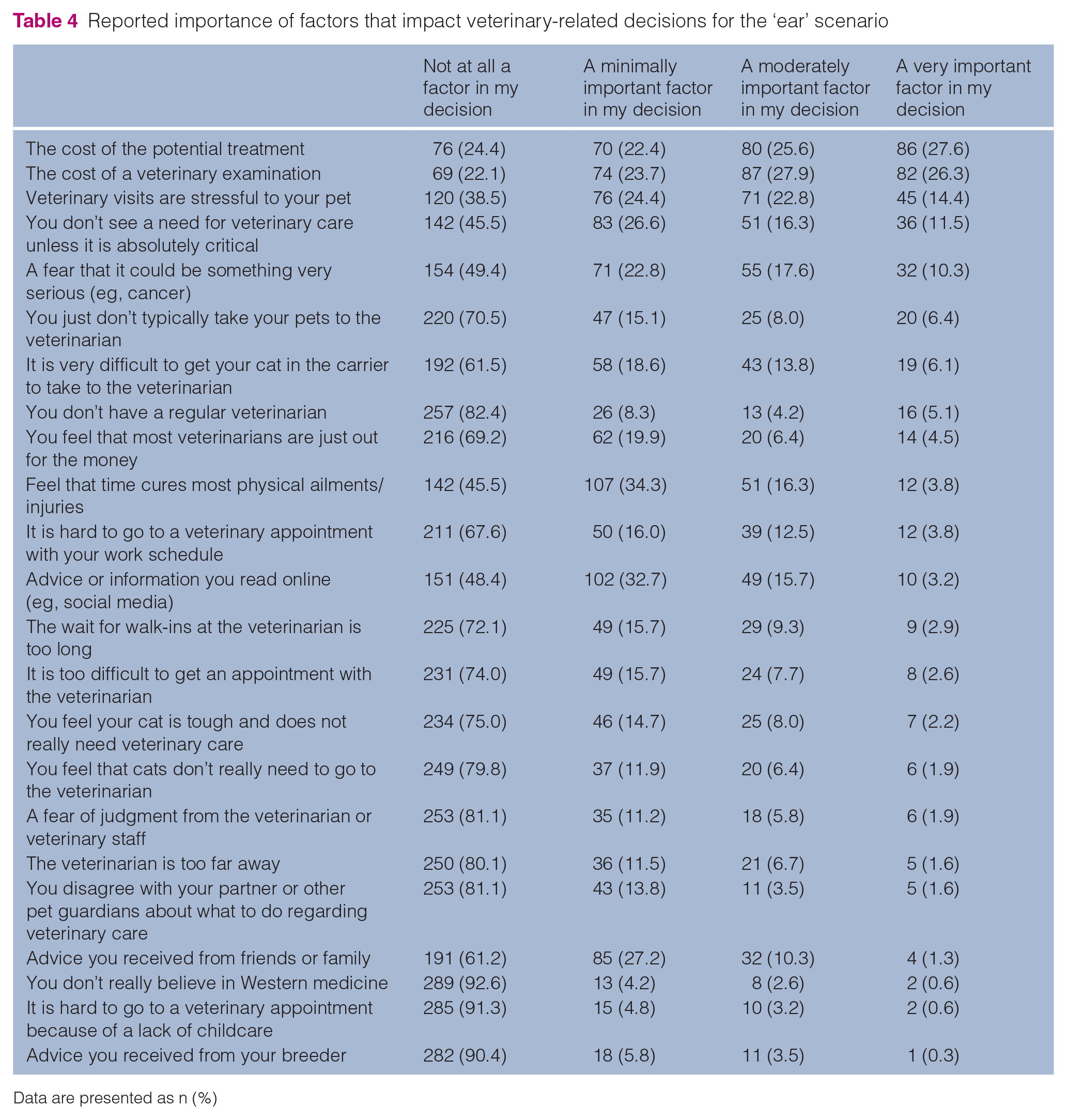
Participants who reported they would delay contacting their veterinarian or not contact a veterinarian at all were asked to indicate the impact of several potential factors on their decision. The most commonly endorsed factors were the same across all three scenarios (Tables 3–5). These included items such as ‘The cost of potential treatment’, ‘A fear that it could be something very serious’, ‘Veterinary visits are stressful to your pet’, ‘You don’t see the need for veterinary care unless it is absolutely critical’ and ‘It is very difficult to get your cat in the carrier to take to the veterinarian’.
Reported importance of factors that impact veterinary-related decisions for the ‘snappy’ scenario
Data are presented as n (%)
Reported importance of factors that impact veterinary-related decisions for the ‘ear’ scenario
Data are presented as n (%)
Reported importance of factors that impact veterinary-related decisions for the ‘walk’ scenario

Data are presented as n (%)
Feline Acute Pain Scale (CSU-FAPS)
Upon viewing the CSU-FAPS, 8 the majority of participants found the scale moderately or very useful in terms of identifying their cat’s pain (90%), for determining if they should take their cat to the veterinarian (86%) or describing their cat’s pain to their veterinarian (92%) (Table 6).
Participants’ reported usefulness of the Feline Acute Pain Scale in identifying their cat’s pain, determining if they should take their cat to the veterinarian and describing their cat’s pain to the veterinarian

Data are presented as n (%)
Assessing the relationship between the perceived usefulness of the CSU-FAPS and guardians’ stated ability to detect pain in their cat, a significant difference was found for identifying their cat’s pain (χ2 = 18.47 [df = 6], P = 0.005), deciding if they should take their cat to the veterinarian (χ2 = 21.17 [df = 6], P = 0.002) and describing their cat’s pain to their veterinarian (χ2 = 21.64 [df = 6], P = 0.001). In each of these cases, those who reported higher ability in detecting their cat’s pain reported finding the CSU-FAPS more helpful than those who reported less ability to detect pain in their cat (Tables 7–9).
Participants’ reported usefulness of the Feline Acute Pain Scale in identifying their cat’s pain by participants’ level of confidence in detecting pain in their cat (n = 362)

Data are presented as n (%)
Participants’ reported usefulness of the Feline Acute Pain Scale in determining if they should take their cat to the veterinarian by their level of confidence in detecting pain in their cat (n = 362)

Data are presented as n (%)
Participants’ reported usefulness of the Feline Acute Pain Scale in describing their cat’s pain to their veterinarian by participants’ level of confidence in detecting pain in their cat (n = 362)

Data are presented as n (%)
Discussion
In this study, we found that pain-related education led to increased guardian concern and a greater reported likelihood of contacting a veterinarian. We also found that guardians’ perceived ability to detect their cat’s pain was a significant positive predictor of veterinary care choices for two of the scenarios. These results suggest that, if given the tools they need to make informed, educated decisions, cat guardians are more likely to seek veterinary care for suspected cat pain. It has been suggested that guardians’ lack of knowledge and understanding of their pets imposes welfare concerns. In addition, many guardians have difficulty interpreting their pet’s behaviors17,18 and may not understand or accurately interpret the causes and implications of some of their behaviors, which can often be associated with pain. Successful education depends on multiple factors, including the context, timing and environment. 19
One novel way to educate guardians about pet pain is to modify a pain scale that has been designed for veterinary professionals. To this end, we asked participants to indicate their perception of the usefulness of a modified version of the CSU-FAPS scale. 8 Approximately 90% of guardians reported finding the scale useful for identifying their cat’s pain level, determining if they should take their cat to the veterinarian and describing their cat’s pain to their veterinarian. This suggests that the CSU-FAPS scale could be useful in both helping guardians identify feline pain as well as facilitating better communication between guardian and veterinarian. Other pain scales currently used by veterinary professionals might also be modified for guardian use, and further research to explore if drawings and/or pictures enhance guardians’ ability to identify and communicate about their cat’s pain would be helpful.
Another predictor of veterinary care choices in two of the scenarios involved guardians’ medical care choices surrounding their own physical pain. Further research exploring the relationship between guardians’ personal healthcare choices and those they make for their pets could help the development of targeted communication to guardians who may be less likely to receive healthcare for their own pain.
In addition to exploring predictors of guardians’ likelihood of seeking veterinary care, we sought to better understand the barriers to seeking veterinary care. The most common barriers pertained to cost and the stress associated with veterinary visits. The cost of a veterinary examination or potential treatment was rated as a moderate or very important factor by >50% of participants. The factor seen as most important after cost was the stress of a veterinary visit for their cat. Lack of veterinary care has been identified as the greatest threat to the health and wellbeing of pets, with as many as 28% of US families unable to afford the care their pets need.20,21 During the past 20 years, the increase in the cost of veterinarian services has significantly outpaced overall inflation. 22
One way to increase access to care is for veterinary healthcare teams to embrace a spectrum of care, defined as customized care based upon case-specific factors that involve the client, veterinarian and patient. 23 It is clear that providing only the most advanced and expensive level of treatment available does not meet the needs of every pet guardian, and it is increasingly recognized that there is a need to offer a continuum of options that considers the client’s needs, wants and limitations.24–28 In addition to an array of financial options, another key element of a spectrum of care is flexibility in how services are provided. Evening, weekend and drop-off appointments may help reduce barriers for some pet guardians. Telehealth is another option, one that can also mitigate stress-related barriers for both cats and their guardians.
Telemedicine, broadly defined as ‘the use of a tool to exchange information about a patient’s clinical health status electronically from one site to another’, 29 in the form of interactive video offers a new way to provide veterinary care to cats. 30 Although a veterinarian–client–patient relationship (VCPR) requires a physical examination and cannot be established electronically, once established, a VCPR can be maintained via telemedicine. 31 Several studies suggest that pet guardians are interested in using telemedicine and see its potential for improving access to veterinary care.32–35 In addition to convenience, telemedicine can mitigate the stress involved with veterinary visits. The effects of stress in cats can be profound, negatively impacting their wellbeing and increasing their risk for infectious and lower urinary tract diseases. 36 Many cats show signs of stress and fear during veterinary examinations, which can negatively influence their guardians’ veterinary care choices.30,37–39 Stress during the veterinary visit is often compounded by cats’ negative response to pet carriers and travel.39–41 In addition to telemedicine, feline-friendly handling guidelines, such as Low Stress Handling techniques, pet-friendly handling guidelines and Fear Free techniques can help reduce cat and guardian stress.42–45
There are several limitations to this study. As with any cross-sectional study, we were not able to assess changes in guardians’ beliefs or behaviors over time. This was a limited sample, so caution should be taken when generalizing to other populations. There may be additional social determinants that factor into the participants’ decisions to access veterinary care that were not assessed in the current study.
Conclusions
Our study suggests that minimal pain-related information provided to cat guardians can positively impact their concern level and veterinary care decisions. By proactively educating guardians about the signs of pain, as well as working to mitigate the primary barriers to veterinary care, we can positively impact cat health and welfare.
Supplemental Material
sj-docx-1-jfm-10.1177_1098612X241272885 – Supplemental material for Behaviors suggestive of pain: the perceptions and veterinary-related decisions of cat guardians in the USA
Appendix – Survey
Footnotes
Conflict of interest
The authors declared no potential conflicts of interest with respect to the research, authorship, and/or publication of this article.
Funding
The authors received no financial support for the research, authorship, and/or publication of this article.
Ethical approval
This work did not involve the use of animals and therefore ethical approval was not specifically required for publication in JFMS.
Informed consent
This work did not involve the use of animals (including cadavers) and therefore informed consent was not required. No animals or people are identifiable within this publication, and therefore additional informed consent for publication was not required.

Supplementary material
The following file is available as supplementary material:
Appendix – Survey
References
Supplementary Material
Please find the following supplemental material available below.
For Open Access articles published under a Creative Commons License, all supplemental material carries the same license as the article it is associated with.
For non-Open Access articles published, all supplemental material carries a non-exclusive license, and permission requests for re-use of supplemental material or any part of supplemental material shall be sent directly to the copyright owner as specified in the copyright notice associated with the article.
