




Abstract
Objectives
Constipation is the infrequent or difficult emission of hard, dry faeces and is a common digestive condition in cats. Psyllium is a low-fermentable fibre, with soluble and insoluble components and water-holding properties. It forms a mucilaginous gel with water and is used for the symptomatic treatment of constipation in various species. This study evaluated the effect of dietary psyllium on faecal characteristics in cats.
Methods
Healthy neutered adult cats (six female and three male, aged 3.3–4.4 years) were consecutively fed a dry extruded diet containing either 6% psyllium (test) or 6% cellulose (control) for 10 days each. During the last 3 days (the collection days) of both feeding periods, bowel movements and faecal scores were recorded, and faeces were collected to measure wet weight and moisture. The statistical analysis used linear mixed models with diet, day and their interaction as fixed effects and animal as a random term.
Results
The test diet was associated with significantly more bowel movements per day over 3 days (P = 0.0052) and on collection day 2 (P = 0.0229) than the control diet. The mean faecal score was higher (softer faeces) over all three collection days (P <0.0001) and on collection days 1, 2 and 3 (P = 0.0011, P = 0.0349, P = 0.0003, respectively) for the test diet vs the control diet; the total faecal wet weight (P = 0.0003) and faecal moisture (%) were also higher (P = 0.0426) for the test diet. Faeces associated with the test diet often had a dry shell and soft interior, which increased the faecal score.
Conclusions and relevance
Psyllium promoted more bowel movements and higher faecal moisture and faecal score in healthy cats, consistent with a previous uncontrolled clinical trial in constipated cats. Together, the studies support the use of dietary psyllium for managing cats with constipation.
Introduction
Constipation is defined as the infrequent or difficult emission of hard and dry faeces and is a common digestive condition in cats. Constipation can be caused directly by colonic or anorectal dysfunction, it may be secondary to organic or systemic disease, or it may be associated with medications. 1 A common treatment for constipation is the incorporation of low-soluble or high-soluble fibre into the diet. Low-soluble fibre, such as cellulose, which is present in a wide range of fruits, vegetables, legumes, grains, nuts and seeds, is bulk forming and improves intestinal motility by distending the colonic lumen. 2 High-soluble fibres, such as pectin, guar gum and psyllium, cause stool softening by increasing luminal water in the colon due to their hydrophilic properties and osmotic activity. They are also associated with a lower postprandial glucose response and a reduction in the concentration of blood cholesterol. 3
Psyllium husk is obtained by grinding and sieving the seeds of the shrub-like plant Plantago ovata. Psyllium husk is a low-fermentable form of fibre with soluble and insoluble constituents. It contains both polysaccharide and non-polysaccharide components that exude a hydrophilic mucilaginous gel when in contact with water, 4 which is lubricating, increases faecal bulk and stimulates peristalsis.3,5,6 Despite the beneficial effect of psyllium in cats with constipation, demonstrated by Freiche et al, 4 the quantitative and qualitative effects of psyllium on stool evacuation and consistency have not been evaluated.
The aim of the present study was to evaluate the effects of a diet containing psyllium on defecation frequency, faecal score and bulk, and faecal moisture in healthy cats, in comparison with a diet containing cellulose.
Materials and methods
Study design and faecal assessments
The study was conducted during two consecutive 10-day feeding periods separated by a 4-day washout period. The test diet was fed during the first feeding period and the control diet was fed during the washout and second feeding period. Cats received a fixed amount of 85 g/day of the allocated diet, according to the standard protocol and feeding regime in the study population. Drinking water was available at all times. The food consumption of individual cats was recorded throughout both feeding periods and the cats were weighed at the start and end of each period.
The first 7 days of each feeding period were only for adaptation to the diet, and the remaining 3 days were for faeces collection (referred to as collection days 1, 2 and 3), when cats were housed in individual lodges and faeces were collected throughout the day between 8:00 am and 5:00 pm. Animal technicians recorded the number of bowel movements per day for each cat and scored faeces visually for consistency from 1 (hard, dry, crumbly) to 5 (liquid) (Table 1). Faeces were weighed, stored cumulatively on an individual tray at −18°C, and then dried for 72 h at 70°C at the end of the 3-day collection period for the analysis of faecal dry weight and moisture. Photographs were taken of examples of bowel movements for each cat.
Faecal scoring scheme

Study diets
The two study diets were complete dry and balanced diets. The test diet contained 6% psyllium husk; the control diet had the same nutrient profile with the psyllium replaced by 6% cellulose (Table 2). Both psyllium and cellulose are feed materials in line with Regulation (EC) 767/2009 and are registered either in the Catalogue of Feed Materials (Commission Regulation (EU) 2017/1017) or in the EU Feed Materials Register (www.feedmaterialsregister.eu).
Nutritional composition of the diets

Animals
Nine healthy adult neutered cats were selected from animals reserved for digestibility studies at the Royal Canin Cattery (Aimargues, France). The cats were managed under permanent veterinary supervision and had a comprehensive annual health assessment comprising a physical examination, urinalysis including urinary protein:creatinine ratio, abdominal ultrasonography, radiography, a complete blood cell count and blood analyses to measure the concentrations of biochemical analytes, electrolytes and total thyroxine. The exclusion criteria for the study included repetitive vomiting, diarrhoea, consumption of less than 10% of the feed ration and any other potential condition deemed significant by the attending veterinarian.
Housing
The cats were housed in a dedicated cattery in groups, with individual access to their food provided by electronically tagged collars. They were given access to a secure outside patio for controlled periods during the adaptation period, and in supervised rooms to avoid loss of faeces during the collection period.
Each pen was equipped with environmental enrichment including high platforms, hiding places and indigestible bedding. The technicians spent time with the cats to ensure human contact. During the faeces collection period, the cats were placed in individual lodges in order to collect faeces specific to each animal.
Statistical analyses
The number of bowel movements are presented as mean (95% confidence interval [CI]) for each of the faecal collection days 1, 2 and 3 and for the whole 3-day collection period. Faecal scores are presented as mean (95% CI) for each collection day and for the whole collection period.
The following formulae were used to calculate the wet weight and moisture content of the faeces.


Statistical analyses were performed using R Core Team (2021). Linear mixed models were used to analyse the total number of bowel movements and mean faecal score, with diet, day and their interaction as fixed effects and animal as a random term. Tukey’s HSD was used for P value correction for within-day between-diet pairwise comparisons. For faecal wet weight and percentage moisture, a test for normality was done for each diet group (test and control) using Shapiro–Wilk tests. If the normality hypothesis was not rejected for both groups, a paired t-test was used to compare the test and control mean values; otherwise, a Wilcoxon signed-rank test was used. The level of significance was set at 5%.
Ethical approval
The study was approved by the Royal Canin Ethics Committee on 25 February 2020.
Results
Study population
The study population comprised six female and three male cats with a median age of 3.7 years (range 3.3–4.4). Body weight was stable between the start and end of the study (mean 4.6 ± 1.1 kg).
Faecal assessments
The number of bowel movements per day was generally similar or higher for individual cats when they received the test diet (containing psyllium) compared with the control diet (containing cellulose). The mean number of bowel movements was statistically significantly higher for the test diet than the control diet on collection day 2, and per day when calculated from the total 3-day collection period (Table 3, Figure 1). A similar pattern was observed for faecal scores (Table 4, Figure 2). The score was close to optimal when cats were fed the control diet and softer than optimal when they were fed the test diet. The differences between diets achieved statistical significance for collection days 1, 2 and 3 separately, and over all 3 days.
Number of bowel movements per day during the last 3 days of 10-day feeding periods of the test diet, containing 6% psyllium, followed by the control diet, containing 6% cellulose (n = 9, healthy adult neutered cats)

Data are mean (95% CI). P values in bold indicate a statistically significant difference between the test and control diets
Faecal scores during the last 3 days of 10-day feeding periods of the test diet, containing 6% psyllium, followed by the control diet, containing 6% cellulose (n = 9, healthy adult neutered cats)
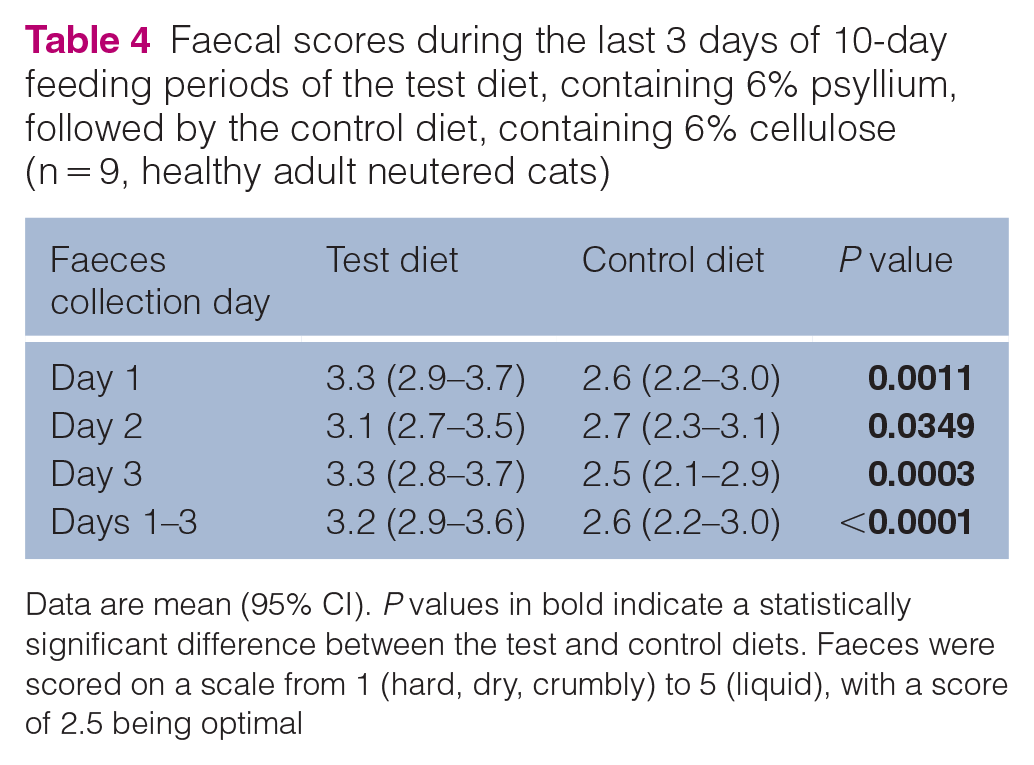
Data are mean (95% CI). P values in bold indicate a statistically significant difference between the test and control diets. Faeces were scored on a scale from 1 (hard, dry, crumbly) to 5 (liquid), with a score of 2.5 being optimal

Box plot of total number of bowel movements during the last 3 days of the 10-day feeding periods of the test diet, containing 6% psyllium, followed by the control diet, containing 6% cellulose (n = 9, healthy adult neutered cats)
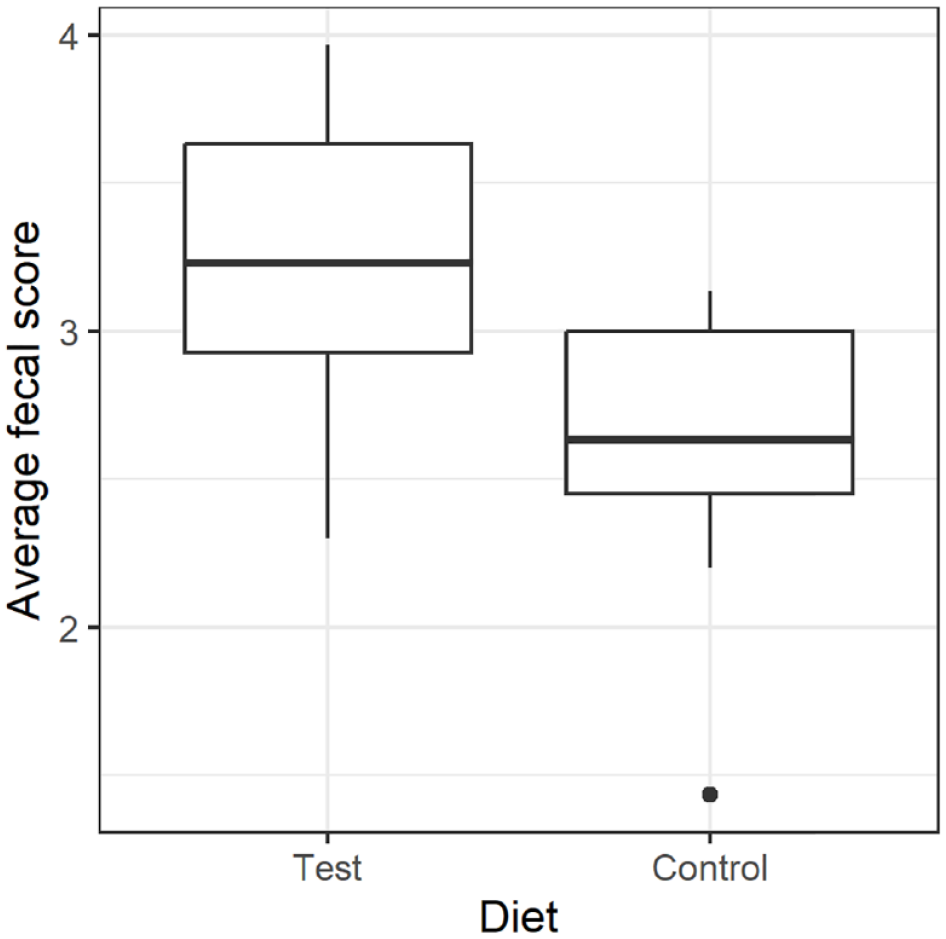
Box plot of mean faecal scores during the last 3 days of the 10-day feeding periods of the test diet, containing 6% psyllium, followed by the control diet, containing 6% cellulose (n = 9, healthy adult neutered cats)
An example of the typical difference in faecal consistency associated with the test and control diets is given in Figure 3, which shows faeces produced by one cat while receiving each diet. The stool produced from the test diet was softer than that from the control diet, while still retaining some form.

Representative photographs of bowel movements from a single cat during the last 3 days of the 10-day consecutive feeding periods of (a) the test diet, containing 6% psyllium, and (b) the control diet, containing 6% cellulose
Faecal analysis
The moisture content (%) and wet weight of the faeces over the 3-day collection periods were statistically significantly higher when the test diet was fed compared with when the control diet was fed (Table 5, Figures 4 and 5).
Faecal moisture content and wet weight during the last 3 days of 10-day feeding periods of the test diet, containing 6% psyllium, followed by the control diet, containing 6% cellulose (n = 9, healthy adult neutered cats)
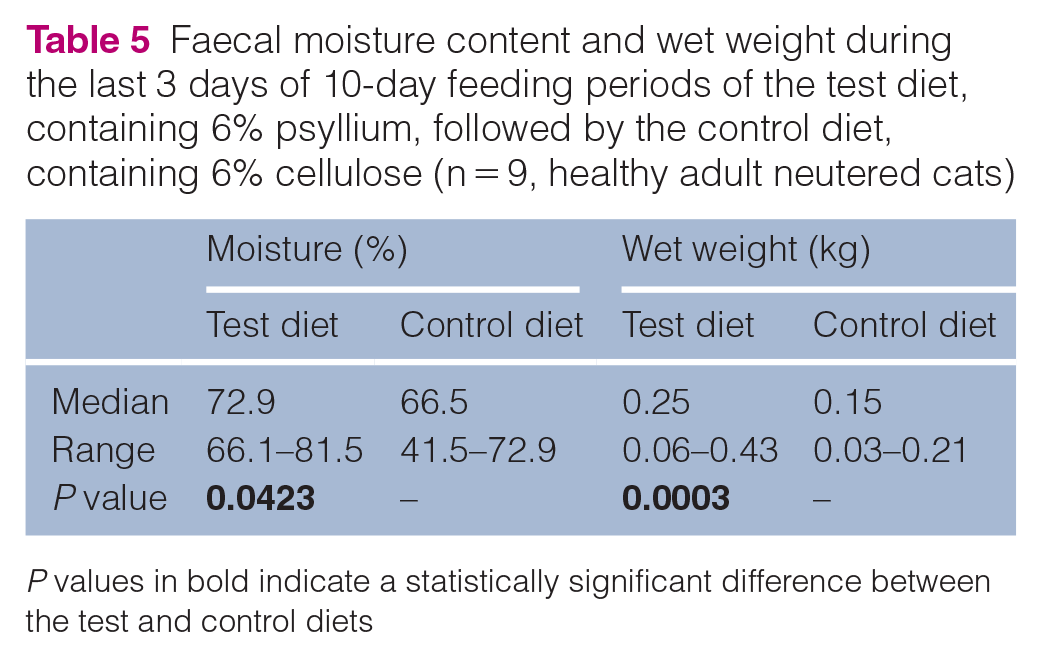
P values in bold indicate a statistically significant difference between the test and control diets
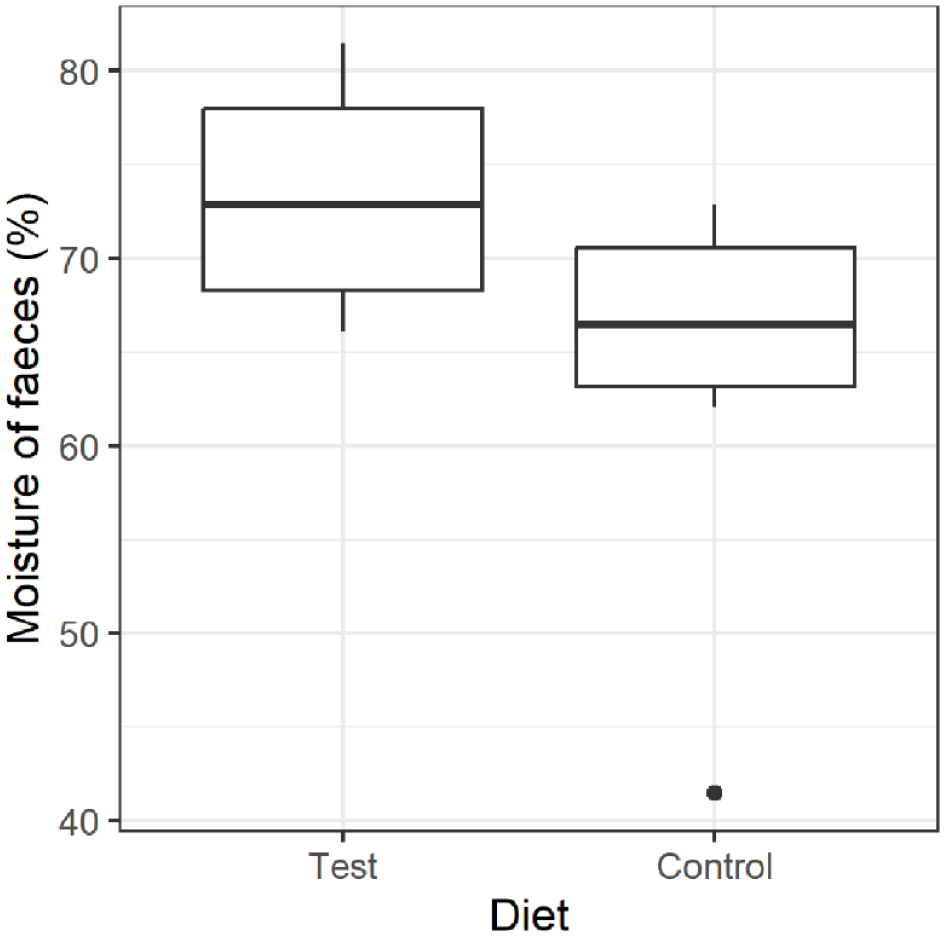
Box plot of faecal moisture during the last 3 days of the 10-day feeding periods of the test diet, containing 6% psyllium, followed by the control diet, containing 6% cellulose (n = 9, healthy adult neutered cats)
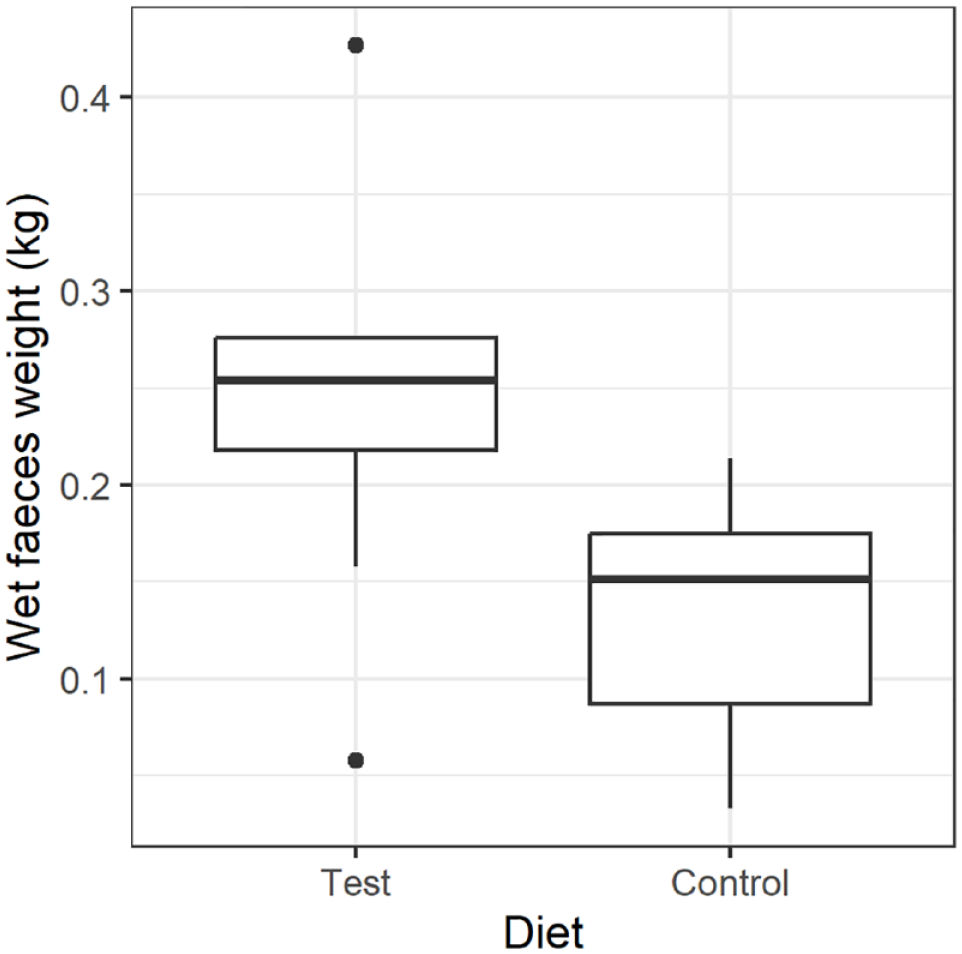
Box plot of faecal wet weight during the last 3 days of the 10-day feeding periods of the test diet, containing 6% psyllium, followed by the control diet, containing 6% cellulose (n = 9 healthy, adult, neutered cats)
Discussion
The treatment generally recommended for mild constipation in cats is the incorporation of fibre into the diet. This study evaluated the effect of a diet containing psyllium on defecation frequency, faecal score, faecal weight and faecal moisture in healthy cats. Feeding the test diet over 10 days resulted in a higher number of bowel movements and softer faeces with a greater moisture content compared with the control diet.
All dietary fibre increases faecal bulk and affects the transit of the stool though the intestine. 3 In this study, psyllium, a soluble, mucilaginous fibre, had a significant effect compared with cellulose, an insoluble fibre. This is likely to be related to the greater water-holding capacity of psyllium and the consequent softer consistency of the stool. These results suggest that psyllium would have a greater relieving effect in mildly constipated cats compared with cellulose, although the degree of efficacy would depend on the root cause of the constipation. For example, human patients with constipation associated with slow transit or dyssynergic defecation are less likely to respond to increased dietary fibre compared with patients without a pathological finding. 7
An increase in the frequency of defecation is associated with a reduction in colonic transit time that results in less fluid being removed from the stool. 1 Solid faeces pass through the large bowel by high-amplitude, infrequent, slow-moving pressure waves. 8 The presence of mucilage in the stool increases the volume, so stimulating peristalsis, decreasing the intraluminal pressure and giving the signal that the intestine should evacuate the stool. 6 In addition, the softening of faeces reduces its viscosity, and therefore the propulsive events are more effective at increasing both colonic transit speed and frequency of passing stools.7,9 This was demonstrated by the difference between diets in the consistency of faeces measured by faecal score, greater faecal moisture content, higher faecal wet weight, as well as a higher number of bowel movements with the test diet vs the control diet.
Conclusions
This study demonstrated that psyllium seed husk promotes bowel movements, higher faecal moisture and a softer faecal consistency in healthy cats, all of which would be beneficial in the management of feline constipation. This is attributed to its propensity to form a gel, 4 which can promote the transit of faeces. These results are consistent with a previous, uncontrolled clinical trial 4 and support the use of psyllium in the management of chronic constipation in cats. Additional studies are needed to evaluate the effects of psyllium seed husk in cats with constipation/obstipation.
Footnotes
Author note
This paper was presented at the 2023 European College of Veterinary Internal Medicine - Companion Animals (ECVIM-CA) Congress.
Conflict of interest
EK, JL, NT, PBvK and IvH are employees of Royal Canin SAS, a division of Mars Petcare.
Funding
The study was funded by Royal Canin, Mars Petcare.
Ethical approval
The work described in this manuscript involved the use of experimental animals and the study therefore had prior ethical approval from an established (or ad hoc) committee as stated in the manuscript.
Informed consent
Informed consent (verbal or written) was obtained from the owner or legal custodian of all animal(s) described in this work (experimental or non-experimental animals, including cadavers) for all procedure(s) undertaken (prospective or retrospective studies). No animals or people are identifiable within this publication, and therefore additional informed consent for publication was not required.
