



Abstract
Practical relevance:
Diabetes mellitus is the second-most common feline endocrinopathy, affecting an estimated 1/200 cats. While the underlying causes vary, around 15-25% of cats with diabetes mellitus develop the condition secondarily to progressive growth hormone (GH)-induced insulin resistance. This typically results in a form of diabetes that is challenging to manage, whereby the response to insulin is very variable or high doses are required to achieve even minimal diabetic control.
Clinical challenges:
Although uncontrolled chronic excessive GH may result in phenotypic changes that raise suspicion for acromegaly, many cats with hypersomatotropism (HST) do not have these changes. In these situations, a clinician's index of suspicion may be increased by the presence of less dramatic changes such as marked polyphagia, stertor or uncontrolled diabetes mellitus. The current diagnostic test of choice is demonstration of a markedly increased serum insulin-like growth factor 1 (IGF1) concentration, but some affected cats will have only a marginal increase; additionally, chronic insulin administration in cats results in an increase in serum IGF1, making the diagnosis less clear cut and requiring additional confirmatory tests.
Evidence base:
Over the past two decades, HST has increasingly been recognised as an underlying cause of diabetes mellitus in cats. This review, which focuses on diagnosis and treatment, utilises data from observational studies, clinical trials and case series, as well as drawing on the experience of the authors in managing this condition.
Introduction
Physiology of growth hormone
Growth hormone (GH) in cats is almost exclusively produced by somatotrope cells in the anterior pituitary gland. In humans, there are several isoforms of GH due to alternate splicing, with the 191 amino acid 22 kDa variant being the most abundant and physiologically important form. The GH isoforms in cats are yet to be described. GH circulates as unbound and protein-bound forms, with protein binding prolonging the half-life and reducing the oscillations of circulating GH concentrations. The circulating half-life of GH in humans is around 30 mins. 1
GH secretion is pulsatile and its regulation complex. The main stimulus for GH secretion is GH-releasing hormone from the hypotha-lamus. Other known stimuli include alpha-adrenergic agonists and ghrelin, but GH secretion is not significantly altered by hypoglycaemia in cats, unlike many other species. 2 Inhibitors of GH secretion include beta-adrenergic agonists, insulin-like growth factor 1 (IGF1), somato-statins and dopamine receptor 2 agonists (Figure 1).

In this schematic diagram showing how growth hormone (GH) secretion is regulated, green arrows represent stimulatory actions while red arrows represent inhibitory actions. Yellow arrows represent target organs for the labelled hormones. GH-releasing hormone (GHRH) is produced in the hypothalamus and stimulates GH release from somatotropes in the anterior pituitary. In concert with insulin, GH stimulates insulin-like growth factor 1 (IGF1) synthesis and secretion from hepatocytes. GH and IGF1 affect multiple tissues, including adipose tissue, bone and muscle. Negative feedback on GH secretion is exerted directly via GH and IGF1, and indirectly via centrally secreted somatostatin ± dopamine
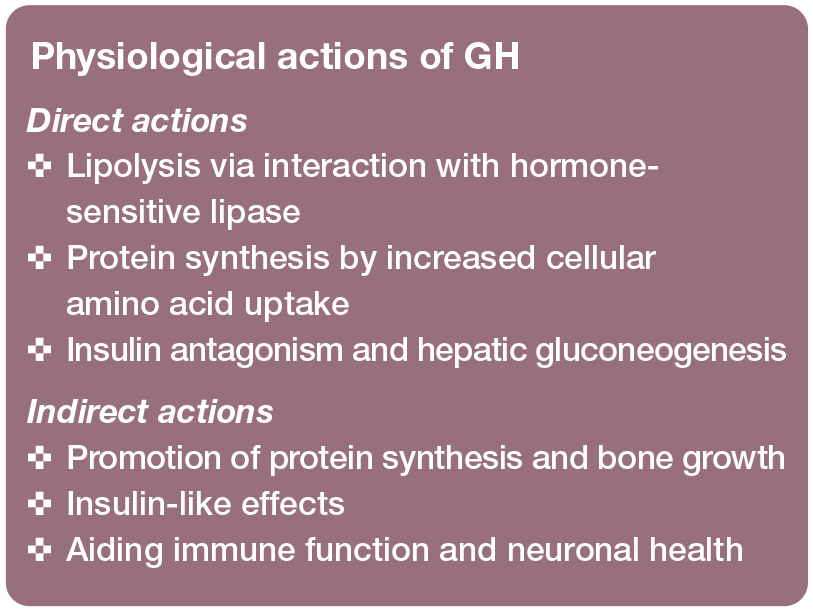
GH exerts both direct and indirect effects (see 'Physiological actions of GH' box), the latter mediated by GH-induced hepatic synthesis and secretion of IGF1.3-5 Similar to GH, IGF1 circulates as unbound and protein-bound forms. Serum half-lives are 10-30 mins and 12-15 h, respectively. 6
Effects of hypersecretion
The cause of chronic excessive GH in cats is almost always a GH-secreting pituitary adenoma/neuroendocrine tumour. This results in numerous physiological alterations, such as excessive soft tissue and bone growth. 7 These alterations can cause phenotypic changes and led to the condition being called acromegaly in people, a term first introduced in 1886 by the French neurologist Pierre Marie. 8 As phenotypic changes were identified in only 26% of individuals with chronic excessive GH in one feline study, the term hypersomato-tropism (HST) is commonly used to describe the condition in cats. 9 Other clinical consequences include neurological signs due to space-occupying effects of some pituitary tumours, a hypertrophic cardiomyopathy (HCM) phenotype, osteoarthritis and arthral-gias. 10 The other main sequela is glucose intolerance, which is discussed below.
GH, IGF1 and glucose
GH antagonises insulin by reducing muscular glucose uptake, decreasing glucose oxidation and increasing gluconeogenesis.11,12 GH also stimulates increased IGF1 secretion, which enhances insulin sensitivity and improves glycaemic control in individuals with extreme insulin resistance. 13 There is a high degree of sequence homology between the insulin receptor and IGF1 receptors, which allows insulin and IGF1 to activate each other's receptors. However, IGF1 has only 10% of the activation potency of insulin at the insulin receptor. 14 The relationship between GH and IGF1 is non-linear, and with IGF1-binding proteins also affecting the availability of IGF1 to activate the insulin receptor, the effect on glycaemic homeostasis is likely to have high interindividual variability. Regardless, the global consequence is insulin resistance. 15
The prevalence of diabetes mellitus in human patients with acromegaly is 12-38%, and impaired glucose tolerance occurs in up to 54% of people with acromegaly.16,17 Diabetes mellitus is more common in those who have had a longer disease duration.18,19 This insulin resistance is reversible with control of the acromegalic condition.19,20
In veterinary medicine, almost all cats diagnosed with HST have concurrent diabetes mellitus. One cat diagnosed with HST but without diabetes mellitus developed overt clinical diabetes several months after the initial diagnosis. 21 The outcome of this patient adds weight to the idea that diabetes mellitus develops as a consequence of uncontrolled HST, with some cats progressing further to extreme insulin resistance.
Presenting signs and diagnostic testing
HST has an insidious progression in humans, and this is likely to be the case in cats. The most common scenario is that GH-induced insulin resistance is recognised at the point that it progresses to overt diabetes mellitus. Studies in Argentina, mainland Europe and the UK have reported a 15-25% prevalance of concurrent HST among feline diabetic patients.9,22,23 Weight gain with poorly controlled diabetes mellitus occurs in roughly 17% of cats with HST, while 42% experience weight loss. 24 The clinical characteristics of 133 cats with a diagnosis of HST are presented in Table 1.
Clinical data for 133 cats diagnosed with HST presenting to the Royal Veterinary College, UK

Data are the authors' unpublished observations, and represent median (range) and IQR, unless otherwise stated
HST = hypersomatotropism; IGF1 = insulin-like growth factor 1; IQR = interquartile range; RIA = radioimmunoassay
Other common presenting signs in cats include polyphagia and increased soft tissue growth, with resulting snorting and stertor.25,26 Physical examination may identify broad facial features, clubbed feet and organomegaly. 26
Biochemical testing
Aside from changes consistent with diabetes mellitus, there are no routine blood or urine test results that are indicative of HST. The current blood test of choice is measurement of serum IGF1. An IGF1 concentration of >1OO0 ng/ml measured using a commercial radio-immunoassay (RIA) had a positive predictive value of 95% for the diagnosis of HST in cats in the UK. 9 It is noteworthy that this study assessed IGF1 in cats with diabetes mellitus, and this cut-off may not be applicable to different populations of cats. An IGF1 concentration between 7OO and 1OOO ng/ml using this RIA represented a 'grey zone'. Ideally, measurement of serum/plasma GH would also be performed, particularly in a patient with a 'grey zone' result.
A GH RIA has been validated for use in cats, 27 and a basal serum GH concentration of >8 ng/l was consistent with a diagnosis of HST in that study. However, random GH assessment is an insensitive test for acromegaly in people and this may also be true for cats with a milder condition. Dynamic GH suppression testing would be more favourable than basal GH testing; the 'gold standard' test in human medicine is an oral glucose tolerance test, while the octreotide suppression test has been utilised in veterinary medicine. It should be noted that the sensitivity of the latter test is compromised because of the limited range of somatostatin receptors expressed in feline HST that are suppressed by octreotide.28,29
Currently, the authors recommend that for patients with 'grey zone' IGF1 results, either repeat testing of IGF1 is undertaken at a later timepoint or intracranial imaging is performed.
Intracranial imaging
The normal pituitary dorsoventral dimension (height) in cats, as assessed using contrast-enhanced CT or MRI, is <3.8 mm.30,31 Pituitary enlargement/neoplasia affects fewer than 2% of cats,9,32 with somatotroph adenomas being the most common feline pituitary neoplasm.33,34 Therefore, the combination of pituitary enlargement and an IGF1 concentration >7OO ng/ml, assessed using an RIA, is highly suggestive of HST in cats. Up to 94% of cats with HST have pituitary enlargement identified using CT imaging. 7 Small pituitary lesions may require MRI for identification, but it is also possible for a cat to have HST without pituitary enlargement being identified using either imaging modality.9,26
Additional findings
As GH induces soft tissue growth, cats with HST might reasonably be expected to have organomegaly. GH-induced soft tissue growth has been documented in a post-mortem investigation (unpublished data from the authors' institute). The study retrospectively analysed the histopathology reports of haematoxylin and eosin-stained tissue samples of 60 cats with HST and diabetes mellitus, 12 cats with diabetes mellitus only and a control population of 75 cats. The specific organs assessed were the pancreas, thyroid, parathyroid and adrenal glands, spleen, liver, kidneys and heart. The cats with HST and concurrent diabetes mellitus had a higher incidence of hyperplasia within the assessed tissue(s) compared with those with diabetes mellitus only or control cats.
Visceral organomegaly was also reported in an ultrasonographic study, with adrenal thickness, renal length and left pancreatic limb thickness being significantly greater in cats with HST compared with control cats. 35
GH and IGF1 concentrations have been increased in some cats with an HCM pheno-type, with 6.7% of such cats having IGF1 concentrations >1000 ng/ml.36-38 It is, therefore, possible that some cats with an HCM phenotype as their only presenting sign have concurrent HST. This is particularly noteworthy as the HST-associated HCM pheno-type is reversible following hypophysectomy (see later). 39
Treatment approaches
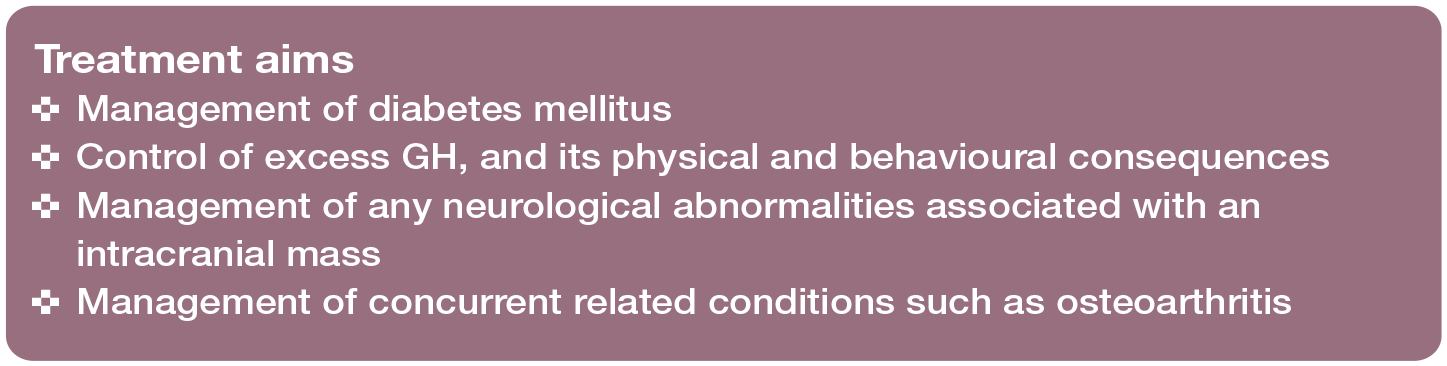
The quality of life of humans with acromegaly is improved following biochemical control of GH and IGF1, and management of ongoing clinical signs. 40 Quality of life in cats with the HST condition is decreased, more markedly so than in cats with diabetes mellitus alone. 41 Therefore, although successful management of diabetes mellitus is a key consideration when deciding on a strategy to manage HST, successful control of excess GH and any other clinical signs also seems to be important (see 'Treatment aims' box).
Treatment options can be divided into three broad categories: medical management, pituitary radiotherapy and pituitary surgery (hypophysectomy).
Medical management
Diabetes mellitus management
Consensus guidelines from the International Society of Feline Medicine and the American Animal Hospital Association on the management of feline diabetes mellitus apply equally to the treatment of HST-induced diabetes mellitus.42,43 Optimising body weight, use of long-acting insulin and feeding of an appropriate diet are key to achieving good gly-caemic control, as evidenced by an acceptable 'diabetic clinical score'. 44
Biochemical control of HST
There are several medical management options used in humans with acromegaly, including administration of somatostatin analogues, dopamine receptor 2 agonists and GH receptor antagonists. The two drug families that have been shown to improve biochemical control of HST and diabetes mellitus in cats are somatostatin analogues and dopamine receptor 2 agonists. This is not surprising as the feline pituitary gland expresses somato-statin receptor (SSTR) subtypes 1, 2 and 5, and dopamine receptor 2, all of which are targets for these drug families. 45
Pasireotide is the somatostatin analogue that has been the most effective in achieving biochemical control of HST in cats. This analogue has high binding affinity for SSTR subtypes 1, 2, 3 and 5, which leads to inhibition of GH secretion.46,47 Short- and long-acting formulations have been trialled in cats with HST.48,49 The authors start with 0.03 mg/kg q24h SC of the short-acting formulation and escalate the dose to q12h if there is an incomplete response. There is typically a rapid response to treatment, with patients requiring lower insulin doses and IGF1 concentrations decreasing within 5 days. The main adverse effects are gastrointestinal upset, with voluminous and pungent cowpat-like stool being common.
Cabergoline is the dopamine agonist of choice because of its longer duration of action and greater affinity for dopamine receptor 2 compared with bromocriptine. Cabergoline is recommended for 'mild' acromegaly (IGF1 <1.5 times the upper reference interval, mild clinical signs) in humans and achieves biochemical control in around one-third of patients.50,51 The response to cabergoline in cats with HST has been, at best, variable; however, this could be due to too many (UK) treated cats having HST that is too severe to respond to this treatment. A study in the UK using a cabergoline dose of 10 [ig/kg q24h reported no improvement in IGF1 concentrations (median starting IGF1 concentration >2000 ng/ml) or diabetic control in eight cats that completed the 90-day treatment period. 52
A second study, in Argentina, using a cabergo-line dose of 10 [ig/kg q48h, reported diabetic remission in 8/22 cats that completed 6 months of treatment; IGF1 normalised in 6/23 cats (median starting IGF1 concentration 135O ng/ml), with those having smaller pituitary masses being more likely to achieve IGF1 control. 53 The greater likelihood of response to cabergoline in patients with smaller pituitary masses may be due to dopamine receptor 2 expression being decreased as pituitary mass size increases. 45
An option that has been utilised in human medicine is the concurrent use of a somato-statin analogue and dopamine receptor 2 agonist. This approach was reported to achieve biochemical control in around 5O% of patients who had experienced a partial response to somatostatin analogue therapy alone. 54 The rationale behind this approach is that dopamine receptor 2 and SSTR subtype 5 can heterodimerise, and thus combination treatment enhances the functional activity of both drugs. This approach has been trialled by the authors, without success to date, but could be considered when other treatment options are not available.
Other medical management
In addition to control of HST through GH inhibition, individual patient factors will determine other medical management protocols, including analgesia if there is osteo-arthritis, antithrombotics if there is significant cardiac disease, and furosemide if the patient has experienced a congestive heart failure event.
Pituitary radiotherapy
Fractionated and stereotactic pituitary radiotherapy protocols have been described in humans and cats to manage HST. In humans, up to 5O% of patients achieve condition remission, while another 25% achieve stable disease, by 2-5 years post-treatment. Approximately 9O% of patients experience a reduced tumour volume in these time periods.55,56
Based on two published studies of stereo-tactic radiotherapy in cats,57,58 the treatment is generally well tolerated, with mild radiation-associated side effects seen in up to 2O% of cats. Diabetic remission was reported to occur in 21-34% of cats, with a median time to lowest insulin dosage being 9-13 months post-treatment. IGF1 control was not described in either study.
Fractionated pituitary radiotherapy has been reported in several studies; however, the specific outcomes of the cats with HST is not always clear.59-63 Where patients with HST can be identified, diabetic remission was achieved in 17-62% of cases; diabetic improvement occurred within 2 months, with diabetic remission reported at a median of 17 weeks post-treatment in one study. 62 IGF1 concentration was not monitored in most studies; however, it remained increased in one case despite improved diabetic control. 59
Survival times for each treatment modality range widely, with median survival times of 1O72 days being described, 57 and an improvement in neurological signs being the most consistent response. The authors' view is that pituitary radiotherapy is best limited to those individuals with neurological signs secondary to a pituitary mass effect.
Pituitary surgery
In human medicine, acromegaly is managed by surgical resection of the pituitary mass, unless the patient is a poor candidate for the procedure.50,64 Centres that regularly perform this surgery are more likely to achieve disease remission and have a lower complication rate. 65 Likewise, a learning curve for the procedure has been identified in veterinary medicine. 66 Currently, in veterinary medicine, hypophysectomy is performed rather than pituitary adenonectomy due to difficulties differentiating healthy from neoplastic pituitary tissue. To date, two centres (in the UK and the Netherlands) have described this treatment in cohorts of cats. The diabetic remission rate was between 71% and 92%, IGF1 control occurred in 9O% of patients that survived the first 4 weeks postoperatively, and a mortality rate of 4-15% was reported, with median survival times of 853-1347 days.67,68 Most patients resume eating and drinking the same day as the surgery and are discharged around 1 week postoperatively. Postoperative treatment regimens include glucocorticoid, thyroid hormone and vasopressin supplementation.
Postoperative hypoglycaemia has been reported in 14-16% of cats, and, in some cases, even after insulin treatment has been discon-tinued.67,68 In the UK study, sepsis accounted for the hypoglycaemia in 4/9 cats, one cat had no underlying identifiable cause and the remaining cats responded to supplemental glucose and/or an increase in the glucocorti-coid dose. 67 Hypoglycaemia occurred in 4/25 cats in the Dutch study, with 3/4 cats having an inappropriately increased serum insulin concentration during the hypoglycaemic event. 68 The authors of that study prescribed diazoxide for three cats that became hypogly-caemic after exogenous insulin administration had already been discontinued, and suggest diazoxide treatment for cats that become hypoglycaemic if additional glucocorticoids are insufficient to maintain normoglycaemia.

As improved quality of life is the key outcome when managing a patient, hypo-physectomy seems to be the treatment of choice. 69 It is likely that improved IGF1 control with hypophysectomy has unseen effects, which result in quality-of-life improvement that extends beyond effective control of diabetes mellitus. See the 'Factors affecting serum IGF1 concentration' box for a discussion of practical considerations when interpreting IGF1 values.

Key Points
✜ Diabetes mellitus is the end result of pancreatic beta cell failure, which may have many underlying causes. A pituitary adenoma leading to excessive GH is the cause in 15–25% of diabetic cats in the UK.
✜ Phenotypic changes associated with HST are commonly not recognised by veterinarians.
✜ Treatment of cats with HST is aimed at improving quality of life by adequately controlling the diabetes mellitus and any other concurrent comorbidities.
✜ Several treatment options are available for the management of HST, including medical management, pituitary radiotherapy and pituitary surgery. Hypophysectomy is associated with the highest quality of life post-treatment.
Footnotes
Conflict of interest
The authors declared no potential conflicts of interest with respect to the research, authorship, and/or publication of this article.
Funding
The authors received no financial support for the research, authorship, and/or publication of this article.
Ethical approval
This work did not involve the use of animals and therefore ethical approval was not specifically required for publication in ]FMS.
Informed consent
This work did not involve the use of animals (including cadavers) and therefore informed consent was not required. No animals or people are identifiable within this publication, and therefore additional informed consent for publication was not required.