



Abstract

Introduction
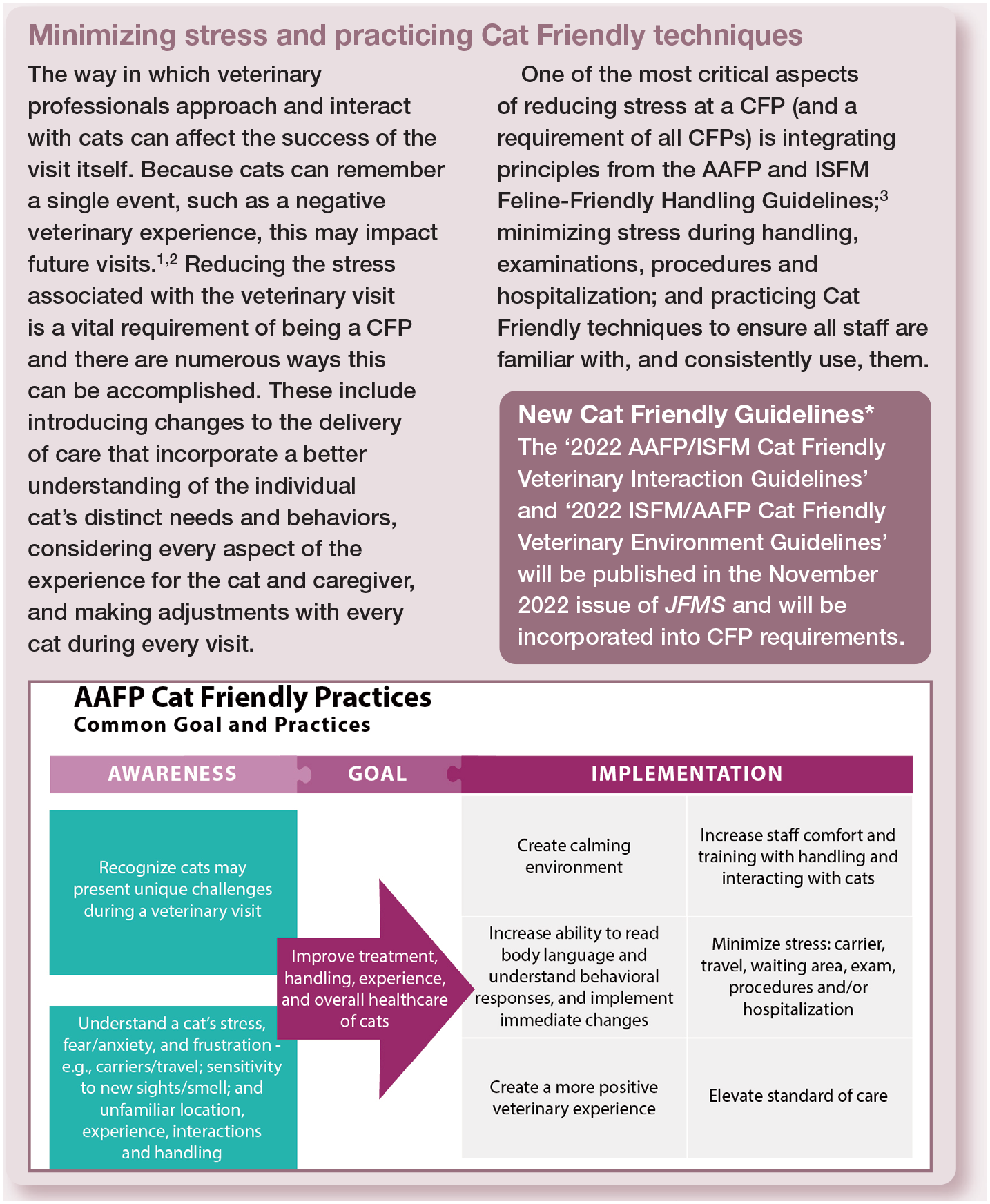
The Cat Friendly Practice (CFP) Program, launched by AAFP alongside the Cat Friendly Clinic programme by ISFM in 2012, provides veterinary professionals and practices with a checklist of criteria and foundational resources to ensure the best care and treatment for cats. Over the past 10 years, implementing these strategies and integrating Cat Friendly processes have allowed veterinary practices to create a positive veterinary experience not only for cats and their caregivers, but also for the entire veterinary team.
The AAFP partnered with the American Veterinary Medical Association Professional Liability Insurance Trust (AVMA PLIT) to conduct a quantitative analysis of workers’ compensation data from 2015 to 2018 to determine if having a reduced risk of injury is also part of the positive experience that comes with being a CFP. As employee safety is central to a healthy and productive veterinary practice, it was posited that practices that had obtained their CFP status, where principles from the AAFP and ISFM Feline-Friendly Handling Guidelines 1 (see box*) were implemented, would see a reduction in workers’ compensation claims.
Why analyze workers’ compensation claims?
Workers’ compensation claims can be a major cost in a veterinary practice. High frequencies and severities of workers’ compensation claims can have a negative impact on a practice’s experience modification factor, which is a multiplier used to calculate a workers’ compensation premium when compared with other policies of similar size within that industry. In most states within the USA, a workers’ compensation modification factor is determined by the National Council on Compensation Insurance (NCCI) by analyzing the cost of losses from a practice and establishing a comparison with the rest of the industry. This modification factor directly affects how much a practice pays for workers’ compensation insurance, and practices with a high modification factor may have to pay 10-50% increased premiums compared with their industry peers with lower modification rates. 4 It is therefore crucial for veterinary practices to explore methods with which they can directly lower their claim costs.
Methods
The AVMA PLIT, as well as HUB International, in partnership with veterinary industry-specific insurance carriers, analyzed workers’ compensation data claims from 2015 to 2018. The industry average workers’ compensation claims data within this report were a snapshot of roughly 10,000 workers’ compensation claims in this 4-year time frame and the benchmark resource for the analysis. Of the ~10,000 total workers’ compensation claims, 641 were from veterinary practices that had an active CFP designation. These workers’ compensation claims filed by AAFP CFPs were compared with the ~10,000 claims filed by all practices covered under the AVMA PLIT Program from 2015 to 2018.
Results and analysis
Workers’ compensation claims
The AVMA PLIT/HUB International found that 48% of overall claims coded to an ‘animal attack’ (the code used in insurance systems) were due to contact with a feline patient.
A further finding was that of the overall workers’ compensation claims, 42% were from those employed at the practice for less than 1 year at the time of filing, suggesting that a newer workforce with less experience is more likely to sustain a workplace-related injury.
Of the overall workers’ compensation claims, 48% coded to an ‘animal attack’ were due to contact with a feline patient

Of the overall workers’ compensation claims, 42% were from those employed at the practice for <1 year

CFP overall claims compared with industry average
When comparing all claims submitted by CFPs with other veterinary practices, the overall average by a CFP was US$1906 per claim. The overall industry average was US$2741 per claim.
Animal contact claims
Out of all the claim types, an animal contact claim was the most prevalent, with 7 out of 10 claims related to an incident with an animal bite or scratch. Analysis by AVMA PLIT/HUB International showed the industry average of a workers’ compensation claim, which is the result of contact or exposure to a pet, cost US$1585 per claim. The same type cost a CFP US$870 per claim.
In addition to experiencing reduced costs per claim across all species, CFPs averaged US$831, compared with the industry average of US$1089, per feline exposure claim.
Body part affected
The largest number of workers’ compensation claims in relation to the body part affected for all veterinary practices was attributed to hand and wrist injuries. Similarly, out of the 641 total claims filed by CFPs, 397 (62%) were for the hands and wrist. The average cost incurred for these claims was US$1015, compared with the industry average of US$1288.
Animal contact claim costs by species compared between Cat Friendly Practices and industry averages

Conclusions and summary
This analysis shows that, with proper training in understanding feline behavioral responses and the implementation of Cat Friendly interactions and handling methods, CFPs have a significant financial reduction in the cost of their workers’ compensation claims. In particular, the CFP Program emphasizes reducing stress, fear/anxiety and frustration during the veterinary experience and creating a calmer environment that directly correlates with overall employee safety and satisfaction. Moreover, in the instances in which an incident does occur, the cost per claim is significantly lower than in veterinary practices that do not employ the same techniques. This will directly affect a practice’s modification factor, which will in turn decrease the cost of the workers’ compensation policy insurance premium.
It was also indicated that, in general, younger veterinary professionals incur more injuries and file more workers’ compensation claims. This supports the recommendation that working at a CFP and receiving additional training, especially in understanding feline behavioral responses, Cat Friendly interactions and Cat Friendly handling techniques, will help reduce injuries.
Footnotes
Acknowledgements
Data collection and analysis were performed and provided courtesy of the AVMA PLIT Program and conducted by Scott Simpson, Risk Consultant through HUB International, with the AVMA PLIT.