




Abstract
Objectives
This study aimed to compare the analgesic effect between carprofen and grapiprant every 12 or 24 h on postoperative pain in cats undergoing ovariohysterectomy, in addition to the effects on the hematological, biochemical and urinalysis variables.
Methods
A total of 32 female cats were randomly divided into three groups, according to the treatment administered with the first dose given orally 90 mins before surgery, as follows: CAR (cats received 4 mg/kg carprofen, n = 11); GRA1 (cats received 2 mg/kg grapiprant, n = 10); and GRA2 (cats received 2 mg/kg grapiprant q12h, n = 11). Pain was assessed by UNESP-Botucatu Multidimensional Composite Pain Scale (UNESP) and Glasgow Feline Composite Measure Pain Scale (GLASGOW) for cats preoperatively (baseline) and at 1, 3, 6, 8, 12 and 24 h after extubation. Venous blood was collected at baseline, and 12 and 24 h after the administration of carprofen or grapiprant to perform a complete blood count (CBC), the percentage of Heinz bodies and serum biochemistry (alanine aminotransferase, aspartate aminotransferase, alkaline phosphatase, gamma-glutamyltransferase, creatinine and urea). Urinalysis was performed at baseline and 24 h after extubation. Glucose levels were evaluated at baseline and 1 h postoperatively.
Results
Pain scores were not significantly different among groups in both scales, although pain was higher at 3 h in comparison with 24 h in all groups. In the GRA1 and GRA2 groups, 67% (14/21) of cats needed rescue analgesia compared with 18% (2/11) in the CAR group. Glucose increased from baseline to 1 h in the GRA1 and GRA2 groups. None of the CBC, serum biochemistry and urinalysis variables differed among groups.
Conclusions and relevance
Grapiprant did not promote adequate analgesia during the first 3 h postoperatively in cats undergoing ovariohysterectomy compared with carprofen, and no benefits were observed by administering grapiprant every 12 h.
Introduction
Non-steroidal anti-inflammatory drugs (NSAIDs) are widely used in veterinary practice. In addition to their anti-inflammatory, antipyretic and analgesic action, the use of NSAIDs is also associated with adverse effects, such as gastric and duodenal bleeding and acute kidney injury, as well as idiosyncratic acute hepatocellular necrosis in dogs. 1 These effects are induced by the inhibition of cyclooxygenase (COX) enzymes, target molecules of NSAIDs, and, for this reason, caution is advised when prescribing such medications for renal and hepatic impaired patients or patients with concurrent gastrointestinal disease, among other conditions. 1 The goal of inhibiting COX is to avoid generating prostanoids from the arachidonic acid cleavage, especially prostaglandin E2 (PGE2), which is the main lipid mediator that contributes to inflammatory pain by sensitization of sensory neurons. 2 PGE2 acts by binding to four (EP1–EP4) G-protein-coupled receptors expressed by primary sensory and dorsal root ganglia (DRG) neurons after peripheral inflammation.2–4 The EP4 receptor has been identified as the primary mediator of PGE2-induced sensitization and inflammation.2,4–7
Grapiprant is a novel analgesic and anti-inflammatory drug that specifically antagonizes the PGE2 receptor, EP4, and its pharmacokinetics parameters and safety have already been demonstrated in cats.8,9 In rats and dogs, the administration of different EP4 receptor antagonists has been found to reduce the nociceptive hypersensitivity in acute and chronic models of inflammatory pain.4,10,11 However, no studies regarding the analgesic effects of EP4 receptor antagonists in cats were found in the databases.
Carprofen is a preferential COX-2 inhibitor in the cat, capable of blocking the synthesis of PGE2. 12 This NSAID reaches its maximum serum concentration about 3 h after oral administration and is an effective analgesia in cats undergoing ovariohysterectomy (OVH) in comparison with pethidine, 13 meloxicam 14 or buprenorphine. 15
This study aims to compare the analgesic effect between carprofen and grapiprant every 12 or 24 h on postoperative pain in female cats undergoing elective OVH, in addition to the effects of the three treatments on the hematological, biochemical and urinalysis variables.
We hypothesize that by blocking the EP4 receptors in the peripheral sensory terminals, the analgesia provided by the administration of grapiprant will not significantly differ from the analgesic effect of carprofen. Furthermore, the hematological and biochemical profiles will not be significantly different among the three treatments.
Materials and methods
Animal selection
The institutional Ethics Committee on Animal Use from Universidade Federal de Santa Maria (number 8735260121) approved the study. A total of 33 client-owned female cats that were admitted for elective OVH by a ventral midline celiotomy were enrolled after informed written consent was signed by the owners. The cats weighed 2–5 kg and were aged 12–60 months. All cats enrolled were deemed to be healthy, based on physical, hematological and biochemical evaluation (total blood count, albumin, alanine aminotransferase [ALT], aspartate aminotransferase [AST], alkaline phosphatase [ALP], gamma-glutamyltransferase [GGT], total proteins [TPs], fructosamine, creatinine and urea). The cats were also negative for feline immunodeficiency virus (FIV) and feline leukemia virus (FeLV) infection (ALERE/BIONOTE FIV Ac/FeLV Ag Test Kit). Included animals tolerated manipulation by not demonstrating fear-based aggression to blood collection, hair clipping and measurement of systolic blood pressure with Doppler sphygmomanometry.
Cats acclimatized for 3 days before administration of treatment and surgery. Throughout both phases, animals were housed in a quiet room in individual cages of 1 m³ enriched with cardboard boxes, pillows, blankets and toys. During the acclimatization period, cats were followed by an investigator for 16 h a day to help the cats adapt to the presence of people and handling. Food and water were provided ad libitum, except for 8 h preoperatively when food, but not water, was withheld.
Study protocol
Cats were randomly allocated into three groups by drawing pieces of paper with group identifications from an envelope: CAR (cats received 4 mg/kg carprofen, single dose, n = 11); GRA1 (cats received 2 mg/kg grapiprant, single dose, n = 11); and GRA2 (cats received 2 mg/kg grapiprant q12h, n = 11). All treatments were administered orally with the first dose given 90 mins before surgery (2 h before extubation) by a participant who did not take part in the anesthesia or any of the assessments. The dose of grapiprant used in this research was determined based on studies by Lebkowska-Wieruszewska et al 8 and Rausch-Derra and Rhodes 9 that identified 2 mg/kg as a safe dose for cats.
Cats were premedicated with acepromazine (0.05 mg/kg) diluted in NaCl 0.9% to a volume of 1 ml administered intravenously over 2 mins, 30 mins before anesthetic induction. General anesthesia was induced with propofol to effect administered using a syringe pump at a rate of 2.5 mg/kg/min, followed by orotracheal intubation after desensitizing the glottis with the aspersion of lidocaine 2% (0.1 ml). Anesthetic maintenance was achieved with isoflurane carried in oxygen. Intraoperative analgesia was accomplished with a remifentanil constant rate infusion (CRI; 10 µg/kg/h) via a syringe pump starting immediately after orotracheal intubation and finishing during skin closure. Remifentanil CRI was increased or decreased by 2.5 µg/kg/h if systolic blood pressure, heart rate (HR) or respiratory rate (RR) were 20% higher or lower than the pre-incisional values.
After stabilization of the anesthetic plane, a pair of proficient surgeons performed the OVH by celiotomy. 16 Throughout the anesthetic period, HR, RR, esophageal temperature, systolic, diastolic and mean blood pressures (SAP, DAP and MAP, respectively), peripheral capillary oxygen saturation (SpO2) and end-tidal carbon dioxide partial pressure (EtCO2) were monitored continuously using a multi-parameter monitor and recorded every 5 mins.
Pain evaluation
Two evaluators masked to the treatment assessed pain on the third day of acclimatization (baseline) and 1 h, 3 h, 6 h, 8 h, 12 h and 24 h after extubation. The UNESP-Botucatu Multidimensional Composite Pain Scale (UNESP) and the Glasgow Feline Composite Measure Pain Scale (GLASGOW) were used to evaluate pain. Morphine (0.1 mg/kg, IV) was administered as a rescue analgesia if scores exceeded 6 points in UNESP or 5 points in GLASGOW, followed by pain reassessment with both scales after 30 mins until normalization of the pain scores (Figure 1). The mean of the two evaluators was considered in the statistical analysis.
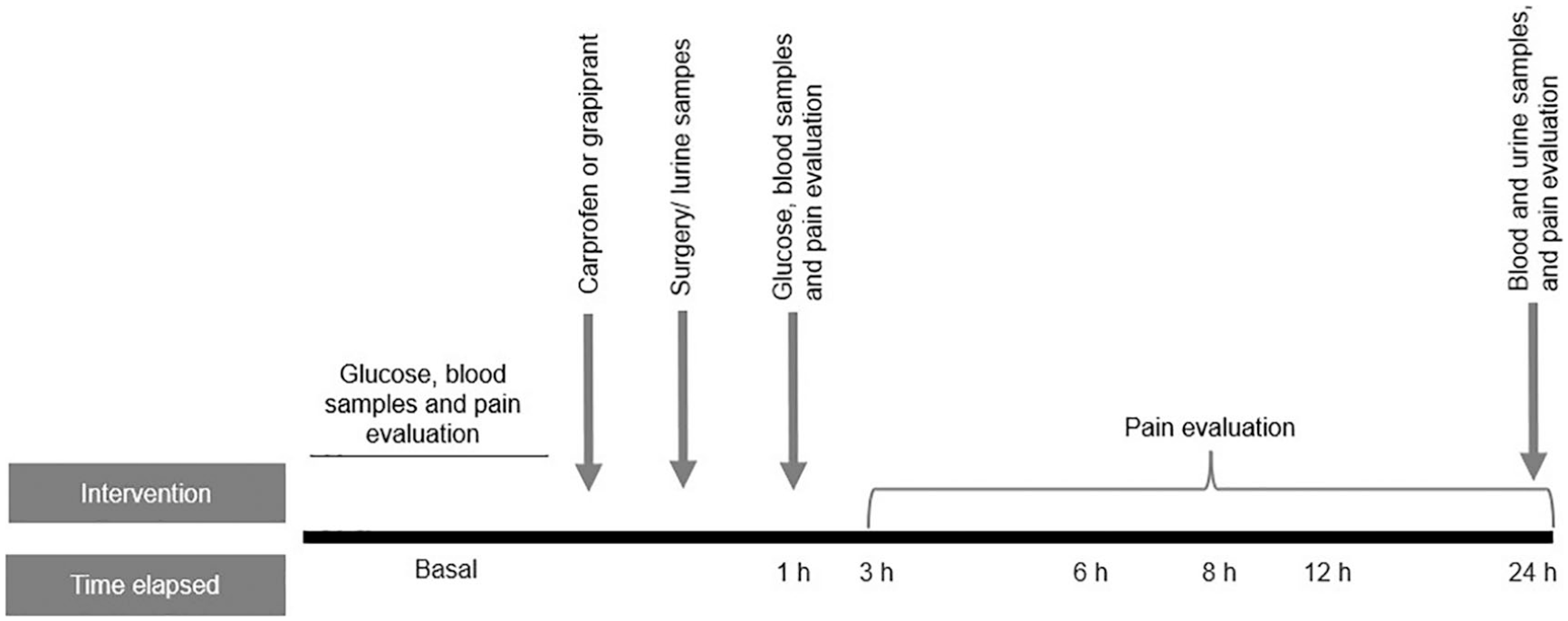
Timeline of the study design
Sample collection
The timeline of the study and sample collection is depicted in Figure 1. Since we administered grapiprant every 12 h in clinical conditions, which has not been described in the current literature, we performed hematological, biochemical and urinalysis evaluations in an attempt to identify any alterations that could occur with this dosage.
Venous blood was collected from a cephalic vein catheter after the dead space was washed with 0.5 ml of saline and the first 0.5 ml of blood discarded. Blood samples were obtained immediately before the administration of the treatments (baseline) and 12 and 24 h after the administration of carprofen and grapiprant for total blood count with the Heinz bodies (HBs) percentage and serum biochemistry (ALT, AST, GGT, ALP, creatinine and urea). Glucose levels were also assessed using a point-of-care glucometer at baseline and after 1 h.
Urine was collected by cystocentesis at baseline and catheterization at 24 h after extubation for urinalysis and evaluation of the urine protein:creatinine ratio (UPC). Urinary catheterization was performed after administering propofol (2–4 mg/kg), after the final blood collection and pain assessment.
Twenty-four hours after extubation all animals were discharged home with a prescription of carprofen 2.2 mg/kg q24h for 2 days and postoperative care. Tramadol (2 mg/kg IV) was given to all cats before discharge.
Statistical analysis
The sample size was determined based on a similar study by Pereira et al 17 in which the analgesic efficacy of two different dosages of dipyrone was compared with meloxicam. Ten cats were enrolled in each group (30 animals in total) to identify a difference of 50% of rescue analgesia between groups. In our study, we proposed using 33 cats (11 in each group).
The data were analyzed using GraphPad Prism 9.0.2 for Windows (GraphPad Software). Normality was assessed by the Shapiro–Wilk test. Data regarding observations over time (pain scores, hematocrit, leukocytes, platelets, HBs, ALT, AST, ALP, GGT, creatinine, urea, glucose levels and urinalysis variables) were analyzed by repeated-measures ANOVA with one grouping factor (CAR, GRA1 and GRA2) and one repeat factor (time), followed by Tukey’s post-hoc test. Demographic data, total anesthetic and surgery times, the time between administration of carprofen/grapiprant and extubation, and propofol dose requirement were compared among groups by Kruskal–Wallis or one-way ANOVA according to data distribution. The number of cats requiring rescue analgesia was compared among groups by Fisher’s exact test. Correlation between the two pain evaluators was assessed by Spearman’s test. Differences were considered statistically significant at P <0.05.
Results
A total of 32 cats completed the study. One animal was excluded due to the presence of pleural effusion discovered during the acclimatization period. Age and weight were significantly different among groups (Table 1). The time between the administration of the treatments and extubation, the duration of anesthesia and surgery were also not statistically different among groups, nor was the dose of propofol used (Table 2).
Age and weight of the cats included in the study

Data are expressed as median (range) or mean ± SD
CAR = carprofen 4 mg/kg single dose; GRA1 = grapiprant 2 mg/kg single dose; GRA2 = grapiprant 2 mg/kg q12h
Data regarding time between administration of carprofen/grapiprant and extubation (C/G–E) and duration of anesthesia and surgery of cats undergoing elective ovariohysterectomy

Data are mean ± SD
CAR = carprofen 4 mg/kg single-dose; GRA1 = grapiprant 2 mg/kg single-dose; GRA2 = grapiprant 2 mg/kg q12h
Analgesia assessment
Regarding evaluation of postoperative pain, no statistically significant difference was observed among treatments (P = 0.1909) by UNESP (mean ± SD for CAR 2.57 ± 0.97, GRA1 3.77 ± 1.66 and GRA2 3.21 ± 1.52), despite pain scores differing over time within the CAR and GRA1 groups (P <0.0001). In both the CAR and GRA1 groups, pain was lower at 24 h compared with pain at 3 h (P = 0.0474 and 0.0204, respectively). By GLASGOW, no statistically significant difference among groups was detected (P = 0.9608; mean ± SD for CAR 2.66 ± 0.70, GRA1 2.78 ± 1.20 and GRA2 2.79 ± 1.50), but pain differed within grapiprant-treated groups over time (P <0.0001). As with the UNESP assessment, pain at 3 h was higher than at 24 h in the GRA1 and GRA2 groups (P = 0.0439 and 0.0109, respectively), while in the GRA2 group pain at 24 h was also lower than pain at 1 h (P = 0.074) (Figure 2). The evaluator’s assessments were positively correlated for both scales (r = 0.7793, P <0.0001 and r = 0.7715, P <0.0001 for UNESP and GLASGOW, respectively).

Mean ± SD pain scores on the (a) UNESP-Botucatu multidimensional composite pain scale (UNESP) and (b) the Glasgow Feline Composite Measure Pain Scale for Cats (GLASGOW). *Statistical difference (P <0.05) compared with the evaluation at 3 h. #Statistical difference compared with the evaluation at 1 h. Dashed lines indicate the threshold score for rescue analgesia in UNESP (⩾6) and GLASGOW (⩾5). CAR = carprofen 4 mg/kg single dose; GRA1 = grapiprant 2 mg/kg single dose; GRA2 = grapiprant 2 mg/kg q12h
Of the animals, 67% (14/21) treated with grapiprant required supplemental analgesia in comparison with only 18% (2/11) in the CAR group (Fisher’s exact test, P = 0.0233).
Most of the rescue analgesia was administered in the first 3 h postoperatively. At 1 h, one animal in the CAR group (1/2) and five (5/14; 35%) in the GRA1 and GRA2 groups received morphine, while at 3 h, another animal in the CAR group (1/2) and seven in the GRA1 and GRA2 groups (7/14; 50%) required supplemental analgesia. Two animals in the GRA1 and GRA2 groups (2/14) required analgesic rescue at 6 h. Rescue analgesia was also required twice in two cats in the GRA1 and GRA2 groups, at 1 h and 3 h (1/14), and 3 h and 6 h (1/14).
Glucose levels were not significantly different among the CAR (69.18 ± 7.08 mg/dl), GRA1 (72.00 ± 26.01 mg/dl) and GRA2 (65.72 ± 14.16 mg/dl) groups at baseline and at 1 h (87.36 ± 25.18, 101.00 ± 39.62 and 102.81 ± 28.05 mg/dl, respectively; P = 0.6720). However, the GRA1 and GRA2 groups had higher glucose levels at 1 h in relation to baseline (P = 0.0031 and 0.0001, respectively), while no statistically significant difference was observed between baseline and 1 h in the CAR (P = 0.0680) group.
Hematological, biochemical and urinalysis assessments
Data regarding hematological variables are presented in Table 3. There was no statistically significant difference among treatments concerning the hematocrit levels (P = 0.8062) and time points of evaluation (P = 0.0774). Plasma proteins changed over time (P <0.0001) within the three groups, without statistical difference among groups (P = 0.3557). In both the CAR and GRA2 groups, plasma proteins were higher at baseline (P = 0.0006 and 0.0376, respectively) and 24 h (P = 0.0091 and 0.0113) than at 12 h, while in the GRA1 group proteins were lower at 12 h (P = 0.0064) and 24 h (P = 0.0101) in relation to baseline.
Hematological parameters over time for cats undergoing elective ovariohysterectomy

Data are mean ± SD. ab = different letters denote statistically significant difference (P <0.05) between time points within the same group
CAR = carprofen 4 mg/kg single dose; GRA1 = grapiprant 2 mg/kg single dose; GRA2 = grapiprant 2 mg/kg q12h
Platelets did not significantly change during all the experiment phases among treatments (P = 0.4178) or over time (P = 0.3116).
HBs were not statistically different among treatments (P = 0.2674); however, within the CAR group (P = 0.0016), the baseline values were higher than at 12 h and 24 h (P = 0.0120 and 0.0029, respectively).
Leucocytes were not statistically different among the treatments (P = 0.6353), but all three groups had an increased leucocyte count from baseline to 12 h (P = 0.0181, 0.0462 and 0.0059 for CAR, GRA1 and GRA2, respectively).
Urinary density did not differ statistically among treatments (P = 0.1179) or over time (P = 0.1394), such as the pH values (P = 0.5949 for treatment and P = 0.4864 for time) or the UPC (P = 0.8188 for group and P = 0.4302 for time) (Table 4).
Urinalysis data by group and over time for cats undergoing elective ovariohysterectomy

Data are mean ± SD
CAR = carprofen 4 mg/kg single dose; GRA1 = grapiprant 2 mg/kg single dose; GRA2 = grapiprant 2 mg/kg q12h; UPC = urine protein:creatinine ratio
Urinary casts were absent in 27/31 (87%) of the animals at baseline and in 25/31 (81%) at 24 h. Hyaline and granular casts were observed in one (3%) and three (10%) of the cats at baseline, and in three (10%) and two (6%) animals at 24 h.
Biochemical variables are presented in Table 5. Albumin (P = 0.1775), ALT (P = 0.4573), AST (P = 0.6379) and ALP (P = 0.5976) were not statistically different among groups and remained stable over time (P = 0.9453, P = 0.0795, P = 0.2459 and P = 0.4396, for each of the previous variables, respectively). No statistically significant difference was found for GGT among treatments (P = 0.1412) or within groups (P = 0.3928). TPs were not statistically significantly different among groups (P = 0.7562) or time points of assessment (P = 0.7571).
Biochemical data by group and over time for cats undergoing elective ovariohysterectomy

Data are mean ± SD. ab = different letters denote statistically significant difference (P <0.05) between time points within the same group
ALP = alkaline phosphatase; ALT = alanine aminotransferase; AST = aspartate aminotransferase; CAR = carprofen 4 mg/kg single dose; GGT = gamma-glutamyltransferase; GRA1 = grapiprant 2 mg/kg single dose; GRA2 = grapiprant 2 mg/kg q12h
Creatinine was not statistically different among groups (P = 0.3460); however, GRA2 baseline values were significantly lower than values at 12 h and 24 h (P = 0.0028 and 0.0044, respectively). Urea was not statistically different among treatments (P = 0.1077). However, in the CAR group, urea values at baseline and 12 h were higher than at 24 h (P = 0.0141 and 0.0131, respectively). In the GRA2 group, baseline values were also higher than at 12 h (P = 0.0093) without differences among the other time points.
Discussion
In this study, only slight decreases regarding creatinine and urea were found in some of the groups and neither of the treatments had effects on hematological variables. However, grapiprant was less effective in providing analgesia in the first 3 h postoperatively compared with carprofen.
The analgesic efficacy of carprofen in cats undergoing OVH has already been demonstrated in the literature.13–15,18 Grapiprant, on the other hand, is a new non-steroidal anti-inflammatory and analgesic drug and its mechanism of action differs from COX inhibitors. 19 By specifically antagonizing both EP2 and EP4 receptors, grapiprant prevents PGE2 from binding to these receptors and activating intracellular signaling nociceptive pathways that will ultimately result in sensitization in both peripheral and central nervous systems. 20 In rodents, grapiprant successfully decreased postoperative pain after paw incision 21 and had antihyperalgesic effects against inflammatory acute and chronic pain in rats injected with carrageenan or Freund’s complete adjuvant. 10 Also, in rabbits, grapiprant increased the thermal withdrawal latency from 1 to 10 h after the painful stimuli, while meloxicam only increased this variable from the fourth hour. 22
According to our findings, during the first 3 h postoperatively, grapiprant-treated groups showed pain scores numerically greater than the cats in the CAR group. Although there was no statistical difference among groups over time, grapiprant provided less analgesia than carprofen since only 33% of the animals in the GRA groups did not need rescue analgesia against 82% in the CAR group. However, in the GRA group, except for two animals, the other 12 required supplemental analgesia only once after being administered morphine. After the sixth hour, no animal in the GRA1 or GRA2 groups required analgesic rescue, suggesting that administering grapiprant q12h did not improve the postoperative analgesia. Also, the increase in glucose levels in the GRA groups at 1 h could have been caused by the inadequate analgesia provided during this period in these groups.
Three clinical trials to evaluate the analgesic efficacy of grapiprant in dogs have been conducted. Rausch-Derra et al 23 obtained a successful response of 30–46.6% in dogs with naturally occurring osteoarthritis in comparison with placebo (16–32.8%) after administering grapiprant for 28 consecutive days. These authors also found an improvement in the clinical signs when assessed by both the investigators and the owners by using the Canine Brief Pain Inventory and a Total Orthopedic Score, respectively. However, when dogs were experimentally induced with acute synovitis by sodium urate injection, the animals receiving grapiprant (2 mg/kg) showed higher lameness scores, lower peak vertical force and vertical impulse values than carprofen-treated dogs during the first 24 h after induction of synovitis, suggesting that carprofen was more effective for attenuation of the lameness and improving analgesia. 24 De Salazar Alcalá et al 25 found comparable results in dogs with experimental acute arthritis. The mean lameness scores of animals receiving grapiprant were significantly higher in comparison with firocoxib-treated animals, and statistically similar to the animals receiving no analgesics. Our findings are corroborated by those previous investigations that indicate low and insignificant efficacy of grapiprant for acute pain from induced inflammation in dogs. In contrast to our results, Southern et al 26 reported that grapiprant was comparable to carprofen in providing postoperative comfort in dogs undergoing OVH.
We administered grapiprant approximately 2 h before extubation in the expectation that, at the end of the surgery, its peak serum concentration would have already been reached. A pharmacokinetics study in the cat reported that grapiprant at 2 mg/kg was rapidly absorbed, reaching the maximum concentration (median 625 ng/ml) at 1.33 h (range 1–2 h) after oral administration. 8 The mean terminal half-life reported in that study was 4.40 h, and grapiprant concentration was detected in the plasma until 24 h after the administration, although its plasma concentration was below the minimal effective concentration described for dogs (164 ng/ml) from 10 h onwards.
In the present study, it was expected that grapiprant would promote adequate analgesia from the end of surgery up to around 10 h after administration. However, 14 animals receiving grapiprant were given analgesic rescue. Surprisingly, despite four grapiprant-treated cats being morphine-rescued twice, no animal required rescue analgesia after the first 3–6 h postoperatively. Since morphine is expected to be effective for 4–6 h in cats, 27 the lower pain scores observed after that period should possibly be attributed to a late analgesic effect of grapiprant. The oral bioavailability of grapiprant is 39.6% in cats with a wide plasma concentration variability that might explain why 33% of cats in the GRA1/GRA2 groups did not require analgesic rescue in the first hours after surgery. In vitro, the greater the concentration and time of exposure to PGE2, the greater the density of EP4 receptors translocated and externalized to the cell surface in the dorsal ganglion root neurons. 28 It is possible that PGE2 needs to reach a sufficient concentration to externalize EP4 receptors, so the EP4 receptor antagonist, grapiprant, can take effect, and this could justify the possible late analgesic effect of the drug observed in our study.
Also, the highly protein-bound characteristics of NSAIDs facilitate their entrance and accumulation in the inflammatory exudate. Therefore, COX-inhibiting NSAIDs can exert anti-inflammatory actions and pain-modifying effects at the surgical site for longer than might be expected from the plasma concentration–time profile. 29 In dogs, the mean percent fraction of unbound grapiprant was 4.35 (0.38%) and 5.01 (0.81%) at 200 and 1000 ng/ml, respectively. 21 Although there is no information regarding plasma protein binding in cats, assuming it should be high as with other NSAIDs and that the initial penetration to sites of action of these drugs is not rapid, this could be another possible explanation for the late analgesic effect of grapiprant.
Carprofen reaches its plasma peak concentration around 3 h after oral administration, 30 with a long elimination half-life of 20.1 h (range 9–49 h) after 4 mg/kg IV. 31 The CAR group findings matched the results from previous studies indicating that carprofen alone promotes adequate postoperative analgesia, considering the low percentage of rescue analgesia administered.14,18
Regarding the hematological variables, the transient increase in leucocytes during the first 12 h was probably due to the initial inflammatory process as reported by Alves et al. 32 The increase in cortisol following an inflammatory stimulus such as surgery induces the detachment of mature neutrophils from the endothelium into the bloodstream before moving into inflamed tissues. 33 Hematocrit, platelets and HBs were unchanged throughout 24 h in accordance with Steagall et al 34 and Rausch-Derra and Rhodes, 9 who failed to demonstrate any significant changes in the hematological profile of cats submitted to repeated administrations of carprofen or grapiprant, respectively.
Although serum creatinine and blood urea nitrogen are considered relatively insensitive indicators of renal damage, both variables are traditionally used as markers of renal insufficiency and routinely measured before administering NSAIDs. 35 In this study, serum creatinine and urea concentration were not significantly different among groups although the CAR and GRA2 groups had elevated baseline values for both variables. Urinary casts, which might indicate acute tubular necrosis depending on the type of sediment present, 36 were also absent in 81% of the animals 24 h after administering the treatments and are consistent with the biochemical variables. The formation of urinary casts can be affected by urinary osmolarity and pH; 36 however, in this study, both urinalysis variables remained stable across all groups and the time points assessed. A UPC above 0.4 indicates proteinuria in cats. 37 In our study, although all groups had a UPC above 1.0 24 h after the administration of the treatments, no difference was observed from the baseline values. These findings, added to the urinalysis data and the profile of the casts, show that no evidence of acute renal damage was observed with the administration of any of the treatments. Physiologic or functional renal proteinuria is described as a transient mild proteinuria caused by heat, venous congestion, fever, extreme exercise and stress, which has already been shown in dogs confined to cages. 38 The confinement and stress of handling could have caused a rise in both preoperative and postoperative UPC values.
Albumin, TP, ALT, AST, GGT and ALP levels observed in our study demonstrate that not only did the treatments not significantly differ from each other, but that carprofen or grapiprant, even when administered every 12 h, did not cause liver cytotoxicity. Those results agree with Steagall et al, 34 who demonstrated that carprofen did not induce hematological or serum biochemistry impairment in cats even when administered over 6 consecutive days. Likewise, grapiprant at 2 mg/kg did not change the erythrocyte, leukocyte or coagulation profiles and no visceral histopathological lesions were found that indicated toxicity due to the use of grapiprant, which was considered safe for use in cats. 9
Despite a favorable analgesic result not being found for grapiprant, the administration of only one dose is a limitation of this study. According to Nagahisa and Okumura, 21 in both dogs and rats, the plasma levels of grapiprant increased in a dose-dependent manner. However, in rats, only a higher dose of grapiprant (133.33 mg/kg vs 44.4 mg/kg) promoted analgesia after paw incision surgery. In this way, administering gradually increasing doses of grapiprant might have led to another result in our study.
Conclusions
Grapiprant was not as effective as carprofen in promoting adequate analgesia in cats undergoing OVH during the first 3 h postoperatively. Although no hematological or biochemical clinically relevant alterations were caused by grapiprant treatments in the 24 h evaluation, no benefits were observed by administering grapiprant every 12 h.
Footnotes
Acknowledgements
This study was partially supported by CNPq (National Council for Scientific and Technological Development).
Conflict of interest
The authors declared no potential conflicts of interest with respect to the research, authorship, and/or publication of this article.
Funding
The authors received no financial support for the research, authorship, and/or publication of this article.
Ethical approval
The work described in this manuscript involved the use of non-experimental (owned or unowned) animals and procedures that differed from established internationally recognized high standards (‘best practice’) of veterinary clinical care for the individual patient. The study therefore had prior ethical approval from an established (or ad hoc) committee as stated in the manuscript.
Informed consent
Informed consent (verbal or written) was obtained from the owner or legal custodian of all animal(s) described in this work (experimental or non-experimental animals, including cadavers) for all procedure(s) undertaken (prospective or retrospective studies). No animals or people are identifiable within this publication, and therefore additional informed consent for publication was not required.
