



Abstract
Practical relevance:
Cardiopulmonary arrest (CPA) can occur in any veterinary or animal care setting and is a particular risk in scenarios involving ill, injured or anesthetized patients. Education of all staff on the prevention and recognition of CPA, as well as the performance of cardiopulmonary resuscitation (CPR), is vital to influencing outcome.
Evidence base:
While there is a plethora of information regarding CPA and CPR in human medicine, there are comparably few studies in the veterinary literature. Many of the current veterinary guidelines are extrapolated from human medicine or studies based on animal models. Ongoing work is needed to tailor guidelines and recommendations to our domestic feline (and canine) patients in a clinical setting.
Aim:
The aim of this article, which is intended for veterinarians in all areas of small animal practice, is to provide an evidence-based review of CPA and CPR in feline patients. The authors have drawn heavily on detailed recommendations published by the Reassessment Campaign on Veterinary Resuscitation (RECOVER) initiative – one of the few resources specific to the veterinary clinical setting – as well as reviewing the available peer-reviewed literature studies, in constructing this article. Among the topics discussed are recognizing and preventing CPA, staff training and clinic preparedness, basic life support and advanced life support interventions, and appropriate post-cardiac arrest care.
Keywords
Introduction
Although in veterinary medicine cardiopulmonary resuscitation (CPR) is often viewed as unrewarding, there is no other clinical situation in which veterinarians so clearly save a patient’s life. Published rates of return of spontaneous circulation (ROSC) in feline patients are as high as 42–71%.1–4 However, reported survival-to-discharge rates are less than 10% for intensive care unit (ICU)-related arrests and up to 42% for perianesthetic arrests.1–3 ,5 In humans, adhering to current American Heart Association (AHA) resuscitation guidelines has been shown to improve survival, 6 and it is thought that applying similar guidelines to veterinary patients experiencing cardiopulmonary arrest (CPA) could improve outcomes in veterinary medicine.
The Reassessment Campaign on Veterinary Resuscitation (RECOVER) initiative has published a consensus of evidence-based recommendations founded upon an extensive review of available published literature, and which includes a veterinary ‘chain of survival’ adapted from the AHA guidelines. 7 The veterinary chain of survival is divided into four categories: prevention and early recognition, basic life support (BLS), advanced life support (ALS) and post-cardiac arrest (PCA) care. 8 The authors have drawn heavily on the recommendations set by the RECOVER initiative to provide clinicians with this review article summarizing current recommendations regarding feline CPR, and have used the veterinary chain of survival categories as the basis for structuring their discussion.
The RECOVER guidelines, as well as charts containing the algorithms and drug dosing information referred to in this article, are available in their entirety free of charge at acvecc-recover.org as well as in a June 2012 supplemental issue of the Journal of Veterinary Emergency and Critical Care. These guidelines are in the process of re-evaluation (see ‘author note’ on page 458).
Etiology and outcome: the cause of arrest matters
Two categories are assessed when evaluating outcomes following CPA: arrests that occur in the perianesthetic period and arrests occurring in otherwise hospitalized patients that are collectively termed ICU-related (regardless of the physical location). The available veterinary literature, from referral and teaching hospitals, shows that patients experiencing perianesthetic arrest have a significantly higher likelihood of survival to discharge than patients with ICU-related arrests,1–3,9 although there are reports of the latter surviving to discharge.5,9
The disparity in survival between these two cohorts can be attributed to several factors. ICU-related arrests generally occur in patients that have significant underlying systemic disease or infection, while perianesthetic arrests can occur in otherwise systemically healthy patients.1–3 As opposed to the typical ill hospitalized ICU-related arrest patient, animals suffering perianesthetic arrests are more likely to have a rapidly reversible cause of arrest such as an adverse drug reaction or hypoventilation, which means the factors predisposing to the arrest can be mitigated.
As is true in many veterinary studies, the survival data are likely heavily influenced by the option for humane euthanasia. There is a need for more large-scale veterinary studies, in a variety of clinical settings, evaluating rates of ROSC and survival-to-discharge of non-euthanized patients in relation to the underlying etiology of CPA.
Preparedness, prevention and early recognition of CPA
Prevention of CPA through identification of at-risk patients, recognition of early signs of impending CPA and swift intervention is arguably of principal importance for improving survival, as outcomes following CPA are poor even with proper BLS, ALS and PCA care. Many high-risk patients can be identified using the ‘five Hs’ and ‘five Ts’ mnemonics derived by Boller et al from AHA guidelines (Table 1).8,10 Appropriate monitoring to note changes in patient status and interventions to correct underlying abnormalities should be implemented in all at-risk patients.
‘Five Hs’ and ‘five Ts’ for identifying patients at high risk of cardiopulmonary arrest

Adapted from Boller et al 8
Training all staff to recognize CPA greatly enhances the ability to intervene efficiently and effectively. Evidence supports improved survival outcomes when CPR is performed by a knowledgeable and well-functioning team that adheres to evidence-based CPR guidelines. 11 All staff members participating in CPR should undergo hands-on training in BLS and ALS every 2 years, and refresher training every 6 months is recommended to prevent clinical ‘skill decay’. 12 Additionally, post-CPR debriefing should be practiced to facilitate discussion of ways the team performed well and identify areas for improvement (see ‘CPR scenario’ on pages 459–460).
A crash cart containing all necessary materials and drugs should be maintained and readily accessible where anesthesia is performed and where patients are triaged and hospitalized (Figure 1). Regular inventory of the crash cart should be performed (Table 2). Algorithms for CPR (Figure 2) and drug dosing charts (Figure 3) should be available for easy reference, as these tools increase speed, accuracy and confidence during CPR when staff are trained and comfortable with their use. 11

(a) Example of a crash cart. Ideally a crash cart should have a breakaway tape or seal so that it is clear when it has been used and thus needs to be restocked; red safety tape has been removed in this instance to show the drawer labels. Images (b–d) illustrate how supplies are organized within the individual drawers – namely (b) endotracheal intubation supplies, (c) emergency drugs and (d) syringes and pre-made saline flushes of various sizes along with drug labels
Essential and recommended items to be stocked in or near the crash cart


Resources such as the two algorithms pictured above and on page 451, created by the RECOVER initiative, are helpful during cardiopulmonary arrest (CPA) to guide resuscitation efforts. BLS = basic life support; CPR = cardiopulmomary resuscitation; CRT = capillary refill time; C:V = compression to ventilation ratio; CVP = central venous pressure; ECG = electrocardiogram; EtCO2 = end tidal carbon dioxide; FiO2 = fraction of inspired oxygen; HTS = hypertonic saline; ICU = intensive care unit; IPPV = intermittent positive pressure ventilation; IV = intravenous; MAP = mean arterial pressure; MM = mucous membrane color; PaCO2 = partial pressure of carbon dioxide; PaO2 = partial pressure of oxygen; PCV = packed cell volume; PEA = pulseless electrical activity; ROSC = return of spontaneous circulation; SAP = systolic arterial pressure; ScvO2 = central venous oxygen saturation; SpO2 = oxygen saturation; VF = ventricular fibrillation; VT = ventricular tachycardia. Reprinted from Fletcher DJ, Boller M, Brainard BM, et al. RECOVER evidence and knowledge gap analysis on veterinary CPR. Part 7: Clinical guidelines. J Vet Emerg Crit Care,12 with permission of John Wiley and Sons

Emergency drug dosing chart created by the RECOVER initiative. Reprinted from Fletcher DJ, Boller M, Brainard BM, et al. RECOVER evidence and knowledge gap analysis on veterinary CPR. Part 7: Clinical guidelines. J Vet Emerg Crit Care,12 with permission of John Wiley and Sons
Basic life support
BLS relates to three main components: circulation, airway and breathing. Above all else, performing high-quality BLS most significantly impacts outcome during CPR. 13 BLS should follow the CAB (circulation–airway– breathing) model, which recommends addressing circulation first, followed by airway, then breathing. This change to the original ABC (airway–breathing–circulation) model was implemented because current evidence in people clearly shows that delaying or interrupting chest compressions is associated with lower ROSC and survival-to-discharge rates.12,14
BLS, starting with chest compressions, should be initiated immediately in any patient that is unresponsive and not breathing (ignoring any agonal breaths). Attempts should not be made to palpate for a pulse or auscultate the heart, as these are inaccurate methods of identifying CPA and result in significant delays to starting interventions.15,16 In human studies, the risk of injury from properly performed chest compressions in a patient not experiencing CPA is only 2%. 17 Given that delays in the initiation of BLS are clearly shown to result in worse neurologic outcome and reduced survival, and the risk of injury is low, compressions should be started immediately in any patient that is suspected to be experiencing CPA. 14

Circulation
Chest compressions should be performed with the patient in lateral recumbency, as this increases the likelihood of ROSC compared with dorsal recumbency. 1 Compression rate should be 100–120 per min, with the compression depth reaching one-third to one-half of the chest width. 14 It is important not to overcompress the highly compliant feline thorax and to avoid leaning onto the patient, as leaning reduces chest wall recoil and decreases hemodynamic performance. 14 Because cats have a small body size and a narrow, highly compliant chest wall, blood flow can be generated utilizing the ‘cardiac pump theory’, which involves direct compression of the ventricles to produce blood flow. (The alternative ‘thoracic pump theory’ will not be discussed here. 12 )
To perform one-handed compressions, the non-dominant hand is placed along the patient’s spine for stabilization, and the dominant hand is wrapped around the sternum at the level of the heart (Figure 4a). Maximum compression of the ventricles is achieved by squeezing with the base of the thumb and the fingers. Note that squeezing with the tip of the thumb results in compression of only the base of the heart, which yields poor cardiac output. 19 Alternatively, a two-handed technique can be used, where one hand is placed directly over the other with fingers interlocked, and the heels of the hands are positioned directly over the ventricles of the heart (Figure 4b). The compressor’s arms are held straight with the wrists, elbows and shoulders all locked and aligned directly above the hands. All movement comes from the compressor’s core body muscles, which helps to reduce fatigue while generating adequate compression force. 13

Hand placement for one-handed (a) and two-handed (b) chest compressions
Airway and breathing
Control of the airway and breathing allows for systemic oxygenation and removal of carbon dioxide. The airway should be assessed and secured immediately following initiation of chest compressions, as the presence of hypoxia and hypercapnia reduces the likelihood of ROSC. 14 Intubation with a cuffed endotracheal tube should be performed in lateral recumbency without interrupting chest compressions. Endotracheal tube placement should be confirmed via direct visualization or palpation before the cuff is inflated and the endotracheal tube is tied securely. An appropriately placed endotracheal tube with an inflated cuff enables the provision of 100% oxygen, protects the airway from risk of aspiration and allows for controlled ventilation. 10
Once the airway is secure, breaths should be delivered at a rate of one breath every 6 s (or 10 breaths/min), with an inspiratory time of 1 s and a tidal volume of approximately 10 ml/kg. 14 Breaths can be given with a manual resuscitator bag (Ambu bag) or with an anaesthetic circuit attached to an anesthesia machine. One-hundred percent oxygen supplementation should be used during CPR in an effort to maximize arterial oxygen content and compensate for decreased cardiac output (as compared with normal) produced by chest compressions. 12 The use of a manual resuscitator bag with room air (fraction of inspired oxygen of 21%) is appropriate when supplemental oxygen is not readily available. Choosing an appropriately sized ventilation bag or use of a pressure limitation mechanism can help to avoid volutrauma and/or barotrauma.

Where an anaesthetic circuit attached to an anesthesia machine is used to provide breaths, any anesthetic gases should be turned off and flushed from the system before rescue breaths are given.
Advanced life support
ALS encompasses all aspects of CPR that are performed in addition to BLS. 20 This includes, but is not limited to, establishment of venous access, administration of drugs, correction of volume deficits, correction of electrolyte abnormalities, use of monitoring equipment and defibrillation. It is imperative that BLS is not compromised during the performance of ALS.
Venous access
If not already established, venous access should be obtained as soon as possible following the initiation, and without interruption, of BLS. Central or jugular venous administration of drugs enables the shortest onset of action, followed by the cephalic and then the saphenous vein routes. 8 If a vein is not readily visible, cut-down techniques should be utilized early to avoid delays in intravenous (IV) access. Medications given via a peripheral IV catheter should be flushed with a minimum of 0.5 ml/kg of an isotonic crystalloid to transport the drug from the peripheral catheter to the central circulation in order to promote quicker onset of action. 28 If IV access is not easily attainable, use of an intraosseous (IO) catheter should be considered, as these can often be placed quickly in cats with proper training. 19 Placement techniques for IO catheters are beyond the scope of this article but can be found in a variety of references including Giunti and Otto. 29
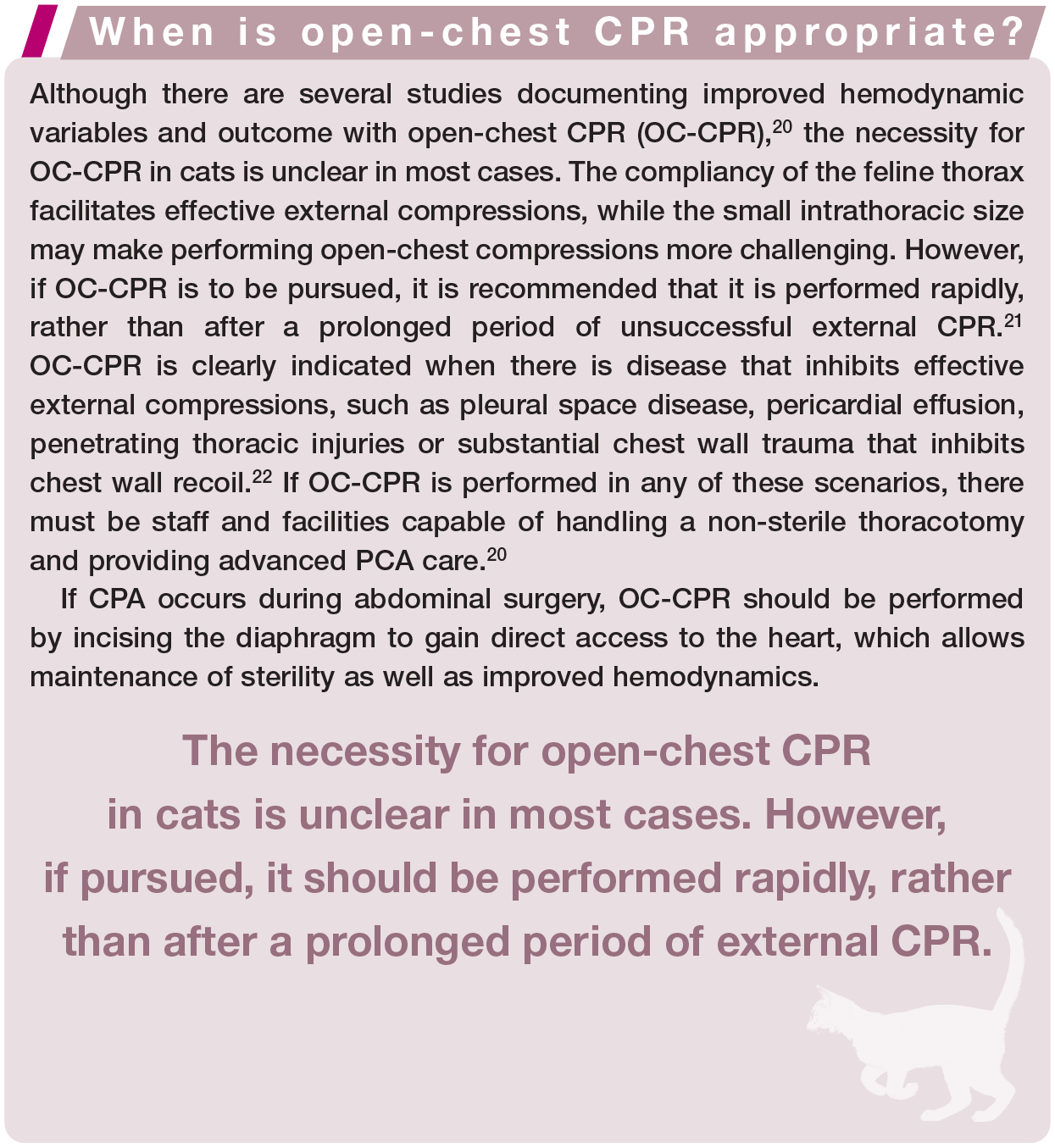
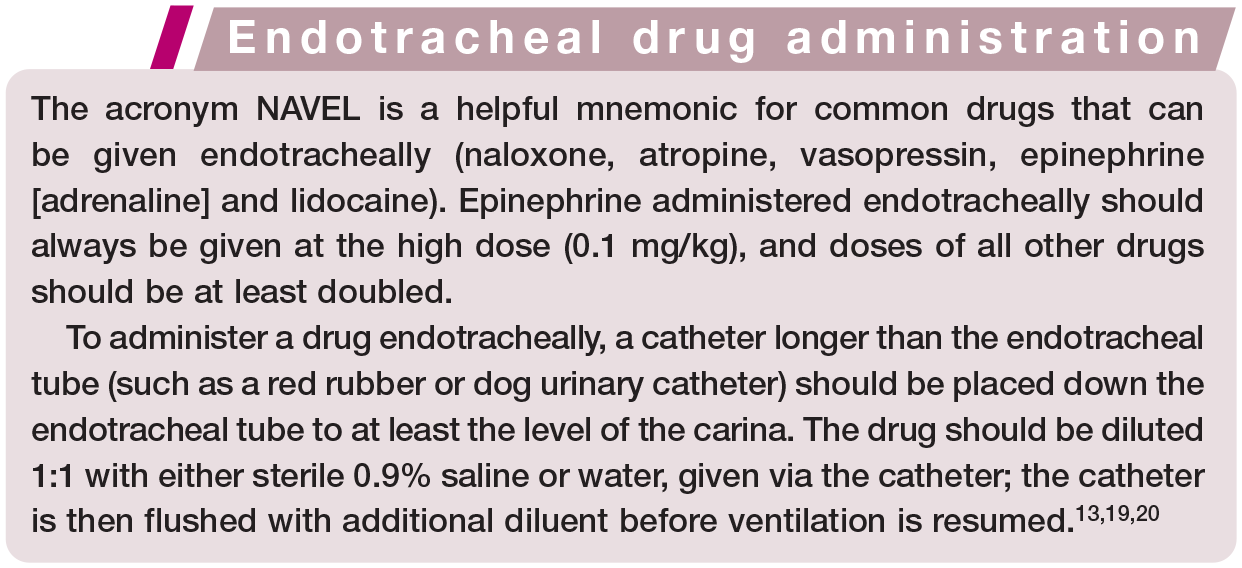
Endotracheal drug administration is associated with lower survival rates than IV or IO routes, but is a reasonable alternative if IV or IO access cannot be obtained. 19 Several drugs can be administered via an endotracheal route (see box on page 455), but the absorption and efficacy during CPR is unknown. 20
Therapeutic drug interventions
Vasopressors such as epinephrine and vasopressin provide benefit during CPR by producing peripheral vasoconstriction, which improves coronary and cerebral perfusion by diverting blood to the brain, heart and lungs. Vasopressors should be administered as early as possible and should be given every 3–5 mins (ie, every other 2-min BLS cycle) during CPR. 20
Epinephrine, a catecholamine, produces peripheral vasoconstriction via alpha-1 receptors, but its beta receptor effects can increase myocardial oxygen demand and predispose to arrhythmias following ROSC. High-dose epinephrine (0.1 mg/kg IV) has been associated with higher rates of ROSC, but a worse survival-to-discharge rate, when compared with low-dose epinephrine (0.01 mg/kg IV). 20 Therefore, low-dose epinephrine is recommended early in CPR, and high-dose epinephrine should only be considered during prolonged CPR efforts or, as discussed above, when administered via the endotracheal route. 20
Alternatively, vasopressin (0.8 U/kg IV) is a non-catecholamine vasopressor that acts upon V1 receptors on the vascular smooth muscle. Unlike alpha-1 receptors, the V1 receptors remain responsive in the presence of acidosis, which is common in CPA. Vasopressin also lacks the beta receptor effects of epinephrine and produces no inotropic or chronotropic effects that could worsen myocardial ischemia. Currently vasopressin and epinephrine are considered equivalent during CPR, and one or both should be given every other BLS cycle. 20
Atropine is a parasympatholytic agent that may be beneficial in cats experiencing bradycardic arrests due to high vagal tone. There is limited data suggesting that use of atropine during vagally mediated arrests may result in higher ROSC rates. 30 A dose of 0.04 mg/kg IV has not been shown to have any detrimental effects, and administration of this dose every 3–5 mins (every other BLS cycle) is reasonable. Higher doses are correlated with worse outcome and are not recommended. 20
Corticosteroids have not been shown to provide benefit during CPR, whereas the harmful effects of corticosteroids, especially at high doses, are well known. Given the high risk to potential benefit ratio, the use of corticosteroids during CPR is not recommended. 20
Some analgesic and sedative drugs have specific antagonists (eg, benzodiazepines with flumazenil, opioids with naloxone, alpha-2 receptor agonists with atipamezole or yohimbine). In any patient experiencing CPA, recently administered sedatives or analgesics should be antagonised, if possible, as this may benefit survival by reducing required hepatic drug metabolism and removing the depressant effects of the medication. 19
Patients that are undergoing general anesthesia should have the vaporizer turned off and the circuit flushed with 100% oxygen before ventilation resumes.
Administration of IV fluids
The administration of IV fluids during CPR is not recommended unless there is cause to believe the patient is hypovolemic. 12 Administration of fluids in euvolemic patients during CPR leads to an increase in central venous pressure, which opposes bloodflow to the brain and heart causing a decrease in coronary perfusion pressure, thus leading to worse outcomes. 12 Known or suspected hypovolemic patients may benefit from a 5–15 ml/kg bolus of isotonic crystalloids to help restore preload and improve cardiac output. In severely anemic patients, a bolus of packed red blood cells can also be considered in an attempt to improve oxygen-carrying capacity or replace blood volume.
Correction of acid–base, electrolyte and metabolic disturbances
Patients experiencing prolonged CPA commonly develop a severe mixed acidosis that can limit the efficacy of epinephrine, cause vasodilation and inhibit normal cellular activities. Sodium bicarbonate (1 mEq/kg IV once, diluted) can be considered in patients undergoing prolonged (>10 mins) CPR that have a severe acidosis (pH <7.0) of metabolic origin. 13
Hyperkalemia is commonly seen in cases of prolonged CPA. Given that severe hyperkalemia directly affects the function of cardiac myocytes, it is reasonable to initiate standard therapies (such as administration of IV calcium gluconate or sodium bicarbonate) in arrested patients with documented severe hyperkalemia (serum potassium >8.0 mEq/l). Other medical treatments for hyperkalemia may also be considered but their efficacy during CPA is unknown. The efficacy of treatment of hypokalemia during CPR has not been evaluated.
The routine administration of calcium during CPR has been shown to produce no positive or negative effect on outcome, despite hypocalcemia being commonly documented in patients experiencing prolonged CPA. However, in cases of documented moderate to severe hypocalcemia, administration of IV calcium (1 ml/kg of 10% calcium gluconate IV once, diluted) may be considered given its importance for muscle contraction. 12
The routine administration of sodium bicarbonate and calcium gluconate without evidence of the above-mentioned abnormalities is not recommended. 20
Monitoring
ECG and ETCO2 monitoring should be routinely performed in all cases of CPA. Pulse oximetry and blood pressure monitoring require a regular and measurable pulse and thus should not be assessed during CPA or CPR efforts. If a venous blood sample can be obtained, performing rapid point-of-care diagnostics such as packed cell volume, total solids, glucose and venous blood gas or other rapid electrolyte evaluation can help to guide ALS therapies. Full biochemical evaluation is not useful, as it requires significant time to run and does not provide additional information to guide CPR therapy.
Ideally, capnography should be used in all cases of CPR, as ETCO2 is directly correlated with cardiac output and can be used to monitor the quality of BLS being performed and assess for ROSC. At a constant minute ventilation, changes in ETCO2 are directly related to changes in cardiac output, which is generated by compressions during CPR. Patients with an ETCO2 >15 mmHg were more likely to achieve ROSC in one study. 1 Adjustments to compression technique should be made to maintain ETCO2 above this threshold or whenever ETCO2 decreases. 19 Monitoring ETCO2 provides a means for identifying ROSC without interruption of CPR cycles. ETCO2 often increases significantly once ROSC is achieved and cardiac output increases.
ECG monitoring is required to determine whether defibrillation is indicated and to assess resuscitation efforts. Because chest compressions cause significant artifact, the ECG should only be evaluated during the brief pause between CPR cycles (every 2 mins). The combination of ECG interpretation and pulse palpation is used to determine the presence of a shockable rhythm, a non-shockable rhythm or a perfusing rhythm (see box).


The four arrest rhythms in veterinary medicine. Asystole (a) is characterized by an essentially flat line ECG. Pulseless electrical activity (b) is noted based on absent arterial pressure waveform (and palpable pulse) despite the presence of repeatable complexes on the ECG. The appearance can vary from normal sinus complexes to ventricular origin complexes. Ventricular fibrillation (c) is characterized by disorganized electrical activity without regular repeated complexes; it can be coarse (as above) or fine in appearance. Pulseless ventricular tachycardia (d) is identified as a ventricular tachycardia (with repeatable complexes) in a patient that is unresponsive and without palpable pulses
Defibrillation
Because the vast majority of feline patients will not have a shockable arrest rhythm, the absence of a defibrillator should not preclude CPR efforts. If an electrical defibrillator is available for use, special considerations need to be made during every CPR effort. Isopropyl alcohol produces a significant fire hazard and should never be used on or near a patient undergoing CPR if defibrillation is a possibility. Instead, conductive gel is appropriate for ECG leads, and povidone–iodine or chlorhexidine solution should be used during IV catheter placement. All staff should be aware of the hazards and proper procedures associated with electrical defibrillation use.
In patients experiencing a shockable rhythm, electrical defibrillation is indicated in order to simultaneously depolarize all of the cardiomycates at once, sending them into a refractory period. The pacemaker cells of the sinus node can then hopefully regain control of rhythm regulation and restore effective ventricular contraction. Study data demonstrate that cardiac ischemic damage begins after 4 mins of VF and the lack of oxygen and energy sources (glucose) associated with this makes defibrillation less successful.31–33 Therefore, it is recommended to perform one full cycle of BLS prior to defibrillation if VF or PVT has been present for more than 4 mins to allow restoration of more normal membrane potential and oxygen levels. 13 In cases of VF or PVT lasting less than 4 mins, BLS should be continued only until the defibrillator is charged and prepared.
In either instance, the paddles are placed over the chest wall overlying the heart (Figure 6). A single shock should be delivered followed by immediate resumption of BLS. The ECG rhythm and pulse should be reassessed following a 2-min cycle of BLS. If a shockable rhythm persists, the patient should be defibrillated once again, and BLS should continue. Cycling of BLS and a single defibrillation should be repeated until a non-shockable or perfusing rhythm is identified. Biphasic defibrillators are recommended over monophasic defibrillators, as they are capable of successfully defibrillating patients with a lower energy output, resulting in less myocardial damage.

(a,b) Positioning of patient and paddles during defibrillation
Post-cardiac arrest care
Despite published rates of ROSC in feline patients ranging from 42–71%,1–4 reported survival-to-discharge rates are significantly lower.1–3 ,5 In addition to those animals that are humanely euthanized, many successfully revived patients will re-arrest or succumb to PCA syndrome, which consists of a combination of anoxic brain injury, systemic ischemia–reperfusion injury, myocardial injury and the disease that was pre-existing or precipitated the arrest. 34 Once the patient is stable enough, referral to a facility that can offer 24-h dedicated PCA care with advanced monitoring techniques is recommended. The following recommendations are based upon Part 6 of the RECOVER guidelines, which evaluates PCA care. 35
The use of goal-directed therapy to support hemodynamics and ventilation is critical to the PCA patient. Following ROSC, the patient’s airway and breathing should be evaluated, and some patients may require mechanical ventilation to achieve oxygenation and ventilatory goals. Hemodynamic and ventilatory status should be monitored through venous and/or arterial blood gas analysis, continuous ECG monitoring, and measurement of blood pressure, blood lactate levels and hematocrit. Oxygen supplementation should be provided and should be titrated down from 100% oxygen to the minimum percentage required to maintain normal oxygenation values (oxygen saturation of 94–95%, partial pressure of oxygen of 80–100 mmHg). Hyperoxemia should be avoided, as it can result in increased free radical formation. A partial pressure of carbon dioxide of 35–45 mmHg is ideal, as hypocapnia results in vasoconstriction leading to cerebral hypoxia, and hypercapnia results in vasodilation leading to increased intracranial pressure. 36
IV access should be attained as soon as possible if not previously established, and IO access should be removed. The use of vasoactive drugs such as norepinephrine (noradrenaline) or epinephrine may be required to maintain normal blood pressure. Positive inotropes, including dobutamine, may be used to maintain adequate cardiac contractility.
Any recumbent patient should be positioned with the head and neck elevated at a 15–30° angle to optimize venous drainage from the head, decreasing the risk of elevated intracranial pressure. Studies of therapeutic hypothermia in human medicine suggest improved cardiac and neurologic outcomes; while studies show possible benefit in veterinary medicine, data are inconclusive.
The high percentage of patients lost in the PCA period (particularly in ICU-related arrests), and the requirement for intensive care and monitoring, highlights the importance of transferring the stabilized patient to a specialized care facility.
Key Points
CPR can be a truly life-saving intervention that any veterinarian can offer at minimal risk to the patient.
Identifying at-risk patients and taking steps to prevent CPA is the best prevention against negative outcome.
Appropriate preparation of supplies and training of personnel helps to ensure that recognition of CPA is efficient and high-quality BLS and ALS are initiated as quickly and effectively as possible.
Compressions should be initiated immediately in any apneic, non-responsive patient without attempting to feel for a pulse or auscultate the heart.
Intubation and venous access should be obtained without cessation of chest compressions.
Aggressive PCA care and monitoring is imperative, as the majority of patients will re-arrest and/or succumb to the consequences of arrest or their underlying disease.
Teams that are knowledgeable and trained in evidence-based CPR guidelines can greatly increase the chances of survival in their feline patients.

Footnotes
Author note
A brief assessment of any implications of the new RECOVER guidelines for the guidance provided in this article will be included as supplementary material when the new RECOVER resource becomes available.
Conflict of interest
The authors declared no potential conflicts of interest with respect to the research, authorship, and/or publication of this article.
Funding
The authors received no financial support for the research, authorship, and/or publication of this article.
Ethical approval
This work did not involve the use of animals and therefore ethical approval was not specifically required for publication in JFMS.
Informed consent
This work did not involve the use of animals (including cadavers) and therefore informed consent was not required. For any animals or people individually identifiable within this publication, informed consent (verbal or written) for their use in the publication was obtained from the people involved.