



Abstract
The guidelines are a consensus report on current recommendations for vaccination of cats of any origin, authored by a Task Force of experts. The guidelines are published simultaneously in the Journal of Feline Medicine and Surgery (volume 22, issue 9, pages 813–830, DOI: 10.1177/1098612X20941784) and the Journal of the American Animal Hospital Association (volume 56, issue 4, pages 249–265, DOI: 10.5326/JAAHA-MS-7123). The guidelines assign approved feline vaccines to core (recommended for all cats) and non-core (recommended based on an individualized risk–benefit assessment) categories. Practitioners can develop individualized vaccination protocols consisting of core vaccines and non-core vaccines based on exposure and susceptibility risk as defined by the patient’s life stage, lifestyle, and place of origin and by environmental and epidemiologic factors. An update on feline injection-site sarcomas indicates that occurrence of this sequela remains infrequent and idiosyncratic. Staff education initiatives should enable the veterinary practice team to be proficient in advising clients on proper vaccination practices and compliance. Vaccination is a component of a preventive healthcare plan. The vaccination visit should always include a thorough physical exam and client education dialog that gives the pet owner an understanding of how clinical staff assess disease risk and propose recommendations that help ensure an enduring owner–pet relationship.
Keywords
Abbreviations:
DNA (deoxyribonucleic acid); FCV (feline calicivirus); FeLV (feline leukemia virus); FHV-1 (feline herpesvirus type 1); FIP (feline infectious peritonitis); FISS (feline injection-site sarcoma); FPV (feline panleukopenia virus); Ig (immunoglobulin); IM (intramuscular); MDA (maternally derived antibodies); SC (subcutaneous); WSAVA (World Small Animal Veterinary Association)
These guidelines were prepared by a Task Force of experts convened by the American Animal Hospital Association (AAHA) and the American Association of Feline Practitioners (AAFP) and were subjected to a formal peer-review process. This document is intended as a guideline only, not an AAHA or AAFP standard of care. These guidelines and recommendations should not be construed as dictating an exclusive protocol, course of treatment, or procedure. Variations in practice may be warranted based on the needs of the individual patient, resources, and limitations unique to each individual practice setting. Evidence- based support for specific recommendations has been cited whenever possible and appropriate.
Other recommendations are based on practical clinical experience and a consensus of expert opinion. Further research is needed to document some of these recommendations. Because each case is different, veterinarians must base their decisions on the best available scientific evidence in conjunction with their own knowledge and experience.
Introduction
As a medically essential and cost-effective method of infectious disease control, vaccination continues to be a mainstay of feline practice and a critical component of an individualized preventive healthcare plan. These guidelines provide the most current information and recommendations for feline vaccination as determined by a Task Force of experts in feline practice. The recommendations are evidence-guided, based on current peer- reviewed literature and data, and complemented by clinical insights collectively derived from decades of experience. The guidelines update the “2013 AAFP Feline Vaccination Advisory Panel Report” and utilize similar recommendations from the 2016 “WSAVA [World Small Animal Veterinary Association] Guidelines for the Vaccination of Dogs and Cats”.1,2 Both of these previously published resources should still be considered relevant and actionable complements to the 2020 guidelines.
The guidelines continue the established approach of considering inclusion of core (recommended for all cats) and non-core (recommended based on an individualized risk–benefit assessment) vaccines in an individualized protocol. As explained in the guidelines, a patient-specific vaccination plan should consider environmental risk factors and life stage and lifestyle factors that determine the likelihood of infectious disease exposure and susceptibility. For example, not all feline patients originate from a home environment, and conversely, most cats described as “indoor only” might find themselves periodically exposed to other cats. The guidelines discuss other presentation scenarios that can potentially affect a risk–benefit assessment and include updates on feline injection-site sarcomas (FISSs) and other vaccinationrelated reactions.
A key component of the guidelines are comprehensive, easy-to-reference tables listing approved core and non-core feline vaccines and the relevant considerations for their use. The guidelines are complemented by an online resource center at aaha.org/felinevaccination and supplemental materials at catvets.com/vaccination. The online resources include frequently asked questions about vaccination that clinicians and pet owners raise as well as a vaccine protocol calculator that uses a cat’s life stage and lifestyle information to suggest an appropriate, individualized vaccination protocol.
The guidelines discuss in some detail the importance of staff and client education in implementing vaccination protocols and recommendations for feline patients. This emphasis is noteworthy in view of the fact that many pet owners, especially cat owners, associate professional veterinary care primarily with two events, vaccination and treatment of acute conditions. 3 Thus, a healthcare visit for the purposes of vaccination becomes an opportunity to more broadly discuss an overall preventive healthcare strategy with the pet owner. Implicit in this approach is an explanation of how the clinician considers life stage, lifestyle, patient health status, environmental, and epidemiologic factors in making vaccination recommendations. The vaccination event then occurs in the context of a practitioner–client discussion on how preventive healthcare forms the basis for the pet owner to maintain a long, rewarding relationship with the animal in his or her care.
Vaccination principles
Active immunization, achieved through proper vaccination, plays a critical role in the control of infectious diseases, both for individual cats and for the cat population as a whole. Some vaccines also reduce the potential for spread of zoonotic infections to humans (e.g., rabies). The benefits of routine, widespread vaccination are clear: the incidence of serious disease caused by pathogenic organisms, such as feline panleukopenia virus (FPV), can be reduced dramatically when widespread vaccination is practiced. However, the quality of vaccine-induced immunity is influenced by the patient’s environment, the characteristics of the vaccine, the pathogen, and the patient’s immune competence. Accurate prediction of the outcome of vaccination or the likelihood of exposure to a pathogen is impossible. Therefore, it is important that veterinarians inform cat owners that vaccination is not a guarantee of protection.
In general, kittens are more susceptible to infection and disease than adults. Thus, they represent a primary target population for immunization. As part of a routine wellness program, the vaccination needs of all cats should be assessed annually, in conjunction with a comprehensive physical examination, modifying vaccination and other control recommendations as necessary based on the current risk (see “Vaccination risk–benefit assessment”).
Kittens born to immune queens lack significant transplacentally acquired antibodies 4 and instead absorb specific maternally derived antibodies (MDA) through colostrum, which provides important protection during early life. Most absorption occurs within 24 hours of birth. However, this MDA also interferes with active immunization. Serum MDA inhibits immunoglobulin (Ig)G production within the neonate through negative feedback mechanisms. It also neutralizes vaccine antigens and prevents them from stimulating an immune response. MDA then declines at a variable rate. Maternally derived IgG in kittens in one study was lowest at around 3–4 weeks of age, and serum IgG and IgA increased dramatically at 5–7 weeks of age. 4 These results suggested that kittens may be susceptible to infectious diseases at about 1 month of age, perhaps as much as 2 weeks earlier than puppies.
Nevertheless, it is critical to recognize that there is considerable individual variation in the rate of decline of MDA, and some kittens maintain high concentrations for months. 5 The persistence of MDA is one of the most common reasons for vaccine failure. The amount of MDA in a kitten at any one time point cannot be predicted because it varies depending on the titer of the dam and the amount of colostrum ingested after birth. As a result, a series of vaccinations is administered to kittens every 2–4 weeks through 16–18 weeks of age in order to increase the chance that successful immunization will occur soon after the decline of MDA to sufficiently low titers. The series is started no sooner than 4 weeks of age, because neonates are more likely to develop vaccine organism-associated disease and may not respond well to vaccination. During administration of the series, a window exists when MDA concentrations are high enough to interfere with immunization but are not sufficient to prevent natural infection. This window of susceptibility can be minimized by decreasing the interval between vaccinations in the series, although use of intervals less than 2 weeks can interfere with successful immunization, especially with attenuated live vaccines.
Once vaccination has been successfully achieved after the decline of MDA, it is generally recommended that a booster vaccine be given 3–4 weeks later (this is especially important for inactivated vaccines, although a boostering effect will also occur following revaccination with attenuated live vaccines).
This means that the series must be extended 3–4 weeks beyond the period in which the decline in MDA occurs, with the final vaccination dose being a booster. In the past, it was recommended that revaccination be performed 1 year after the initial kitten series, and then for most vaccines every 3 years thereafter. However, owing to studies that suggest up to one-third of kittens may fail to respond to a final core vaccine at 16 weeks and may have blocking MDA at 20 weeks, the WSAVA recommends that the 1 year vaccine (feline viral rhinotracheitis– calicivirus–panleukopenia only) be replaced with revaccination at 6 months of age.2,6,7
In this update, this Task Force has adopted the same recommendation of revaccination against FPV, feline herpesvirus type 1 (FHV-1), and feline calicivirus (FCV) at 6 months of age to potentially reduce the window of susceptibility in kittens with MDA toward the end of the kitten series (16–18 weeks). The Task Force recognizes that this means an additional visit will still be necessary for administration of the annual feline leukemia virus (FeLV) and rabies vaccinations in young cats.

The risk of infection and disease varies with factors such as the age and health of the cat, magnitude of exposure to the infectious agent, the pathogenicity of the agent, and the vaccination history of the cat. Some of the factors that impact an individual animal’s ability to respond to vaccination include interference from MDA, congenital or acquired immunodeficiency, concurrent disease, inadequate nutrition, chronic stress, and very young or old age. Some vaccines (e.g., those for FPV) induce a stronger protective response than others (e.g., those for FHV-1). Because vaccine- induced protection is variable and not absolute, vaccination should not be used as the only form of protection, and other control measures, such as those that reduce exposure to infectious agents, should also be employed.
Types of feline vaccines
Vaccines, including those from different manufacturers that are licensed to protect against the same pathogen, should not be assumed as equivalent. Differences in processes and technology used to produce vaccines, as well as additives such as adjuvants, and vaccine route of administration influence efficacy, safety, and duration of immunity. Vaccines may be inactivated, attenuated live, or recombinant (Table 1). All veterinary vaccines, before licensing, are assessed for efficacy, safety, potency, and purity. Vaccine efficacy is often expressed as preventable fraction, defined as the proportion of vaccinated animals that do not develop a disease after challenge (so-called sterilizing immunity, e.g., FPV, FeLV, and rabies vaccines), compared with unvaccinated animals that do develop the disease. It can also be expressed as mitigatable fraction (proportion with reduction in severity of clinical signs, e.g., FHV-1 and FCV vaccines). Other claims include reduction of pathogen shedding, prevention of a specific clinical sign, or prevention of mortality. The level or degree of protection claim can therefore be limited.
Types of feline vaccines and their attributes

To facilitate vaccine selection, vaccines for dogs and cats have been divided into core vaccines, non-core vaccines, and those generally not recommended.
The
The decision to vaccinate, even with core vaccines, should be based on a risk–benefit assessment for each cat and for each vaccine antigen. Benefits of vaccination should be balanced against the risk of adverse events, likelihood of exposure, and disease severity.
Every effort should be made to ensure that cats are healthy before vaccination. However, concurrent illness (including retroviral infections) does not necessarily preclude vaccination. 34 The 2020 AAFP Feline Retrovirus Testing and Management Guidelines state that vaccines should not be avoided in cats with retroviral infection because they can develop more severe clinical disease related to FPV and upper respiratory tract infections after natural exposure compared with uninfected cats. 34
Core vaccines for pet cats (continued on page 818)

Core vaccines for shelter-housed cats

Non-core vaccines for pet cats

Not generally recommended vaccines for pet cats

Potential therapeutic benefits of vaccination
Active immunization can enhance non-specific immunity, leading to reduction in disease caused by non-target pathogens. One study showed that vaccination of cats with an intranasal FHV-1–FCV vaccine was associated with reduction in clinical signs following challenge with B bronchiseptica. 24 More studies are needed to assess the non-target effects of different vaccine types. There is also interest in whether vaccines might provide therapeutic benefits in cats already infected with target pathogens. Improvement in chronic upper respiratory tract signs that were previously refractory to other treatments was documented in 13 cats vaccinated with an intranasal FHV-1–FCV vaccine. 35 Most vaccines, however, provide no therapeutic benefit, as clearly documented for FeLV vaccines. 36
Vaccination risk–benefit assessment
The Task Force supports the WSAVA’s recommendation that veterinarians should vaccinate every animal with core vaccines and give non-core vaccines no more frequently than is deemed necessary. 2 The decision whether or not to administer a vaccine to a cat, and how frequently, relies on an individual case-by-case assessment by the veterinarian. This involves consideration of the animal, the animal’s environment, and the pathogen in question. Additionally, risk–benefit assessments should consider the safety of the vaccine, other adverse effects of vaccination (e.g., the effect of feline immunodeficiency virus vaccination on in-clinic diagnostic test kits), and the efficacy of the vaccine. The result of this assessment should be an individualized, evidence-guided recommendation to vaccinate or not to vaccinate.
Patient’s characteristics
Age is an important factor in assessing an individual’s risk profile. In contrast to puppies, kittens born to immune queens appear to lack transplacentally acquired antibodies and instead absorb specific MDA through colostrum, 4 which provides important protection during early life. Once MDA have waned, however, kittens become susceptible to infection. Most infectious diseases are more prevalent in kittens than adults, and therefore, kittens (in particular, those younger than 6 months old) represent a principal primary target population for vaccination. Conversely, adult cats generally have a more robust adaptive immune response when challenged (assuming they are healthy and not immuno- compromised), whether due to previous natural exposure or vaccination, and age- related resistance to challenge is particularly a feature of FeLV infection. 26 Consequently, vaccination of mature cats is generally considered less critical than vaccination of kittens. The presence of concurrent disease or stress causing immunosuppression should also be a consideration prior to vaccination because this may affect an animal’s susceptibility to infection and response to vaccination.

Patient’s environment
Population density and opportunity for exposure to infectious agents are two critical issues that should form part of the risk–benefit assessment. In general, cats and kittens living in larger multi-cat households and environments (e.g., boarding, breeding, foster, or shelter facilities) have a higher risk of infection than cats living in one- or two-cat households. In addition to the possible presence of infected animals acting as reservoirs for infection in multi-cat households, the immunosuppressive effects of stress associated with high-density feline housing may result in reactivation of some infections as well as increased susceptibility to new infections. The introduction of new cats into multi-cat households also increases the risk of infectious disease not only to the cat entering the household but also to the whole group because of possible direct exposure to new infectious agents.
When assessing the opportunity for exposure to a given pathogen for an individual cat, the lifestyle of the cat and other cats in the same household needs to be considered. It is critical to determine whether the cat is indoor- only or has outdoor access (including supervised outdoor visits on a harness, or boarding) because cats with outdoor access may be at increased risk of pathogen exposure. Indoor- only cats, however, may still be determined to be at risk of exposure to pathogens, either from other cats in the household (i.e., subclinically infected or carrier cats), or by fomite transmission of pathogens brought in from outside on the owner’s body, clothing, or shoes. Indoor-only cats may also be exposed to infectious agents when brought to a veterinary clinic for a wellness examination. In theory, strictly indoor cats may be more susceptible to developing some infectious diseases (such as FPV and FCV infection) than cats with outdoor access because they may not receive “natural boosting of immunity” that occurs with natural exposure. 1
The geographic distribution of infectious agents may also result in different risks of exposure (e.g., rabies), and therefore, questions regarding future travel should be included in determining the risk of exposure to specific infectious agents.
Infectious agents
The likelihood of infection and disease is influenced by pathogen factors such as virulence, strain variation, and challenge dose (i.e., how many infectious units of exposure). The need for vaccination is greatest against pathogens with high virulence, such as FPV, and pathogens that cause widespread morbidity, such as FHV-1.
Creating an individualized, lifestyle-based vaccination plan
The vaccination needs of each cat should be evaluated individually and rationally, based on health status, age, and possible, realistic exposure to disease (Table 6). Owners and veterinarians must work together to determine the likelihood of the animal coming into contact with other animals that may spread disease, acquiring parasites that may harbor a disease-causing agent, or living in an area where a disease is known to be endemic or very widespread. 2
Risk assessment variables determining an individualized vaccination plan
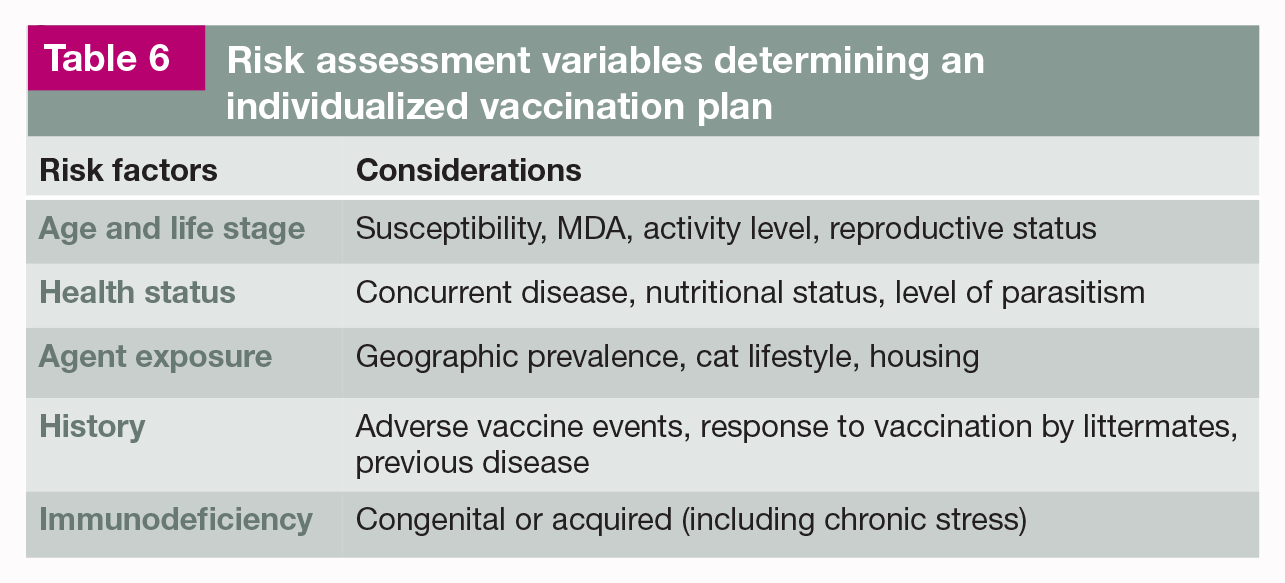
Questions must be asked about the lifestyle of that specific cat as well as any other cats in the household or potentially introduced into the household. The travel, boarding, housing, and enrichment activities or excursions outside of the home should also be considered. 1 This risk assessment for exposure to disease should be done at least once a year.
The life stage of the cat must also be considered with respect to possibility of exposure to disease and the health status of the animal. Infectious diseases are more prevalent in kittens, and in general, kittens (younger than 6 months old) are more susceptible to infection. 1 Younger cats also tend to behave more unpredictably and require more enrichment activities, which may increase their opportunity for exposure. 37
The health status of the individual cat, including any previously documented adverse events to vaccines, also determines the vaccination recommendations. The nutritional status, general health (i.e., any concurrent infections or other disease) and the pregnancy status of females may change the type and schedule of vaccination for that individual cat (Table 6). As with lifestyle changes, changes in health status must be evaluated at least yearly. 1
The population density, along with the opportunity for exposure to other cats, is a major factor in determining the need for vaccination. Larger multi-cat households are likely to have a greater risk of infection and disease than households of one or two cats. The introduction of new cats and the social dynamics of the group may also cause immunosuppressive stress, leading to increased risk of disease by new infection or recrudescence. Each cat in a multi-cat environment must have a vaccination plan that balances the protection of the individual with that of the household population. 1
Cats entering boarding, breeding, foster, or shelter situations have increased risk of disease exposure as well as systemic stress. Vaccination may be warranted prior to entering these environments when possible (see Tables 2 and 3). Additionally, vaccination intervals may need to be shortened depending upon these possible scenarios. 1 As with multi-cat households, the vaccination plan for the individual cat must be considered in relation to the entire population.
One vaccination plan or protocol cannot be applied to every cat. Each animal must be evaluated and an individualized plan created that will most protect that particular cat. That plan must be reassessed when changes in health and lifestyle occur, requiring client education and compliance with at least yearly veterinary visits. 38
Feline patient populations
For the purpose of creating specific, individu‑ alized vaccination recommendations based on risk of exposure, the Task Force has identified and defined the following feline populations based on their environment and lifestyle. The guidelines begin by discussing pet cats and then discuss a number of feline populations that are considered to be at relatively high risk of infectious disease exposure; namely, shelter cats, trap–neuter–return/trap–neuter– release cats, cattery cats, and foster cats.
Pet cats
Pet cats include any cat kept by human beings as a source of companionship and pleasure. Pet cats are further categorized by housing status (indoor, outdoor, or indoor–outdoor cats) and number of cats in the household (single-cat or larger multi-cat). Although these distinctions are important, the most significant issue to consider regarding vaccination of pet cats is the individual cat’s exposure risk and exposure frequency to other cats and feline infectious diseases. Even indoor cats from single-cat households will inevitably be exposed to other feline infectious pathogens in situations such as a veterinary clinic visit, contact with other cats entering the premises, or exposure to contaminated fomites introduced by human contact. Client education for owners of these patients should focus on risk of exposure to other cats rather than on where the cat eats, sleeps, or spends most of its time.
For high-risk, multi-cat households, the probability of infectious disease exposure and transmission is proportionate to the number or density of cats on the premises. 39 It is important to educate clients about the increased disease risks to this population of cats and to discuss increased owner responsibility to ensure appropriate preventive health- care initiatives associated with housing many cats in a confined space.
Shelter cats
These are cats living for indeterminate periods in centers for relinquished or lost animals.
Trap–neuter–return/trap–neuter–release cats
These are community or feral cats of either sex that live entirely separate from people and cannot safely be handled. Trap–neuter–release/ trap–neuter–return cats may survive completely independently of humans, but some semiferal colonies receive support from individuals.
Cattery cats
These cats are maintained in commercial facilities; for example, breeding or boarding facilities, and pet stores with a showcase model.
Foster cats
Foster cats are kittens or adult cats temporarily housed for rescue, rehabilitation, and rehoming purposes. The most important consideration in a foster cat household is ensuring that the permanent population of the household is appropriately vaccinated to provide protection from disease exposure originating with foster cats.
Serology and diagnostics
The interpretation of an antibody test result can be complex because antibody testing is used for many reasons. Depending on the antibodies tested for, antibody testing can be used for (1) diagnosis of infection, (2) identification of previous exposure to pathogens (particularly in unvaccinated animals), and (3) assessment of immunity prior to or following vaccination (Table 7). Clinicians should understand when and why to perform anti- body testing and use this knowledge to make evidence-based decisions prior to vaccination.
Possible uses of in-clinic serology testing

Hemagglutination inhibition (for FPV) and serum neutralization (for FHV-1, FCV, and rabies) are the reference standards to determine the presence of effective antibody-mediated immunity. These test methodologies can only be performed in a laboratory setting using live cell cultures (i.e., they cannot be performed in a practice using rapid patient-side test kits). These diagnostic tests are predominantly research tools used in vaccine efficacy and prevalence studies.
It is important when attempting to demonstrate protective immunity in a patient using an in-clinic antibody test kit that the performance of the kit be compared against the appropriate reference standard in order to demonstrate correlation with protective immunity.
The presence of anti-FPV antibodies correlates strongly with protection (Table 7). Currently, experts recommend antibody testing for FPV to assess immunity and inform decisions about whether to vaccinate.6,40 Rapid in-clinic test kits to detect antibodies to FPV, FHV-1, and FCV are available to veterinarians in North America and have been validated in two different studies using the appropriate reference tests.47,48 Of concern, however, was the occurrence of some anti- FPV antibody false-positive results in one study, which in practice would lead to some unprotected cats not being vaccinated. 48
Adverse postvaccination reactions
Although the administration of biological products is never entirely free of risk, currently available feline vaccines have an excellent safety record. That said, the true prevalence of adverse reactions is likely to be underestimated owing to underreporting by both veterinarians and owners. 49 Therefore, it is important to report any known or suspected negative events associated with vaccination. In the United States, veterinarians are requested to contact the manufacturer (Veterinary Technical Services) of the vaccine(s) considered to be involved. Veterinarians may also report known or suspected adverse events directly to the U.S. Department of Agriculture; the Center for Veterinary Biologics of the U.S. Department of Agriculture’s Animal and Plant Health Inspection Service can be contacted by the following means:
At the time of vaccine administration, included in the patient’s permanent medical record should be the name, serial number, expiration date and manufacturer of the vaccine(s) given, date of administration, name of the person administering the vaccine(s), and the site and route of the vaccine administration. Adverse events should be recorded in a manner that will clearly alert all staff members during future visits.
Prevalence and types of adverse reactions
Postvaccination adverse events in cats are considered rare. 49 In the most substantial survey to date, any adverse reactions were recorded for cats presented to Banfield Pet Hospitals in the United States between 2002 and 2005. 42 During this period, more than 1.25 million doses of various vaccines were administered to nearly 500,000 cats. Adverse reactions within 30 days of vaccination were reported at a rate of 0.52% of cats vaccinated. The most commonly reported vaccine reactions are lethargy, anorexia, and fever for a few days after vaccination, or local inflammation at the site of injection.42,50,51 In the Banfield Pet Hospital population, the risk of an adverse reaction was greatest in cats around 1 year of age and/or increased as the total volume of vaccine and number of vaccines administered concurrently increased. 42
Hypersensitivity reactions
Although anaphylaxis (type I hypersensitivity reaction) is rare (approximately 1–5 per 10,000 vaccinations),42,52 it may manifest as vomiting, diarrhea, respiratory distress, facial or generalized pruritus, facial swelling, and collapse.51,53,54 Where revaccination is considered necessary in a cat that has experienced an allergic reaction, using a different vaccine formulation and premedicating with an anti- histamine and glucocorticoid 20–30 minutes prior to vaccine administration is recommended, followed by close observation of the patient for several hours.42,53 Other forms of hypersensitivity reactions (types II, III, and IV) almost certainly also occur in cats after vaccination, but these are rarely documented.
Postvaccination monitoring
The Task Force recommends that veterinarians and owners monitor the vaccination site for swelling or lumps using the “3-2-1” rule. Biopsy of any mass present is warranted if it (1) remains present 3 months after vaccination, (2) is larger than 2 cm in diameter, or (3) is increasing in size 1 month after vaccination.1,55 It is recommended to obtain an incisional biopsy on any masses meeting any of these criteria. Fine-needle aspirates may not provide diagnostic cellular tissue, whereas excisional biopsies rarely meet appropriate margins (5 cm in two fascial planes) as required in the case of injection-site sarcomas, thus increasing the morbidity and mortality risks associated with sarcoma invasion.
Update on feline injection-site sarcomas
FISSs, largely caused by vaccines (although other materials have been implicated), have been recognized since 1991. 56 Three decades later, much about them remains unknown. Within the United States, FISS incidence estimates, although low, have varied by at least an order of magnitude, and worldwide FISS incidence estimates vary by country depending on the relative use of vaccine types (e.g., FeLV, rabies) and population susceptibility.
The Task Force makes the following observations regarding vaccination:
Neither vaccinating in the interscapular space nor decreasing vaccine volume is recommended.
Distal limb injection is recommended to facilitate amputation with 5 cm margins in two fascial planes in the case of injection-site sarcoma (Figure 1).
More recently, ventral abdominal subcutaneous injections have been used because of the perceived relative ease of tumor removal without the need for amputation. 2 However, the need to remove two fascial planes and 5 cm margins would still necessitate aggressive tissue removal from the abdomen and abdominal cavity.

Vaccination sites: recommended injection sites in the distal limbs and tail.
Tail vaccination has also been reported as well tolerated and elicited acceptable serological responses to vaccination in the distal limbs. 57 To facilitate 5 cm margins in the case of injection-site sarcoma, vaccinations must be administered in the distal tail, something that may not be practical for most clinicians.
Follow the 3-2-1 rule for postvaccination swelling.1,55 Obtain incisional biopsies for appropriate diagnosis.
The 2013 AAFP Feline Vaccination Advisory Panel Report included recommendations for specific vaccine antigens to be administered at specific anatomical locations in the distal limbs. 1 This technique has helped facilitate the identification of the vaccine antigen used if a sarcoma developed subsequently at the injection site. Since this technique has been widely adopted, these injection-site recommendations have also led to a shift in the site of tumor formation to the distal limbs, thus facilitating potentially life-saving surgery for patients suffering from these invasive tumors. 58 The 2020 AAHA/AAFP Feline Vaccination Guidelines Task Force recognizes and supports the value of the 2013 recommendations and recognizes that practitioners may, at times, need to use medically appropriate discretion regarding the anatomical location of vaccine administration. Practitioners are strongly advised to keep complete, accurate records for antigen administration site and route of vaccine administration.
The Task Force offers the following analysis of current research about vaccine safety:
Staff and client education
The veterinarian’s role and responsibilities
A veterinarian should assess every patient regardless of appointment type (wellness, acute care or follow-up visit) for current vaccination status based on age and lifestyle. Informed by this assessment, an individualized patient vaccination plan should be developed or modified and then discussed and agreed upon in collaboration with the cat owner.
In addition to overseeing the development of feline vaccination protocols, the veterinarian should provide staff education on the following:
–Zoonotic disease prevention.
–Separate administration sites for each vaccination (based on consistent vaccination site guidelines for that practice).
–Potential life-threatening adverse events (i.e., anaphylaxis) and minor adverse events (i.e., localized swelling) following vaccination.
–Vaccine reconstitution and handling (the AAFP recommends using vaccines within 30 minutes of reconstitution). 53
–Standard sharps safety procedures to prevent accidental needle sticks. 63
The Centers for Disease Control and Prevention (CDC) online training module, “You Call the Shots: Vaccine Storage and Handling,” is a useful resource for staff training on vaccination. 64 The practice should designate a person to be the primary vaccine coordinator for the facility. This person will be responsible for ensuring all vaccines are stored and handled correctly. A second staff member to serve as an alternate in the absence of the primary coordinator should be appointed (this is particularly important in case of after-hours emergencies). Both coordinators should be fully trained in routine and emergency policies and procedures. 65
The healthcare team, led by the veterinarian, should emphasize and educate clients that they are part of a team approach to vaccine management, requiring the entire staff’s understanding of zoonotic disease, core and non-core vaccines determined by the pet’s lifestyle, hospital policy, state law, client compliance, and adverse vaccination events.
Credentialed veterinary technician or veterinary assistant roles and responsibilities
A veterinary technician or assistant often assumes the role of designated vaccine coordinator, assisting in vaccination storage and inventory management. AAHA guidelines on vaccine storage and handling, and the CDC Vaccine Storage and Handling Toolkit are useful resources for this purpose.64,65 The vaccine coordinator is often responsible for reconstitution of vaccines and administration of vaccinations as directed by the attending veterinarian in compliance with state law. 66 This individual is also often given responsibility for implementing feline-friendly handling techniques in the hospital setting to minimize stress during examinations and vaccine administration 67 and for maintaining effective client education and follow-up, including verbal and written instructions on potential adverse events after vaccine administration and disease prevention.

Roles and responsibilities of reception and other client-service personnel
The reception staff is typically charged with maintaining patient files with vaccination information, including date administered, along with the production lot serial number and expiration date of the vaccine. Reception personnel are also responsible for contacting clients and scheduling follow-up appointments for booster series and yearly vaccinations in advance as directed by the prescribing veterinarian. Non-clinical staff should understand the potential life-threatening and minor adverse events that can occur following vaccination that require veterinary assistance.
Client education
Pet owner clients are an essential member of a cat’s healthcare team. Although clients can be instrumental in helping improve healthcare for their cats, the Task Force recommends that vaccination be performed by a veterinarian. Vaccination is a medical procedure. Vaccines are available through sources other than a veterinarian, but they may not protect a cat against disease unless properly stored, handled, and administered. The principles of feline vaccination outlined in the box below represent a basic client education overview for cat owners.


Summary Points
Vaccination protocols for cats should consist of recommended core vaccines and discretionary non-core vaccines as defined and listed in the guidelines. Vaccines in the latter category are given based on a risk–benefit assessment. Risk is determined by the patient’s life stage, lifestyle, clinical history, and health status and by environmental and epidemiologic risk factors.
Although feline vaccination is universally practiced by primary care companion animal practices, there is no single protocol suitable for all feline patients. Rather, vaccination of cats should be patient-specific and guided by an individual risk–benefit assessment using the criteria listed in the guidelines.
In the case of some vaccines, practitioners have a choice of different types of antigens, including those that are inactivated, attenuated, and in recombinant form. The patient’s clinical and vaccination status, such as the possible presence of maternally derived immunity or a history of adverse postvaccination reactions, are factors that may influence the choice of vaccine type.
Although most feline patients are household pets, practitioners should anticipate situations in which higher-risk cats are presented for vaccination, including those from shelter, cattery, feral, or foster care origins.
Adverse postvaccination reactions unavoidably occur in a small percentage of cats. Because of their neoplastic etiology, FISSs continue to be the most serious, if infrequent, vaccine-associated adverse event. Detection of patterns in FISS incidence remains elusive, and their occurrence continues to be idiosyncratic. Advising clients in advance of the possibility of hypersensitivity or other reactions will help minimize their concerns.
All members of the practice team, including clinical and non-clinical personnel, should have a well-informed understanding of the importance of vaccination of feline patients and be able to advise clients of the practice’s approach to an individualized vaccination plan.
The vaccination visit is an ideal time for a client education dialog in which the clinical staff has an opportunity to discuss the role of vaccination as an essential component of preventive healthcare tailored to the individual patient.
Supplemental Material
sj-pdf-1-jfm-10.1177_1098612X20941784 – Supplemental material for 2020 AAHA/AAFP Feline Vaccination Guidelines
Supplemental material, sj-pdf-1-jfm-10.1177_1098612X20941784 for 2020 AAHA/AAFP Feline Vaccination Guidelines by Amy ES Stone, Gary O Brummet, Ellen M Carozza, Philip H Kass, Ernest P Petersen, Jane Sykes and Mark E Westman in Journal of Feline Medicine and Surgery
Supplemental Material
sj-pdf-2-jfm-10.1177_1098612X20941784 – Supplemental material for 2020 AAHA/AAFP Feline Vaccination Guidelines
Supplemental material, sj-pdf-2-jfm-10.1177_1098612X20941784 for 2020 AAHA/AAFP Feline Vaccination Guidelines by Amy ES Stone, Gary O Brummet, Ellen M Carozza, Philip H Kass, Ernest P Petersen, Jane Sykes and Mark E Westman in Journal of Feline Medicine and Surgery
Supplemental Material
sj-pdf-3-jfm-10.1177_1098612X20941784 – Supplemental material for 2020 AAHA/AAFP Feline Vaccination Guidelines
Supplemental material, sj-pdf-3-jfm-10.1177_1098612X20941784 for 2020 AAHA/AAFP Feline Vaccination Guidelines by Amy ES Stone, Gary O Brummet, Ellen M Carozza, Philip H Kass, Ernest P Petersen, Jane Sykes and Mark E Westman in Journal of Feline Medicine and Surgery
Footnotes
Acknowledgements
The Task Force gratefully acknowledges the contribution of Mark Dana of Scientific Communications Services, LLC, and the Kanara Consulting Group, LLC, in the preparation of the guidelines manuscript.
Conflict of interest
Amy ES Stone has received speaking fees from Boehringer Ingelheim Animal Health USA Inc. Jane Sykes receives honoraria and research funding from Boehringer Ingelheim Animal Health USA Inc., Elanco Animal Health, IDEXX Laboratories Inc., and Merck Animal Health. Ernest P Petersen was a stockholder of Phoenix Central Laboratory prior to its sale to Zoetis Petcare (after these guidelines were written) but was not employed at the lab nor on the Board of Governors, and was not involved in the sale. The other members of the Task Force have no conflicts of interest to declare.
Funding
Boehringer Ingelheim Animal Health USA Inc., Elanco Animal Health, Merck Animal Health, and Zoetis Petcare supported the development of the 2020 AAHA/AAFP Feline Vaccination Guidelines and resources through an educational grant to AAHA.
Ethical approval
This work did not involve the use of animals and, therefore, ethical approval was not necessarily required.
Informed consent
This work did not involve the use of animals and, therefore, informed consent was not required. For any animals individually identifiable within this publication, informed consent (either verbal or written) for their use in the publication was obtained from the people involved.
References
Supplementary Material
Please find the following supplemental material available below.
For Open Access articles published under a Creative Commons License, all supplemental material carries the same license as the article it is associated with.
For non-Open Access articles published, all supplemental material carries a non-exclusive license, and permission requests for re-use of supplemental material or any part of supplemental material shall be sent directly to the copyright owner as specified in the copyright notice associated with the article.
