




Abstract
Objectives
Food puzzles may provide enrichment to domestic cats. The purpose of our survey was to determine: (1) how respondents fed their cat (type[s] of food, amount and mode of delivery); (2) how many people used food puzzles to provide food for their cats; and (3) owner attitudes about food puzzles.
Methods
We conducted an online survey from January to April of 2018 to ask cat owners (n = 3192) questions related to their cat feeding practices and use of food puzzles.
Results
Most cat owners fed their cats dry food, with half of those owners offering it ad libitum. Thirty percent of participants offered food puzzles to their cats; another 18% had tried food puzzles but were no longer using them. The remaining participants had never used a food puzzle with their cat. Reasons for not using food puzzles included perceptions about the cat (eg, being too lazy), multiple pets in the home, pets fed different diets, health issues and feeding an exclusively wet food diet. Many participants did not know how to choose or introduce a food puzzle to their cat, and many non-users saw no need or benefit to their cat.
Conclusions and relevance
This survey provided information about the feeding habits of cat owners and why they do and do not use food puzzles with their cats. Because of the scarcity of empirical evidence about the effects of food puzzles on pet cat welfare, more research is needed to determine the role of food puzzles as part of an overall enrichment plan.
Introduction
Environmental enrichment (although without a single, agreed-upon, definition) generally refers to the addition of activities, objects or companionship to optimize physical and psychological states and improve an animal’s welfare.1–3 Appropriate enrichment encourages species-typical behaviors, 1 and may improve welfare by providing an individual a greater perception of control and choice in their environment, 4 and reducing their perception of threat. 5 Because all non-domesticated animals must forage for food, whether by hunting, scavenging or searching, interventions that encourage foraging behavior are commonly implemented for zoo and laboratory animals.
Previous studies of companion animals have demonstrated positive effects of foraging toys on behavior. Shelter dogs that were provided with a Kong toy stuffed with frozen food in addition to reinforcement-based training were calmer, quieter and showed less jumping behavior when meeting potential adopters. 6 Shelter parrots that engaged in feather-picking spent more time foraging and showed improved feather condition when provided with a food puzzle. 7 Case studies suggest positive effects of food puzzles on the behavior of cats such as weight loss and resolution of inter-cat aggression and other behavioral concerns, 8 even though a recent study found that food puzzles may not increase overall activity levels in house cats. 9 Despite potential benefits, a recent survey found that less than 5% of Portuguese cat owners attending a veterinary practice provided food puzzles for their cats or hid food around the home to stimulate foraging behavior. 10
Previous studies have found that >40% of cat owners report feeding their cats dry food exclusively, with around 30% feeding a diet of at least half canned food. 11 Many cats (40–60%) are free fed,11,12 and free feeding has been associated with obesity in cats.12–14 For cats that are not free fed, twice-daily meals are also common (40% of all cats). 11 However, previous studies of feeding have looked at overall feeding practices and have not provided detailed information about how different food types are fed (eg, discriminating between free feeding dry food while simultaneously meal-feeding wet food within the same household).
The purpose of the current survey was: (1) to determine how respondents feed their cats (type[s] of food, amount and mode of delivery for each type of food offered); (2) to determine how many people use food puzzles to provide food for their cats; and (3) to explore owner attitudes about the use of food puzzles. By understanding how people feed their cats, and what possible sources of resistance to encouraging the use of food puzzles might exist, veterinarians and other paraprofessionals can better advise clients about incorporating food puzzles into their feeding practices to promote (presumably enriching) foraging behavior.
Materials and methods
The procedures of this study were approved by the Institutional Review Board of the University of California (UC), Davis.
Procedure
We solicited participants for a web-based survey, conducted using Qualtrics (www.qualtrics.com), from January to April of 2018. There were no incentives for participation. We posted our solicitation through the UC Davis Animal Behavior Service Facebook page, as well as several other social media outlets, newsletters, listservs and websites, such as Twitter, Facebook and the Veterinary Information Network. To generate participation, we encouraged people to share links to the survey on their own social media accounts. The solicitation was entitled ‘Cat Feeding Survey’.
We asked participants to answer questions regarding one cat in their household whose name started closest to the letter ‘A’. We asked for that cat’s age, sex and neuter status. The survey included standard demographic questions about the participant and household characteristics (eg, number of children, adults, other pets in the household).
Participants were asked how much (only food fed, half or more of diet, less than half of diet, only feed occasionally or never feed) of different types of food (eg, adult dry food, adult wet food, raw, etc) they fed their cat. If they chose ‘other’ they were asked to specify what they fed their cat. We asked them if they meal or free fed each type of food offered to their cat.
We next displayed pictures of different types of food puzzles, and asked participants if they used food puzzles in their home. If they answered yes, participants next answered questions about the types of food puzzles they offered, what kind of food puzzles the cat preferred to use, and how owners encouraged use. We also asked respondents why they started using food puzzles, offering several options (eg, ‘My cat’s veterinarian recommended them’), as well as the ability to provide an open-ended text answer.
Participants who indicated that they did not use food puzzles were asked to respond to statements using a 5-point Likert scale (with the choices ‘strongly agree’, ‘agree’, ‘neither agree nor disagree’, ‘disagree’ and ‘strongly disagree’). Statements could be about food puzzles, their cat or the owner, such as ‘My cat is too lazy to use food puzzles’ and ‘I don’t know how to use or choose food puzzles for my cat’. If participants indicated that they previously used food puzzles, but no longer did so, they were asked to respond to similar statements with a 5-point Likert scale. All participants were also allowed to provide open-ended comments about why they did not use food puzzles. The entire survey, including the images of food puzzles used, is included in Appendix 1 in the supplementary material.
Data were downloaded into an Excel spreadsheet and all analyses were performed using SAS 9.4 (SAS Institute) and OpenRefine (Metaweb Technologies). Answers to questions that used the 5-point Likert scale were collapsed into three categories: ‘agree’ and ‘strongly agree’ were coded as ‘agree’, ‘disagree’ and ‘strongly disagree’ were categorized as ‘disagree’, and selections of ‘neither agree nor disagree’ were coded as ‘neutral’. To determine if previous food puzzle use influenced human attitudes about using them, we conducted exploratory χ2 analyses on the survey items that were asked of both former users and non-users.
Results
Participants
In total, 3838 people started the survey, from which we obtained 3192 valid questionnaires. Some surveys (n = 614) were removed for being incomplete, and we removed 32 surveys that were duplicates based on IP address and demographic variables.
Most participants (90%) identified as female and as white/Caucasian. Four percent were aged 18–24 years; 21% were aged 25–34 years; 22% were 35–44 aged years; 19% were aged 45–54 years; 19% were aged 55–64; and 14% were aged 65+ years (1% did not specify an age group to which they belonged). Households had an average of 2.4 cats (median 2), and fewer than half (40%) of participating households had a dog. Most homes (85%) had no children under 18 years of age in them, and the participant was the only adult in 28% of responding households. Most participants (97%) had at least a high school education.
The average age of the cats in the study was 7.6 years (median 7 years; range 0–30). The cats were equally likely to be male (n = 1599) or female (n = 1592); the majority (98%) were neutered and random-bred (90%); and 46% were obtained from a rescue group. Most (82%) cats in the study were housed indoors only, and owners had an average of 8.5 h a day during which they could observe their cat’s behavior.
General feeding practices
A summary of feeding practices is presented in Figure 1. Dry food was the most commonly fed food and participants were more likely to free feed dry food and meal feed wet food. Only 30% of participants currently used a food puzzle, 18% had tried food puzzles in the past but were no longer using them and more than half of participants (52%) had never used a food puzzle with their cat.

Number of participants feeding each food type by percentage of diet
Current food puzzle users
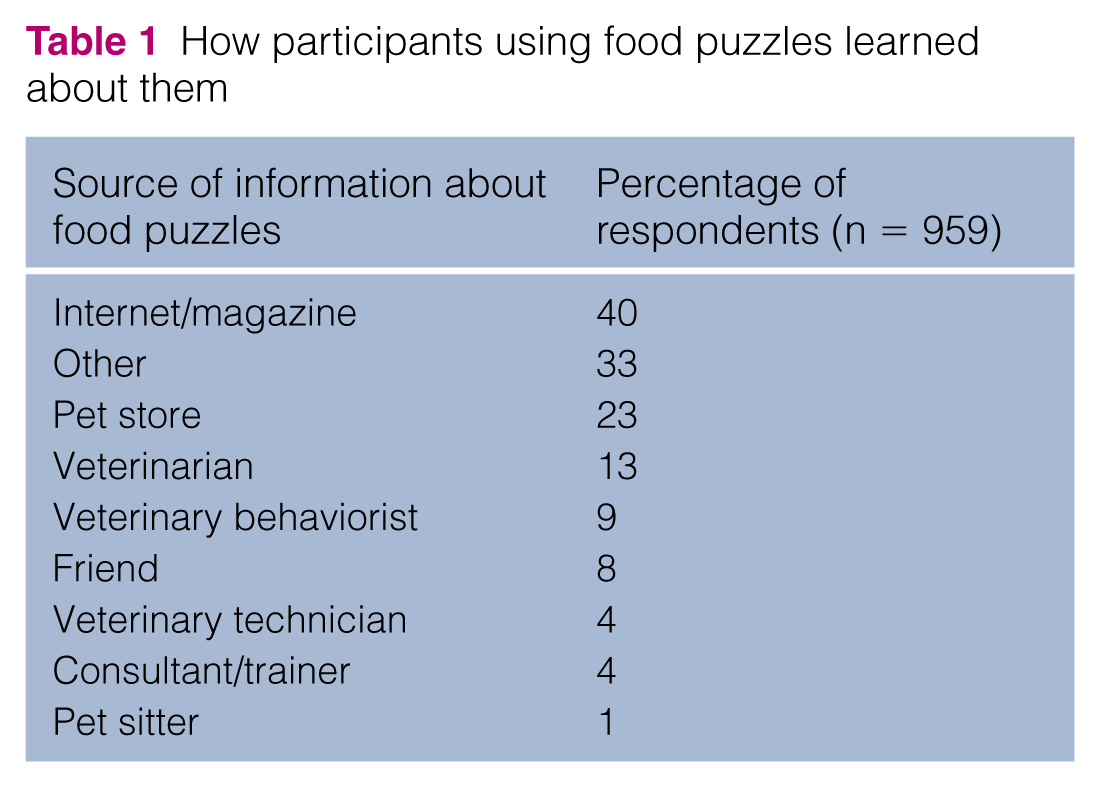
Of the 959 participants (30%) who currently used food puzzles, most reported that they started using food puzzles after learning about them on the internet or seeing them in a pet store (Table 1). Most current users used purchased and mobile food puzzles for dry food only (as opposed to homemade or stationary puzzles; Table 2), and no participants reported using food puzzles for wet food only. More than half of current users (52%) used just one type of food puzzle and 33% used two different types of food puzzles. Almost a quarter (24%) of current users fed half or more of their cat’s food in a puzzle, and 50% reported only using food puzzles occasionally. Participants primarily used praise (60%) and treats (67%) to encourage food puzzle use. Forty-nine percent of users ‘showed’ their cat how to use the puzzle, and 32% said their cat did not need any guidance to attract them to the puzzle.
How participants using food puzzles learned about them
Types of food puzzles used with cats by current and previous users

Previous food puzzle users
Like current users, previous users of food puzzles (n = 560 [18%]) primarily used purchased and mobile food puzzles for dry food (Table 2). The most common reasons for no longer using food puzzles were related to the cat: participants endorsed statements such as their cat was too lazy or never figured them out. Participants also reported that their cat did not benefit from using them, that the puzzles were messy, or cited having a dog or pets fed different diets as deterrents (Table 3).
Percentage agreement of former users of food puzzles and those who never used food puzzles to survey items

Items that were statistically different when tested via χ2, P <0.05
Non-users of food puzzles
For those participants who had never used a food puzzle (n = 1673 [52%]), the most common reasons were having dogs or having multiple cats with different weight goals. Many respondents reported that they did not know how to choose or use food puzzles. Participants also expressed concern that the puzzles might attract bugs.
Some participants’ responses focused on the traits of their pet cat, reporting that their cat was lazy or too finicky to use a food puzzle. Other participants felt food puzzles were not necessary because their cat hunted or was allowed outdoors (Table 3). Some participants (8%) left comments that they had never heard of food puzzles and almost 2% expressed interest in trying food puzzles after participating in the survey.
Effects of previous food puzzle use on responses
Participants who had previously tried and stopped using food puzzles were more likely to endorse that their cat was lazy or dumb, and that puzzles were a trip hazard, compared with participants who had never used food puzzles. However, those who had never tried food puzzles were more concerned about bugs, dogs in the home or cats fighting over the puzzles. They also were more likely to respond that food puzzles were unnecessary because their cat hunts or was too old. There were no differences between groups on agreement with statements that their cats were too finicky, or that they did not use food puzzles due to infants in the home (Table 3). Because we did not have a priori hypotheses about these analyses, they should be interpreted with some caution.
Discussion
The primary objectives of this survey were to assess the prevalence of the use of food puzzles with domestic cats, the frequency of the lapse of their use and how their use was related to current feeding practices. We also identified some of the key obstacles that cat owners encountered when using food puzzles. We addressed how to overcome some of these obstacles in a previous paper, 8 but some resistance to implementing food puzzles appears to be rooted in the owner’s beliefs about their cat’s abilities.
For participants who had tried puzzles but no longer used them, the most commonly endorsed reasons were related to the behavior of the cat. These participants were more likely to agree with statements that their cat was lazy or dumb than were those who had never tried food puzzles. Apparently, the failure of a cat to engage with a food puzzle may negatively affect an owner’s attitude about their cat’s intelligence or interest in enrichment.
People who stopped using food puzzles also reported observing no benefits for their cat. Some participants left comments implying that cats only needed food puzzles if there was a problem that needed to be fixed – such as obesity. Others mentioned that food puzzles were not necessary because their cat had outdoor access or other opportunities for hunting.
Living with multiple pets and pets fed different diets were other common concerns about using food puzzles. Previous research showed that the presence of a food puzzle did not affect agonistic relations between cats; 15 however, a small number of participants in the current survey cited cats’ fighting over a puzzle as a reason for no longer using them.
As in previous studies, dry food was the most commonly offered food for cats, and this practice was strongly associated with free feeding. Respondents to our survey were less likely to feed dry food exclusively (17.2%) vs a previous study of the feeding practices of pet owners (40%). 11 This difference may be due to changing attitudes toward cat food in the past 10 years, or it could be because we used a convenience sample for our study rather than a randomized population like that targeted in the 2008 study.
Feeding dry food to cats may facilitate introduction of food puzzles as a primary vehicle for food delivery because it appears that most food puzzles are designed for use with dry food. However, as a result, few people feed wet food via food puzzles, or are aware of available food puzzles that can be used with wet food. This may inadvertently limit the number of cats that are offered food puzzles.
A third of survey participants used food puzzles with their cats, although over half of those participants only used food puzzles occasionally. Overall, 7% of participants reported feeding more than half of their cat’s diet from a food puzzle. These figures are higher than the number reported by Portuguese cat owners in a recent study of general enrichment provisions. 10 This may reflect differences in solicitation methods (the current study explicitly mentioned feeding), or differences in participants (cat owners in a veterinary clinic vs participants in an online survey). Non-users also may have been more likely to drop out of the survey.
The benefits of using foraging enrichment with captive species has been demonstrated,16–18 and food puzzles are promoted as improving cat welfare, 8 but there have been few studies of their use and potential benefits with companion animals. We need additional empirical evidence about their effects on cats, given that some cat owners in the current study reported observing no benefit for their own cat after implementing food puzzles. A recent study found no increase in cats’ activity when using food puzzles. 9 Another study in rats demonstrated that enrichment may provide neurocognitive benefits, such as prevention of memory loss, even without a measurable increase in activity. 19 Thus, there may be other benefits for cats when using food puzzles, such as cognitive improvements, stress or anxiety reduction, or weight loss, that should be investigated in future studies.
However, some cats may be neophobic and hesitant to interact with new toys (as has been found in Amazon parrots). 20 A previous study demonstrated that cats often are neophobic toward new foods, 21 but little research has been done on individual differences in or tendencies toward neophobia in domestic cats in other domains, such as enrichment objects or toys. All cats in a previous study used offered food puzzles, 9 and almost a third of the current users in our survey reported their cat used a food puzzle without any human intervention. Future studies can assess whether some methods of introduction of foraging enrichment are more effective than others; for example, whether higher-value food should be used, or whether food puzzles should be introduced alongside the cat’s normal food station, to avoid potential stress from the change in routine. 5
We also know little about cats’ problem-solving abilities and how that might influence willingness to interact with a food puzzle, although recent research suggests a relationship between domestic cat socialization and problem-solving abilities. 22 If a puzzle is too difficult, a cat could experience frustration, which has been associated with aggression. 23 Future studies could explore how problem-solving ability, persistence and motivation are related to a cat’s ongoing interest in food puzzles.
To complement information available online, veterinary caregivers could be a source of education about food puzzles, 24 including addressing and demonstrating their use during wellness visits, and displaying and selling food puzzles in their reception areas. Pet practitioners could play an important role in guiding cat owners in choosing and using food puzzles to increase the likelihood of their successful implementation. To that end, a previously published review included a free handout that veterinarians can provide to clients about the selection and introduction of food puzzles for pet cats. 8
This study is limited by the fact that we used a convenience sample of pet owners, and because it was motivated by information-gathering, rather than hypothesis testing. It is also possible that respondents’ answers were affected by the non-random presentation of survey items. However, we had a large number of respondents to our survey and have identified areas for future research, as well as ways that feline practitioners might wish to target educational strategies for clients, should they wish to encourage the use of food puzzles, as has been recommended in a recent consensus statement on feline feeding practices. 24
Conclusions
Although almost half of the respondents in our study had tried food puzzles as enrichment for their cats, food puzzles were seldom used as a primary way to provide cats with meals. Understanding how and what clients feed their cats, as well as which factors create resistance to using food puzzles can help clinicians refine educational strategies to encourage their use. 24
Supplemental Material
Appendix 1
Cat feeding survey
Footnotes
Acknowledgements
The authors would like to thank two anonymous reviewers for feedback that greatly improved this manuscript.
Supplementary material
The following file is available online: Appendix 1: Cat feeding survey
Conflict of interest
The authors declared no potential conflicts of interest with respect to the research, authorship, and/or publication of this article.
Funding
This research was supported by funding from Maddie’s Fund to MD. Maddie’s Fund was not involved in production of this manuscript or the decision to submit the article for publication.

References
Supplementary Material
Please find the following supplemental material available below.
For Open Access articles published under a Creative Commons License, all supplemental material carries the same license as the article it is associated with.
For non-Open Access articles published, all supplemental material carries a non-exclusive license, and permission requests for re-use of supplemental material or any part of supplemental material shall be sent directly to the copyright owner as specified in the copyright notice associated with the article.
