



Abstract
Practical relevance:
Not every cat shelter will have purpose-built accommodation but housing designed with the basic needs of cats in mind, whether purpose-built or adapted from existing housing, will improve the experience of cats passing through the facility.
Challenges:
Designing and building accommodation for cats in shelters should be a thoughtful process. There is a range of different housing types available. A variety of factors, such as expected length of stay, type of cat, cost and disease risk, will influence which design is most appropriate.
Aims:
This review, the second in a two-part series, provides an overview of some of the essential requirements for housing shelter cats, either singly or in groups. Specific practical aspects of housing, including design, space allowances, cage furnishings and suitable construction materials, are discussed, and suggestions made for upgrading existing housing where extensive rebuilding is not feasible or realistic.
Evidence base:
There is a relatively small body of empirical evidence to inform shelter design recommendations. The recommendations in this article are based on a careful review of the available evidence, some of which has come from allied fields such as the care of experimental animals. Where evidence is not yet available, recommendations have been based on field experience and collective expert opinion.
Core needs to be met
Our understanding of cats and their housing needs in animal sheltering has grown tremendously. A variety of housing designs can function to meet the needs of cats, adopters and organizations. Cost and facility considerations (such as constraints on size or room arrangement), together with anticipated length of stay (LOS), disease risk and type of cats to be housed (eg, kitten or adult, friendly or less socialized) will influence which design is most appropriate in each situation.
Regardless of specific design, a cat’s enclosure should be large enough to allow separation of the bed, food and water from the elimination site, and for the cat to perform natural behaviors such as stretching and playing. Ideally, all enclosures should include an elevated vantage point1,2 as well as a place to hide, a firm cool surface to stretch out on and a soft, comfortable bed.

Good housing is important throughout the shelter, but should especially be prioritized in areas where newly admitted cats are housed. 3 Whether the cat is a coddled pet or free-roaming stray, shelter confinement is likely to be a stressful experience at best, with potentially fatal consequences for cats that fail to adapt.4–6 Providing excellent housing and a good housing environment immediately on intake can offset stress and support the cat’s health through this critical transition. Well-designed housing also facilitates routine care with limited handling and disruption, important for preventing disease and disease spread in cats whose health status is not fully known.
Each change of housing carries a risk of reactivating feline herpesvirus.7,8 Ideally, the cat will go through intake procedures (examination, vaccination, identification, etc) and then be placed directly into its shelter housing, rather than housed in a shorter-term cage for an hour or two awaiting examination. In addition to lowering disease risk, eliminating this step can reduce cleaning needs and help cats in their acclimation process by providing one housing unit with which to familiarize to.
Isolation areas too should never be an afterthought when it comes to housing quality. Sick cats are even more susceptible to the effects of environmental stressors, and handling of these cats carries a heightened risk of spreading pathogens unless staff are meticulous about biosecurity and stress management. Double-compartment housing, natural lighting, good air quality and delivery, and a quiet, comfortable environment free from dog and other noise will facilitate speedy recovery.
Individual housing units
Adequate housing space
Floor space recommendations for short-term (no longer than 2 weeks) single-cat housing are 0.75–1 m2 (8‒11 sq ft).9,10 For new cage housing selection, at least 1 m2 (11 sq ft) of floor space/cat is recommended (shelf space is not included when calculating floor space). 9 A standard cage unit that is around 152 cm (5 ft) wide x 70 cm (28 in) deep x 66–76 cm (26‒30 in) high will meet the 1 m2 space recommendations. Alternatively, existing individual cage units can be retrofitted to meet space guidelines. This works particularly well for traditional-size stainless steel housing units that singly are too small to house a cat (~60 cm [2 ft] wide x 70 cm [28 in] deep x 60 cm [2 ft] high). These sturdy cages can be converted to multiple unit ‘apartments’ by using pass- throughs or portals between cages (Figure 1). When portalized, two cages provide 0.75 m2 (8 sq ft) of floor space to a single cat occupant. Retrofitting with portals has the added benefit of creating a multiple-compartment configuration. Depending on the type of existing cage material, pre-made portals are available for purchase from several cage manufacturers. Instructions for homemade polyvinyl chloride (PVC) portals are also available. 11 Doors on the portal enhance ease of daily care and flexibility of use, such that a sudden influx of cats can be accommodated short term on either side of a double-compartment unit. However, closure of portal doors to provide more housing is an indicator that capacity is exceeded and cat housing needs are not being met.

(a) A cat portal can be used to convert single cages to multi-unit housing. (b) The metal cage wall is cut in preparation for installing a portal. (c) The installed portal. (d) A bank of cages with portals installed
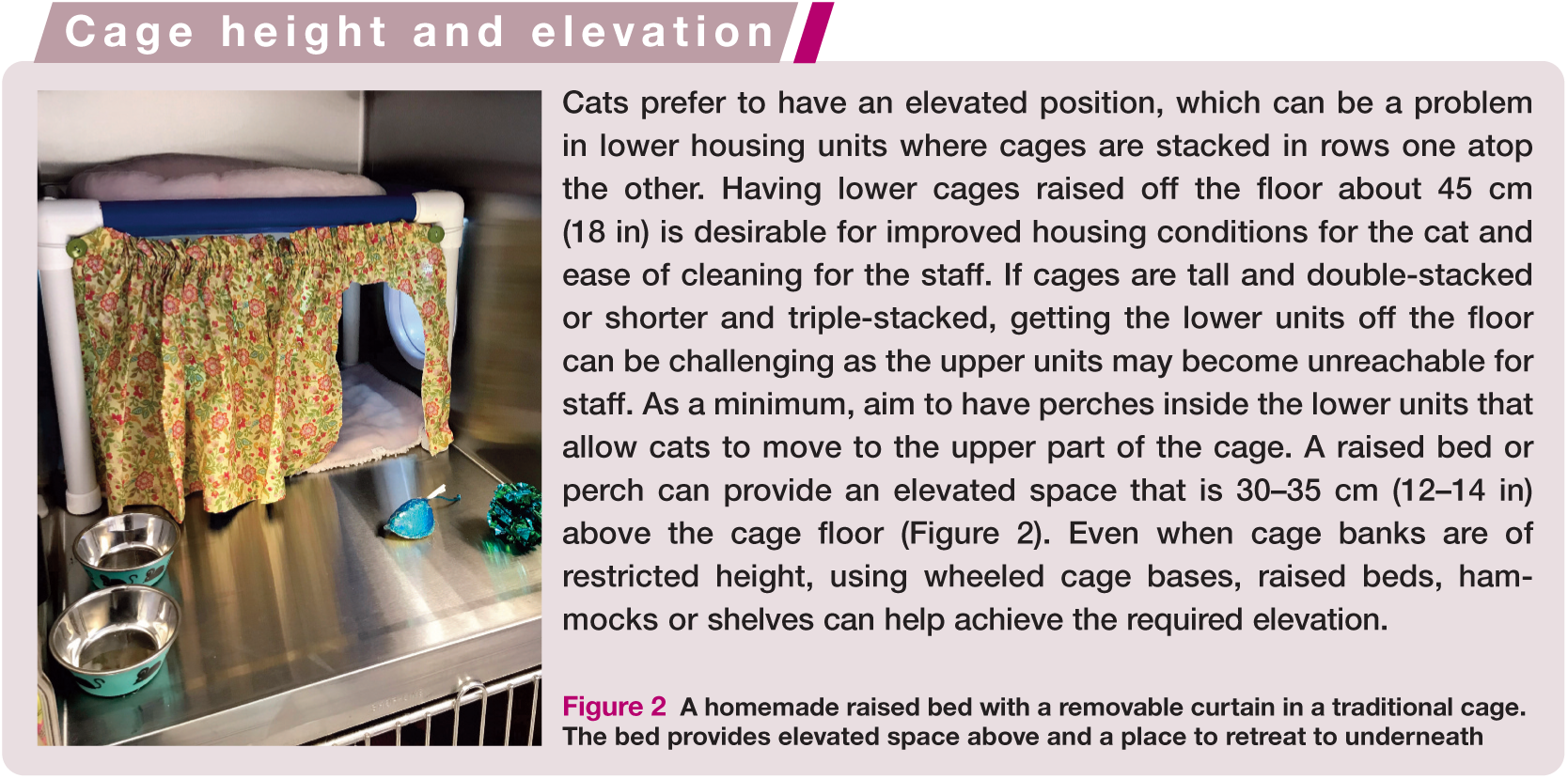

A homemade raised bed with a removable curtain in a traditional cage. The bed provides elevated space above and a place to retreat to underneath
Double-compartment housing
Double-compartment cage housing comprises two separate areas within the same housing unit connected by a pass-through (a doorway or portal). The double-compartment unit provides adequate space for the animal and allows full-time access to both compartments. One compartment contains the bed, food and water, and the other contains the litter box. This arrangement facilitates numerous environmental choices by the cat depending on the cage set-up, such as whether to be visible or not, a soft or hard surface for resting, and elevated or cage floor level as a vantage point. During routine cleaning, the animal is not handled (or is minimally handled) and remains in the housing unit on one side while the other side is spot-cleaned.
Double compartments, when side-to-side, may or may not be equal in width. For a slightly compact double-compartment unit the litter box area can be reduced in size. Our preferred double-compartment units are sized to provide 1 m2 (11 sq ft) of floor space. This can be achieved with two standard-size cages: 76 cm (30 in) wide x 70 cm (28 in) deep x 66–76 cm (26–30 in) high with a portal between. The main living side should be a minimum of 76–90 cm (30‒36 in) wide. This allows enough space for most cats to stretch out fully relaxed on the diagonal. The minimum width for the litter box side is about 38 cm (15 in). This will accommodate an adequate-sized litter box. This smaller compartment should be clear of cage furniture (eg, shelving above the litter box area) to allow for normal posturing during urination and defecation. The floor space for the smallest recommended double-compartment unit is about 0.75 m2 (8 sq ft), with a total width of 122 cm (4 ft) x 70 cm (28 in) deep x 66–76 cm (26‒30 in) high (Figure 3).


Double-compartment cat housing unit with an 85 cm (33 in) wide main compartment and a 38 cm (15 in) wide side compartment: total floor space of ~0.75 m2 (8 sq ft)
While they may seem space efficient, compartments that are shallower or narrower than the above guidelines are not generally recommended (Figure 4a). They are difficult to inspect and clean, and do not allow for a litter box with sufficient clearance for normal posturing during elimination (Figure 4b). Additionally, a frightened or fearful cat may hold guard at the back of the small compartment, making its removal potentially stressful for both cat and staff.
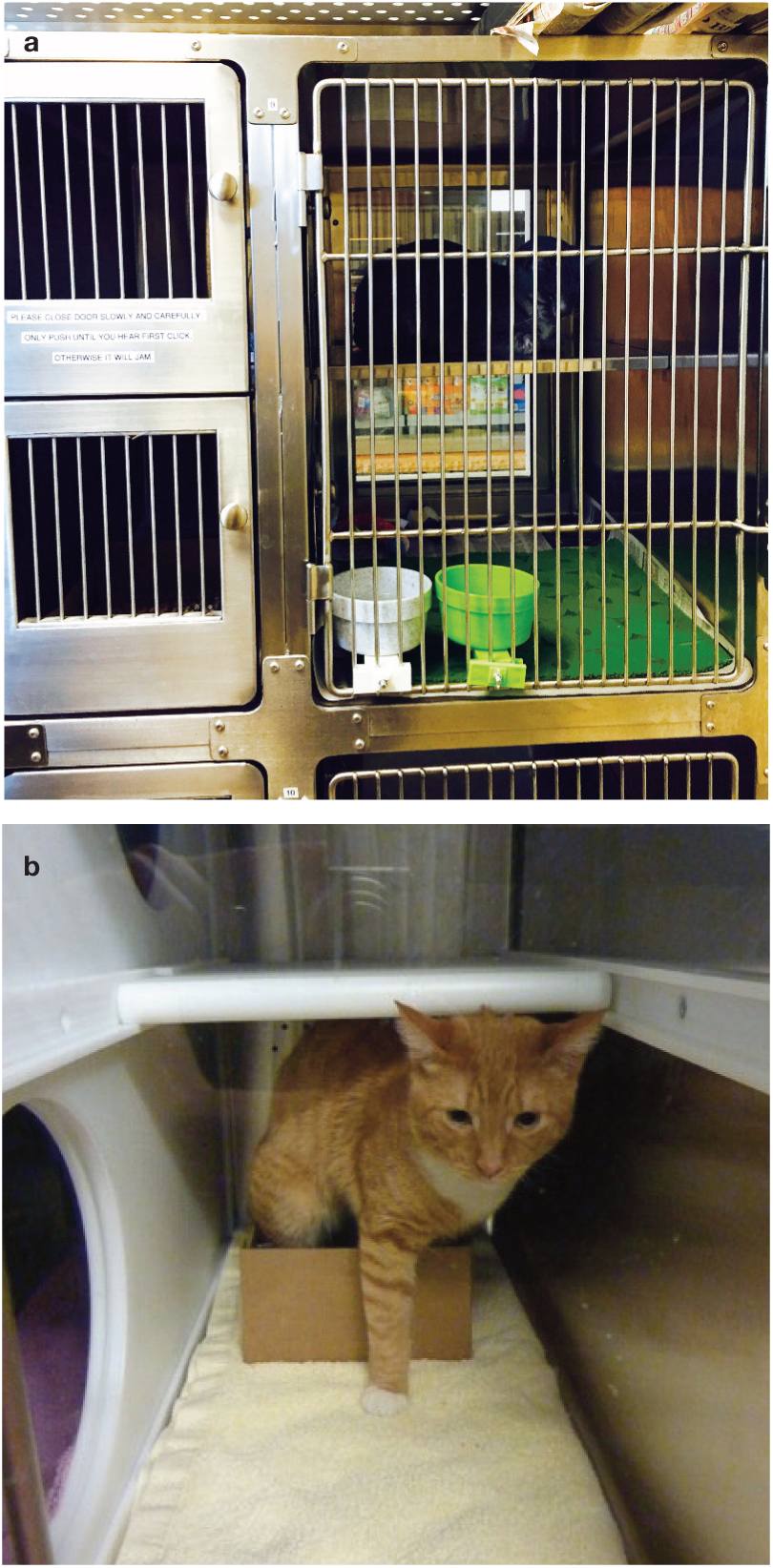
(a) A cage with a main compartment (76 cm [30 in] high) and two overly small additional compartments (each 38 cm [15 in] high). (b) A litter box located under a 38 cm (15 in) high shelf. The litter box is too small and the shelf impedes normal posturing – this cat is struggling to toilet
Double-compartment housing can be configured side-to-side or up-to-down. Side-to-side compartments conserve cage floor space (since the portal is in the cage wall) and allow flexibility in terms of compartment number and overall cage size. This is often a good housing choice in initial holding areas. Up-to-down units can also work well (Figure 5a). It is best if the units are the same size, with the litter box in the lower level and the food, water and bed in the upper level (Figure 5b). This set-up is ideal in adoption housing areas, as it allows all cats a chance to be presented at the eye level of potential adopters.A small shelf or raised bed located under the pass-through into the lower unit provides a step for cats to move up and down. Cat selection for up-to-down units is important – very young and/or cats with mobility problems may not maneuvre well up-to-down. 12

(a) Cat accessing the upper level via a portal. (b) Note the location of the litter box in the lower level, and the bed and food and water bowls in the upper level
Quad unit
An extremely versatile yet simple and potentially mobile housing unit is the quad unit – four single cages (each76 cm [30 in] wide) with portals side-to-side and up-to-down (Figure 6). This configuration can be used to meet several common cat housing needs. On an ongoing basis, the quad can be used as two double-compartment units, either up-to-down or side-to-side. When cat populations are low, or when LOS may be extended, the entire unit can be set up for a single adult cat to roam through all four compartments. For the day of an adoption event, the pass-through doors can be closed if needed and the quad unit can be used as four single units (for example, to display and adopt out different litters of kittens).
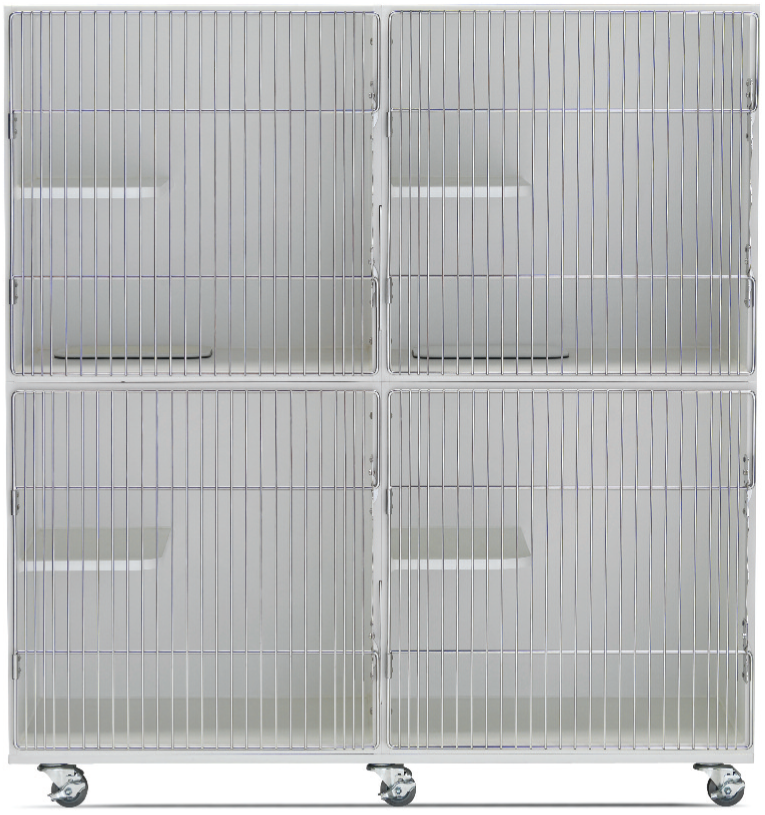
Example of a quad unit: a 152 cm (5 ft) laminate assembly with pass throughs side-to-side and up-to-down (Shor-Line)
Small room housing for groups or individuals
In the US, group housing is commonly seen as the main alternative to cage housing and is practiced in many shelters. The co-housing of unfamiliar cats with potentially high turnover makes this option less than ideal under some circumstances. Group housing may be preferred for the more difficult to rehome cats (provided they are able to socialize with others), especially where single-unit housing is unsuitable for a long stay. Stable groups and consistent husbandry have been shown to reduce stress in such environments. 13 This may be facilitated by reducing group sizes.
Larger group rooms can be modified into smaller group housing spaces using lightweight materials (such as coated wire or chain link enclosures) to divide up the space. Some shared walls may benefit from being solid (from floor level to perhaps 90–120 cm [3–4 ft]). This can be achieved with 6 mm (0.25 in) plastic sheeting (high-density polyethylene or similar), fiberglass sheeting or another solid visual barrier made with easy-to-clean materials. Structures that allow hiding and retreat should be provided such that cats in adjoining spaces can choose to be seen or not seen. Due to the potential for limiting ventilation and lighting by dividing larger rooms that were essentially designed to be open, we do not recommend modifying the room into entirely enclosed smaller rooms. Also always check with local laws and building codes before modifying any existing structure.
While group housing can be considered for some cat-social cats, individual small rooms or walk-in runs meet the needs of most cats including the longer-stay cat, less cat-social cats or those that require individual monitoring or care (such as special diets) (Figure 7).
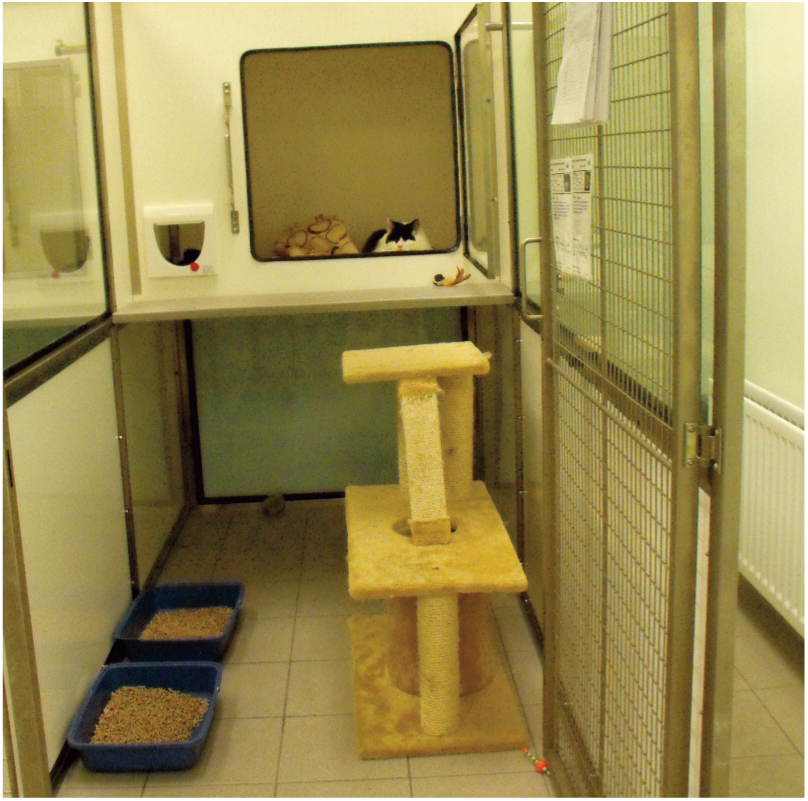
Many cats will benefit from individual housing
Floor space generally meets or exceeds 1.7 m2 (18 sq ft)/cat, making them a good housing space for an individual cat or a pair of cats (when 3.4 m2 [36 sq ft] or greater is provided), especially for those that exhibit frustration in more confined housing or are expected to have an extended stay. Care staff can enter this type of housing, providing flexible care options, including the possibility of quiet time with a person in the housing unit (with or without handling the cat), and reducing the stress of having to move the cat out of its familiar housing space. A door that allows entry or interaction from the outside aisle is ideal (Figure 8). Steps, crates and shelving can be easily and cheaply improvised to allow cats options for movement and vantage points within the housing space (Figure 9).

Individual room doors that allow viewing through a glass panel (centre of door) and interaction and ventilation through plastic-coated grates (top and bottom of door)


(a–d) Individual and group rooms with a variety of amenities to increase the availability of elevated space
Beyond the cage: indoor/outdoor housing
Although indoor cage housing is common in many shelters, in others, particularly in the UK, cat housing is traditionally more spacious, with a snug indoor area and an outdoor run accessed by a cat flap (Figure 10). Indoor/ outdoor housing can provide many benefits over a cage set-up, including access to the outdoors with natural light, ventilation and olfactory stimulation; visual choice; separation of resources; and more opportunities for play and exercise. However, even subtle aspects of design and management can affect the use of this space. For example, where dividers between units are transparent, this may limit cats’ use of outdoor space because of visual conflict with cats on either side (Figure 11), effectively restricting them to the much smaller indoor space. With some strategically placed modifications (opaque plastic or fiberglass sheeting) more visual choice can be provided. Equally, accessing litter trays via relatively steep ramps may be difficult for old or injured cats, so alternative arrangements must be made. Provision of a seating area within the larger, enterable part of the unit could encourage comfortable interaction with staff and potential adopters on the cat’s terms (Figure 12).

Indoor/outdoor cat housing accessed with a cat flap door (top centre of photograph). Note the door to the left of the cat flap, for ease of staff entry

Outdoor housing areas with potential for conflict due to use of clear dividers separating the outdoor pen areas

Cat housing that is large enough for furniture can encourage interaction with visitors, although typically cats will choose to occupy the most comfortable spots first!

Integral features of housing units
Doors
The door is an important component of the housing unit. As well as providing access into the unit, it serves to allow or restrict physical interaction between humans and cats (eg, bars vs glass) and is the entry point for air into the unit (ventilation).
Although there are generally enough gaps around glass doors to allow oxygenated air to enter the housing space, solid glass doors do not allow sufficient natural ventilation of the unit, which will be at risk of poor interior air quality if not mechanically ventilated. Barred doors allow air to freely enter and exit the housing unit. Bars also allow interactions with people, providing cats with more choice in their housing environment. Hybrid doors are combinations of glass and bars (Figure 8) and may help meet some of the needs for interaction and ventilation that solid glass doors do not. Opaque panels or other improvisations (Figure 13) may be used for a portion of the door, to provide a built-in or removable partial visual barrier, respectively; however, they should not cover the majority of the door, as they reduce choice, may reduce ventilation and make observing the cat difficult.

Removable partial visual barriers can be used on cage doors where necessary
Hinges and latches
Hinges, and particularly door latches, strongly influence the noise associated with routine cleaning and care. in particular, metal latches that rely on the weight of the latch for closure can be disruptive to cats – it is not uncommon to see several cats in a room startle awake or freeze in place when one of these cage doors is opened and closed with a metal-on-metal clang. To address this, several cage manufacturers make hinges and latches that are designed to be quiet; some can be used to replace existing noisy metal latches (Figure 14). When ordering new caging, check that latches and hinges are quiet when opening and closing.

(a) Plastic-coated stainless steel quiet hinge; (b) plastic latch (Shor-Line); (c) soft close hinges (Mason Company); and (d) gate lock (Snyder Manufacturing Company)
Cage construction material
A variety of materials are available for cage construction. Table 1 summarizes the important properties of some commonly used materials. Although cost is always a factor in material choice, it is also worth factoring in durability, as investing in a more expensive material may pay dividends over time.
Properties of some commonly used cage construction materials

$ = least expensive; $$ = moderately expensive; $$$ = most expensive
Mostly, these cages are now made of brushed stainless steel, which greatly reduces the problem of cats being frightened by their reflection
Although imperviousness of surface has historically been a great concern in animal housing, disinfectants now on the market (such as potassium peroxymonosulfate and accelerated hydrogen peroxide) can mean this is less important. These chemicals reliably inactivate even the tough, unenveloped viruses such as panleukopenia and calicivirus, and have better penetration into porous surfaces and improved activity in the face of organic matter, compared with historically common disinfectants such as sodium hypochlorite and the quaternary ammonium disinfectants.14–18 There has been a tendency to select only cage material that is non-porous and durable for shelter cat housing. While there are housing areas where that may prove to be desired (sick bay, intake areas, etc), given the availability of modern disinfectants, warmer, quieter cage materials that lend to a greater variety of cage configurations and sizes may be preferable.
Stainless steel (or stainless steel and durable plastic) is recommended over chromed steel or galvanized steel for use as a construction material and/or for cage hardware (screws, hinges, latches, dishes, etc), as the latter steel materials have low durability in animal sheltering environments.

Shelving and perches
Shelves intended for cats to use and enjoy should be a minimum 30 cm (12 in) wide and be long enough for a cat to fully lie out, or should extend the full length or depth of the cage. Shelves should be raised 33–35 cm (13‒14 in) off the cage floor to accommodate hiding boxes, carriers or other solid objects that may need to slide under them. An area of the cage should be free of furniture (eg, shelves) to allow for normal litter box posturing and other stretching behaviors; for instance, consider putting a shelf in only one compartment of a double-compartment cage to allow full height use on the other side.
Be careful with built-in shelving – it can be hard to clean and can impede the use of some amenities (solid hiding structures) and litter boxes, and limit the configuration of the cage set-up.
The surrounding environment
There are some key components that make good environments for cats. Ideally, the room should be quiet, with no vibrations from mechanical systems, and have good air quality, natural lighting, visual stimulation, minimal to no exposure to dogs or dog noise, consistent care staff and space for out-of-cage time if cage housed.
Air quality
Guidelines suggest 10‒20 room air exchanges, with fresh air every hour, for adequate ventilation of animal facilities. 9 The quality of the air can vary within a room and it is important to ensure the air quality is good in animal care areas, especially at the level of the animal within its housing unit.
Temperature and humidity
An ambient temperature of 15.5–26.5°C (60‒80°F) and humidity of 30–70% are recommended, 9 but animals must be provided with bedding and monitored for comfort even when this range is provided and maintained. Additionally, adequate space and surface variety within the housing unit are important to allow cats to thermoregulate.
Lighting
The Association of Shelter Veterinarians’ guidelines state: ‘Light and darkness should be provided so that they support the natural (circadian) rhythms of wakefulness and sleep’. 9 Natural light should be offered whenever possible. When artificial light is used, it should closely approximate natural light in both duration and intensity. 9 Skylights and/or solar tubes can help to provide natural light through the ceiling in rooms that do not have window or outdoor wall access.
Visual stimulation
Where possible housing units should be set up such that they provide cats with a ‘view’. This can be a view of the outside, the centre of the room, a television monitor or other cats, so long as there is a way for all cats to choose to limit their view if they wish (eg, hiding space, partial visual barriers on doors). A window view may be best – indoor cats spend as much as 5 h a day in this activity when given the option. 21
Noise
Cats have a wide hearing range, extending ‘…from 48 Hz to 85 kHz, giving it one of the broadest hearing ranges among mammals’, far beyond that of humans. 22 Limiting noise exposure for cats through shelter design and housing choice is an important component of stress management. As well as selecting quietly opening and closing cage doors, reduce any additional metal-on-metal noise (for instance by providing food and water dishes made of non-metal material or metal dishes that have rubber-coated bases). For older metal cages, a small piece (10 x 15 cm [4 x 6 in]) of automotive acoustic dampening material can be attached to the centre of the exterior side of the cage walls to dampen the high pitch twang of the metal. Staff can also help by being aware of the need for quiet in cat living areas and conducting their work accordingly; for example, avoiding use of radios playing very loud music, loud talking, slamming of drawers/doors or use of noisy equipment.
The design of the facility will also impact noise exposure for cats. A good rule of thumb in new building construction is to ensure that at least two doors separate cat housing areas from noisy areas in the facility (including all dog housing areas). Sound-blocking doors are available if needed.
Inexpensive fixes for reducing noise entering through doorways in existing facilities include making it a habit to always close the door when entering or exiting cat housing areas and sealing the door jamb with self-adhesive sound-proofing tape or weather stripping.
Sound-absorbing acoustic tile type products can be used on ceilings and walls to improve room acoustics. Most acoustic tiles are rated with a noise reduction coefficient (NRC): the closer to 1 a panel is rated, the better the absorption of sound. Use of acoustic tiles and wall material in cat housing areas, as well as other noisy areas of the shelter such as the lobby and dog housing areas, can help reduce noise throughout the facility.
Out-of-cage time and interaction areas
Having out-of-cage space (a large pen, enclosed adjacent room or other secure enclosure) in housing facilities provides more flexibility for care and use. Ideally, this space should be large enough for a human to spend quiet time or have interaction with the cat. Out-of-cage time combined with behavioral enrichment (clicker training) was shown to lower the risk of upper respiratory tract disease for cats that were exhibiting frustration in a shelter. 23
Species separation
Species separation should begin on arrival and continue from the entryway and lobby (separate waiting areas) and intake processes (separate intake exam rooms), through housing areas, medical and surgery recovery areas, adoption areas and to all outcomes. Having shelves available so that carriers can be positioned at an elevated level can be a helpful addition (Figure 15).
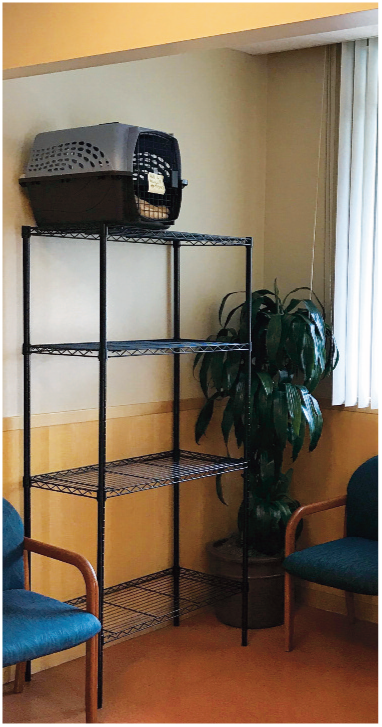
Cats feel safer in elevated positions
Small changes, big difference
Where current housing does not meet cats’ needs, and where rebuilding is not practical, we hope the suggestions in this article will inspire ways in which existing housing can be better adapted to meet cats’ welfare needs. Even where facilities fall short of ideal, small changes can make a big difference to accommodation from a cat’s perspective. Some adaptations can be made easily and inexpensively; for example, using cardboard boxes or open cat carriers to provide cats with a hiding place. Placing portals into existing housing to provide double-compartment housing can be transformative for cat welfare and health when single cages have been the norm. 24
Whatever the housing facilities, giving each cat as short a stay as possible is an essential management tool, so collection and analysis of data, and exploration of how LOS can be shortened, is an important step in improving feline welfare in shelters.
Key Points
✜ This article provides an overview of some of the essential requirements for cat housing in a short-term stay shelter. These principles apply to any environment where cats are confined, including hospitalization in veterinary practices.
✜ While not every shelter will have purpose-built accommodation, by appreciating cats’ basic needs, existing housing can be adapted and improved to ensure each cat has as positive and as brief a stay as possible.
Footnotes
Conflict of interest
Jenny Stavisky declares no conflict of interest. Denae Wagner provides consultation services to Shor-Line, Kansas City, KS, USA. The Koret Shelter Medicine Program (KSMP) (Denae Wagner and Kate Hurley) designed, developed and had manufactured a cat portal intended for remodeling existing housing, and which is sold through the KSMP and Shor-Line. KSMP also provides instructions online for making portals for free. Some of the information in this article has been presented orally or is adapted from conference presentation proceedings by the authors.
Funding
The authors received no financial support for the research, authorship, and/or publication of this article.
References
Supplementary Material
Please find the following supplemental material available below.
For Open Access articles published under a Creative Commons License, all supplemental material carries the same license as the article it is associated with.
For non-Open Access articles published, all supplemental material carries a non-exclusive license, and permission requests for re-use of supplemental material or any part of supplemental material shall be sent directly to the copyright owner as specified in the copyright notice associated with the article.
