



Abstract
Practical relevance:
Shelters and rehoming centres are a valuable tool in the population management and rehoming of cats. However, housing large numbers of a relatively asocial species in close proximity poses significant challenges. Well-designed accommodation enables improved standards of husbandry, as well as a better working environment for staff. This can have a significant benefit in expediting rehoming, as cats are healthier, and more likely to display natural behaviors and have positive interactions with potential adopters.
Global importance:
As cat overpopulation is such a widespread issue, cat shelters are common in many countries. This review will be of interest to those involved in the design and construction of cat shelters, and to those caring for the cats within them. The principles discussed also apply to boarding, breeding, research and hospitalization facilities.
Challenges:
Shelter housing poses substantial challenges in terms of maintaining positive health and wellbeing while sustaining adoption at an optimum rate. Disease control and biosecurity are typically facilitated by having a relatively barren, easily cleanable environment. However, this must be weighed against the provision of opportunities for cats to perform natural behaviors such as hiding, perching and interacting if they wish. A more enriched environment has also been shown to expedite adoption.
Aims:
This review, the first in a two-part series, discusses practical aspects of housing and shelter design for the health, welfare and adoption of shelter cats.
Evidence base:
There is a relatively small body of empirical evidence to inform shelter design recommendations. The recommendations in this article are based on a careful review of the available evidence, some of which has come from allied fields such as the care of experimental animals. Where evidence is not yet available, recommendations have been based on field experience and collective expert opinion.
A matter of life or death
In many parts of the world, animal shelters form a cornerstone of efforts to manage free-roaming, unwanted and abandoned companion animals, with cats making up a substantial portion of shelter intake.1–5 The design of an animal shelter facility and the housing therein will affect both the success of the organization and the experience of each animal that passes through its care. This is particularly true for cats, a species that is exquisitely sensitive to environmental changes. The quality of housing can be literally a matter of life or death for a cat entering a shelter.
In spite of its importance, poor cat housing has been identified as ‘one of the greatest shortcomings observed in shelters,’ one that has ‘a sub-stantially negative impact on both health and wellbeing’. 6 All too often, cat housing in shelters still consists of small, stainless steel, single-compartment caging. Such caging also remains common in many veterinary clinics, although in recent years the ISFM’s Cat Friendly Clinic programme 7 and the AAFP’s Cat Friendly Practice program8 have sought to address this. The durability and permanence of this type of housing may account for its continued prevalence, despite our understanding of the needs of cats and our goals for sheltering having evolved dramatically. Even when adequately sized, much existing cat housing fails to meet cats’ needs for environmental control and behavioral expression.
Conversely, just as poor housing can profoundly compromise welfare, good housing can be a powerful tool in promoting positive welfare. Presented with a bewildering array of options, the development of a successful housing plan in a shelter can be guided by the answers to three key questions:

✜ What are the aims of the organization, and how will the housing support these goals?
✜ How many housing units are needed to serve the overall aim of the organization?
✜ What kind of housing is most appropriate for the needs of the cats as well as the organization itself?

Defining required housing capacity
An early decision to be made when designing a shelter will be the number of cats a given facility will accommodate, and therefore the number of housing units required. This will strongly influence the building costs as well as operational costs over the lifetime of the building. Additionally, the number of cats housed at any one time will affect everything from disease risk to chances for adoption, sometimes in counterintuitive ways. Given its far-reaching impact, basing the key decision of capacity simply on the number of units that will fit in the available space would be a reckless choice. Rather, the daily housing (or holding) capacity should be based on thoughtful analysis of the desired flow-through (ie, throughput) ‒ that is, the number of cats that will move through the shelter’s care over the course of each month or year, and the length of time these cats would optimally stay, on average.
Length of stay, holding capacity and flow-through
Put simply, the required holding capacity will equal the number of cats entering the shelter daily, multiplied by the average number of days each cat will remain in the shelter’s care (length of stay, or LoS). This can also be considered from the opposite perspective: the average LoS will equal the number of cats housed at any given time divided by the daily rate of cats leaving.
Ideally, all shelters should measure their average LoS as a key performance indicator. As seen below, even small changes in LoS can have a large impact on housing capacity needs when multiplied by many cats. Factors such as high rates of disease and unnecessarily arduous adoption processes can increase LoS.

Reducing housing capacity can also positively affect a cat’s chances of adoption. Simple arithmetic determines that a longer ‘line’ of cats waiting for adoption means a longer wait for each one. in a shelter that houses 150 cats at any given time and adopts out on average five a day, each cat will have a 1 in 30 chance of adoption on a given day and the average LoS will be 30 days. Lower the population by one third to just 100 cats, and as long as the same number of potential adopters still come to the shelter, each cat’s chance of adoption will increase to 1 in 20 as the average LoS drops to 20 days.
Fewer choices to select from seem to directly increase the likelihood of selection and satisfaction, as has been shown in a wide range of contexts, from purchasing gourmet chocolates to choosing potential life partners.9,10 A pilot study documented that a 40% reduction in the number of cats visible for adoption more than doubled the frequency with which potential adopters actually left with a cat. 11
Therefore, if equally good or better out-comes can be achieved, a scenario in which fewer cats are housed at any one time is clearly preferable. There may be additional benefits from both shortening the average LoS and decreasing the number of cats available. LoS is a common and significant risk factor for feline upper respiratory tract disease in shelters.12–15 increasing LoS also increases the complexity of meeting the behavioral needs of cats, and some cats will inevitably suffer behavioral deterioration with prolonged confinement.6,16 Healthy cats exhibiting relaxed and outgoing behavior are likely to be adopted more quickly and less likely to be euthanized, further correlating a shorter LoS with positive outcomes.17–19
In 2012, the British Columbia Society for the Prevention of Cruelty to Animals (BC SPCA) formalized a management model termed Capacity for Care (C4C), which combined minimum housing space guidelines with a calculated optimal daily population of cats based on adoption rate. This model resulted in:
✜ A doubling of cage space – from 0.53 m2 (5.8 sq ft) to 1 m2 (11 sq ft);
✜ An approximately 50% decrease in the number of cats housed;
✜ A 15% increase in the number of cats adopted;
✜ A decrease in the average LoS from 40 to 22 days;
✜ A reduction in the number of cats in isolation from 16 (maximum allowable) on any given day to an estimated total of 10–15 for the entire year.4,20
This model was piloted at three Canadian shelters in 2014 and 2015, producing a range of positive results, including decreased respiratory infection, lower veterinary costs, increased percentage of cats adopted and lower percentage of cats euthanized.21,22
Optimal population and target LOS
Logic tells us that for all the benefits of lowering the daily population, there must be a level below which decreased capacity will have a detrimental, rather than beneficial, effect. Housing numbers must be adequate to afford each cat a length of stay that accommodates veterinary treatment (where needed) and mandated holding periods (variously determined by country, state or local laws), as well as allowing a sufficient length of time for cats to be offered for adoption. Potential adopters need a variety of cats to choose from, ideally representing a range of ages, appearances and temperaments. The sweet spot will represent an optimal population size that enables these conditions to be provided to every cat while minimizing any unproductive additional time in confinement. 23

Calculation of the optimal shelter population is based on the number of cats the shelter aims to serve over time, which is then used to derive a daily average intake or outcome rate.23–25 The average daily rate is multiplied by a target LoS to calculate the ideal daily population. Because of the seasonal nature of cat reproduction, peak month as well as average annual intake should be considered. Foster capacity may also need to be considered separately when calculating LoS. Housing considerations differ for kittens vs adult cats: highly disinfectable surfaces are often prioritized, the anticipated length of stay will be shorter in most shelters, and multiple members of the same litter may be housed per enclosure. Therefore, separate calculations should be made for adult vs kitten housing requirements.
Identifying a realistic target LOS requires consideration of organizational constraints, such as the length of any required holding period and constraints to delivery of needed care, such as limitations to spay/neuter services. optimism and realism should be balanced in selecting an attainable target. For most shelters, this will be less than 3‒4 weeks on average for cats entering the shelter with no extraordinary care requirements. A good starting point, therefore, would be to plan no more housing than 75‒100% of the expected monthly intake (not including isolation and areas for cats requiring extensive care). Many shelters attain an even lower LOS in conjunction with high live release rates through proactive management practices, and the planned number of housing units can be adjusted downwards accordingly, if this is the case. (See also the case example above.)

Housing design to accommodate cats’ needs
Getting the numbers right is critical to a successful housing plan, but equally important is designing accommodation that genuinely meets the needs of cats (for an accessible ethology of cats, see Bradshaw and Ellis 2016 26 ). The evolution and relatively recent domestication of cats have specific implications for housing. domestic cats have evolved from ancestor species, most probably the African/Arabian wildcat, and are thought to have begun living closely with humans in the Middle East around 10,000‒12,000 years ago.27,28 Their origin as largely solitary, territorial predators manifests itself in factors such as a need for privacy and an elevated resting place from which they can survey their environment.29–32 Often, feline expression of stress or disease appears comparatively subtle, requiring careful observation and investigation. 33 This may account for the historical tolerance of relatively poor housing for cats compared with that afforded to dogs in many confinement contexts, as feline distress is less obviously manifest.
Cats’ ancestral lifestyles are also likely to have influenced the interactions between cats and their pathogens, which have co-evolved. African/Arabian wildcats are likely to encounter others at times of physiological and psychological stress, such as mating and territorial disputes (sex being a relatively aggressive activity for cats). For their pathogens, then, an important strategy is to lie latent within a cat and re-emerge at these stressful times, when opportunities for transmission are likely to occur. This may explain why cats appear to be peculiarly likely to exhibit long periods of asymptomatic carriage of infectious diseases, which then recrudesce under stress. it also explains why an emphasis on stress reduction in cat husbandry is so key to disease prevention. 18
Meeting core needs
The core needs of domestic cats kept in confinement have been expressed in various ways, in reference to Brambell’s ‘five freedoms,’ which provide for very basic physiological requirements. 34 More recently, the specific environmental needs for cat housing have been described in terms of ‘five pillars’:31,35
✜ A safe place to rest;
✜ Multiple resources;
✜ Ability to express play and predatory behavior;
✜ Positive and consistent human contact;
✜ Appropriate olfactory stimulation.
Within these broad guidelines, individual cat (and kitten) requirements and preferences will vary. Attentive monitoring will help identify cats that need modification to their environment. When a fastidious animal, such as a cat, is found resting in its litter tray, this is usually a sign that it needs a more comfortable or more enclosed resting or hiding place.36–38 On the other hand, constantly hiding is an indicator that a cat is failing to adapt and may need to be moved to a quieter area of the shelter and/or a different type of housing altogether. 39
Other indicators of stress in shelter cats include general ‘sickness behaviors’ such as decreased activity, decreased grooming and feigned sleeping, as well as physical manifestations such as anorexia, weight loss, diarrhea, vomiting and reactivation of latent feline her-pesvirus manifesting as upper respiratory tract infection. 40 Simple monitoring practices, such as noting whether a cat ate ‘all’, ‘some’ or ‘none’ of its food, may help identify stressed cats early in their shelter stay and trigger intervention to provide a more enriched environment tailored to the cat’s individual needs. 41 The variety of possible enrichment techniques is wide, and often low-cost. A more enriched environment has also been shown to expedite adoption. 42 A full exploration is beyond the scope of the present article; however, an excellent introduction to this topic can be found elsewhere. 30
Disease control
Of course, the more complex and enriched a cat’s environment is, the harder it is to decontaminate. This trade-off is often a topic of debate. Where infectious diseases such as parvovirus/panleukopenia and dermatophytosis are common, housing surfaces that can be effectively disinfected are paramount. However, decisions are complicated by the fact that viruses such as feline herpesvirus and feline calicivirus are commonly carried, and shedding levels and disease expression are heavily influenced by stress. Housing setup and management practices may play a greater role than the imperviousness of surfaces in managing these diseases. For instance, double-compartment (Figure 1) or walk-in housing facilitates spot-cleaning rather than daily whole-pen disinfection when there is no change in residents. This helps maintain olfactory continuity, reduce stress and limit fomite transmission in the course of daily care, translating to a lower exposure to pathogens (due to both reduced shedding and reduced spread).

Double-compartment housing
Lowering stress and promoting positive welfare can also support cats’ ability to withstand disease challenge. Providing cats with choice and control over their environment has been identified as an important aspect of positive welfare. 34 A predictable routine of interaction can help cats to acclimatize to their environment; for example, regular positive daily interaction with humans, tailored to the cat’s demeanor (anxious, frustrated or contented) has been shown to increase immunoglobulin A secretion and reduce the risk of developing upper respiratory tract disease in shelter cats.38,43–45
While not all these interventions are directly housing-related, housing can support stress-reducing management practices; for instance, housing cats at human eye level to facilitate gentle positive interaction with staff and visitors. in turn, contented cats with stronger immune systems may withstand more pathogen exposure, permitting use of warmer, less expensive and more flexible housing materials instead of the surfaces required for the strictest disease control.


(a,b) These group-housed cats are sharing their beds due to insufficient resources. Several individuals are seen with signs of stress and upper respiratory tract disease – tense body posture, piloerection and narrowed eyes due to ocular discomfort

This photograph was taken at the same shelter as Figure 2. Here a cat guards the single access point to the larger outdoor enclosure, effectively negating the availability of that space and all its associated resources to other cats in the group
Housing considerations to facilitate adoption
Even with the best of housing, animal shelter accommodation should be as temporary as possible. Fundamentally, the environment must function as a shop floor, encouraging and expediting rehoming as well as meeting cats’ needs.
As described earlier, simply optimizing the number of cats on view for adoption is one powerful way to increase the speed and success of a rehoming program. Additionally, the behavior and presentation of cats will exert a significant influence. 42 While some adopters are doubtless moved to save the lives of the neediest cats, most prefer friendly and outgoing pets.17,48 Behavior is a particularly important factor in adult cat selection, perhaps because there is less variation in size and appearance than there is with dogs. 19 A study in the UK found that cats that rubbed against toys or furniture (Figure 4) were adopted 30% more quickly, while a US study found that active cats were significantly more likely to be adopted.49,50

Cats that rub against furniture, toys, etc, have been found to be adopted appreciably more quickly
Placing adoption housing at eye level and providing toys within the enclosure (even if the cat does not play with them) can also hasten adoptions. 50
Allowing cats to participate in their own re-homing by approaching potential adopters may support both cat welfare and adoption. From their earliest origin as domesticated animals, cats have played an active role in choosing to affiliate with humans. 28 it is common to hear an owner proudly say that rather than choosing their cat, ‘this cat chose me’. By permitting cats to literally reach out to visitors, rather than enclosing them behind solid partitions, housing design can help recreate the serendipity of a stray that showed up on the doorstep (Figure 5). Perhaps reflecting this, being able to enter the cat’s cage was cited as the most important environmental factor in cat selection in one study. 42

Cat displaying desire for interaction
Giving cats the choice of soliciting or avoiding interaction is an important element of environmental control. Unlike more social species, such as dogs, cats do not have an extensive repertoire of visual communication cues with which to signal friendliness from within an enclosure; they rely instead on the ‘tail-up’ approach and physical rub as their primary means of expression.49,51 Many cats strongly prefer social interaction with a human over playing with toys. 52 in addition to providing meaningful enrichment, engagement with visitors, staff and volunteers provides many opportunities for reinforcement of positive social behavior, and tends to encourage the cats towards the ‘public’ side of their housing enclosure (Figure 6).

Interaction with a cat in adoption cage housing
While the objection may be raised that allowing adopters to touch cats (and cats to touch adopters) will spread disease, this is likely to be of minimal concern between healthy adult cats. in the absence of clinical signs, the volume of pathogen shedding is reduced and fomite transmission via casual contact is much less likely: close direct contact of several days’ duration was required for feline herpesvirus transmission between carrier cats.53–55 Panleukopenia and dermatophytosis, two of the most serious diseases affecting shelter cats, are well controlled by appropriate vaccination for the former and careful examination with appropriate follow-up diagnostics and isolation for the latter.

The amount of contact allowed or encouraged may vary by shelter, and will depend on careful balancing of factors such as pressure for throughput and disease prevalence. Hand-washing stations and disinfectant gels in public areas are recommended for cleanliness and public safety.
For all the importance of providing opportunity and encouraging interaction, every animal deserves a chance to retreat. Perhaps surprisingly, this also supports adoption: providing the option of a hiding place leads cats to spend less time trying to hide, and cats with hiding spaces are more likely to approach adopters (Figure 7).38,48
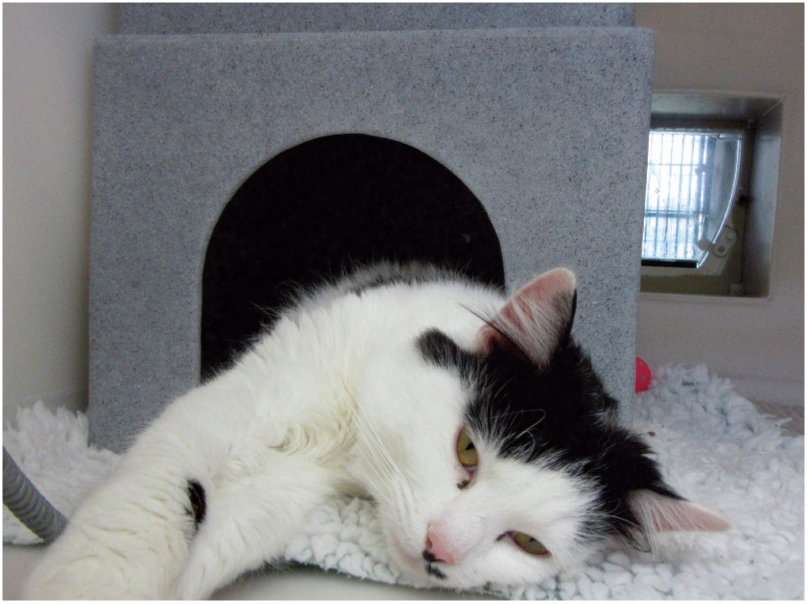
Providing the option of a hiding place will help cats relax, and may improve their adoptability
Key Points
✜ By careful evaluation of organizational aims, shelter housing design can be optimized to suit the planned activities. This will ensure cats can be rehomed as efficiently as possible, while promoting excellent welfare and providing a safe and positive working environment.
✜ Consideration of cats’ basic species-specific needs is essential when creating suitable housing.
✜ Proactive stress management is a key tool in reducing disease and fostering physical and psychological wellbeing of shelter cats.
Footnotes
Conflict of interest
Jenny Stavisky declares no conflict of interest. Kate Hurley and Denae Wagner provide animal shelter facility design consultation services through the Koret Shelter Medicine Program at UC Davis, CA, USA. Denae Wagner provides consultation services to Shor-Line, Kansas City, KS, USA. Some of the information in this article has been presented orally or is adapted from conference presentation proceedings by the authors.
Funding
The authors received no financial support for the research, authorship, and/or publication of this article.
References
Supplementary Material
Please find the following supplemental material available below.
For Open Access articles published under a Creative Commons License, all supplemental material carries the same license as the article it is associated with.
For non-Open Access articles published, all supplemental material carries a non-exclusive license, and permission requests for re-use of supplemental material or any part of supplemental material shall be sent directly to the copyright owner as specified in the copyright notice associated with the article.
