




Abstract
Objectives
The objective of this study was to investigate potential risk factors for the diagnosis of feline idiopathic cystitis (FIC) in cats living in a primarily indoor environment.
Methods
A case-control study focusing on a cohort of cats attending a first-opinion veterinary practice in Seoul, South Korea, from 2012–2016, was undertaken. Data were collected from cats’ owners by questionnaire and analysed using a multivariable logistic regression analysis.
Results
Fifty-eight cases of FIC and 281 randomly selected controls were surveyed. Over 90% of the cases and controls had no access to the outside, and 100% and 91% of the cases and controls, respectively, were neutered. The estimated prevalence of an FIC diagnosis was 1.77% (95% confidence interval [CI] 1.36–2.18). The final logistic regression model included five variables associated with an FIC diagnosis. Males had 2.34 times the odds of being diagnosed with FIC compared with females (95% CI 1.18–4.62; P = 0.015). Cats reported as not having vantage points had 4.64 times the odds of an FIC diagnosis compared with those reported as having vantage points (95% CI 2.05–10.49; P <0.001). Cats living in an apartment had 2.53 times the odds of an FIC diagnosis compared with those living in a house (95% CI 1.30–4.93; P = 0.006). Cats cohabiting with other cats were more likely to be diagnosed with FIC than those living alone (odds ratio 3.16, 95% CI 1.61–6.22; P = 0.001). Cats using non-clumping litter had 2.62 times the odds of an FIC diagnosis compared with those using clumping litter (95% CI 1.38–4.96; P = 0.003).
Conclusions and relevance
This study was conducted in a different epidemiological context from previous studies in that the overwhelming majority of the cats studied were housed entirely indoors. This study identified several significant associations related to a cat’s indoor environment. These findings suggest that the cat’s physical and social environment may play a role in the development of FIC.
Introduction
Feline lower urinary tract disease (FLUTD) is a collective term describing any disorder affecting the urinary bladder or urethra of cats. Cats with FLUTD show variable combinations of lower urinary tract signs (LUTS). Cystic calculi, bacterial urinary tract infections, inflammation, neoplasia and neurogenic disease are among the possible causes of FLUTD. However, the exact cause of FLUTD is not identified in the majority of cases, in which case the term feline idiopathic cystitis (FIC) is used. 1
Previous studies have identified several demographic associations. Middle-aged cats had the greatest risk of being diagnosed with FLUTD and FIC,2–4 and male cats3,5 and being overweight2,3,6,7 had increased risk, although the former was not observed in other studies.2,8,9 Previous studies have also identified several associations related to a cat’s physical and social environment, suggesting that the cat’s environment and associated stressors may be involved in the pathogenesis of FLUTD and FIC. Restricted access to the outside, litter box use, frequent diet changes and cohabitation with other cats have been associated with an increased risk of FLUTD and FIC.3,7,8,10,11 Furthermore, a variety of abnormalities have been identified in the neural, hormonal and immune systems of cats with FIC. In particular, previous studies observed the imbalance between the sympathetic nervous system and hypothalamic–pituitary–adrenal axis, suggesting that stress plays a role in the pathogenesis of FIC.12–17
The aim of this study was to investigate major risk factors for FIC that originate from cats themselves and their indoor environment. It should be emphasised that this study was conducted in a different epidemiological context from previous FIC studies, which were only performed in Western countries. In particular, two recent FIC studies in Belgium and Norway showed that around 60% of cats had access to the outside.7,11 This contrasts strikingly with the situation in South Korea, where the overwhelming majority of cats live strictly indoors owing to the highly urbanised environment. Considering that the outdoor environment is full of uncertainties that may confound various associations stemming from the indoor environment and cats themselves, this trend provided a unique opportunity to investigate potential risk factors for FIC in a relatively controlled indoor setting.
Materials and methods
A case-control study nested within the cohort of cats attending a first-opinion veterinary practice in Seoul, South Korea, was undertaken. The study population consisted of all cats registered at Baek-San Small Animal Practice from 1 June 2012 to 31 July 2016. A sample size calculation was made, estimating that 66 cases and 262 controls were required to detect an odds ratio (OR) of 2.5 or greater, assuming that 60% of controls are exposed to a potential risk factor (95% significance, 80% power, 1:4 case-control ratio).
For cases, considering that urine culture is an essential part of an FIC diagnosis, cats with urine culture results were first selected from a reference laboratory database; urine culture was part of routine diagnostics for all cats presented with LUTS. Among the selected, those presented for LUTS, including pollakiuria, stranguria, periuria, dysuria and haematuria, were classified as FLUTD cases. Next, among FLUTD cases, those with a documented physical examination, urinalysis, urine culture, abdominal radiography and ultrasonography were selected as candidates for FIC cases. Finally, FLUTD cases were further classified as FIC cases if the above diagnostics failed to specify the cause of LUTS. This study did not exclude cats with comorbidities from the FIC cases.
For controls, cats were first selected by a simple random sampling approach from those presented for reasons other than LUTS. From these, only those without a history of LUTS were selected as controls after asking the owners whether their cat had previous or current episodes of LUTS. The owners of the cases and controls who agreed to participate completed an online questionnaire, which included questions about their cat’s demography, behaviour, living environment, diet and litter (see supplementary material). To minimise recall bias, some questions asked the owners of the cases to base their answers on the situation at the time of FIC diagnosis, whereas the owners of the controls were asked to base their answers on the situation at the time of their most recent visit to the practice. Ethical approval for the study was granted by the Clinical Research Ethical Review Board at the Royal Veterinary College (reference number 2016/1563).
Within the questionnaire, the owners were asked how their cat usually behaved in potentially stressful situations at home (‘behaviours at home’) and at the practice (‘behaviours at practice’) separately, and were given four choices that referred to hiding, freezing, aggressive behaviour and friendly behaviour. In the analysis, the first three choices were classified as negative affectivity, and the last choice was classified as positive affectivity. Breed, body condition score (BCS), litter type and residence type were re-categorised to avoid data sparsity and/or to reduce the number of parameters in multivariable analysis.
Analyses were conducted using STATA 14. The baseline characteristics of all exposure variables were explored first. Categorical variables were cross-tabulated and examined by χ2 test. McNemar’s χ2 test was performed for paired exposure variables to investigate whether an individual cat’s behaviour in potentially stressful situations was different at home from at the practice. A univariable logistic regression analysis was then conducted, but only χ2 tests were performed for neuter status and watering to avoid complete separation of the data due to zero observation.
A manual stepwise forward selection process based on the likelihood ratio statistic was used in the multivariable logistic regression analysis. 18 In the first cycle, exposure variables with a liberal association in the univariable analysis (P <0.2) were added, in turn, to a base model. The exposure variable with the most significant P value was retained in the model. The same process was then repeated for each of the remaining exposure variables in the next cycle. At the end of each cycle, exposure variables that had a P value >0.05 were removed from the model and reused in the next cycle with the other remaining exposure variables. Food bowl and water bowl (shared vs non-shared) were not included in the model, since they were considered to be on the causal pathway between multiple cats and the outcome. The model was finalised when no remaining exposure variable met the entry criterion (P <0.05) and all two-way interaction terms had been examined for exposure variables using a likelihood ratio test for interaction. The goodness of fit of the final models was assessed with the Hosmer–Lemeshow test. The predictive ability of the final models was evaluated by the area under the receiver operating characteristic (ROC) curve.
Results
Tables 1–5 shows descriptive statistics and the results of the univariable analysis. A total of 4014 cats were registered at the practice during the study period, of which 107 cats met the case definition of FLUTD, yielding a period FLUTD prevalence of 2.67% (95% confidence interval [CI] 2.17–3.16). Among the FLUTD cases, 71 (66.4%) were further classified as FIC cases, resulting in a period FIC prevalence of 1.77% (95% CI 1.36–2.18). The owners of 58 FIC cases participated in the present study (81.7%). Among the owners of the 500 control candidates, 281 completed the questionnaire (56.2%). Over 90% of the owners of the cases and controls reported that their cats had no access to the outside, and 100% and 90.8% of the cases and controls, respectively, were neutered. In total, 75.9% of the cases and 54.1% of the controls were male. The median age was 5 years (interquartile range [IQR] 3.0–7.0) in the cases and 4 years (IQR 2.0–7.0) in the controls. The most common breed was domestic shorthair (36.2% of cases and 25.5% of controls), followed by Persian and Scottish Fold in both the cases and controls.
Descriptive statistics and the results of univariable logistic regression analysis

χ2 test
FIC = feline idiopathic cystitis; OR = odds ratio; CI = confidence interval; Wald = category-specific Wald test P value; LRT = variable-specific likelihood ratio test; NA = not applicable; BCS = body condition score
Descriptive statistics and the results of univariable logistic regression analysis
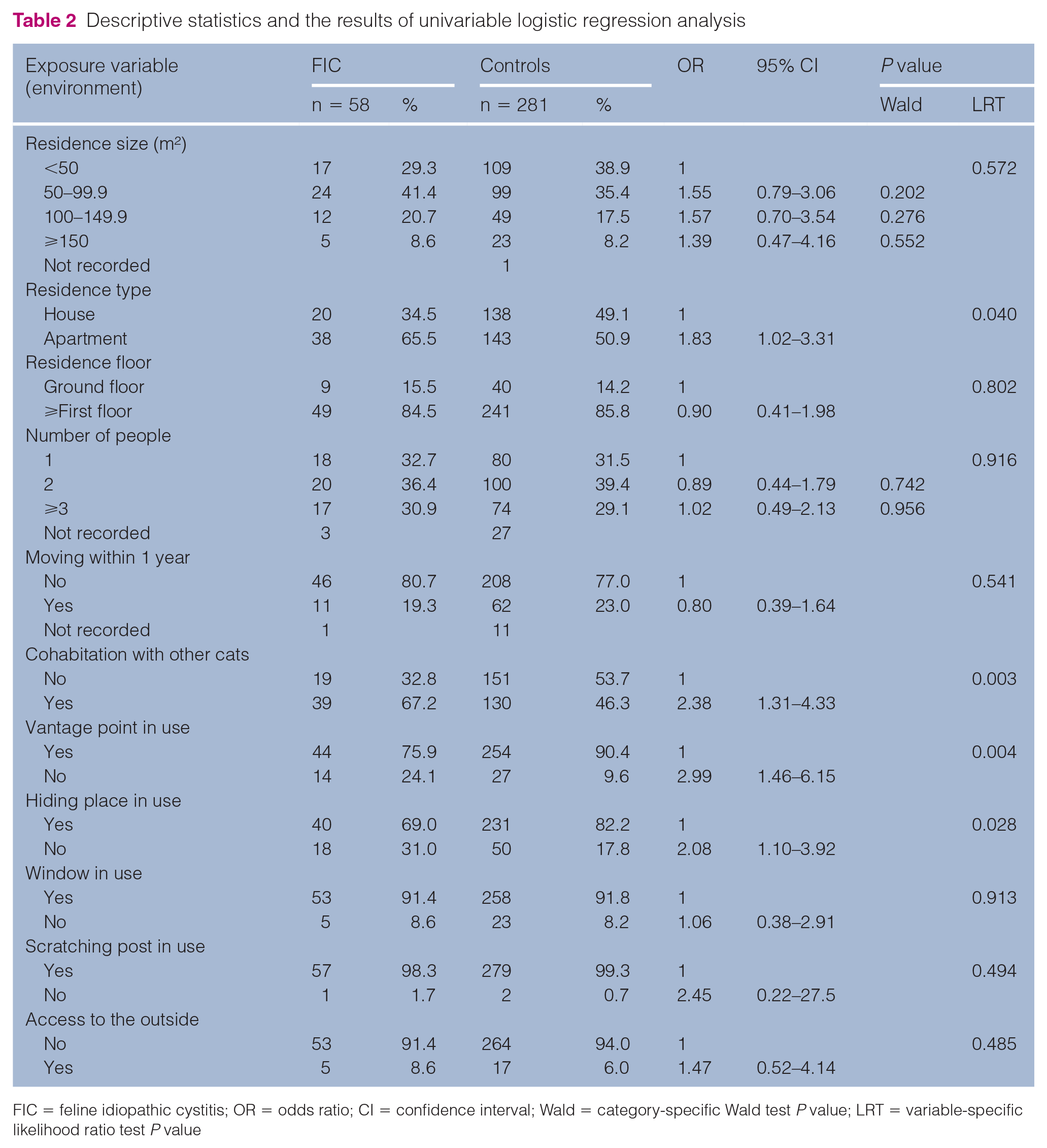
FIC = feline idiopathic cystitis; OR = odds ratio; CI = confidence interval; Wald = category-specific Wald test P value; LRT = variable-specific likelihood ratio test P value
Descriptive statistics and the results of univariable logistic regression analysis
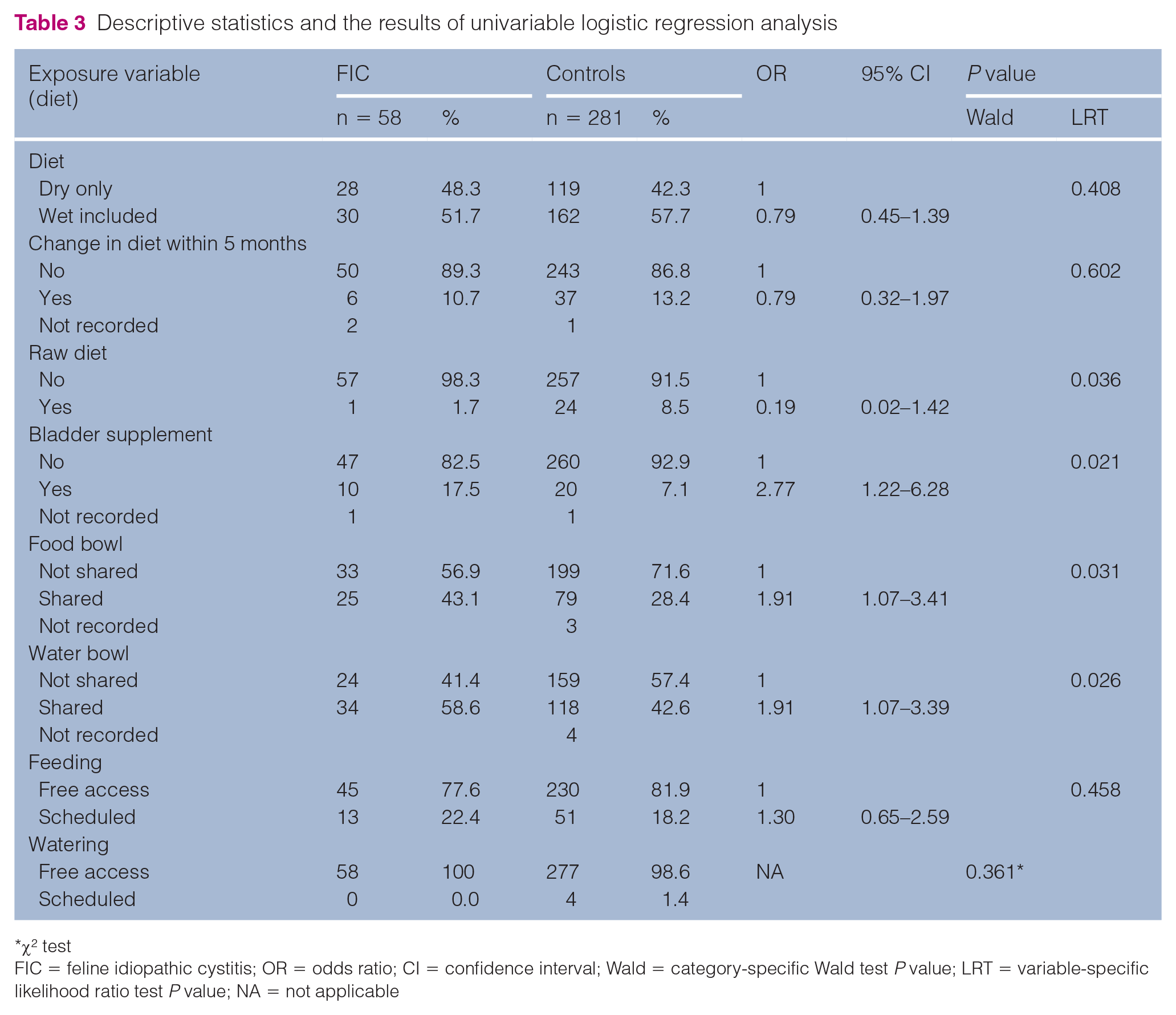
χ2 test
FIC = feline idiopathic cystitis; OR = odds ratio; CI = confidence interval; Wald = category-specific Wald test P value; LRT = variable-specific likelihood ratio test P value; NA = not applicable
Descriptive statistics and the results of univariable logistic regression analysis
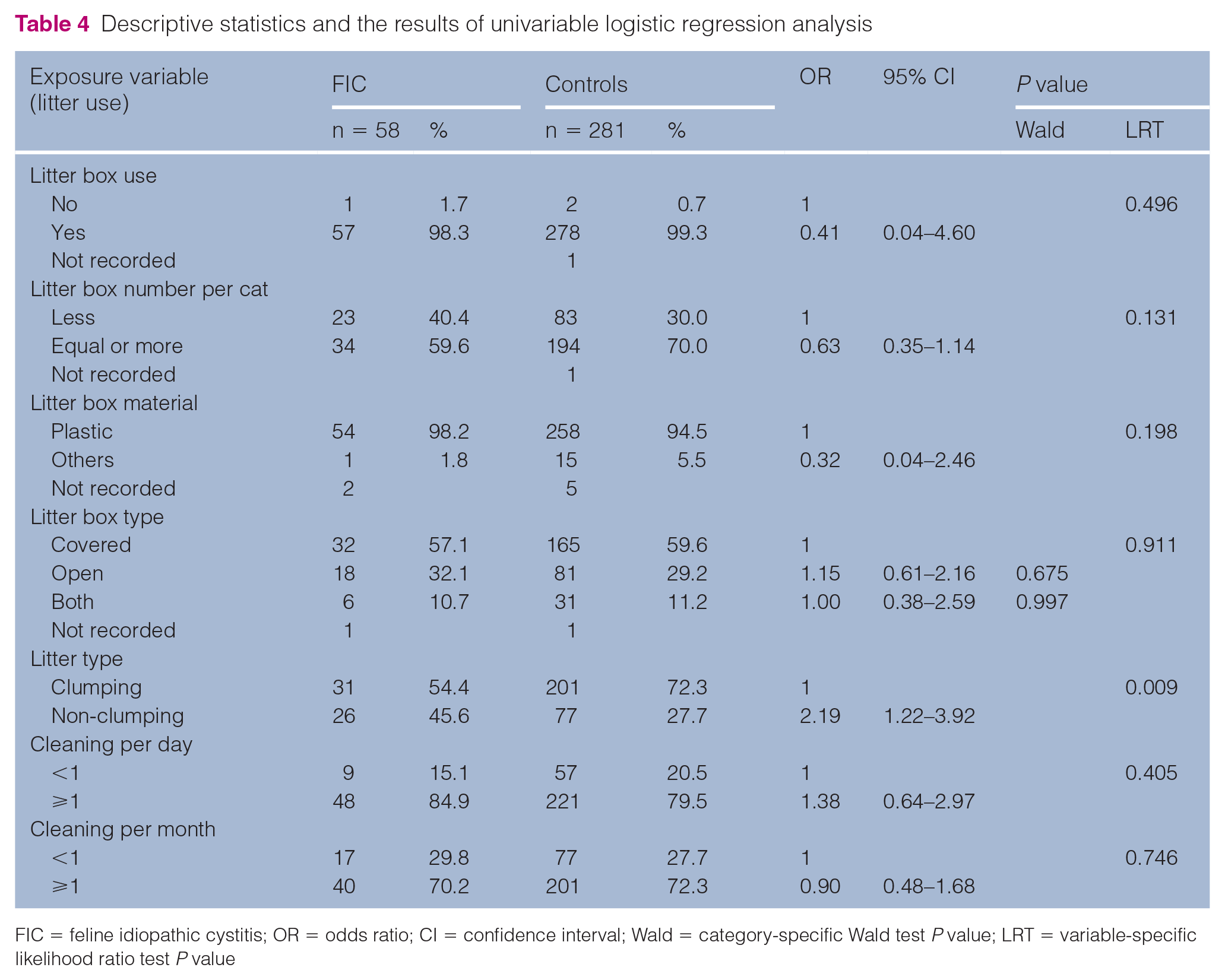
FIC = feline idiopathic cystitis; OR = odds ratio; CI = confidence interval; Wald = category-specific Wald test P value; LRT = variable-specific likelihood ratio test P value
Descriptive statistics and the results of univariable logistic regression analysis

FIC = feline idiopathic cystitis; OR = odds ratio; CI = confidence interval; Wald = category-specific Wald test P value; LRT = variable-specific likelihood ratio test P value
Sex, age, neuter status, age when neutered, BCS, multiple cats, vantage point in use, hiding place in use, raw diet, bladder supplement, sharing food bowl, sharing water bowl and litter type showed a statistically significant association with FIC diagnosis. For behaviour at home and behaviour at practice, there was no evidence to support their association with FIC diagnosis. However, interestingly, McNemar’s χ2 test showed that both case and control cats were more likely to show negative behaviour at the practice (86.2% and 79.7%, respectively) than at home (55.2% and 51.6%, respectively) in potentially stressful situations (P <0.001).
Table 6 shows the results of the multivariable analysis. After controlling for the other exposure variables in the model, cats living in apartments had 2.53 times the odds of FIC diagnosis compared with those living in houses (95% CI 1.30–4.93; P = 0.006). Cats reported as not having vantage points that they used to take a rest or have an overview of their surroundings had 4.64 times the odds of FIC diagnosis compared with those reported as having vantage points that the cats used (95% CI 2.05–10.49; P <0.001). Cats cohabiting with other cats were more likely to be diagnosed with FIC than those living alone (OR 3.16, 95% CI 1.61–6.22; P = 0.001). Cats using non-clumping litter were more likely to be diagnosed with FIC than those using clumping litter (OR 2.62, 95% CI 1.38–4.96; P = 0.003). Males had 2.34 times the odds of being diagnosed with FIC compared with females (95% CI 1.18–4.62; P = 0.015). The final FIC model showed no evidence of poor fit (Hosmer–Lemeshow test P = 0.687) and acceptable discrimination (the area under the ROC curve 0.763).
Final multivariable logistic regression model
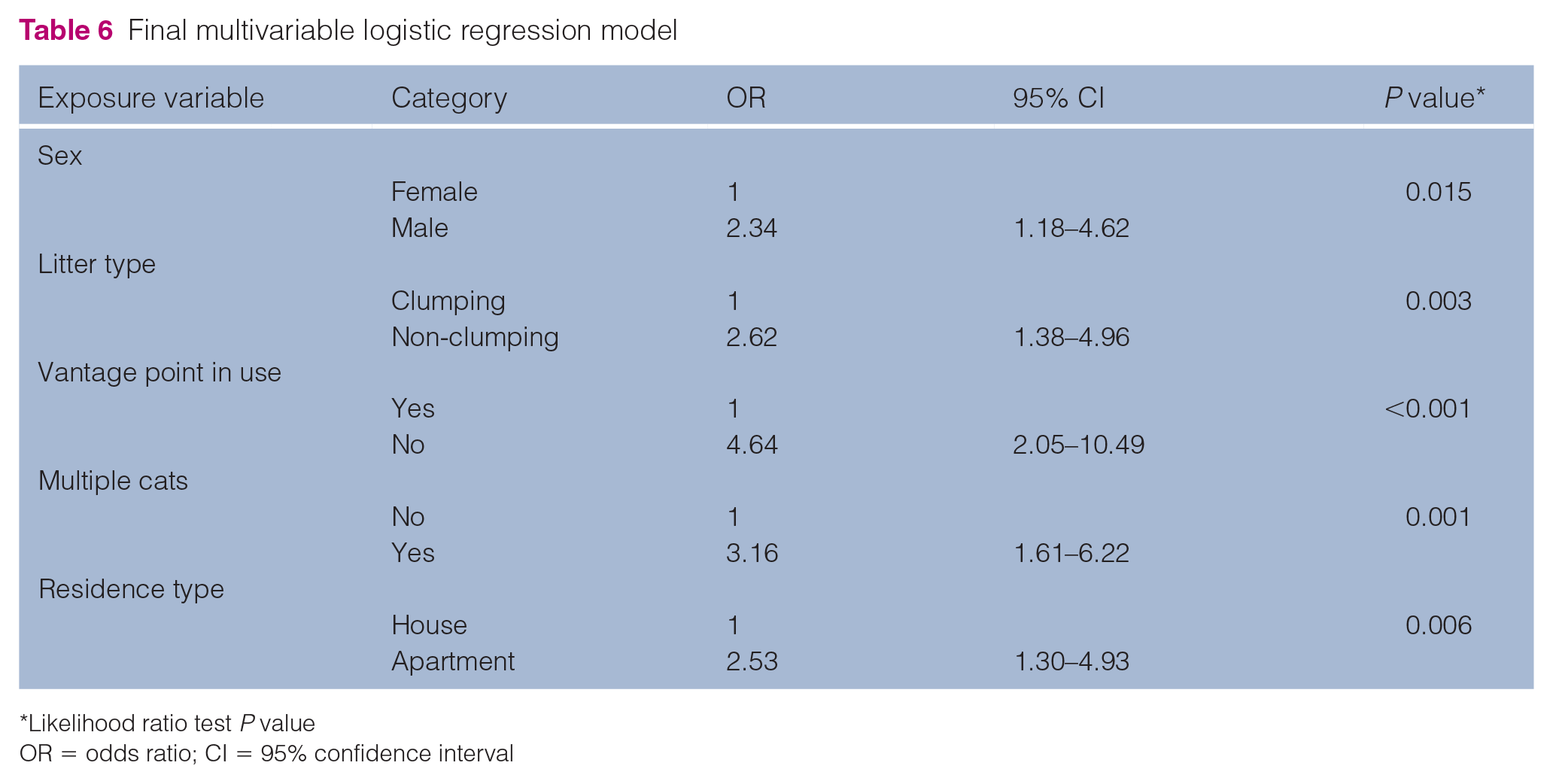
Likelihood ratio test P value
OR = odds ratio; CI = 95% confidence interval
Discussion
The findings of this study highlight that a number of cat and home environmental factors appear to be associated with FIC diagnosis.19,20 It should be highlighted that the study identified associations that were not identified in another recent study; 11 residence type, vantage point, multiple cats and litter type did not have statistically significant associations in that study. This could be attributed to the fact that the present and previous studies had very different study populations in terms of outdoor access; only 6.5% of the cats had access to the outside in the present report, whereas more than half did in the Norwegian study. 11 An indoor environment might have a more profound effect on the welfare of cats housed completely indoors than those allowed to go outside. For example, cats without outdoor access would have no choice but to depend solely on their indoor environment, whereas those with outdoor access would have substitutes for vantage points or litter in their outdoor environment. Thus, the effect of these exposure variables might have been more pronounced and detected in the present study.
The associations of FIC with vantage points in use, multiple cats and litter type support the value of effective environmental enrichment for cats housed entirely indoors. Interestingly, cats reported as not having vantage points that they used had more than four times the odds of an FIC diagnosis than those that did not have vantage points. Although not significant in the multivariable analysis, cats reported as not having hiding places that they used also had an increased risk of FIC in the univariable analysis. These findings further support the argument of Rochlitz 21 that cats housed indoors should have a sufficient number of resting areas where they can use the vertical dimension, as well as places where they can retreat and conceal themselves, to improve both physical and psychological health. Without vantage points or hiding places, the cats might have limited control over their surroundings and difficulties in managing stressful situations, which could lead to an increased level of physiological and behavioural stress responses.
Cats living in an apartment had an increased risk of an FIC diagnosis than those living in a house. Considering that apartments generally present an exclusive environment compared with houses, cats in an apartment might be less likely to be exposed to various sensory stimuli from the outer world than those in a house. This lack of external stimuli might cause the cats to experience a high level of boredom, making them vulnerable to stress-related diseases, including FIC. 22 This might still be the case, even though most of the cats in this study did not have outdoor access. However, the size of residence was not associated with an FIC diagnosis. These findings, along with other findings related to environmental enrichment, might support the argument that the quality is more important than the quantity of space beyond a certain minimum size. 21
Consistent with other studies,3,8 cohabitation with other cats was associated with an increased risk of FIC. Cats housed in groups may be subject to stress from conflicts between themselves. 23 In particular, stress from conflicts may be more severe in cats kept entirely indoors because, in addition to the social relationships between the cats, the physical environment is an important contributor to inter-cat conflicts.21,24 Although sharing food or water with other animals was associated with an increased risk of FIC in the univariable analyses, these associations disappeared when controlled for multiple cats, suggesting that sharing food or water is not necessarily an independent risk factor for FIC.
Cats using non-clumping litter were at increased risk of the outcomes compared with those using clumping litter. This result may be explained by cats’ general preference for clumping litter. In a study that investigated cats’ litter preferences, 25 clumping litter was most preferred, whereas wood-product litter was never used. Interestingly, pellets, mostly made of wood, were strongly associated with an increased risk of the outcome when litter types were analysed individually in the present study. In contrast with other studies,3,7,8 litter box use per se was not associated with an FIC diagnosis in the present study. However, litter box use could not be examined as an independent risk factor for FIC since >90% of the cats had no choice but to use a litter box in this study owing to indoor confinement. This study also did not identify other associations related to a litter box, such as its type, number, material and management. These findings suggest that litter type is an important environmental risk factor for FIC that should be considered in the management of FIC, especially when cats are kept indoors.
Males were more likely to be diagnosed with FIC than females, as previously observed.3,5 However, it should be noted that neuter status was not accounted for in the current study, since there were no intact FIC cases. Neutering has been suggested as an independent risk factor for FLUTD and FIC.2,26 Also, in the current study males were more likely to be neutered than females. The observed association may therefore have been confounded by neuter status and the true OR for sex overestimated. In fact, when sex was stratified by a cat’s neuter status, Lekcharoensuk et al 2 observed that spayed females were at increased risk of FLUTD vs intact males. It would thus be interesting to investigate in future studies an association between sex and the outcomes by controlling for neuter status in an exclusively indoor environment.
Age was associated with FIC in the univariable analysis; middle-aged cats had the greatest ORs. This concurs with a previous study that showed cats aged between 4 and 10 and cats aged between 4 and 7 as being at the greatest risk of FIC and FLUTD, respectively. 2 However, it should be emphasised that the previous study did not control for potential confounders in the analysis. In fact, in the present study, cats living with other cats tended to be older than those living alone, and the association disappeared when controlled for multiple cats, suggesting that ageing itself may not be an independent risk factor for FIC.
In the univariable analysis, there was a linear association between BCS and the outcomes: the risk of FIC diagnosis increased as the score increased. However, in contrast with previous studies,3,7,11 BCS was no longer associated with the outcomes once it was controlled for age and sex. Age and sex have been suggested as independent risk factors for FLUTD and FIC, 26 and these variables were associated with BCS in the current study, as in other studies.6,27,28 Also, these variables are highly unlikely to be on the causal pathway between BCS and the outcomes. This suggests that the univariable associations observed in this study were partly due to the confounding effects of age and sex. It should be noted that neutering was not adjusted due to the aforementioned zero-observation issue.
This study had some limitations. First, selection bias should be considered since there was a considerable difference in the response rates between the cases and controls. However, its impact should be considered minimal considering that the exposure variables under evaluation were considered unrelated to the factors that determined study participation. This study was also prone to reverse causality. For instance, the owners might have provided their cat with a bladder supplement after it started to show LUTS but before the documented veterinary diagnosis. Therefore, the observed association between bladder supplementation and FIC diagnosis might have resulted from the clinical signs.
Second, while the widespread trend of indoor housing enabled the investigation of potential risk factors for FIC in a new epidemiological context, this may affect the generalisability of the study results to the domestic cat population, whose housing trends differ significantly from those of the population represented in this study. Also, the study population may not be representative of the domestic cat population in Seoul or South Korea as a whole, as only one practice participated in this study. Finally, the findings of this study were dependent on the owner’s subjective judgement owing to the questionnaire-based study. It is therefore possible that the information on some exposure variables may have been misclassified.
Conclusions
This study identified several statistically significant associations for FIC. These results support the consideration that complex interactions between environmental and animal factors play a central role in the development and recurrence of FIC. The findings suggest that factors related to the cat’s physical and social environment should be considered in the diagnosis of FIC.
Supplemental Material
Click here for Supplementary Material
Questionnaire for cases
Supplemental Material
Click here for Supplementary Material
Questionnaire for controls
Footnotes
Supplementary material
The following files are available:
Questionnaire for cases
Questionnaire for controls
Conflict of interest
The authors declared no potential conflicts of interest with respect to the research, authorship, and/or publication of this article.
Funding
The authors received no financial support for the research, authorship, and/or publication of this article.
References
Supplementary Material
Please find the following supplemental material available below.
For Open Access articles published under a Creative Commons License, all supplemental material carries the same license as the article it is associated with.
For non-Open Access articles published, all supplemental material carries a non-exclusive license, and permission requests for re-use of supplemental material or any part of supplemental material shall be sent directly to the copyright owner as specified in the copyright notice associated with the article.
