



Abstract
Practical relevance
Cat breeders aim to suppress the sexual cycle for a defined period. This is a challenge as most preparations available for this intention are orally administered progestins; however, these drugs may have side effects, especially when used over a long period of time. Long-acting gonadotropin-releasing hormone agonist implants have been used successfully to suppress the oestrous cycle in cats for a longer period. After removal of the implant, the duration of action was shortened; however, the re-occurrence of normal cyclicity cannot be foreseen. The search for alternatives is therefore ongoing.
Clinical challenges
Another possibility for oestrus control is orally administered melatonin preparations; however, previous studies have shown that the effect was not satisfactory. After subcutaneous application of a melatonin implant developed for induction of oestrus in sheep (Melovine; Ceva Santé Animale), duration of oestrus suppression was shown to differ highly in individuals and in some cases no effect was observed. Nevertheless, it is used for short-term oestrus suppression in female cats.
Aims
This article provides an overview of recent studies and clinical experiences of the use of melatonin as a contraceptive in cats. It explains the function of melatonin in cats, discusses previous studies, provides clinical experience with Melovine (27 cases) and elucidates advantages and disadvantages.
Evidence base
Information provided in this article is drawn from the published literature and the author’s own clinical experience.
Introduction
Orally administered progestins have been used for decades, as after the cessation of treatment, oestrus will re-appear within a few days. 1 However, cystic endometrial hyperplasia and pyometra,2–4 mammary neoplasms, fibroadenomatosis5,6 and diabetes mellitus 7 have been described after the treatment of female cats with progestins, especially after prolonged use of medroxyprogesterone (for review, see Munson 1 , Kutzler and Wood 8 and Goericke-Pesch et al 9 ). Injectable proligestone did not significantly change serum glucose and insulin concentrations in treated cats, 10 but has been associated with the occurrence of pyometra in female cats. 11 Furthermore, the duration of oestrus suppression is highly individual and not predictable.
Meanwhile, long-term gonadotropin-releasing hormone (GnRH) agonist implants, such as the deslorelin implant Suprelorin (Virbac), have been proven to suppress ovarian activity safely and is fully reversible,12–15 even in prepubertal cats.16,17 However, duration of suppression is not only dose dependent, but is also proven to be highly individual and variable. Even though recent experiences show that implant removal can shorten the duration of suppression, the period until full recovery of cyclicity cannot be predicted. In one study, oestrus and ovulation were successfully induced at day 10 after removal of a 4.7 mg deslorelin implant, 3 months after application. 18 However, the duration until occurrence of a natural oestrus after implant removal has not been evaluated and seems to be highly individual. Short-term suppression is sometimes desired for breeding cats but the requirements for such a medicament are high, rendering the development difficult. Besides a predictable duration of effectiveness, they should have no side effects and absolute reversibility is a requirement.
The search for a safe short-term contraceptive for female cats is ongoing; at present available medicaments are mostly suitable for long-term suppression of oestrus.
In summary, orally administered progestins may have side effects, and long-term GnRH agonist implants have been proven to suppress ovarian activity safely and are fully reversible; however, the duration until occurrence of a natural oestrus after implant removal is highly individual. The present article shall therefore discuss recent findings concerning the use of melatonin as a short-term contraceptive in cats.
Effect of melatonin on the feline oestrous cycle
Melatonin (N-acetyl-5-methoxytryptamine), a neuromodulatory substance, is produced and secreted by the pineal gland of the central nervous system (CNS). 19 The duration of melatonin secretion is proportional to the length of the night; 20 in one study, melatonin concentrations in cats were 15-fold higher during the dark phase than the light phase. 21 The cat is a long-day breeder species, meaning that the ovarian activity starts during early spring time, when the day length is increasing.22,23 As a direct effect of the increasing light on the cerebral cortex, melatonin secretion from the pineal gland is suppressed, resulting in the suppressive effect on hypothalamic secretion of GnRH. Consequently, the secretion of gonadotropins from the anterior hypophysis is increased, leading to an increase in sexual steroid hormones.24,25

Effect of increasing day length on the hypothalamus–hypophysis–ovarian axis. The increasing light during early spring directly affects the cerebral cortex; consequently, melatonin secretion from the pineal gland is suppressed resulting in the suppressive effect on hypothalamic secretion of gonadotropin-releasing hormone (GnRH); the secretion of gonadotropins is increased, leading to an increase in serum sexual steroid hormone concentration. –ve = secretion decreased; +ve = secretion increased; FSH = follicle-stimulating hormone;LH = luteinising hormone
Michel never observed signs of oestrus as assessed by vaginal cytology and observation of behaviour when female cats were kept in a room with 8 h of light and 16 h of darkness. 26 Leyva et al found that peak melatonin concentrations were significantly higher when cats received short periods of light (8 h) compared with normal or prolonged exposure to light (14 vs 24 h). 24 The same group assessed that prolonged exposure to light (24 h) induced follicular waves in all experimental cats after 45 days, which coincided with significantly decreased melatonin and prolactin (PRL) values. Melatonin and PRL secretion were found to be extremely dependent on the photoperiod, 25 and the CNS can be entrained to change its secretion pattern via changes in light exposure. 27
The idea to administer melatonin parenterally to suppress the oestrous cycle in cats is not new. As melatonin is known to suppress ovarian activity in cats, 28 melatonin was considered as a contraceptive in queens decades ago; meanwhile, different trials were performed to suppress oestrus by different applications of melatonin. Early studies from the 1980s using frequent injections or tablets, as well as new ones using long-term release subcutaneous implants, are available (see Table 1).
Overview of experimental studies and clinical trials using melatonin for oestrus suppression in cats
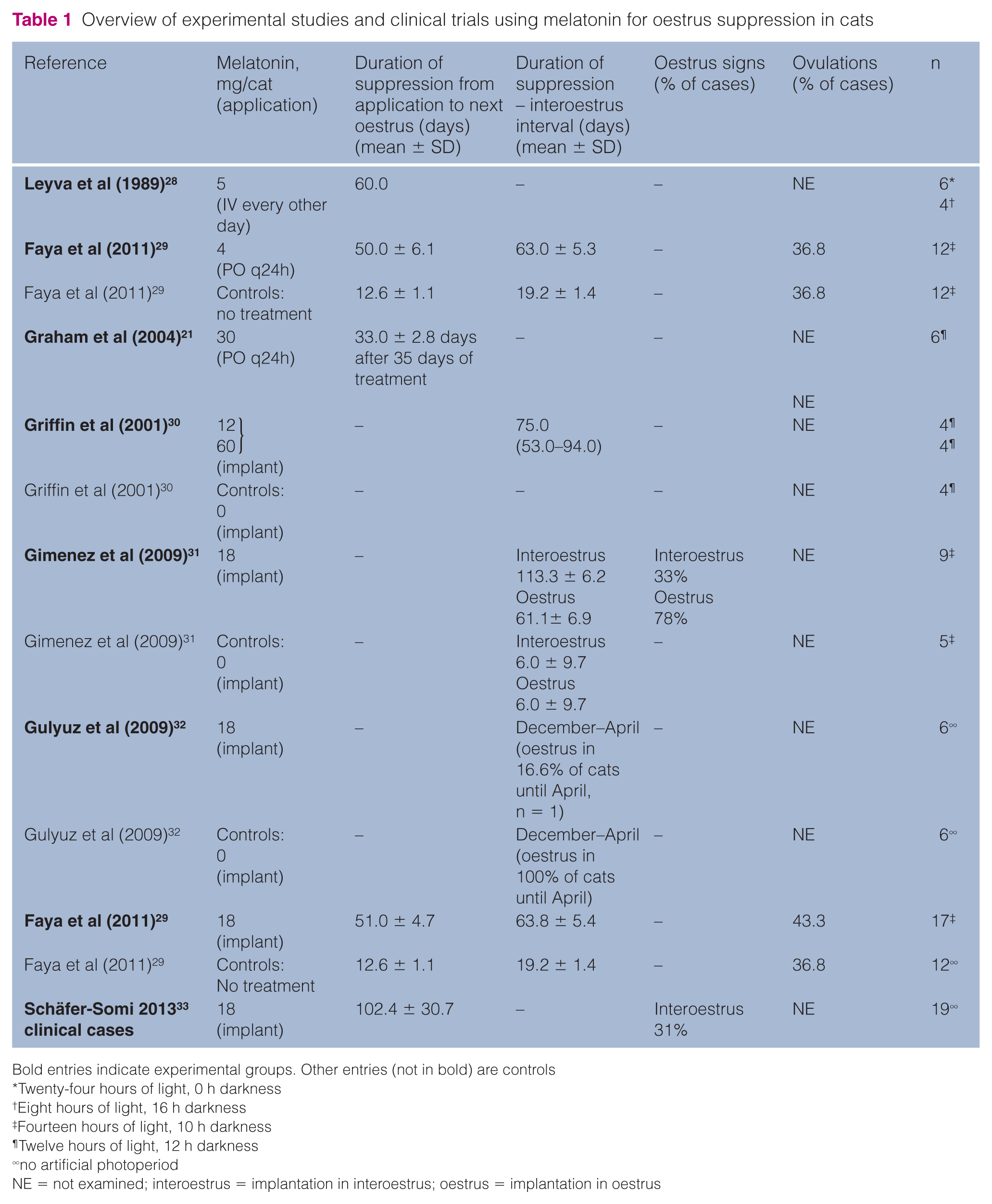
Bold entries indicate experimental groups. Other entries (not in bold) are controls
Twenty-four hours of light, 0 h darkness
Eight hours of light, 16 h darkness
Fourteen hours of light, 10 h darkness
Twelve hours of light, 12 h darkness
no artificial photoperiod
NE = not examined; interoestrus = implantation in interoestrus; oestrus = implantation in oestrus
Suppression of oestrus with injectable and oral melatonin
Frequent intravenous injections are not recommended for practical use, but have been used successfully in queens; even under the influence of 24 h of daylight, injection of 5 mg melatonin every other day completely suppressed signs of oestrus, which was shown to be completely reversible after the end of the 60 day treatment. 28
In another study, 12 cats were fed 4 mg melatonin tablets (Melatol; Elisium [n = 19 intervals]) q24h over 19 interoestrus intervals 2 h before the light was turned off and until the occurrence of first oestrus. Cats were exposed to a photoperiod of 14 h light/10 h darkness. First oestrus after the beginning of treatment was, on average, at 63 days; the authors observed ovulations and pseudopregnancy in 36.8% of 19 interoestrus intervals and 12 non-ovulatory cycles. 29 The duration of suppression in this trial was rather short and did not exceed the duration of physiological pseudopregnancy in cats.34–36 Furthermore, the first oestrus occurred during treatment and a rather high incidence of ovulatory cycles was observed, rendering the effect of melatonin at this low dosage questionable.
In a further study, six female cats received 30 mg melatonin orally q24h for 35 days while exposed to a 12 h light/12 h darkness regimen. Melatonin was given 3 h before the lights were turned off. The dosage led to the maintenance of circulating melatonin concentrations at or above the endogenous night-time concentrations during the 8 h blood sampling period. The treatment was completely reversible as ovarian activity returned to normal in all cats 21–40 days after the end of treatment. 21
These studies are difficult to compare, as different amounts, preparations and concentrations of melatonin were used over different time periods; furthermore, different light protocols were used before and during the experiments. In one study, cats changed treatment groups (implants vs tablets vs controls) with only one washout period of one interoestrus interval in-between. Frequent injections and oral applications of melatonin did not provide satisfying results; therefore, trials with long-term release subcutaneous implants, as used in sheep for oestrus induction, were performed.
Suppression of the oestrous cycle with subcutaneous implants
To prolong and improve the effect, and to overcome impractical daily application, long-term-release subcutaneous implants were investigated at different dosages. In one study, 12 mg melatonin implants were used for oestrus suppression in 12 cats exposed to an artificial photoperiod of 12 h light/12 h darkness for 12 months before the study. 30 Cats either received one implant (n = 4), or five implants (n = 4) or placebo implants (n = 4). Unfortunately, the cycle stage during implantation was not given. The authors observed oestrus suppression in 0/4, 2/4 and 3/4 cats in control, low- and high-dose groups, respectively, and delayed occurrence of oestrus suppression (17–26 days). Duration of oestrus suppression averaged 75 days (53–94 days). They did not observe any relationship between melatonin dosage, plasma melatonin concentration and duration of oestrus suppression, but pointed out the highly individual dosage required, which might be related to individual response.
In all eight cats that had received melatonin implants, uterine pathologies (uterine thickening, endometrial hyperplasia, cystic changes) were detected, irrespective of the dosage. 30 Uterine pathologies have not been mentioned before and a relationship with the implant is not proven; however, the possibility should be considered and treated cats examined accordingly.
Gulyuz et al used six experimental cats and six placebo implanted control cats to evaluate the effect of a subcutaneous implant containing 18 mg melatonin, as used for oestrus induction in sheep (Melovine; Ceva Santé Animale; Figures 2 and 3). 32
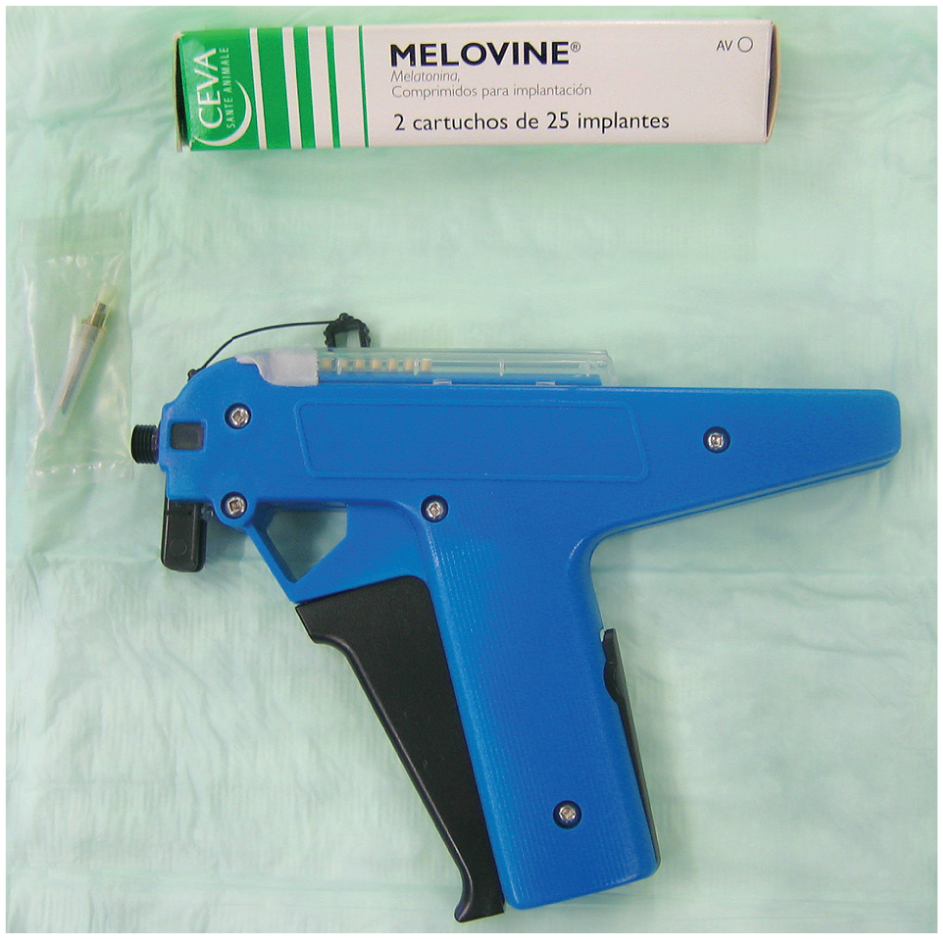
Melovine (Ceva Santé Animale) implants and applicator. The implants are available as packages of 2 × 25 pieces with one needle. One cartouche with 25 implants has to be inserted in the applicator, which then has to be refrigerated. After opening of the sterile package and insertion in the applicator, implants should be quickly expended. For practical reasons, application without an applicator, after stitch incision of the skin, is the method of choice. The wound should then be closed with a suture

Subcutaneous application with the applicator. A small region behind the navel is clipped and disinfected, and the implant is placed subcutaneously, approximately 2 cm behind the navel. This region is preferable as application between the shoulder blades might trigger a tissue reaction. Local anaesthesia may be useful in nervous cats
The cats were exposed to natural photoperiod conditions. The study started in December and ended in April, when the implant was removed in all animals. When the length of daylight reached 10.5 h, all control cats (6/6), but only one female in the experimental group, showed signs of oestrus. The authors concluded that the implants are useful in prolonging natural anoestrus in breeding cats.
In the same year, Gimenez et al used nine experimental cats and administered Melovine implants twice in consecutive cycles: first during interoestrus and then in oestrus. 31 Five controls received placebos. The implants were not removed. Melovine suppressed the oestrous cycles of female cats for 61.1 days when administered in oestrus and even longer when administered in interoestrus. The effect was completely reversible. In the placebo group, the interoestrus interval was significantly shorter, irrespective of time of application (interoestrus vs oestrus). Interestingly, the authors found superficial cells in the vaginal cytology in 33% of Melovine cats implanted in interoestrus and in 78% of cats implanted in oestrus; oestrus behaviour was seen for 2 days and 2–3 days, respectively, during one of my own studies. 36 In this latter study, oestrus signs were observed 1–10 days after the insertion of Melovine implants in interoestrus in six cats. As there has been no report of a stimulatory effect of melatonin in cats, this is not considered to be a flare-up, as can be observed after the application of GnRH agonists; the application time was probably too close to the next oestrus and coincided with a developing follicular wave that could not be suppressed. As, during this study, consecutive cycles were suppressed for 88–90 days, this could have been a delayed effect of melatonin on GnRH secretion after melatonin implant insertion.
However, another group investigated the use of the same implants in 17 postpubertal cats in interoestrus; 29 under similar experimental conditions as Gimenez et al, 31 they observed an average interoestrus interval of 63.8 days, which was significantly shorter than observed by Gimenez et al, 31 even though the implants were administered during interoestrus and the same artificial photoperiod was used in both studies. During treatment, ovulation and pseudopregnancy were observed in 43.3% of interoestrus intervals, and a total of 17 non-ovulatory intervals. However, none of the cats showed oestrus signs immediately after implantation, which was evaluated as a positive response to melatonin treatment and as a result of thorough clinical examination of cats, which were strictly implanted in interoestrus. However, these results confirm the findings of Griffin et al, 30 who found that the dosage required seems to be highly individual. When the 18 mg implant is administered in interoestrus, oestrus suppression should be possible without initial oestrus signs and last, on average, for 3 months; however, ovulations and pseudopregnancy may occur.
In one of my own studies, 33 the data of 19 privately owned cats introduced to the clinic for short-term suppression of ovarian activity were evaluated. Only cats in interoestrus showing no signs of oestrus clinically, and in most cases cytologically, were implanted subcutaneously behind the navel, using the applicator provided by the manufacturer. In six cats oestrus occurred after 1–10 days.
One of these cats with initial oestrus after Melovine application was bred during the oestrus after the implantation; the implant was not removed and the cat gave birth to a healthy kitten. The course and duration of pregnancy, parturition and lactation, as well as brooding care, were normal. In the other five cats, duration of suppression after the initial oestrus was 90 days (as observed by the owners). When these cats were excluded, the suppression of oestrus in the other 13 cats was 56–156 days. 33
Data were also then collected from a further eight cats, resulting in a patient pool of 27 cats of different breeds (British Shorthair, n = 7; Maine Coon, n = 9; Turkish Angora, n = 1; Oriental Shorthair, n = 1; Norwegian Forest Cat, n = 8; European Shorthair, n = 1) aged (mean ± SD) 23.1 ± 17.2 months; all were postpubertal and all were treated as described. 33 In 22/27 cats, no oestrus occurred for an average of 103.9 days (S Schäfer-Somi, unpublished data), which is longer than the longest pseudopregnancy period reported in the literature.34–36 In the other cats, the absence of oestrus was significantly shorter, and failure of treatment, as well as ovulation and pseudopregnancy, could not be excluded (S Schäfer-Somi, unpublished data).
In Figure 4, the duration of absence of oestrus after implant insertion within the three groups of the most frequently presented breeds British Shorthair (n = 7), Maine Coon (n = 11) and Norwegian Forest Cat (n = 8) is given as box and whisker plots (S Schäfer-Somi, unpublished data).

Duration of oestrus absence in the three groups of the most frequently presented breeds. *Significant difference (P <0.05). Days = days between insertion of implant and occurrence of next oestrus; British = British Shorthair (n = 7); Main Co = Maine Coon (n = 11); Norweg = Norwegian Forest Cat (n = 8)
Even though a significant difference was calculated between British Shorthair and Norwegian Forest Cats (P <0.05), the highly individual effectiveness described previously underpins these results.29,31 This fact has to be communicated to the cat’s owner before implantation.
Effectiveness in puerperal cats has not been sufficiently investigated. Further studies are therefore required; the influence of kitten number and week of lactation, as well as the effect on serum prolactin concentration, will be of interest.
Effect of melatonin in prepubertal female cats
Faya et al investigated the effect of 18 mg melatonin implants in 32 prepubertal cats exposed to a 14 h light: 10 h darkness regimen. 29 At the age of 3 months, cats were allotted to three groups: cats weighing 1.9 ± 0.3 kg (n = 12; group 1) and those weighing 1.5 ± 0.3 kg (n = 10; group 2) received the melatonin implants, whereas 10 control cats (group 3) did not receive treatment. Cats were observed daily for signs of oestrus and three times weekly by vaginal cytology. There was no significant difference between groups with regard to age at the start of puberty (232.4 days, 208.6 days and 192.4 days in groups 1, 2 and 3, respectively; P >0.1). The authors concluded that the 18 mg implant did not delay puberty in prepubertal cats and proposed further studies with higher concentrations of melatonin – formulations with prolonged effect or repeated application. Melovine is therefore not useful for the delay of puberty in female cats
Factors limiting practical use
Even though the occurrence of the next cycle after the Melovine implant is easier to predict, that is, the longest period of suppression was 5.5 months, several factors limit its use, such as the rather short and highly individual duration of suppression.
Another problem is that repeated use has not been investigated sufficiently. In my study, repeated application twice was performed, and in one cat no suppression of oestrus was observed after the application following the first suppression. 33 Gimenez et al observed shorter interoestrus intervals when Melovine was applied a second time in the oestrus following the first insertion. 31 An explanation for this could be that the duration of suppression is relative to the prior melatonin pattern and not the absolute duration. This phenomenon, called photorefractoriness, occurs in mammals after prolonged light exposure (>14 h), when a sudden change to shortened light exposure occurs. This has also been observed in sheep. 37 If a cat had elevated melatonin secretions in the past, the hypophysis may become desensitised to elevated melatonin over time; that is, photorefractory. 21 This was also hypothesised by Gimenez et al; 31 however, as no report about photorefractoriness in cats is available, it remains to be proven whether this negatively influences the effect of repeated applications in cats. From a practical point of view, as there was no effect in a rather high percentage of cats after single use, it is questionable whether investigations concerning repeated use make sense. The investigation of the effect of higher dosages or slow-release formulations might be more useful.
Another limiting factor is that if the implant is not exactly applied in the interoestrus stage, a fertile cycle may occur a short time after the implant application. Faya et al inserted the Melovine implants on day 2 of the cytological interoestrus, defined as <80% superficial cells. 29 In my own clients, oestrus signs were seen in six cats 1–10 days after treatment; however, no cycles were observed thereafter for 88–90 days. This supposedly delayed effect is considered a disadvantage as these cats can conceive if mated. However, at least the birth of healthy kittens in one case indicates that Melovine did not exert a negative effect on embryo or fetal development. 33 The implant was not removed, parturition and the postpartum period were normal, and the cat received another implant 3 weeks after parturition but came into oestrus 3 weeks thereafter.
Taking all the studies together, in most cases the 18 mg melatonin implant Melovine suppressed ovarian activity longer than the average natural pseudopregnancy period, especially when implanted in interoestrus. However, ovulations occurred in >40% of interoestrus intervals in one study, 29 and I observed the occurrence of the next oestrus after a normal interoestrus interval of 16–21 days in 3/27 cases, indicating failure of treatment (S Schäfer-Somi et al, unpublished data). The uterine pathologies observed by Griffin et al are precarious, 30 even though a direct effect of melatonin cannot be proven; more cases should be observed to that effect. Furthermore, the Melovine implants are not officially licensed for the use in cats; off-label use is therefore the rule.
The implants are sometimes difficult to obtain; in some countries they can be obtained via the international pharmacy in packages of 2 × 25 pieces with only one needle. The applicator, made for use in sheep, has to be bought separately; extra needles are difficult to obtain. Surgical application by stitch incision with a scalpel blade after local anaesthesia is therefore the method of choice, rendering repeated treatment unattractive. The implant is mostly administered subcutaneously between the shoulder blades or behind the navel. Investigations concerning the effect of the site of application are lacking. At present, there are few recommendable alternatives. Immunocontraceptives are intensely investigated and under development but at present are not available for practical use. The most interesting alternative, deslorelin implants, removable after several months, are available and can be recommended; however, the prediction of the next fertile cycle is difficult.
Conclusions
The 18 mg implant Melovine can be used off-label for short-term suppression of oestrus in cats under field conditions. However, the owner must be informed before implantation about the highly individual and sometimes delayed effectiveness, and the possibility of failure. Repeated application cannot be recommended at present. The effectiveness in puerperal cats, the effect of the site of application and possible side effects on the uterus need to be investigated further. Development of a better preparation for short-term suppression of the oestrous cycle in cats would be desirable.
Footnotes
Acknowledgements
The author greatly acknowledges the help of Julia Maderner with the design and revision of the figures.
Conflicts of interest
The author declared no potential conflicts of interest with respect to the research, authorship, and/or publication of this article.
Funding
The author received no financial support for the research, authorship, and/or publication of this article.