




Abstract
Objectives
Going to the veterinary clinic is a stressful experience for most cats as they feel threatened when entering a new and confined environment. The aim of this research was to investigate if Feliway spray, when used on the table in the consultation room, can decrease cats’ stress and ease their handling.
Methods
A randomised, double-blind, placebo-controlled clinical trial was developed, using a total sample of 87 cats of both sexes, castrated or intact, of any breed, aged >26 weeks. A Feliway spray and a placebo solution spray were tested in two different consultation rooms. During the first phase, Feliway spray was applied to the examination table of one room and the placebo spray in the other. After a washout period of 15 days the spray allocation was switched. After the first 15 mins of general questioning and physical examination carried out by the veterinarian, the observer assessed the stress levels of the cats based on a seven-level ‘cat stress score’, and the ease of handling based on a five-point ‘scale of handling’ developed by the authors.
Results
The study demonstrated that the use of Feliway spray leads to significant (P = 0.01) differences in cats’ usual behaviour, according to their owners. With regard to stress, animals exposed to Feliway spray showed significantly lower stress levels than those treated with placebo (P = 0.02). Regarding the scale of handling, the scoring did not differ significantly between cats under the effect of Feliway spray and cats receiving placebo (P = 0.01).
Conclusions and relevance
This research shows that the use of Feliway spray on the examination table improves the welfare of cats by reducing their stress during veterinary consultations. Feliway spray significantly changed the behaviour of the cats in this study, and offers a simple and effective way to help decrease stress in cats during the consultation.
Introduction
The domestic cat population has increased considerably, and exceeds the number of dogs in some countries. As a result, the number of cats attending veterinary consultations has increased. 1 However, some owners will not seek veterinary help as much as they should, and some reasons for this include the cat’s stress and fear, and the practical difficulties in transporting the cat to the clinic. 2
Going to the vet is a stressful experience for most animals, especially for cats as they feel threatened upon entering a new and confined environment, which reduces their normal active behavioural response owing to contact with unfamiliar people and animals, previous negative experiences, pain and physical restraint.3–5
The major role of veterinarians is to assure the wellbeing of animals, relieving their suffering, whether physical or emotional. To reduce stress in cats there are several strategies that veterinarians, staff and clients can use (eg, reducing waiting time, conducting the examination wherever the cat is more comfortable, avoiding loud noises and sudden movement).4,5
Five functional feline pheromone fractions (F1–F5) have been isolated from the facial secretions of cats. The F3 fraction is deposited on familiar objects to help manage space, emotionally stabilise the cat, promote food intake and exploratory behaviours, and control urine marking.6,7 This fraction has been artificially synthesised and commercialised (Feliway; Ceva Santé Animale) as a possible treatment for stress-related behaviours in cats. 8 Feliway, as a spray, has been shown to reduce both sexual and non-sexual (reactive) long-term urine spraying;9,10 reduce signs and recurrences of feline idiopathic cystitis, which is a stress-related clinical condition;11,12 encourage cats to settle, and thus prevent them from not returning from daily walks when visiting a holiday home with their owners; 13 reduce signs of stress during transportation; 14 provide calming effects (based on body posture and location in cage) and improve both interest in food and food intake in unfamiliar surroundings in hospitalised cats.15,16
Based on this scientific evidence, a question that still remains unanswered is: could this synthetic pheromone also help in the handling of cats and reduce their stress while at the vet’s?
The aim of this research was to investigate whether and to what extent the use of Feliway spray helps to decrease cats’ stress and ease their handling during veterinary consultations. If it does have an effect, this would positively contribute to both the course of the consultation and the welfare of the animal, helping to build the owner–vet–cat interaction.
Materials and methods
A randomised, double-blind, placebo-controlled clinical trial was carried at the Veterinary Hospital of Braga. The hospital has two separate non-communicating consultation rooms, where the study was carried out (both similar in size and comprising the same internal layout).
To minimise residual chemical traces of stress released by the previous cat, between consultations the examination table was cleaned with a standard surface disinfectant and paper towels, the floor was mopped and the room was aired by opening the door. Between each treatment phase of the trial (pheromone and placebo), rooms were cleaned with a standard surface disinfectant and a 2 week interval was added to prevent chemical cross-contamination from synthetic pheromone traces between the switched rooms.
All consultations were carried out by the same veterinarian and every assessment recorded by the same observer. The owner of each cat also attended the full consultation. Consultations were carried out alternately in room A and room B, to which cats were randomly allocated. Consultations were standardised to 15 mins and followed the same sequence: general data collection, anamnesis and physical examination (turgor test, mucous membrane examination, capillary refill time, body condition assessment, abdominal palpation, pulse, cardiopulmonary auscultation and rectal temperature evaluation).
Regarding inclusion criteria, both male and female cats, castrated or intact, of all breeds, indoor or outdoor, were included in this trial. To guarantee the cat had already been brought to a veterinarian consultation before to allow comparison and to prevent kitten behavioural reactions, which can occur until the cat is 6 months old, a minimum age of inclusion was set at 26 weeks. 2 All included cats had already been to the vet at least once.
As illness or pain may alter normal behaviour,17–19 had the cat already been diagnosed with any clinical problem or had its physical examination revealed any problem, it was excluded from the study sample. Cats under the influence of any drugs were also kept out of the trial.
When the cat arrived at the hospital, the time of arrival was recorded and the owner was invited to participate in the trial. As prolonged periods in the waiting room may increase fear and anxiety, and to avoid large disparities between cats’ waiting times, a maximum waiting time of 25 mins was set.4,20 When called for consultation, waiting time was checked to ensure it was <25 mins (otherwise, the cat was excluded). From then on, cats arriving for consultation were randomly assigned to one of the rooms based on order of arrival. Each cat was observed only once during the study, in one of the rooms.
Eight spray bottles (all from Ceva Santé Animale) containing an alcohol-based, transparent and colourless liquid solution were used. Half the bottles contained a placebo solution and the other half a pheromone solution, labelled with the letters B and L, respectively. Neither the owner nor the experimenters had access to the substance matching each code until the statistical analysis stage ended.
The solution was applied to the examination table by pressing the spray bottle handle five times, 15 mins before each consultation to allow the alcohol scent to disappear.
Assessment parameters
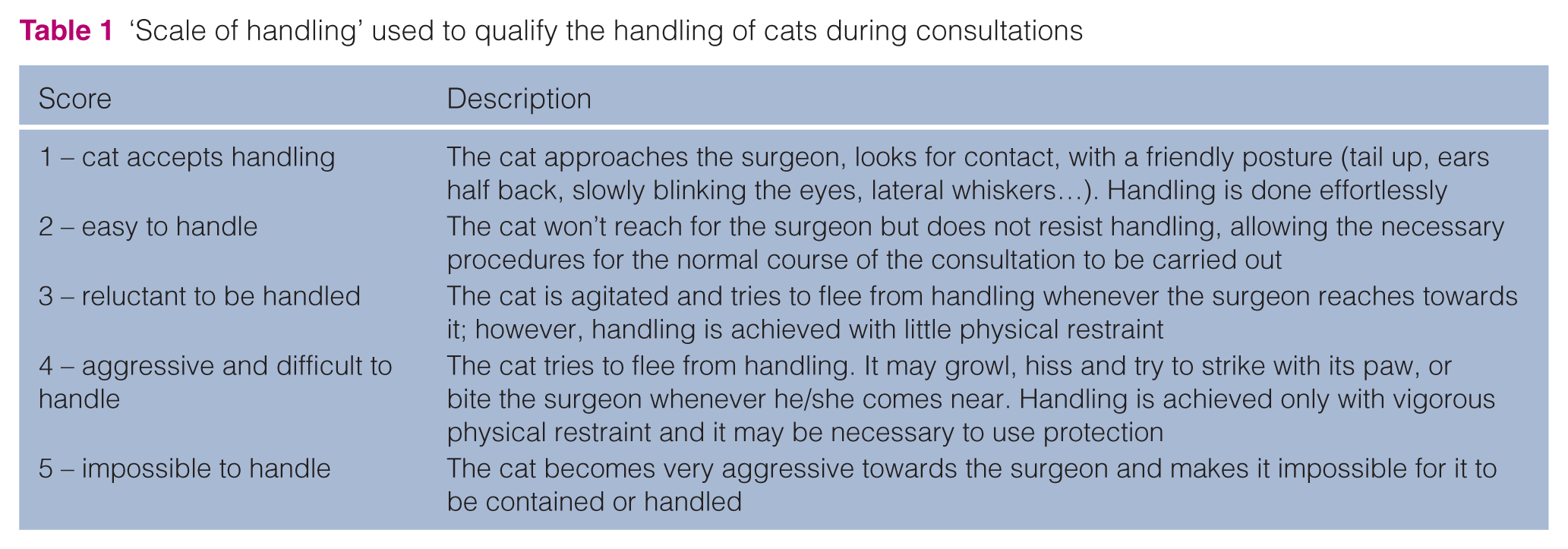
Three assessment criteria were considered, two evaluated by the observer (one of the authors of this trial) and one by the owner. Firstly, to assess stress level without interaction during the consultation, the observer made use of Kessler and Turner’s ‘cat stress score’ (CSS) scale, which varies from ‘fully relaxed’ to ‘terrorised’, based on postural and behavioural elements of the cat. 21 Secondly, a ‘scale of handling’ (Table 1), varying between ‘cat accepts handling’ and ‘impossible to handle’, was designed by the authors. This scale was developed so the observer could assess the ease of handling during consultation interaction. This scale was built based on the cat’s reaction in response to the surgeon’s approach. Cats that froze during consultation were classified as ‘easy to handle’, as this scale measures the handling, and these cats are easily manipulated. Thirdly, owners were asked to give their opinion on their cat’s behaviour at the end of the current consultation compared with previous ones. They could choose between the following options: ‘no difference/same as usual’, ‘easier to handle/more relaxed’, ‘more difficult to handle/more agitated’ and ‘more difficult to handle/more aggressive’.
‘Scale of handling’ used to qualify the handling of cats during consultations
Information about the consultation room and spray used, waiting time, cat’s identification, health condition, consultation data and medical procedures, cat’s behaviour (CSS and scale of handling) and the owner’s opinion were logged on a form.
As one of the goals of this study was everyday applicability, and owing to the lack of unanimity throughout related studies regarding the minimum time of necessary exposure, 15 the chosen interval was 15 mins. Therefore, 15 mins after the beginning of the consultation the observer filled in the form about the cat’s ease of handling, based on its behaviour and stress level at that precise moment. This assessment, performed at the same time for all cats, also reflected their general state after full veterinary examination. Lastly, the owner was asked to give his/her opinion about the overall behaviour of the cat during the consultation and to compare it with previous ones, and this was logged.
Study phases
The trial began with a 15 day period, during which the observer became familiarised with the evaluation tools and procedure during real consultations, but data were not recorded nor analysed.
During the next 15 days, the observer logged the behaviour of each cat in one of the two consultation rooms, with no spray being used, serving as a control sample.
During the following month, the observer logged the behaviour of each cat in one of the two rooms. Spray ‘B’ was used on room A’s examination table and spray ‘L’ on room B’s table. The following week was intended to have a washout effect so no spray was used in any room and no data were registered.
During the following 15 days no spray was used on the tables in each room but the observer continued to assess and log the cats’ behaviour, serving as a control sample (combined with the first one).
Finally, during the last month, both placebo and Feliway sprays were used on the tables in each of the consultation rooms in reverse order from that used earlier (spray ‘L’ on room A’s table and spray ‘B’ on room B’s table).
This study design prevented any product cross-contamination between the rooms and led to three cat populations observed in different time periods: under the influence of Feliway spray, placebo spray and no spray at all.
Statistical analysis
A confidence level of 95% was used. Comparability between groups was checked. The differences between treatment groups for continuous variables (CSS and scale of handling) were analysed with Student’s t-tests, whereas P values using Fisher’s exact test were calculated to check for any differences in the qualitative efficacy parameters (different to usual behaviour, CSS in classes and scale of handling in classes). The efficacy of the product was evaluated by comparing the cat populations observed under the influence of Feliway spray or the placebo spray. The study design also included the assessment of a third control group without the use of any spray in both rooms, based on the same behaviour parameters mentioned above, to check for any difference with the use of the placebo spray. This analysis was meant to better evaluate the ‘placebo effect’, which might also influence the owner’s opinion and the cat’s behaviour. To identify a possible effect of the room and age factors, a logistic regression model including treatment group, room and age was used on ‘different to usual behaviour’ and CSS (⩽3 vs >3).
Results
The study population comprised 87 cats, of which 29 (33%) were exposed to Feliway spray, 33 (38%) to placebo and 25 (29%) to no spray (control sample). Respectively, the three groups included 11 (38%), 16 (48%) and 11 (44%) females, of which seven (63%), nine (56%) and nine (82%) were spayed; and 18 (62%), 17 (52%) and 14 (56%) males, of which nine (50%), seven (41%) and five (35%) were castrated. No differences between groups were found on sex or sexual status. The average age was 3 years (range 7.0 months–15.8 years). Median age was lower in the Feliway spray group (1.5 years vs 4.5 years). Regarding breed, 54 (87.1%) were domestic shorthairs and eight (12.9%) were purebreds. With regard to the reason for appointment, most animals (n = 36; 58.1%) presented for prophylactic measures (vaccination and/or deworming), followed by annual check-up (n = 20; 32.3%) and presurgical assessment (n = 3; 4.8%). The remaining animals (n = 3; 4.8%) attended the hospital for brushing, nail trimming and microchip implantation.
The mean waiting time was 10.6 mins (range 5.0–24.0 mins). There were no significant differences between both groups tested with the two sprays in terms of all the cats’ characteristics, waiting times and reasons for consultation. The relation between age factor and outcome was tested.
The sample of cats under the effect of Feliway spray had significantly lower stress scores than the sample under the effect of placebo spray (P <0.01; Student’s t-test), as shown in Figure 1. The mean value obtained in the Feliway group was 3.2 (reflecting a ‘weakly tense’ state), whereas mean value with placebo was 4 (‘very tense’ state). The group tested with Feliway spray also had a significantly higher number of cats with scores⩽3 on the CSS scale (P = 0.02; Fisher’s exact test). The effect size calculated from CSS values was 0.78, corresponding to a large effect.

Mean and SD of the cat stress scores according to treatment, based on behavioural observations
When looking at handling scale, both full population (based on their mean scores) and subpopulations below the threshold of score 3 (as opposed to cats scored as 4 or 5, corresponding to aggressive cats or cats that were impossible to handle) were analysed. Although there were more cats easier to handle in the pheromone group, when looking at their mean handling score (Figure 2), and also when focusing on the subpopulation of cats with a score ⩽3, these differences were not statistically significant (P = 0.11 [Student’s t-test] and P = 0.10 [Fisher’s exact test]).
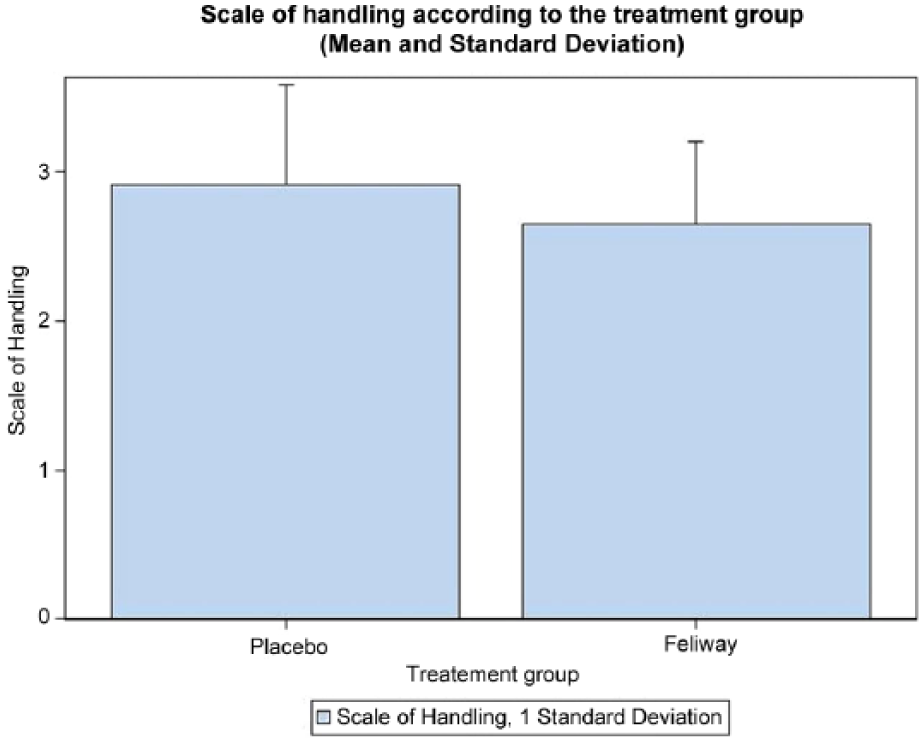
Mean and SD of the scale of handling scores, according to the treatment
Owners whose cats were under the influence of the pheromone during the consultation answered more often that their cat was ‘easier to handle/more relaxed’ (41.4%) than owners whose cats were under the influence of placebo (3.0%). These results were statistically significant (P <0.01; Fisher’s exact test).
To assess whether room and age factors were significant with regard to the results, a logistic regression model was also used. In analysing ‘different to usual behaviour’ the odds ratios (OR) were 0/246 (95% confidence interval [CI] 0.050–1.207) and 0.956 (95% CI 0.731–1.252) for ‘room’ and ‘age’, respectively. Similar results were obtained by analysing ‘CSS ⩽3 vs CSS >3’, with the ORs being 0.532 (95% CI 0.174–1.632) and 0.891 (95% CI 0.745–1.065) for ‘room’ and ‘age’, respectively.
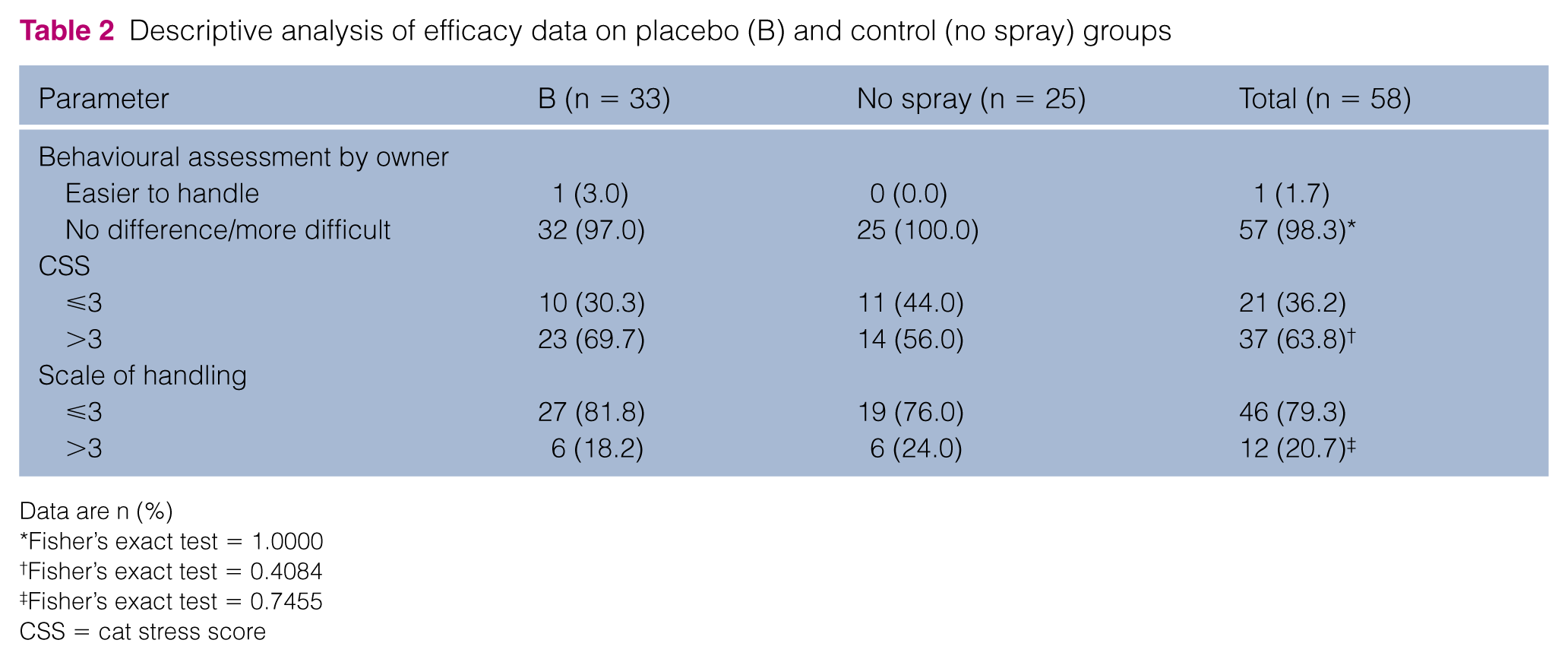
Additionally, there were no significant differences between cats from the placebo and the control (no spray) groups, whatever the efficacy criteria considered (Table 2): owner-assessed comparison with usual behaviour (P = 1.00), CSS >3 or ⩽3 (P = 0.40) and scale of handling scores > 3 or ⩽3 (P = 0.74).
Descriptive analysis of efficacy data on placebo (B) and control (no spray) groups
Data are n (%)
Fisher’s exact test = 1.0000
Fisher’s exact test = 0.4084
Fisher’s exact test = 0.7455
CSS = cat stress score
Discussion
In addition to the growing recognition of the importance of animal welfare, there are several advantages to reducing cats’ stress during consultations: it makes cats easier to handle and more comfortable, preventing both the animal and the hospital staff from getting hurt, making consultations easier and more pleasant for everyone, and achieving a physical examination that is more reliable.5,22,23
Despite the scant literature data available regarding the minimum time of exposure to the pheromone for its action to be noticeable, the 15 min interval was enough to produce changes in the behaviour of cats, causing the owners to notice significant differences in their animals’ behaviour compared with previous consultations, as well as leading to real differences between both groups regarding stress scoring, reflected by the large effect size calculated. Effect sizes can also be interpreted in terms of the percentage of non-overlap of the treated group’s scores with those of the untreated group. An effect size of 0.8 indicates a non-overlap of 47.4% in the two distributions. 24
The pheromone group obtained significantly lower CSS scorings (mean of 4 for cats tested with placebo and 3.2 for cats under the effect of Feliway spray), which indicates that Feliway spray does, indeed, decrease stress in animals, as reflected by behavioural and postural signs. These results comply with the studies carried by Griffith et al and Kronen et al,15,16 who demonstrated that use of the F3 pheromone in a clinical or hospital environment can help reduce cat stress behaviours, producing a calming effect.
Feliway spray seems to help in making cats easier to handle, although the results are not significant. We believe these non-significant results might be explained by the following facts: (1) each score of the scale could include quite varied levels of handling during the consultation, potentially leading to different cats being assigned to the same level on this scale, despite showing a different (improved) behaviour from previous consultation as assessed by their owners; (2) whenever owners noticed some difference to usual behaviour (whether that difference was related to the cat being easier to handle or being more relaxed), the investigator ticked the option ‘easier to handle/more relaxed’, which might not have been appropriate for both aspects of the question; (3) typically, a cat that freezes will be easier to handle, despite not reflecting a more relaxed cat, which might have led to minimising of the differences assessed through the scale; (4) assessing the animal’s health based only on physical examination might have caused the investigator to overlook certain pains exacerbated by palpation, causing animals to be more reluctant to handling owing to discomfort; (5) the history of the animal regarding factors that may influence the way they behave when facing an unusual situation, as well as their friendliness and boldness towards humans (early years socialisation, previous experience with humans, genetics/parents’ sociability, housing conditions, owner attachment and other owner-related factors), were not taken into consideration in this study; thus, when analysing the results in this work, one should consider that cats’ behaviour with regard to human contact differs depending on the individual cat.
To our knowledge there are no scales to assess the handling of cats during consultations, so we developed the ‘scale of handling’. Although, as one can see by the limitations described above, it needs to be improved (eg, by including more levels to make it more discriminant). We hope that this scale can be used in future studies as a basis to develop new scales that assess handling.
For future studies, it would be interesting to evaluate the inter-relations between individual variables such as sex, age, indoor/outdoor lifestyle, neutering and breed of each cat and the obtained stress and handling scores, as well as the connections between CSS scores and scale of handling.
Conclusions
This study supports the effectiveness of Feliway spray in reducing the stress of cats during consultations, helping them to cope better with the veterinary examination, from a feline welfare perspective. These results endorse Feliway spray as a simple, practical tool that is free of negative effects and can be used in situations of increased stress, making it more pleasant for all participants in the consultation and preventing negative experiences; this might help reduce anxiety during future visits. Ultimately, this increases the chance of success in the collection of physiological data that truly portray the health status of the cat and also helps strengthen the link between the client and the veterinary surgeon. Efforts towards minimising a cat’s stress also fall into the ‘feline-friendly’/‘cat-friendly’ approach that is increasingly recommended to vets through guidelines and campaigns. 5
Footnotes
Acknowledgements
The authors deeply thank Dr Luís Almeida, Veterinary Hospital of Braga, and his excellent team, who were always available to help during the trial. We also thank all the owners who let their cats enter the study.
This study was presented at the European College of Animal Welfare and Behavioural Medicine (ECAWBM) 2014 Annual Congress, in Apt, France and the abstract submitted to the congress was published in its proceedings.
Conflict of interest
This trial was spontaneously initiated by the first author for a Masters thesis project. Ceva Santé Animale was secondarily contacted for advice into the study design and contributed to the writing of the paper.
Funding
This research received no grant from any funding agency in the public, commercial or not-for-profit sectors.